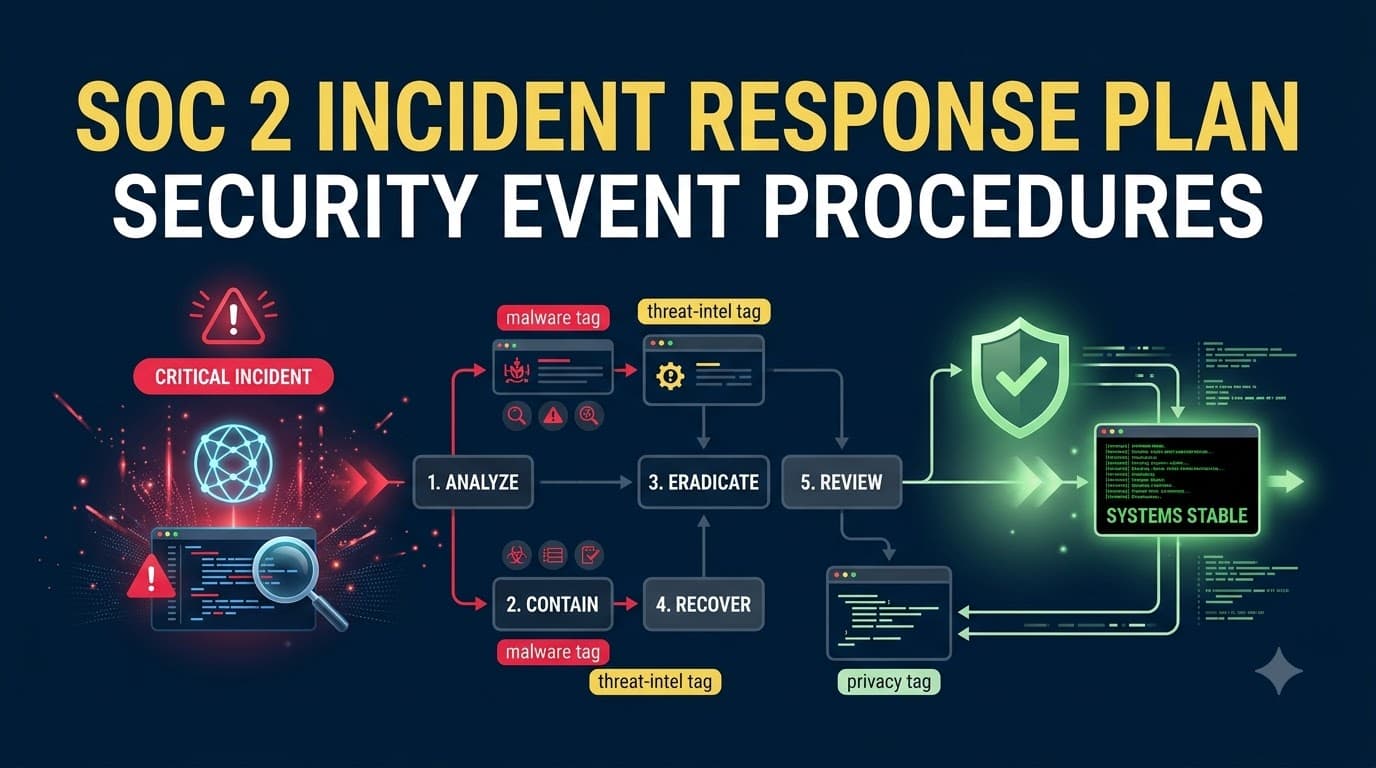
The 2:14 AM Slack Thread That Wasn't a Plan
Dana Okafor, VP of Engineering at a freight-visibility SaaS platform called Ferrymark Logistics, got the page at 2:14 AM: unusual outbound traffic from a staging database host, flagged by an EDR agent nobody remembered installing eighteen months earlier. By 2:30 AM there were eleven people in a Slack channel named #incident-holy-crap, three competing theories about what was happening, and zero agreement on who was actually in charge of the response. By 4:00 AM the "incident" turned out to be a misconfigured backup job talking to an unexpected IP range — not a breach at all — but the post-mortem was brutal in a different way. Ferrymark was nine weeks into the observation window for its first SOC 2 Type II report, a report a $2.3 million logistics-enterprise deal was contractually conditioned on, and the audit firm's fieldwork notes from the week before had already flagged an exception: "Entity described incident response verbally; no documented incident response plan was provided for inspection."
Dana's team hadn't been negligent. They had good engineers, a capable on-call rotation, and a genuine instinct for fixing things fast. What they didn't have was a plan — a written, versioned, tested document that named roles, defined severity, specified who talks to customers and when, and could be handed to an auditor as evidence that response wasn't improvised. That gap is far more common than most engineering leaders expect, and it is one of the most frequent Common Criteria exceptions I see in fifteen-plus years of walking service organizations through SOC 2 examinations. Teams that respond well to incidents in practice routinely fail the specific test an auditor is running, which isn't "did you handle the incident" — it's "can you produce and demonstrate a documented, repeatable process that governed how you handled it."
This article is that document, built out in the structure and depth an auditor actually wants to see. It complements, but does not replace, the broader SOC 2 Incident Response: Security Event Management and Reporting article, which covers the wider incident response program — governance, tooling landscape, and organizational maturity. This piece is the plan itself: the procedural spine an auditor pulls off the shelf, reads top to bottom, and tests against what actually happened during three or four incidents in your audit period.
Dana's story isn't unusual, and it isn't really a story about a bad team. It's a story about the gap between operational competence and documented, testable process — a gap that shows up specifically at the worst possible moment, which is either during a live incident or during audit fieldwork, and sometimes both in the same quarter. The fix isn't complicated, but it does require sitting down and building the actual document, section by section, with enough specificity that it holds up under both kinds of pressure.
Who This Is For and What You'll Walk Away With
This is written for security leads, compliance managers, and engineering directors at service organizations pursuing or maintaining a SOC 2 report who need to produce (or fix) their incident response plan document — not just talk about incident response in an audit interview. You'll walk away with a real severity classification framework, a RACI model for incident roles, containment and recovery playbooks by incident type, a communication and breach notification structure, a tabletop testing cadence, and the specific evidence artifacts auditors sample against CC7.3 through CC7.5. Everything here is built to be adapted into your own plan document, not copied verbatim — your severity thresholds, escalation paths, and notification timelines need to match your actual environment and contracts.
Why SOC 2 Auditors Treat the Incident Response Plan as a Standalone Artifact
Auditors don't test whether your team is smart under pressure. They test whether a documented control existed, was communicated, and was followed consistently across the audit period. An incident response plan is one of the few control artifacts that gets tested twice: once as a design control (does the document exist, is it complete, was it approved) and once as an operating control (did actual incidents during the period follow the documented steps, and is there audit evidence to prove it).
That double test is why "we handle incidents well, we just don't write it down" is a losing position in a SOC 2 examination. A Type I report only needs the plan to exist and be suitably designed at a point in time. A Type II report requires the auditor to select actual security events — sometimes from your ticketing system, sometimes from monitoring alerts your SIEM generated — and trace them against the plan's defined steps. If the plan says incidents get a severity rating within 30 minutes of detection and your ticket history shows a four-hour gap with no documented reason, that's an exception, not a footnote.
The plan also functions as evidence of governance maturity beyond the specific CC7 controls. Auditors — and increasingly, prospective customers reading your report — read the incident response plan as a proxy for how seriously the organization treats operational discipline generally. A thin, generic plan (or one obviously copied from a template and never touched) reads very differently than a plan with real severity thresholds, named roles tied to your actual org chart, and a documented review history.
"I can tell within the first two pages whether an incident response plan was written for an auditor or written to actually be used during a 2 AM incident. The auditor-only ones have no phone numbers, no named backups, and a severity matrix that was clearly pasted from somewhere else. The real ones are a little ugly — because real operational documents always are." — Elena Cross, SOC 2 Auditor, Ashgrove & Vance CPAs
CC7.3–CC7.5: What the Common Criteria Actually Require
The Trust Services Criteria's CC7 series covers system operations, and three of its five points of focus deal directly with incident handling. Understanding the boundary between them matters because it tells you exactly what your plan document needs to address, section by section, and it tells you which controls your auditor will test with different evidence.
Criterion | What It Requires | What Your Plan Must Document | Typical Evidence Sampled |
|---|---|---|---|
CC7.1 | Procedures to detect anomalies (config baselines, vulnerability scanning) | Detection sources and baseline monitoring — largely covered in Security Monitoring: SIEM and Log Management | Monitoring tool configs, scan schedules |
CC7.2 | Ongoing monitoring for anomalies indicative of incidents | Alert thresholds, monitoring coverage, on-call structure | SIEM alert logs, on-call schedules |
CC7.3 | Evaluating security events to determine whether they are incidents | Severity classification framework, triage process, escalation criteria | Triage records, severity assignment logs |
CC7.4 | Executing a defined incident response program: understand, contain, remediate, communicate | Roles/RACI, containment and eradication playbooks, communication plan | Incident tickets, comms logs, containment timestamps |
CC7.5 | Recovering from identified incidents | Recovery validation steps, post-incident review process | Recovery sign-offs, post-incident review reports |
This article is deliberately scoped to CC7.3 through CC7.5 — the response plan itself — while treating detection (CC7.1–CC7.2) as the handoff point from your monitoring program. If your organization hasn't yet built out detection coverage, that gap will surface here too, because a beautifully documented triage process is meaningless if nothing tells you an event happened in the first place.
The Plan vs. the Program: Scoping This Document Correctly
I want to be precise about scope, because I've watched teams spend a month writing one bloated 40-page document trying to cover everything from SIEM tuning to backup architecture to communications, and it satisfies nobody. The broader Incident Response program article covers organizational structure, staffing models, tooling ecosystems, threat intelligence integration, and how incident response fits into your overall security operating model. This article is the plan — the specific, procedural, testable document that says: here is how we classify severity, here is who does what, here is the sequence of steps from detection to closure, here is who we tell and when.
In practice, most service organizations maintain the plan as its own controlled document (versioned, owner-assigned, reviewed on a set cadence) that sits underneath a broader security policy set. The plan references but doesn't duplicate your business continuity and disaster recovery plans, which live separately and get their own testing cadence covered in Business Continuity Testing: Disaster Recovery Validation. It references but doesn't restate your data backup and recovery procedures. Keeping the boundaries clean makes the plan shorter, more usable at 2 AM, and easier for an auditor to trace against actual incident tickets.
Anatomy of an Audit-Ready Incident Response Plan Document
Every plan I've helped a client build for SOC 2 purposes follows roughly the same skeleton, adjusted for company size and the systems in scope. Auditors don't require a specific format, but they consistently look for these sections, and a document missing several of them tends to generate a request for additional information at minimum, and an exception at worst.
Section | Purpose | Commonly Missing In Weak Plans |
|---|---|---|
Purpose and scope | Defines what systems/data the plan covers | Scope doesn't match the SOC 2 system boundary |
Definitions | Defines "security incident" vs. "event" vs. "breach" | Vague or circular definitions |
Roles and responsibilities | Named roles, RACI, backups for each role | Named individuals with no backup, or roles with no names at all |
Severity classification | Tiered framework with objective criteria | Subjective tiers ("bad," "really bad") with no thresholds |
Detection and reporting | How incidents are identified and reported internally | No path for non-technical staff to report a suspected incident |
Triage and declaration | How an event becomes a declared incident | No documented decision point or owner |
Containment procedures | Playbooks by incident type | Generic "isolate the system" with no specifics |
Eradication procedures | Root cause removal steps | Confused with containment; no distinct eradication step |
Recovery procedures | Restoration and validation steps | No validation criteria before declaring "resolved" |
Communication plan | Internal escalation, executive notification, customer/regulator notification | Missing timelines or decision owners |
Evidence and documentation | What gets logged during an incident and where | No standard incident record template |
Post-incident review | Root cause analysis and corrective action process | Review happens informally, never documented |
Testing and maintenance | Tabletop cadence, plan review schedule, version history | No test history; plan hasn't been updated in years |
Appendices | Contact lists, escalation trees, external vendor/forensics contacts | Contact lists stale or unowned |
"The plan I ask for in fieldwork isn't a policy essay. It's an operations manual. I want to open it during a walkthrough and be able to answer: if a laptop went missing right now, who gets called first, what happens in the first hour, and how would I know afterward that it happened the way this document says it should." — Marcus Feld, Senior Manager, IT Audit, a mid-market CPA firm
Authoring the Plan: A Practical Build Process
Teams that have never written this document tend to either over-invest (a six-week project that produces a 45-page document nobody will read at 2 AM) or under-invest (a two-hour draft that satisfies nobody, least of all an auditor). Neither extreme works well. The build process I use with clients runs in five stages, typically compressed into two to four weeks depending on organizational size.
Stage | What Happens | Typical Duration | Output |
|---|---|---|---|
1. Inventory current practice | Interview on-call staff and past incident handlers about what actually happens today, including the informal steps nobody wrote down | 3–5 days | Raw notes on existing (undocumented) process |
2. Draft the skeleton | Populate the section structure (purpose, roles, severity, playbooks, communication, testing) using current practice as the baseline, not an idealized version | 1 week | First draft, marked for review |
3. Cross-functional review | Legal, executive sponsor, and technical leads review and correct role assumptions, notification timelines, and playbook accuracy | 3–5 days | Revised draft with sign-off comments resolved |
4. Formal approval | Named approver (typically CISO/security lead and an executive sponsor) signs off, version 1.0 is recorded | 1–2 days | Approved, dated, version-controlled plan |
5. Initial tabletop validation | Run a first tabletop exercise against the new plan before relying on it operationally | 1 week to schedule and run | Findings log, first round of corrections |
The step teams skip most often is the first one — inventorying what actually happens today before writing down what should happen. Skipping it produces a plan that looks correct on paper but doesn't match how the team actually communicates or escalates, which is exactly the mismatch an auditor's sample testing is designed to catch. I'd rather see a plan built from messy reality and cleaned up over two tabletop cycles than a pristine document written from a template that nobody in the organization actually recognizes.
Roles, Ownership, and the Incident Response RACI
The single most common gap I find in incident response plans isn't a missing procedure — it's ambiguous ownership. Everyone assumes someone else has final authority to declare an incident, engage legal, or approve a customer notification, and during a real event that ambiguity costs the most valuable resource you have: time. A RACI model, built into the plan itself rather than left as a separate slide deck nobody opens, fixes this.
Role | Responsible For | Typical Title | Backup Required |
|---|---|---|---|
Incident Commander (IC) | Overall response coordination, severity confirmation, resource allocation | Security lead / SOC manager | Yes — named deputy |
Technical Lead | Investigation, containment, eradication execution | Senior engineer / SRE on-call | Yes |
Communications Lead | Internal updates, customer-facing messaging drafts | Compliance manager / Head of Trust | Yes |
Legal Counsel | Breach notification obligations, privilege, law enforcement liaison | General counsel / outside counsel | Yes (outside counsel as backup) |
Executive Sponsor | Final approval on customer/regulator notification, resourcing decisions | CTO / CEO | Yes |
Scribe | Real-time incident timeline and evidence logging | Rotating role, IC-assigned | Not required, but recommended |
HR/People Lead | Only for insider-threat or employee-related incidents | HR Director | As needed |
A simplified RACI mapped to the incident lifecycle looks like this:
Activity | Incident Commander | Technical Lead | Communications Lead | Legal | Executive Sponsor |
|---|---|---|---|---|---|
Declare incident / assign severity | A/R | C | I | I | I |
Contain and eradicate | A | R | I | I | I |
Draft internal updates | C | C | R | C | I |
Draft customer notification | C | I | R | A | A |
Engage law enforcement / regulators | C | I | I | R/A | A |
Approve public statement | I | I | C | C | A/R |
Close incident and sign off recovery | A/R | R | I | I | I |
Keep this table current. When an auditor asks "who was the incident commander for the March event," the answer needs to match the org chart in the plan, not a name that left the company eighteen months ago.
Building a Severity Classification Framework
Severity classification is where CC7.3 lives, and it's the section auditors probe hardest, because it's the decision point that determines everything downstream — how fast you respond, who gets notified, and whether the incident eventually needs to be disclosed externally. A workable severity framework needs objective, observable criteria, not adjectives.
Severity | Definition | Example Trigger | Initial Response Time | Who's Notified |
|---|---|---|---|---|
SEV-1 (Critical) | Confirmed unauthorized access to production data, or a system outage affecting all customers | Data breach confirmed; ransomware encryption in progress | Immediate (page on-call) | IC, Exec Sponsor, Legal within 30 min |
SEV-2 (High) | Suspected unauthorized access or significant service degradation, unconfirmed scope | Anomalous data exfiltration alert; privileged account compromise suspected | Within 30 minutes | IC, Technical Lead, Comms Lead |
SEV-3 (Medium) | Contained security event with limited or no customer impact | Isolated malware on a single endpoint, contained by EDR | Within 4 hours | Security team, IC informed |
SEV-4 (Low) | Policy violation or anomaly with no evidence of compromise | Failed login spike traced to a misconfigured integration | Within 1 business day | Security team log only |
Severity should be re-evaluated as investigation progresses — a SEV-3 that turns out to involve customer data becomes a SEV-1 the moment that scope is confirmed, and the plan should say explicitly that severity is not fixed at declaration. I've reviewed plans that treated the initial severity rating as permanent, which meant a genuinely serious breach sat in a low-priority queue for two days because nobody had a documented trigger for re-classification.
"We rewrote our severity matrix after a tabletop exercise proved our SEV-2 threshold was so vague that three different engineers would have classified the same scenario three different ways. Now every tier has a yes/no checklist. Ambiguity is the enemy of speed." — Raj Patel, Incident Commander, BluePeak Payments
Detection: Where Incidents Actually Come From
A response plan has to name its detection sources, because CC7.3 evaluation only starts once something surfaces. In practice, detection comes from a mix of automated and human sources, and the plan should explicitly cover both — auditors specifically look for a documented path for non-technical employees to report a suspected incident, since not every SEV-1 starts with a SIEM alert.
Detection Source | Example | Typical Severity Range |
|---|---|---|
SIEM / log correlation alerts | Anomalous authentication pattern, impossible travel | SEV-2 to SEV-4 |
EDR / endpoint alerts | Malware execution, suspicious process behavior | SEV-1 to SEV-3 |
Cloud provider security notifications | Exposed storage bucket, compromised API key | SEV-1 to SEV-2 |
Employee report | Suspicious email, lost device, accidental data exposure | SEV-1 to SEV-4 |
Customer report | Reported account compromise or data anomaly | SEV-1 to SEV-3 |
Vendor/subservice organization notification | A subservice organization reports its own incident affecting your data | SEV-1 to SEV-2 |
Threat intelligence feed | Credential dump, dark web mention of company domain | SEV-2 to SEV-4 |
Penetration testing / vulnerability scanning findings | Exploitable finding discovered during testing | Rated per exploitability |
The detection layer connects directly to the monitoring program covered in Security Monitoring: SIEM and Log Management — this plan assumes that program exists and simply defines what happens once it fires. If your detection coverage is thin, no amount of triage process elegance will compensate; auditors will eventually ask why incidents were discovered by customers rather than internal monitoring, and that's a much harder conversation than a documentation gap.
Triage: Turning an Alert Into a Declared Incident
Triage is the bridge between "something looks off" and "this is a declared, severity-rated incident with an assigned commander." Skipping a documented triage step is how organizations end up with either alert fatigue (everything gets escalated, nobody trusts the process) or under-response (real incidents get dismissed as noise).
A workable triage procedure documents:
Initial acknowledgment — the on-call responder confirms receipt of the alert or report within a defined SLA (commonly 15 minutes for automated alerts, 1 hour for human reports).
Initial assessment — a quick determination of whether this is a false positive, a benign event, or a candidate incident, using a documented checklist rather than gut feel.
Severity assignment — mapped against the severity table above, with the assigning person's name and timestamp logged.
Incident Commander assignment — for SEV-1 and SEV-2, an IC is assigned immediately; for SEV-3/4, the on-call engineer may retain ownership.
Ticket creation — every declared incident gets a ticket in the system of record, timestamped, with severity and IC recorded — this becomes the evidence trail an auditor samples later.
The gap I most often flag in this section: teams that handle incidents entirely in ephemeral chat channels with no corresponding ticket. Chat is fine for real-time coordination, but if the only record of a SEV-1 incident is a Slack thread that gets archived and is unsearchable eighteen months later during an audit, you have no audit trail and no evidence. Every plan should mandate a persistent ticket, even if it's created retroactively within a defined window (I recommend no more than 24 hours after declaration).
Containment Playbooks by Incident Type
Generic containment guidance ("isolate affected systems") reads fine in a policy document and fails completely at 2 AM when nobody knows what "isolate" means for a specific system. The most useful plans include short, specific playbooks keyed to common incident types.
Incident Type | First Containment Action | Secondary Actions | Owner |
|---|---|---|---|
Compromised user credentials | Force password reset, revoke active sessions/tokens | Review account activity logs, check for lateral movement, enforce MFA if not already required | Technical Lead / IAM owner |
Ransomware / encryption event | Isolate affected hosts from network (not power-off, to preserve memory evidence) | Identify patient zero, check backup integrity, engage forensics if scope unclear | Technical Lead + IC |
Data exfiltration suspected | Block egress to identified destination, revoke API keys/tokens in use | Preserve logs, quantify data scope, assess whether PII or customer data involved | Technical Lead |
Malicious insider activity | Suspend account access (coordinate with HR/Legal first) | Preserve evidence per chain of custody, avoid tipping off individual prematurely | IC + HR + Legal |
Cloud misconfiguration exposure (e.g., public bucket) | Restrict access immediately, rotate any exposed credentials | Determine what was accessible and for how long, check access logs | Technical Lead |
Third-party/vendor breach affecting your data | Confirm scope with vendor, rotate shared credentials | Assess CUEC/CSOC implications, notify affected customers per contract | IC + Legal |
Denial-of-service / availability incident | Engage upstream mitigation (CDN/DDoS protection), scale defensively | Communicate status to customers via status page | Technical Lead + Comms Lead |
Phishing leading to account compromise | Isolate compromised account, block sender domain | Security awareness training follow-up, check for further compromise | Technical Lead |
Containment decisions should be logged with a timestamp and rationale — not because bureaucracy is fun, but because "why did we choose network isolation over full shutdown" is exactly the kind of question that comes up in post-incident review, and in litigation if it ever goes there.
Eradication: Removing the Threat, Not Just the Symptom
Eradication is the step most plans compress into a single bullet point, and it's also the step most likely to produce a repeat incident when it's rushed. Containment stops the bleeding; eradication removes the cause. A plan should be explicit that recovery cannot begin until eradication is confirmed, because restoring service on top of an unresolved root cause is how organizations get hit twice by the same actor within a month.
Eradication steps typically documented in a mature plan:
Confirm root cause through investigation (not assumption) — malware analysis, log review, or forensic support as needed.
Remove malicious artifacts: malware, unauthorized accounts, backdoors, scheduled tasks, altered configurations.
Patch or reconfigure the exploited vulnerability — cross-reference with your patch management process where applicable.
Rotate all credentials and secrets that may have been exposed, not just the ones confirmed compromised.
Validate that eradication is complete via a second, independent check (a different engineer than the one who performed the fix) before moving to recovery.
That independent-check requirement matters more than it looks. I've reviewed incidents where the same engineer who introduced the fix also declared it successful, and it later turned out the fix addressed a symptom rather than the actual entry point. A second set of eyes, documented in the plan as a required step rather than a courtesy, catches this.
Recovery: Restoring Service and Validating Integrity
Recovery is where CC7.5 lives, and it's judged on two dimensions: did service actually get restored, and was integrity validated before declaring the incident closed. A plan needs explicit validation criteria — not "it looks fine now" but a checklist tied to the specific incident type.
Recovery Step | What It Validates | Evidence Generated |
|---|---|---|
Restore from clean backup (if applicable) | Data integrity, no residual malicious code | Backup restoration log, integrity hash comparison |
Re-enable network/system access incrementally | No recurrence of malicious activity post-restoration | Monitoring dashboard showing clean activity window |
Validate application functionality | Business operations resumed correctly | QA/smoke test results |
Confirm monitoring coverage restored | Detection capability wasn't degraded by the incident | Monitoring config review |
Formal recovery sign-off | Accountable decision to close the incident | IC sign-off with timestamp, recorded in ticket |
Recovery timing ties directly to your recovery time objective and recovery point objective commitments, which are typically defined in your business continuity and disaster recovery documentation rather than restated here — the plan should reference those targets rather than duplicate them. Where an incident triggers a full DR failover, the recovery section of this plan should hand off explicitly to your DR runbook.
Communication Plan: Internal Escalation and Executive Updates
Communication failures during incidents are rarely about withholding information maliciously — they're about nobody having pre-agreed on cadence, channel, and audience before the pressure hit. The plan should specify, by severity tier, who gets updates and how often.
Audience | SEV-1 Cadence | SEV-2 Cadence | SEV-3/4 Cadence | Channel |
|---|---|---|---|---|
Incident response team | Continuous (war room/bridge) | Every 30–60 min | As needed | Dedicated incident channel + bridge call |
Executive leadership | Within 30 min of declaration, then hourly | Within 2 hours, then every 4 hours | Daily digest | Direct message/call, then written summary |
Board (if material) | Within 24 hours for confirmed material incidents | As escalated by executives | Not typically | Board communication protocol |
All employees | If action required (e.g., password reset) | If action required | Rarely | Company-wide email/Slack |
Affected customers | Per contractual/legal timeline | Per contractual/legal timeline | Rarely required | Status page, direct account communication |
Auditors (SOC 2 firm) | At next scheduled interaction, noted in evidence | At next scheduled interaction | Logged, not proactively reported | Evidence log for period |
A dedicated Communications Lead role — not the Incident Commander, whose attention needs to stay on resolution — should own drafting and distributing updates. Every plan I build separates these roles explicitly, because I've watched incident commanders lose critical response time drafting customer-facing status page copy instead of directing containment.
"The worst version of a comms failure isn't saying too little. It's three different people telling three different customers three different stories because nobody owned the message. We built a single-owner rule into our plan after that happened once. Never again." — Sam Whitfield, Head of Trust, Corvid Analytics
Breach Notification: Regulatory, Contractual, and Customer Obligations
This section requires the most care, both legally and in how it's written into the plan, because breach notification obligations vary by jurisdiction, data type, and contract — and SOC 2 itself imposes no notification law. What SOC 2 requires is evidence that your plan identifies the relevant obligations and defines a documented process for meeting them; it does not make you compliant with any specific breach notification law. Get your actual notification triggers, timelines, and templates reviewed by counsel — the table below is illustrative of the categories a plan should address, not a substitute for legal advice.
Obligation Type | Illustrative Trigger | Illustrative Timeline Category | Who Determines Applicability |
|---|---|---|---|
Contractual (customer DPA/MSA) | Confirmed unauthorized access to customer data | Often 24–72 hours per contract terms | Legal + account management, reviewing signed agreements |
State/regional breach notification statutes | PII exposure meeting statutory definition | Varies by jurisdiction; commonly "without unreasonable delay" | Legal counsel |
GDPR-related (if EU personal data in scope) | Personal data breach likely to result in risk | 72 hours to supervisory authority where applicable | Legal / Data Protection Officer |
Sector-specific regulation (e.g., financial, healthcare) | Breach involving regulated data category | Regulation-specific, often shorter windows | Legal + compliance |
Cyber insurance policy notification | Any incident meeting policy-defined threshold | Often within days of discovery | IC + Legal, per policy terms |
Law enforcement engagement | Criminal activity, ransomware, extortion | As determined by Legal/IC, case by case | Legal + Executive Sponsor |
The plan's job is to say: here is the decision tree, here is who owns the legal determination (never the engineering team alone), and here is the process for reaching a decision quickly enough to meet the shortest applicable deadline. I strongly recommend pre-drafting notification templates during calmer times — a data breach notification letter written from scratch during an active SEV-1 is a letter written under the worst possible conditions.
"Legal review during an incident should be confirming a plan, not building one from zero. If your general counsel is asking 'what's our process here' for the first time while the incident is live, the plan failed before the incident even started." — Priya Sharma, vCISO, Meridian Advisory Group
Escalating to the Board and Handling Regulator Inquiries
Board-level escalation deserves its own explicit trigger criteria in the plan rather than being left to an executive's judgment in the moment, because "material" is a word that means different things to different people under pressure. A workable plan defines what automatically triggers board notification, independent of whether any one executive feels it's warranted in the moment.
Trigger | Board Notification Expected? | Typical Timing |
|---|---|---|
Confirmed SEV-1 with customer data exposure | Yes | Within 24–48 hours of confirmation |
Ransomware with operational impact | Yes | Within 24 hours |
Regulatory inquiry or subpoena received | Yes | Immediately upon receipt |
SEV-1 contained with no data exposure confirmed | Executive Sponsor discretion, typically informational | Next scheduled update |
SEV-2/3/4 events | Not typically; aggregated in periodic reporting | Quarterly summary |
Regulator inquiries — whether prompted by a self-reported notification or an independent investigation — should route through Legal exclusively, with the plan explicit that no other role, including well-intentioned technical staff trying to be helpful, communicates directly with a regulator without Legal's involvement. This isn't about hiding information; it's about ensuring responses are accurate, consistent, and don't inadvertently create legal exposure through informal or incomplete statements made under pressure.
I've also seen real value in a standing, non-incident-triggered annual briefing to the board covering the incident response program generally — testing history, metrics trends, and any near-misses surfaced by tabletop exercises — so that the first time the board hears about incident response isn't during an actual crisis. Boards that already have that context tend to ask better questions and make faster decisions when a real SEV-1 does require their involvement.
Working with Legal and Public Relations Before You Need Them
A functioning incident response plan treats legal and communications engagement as pre-negotiated relationships, not decisions made under duress. For smaller service organizations, this often means an outside counsel retainer specifically for breach response, contact details maintained in the plan's appendix, and a pre-agreed engagement process that doesn't require a purchase order to be cut during a live incident.
Practical elements worth building into the plan:
Pre-approved outside counsel contact with breach-response experience, not just general corporate counsel — data breach law is a specialty.
Attorney-client privilege guidance: many organizations route incident investigation communications through counsel specifically to preserve privilege; the plan should note when and how this applies, per your counsel's guidance.
PR/communications support, whether in-house or retained, for incidents with public-facing impact.
Cyber insurance carrier contact and claim process, since many policies require notification within a specific window and may mandate use of specific forensics or legal vendors to preserve coverage.
Forensics vendor pre-qualification, so that engaging a third-party investigator doesn't start with a vendor selection process mid-incident.
I've seen the cost difference this makes directly: organizations with pre-negotiated forensics and legal relationships typically engage external support within hours; organizations without them lose a day or more just to procurement and vetting, time that matters enormously in a live incident.
One more practical point: these relationships need to be tested, not just contracted. I recommend including at least one legal/PR-focused tabletop scenario per year specifically to validate that outside counsel and communications support can actually be reached and looped in within the timeframes the plan assumes — a signed retainer that nobody has ever actually called during a drill is still an unknown quantity when a real incident hits.
Incident Response in Multi-Tenant and Subservice Organization Environments
Most SOC 2 service organizations run multi-tenant platforms, and most also depend on their own subservice organizations — cloud infrastructure providers, payment processors, authentication providers. Both facts complicate incident response in ways a generic plan often ignores.
On the multi-tenant side, the plan needs an explicit process for scoping impact: when a compromised account or vulnerability is discovered, containment and communication both depend on knowing precisely which tenants were affected, not just that "a tenant" was affected. Plans that don't address tenant-boundary investigation as a distinct triage step tend to either over-notify (alarming customers who were never at risk, damaging trust) or under-notify (missing customers who were actually affected because the scoping work wasn't done carefully). Build tenant-impact scoping into the triage and communication sections explicitly, with a named owner for confirming scope before any customer notification goes out.
On the subservice organization side, the plan needs to address incidents that originate outside your own environment. If a subservice organization — say, your identity provider or cloud host — reports its own incident, your plan should define: how that notification gets routed internally, who assesses whether it affects your system boundary, and how it feeds into your own severity classification and, if applicable, your own customer notification obligations. This is closely tied to how you've structured vendor risk management and third-party oversight more broadly — see SOC 2 Vendor Management: Third-Party Service Provider Assessment for how vendor incident-notification clauses should be built into contracts well before you need them.
A plan that only addresses incidents your own team discovers, without a defined path for vendor-originated notifications, will have a real gap the first time a cloud provider's incident touches your environment — which, for most service organizations relying on major cloud infrastructure, is a matter of when, not if.
Tabletop Exercises: Testing the Plan Without a Real Fire
A plan that has never been tested is a hypothesis, not a control — and auditors know the difference. CC7.4 and CC7.5 both benefit from documented evidence that the plan was exercised, not just written. Tabletop exercises are the standard, cost-effective way to do this: a facilitated walkthrough of a realistic scenario where the response team talks through their actions without touching production systems.
Exercise Type | Frequency | Participants | Primary Goal |
|---|---|---|---|
Tabletop exercise (scenario walkthrough) | Quarterly to semi-annual | IR team, relevant executives | Validate roles, decision points, communication flow |
Technical simulation (e.g., simulated phishing-to-compromise chain) | Annual | Technical responders, security team | Validate technical containment procedures |
Full-scale/live-fire exercise | Annual or biennial, for higher-maturity programs | Cross-functional, including Legal/Exec | Validate end-to-end response under time pressure |
Communication-only drill | Semi-annual | Comms Lead, Legal, Exec Sponsor | Validate notification drafting and approval speed |
New-hire/role-specific walkthrough | Upon role assignment | Newly assigned IC/Technical Lead backups | Validate individual readiness in named backup roles |
Each exercise should produce a written record: scenario used, participants, timeline of decisions, gaps identified, and — critically — assigned owners and due dates for closing those gaps. That record is exactly what an auditor samples to confirm CC7.4/CC7.5 operating effectiveness. A tabletop with no documented outcome is barely better than no tabletop at all from an evidence perspective, even if the discussion itself was valuable.
"We run a tabletop every quarter and rotate the scenario — ransomware one quarter, insider threat the next, a vendor breach after that. The value isn't testing the same muscle repeatedly. It's finding a different gap every time." — Tom Reyes, Director of Security Operations, Nordlight Cloud
Post-Incident Review and the Corrective Action Loop
Every declared incident — not just the severe ones — should close with a documented post-incident review. This is the step that turns individual incidents into organizational learning, and it's also a direct evidence source for CC7.5's recovery requirement, since a documented review demonstrates the organization evaluated whether recovery was complete and whether the underlying cause was actually addressed.
A useful post-incident review template covers:
Review Element | Purpose |
|---|---|
Incident timeline (detection through closure) | Establishes factual record, identifies delay points |
Root cause determination | Distinguishes symptom from underlying cause — see root cause analysis |
What worked / what didn't | Honest assessment of the response itself, not just the technical fix |
Plan deviations | Where the team departed from documented procedure, and why |
Corrective actions with owners and due dates | Converts findings into a tracked corrective action plan |
Communication effectiveness review | Whether internal/external comms met the plan's cadence and quality bar |
Sign-off | IC and Executive Sponsor confirm review completion |
The most valuable discipline here is a blameless review culture — reviews that focus on process and system gaps rather than individual fault produce far more honest input, and honest input is what actually improves the plan. I've watched review culture directly affect audit outcomes: organizations with a documented history of finding and fixing their own gaps present far better to an auditor than organizations whose reviews always conclude "no changes needed," which reads, correctly, as reviews that aren't being taken seriously.
Evidence: What Auditors Sample for CC7.3–CC7.5
Knowing what an auditor will actually ask for lets you keep the right records as you go rather than reconstructing them under deadline pressure during fieldwork — a pattern covered in more depth in Evidence Collection: Documentation and Testing Requirements.
Control | Evidence Auditors Typically Sample |
|---|---|
CC7.3 (evaluation/severity) | Incident tickets showing severity assignment, timestamp, and assigning individual |
CC7.3 | Documented triage checklist or decision criteria used |
CC7.4 (response execution) | Containment/eradication timeline within incident tickets |
CC7.4 | Communication logs — internal updates and, where applicable, customer notifications |
CC7.4 | Evidence the RACI was followed (correct roles engaged for the severity tier) |
CC7.5 (recovery) | Recovery sign-off records, validation checklist completion |
CC7.5 | Post-incident review reports with corrective actions tracked to closure |
CC7.3–CC7.5 (plan maintenance) | Version history of the plan document, approval records, review dates |
CC7.3–CC7.5 (testing) | Tabletop exercise records — scenario, participants, findings, closure of gaps |
Auditors typically select a sample of actual incidents from the period (frequently including all SEV-1s and a sample of lower-severity events) and trace each one against this evidence list. If your organization had zero incidents during the audit period — which does happen for smaller or newer service organizations — the auditor will instead rely more heavily on the tabletop exercise records as the primary operating-effectiveness evidence, which is exactly why testing cadence matters even when things are quiet.
Type I vs. Type II: What Changes for the Incident Response Plan
The incident response plan itself doesn't change between a Type I engagement and a Type II report — the same document, the same severity framework, the same roles apply either way. What changes is what the auditor tests against it.
For a Type I engagement, the auditor evaluates suitability of design at a single point in time: does the plan exist, is it approved, does it address CC7.3 through CC7.5 completely, and are roles and severity criteria specific enough to be usable. There's no requirement to show the plan was exercised against a real incident, because a Type I report doesn't test operating effectiveness over a period at all.
For a Type II report, the auditor adds operating-effectiveness testing across the observation window — commonly three to twelve months. That means actual incident tickets, actual severity assignments, actual communication logs, and actual tabletop exercise records all become fair game for sampling. An organization moving from its first Type I to its first Type II report should expect the incident response plan to face meaningfully more scrutiny the second time around, simply because there's now a period of operating history to trace it against.
Aspect | Type I Expectation | Type II Expectation |
|---|---|---|
Plan existence and approval | Required | Required |
Severity/RACI specificity | Required | Required |
Evidence of actual incident handling | Not required | Required, sampled from the period |
Tabletop exercise records | Helpful but not strictly required | Expected, especially if no real incidents occurred |
Post-incident review documentation | Not applicable if no incidents pre-date the report | Required for any incidents within the period |
Plan version history | Snapshot as of the point-in-time | Required to show the plan didn't sit static across the period |
Practically, this means organizations preparing for their first Type II should start building the incident response plan's evidence trail well before fieldwork begins — retrofitting a communication log or a severity rationale months after an incident closed is far weaker evidence than a contemporaneous record, and auditors can usually tell the difference.
Documenting the Plan for Different Audiences
A single incident response plan document typically needs to serve three different audiences, and conflating them is a common reason plans become either too vague to be operationally useful or too detailed to share safely outside the security team.
Audience | What They Need | What Should Not Be Shared |
|---|---|---|
Internal response team | Full operational detail: specific tool names, escalation phone numbers, technical playbook steps | N/A — this audience needs everything |
SOC 2 auditor | Full plan document plus evidence of testing and actual incident handling | Nothing withheld — auditors work under confidentiality and need the complete picture |
Prospective/existing customers | High-level assurance that a plan exists, is tested, and defines severity and communication commitments | Internal contact details, specific tooling, technical containment specifics that could aid an attacker |
Board/executive leadership | Governance-level summary: roles, escalation triggers, notification obligations, testing cadence and results | Granular technical playbook steps |
The practical solution most organizations land on is a single authoritative internal document — the one covered throughout this article, and the one your auditor reviews in full — plus a one-to-two-page summary derived from it for customer-facing use, often published to a trust portal or shared during vendor security reviews. The summary should never be the only version that exists; I've seen organizations build the customer-facing summary first and never get around to writing the operational detail behind it, which satisfies sales conversations right up until an auditor or a real incident asks for the substance behind the summary.
Keep the mapping between the two documents explicit and version them together. When the internal plan changes materially — a new severity tier, a revised notification timeline — the customer-facing summary should be reviewed for consistency in the same maintenance cycle, not as an afterthought months later.
Common Gaps That Trigger Exceptions
Gap | Why It Happens | How to Fix It |
|---|---|---|
No documented plan exists at all | Team relies on tribal knowledge and ad hoc Slack coordination | Write and formally approve a plan before the next audit period begins |
Plan exists but was never followed during an actual incident | Plan written for the auditor, not for daily use | Build the plan from how the team actually works, then train to it |
Severity criteria are subjective | Copied from a template without adapting to the environment | Rewrite tiers with objective, observable triggers specific to your systems |
No named backups for key roles | Plan assumes one person is always available | Assign and document at least one backup per critical role |
No tabletop exercise history | Testing treated as optional or "when we have time" | Schedule exercises on a fixed calendar cadence, treat as non-negotiable |
Communication timelines undefined | Nobody thought through cadence until an incident forced it | Define cadence by severity tier in the plan itself |
Breach notification section vague or absent | Treated as purely a legal function outside the security team's scope | Involve Legal in plan authorship; document the decision process, not just the outcome |
Post-incident reviews inconsistent or undocumented | Reviews happen verbally, findings aren't tracked | Standardize a review template and require sign-off for every declared incident |
Plan not updated after org changes (new hires, restructuring) | No owner or review cadence assigned to the document itself | Assign a document owner and a fixed annual (minimum) review cycle |
Evidence scattered across chat, email, and tickets with no single source of truth | No standard requiring a persistent incident record | Mandate a ticket for every declared incident, referenced in the plan |
Keeping the Plan Alive: Review and Maintenance Cadence
A plan that sits untouched between audits is a liability disguised as a control. I recommend a maintenance cadence baked directly into the plan document itself, with the review history logged as evidence.
Review Trigger | Frequency | Owner |
|---|---|---|
Scheduled full review | Annual, minimum | Security/Compliance lead |
Post-incident update | Within 2 weeks of any SEV-1/SEV-2 closure | IC + document owner |
Post-tabletop update | Within 2 weeks of each exercise | Document owner |
Organizational change trigger | Upon role/org chart changes affecting named roles | Document owner |
New system/service in scope | Upon significant architecture or scope changes | Security lead, cross-checked against system boundary |
Regulatory/contractual change | As new obligations are identified | Legal + Compliance |
Version control | Every revision, with change log | Document owner |
Treat the plan the same way you'd treat production code: version it, log the change history, and require a named approver for each revision. This single practice — visible version history with dated approvals — is one of the fastest ways to demonstrate to an auditor that the plan is a living control rather than a document generated once for a first SOC 2 report and forgotten.
Metrics That Matter: Measuring Incident Response Performance
A plan that's never measured against its own targets tends to drift — response times creep up, severity assignments get inconsistent, and nobody notices until an auditor's sample turns up an outlier. Tracking a small set of metrics, reviewed at the same cadence as the plan itself, keeps the document honest and gives you an early warning system independent of the audit cycle.
Metric | What It Measures | Why It Matters to the Plan |
|---|---|---|
Mean time to detect (MTTD) | Time from incident occurrence to detection | Validates detection coverage feeding CC7.1–CC7.2 |
Mean time to acknowledge (MTTA) | Time from alert/report to triage acknowledgment | Validates the triage SLA defined in the plan |
Mean time to contain (MTTC) | Time from declaration to containment | Validates containment playbook effectiveness by incident type |
Mean time to remediate (MTTR) | Time from declaration to full recovery sign-off | Core measure of overall response performance |
Severity re-classification rate | How often initial severity is later revised | High rates suggest the severity matrix needs tightening |
Plan deviation rate | How often actual response departed from documented steps | Signals whether the plan reflects reality or needs a rewrite |
Corrective action closure rate | Percentage of post-incident review actions closed by due date | Demonstrates the review process produces real change |
Tabletop finding closure rate | Percentage of exercise findings resolved before the next exercise | Distinguishes a plan that's tested from one that's tested and improved |
None of these metrics are named SOC 2 requirements, but auditors who see a service organization tracking and reviewing them tend to treat the incident response control area with more confidence generally — it's evidence the organization manages the plan as an operating discipline rather than a document that exists solely for fieldwork. I recommend reviewing this set quarterly alongside the tabletop cadence, with trends — not just point-in-time numbers — reported to whoever owns the plan's maintenance.
Aligning the Plan with Change Management
Incident response and change management intersect more often than either policy tends to acknowledge. A meaningful share of the incidents I've investigated over the years trace back to an unreviewed or poorly tested change — a configuration push that opened a port, a deployment that disabled a security control, an infrastructure change that quietly widened an access policy. The incident response plan should explicitly cross-reference SOC 2 Change Management: System and Application Updates in two directions.
First, emergency changes made during containment or eradication (rotating a credential, pushing an emergency patch, disabling a compromised integration) need a defined fast-path within your change process — one that still captures approval and a record, just compressed for urgency, rather than bypassing change control entirely. A plan that requires normal change-approval timelines during an active SEV-1 will either get ignored, creating an undocumented change, or slow the response unacceptably.
Second, post-incident corrective actions frequently result in permanent changes — a new firewall rule, a revoked permission set, a patched dependency — and those should flow back into standard change management for tracking and review, rather than existing only as a line item in a post-incident report that nobody revisits.
Change Type During Incident Response | Approval Path | Documentation Requirement |
|---|---|---|
Emergency containment change (credential rotation, network isolation) | Verbal/IC approval, logged in real time | Retroactive change ticket within 24 hours |
Emergency eradication change (patch, config fix) | IC + Technical Lead approval | Retroactive change ticket within 24 hours, peer-reviewed |
Post-incident permanent fix (new control, policy update) | Standard change management process | Standard change ticket, linked to incident record |
Plan-driven process change (updated playbook, revised severity tier) | Document owner + IC review | Plan version history entry |
Keeping this link explicit avoids two failure modes I see constantly: incident responders bypassing change control out of habit because "it was an emergency," and post-incident fixes that get implemented once during the fire drill and then quietly reverted or forgotten because they were never captured in the normal change record.
Tooling That Supports the Plan
The plan document itself doesn't require specific tooling to satisfy SOC 2, but a consistent toolset makes the plan executable rather than aspirational. Auditors don't mandate any of these, but they do ask how declared incidents are tracked, and "we track them somewhere, usually" is a weak answer.
Function | Typical Tooling Category | What It Supports in the Plan |
|---|---|---|
Incident ticketing/system of record | ITSM or dedicated incident management platform | Evidence trail for CC7.3–CC7.5 |
Alerting and on-call | Paging/on-call scheduling tool | Detection-to-acknowledgment SLA evidence |
Communication/war room | Dedicated incident channel + video bridge | Real-time coordination, referenced but not the system of record |
Status page | Public/customer status communication tool | Supports the communication plan's customer-facing tier |
Forensics/evidence preservation | Disk imaging, log preservation tooling | Supports chain of custody for serious incidents |
Post-incident review tracking | Same ticketing system or a dedicated corrective-action tracker | Tracks corrective actions to closure |
Plan document control | Version-controlled document repository (wiki, Git-backed docs, GRC platform) | Supports version history evidence |
Whatever you choose, consistency matters more than sophistication. A small service organization running incident tickets through a well-disciplined shared ticketing system with clear conventions will pass an audit more easily than a larger organization with expensive tooling and inconsistent usage.
Working with External Incident Response Retainers and MSSPs
Not every service organization has the headcount to staff a 24/7 incident response function internally, and that's fine — SOC 2 doesn't require an in-house team, it requires a documented, followed process, whether the hands executing that process are employees or a contracted managed security service provider (MSSP) or incident response retainer firm. What the plan needs to make explicit is where the boundary sits between internal and external responsibility.
Function | Common Internal Owner | Common Externally-Retained Owner |
|---|---|---|
Initial detection/alerting | Internal (with MSSP-provided monitoring in smaller orgs) | MSSP-managed SOC/SIEM monitoring |
Triage and severity assignment | Internal Incident Commander | MSSP analyst, with internal IC confirming severity |
Containment execution | Internal technical staff | MSSP or retained IR firm for complex/SEV-1 events |
Forensic investigation | Rare internally, except at larger organizations | Specialist digital forensics/incident response (DFIR) firm |
Communication and notification decisions | Always internal (Legal, Comms Lead, Exec Sponsor) | Not delegated externally |
Post-incident review | Internal, informed by external partner's findings | External partner typically contributes a technical findings report |
The plan should name the retained firm, the engagement trigger (which severity tiers automatically activate the retainer versus which are handled internally first), and the escalation contact — treated with the same rigor as an internal on-call rotation. I've reviewed plans that listed an MSSP relationship in a single sentence with no activation criteria, no named contact, and no tested communication path; when a real SEV-1 hit, the team lost nearly two hours simply figuring out how to reach the right person at the retained firm. That delay is entirely avoidable with a documented, pre-tested handoff.
Training, Awareness, and the Human Side of Incident Response
A plan is only as good as the people who are supposed to follow it, and follow-through starts well before an incident with basic awareness — most incidents I've reviewed as a consultant began with a phishing email, a misdirected file share, or a lost device, meaning your broader security awareness training program is effectively the first line of the incident response plan, not a separate initiative.
Specific to the plan itself, training needs go beyond general awareness:
All employees need to know how and to whom to report a suspected incident — this belongs in onboarding and annual refresher training, not just the security team's internal documentation.
Named IC and Technical Lead role-holders (and their backups) need role-specific training beyond general awareness — tabletop participation is part of this, but so is a documented walkthrough when someone is newly assigned a backup role.
Executives need enough familiarity with the communication plan and their own role in it that a live incident isn't the first time they've seen an escalation call.
New hires in security/engineering roles should review the plan as part of onboarding, with acknowledgment logged — this is a commonly sampled piece of evidence in its own right.
Case Study: Ferrymark Logistics Closes the Gap
Returning to Dana Okafor's 2:14 AM Slack thread — Ferrymark had eleven weeks left before their Type II observation period closed, and the exception the auditor had already flagged wasn't going away without a real plan document. Dana's team spent three weeks building the plan using the structure above: they defined four severity tiers with objective triggers pulled from their actual monitoring stack, assigned an IC and named backup for each of three shifts, and — critically — ran a tabletop exercise using a scenario modeled on the exact false alarm that had happened weeks earlier, this time with the plan's triage checklist in hand.
The tabletop surfaced something the real incident hadn't: their severity criteria for "unusual outbound traffic" would have classified the same event as SEV-2 under the new framework, triggering IC assignment and a documented 30-minute response window, rather than an unstructured eleven-person Slack pile-on. Six weeks later, a genuine SEV-2 event occurred — a third-party dependency with a known vulnerability — and the response followed the documented plan almost exactly: IC assigned within four minutes, containment within forty minutes, and a full post-incident review filed within the required window. The Type II report shipped with the incident cited as a positive evidence sample rather than a gap, and the $2.3 million logistics deal closed on schedule, with the customer's security team specifically calling out the incident response plan during their own vendor review.
Dana's retrospective on the eleven weeks between the 2:14 AM Slack thread and the finished plan was blunt: the hardest part wasn't writing the containment playbooks or the severity table, both of which took a few focused days once the team sat down. It was getting agreement on who actually held final authority to declare a SEV-1 and wake up the executive team at 2 AM — a question the organization had genuinely never resolved before, despite having responded to a dozen smaller incidents over the prior two years without it ever becoming a visible problem.
Case Study: Bramwell Data Systems Ransomware Response
Bramwell Data Systems, a mid-sized data-processing service organization, had a documented incident response plan for over a year before it was truly tested — a ransomware variant reached three production hosts via a compromised third-party remote access tool. Because the plan's containment playbook specifically addressed ransomware (network isolation rather than power-off, to preserve forensic evidence, immediate credential rotation across the environment, and pre-identified forensics vendor engagement), the technical lead executed containment in 47 minutes from detection — down from an internal benchmark of roughly six hours the team had estimated based on an earlier, less-structured incident eighteen months prior.
Because the communication plan specified a single Communications Lead and a pre-drafted customer notification template reviewed in advance by counsel, Bramwell notified affected customers within their contractual 72-hour window with a clear, consistent message, rather than the fragmented communication that had damaged customer trust during the earlier event. The company's cyber insurance carrier later cited the documented, tested plan as a contributing factor in a more favorable claims process, and Bramwell's leadership estimated the structured response avoided roughly $180,000 in additional recovery costs and at least one enterprise customer who had explicitly flagged the earlier, undocumented incident as a renewal risk.
The post-incident review also surfaced a subtler win: because the plan required an independent second engineer to validate eradication before recovery began, the team caught a second, dormant instance of the same remote access tool on a host that hadn't yet shown symptoms — a foothold that, left unaddressed, would very likely have produced a second ransomware event within weeks. That single validation step, easy to skip under pressure, is arguably what turned a bad incident into a contained one.
Case Study: The Tabletop That Paid for Itself at Solace Health Analytics
Solace Health Analytics ran a routine quarterly tabletop exercise simulating a compromised administrator account. The exercise revealed that the documented escalation path assumed the on-call security engineer had standing access to revoke sessions across all connected identity providers — access that had quietly been removed during a permissions cleanup eight months earlier and never restored, because nobody had reason to notice until the tabletop forced the question. The gap was closed within a week, access restored with appropriate approval and logging.
Three weeks later, an actual compromised administrator credential was detected — a genuine SEV-1 event triggered by a successful phishing attempt against an IT administrator. Because the access gap had already been closed, the technical lead revoked sessions and rotated credentials within eleven minutes of confirmation, well inside the plan's 30-minute response window for SEV-1 events. Solace's leadership was direct in the post-incident review about the causal chain: the tabletop exercise, not the real incident, was what actually found and fixed the gap that mattered.
It's worth being honest about why this worked: the tabletop scenario was chosen deliberately to stress the escalation path, not just the technical response, and the exercise facilitator asked the specific question — "who has the access to actually do this, right now, and can you prove it?" — that surfaced the gap. A tabletop that only asks "what would you do" without verifying the team can actually do it tends to miss exactly this category of failure. Solace now builds an access-verification checkpoint into every exercise as a standing agenda item, not just a one-time fix.
Visual: The Incident Response Lifecycle
flowchart LR
    A[Preparation<br/>Plan, roles, training] --> B[Detection<br/>SIEM, EDR, employee/customer report]
    B --> C[Triage<br/>Severity assignment - CC7.3]
    C --> D[Containment<br/>Playbook execution - CC7.4]
    D --> E[Eradication<br/>Root cause removal]
    E --> F[Recovery<br/>Validated restoration - CC7.5]
    F --> G[Post-Incident Review<br/>Root cause + corrective actions]
    G --> A
    G --> H[Communication Plan<br/>runs in parallel from Triage onward]
    C -.-> H
    D -.-> H
    F -.-> H
The loop back from post-incident review to preparation is the detail most plans miss visually even when they get it right procedurally — every incident should feed back into the plan itself, whether that's a severity tier adjustment, a new playbook entry, or a role reassignment.
Budgeting for an Incident Response Program
Building and maintaining the plan has a real cost, and it's worth budgeting for explicitly rather than treating it as free overhead absorbed by the security team's existing workload. These figures are illustrative, based on patterns I've seen across client engagements, and will vary significantly by organization size and complexity.
Cost Category | Illustrative Range (Annual) | Notes |
|---|---|---|
Initial plan development (consulting or internal time) | $8,000–$25,000 | One-time, higher if built alongside broader SOC 2 readiness |
Tabletop exercise facilitation (external) | $3,000–$8,000 per exercise | Internal facilitation reduces cost but benefits from outside objectivity periodically |
Incident ticketing/management tooling | $2,000–$15,000 | Scales with team size and platform choice |
Outside counsel retainer (breach response) | $5,000–$20,000 | Often structured as a retainer with reduced hourly rates during activation |
Forensics vendor pre-qualification/retainer | $3,000–$10,000 | Optional but reduces response time significantly when needed |
Cyber insurance premium uplift for documented IR program | Varies, often 10–20% reduction vs. undocumented program | Many carriers price documented, tested plans more favorably |
Ongoing plan maintenance (internal time) | 40–80 hours/year | Review, update, tabletop coordination |
The consistent pattern across engagements: the cost of building and testing the plan is a fraction of the cost of a poorly handled real incident, both in direct remediation cost and in lost or delayed enterprise deals that were contractually or practically conditioned on a credible SOC 2 report.
Turning Incident Response Readiness Into a Business Advantage
It's easy to treat the incident response plan as pure audit overhead — a document that exists to satisfy CC7.3 through CC7.5 and nothing more. That framing undersells what a genuinely good plan does for the business. Enterprise procurement teams increasingly ask pointed incident response questions during vendor security reviews, independent of whether a SOC 2 report is even in hand yet: how fast do you detect, who's in charge, how do you communicate, and can you show us it's been tested. A well-built plan, backed by real tabletop history and a clean post-incident review record, answers those questions in minutes instead of triggering a follow-up security questionnaire that stalls a deal by weeks.
I've watched the plan itself become a sales asset — summarized, not the full internal document, which stays confidential, in trust portal materials, referenced in security questionnaires, and cited directly by prospective customers as a reason they felt comfortable signing. That's the real payoff of treating this as a genuine operational document rather than an audit artifact: it protects the business when something goes wrong, and it helps win business before anything does.
If you're building or overhauling your plan, start with the SOC 2 Readiness Checklist to see where incident response fits into your broader audit preparation, use the SOC 2 Control Matrix / RACI Template to formalize the roles table above against your actual org chart, and pull relevant policy language from the SOC 2 Policy Pack to keep the plan consistent with your other governing documents. For a broader vocabulary check across your documentation, the SOC 2 Glossary is a fast way to make sure your plan uses terms consistently with how your auditor and your customers expect to see them defined.
A documented, tested, evidenced incident response plan won't prevent every incident. What it does is guarantee that when something does happen, your organization responds like Bramwell and Ferrymark did — with a plan already in hand — rather than like Dana's team at 2:14 AM, building the process in real time while the clock on both the incident and the audit is already running.