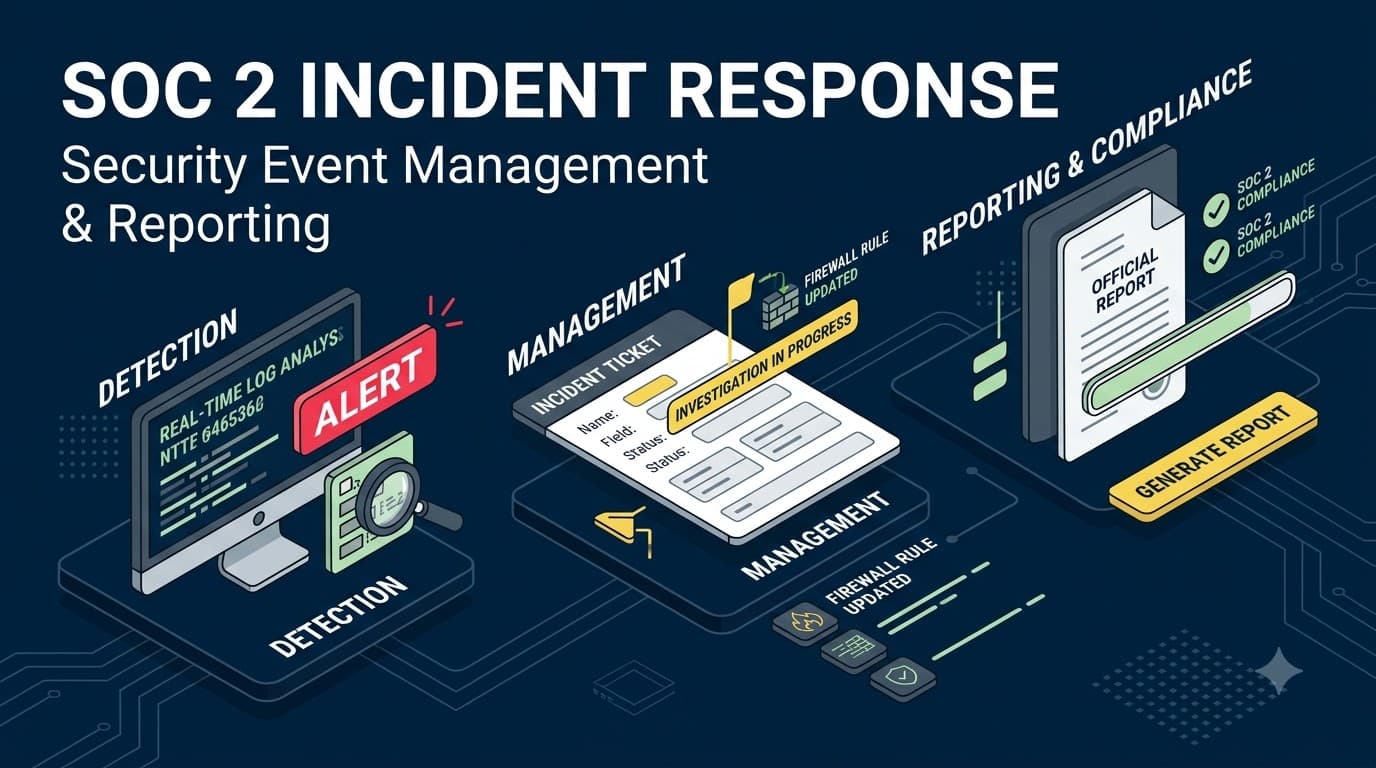
Maria Chen got the Slack alert at 2:14 a.m.: unusual outbound traffic from a database server that had no business talking to the internet. She was VP of Engineering at Fintrail Payments, a 140-person payments-infrastructure startup processing roughly $900 million a year in transaction volume for mid-market merchants. Fintrail's SOC 2 Type II audit period had started four months earlier. Its biggest enterprise prospect — a $2.3 million annual contract — was contingent on a clean report.
By 2:19 a.m., the on-call security engineer had confirmed it: a contractor's laptop, compromised through a phishing email eleven days prior, had been used to plant a credential-harvesting script on a build server. The attacker was now attempting lateral movement toward the payments database. Fintrail had an incident response plan, written eight months earlier and tested exactly once in a tabletop exercise. That plan — and the muscle memory from that one drill — was the difference between a four-hour contained incident with a clean post-mortem and a multi-day breach that would have detonated the enterprise deal, triggered mandatory breach notifications in fourteen states, and very possibly ended with a qualified opinion on the SOC 2 report six weeks later.
This is a guide to building that capability before you need it — not the day after. I've run incident response programs and sat across the table from Fintrail-shaped companies more times than I can count over fifteen-plus years of consulting, and the pattern is depressingly consistent: organizations that treat incident response as a checkbox for the audit get caught flat-footed by the first real event, and organizations that build it as an operational muscle sail through both the audit and the incident. This article shows you how to do the latter.
Who This Is For
This is written for security leaders, engineering managers, and compliance owners at service organizations pursuing or maintaining a SOC 2 report — typically SaaS companies, fintechs, and B2B platforms handling customer data — who need to stand up or mature an incident response function that will hold up under Type II testing. You'll walk away with a concrete incident response plan structure, a severity classification model, playbooks for the incident types auditors ask about most, a communication and breach-notification framework, and — critically — a map of exactly what evidence your auditor will sample when they test Common Criteria 7.3 through 7.5. If you already have an IR plan gathering dust in a shared drive, this will show you the gap between "we have a document" and "we have a program." Want a starting point instead of a blank page? Pull our SOC 2 Policy Pack and adapt the incident response policy template to your environment rather than drafting from scratch.
If your organization is pursuing both frameworks at once, most of what follows also satisfies ISO 27001's incident management clause — worth reading alongside our guide to running ISO 27001 and SOC 2 together if that's your situation.
Why Incident Response Is a Load-Bearing Wall in SOC 2
Trust Services Criteria assessments spend a lot of time on prevention — access control, change management, encryption. But every auditor I've worked with tells the same story: incident response is where the theoretical soundness of a control environment meets reality. You can have flawless access reviews and beautiful firewall rules, but eventually something will go wrong — a misconfigured S3 bucket, a phished employee, a vulnerable third-party library. What separates a mature service organization from an immature one isn't whether incidents happen. It's whether the organization detects them quickly, responds in a disciplined way, and can produce a paper trail proving it.
That's precisely what CC7.3, CC7.4, and CC7.5 of the common criteria test. These three criteria don't exist in isolation — they're the operational back half of CC7 (System Operations), which starts with CC7.1 (vulnerability detection) and CC7.2 (monitoring for anomalies) and culminates in evaluating, responding to, and recovering from actual security incidents.
Criterion | Focus | What Auditors Test |
|---|---|---|
CC7.1 | Detects and monitors for new vulnerabilities and susceptibility to unauthorized configuration changes | Vulnerability scanning cadence, configuration monitoring, baseline drift detection |
CC7.2 | Monitors system components for anomalies indicative of malicious acts, natural disasters, or errors | SIEM/log monitoring coverage, alerting thresholds, monitoring tool inventory |
CC7.3 | Evaluates security events to determine whether they represent a security incident | Triage process, severity classification, escalation criteria, time-to-triage evidence |
CC7.4 | Responds to identified security incidents by executing a defined incident response program | IR plan, playbooks, containment actions, ticket/timeline evidence per incident |
CC7.5 | Identifies, develops, and implements activities to recover from identified security incidents | Recovery procedures, root cause analysis, corrective action tracking, post-mortems |
I map this deliberately because I've watched teams walk into an audit with a beautifully worded incident response policy and nothing else — no tickets, no timelines, no evidence anyone ever actually followed it. An auditor testing operating effectiveness under a Type II report doesn't care how well-written your policy is. They care whether, during the audit period, you can show a sample of actual events, actual triage decisions, actual response actions, and actual recovery confirmation. Design without operation is a Type I story. Type II wants proof of the whole loop, every time.
"The single biggest gap I see in Type II incident response testing isn't a missing plan — it's a missing paper trail. Companies respond to incidents just fine operationally, then can't produce the ticket that shows when they detected it, when they triaged it, and when they closed it. If it's not written down with timestamps, as far as your auditor is concerned, it didn't happen." — James Whitfield, Audit Partner, Whitfield & Cross LLP
The SOC 2 Incident Response Lifecycle
Before getting into plan structure, it helps to see the whole lifecycle end to end, because SOC 2 testing follows this exact shape — auditors sample incidents and trace them through every stage.
flowchart LR
    A[Detection<br/>CC7.1/CC7.2] --> B[Triage & Evaluation<br/>CC7.3]
    B --> C{Confirmed<br/>Incident?}
    C -->|No| D[Log as Event<br/>Close]
    C -->|Yes| E[Classification<br/>& Escalation]
    E --> F[Containment<br/>CC7.4]
    F --> G[Eradication]
    G --> H[Recovery<br/>CC7.5]
    H --> I[Notification &<br/>Communication]
    I --> J[Post-Incident<br/>Review]
    J --> K[Corrective Actions<br/>& Lessons Learned]
    K --> L[(Evidence Repository)]
    B -.-> L
    F -.-> L
    H -.-> L
    J -.-> L
Every box in that diagram needs to leave a fingerprint — a ticket, a timestamp, a sign-off, a document — because the evidence repository at the bottom is what your auditor actually samples. I'll come back to this diagram's logic repeatedly through the article, because it's the skeleton the whole IR program hangs on.
Building the Incident Response Plan: Core Components
An incident response plan (IRP) is the foundational artifact your auditor will request in the first week of fieldwork. It doesn't need to be a hundred pages — I've seen twelve-page plans that were audit-ready and eighty-page plans that were pure theater. What matters is completeness, not length.
Component | Purpose | Common Gap |
|---|---|---|
Purpose & scope statement | Defines what systems/data the plan covers | Scope doesn't match actual system boundary in the SOC 2 description |
Roles and responsibilities | Names who does what during an incident | Roles reference job titles that no longer exist |
Severity classification | Defines incident tiers and response SLAs | Severity criteria are vague ("high," "low") with no measurable trigger |
Detection and reporting channels | How incidents are identified and reported internally | No defined channel for employees to report suspected incidents |
Triage and escalation procedure | How a reported event becomes a classified incident | No documented decision criteria — triage is "tribal knowledge" |
Containment, eradication, recovery steps | Tactical response guidance, often per incident type | Playbooks exist for ransomware but not for data exposure or insider threat |
Communication plan | Internal and external notification procedures | No legal/PR involvement defined; notification obligations not mapped |
Evidence and documentation requirements | What must be logged during response | Documentation is retroactive, reconstructed after the fact |
Post-incident review process | Root cause analysis and corrective actions | Post-mortems happen informally in Slack and are never saved |
Plan testing and maintenance | Tabletop cadence, plan review/update schedule | Plan hasn't been reviewed or tested since it was written |
A plan lacking any of those ten rows will draw an auditor's attention immediately, because each row typically becomes a distinct test-of-design question during walkthroughs. I keep a version of this table taped to the inside of every IR plan project I run — it's the fastest gap-check I know.
Who Owns What: Incident Response Roles
Every incident response plan needs named accountability, not just a generic "the security team will respond" sentence. Auditors specifically probe whether roles are assigned to real people (or role titles mapped to real people) and whether those people know their responsibilities — this often comes out in interview walkthroughs, not just document review.
Role | Primary Responsibility | Typical Owner |
|---|---|---|
Incident Commander | Overall incident ownership, decision authority, coordinates response | Security Operations Lead / CISO delegate |
Technical Lead | Directs containment, forensics, and technical remediation | Senior security engineer or platform lead |
Communications Lead | Manages internal updates, customer notification, PR coordination | Head of Comms / Marketing, with legal review |
Legal Counsel | Assesses notification obligations, privilege, regulatory exposure | General Counsel or outside breach counsel |
Executive Sponsor | Authorizes major decisions (e.g., customer notification, system shutdown) | CEO, CTO, or COO depending on incident scope |
Scribe / Documentation Owner | Maintains the incident timeline and evidence log in real time | Assigned rotating role, often a security analyst |
HR Representative | Handles incidents involving employee misconduct or insider threat | HR Business Partner |
Customer Success Liaison | Coordinates customer-facing communication with account teams | CS Director |
I push clients hard on the Scribe role because it's the one most often skipped — and it's the single highest-leverage role for SOC 2 evidence. Someone needs to be capturing timestamps, decisions, and actions as they happen, not reconstructing them from memory during the post-mortem three days later. A dedicated scribe converts a chaotic incident into a clean audit trail almost for free.
If you're staffing this for the first time, our SOC 2 Control Matrix / RACI Template has a ready-made incident response section you can adapt rather than building the matrix below from a blank sheet.
"I make every incident commander candidate shadow two live incidents before they're allowed to run one solo. You can read a plan a hundred times, but the first time someone's paging you at 3 a.m. about a possible ransomware event is not the moment to be reading the plan for the first time." — Derek Osei, CISO, Bramwell Health Analytics
RACI for Incident Response
Beyond primary ownership, a RACI (Responsible, Accountable, Consulted, Informed) matrix resolves the ambiguity that causes response delays — the number one root cause I see in post-mortems is "we weren't sure who was supposed to decide X."
Activity | Incident Commander | Technical Lead | Legal Counsel | Comms Lead | Executive Sponsor |
|---|---|---|---|---|---|
Declare incident / set severity | A/R | C | I | I | I |
Contain affected systems | A | R | I | I | I |
Determine notification obligations | C | I | A/R | C | I |
Draft customer notification | I | I | C | A/R | C |
Approve public statement | I | I | C | R | A |
Engage law enforcement | C | I | A/R | I | C |
Approve system shutdown (production) | R | C | I | I | A |
Close incident / sign off post-mortem | A/R | R | I | I | I |
Severity Classification: The Backbone of Consistent Response
Nothing derails a SOC 2 test faster than inconsistent severity assignment — an auditor pulling three "high" severity incidents from the period and finding wildly different response timelines for each. A defensible severity model needs objective triggers, not subjective judgment calls.
Severity | Definition | Example Triggers | Target Response Time | Target Containment Time |
|---|---|---|---|---|
SEV-1 (Critical) | Confirmed compromise of production systems, customer data, or payment infrastructure; active data exfiltration | Confirmed ransomware on production, active exfiltration, full service outage from attack | 15 minutes | 4 hours |
SEV-2 (High) | Significant risk to confidentiality/integrity/availability but not yet confirmed customer data impact | Compromised privileged credential, malware on a single production host, confirmed unauthorized access attempt | 30 minutes | 8 hours |
SEV-3 (Medium) | Contained risk with limited blast radius; suspicious activity requiring investigation | Phishing click without follow-on compromise, isolated malware on a non-production endpoint | 4 hours | 24 hours |
SEV-4 (Low) | Policy violation or anomaly with negligible security impact | Failed login spike from a known IP, minor policy exception | 1 business day | 5 business days |
Two things matter here beyond the table itself. First, the triggers need to be concrete enough that two different on-call engineers would classify the same event the same way — "significant" and "limited" are doing real work in that table only because they're paired with specific examples. Second, whatever targets you set, your evidence needs to show you actually hit them (or documented why you didn't) — auditors will calculate actual response times from ticket timestamps and compare them against your stated SLAs.
Detection: Where Incidents Actually Come From
CC7.1 and CC7.2 set up the detection capability that CC7.3 depends on. In practice, incidents surface through a mix of automated and human channels, and your evidence needs to show coverage across all of them — not just the SIEM dashboard.
Detection Source | Description | Typical Tooling |
|---|---|---|
SIEM / log correlation | Automated alerting on correlated log events across infrastructure | Splunk, Datadog Security, Sumo Logic, Chronicle |
Endpoint detection and response (EDR) | Behavioral detection on workstations and servers | CrowdStrike, SentinelOne, Microsoft Defender for Endpoint |
Cloud-native security monitoring | Detects misconfigurations and anomalous cloud API activity | AWS GuardDuty, Azure Defender, GCP Security Command Center |
Employee reporting | Staff reporting suspicious emails, behavior, or lost devices | Dedicated "report phishing" button, security@ inbox, Slack channel |
Vendor / third-party notification | A subservice organization or vendor discloses an incident affecting you | Contractual notification clauses, vendor security bulletins |
Customer-reported anomalies | A customer flags unexpected behavior or possible exposure | Support ticket escalation path to security team |
Vulnerability scanning results | A scan surfaces an actively exploited vulnerability | Tenable, Qualys, Wiz, Snyk |
Threat intelligence feeds | External indicators matched against internal telemetry | Recorded Future, open-source feeds, ISAC sharing |
A mature SOC 2 Security Monitoring program is what stitches these sources together into something an analyst can actually triage — without centralized log correlation, you're relying on luck and individual vigilance, and auditors notice when detection coverage has obvious blind spots (unmonitored cloud accounts, no endpoint coverage on contractor laptops, and so on). I always ask clients the blunt question: if an attacker sat quietly in your environment for two weeks doing reconnaissance, which of these eight channels would actually catch them? If the honest answer is "maybe the SIEM, if someone happened to be looking," that's a finding waiting to happen.
Detection quality also depends heavily on the underlying SOC 2 Security Criteria implementation — logging can't detect what isn't instrumented, and access anomalies can't be flagged if authentication events aren't centrally captured in the first place.
Triage: Turning an Alert Into a Decision (CC7.3)
Triage is the criterion auditors most often find under-evidenced, because it happens fast and informally. The fix is a documented decision framework that turns "is this a real incident?" into a repeatable process rather than a gut call.
Triage Step | Question Answered | Owner | Evidence Produced |
|---|---|---|---|
Initial validation | Is this a false positive, or a real event requiring investigation? | On-call analyst | Ticket created with timestamp |
Scope assessment | What systems, data, or users are potentially affected? | Technical Lead | Scope notes in ticket |
Severity assignment | Which SEV tier applies based on the classification table? | Incident Commander | Severity field set in ticketing system |
Escalation decision | Does this require IR team activation, legal, or executive notification? | Incident Commander | Escalation log / paging record |
Declare or dismiss | Formally declare as an incident, or close as a benign event | Incident Commander | Disposition recorded with rationale |
The evidence column is the whole point of this table. When I build triage workflows for clients, I insist every one of those five steps writes something to the ticket automatically or by habit — because a triage process that lives entirely in someone's head produces zero auditable evidence, no matter how good the actual decision-making is.
If you're deciding how your program stacks up against peers pursuing the same ISO 27001 vs SOC 2 question, incident evaluation and response is one of the clearest overlap points between the two frameworks — the documentation habits below satisfy both.
"Auditors don't grade you on whether you made the perfect call in the first five minutes. They grade you on whether you can show your reasoning. 'We saw X, we assessed the blast radius as Y, so we classified it SEV-2 and paged the on-call lead' — that sentence, timestamped, is worth more than a perfect outcome with no trail." — Priya Nair, Director of Security Operations, Loomstack Cloud
Containment: Stopping the Bleeding
Containment strategy varies by incident type, and a one-size-fits-all "isolate the host" instruction isn't sufficient for a mature playbook. Different incident types call for different first moves.
Incident Type | Immediate Containment Action | Secondary Action |
|---|---|---|
Ransomware / malware on endpoint | Isolate host from network (EDR quarantine) | Disable associated user credentials, preserve disk image |
Compromised credential | Force password reset, revoke active sessions/tokens | Review MFA enforcement, audit recent activity from account |
Data exposure (misconfigured storage) | Restrict public access / revoke exposed permissions immediately | Determine what was accessed and by whom via access logs |
Insider threat | Suspend account access pending investigation (coordinate with HR/Legal) | Preserve forensic evidence before any device is returned |
DDoS / availability attack | Engage upstream mitigation (CDN/DDoS protection service) | Scale defenses, notify affected customers of degraded service |
Third-party / vendor compromise | Rotate shared credentials and API keys with the vendor | Assess data shared with the vendor, review vendor risk management file |
Phishing with credential harvest | Reset affected credentials, block sender domain/URL | Search mail logs for other recipients, notify affected users |
Containment decisions frequently intersect with change management — isolating a production host, rotating credentials, or pushing an emergency patch are all changes, and auditors increasingly ask how emergency changes made during an incident still get logged and approved after the fact, even under time pressure. This is exactly where a well-run SOC 2 Change Management process earns its keep: a documented emergency-change exception path means your 2 a.m. firewall rule change doesn't become an unlogged, unapproved deviation that shows up as a separate finding in the same audit.
Eradication and Recovery (CC7.5)
Once contained, eradication removes the root cause — the malicious script, the compromised account, the vulnerable package — and recovery restores normal operations with confidence the threat is gone, not just quiet.
Recovery Phase | Activities | Exit Criteria |
|---|---|---|
Eradication | Remove malware/backdoors, patch exploited vulnerability, rotate all potentially exposed credentials | Confirmed clean via scan/forensic review |
System restoration | Restore from known-clean backup or rebuild from a trusted image | System validated against integrity baseline |
Validation testing | Confirm system functions correctly and no residual indicators of compromise remain | Sign-off from Technical Lead |
Monitoring intensification | Increase logging/alerting sensitivity on affected systems temporarily | Defined observation window closed without recurrence |
Return to normal operations | Formal declaration that the incident is resolved | Incident Commander sign-off, ticket closed |
Recovery timelines should tie back to your organization's stated recovery time objective (RTO) and recovery point objective (RPO) commitments — if your SOC 2 Data Backup and Recovery documentation promises a four-hour RTO for critical systems, your incident recovery evidence needs to actually demonstrate you can hit that number under real incident conditions, not just in a scheduled disaster recovery drill. Immutable backups matter enormously here, especially for ransomware scenarios — if backups can be encrypted or deleted by the same attacker who compromised production, you don't actually have a recovery path, you have a hope.
Severity | Target Full Recovery Time | Post-Recovery Monitoring Window |
|---|---|---|
SEV-1 | 24 hours | 30 days |
SEV-2 | 48 hours | 14 days |
SEV-3 | 5 business days | 7 days |
SEV-4 | 10 business days | N/A |
Playbooks: Pre-Written Response Guidance by Incident Type
Generic incident response plans handle the "shape" of a response well but fall apart on specifics. Playbooks fill that gap with pre-written, incident-type-specific guidance that a stressed on-call engineer can follow without reinventing the process at 3 a.m.
Playbook | Covers | Key Distinctive Steps |
|---|---|---|
Ransomware response | Encryption of production or corporate systems | Isolate immediately, assess backup integrity before any restoration, engage cyber insurance and outside counsel early |
Data breach / exposure | Unauthorized access to or disclosure of customer/PII | Determine data types exposed, map to applicable breach notification triggers, engage legal before any customer communication |
Insider threat | Malicious or negligent action by an employee/contractor | Coordinate tightly with HR and Legal, preserve evidence per chain of custody standards, avoid tipping off the subject prematurely |
Credential compromise | Stolen or phished user/service credentials | Force reset, review OAuth grants and API tokens, check for lateral movement |
DDoS / availability incident | Attack degrading service availability | Activate mitigation provider, communicate status to customers, document impact against SLA commitments |
Third-party/vendor incident | A subservice organization reports its own incident | Assess shared data/access, request vendor's incident report, evaluate contractual notification obligations |
Physical security incident | Lost device, unauthorized facility access | Remote wipe device, review badge logs, assess data exposure risk |
I've stopped counting how many audits I've watched stall because a company had a beautiful ransomware playbook and nothing else — and the sampled incident during the period turned out to be a misconfigured storage bucket exposing customer PII. Build the playbook set to match your actual risk profile, not just the scariest headline scenario.
Communication: Internal Escalation and External Notification
Communication failures during incidents are rarely about technical incompetence — they're about ambiguity over who talks to whom, and when. A tiered escalation and notification matrix removes the guesswork.
Audience | Trigger | Timing Target | Owner |
|---|---|---|---|
On-call security/eng team | Any SEV-1/SEV-2 declared | Immediate (automated page) | Incident Commander |
Engineering leadership | SEV-1, or SEV-2 lasting >2 hours | Within 30 minutes of declaration | Incident Commander |
Executive team | SEV-1, or any incident with customer data impact | Within 1 hour of declaration | Incident Commander |
Legal counsel | Any incident with potential regulatory/contractual notification obligation | Within 1 hour of declaration | Incident Commander / Comms Lead |
Affected customers | Confirmed impact to customer data or committed service levels | Per contractual/regulatory deadline (see below) | Comms Lead, approved by Legal + Executive Sponsor |
Board / investors | Material incident per governance policy | Per board communication policy, typically 24–72 hours | CEO / Executive Sponsor |
Regulators | Where legally required (state AG, sector regulator) | Per applicable law (commonly 30–72 hours from discovery) | Legal Counsel |
Cyber insurance carrier | Any incident potentially triggering a claim | Per policy terms, often 24–72 hours | Legal Counsel / CFO |
"The worst version of a breach isn't the breach itself — it's the customer finding out from a journalist or a dark web monitoring alert before they hear it from us. We rehearse the notification playbook as hard as we rehearse the technical containment steps, because a technically clean incident with a botched notification still burns the relationship." — Sarah Kimura, General Counsel, Fintrail Payments
Breach and Customer Notification Obligations
This is the section where I see the most confusion, because notification obligations stack from multiple directions at once: state law, sector regulation, and contract language — and SOC 2 itself imposes none of this directly. SOC 2 is not a law; it's an attestation over the Trust Services Criteria, and it doesn't create notification requirements on its own. What CC7.4 and CC7.5 test is whether you have a defined, followed process for determining and meeting whatever obligations do apply to you.
Source of Obligation | Typical Trigger | Illustrative Timing | Notes |
|---|---|---|---|
U.S. state breach notification laws | Unauthorized access/acquisition of unencrypted PII (varies by state definition) | Commonly "without unreasonable delay," some states set a hard cap (e.g., 30–60 days) | All 50 states have some form of this law; requirements vary significantly |
GDPR (EU) | Personal data breach likely to result in risk to individuals | 72 hours to supervisory authority from awareness | Applies if you process EU residents' data, regardless of company location |
Sector regulation (e.g., financial services) | Incident affecting regulated systems or data | Often 24–72 hours to primary regulator | Varies by regulator; some require immediate notice for material incidents |
Customer contracts / DPAs | Contractually defined "security incident" affecting customer data | Frequently 24–72 hours, sometimes "promptly" | Often stricter than legal minimums — read every enterprise DPA carefully |
Cyber insurance policy | Incident meeting policy's claim-notice definition | Often "as soon as practicable," some set fixed windows | Late notice can jeopardize coverage — treat this deadline as non-negotiable |
The practical discipline I install with every client is a single "notification obligation map" reviewed at least annually by legal counsel — a living document cross-referencing which jurisdictions, regulators, and customer contracts apply, and what each requires. During an actual incident, nobody has time to research fifty states' breach laws from scratch; the map needs to already exist so legal counsel can apply it against the specific facts within the hour, not the week.
Notification Package Element | Purpose |
|---|---|
What happened (factual, non-speculative) | Establishes the scope of disclosure without overcommitting on unconfirmed details |
Data types potentially affected | Lets the recipient assess their own risk |
Actions taken to contain and remediate | Demonstrates competent response |
Recommended actions for the recipient | Password resets, credit monitoring, etc. where applicable |
Contact point for follow-up questions | Single accountable channel, avoids fragmented communication |
Timeline of key events | Supports both transparency and later audit/regulatory review |
I'll say this plainly because I've seen it burn companies: legal counsel drafts and approves every external notification before it goes out, full stop. Engineering teams that draft their own customer emails under pressure — however well-intentioned — routinely include speculative root cause language ("it looks like our vendor's API was compromised") that turns into a liability if it's later proven wrong.
Working With Forensics, Counsel, and Insurance
Larger or more ambiguous incidents pull in specialists beyond the internal IR team. Knowing when to engage them — and having the relationships pre-negotiated — is itself a maturity signal auditors look for.
Partner | When to Engage | Why Pre-Negotiate |
|---|---|---|
Outside breach counsel | Any incident with likely regulatory or litigation exposure | Establishes attorney-client privilege over the investigation from the outset |
Digital forensics firm | Incidents requiring evidentiary-quality investigation (insider threat, suspected data theft) | Retainer agreements signed in advance avoid delays and rate-shopping mid-crisis |
Cyber insurance carrier / breach coach | Any incident potentially triggering coverage | Many policies require using carrier-approved vendors — engaging your own first can void reimbursement |
Law enforcement (FBI, local, sector-specific) | Ransomware, significant fraud, nation-state indicators | Some regulators expect evidence law enforcement was considered/engaged |
PR / crisis communications firm | Incidents with public/media exposure risk | Pre-vetted firm can turn around a statement in hours, not days |
A retainer signed in a calm Tuesday afternoon meeting is worth far more than a frantic Saturday-night phone call to a forensics firm you've never worked with. I recommend every client with a SOC 2 program keep at least a breach counsel retainer and a forensics retainer on file, reviewed annually — and I log the existence of those retainers as evidence in the IR program itself, because auditors sometimes ask directly whether pre-arranged external support exists.
Post-Incident Review: Root Cause Analysis and Lessons Learned
CC7.5 explicitly tests whether the organization "identifies, develops, and implements" recovery activities — meaning a post-mortem isn't optional color commentary, it's a control in its own right. A good post-mortem is blameless, specific, and produces tracked corrective actions, not vague good intentions.
Post-Mortem Field | Purpose |
|---|---|
Incident summary | One-paragraph factual account of what happened |
Timeline | Minute-by-minute or hour-by-hour record from detection to resolution |
Root cause | The underlying condition that allowed the incident, via root cause analysis |
Contributing factors | Secondary conditions that worsened impact or delayed response |
What went well | Reinforces effective practices so they're repeated |
What went poorly | Honest, blameless assessment of gaps in tooling, process, or communication |
Corrective actions | Specific, owned, dated remediation items |
Severity/impact assessment | Final confirmed scope and business impact |
Sign-off | Incident Commander and relevant leadership approval |
The corrective actions row is where most post-mortems die quietly. I've reviewed dozens of post-mortem documents with a beautifully written "what went poorly" section and a corrective actions list that reads "improve monitoring" with no owner, no due date, and no evidence it was ever done. That's an open invitation for an auditor to flag a repeat finding, because CC7.5 is explicitly about whether recovery activities were implemented — not just identified on paper.
Corrective Action Status Tracking | Field |
|---|---|
Action description | Specific, verifiable statement of what will change |
Owner | Named individual, not a team |
Due date | Realistic date, tracked against actual completion |
Priority | Tied to severity of the underlying gap |
Verification method | How completion will be confirmed (e.g., control test, code review) |
Status | Open / In Progress / Complete / Overdue |
I strongly recommend tracking these in the same system used for control deficiency and corrective action plan (CAP) tracking elsewhere in your compliance program — auditors like seeing one coherent remediation-tracking mechanism rather than incident corrective actions living in a totally separate tool from every other finding.
The Evidence Auditors Actually Sample
This is the section to bookmark. Everything above is process; this is proof. During Type II fieldwork, your auditor will select a sample of incidents (and often a sample of "no incidents occurred" periods too, to test monitoring coverage) and trace each one through the lifecycle looking for exactly this evidence.
CC Reference | What's Tested | Evidence Auditors Request |
|---|---|---|
CC7.1 | Vulnerability/configuration monitoring exists | Scan reports, configuration monitoring tool output, remediation tickets |
CC7.2 | Anomaly monitoring is operating | SIEM alert logs, monitoring tool configuration, sample of alerts reviewed |
CC7.3 | Events are evaluated to determine incident status | Triage tickets showing disposition (confirmed/dismissed) and rationale |
CC7.4 | Incidents are responded to per the defined program | Incident tickets with timeline, severity assignment, response actions, communications sent |
CC7.5 | Recovery activities are identified and implemented | Post-mortem documents, corrective action tracking, recovery validation sign-off |
Cross-cutting | IR plan itself is current and approved | Version-controlled IR plan with review/approval dates |
Cross-cutting | Team is trained and plan is tested | Tabletop exercise records, IR training completion records |
The single most useful thing I tell every client early in a SOC 2 program: build your ticketing workflow so that this evidence is a byproduct of doing the work, not a separate documentation exercise performed afterward. If your incident management tool automatically timestamps detection, triage, severity assignment, and closure, you're not "creating audit evidence" — you're just running incidents properly, and the evidence falls out for free. Retroactively reconstructed timelines are the single fastest way to draw auditor skepticism, because handwriting doesn't match server logs.
Before your next audit window opens, run your evidence trail against our SOC 2 Readiness Checklist — the incident response section maps almost exactly to the evidence gaps table below.
Common Evidence Gap | Consequence | Fix |
|---|---|---|
No ticket for a real incident (handled "informally" in Slack) | Auditor can't verify CC7.3/7.4 operated | Mandate a ticket for every SEV-1 through SEV-3 event, no exceptions |
Severity assigned but not logged in the system | Can't test consistency of classification | Make severity a required ticket field, not a conversation |
Post-mortem exists but was never approved/signed off | CC7.5 recovery activities look incomplete | Require documented sign-off before ticket closure |
Corrective actions listed but no completion evidence | Repeat finding risk in next audit cycle | Track actions in the same CAP system as other findings |
Notification sent but not retained | Can't demonstrate CC7.4 communication occurred | Archive all incident communications in the incident record |
Testing the Plan: Tabletop Exercises
A plan that's never been tested is a hypothesis, not a capability. Regular tabletop exercises are both a genuine risk-reduction activity and increasingly something auditors ask about directly as evidence the IR program is more than paperwork.
Exercise Type | Cadence | Participants | Purpose |
|---|---|---|---|
Executive tabletop | Annually | Leadership team, Legal, Comms | Test decision-making and communication under a scenario, not technical response |
Technical tabletop | Quarterly | Security/engineering IR team | Walk through technical containment/response steps for a specific playbook |
Full-scale simulation | Annually | Cross-functional, including on-call rotation | End-to-end test including detection, paging, and (where feasible) actual isolation drills |
New-hire IR walkthrough | Within 30 days of joining relevant roles | New security/on-call staff | Familiarize new team members with the plan before they're on-call |
Tabletop Scenario Bank | Tests |
|---|---|
Ransomware encrypting production database | Containment decision-making, backup validation, insurance/legal engagement |
Phishing leading to admin credential compromise | Detection speed, credential rotation process, scope assessment |
Third-party vendor breach affecting shared data | Vendor coordination, notification obligation mapping |
Departing employee exfiltrating source code | HR/Legal coordination, forensic evidence preservation |
Public cloud storage bucket misconfigured to public | Rapid containment, customer data exposure assessment |
Extended outage during active DDoS | Availability commitments, customer communication under pressure |
Every tabletop should produce its own lightweight after-action summary — attendees, scenario, findings, and follow-up items — filed in the same evidence repository as real incidents. I've had auditors specifically request the previous year's tabletop records to confirm the exercise cadence is actually being kept, not just claimed in the policy document.
Tooling Landscape
You don't need enterprise-grade tooling to run a defensible IR program, but you do need something more structured than a shared inbox and good intentions.
Category | Purpose | Example Tools |
|---|---|---|
Ticketing / case management | Central incident record, timeline, evidence attachment | Jira Service Management, PagerDuty Incident Response, ServiceNow |
Alerting and paging | Ensures the right person is notified immediately | PagerDuty, Opsgenie, VictorOps |
SIEM / log analysis | Correlates events across systems for detection and investigation | Splunk, Datadog, Microsoft Sentinel |
SOAR (orchestration/automation) | Automates repeatable containment/response steps | Splunk SOAR, Palo Alto Cortex XSOAR, Tines |
Forensic imaging/analysis | Evidentiary-quality investigation of compromised systems | EnCase, Magnet AXIOM, Velociraptor |
Secure communication | Out-of-band comms if primary channels are compromised | Signal, a dedicated bridge line, offline runbook copies |
Documentation/evidence repository | Central, access-controlled store for IR artifacts | Confluence with restricted space, dedicated GRC platform |
A small but important note on secure communication: if your primary collaboration tool (Slack, email, Teams) is itself potentially compromised or unavailable during the incident, you need a pre-arranged fallback channel. I've watched a response stall for forty minutes because the IR team's default coordination channel was hosted on the same identity provider that had just been compromised.
Common Mistakes That Show Up as Audit Findings
Patterns repeat across the incident response programs I review. These are the ones I flag most often before an auditor gets the chance to — many of them surface first during a proper SOC 2 readiness assessment, which is exactly why I run one before every audit, not after a finding.
Mistake | Why It's a Problem | How to Fix It |
|---|---|---|
IR plan hasn't been updated since it was written | Roles, tools, and escalation paths drift out of date | Mandate at least annual plan review with dated sign-off |
No evidence of actual incidents during the period | Either nothing happened (unlikely over 6–12 months) or events weren't logged | Reconcile against SIEM alert volume and helpdesk tickets to find unlogged events |
Severity classification is inconsistent across incidents | Undermines confidence the process is followed reliably | Build severity criteria into the ticketing system as required fields, not free text |
Post-mortems exist for major incidents only | Smaller incidents (SEV-3/4) that reveal systemic gaps go unexamined | Require lightweight post-mortems for all confirmed incidents, scaled to severity |
No documented notification-obligation analysis | Legal exposure and inconsistent customer communication | Maintain and annually review the notification obligation map |
Tabletop exercises undocumented or skipped | Can't demonstrate plan is tested; team competency unverified | Calendar-lock exercises, always produce an after-action record |
Corrective actions never verified as closed | Repeat root causes across multiple incidents | Track in the same CAP system as other compliance findings, with verification evidence |
IR plan scope doesn't match SOC 2 system boundary | Confusing or contradictory answers during interviews | Review IR plan scope against the system description every audit cycle |
Case Study: Fintrail Payments — The Four-Hour Save
Returning to Maria Chen's 2:14 a.m. alert: within five minutes, the on-call analyst had confirmed unusual outbound traffic and paged the Incident Commander per the SEV-2 escalation path. By 2:30 a.m., the compromised build server had been isolated, the contractor's credentials revoked, and the Technical Lead had begun reviewing access logs to determine whether the payments database had actually been touched. It hadn't — the lateral movement attempt had been caught before it reached anything customer-facing.
By 6 a.m., Fintrail's legal counsel had reviewed the notification obligation map and determined no customer notification threshold had been met, since no customer data was accessed. By 9 a.m., the incident was contained, the phishing vector patched with additional email filtering rules, and a post-mortem scheduled for the following day. The whole event — from detection to full recovery confirmation — took just under seven hours, with a full evidence trail: tickets, timestamped Slack logs archived to the incident record, the access log review, and a signed-off post-mortem with three corrective actions (contractor laptop EDR enrollment, tightened build-server network segmentation, and a refreshed phishing training module).
Six weeks later, when Fintrail's Type II auditor sampled incidents from the period, this was one of two events selected. Every question the auditor asked — how was it detected, who decided severity, when was legal engaged, what was the corrective action status — had a documented answer with a timestamp attached. The report came back unqualified. The $2.3 million enterprise contract closed three weeks after that.
Case Study: Bramwell Health Analytics — The Notification Gap
Bramwell Health Analytics, a healthtech data platform, experienced a genuinely well-handled technical incident: a former employee's still-active API key was used to pull a dataset containing partial patient records before being caught and revoked within ninety minutes. The technical response was fast and competent. The failure was downstream — nobody had mapped which state breach notification laws applied to the specific patient population affected, and legal counsel wasn't looped in until four days after containment, well past several states' "without unreasonable delay" expectations.
During the subsequent SOC 2 Type II audit, this incident became a control exception — not because the technical response failed CC7.4, but because the delayed legal engagement raised questions about whether the organization's incident response program, as designed, reliably triggered the right stakeholders at the right time. Bramwell's corrective action was concrete: build and maintain the notification obligation map, add "Legal Counsel notified" as a mandatory field triggered automatically for any incident touching PII, and retest in a follow-up tabletop within the quarter. The next year's report came back clean, and Bramwell now cites the incident, anonymized, in its own sales conversations as proof its process improved under pressure — turning a finding into a credibility story.
Case Study: Loomstack Cloud — Catching an Insider Early
Loomstack Cloud, a mid-sized infrastructure-as-a-service provider, detected unusual data-staging activity from an engineer's account two weeks before their planned resignation — large volumes of proprietary configuration templates being copied to a personal cloud storage account. Behavioral monitoring on privileged accounts flagged the anomaly; the insider threat playbook kicked in immediately, coordinating HR, Legal, and the Technical Lead before the employee's final day. Access was quietly restricted pending investigation, evidence was preserved under proper chain of custody, and HR handled the offboarding conversation with the facts already established.
The financial impact avoided was hard to pin down precisely — Loomstack estimated the proprietary templates represented roughly $400,000 in engineering effort, and losing them to a competitor could have meant significantly more in lost differentiation. What mattered for the SOC 2 program was cleaner: this became the auditor's sampled insider-threat scenario, and the fact that a dedicated playbook existed, was followed precisely, and produced complete documentation — without ever tipping off the employee prematurely — was exactly the kind of operating-effectiveness evidence that makes CC7.3–7.5 testing straightforward instead of adversarial.
Metrics That Matter
Numbers make an incident response program legible to leadership and auditors alike. I recommend tracking a small, honest set rather than a sprawling dashboard nobody reads.
Metric | What It Measures | Why It Matters |
|---|---|---|
Mean time to detect (MTTD) | Average time from incident occurrence to detection | Reflects monitoring coverage and quality |
Mean time to acknowledge (MTTA) | Average time from alert to human acknowledgment | Reflects paging/escalation effectiveness |
Mean time to contain | Average time from declaration to containment | Core measure of response competence |
Average time from containment to full recovery | Reflects recovery process maturity | |
Incidents by severity (trend) | Volume and mix of SEV-1 through SEV-4 over time | Surfaces whether risk is rising, falling, or shifting type |
Corrective action closure rate | Percentage of post-mortem actions completed on time | Signals whether lessons learned actually change the environment |
Tabletop exercise completion rate | Percentage of scheduled exercises actually run | Direct proxy for plan currency and team readiness |
Repeat root cause rate | Percentage of incidents sharing a root cause with a prior incident | Flags corrective actions that didn't actually stick |
I present these quarterly to leadership specifically because a rising MTTD or a low corrective-action closure rate is exactly the kind of early warning that lets you fix a program gap before an auditor — or a real attacker — finds it for you.
The Business Case: Incident Response as Investment, Not Overhead
Every client resists the incident response budget line until the first real event, and then the budget conversation gets very easy very fast. It's worth making the argument proactively.
Cost Category | Illustrative Investment | Illustrative Cost of Absence |
|---|---|---|
Dedicated IR tooling (ticketing, SIEM, EDR) | $40,000–$150,000/year depending on scale | Undetected dwell time measured in weeks, not hours |
Tabletop exercises and training | $10,000–$30,000/year (facilitator time, staff hours) | Untested plan fails under real pressure; response chaos extends impact |
Retainers (forensics, breach counsel) | $15,000–$40,000/year | Emergency-rate vendor sourcing mid-crisis, days of delay |
Cyber insurance premium | Varies widely by coverage/revenue | Uninsured full-cost exposure to breach response, legal, and notification costs |
Dedicated IR/security headcount | One FTE plus fully loaded costs | Response falls to already-stretched engineering staff, slower and less consistent |
Against that column, the average cost of a poorly handled incident — direct remediation, customer churn, delayed or lost deals contingent on a clean SOC 2 report, regulatory exposure, and the sheer hours burned in crisis mode — dwarfs the annual investment almost every time I've modeled it for a client. The Fintrail case above is the sharpest version of that math: a seven-hour, well-documented incident protected a $2.3 million contract. The inverse — a mishandled version of the same event — could plausibly have cost that deal, triggered fourteen-state notification obligations, and put a qualified opinion on the report headed to every prospect in the pipeline.
Incident Response as a Trust Differentiator, Not Just an Audit Line Item
I'll end where I usually end this conversation with clients: the organizations that get the most business value out of their SOC 2 report are the ones that stop treating incident response as a compliance obligation and start treating it as a sales asset. Enterprise buyers doing vendor risk assessments ask pointed questions about incident history and response maturity — not because they expect you to be perfect, but because how you handle imperfection tells them more about your operational discipline than a flawless-looking control matrix ever could.
A well-run IR program, backed by real evidence, lets you answer "tell me about your worst incident in the last two years" with a specific, honest, competently-resolved story instead of a defensive non-answer. That answer, delivered with confidence in a security questionnaire call, closes deals. Fintrail's ransomware near-miss became a case study its sales team uses, with client permission redacted, in exactly those conversations. Bramwell turned a control exception into proof its program actually learns and improves. That's the real payoff: incident response done right isn't just what keeps your SOC 2 report clean — it's what turns your worst day into your best evidence that you're worth trusting with the next one.
If you're building or maturing this capability, start with the gap-check tables in this article against your current plan, get your severity classification and evidence trail solid before your next audit period opens, and run at least one real tabletop exercise before you assume the plan works. Not sure how big the gap actually is? Run our SOC 2 Gap Analysis Tool against your current IR plan, or take the "Are You SOC 2 Ready?" quiz for a faster gut-check. For definitions of every term used in this article and across the rest of the pillar, our SOC 2 Glossary is a standing reference worth bookmarking. PentesterWorld's compliance team can help you pressure-test the whole program before an auditor does it for you — reach out, and let's make sure your next incident is a footnote, not a headline.