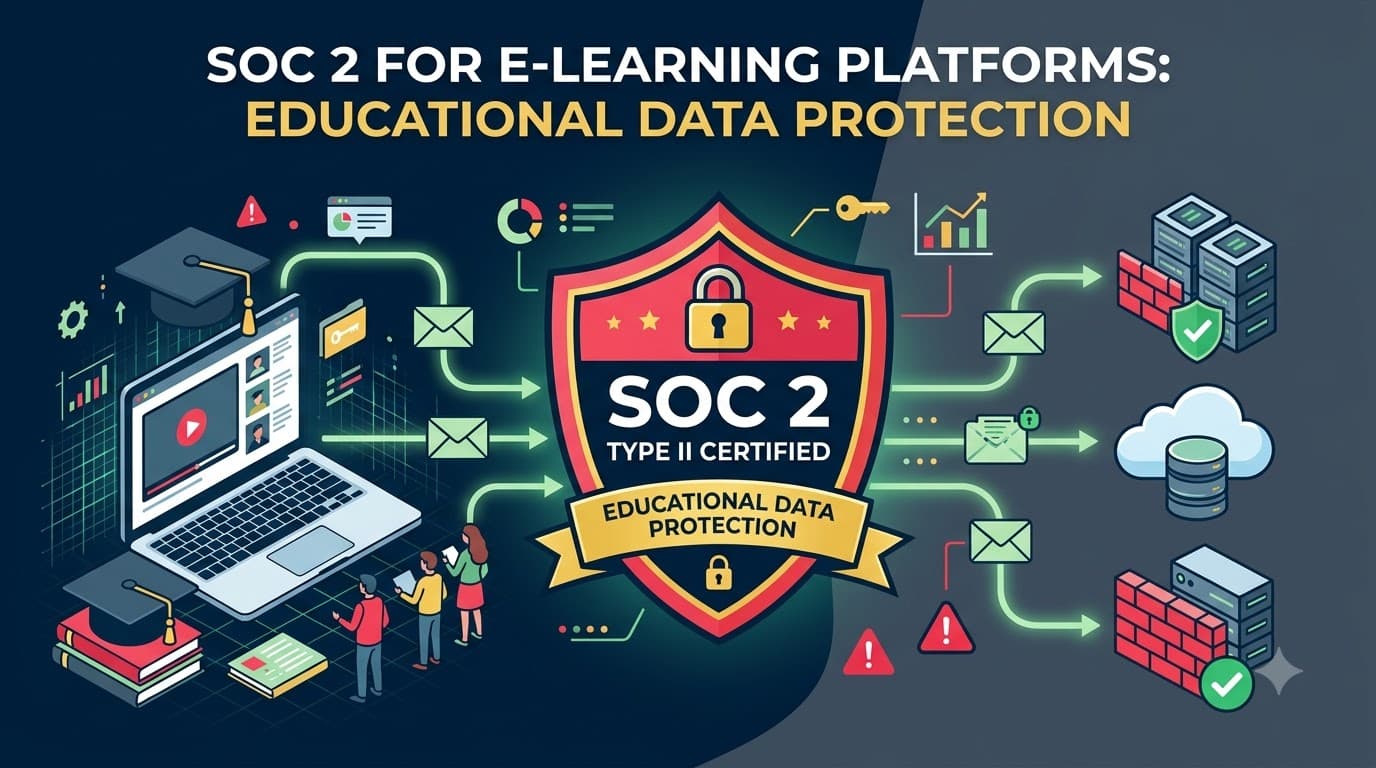
Priya Nakamura had rewritten the RFP response three times already. Lumenor Learning's platform was running cleanly across 900 school districts and 4.2 million students, the product team had just shipped an adaptive-math engine that teachers genuinely liked, and sales had a signature all but ready on a $3.1 million, four-year contract with the Meridian State Department of Education. Then procurement sent back a redline: "Please provide your current SOC 2 Type II report, scoped to include Privacy and Confidentiality, along with a data processing addendum addressing FERPA and, where applicable, COPPA."
Lumenor didn't have one. They had a SOC 2 report — a Security-only Type I, two years old, commissioned in a hurry before a different enterprise deal. It said nothing about how student photos, individualized education program (IEP) flags, or disciplinary notes were classified, retained, or deleted. It said nothing about parental consent for the platform's under-13 vocabulary app, which had quietly become the fastest-growing product line. The state procurement office wasn't asking Lumenor to prove it was "FERPA certified" — no such certification exists — it was asking Lumenor to prove, with independent evidence, that its controls matched the promises in its contract. Priya had six months to close that gap before the deal expired on the table. This is the version of that story that ends well, and it's a version plenty of ed-tech vendors are still living through right now, mid-negotiation, with a school year's worth of revenue riding on a report they haven't started.
Who This Is for and What You'll Walk Away With
This is for founders, security leads, and product teams at learning management systems, tutoring platforms, assessment tools, school communication apps, and corporate or higher-ed training platforms fielding a SOC 2 request from a district, university, or enterprise learning-and-development buyer. You'll get a working map of which Trust Services Criteria to scope in, how the Privacy (TSC) and Confidentiality criteria translate into concrete controls for student and learner data, where SOC 2 stops and FERPA/COPPA obligations begin, and a realistic readiness timeline with illustrative costs. You will not walk away thinking a SOC 2 report makes you "FERPA compliant" — it doesn't, and no credentialed auditor will tell you otherwise.
Why E-Learning Platforms Are Getting the SOC 2 Ask Now
Five years ago, a district technology director evaluating a new reading app asked for a security questionnaire and maybe a reference call. Today the same director's procurement office has a vendor risk checklist with a line item that reads "SOC 2 Type II report, current within twelve months" — and increasingly, "confirm Privacy and Confidentiality are in scope." Three forces pushed that shift. First, a wave of publicized incidents at ed-tech vendors — exposed grade databases, leaked student rosters, breached tutoring-platform credentials — made district general counsel offices risk-averse in a way they weren't a decade ago. Second, state student-data-privacy laws (the pattern set by California's SOPIPA and echoed in dozens of state statutes) created contractual obligations that districts now push down to vendors by default, and a SOC 2 report is the cheapest way for a district's own auditors to get comfortable. Third, procurement consolidation: districts buy fewer, larger platforms and expect enterprise-grade assurance in return, especially once a single vendor touches attendance, grades, special-education data, and payment information under one login.
"Districts don't read your privacy policy anymore — they read your SOC 2 report, and they read it looking for exactly two words: Privacy and Confidentiality. If those sections aren't in scope, the deal stalls in legal review before it ever reaches a signature." — Priya Nakamura, Head of Trust & Compliance, Lumenor Learning
The Education Data Landscape: What's Actually Being Protected
Before scoping any audit, it helps to inventory what an e-learning platform actually holds, because "student data" undersells the breadth of it. A modern LMS or tutoring app typically touches identity data, academic performance data, behavioral and usage data, and — increasingly — biometric or health-adjacent data, each with a different sensitivity profile and a different legal backdrop.
Table 1: Education Data Types and Sensitivity
Data Category | Examples | Sensitivity | Primary Legal Context (US) |
|---|---|---|---|
Directory-type identity data | Name, school, grade level | Low–Moderate | FERPA (directory info exception, opt-out required) |
Core education records | Grades, transcripts, enrollment, attendance | High | FERPA |
Special education / disability data | IEP status, accommodations, evaluations | Very High | FERPA + IDEA-adjacent protections |
Behavioral and disciplinary data | Detentions, incident reports, counseling notes | Very High | FERPA |
Assessment and testing data | Quiz results, standardized test scores | High | FERPA + state testing statutes |
Usage and engagement telemetry | Login times, click paths, video watch time | Moderate | State student privacy laws |
Communications | Chat with teachers/tutors, discussion posts | Moderate–High | FERPA (if part of education record) |
Children's account data (under 13) | Username, email, voice/video, persistent identifiers | Very High | COPPA |
Biometric or proctoring data | Face scans, keystroke patterns, eye tracking | Very High | State biometric laws + COPPA (if applicable) |
Payment/billing data | Card data, parent billing info | High | PCI DSS, state breach law |
Parent/guardian contact data | Email, phone, emergency contacts | Moderate | State privacy law |
The instinct is to treat all of this as one undifferentiated blob of "student data." Don't. Data classification is the control that everything else — encryption strength, retention period, who can query it, whether it can leave the production environment — hangs off of, and an auditor testing your Confidentiality criteria will ask for exactly this table, or something like it, on day one of fieldwork.
FERPA, COPPA, and SOC 2: Three Different Things That Must Work Together
This is the section that gets misquoted in sales decks, so it's worth being precise. FERPA is a federal law that governs education records held by schools and the vendors ("school officials") that process data on a school's behalf — it grants parents (and eligible students 18+) rights to inspect, correct, and control disclosure of those records, and it's enforced by the U.S. Department of Education, not by a private auditor. COPPA is a federal law enforced by the FTC that governs the online collection of personal information from children under 13, requiring verifiable parental consent, data minimization, and deletion rights, regardless of whether a school is involved. SOC 2 is neither of these. It's a voluntary attestation from the AICPA framework, performed by a licensed CPA firm, that tests whether an organization's controls meet the Trust Services Criteria it has committed to. No SOC 2 report certifies FERPA or COPPA compliance — but a well-scoped one produces exactly the evidence a district's counsel needs to conclude, independently, that a vendor is likely operating the way its contract says it will.
Table 2: FERPA vs. COPPA vs. SOC 2 at a Glance
Dimension | FERPA | COPPA | SOC 2 |
|---|---|---|---|
Type of instrument | Federal law | Federal law | Voluntary attestation (AICPA/SSAE 18) |
Enforced by | U.S. Department of Education | Federal Trade Commission | No regulator — a CPA firm issues an opinion |
Who it binds | Schools/districts receiving federal funds, and their vendors as "school officials" | Any operator collecting data from children under 13 online | Any service organization choosing to be examined |
Core protection | Parental/eligible-student rights over education records | Verifiable parental consent + minimization for under-13 users | Assurance that stated controls exist and operate |
Applies regardless of contract? | Yes, if data is an "education record" | Yes, if the operator has actual knowledge of under-13 users | No — scope is negotiated per engagement |
Produces a "pass/fail" or certificate? | No formal certification; compliance is a legal determination | No formal certification; FTC enforcement/settlements | No — an opinion (unqualified, qualified, adverse, disclaimer), not a certificate |
What it tells a district | Legal accountability for the education record | Legal accountability for children's data collection | Independent evidence the vendor's controls match its claims |
"I tell every ed-tech client the same thing in the kickoff call: SOC 2 will not make your COPPA problem go away. If you don't have verifiable parental consent for your under-13 users, no auditor's opinion fixes that. What SOC 2 does is prove the consent mechanism you built actually works the way you say it does, every day, not just on the day you built it." — Marcus Webb, Partner, Alderbrook & Finch CPAs
Where SOC 2 Stops and Education Law Begins
The cleanest way to think about the boundary: FERPA and COPPA define what you are legally obligated to do with student and children's data — get consent, honor deletion requests, limit disclosure, designate a "school official" relationship correctly. SOC 2 defines how you prove you're actually doing it, through the Common Criteria plus whichever optional criteria you scope in. A platform can be fully FERPA- and COPPA-aligned on paper — good policies, a signed data processing agreement, a consent flow — and still fail a SOC 2 Type II report if the operating evidence doesn't hold up: access reviews that were supposed to happen quarterly but slipped, a subprocessor that never signed the required data protection terms, encryption that's documented but wasn't actually enforced on a legacy database. Conversely, a platform can pass SOC 2 cleanly and still be out of compliance with FERPA if it never established the school-official relationship correctly, or with COPPA if its consent flow doesn't meet the FTC's "verifiable" bar. The two systems reinforce each other; neither substitutes for the other.
Choosing Your Trust Services Criteria Scope
The single biggest scoping mistake e-learning vendors make is treating Security as the whole assignment because it's the only mandatory criterion. For a platform holding student data, that's a category error a district's legal team will catch immediately.
Table 3: Trust Services Criteria Applicability for E-Learning Platforms
Criterion | Required? | Why It Matters for E-Learning | Typical Scoping Decision |
|---|---|---|---|
Security (Common Criteria) | Always required | Baseline access control, monitoring, incident response over all systems touching student data | In scope, no exceptions |
Privacy (TSC) | Optional, strongly expected | Governs collection, use, retention, disclosure of student/parent PII; districts explicitly ask for it | In scope for any platform handling identifiable student data |
Confidentiality | Optional, strongly expected | Governs protection of education records, IEPs, disciplinary data under NDA/contract terms | In scope for nearly all K-12 and higher-ed platforms |
Availability (TSC) | Optional, commonly included | Learning delivery, exam windows, live class sessions depend on uptime | In scope if the platform is instructional-delivery-critical |
Processing Integrity | Optional, situational | Matters when the platform computes grades, scores, or certifications | In scope for assessment/gradebook/certification platforms |
For a pure content-delivery tool with no grading logic, Processing Integrity may be a stretch not worth the audit cost. For an adaptive-assessment engine that outputs a score a school records in a transcript, leaving it out is a gap a sharp district evaluator will flag. Read the SOC 2 Trust Services Criteria: Security, Availability, Processing Integrity, Confidentiality, Privacy overview if you're new to how these categories interact, and see SOC 2 Type I vs Type II: Choosing the Right Audit Type before committing to a Type II — most district and university buyers will accept a Type I as a bridge but expect Type II within a year.
Privacy Criteria (P1–P8) in an E-Learning Context
The AICPA's Privacy category runs from P1 (notice and communication of objectives) through P8 (monitoring and enforcement), and it's the criterion most e-learning vendors under-scope on their first audit because it requires product and legal artifacts, not just infrastructure controls.
Table 4: Privacy Criteria Mapped to E-Learning Practice
Criterion | AICPA Focus | E-Learning Application |
|---|---|---|
P1 | Notice | Plain-language privacy notice for parents/guardians and educators, separate from a general ToS |
P2 | Choice and consent | Verifiable parental consent flow for under-13 accounts; opt-out for directory information |
P3 | Collection | Data collection limited to what the product feature actually requires |
P4 | Use, retention, disposal | Student data used only for stated educational purposes; retention schedule enforced |
P5 | Access | Parent/eligible-student ability to view, correct, and request deletion of their record |
P6 | Disclosure to third parties | Subprocessor list, data-sharing agreements, no ad-tech or resale of student data |
P7 | Quality | Accuracy checks on records that feed grades, IEP status, or accommodations |
P8 | Monitoring and enforcement | Complaint handling, internal privacy audits, breach response tied to privacy commitments |
P6 is where most e-learning platforms get tripped up during fieldwork: auditors will ask for the actual list of subprocessors that touch student data — video conferencing, plagiarism detection, analytics, customer support tooling — and test whether each one has a signed agreement prohibiting use of student data for advertising or unrelated model training. If your analytics vendor's default terms allow "product improvement" use of customer data broadly, that's a Privacy exception waiting to be written up. For the full criterion-by-criterion build-out, see SOC 2 Privacy Criteria: Personal Information Management and Protection.
Confidentiality Criteria in an E-Learning Context
Where Privacy governs personal information broadly, Confidentiality governs any information a platform has committed — by contract, policy, or law — to protect from unauthorized disclosure. For e-learning, that includes student PII but also extends to non-personal but sensitive material: standardized test content under embargo, curriculum licensed under NDA, internal district assessment data, and proprietary content from publishing partners.
Table 5: Confidentiality Controls for E-Learning Platforms
Confidentiality Focus | Control Example |
|---|---|
Identification of confidential information | Data classification policy explicitly naming student records, test content, IEP data as "confidential" tier |
Contractual commitments | Data processing agreements with every district/university customer; NDAs with content and assessment partners |
Access restriction | Role-based access control limiting IEP and disciplinary data to counselors/administrators, not all teachers |
Encryption | Encryption at rest and in-transit encryption for all confidential data stores |
Disposal | Secure deletion/cryptographic erasure at end of retention period or on verified deletion request |
Third-party confidentiality | Subprocessor agreements mirroring the platform's own confidentiality commitments |
A recurring finding in ed-tech audits: teachers given broad admin-console access "because it's easier" end up able to view every student's IEP flag district-wide, not just their own roster. That's a Confidentiality control gap even if no breach ever occurs — the criterion tests whether access could exceed the stated commitment, not just whether it was abused. See SOC 2 Confidentiality Criteria: Information Protection Beyond Security for the full control build.
Security (Common Criteria) Essentials for Ed-Tech
Security is mandatory in every SOC 2 report and maps to the COSO-aligned Common Criteria (CC1–CC9). For e-learning platforms, a handful of these carry outsized weight because of who's on the other end of the login screen — students, some of them minors, using shared or school-issued devices.
Table 6: Common Criteria Priorities for E-Learning Platforms
Common Criteria | Focus | E-Learning-Specific Emphasis |
|---|---|---|
CC1 | Control environment | Named privacy/security owner; board or leadership visibility into student-data risk |
CC2 | Communication and information | Clear internal policy on what counts as an "education record" |
CC3 | Risk assessment | Explicit risk register entries for children's accounts, IEP data, district integrations |
CC5 | Control activities | MFA for all admin and teacher accounts; SSO integration with district identity providers |
CC6 | Logical/physical access | Roster-based provisioning tied to Student Information System (SIS) sync, prompt deprovisioning at year-end |
CC7 | System operations | Monitoring for anomalous bulk data export (a common indicator of scraping/breach) |
CC8 | Change management | Controlled release process before grading-logic or consent-flow changes ship |
CC9 | Risk mitigation | Cyber insurance and incident response tested against a children's-data breach scenario |
CC6 deserves special attention: most districts provision and deprovision accounts through nightly SIS syncs, and a stale account for a student who transferred schools eighteen months ago is exactly the kind of finding a Type II sample test surfaces. Build the deprovisioning logic into the roster sync itself, not a manual quarterly review.
Availability: Keeping Learning Delivered
Availability sits differently for e-learning than for, say, a back-office SaaS tool, because downtime during a scheduled exam window or a live class session isn't just an inconvenience — it can invalidate an assessment or strand a teacher mid-lesson in front of thirty students.
Table 7: Availability Considerations for Learning Delivery
Scenario | Availability Risk | Typical Control |
|---|---|---|
Scheduled standardized assessment window | Platform must be up for a fixed, non-negotiable window | Capacity testing before the testing season; on-call escalation tier during exam days |
Live synchronous class sessions | Video/conferencing dependency introduces a subservice organization risk | Documented failover to a backup conferencing provider |
End-of-term grade submission deadlines | Spike in concurrent write traffic to gradebook | Load testing tied to historical end-of-term traffic patterns |
District SIS sync windows | Overnight batch jobs feeding rosters/grades | Monitoring and alerting on sync job failure, not just system uptime |
Recovery objectives | Data loss during an outage affecting grades or IEP records | Defined recovery point objective (RPO) and recovery time objective (RTO) tested at least annually |
For platforms where instructional delivery is core to the value proposition, Availability should be in scope from the first audit, not added later — see SOC 2 Availability Criteria: System Uptime and Performance Management and SOC 2 Data Backup and Recovery: Business Continuity Planning for the underlying control architecture. Our SOC 2 Trust Services Criteria Mapping Template walks through exactly this kind of scoping decision, criterion by criterion, for teams deciding what belongs in year-one scope.
Processing Integrity: Do You Need It?
Processing Integrity is the criterion most e-learning vendors can legitimately skip on their first audit — unless the platform's core function is computing something a school or student relies on as authoritative: a grade, a competency score, a certification, or a placement recommendation.
"We almost left Processing Integrity out of scope in year one because it looked like extra cost for a criterion nobody was asking for by name. Then our biggest higher-ed customer asked, in writing, how we guarantee a computed course grade matches the underlying assignment scores. That's Processing Integrity, whether you call it that or not." — Renata Ford, VP Engineering, SkillForge
Table 8: Processing Integrity Triggers for E-Learning Platforms
Platform Function | Processing Integrity Relevant? | Rationale |
|---|---|---|
Static content delivery (video lessons, reading material) | No | No computation feeding a record of record |
Adaptive quiz scoring feeding a gradebook | Yes | Score accuracy directly affects an education record |
Automated proctoring flags | Yes | False positives/negatives have disciplinary consequences |
Certification/badge issuance | Yes | Third parties (employers, licensing bodies) rely on the output |
Discussion forums, messaging | No | No computed output feeding a record |
Attendance auto-tracking from login data | Yes | Feeds a compliance-relevant education record |
Consent, Parental Rights, and Age-Banding
Age is the pivot point for almost every consent decision an e-learning platform makes, and getting the bands wrong is the single most common design flaw auditors and privacy counsel flag.
Table 9: Consent and Parental Rights by Age Band (US Context)
Age Band | Governing Framework | Consent Requirement | Access/Deletion Rights Holder |
|---|---|---|---|
Under 13 | COPPA (+ FERPA if school-provided) | Verifiable parental consent before collection, unless a valid school-consent exception applies | Parent/guardian |
13–17 | State student privacy laws + FERPA (if K-12) | Varies by state; often school/district consent under FERPA's school-official exception | Parent/guardian (K-12) or student, depending on state |
18+ / eligible student | FERPA transfers rights to the student | Student's own account, own consent for non-required processing | Student |
Corporate/adult learner (non-K-12) | General privacy law (state consumer privacy statutes), no FERPA/COPPA | Standard notice-and-consent under platform ToS | The learner/employee |
A frequent design trap: a platform built for K-12 relies on the FERPA "school official" exception to avoid direct parental consent — which is legitimate when the school, not the vendor, is the party directing data use for a legitimate educational purpose — but then reuses the same account infrastructure for a public-facing under-13 product where no school relationship exists. COPPA doesn't recognize a school exception that broad; verifiable parental consent becomes non-negotiable the moment a district isn't standing between the vendor and the child. Every glossary link to parental consent mechanisms in this article assumes that distinction is already baked into the product's account architecture — retrofitting it after launch is materially more expensive than designing for it up front.
Data Minimization in Product Design
Data minimization isn't a policy statement — it's a product design discipline, and it's one of the fastest ways to shrink both your SOC 2 testing scope and your regulatory exposure at the same time.
Table 10: Data Minimization Checklist for E-Learning Features
Product Area | Minimization Practice |
|---|---|
Account creation | Collect only fields required for the account's actual function (no unnecessary birthdate, address, phone for a reading app) |
Analytics/telemetry | Aggregate or pseudonymize engagement data before it reaches dashboards not tied to individual support |
Third-party integrations | Pass the minimum required fields to video, proctoring, or plagiarism-detection subprocessors — not a full profile |
Parent/guardian portals | Limit visibility to the specific child's record, not siblings' or classmates' |
AI/ML features | Exclude direct identifiers from model training sets; document what training data includes |
Support tooling | Mask or redact full student records in customer-support ticketing by default |
Marketing/product teams | No access to identifiable student records for product analytics — synthetic or aggregated data only |
Roles and Access: Students, Parents, Teachers, Districts, Admins
E-learning platforms have a more layered access model than most SaaS products, because the "customer" (a district or university), the "user" (a teacher or student), and the "data subject" (frequently a minor who never logged in themselves) aren't the same party.
Table 11: Roles and Data Access Needs
Role | Typical Access Need | Access Risk if Over-Provisioned |
|---|---|---|
Student | Own coursework, grades, submissions | Access to classmates' records via IDOR-style flaws |
Parent/guardian | Own child's grades, progress, consent settings | Access to other children's records in shared-household edge cases |
Teacher | Own class roster's grades, assignments, limited behavioral notes | District-wide access to IEP/disciplinary data |
School/district admin | District-wide roster, reporting, SIS integration management | Excess access surviving after contract termination |
Platform customer support | Ticket-scoped account details | Full record access for unrelated troubleshooting |
Platform engineering | Production access for debugging | Standing access to identifiable student data outside break-glass procedures |
Least privilege isn't a slogan here — it's the difference between a teacher legitimately supporting a struggling student and a support engineer who can query any student's disciplinary history from a debugging console. Structure roles around the narrowest legitimate need, then log and time-box any exception.
Third-Party and Subprocessor Risk: The Ed-Tech Vendor Sprawl Problem
The average mid-size e-learning platform integrates with a surprising number of subprocessors — video conferencing, proctoring, plagiarism detection, analytics, customer support, payment processing, and increasingly an AI/LLM provider for tutoring or content generation. Each one is a potential path for student data to leave the platform's own control boundary.
Table 12: Subprocessor Risk Categories for E-Learning Platforms
Subprocessor Type | Data Typically Shared | Key Diligence Question |
|---|---|---|
Video conferencing / live class | Video, audio, chat transcripts, participant lists (minors) | Does the contract prohibit use of session data for the vendor's own model training? |
Automated/remote proctoring | Webcam feed, biometric flags, browser activity | Is there a documented false-positive appeal process for disciplinary consequences? |
Plagiarism/AI-detection | Full text of student submissions | Is submitted work retained or reused beyond the single check? |
Learning analytics/BI | Usage telemetry, sometimes identifiable | Is data aggregated before leaving the platform's environment? |
Payment processor | Parent/guardian billing data | PCI DSS scope reduction (tokenization, hosted fields) |
Customer support platform | Ticket content, potentially including student PII | Field-level redaction/masking configured? |
AI/LLM provider (tutoring, content generation) | Prompts, potentially student-authored text | Zero-retention or opt-out from training on submitted data |
This is a direct extension of the Common Criteria requirement to manage vendor risk, and it's tested explicitly under Confidentiality and Privacy for any vendor touching student data. See SOC 2 Common Controls: Shared Responsibility in Service Organizations for how subservice organization risk is typically documented, and treat every new subprocessor addition as a vendor risk management decision, not a procurement afterthought.
"We added an AI writing-feedback feature in eight weeks because engineering could ship it that fast. It took privacy and legal another eleven weeks to get the vendor contract to a place where student essays weren't being used for the vendor's own model training by default. Ship the feature; don't ship the default data-sharing terms that came with the vendor's standard contract." — Dr. Sasha Ilyin, Chief Privacy Officer, AlphaQuest Kids
Special Categories: IEPs, Disability Data, and Behavioral Records
Special education and disability-related data deserves its own callout because it carries legal protections beyond generic student PII, and because the consequences of a leak are personal in a way a leaked login timestamp is not. IEP status, accommodation plans, and evaluation records are among the most sensitive categories a K-12 platform can hold — disclosure risk isn't abstract; it can affect how a child is treated by peers, teachers, or even future institutions if the data resurfaces years later. Platforms that touch this data should apply the strictest tier of their data classification scheme, restrict access to a narrowly defined set of roles (special education staff and counselors, not general classroom teachers by default), and avoid including IEP or disability flags in any analytics, reporting, or AI training pipeline that wasn't purpose-built and legally reviewed for that use. The same discipline applies to behavioral and disciplinary records: a suspension note or counseling referral is exactly the kind of "education record" FERPA was written to protect from casual disclosure, and it should never appear in a general-purpose reporting dashboard visible to non-essential staff.
Case Study: Lumenor Learning Closes the Gap
Priya's six-month clock started with a scoping decision: Security, Availability, Confidentiality, and Privacy all in scope, Processing Integrity added for the adaptive-assessment product line specifically, since its scores fed directly into district gradebooks. The gap analysis found four material issues: no formal data classification policy, IEP-flag visibility open to all teacher accounts rather than counselors, a video-tutoring subprocessor without a signed data protection addendum, and no documented deletion process for graduated or transferred students. Over four months, the team built a classification policy, re-scoped teacher roles to remove default IEP visibility, renegotiated the subprocessor contract (losing three weeks to a vendor legal review), and automated deletion on a 90-day post-graduation schedule tied to the SIS sync. The Type II observation period ran six months with one noted exception — a handful of stale accounts from a district that switched SIS vendors mid-year — remediated and retested before the report issued. The Meridian contract closed at $3.1 million over four years, and two additional state agencies cited the report directly in their own procurement decisions within the following two quarters, without a separate security review cycle.
Case Study: AlphaQuest Kids and the Verifiable Consent Problem
AlphaQuest Kids, a vocabulary and phonics app aimed at ages 4–10, had grown almost entirely through direct-to-consumer app store downloads rather than school contracts — meaning FERPA's school-official exception never applied, and COPPA's verifiable-parental-consent requirement was the whole ballgame. Their original signup flow let a child enter a parent's email, sent a confirmation link, and treated a click as consent — a pattern the FTC has repeatedly signaled falls short of "verifiable." Ahead of a SOC 2 engagement requested by a distribution partner, Dr. Ilyin's team rebuilt the flow around a small credit-card verification charge (refunded) plus a signed consent form, added a parent dashboard exposing every data point collected about the child with one-click deletion, and excluded all under-13 accounts from any analytics pipeline not directly tied to product safety. The resulting Privacy-scoped SOC 2 report became a standard attachment in every future distribution and school-pilot conversation — not because it certified COPPA compliance, but because it gave partners independent evidence the consent mechanism actually operated as designed across a full observation period, not just on launch day.
Case Study: SkillForge and the Adult-Learner/HR-Tech Overlap
SkillForge, a corporate and higher-ed learning platform, sits in an interesting middle zone: no COPPA exposure (its learners are employees and adult students), limited direct FERPA exposure except where universities use it for credit-bearing coursework, but heavy overlap with employee data protection concerns familiar from HR technology. Renata Ford's team found that scoping SkillForge's SOC 2 alongside the same Confidentiality and Privacy discipline used in SOC 2 for HR Technology Platforms: Employee Data Protection shortened their own control-mapping work considerably — training completion records, skills assessments, and certification data map almost directly onto the employee-record protections HR-tech vendors already have to solve for, right down to segregating manager visibility from HR-only fields. The lesson generalizes: any platform that straddles "learner" and "employee" should borrow control patterns across both pillars rather than treating them as unrelated problems.
How This Fits Alongside ISO 27001
A meaningful share of e-learning platforms selling into higher education and enterprise corporate-training markets encounter ISO 27001 requests alongside — or instead of — SOC 2, particularly from international university systems and multinational employers. The two aren't competitors; ISO 27001 is a certifiable information security management system, SOC 2 is a criteria-based attestation, and plenty of mature ed-tech vendors end up holding both. If you're weighing which to pursue first, ISO 27001 vs SOC 2: which one do you need walks through the decision factors, and Running ISO 27001 and SOC 2 Together covers how to avoid duplicating evidence-collection work once you're maintaining both. For platforms mapping controls across multiple frameworks at once, the ISO 27001, SOC 2 & NIST CSF Crosswalk is worth bookmarking before you start writing policy from scratch a second time.
Building Your Control Set: A Sample Control Matrix
Turning the criteria above into an actual auditable control set means writing specific, testable control statements, each mapped to a criterion and paired with the evidence an auditor will sample.
Table 13: Sample Control Matrix for an E-Learning Platform
Control Statement | TSC Mapped | Evidence Type |
|---|---|---|
Access to IEP and disciplinary data is restricted to roles designated "special education staff" or "counselor" in the identity provider | Confidentiality, Security | Access review export, IdP role config |
Under-13 accounts require verifiable parental consent before any data collection beyond account creation | Privacy | Consent flow logs, sample consent records |
Student accounts are deprovisioned within 30 days of confirmed withdrawal or graduation per SIS sync | Privacy, Security | Deprovisioning logs, SIS sync reports |
All subprocessors with access to student data have a signed data protection addendum prohibiting use for advertising or model training | Privacy, Confidentiality | Signed vendor contracts, subprocessor register |
Gradebook computation logic is covered by automated regression tests before production release | Processing Integrity | CI/CD test results, change tickets |
Platform availability during published exam windows is monitored with defined escalation | Availability | Uptime monitoring dashboards, incident tickets |
Data at rest containing student PII is encrypted using an approved algorithm | Confidentiality, Security | Encryption configuration evidence, key management logs |
Parent/guardian deletion requests are completed and confirmed within a defined SLA | Privacy | Deletion request tickets, completion timestamps |
Teams building this out from scratch often start from our SOC 2 Control Matrix / RACI Template rather than a blank spreadsheet — it saves the first few weeks of control-writing that every readiness engagement otherwise burns.
Incident Response and Breach Notification for Student Data
An incident involving student data triggers a wider notification web than a typical B2B SaaS breach — potentially FERPA-adjacent reporting obligations to the affected school or district, COPPA/FTC exposure if under-13 accounts are involved, and a patchwork of state breach notification statutes, many of which carry shorter clocks and lower thresholds when minors' data is involved.
Table 14: Incident Response Timeline Considerations for Student Data
Stage | Typical Timeframe | Ed-Tech-Specific Consideration |
|---|---|---|
Detection to internal escalation | Within hours | Classify by data type immediately (does it touch IEP/behavioral data?) |
Assessment of scope | 24–72 hours | Determine which districts/schools/age bands are affected |
Notification to affected districts/institutions | Per contract, often 24–72 hours | Districts often have their own downstream notification duty to parents |
Notification to affected individuals/parents | Per state breach notification law | Several states shorten timelines or lower thresholds for minors' data |
Regulatory notification (state AG, FTC if COPPA-relevant) | Varies by state; FTC has no fixed statutory clock but expects prompt action | Legal counsel should assess COPPA exposure immediately if under-13 accounts touched |
Post-incident report and remediation plan | 2–4 weeks | Feed into next SOC 2 observation period as a documented exception if applicable |
Build this table into your actual incident response plan, not just this article — see SOC 2 Incident Response: Security Event Management and Reporting for the broader control framework it sits inside.
Data Retention and Deletion
Retention is where good intentions meet operational reality: a platform can have a beautifully written policy and still fail an audit if the deletion job silently stopped running eight months ago.
Table 15: Illustrative Data Retention Schedule by Category
Data Category | Illustrative Retention Period | Deletion Trigger |
|---|---|---|
Active student account data | Duration of enrollment + contract term | District contract termination or student withdrawal |
Grades/education records | Per district contract (often mirrors district's own retention schedule) | District instruction or contract end |
Under-13 account data (no active school relationship) | Minimal — only what's needed for account function | Parent deletion request, or account inactivity threshold |
Support tickets containing student PII | 12–24 months | Automated purge job |
Backup copies | Rolling window matching production retention plus recovery buffer | Backup rotation policy |
Analytics/telemetry (identifiable) | 90 days, then aggregated/pseudonymized | Automated pipeline |
Marketing/lead data (non-student) | Per standard CRM retention | Standard opt-out/deletion request |
Pair this table with an automated enforcement job, not a manual calendar reminder — auditors sampling Type II evidence will ask for proof the deletion actually ran on schedule, not just that the policy exists.
Readiness Roadmap and Timeline
Most e-learning platforms starting from a Security-only baseline need four to seven months of readiness work before a Type II observation period can even begin, longer if consent-flow or access-model rebuilding is required.
Table 16: Illustrative Readiness Timeline
Phase | Duration | Key Activities |
|---|---|---|
Scoping and gap analysis | 3–4 weeks | Confirm TSC scope, inventory subprocessors, classify data |
Policy and control design | 4–6 weeks | Data classification policy, retention schedule, consent flow spec |
Remediation (access, encryption, contracts) | 8–14 weeks | Role re-scoping, subprocessor contract updates, deletion automation |
Internal control testing | 3–4 weeks | Dry-run evidence collection, mock sampling |
Type I report (optional bridge) | 2–4 weeks after design freeze | Point-in-time design opinion |
Type II observation period | 3–12 months (commonly 6) | Operating effectiveness testing across the window |
Report issuance | 2–4 weeks after period end | Auditor fieldwork, report drafting, opinion issuance |
See SOC 2 Readiness Assessment: Pre-Audit Preparation Checklist for a deeper walkthrough of the gap-analysis phase, and don't skip the readiness assessment step even under deal pressure — rushing straight into an observation period without one is the single most common cause of a qualified opinion in this sector. Our SOC 2 Readiness Checklist and SOC 2 Gap Analysis Tool are built around exactly this phase, and pair well with the SOC 2 Policy Pack if your data classification and retention policies don't exist yet.
Cost Considerations
Costs vary widely by scope and platform maturity, but e-learning platforms tend to land on the higher end of typical SOC 2 cost ranges because Privacy scoping adds legal and product work beyond pure infrastructure controls.
Table 17: Illustrative Cost Ranges by Platform Size (Type II, Security + Privacy + Confidentiality)
Platform Profile | Readiness/Remediation Cost | Audit Fee | Total Illustrative First-Year Range |
|---|---|---|---|
Early-stage (under 50k students, single product) | $25,000–$50,000 | $20,000–$35,000 | $45,000–$85,000 |
Mid-market (100k–1M students, multiple integrations) | $60,000–$120,000 | $35,000–$60,000 | $95,000–$180,000 |
Enterprise (multi-million students, K-12 and higher-ed lines) | $150,000–$300,000+ | $60,000–$110,000 | $210,000–$410,000+ |
These figures are illustrative and vary by legal complexity (multi-state consent requirements add cost), number of subprocessors requiring contract renegotiation, and whether COPPA-driven consent-flow rebuilding is needed. Budget for legal review time explicitly — it's the line item ed-tech teams underestimate most.
Common Pitfalls E-Learning Platforms Make
A short, blunt list, drawn from patterns that repeat across engagements: scoping Security-only because it's the mandatory minimum, then discovering mid-sales-cycle that every serious district buyer wants Privacy and Confidentiality too. Treating the FERPA "school official" exception as a blanket shield that also covers direct-to-consumer products with no school relationship. Letting teacher or admin roles default to broad access because narrower roles are "more work to configure." Adding a new subprocessor — especially an AI feature — under startup time pressure, with a signed contract following weeks later instead of before launch. Writing a beautiful retention policy that no automated job actually enforces. Assuming a SOC 2 report, once issued, is permanent — it isn't; a Type II report covers a fixed window and needs a fresh observation period (or a bridge letter in the interim) to stay current for procurement purposes.
Student Data Flow and Consent Touchpoints
flowchart LR
    A[Parent/Guardian] -->|Verifiable consent, under 13| B(E-Learning Platform)
    S[Student 13+/School-enrolled] -->|School-official relationship| B
    D[District/University] -->|Data Processing Agreement| B
    B -->|Minimum necessary data| V1[Video/Conferencing Subprocessor]
    B -->|Text submissions only| V2[Plagiarism/AI-Detection Subprocessor]
    B -->|Aggregated telemetry| V3[Analytics Subprocessor]
    B -->|Tokenized billing only| V4[Payment Processor]
    B -->|Encrypted storage, classified| DB[(Student Data Store)]
    DB -->|Access request| A
    DB -->|Deletion on withdrawal/graduation| X[Automated Deletion Job]
    B -->|Breach notification| D
    D -->|Downstream notification| A
This is a simplified version of the diagram most e-learning platforms need to build for their own environment — the point isn't the exact shape, it's making every arrow correspond to a documented, contractually bounded data flow rather than an assumed one.
Working with School Districts and Higher-Ed Procurement
Districts and universities aren't passive report recipients — they carry their own obligations that a vendor's SOC 2 report has to interlock with, most visibly through complementary user entity controls.
Table 18: RACI for Student Data Protection
Responsibility | Platform (Vendor) | District/University | Parent/Guardian |
|---|---|---|---|
Secure infrastructure and application controls | Responsible | Consulted | Informed |
Verifiable parental consent (under 13, direct-to-consumer) | Responsible | Informed | Accountable (grants consent) |
Roster provisioning/deprovisioning accuracy | Consulted | Responsible/Accountable | Informed |
Data processing agreement terms | Responsible (drafts/negotiates) | Accountable (approves/signs) | Informed |
Breach notification to affected individuals | Consulted (notifies district) | Responsible/Accountable (notifies parents, per state law) | Informed |
Access rights requests (view/correct/delete education record) | Responsible (executes) | Accountable (authorizes) | Consulted (initiates) |
Subprocessor oversight | Responsible | Consulted (via contract review) | Informed |
The complementary user entity controls section of a SOC 2 report is where a platform documents exactly what it expects the district or university to do on its end — accurate, timely roster data being the most common one, since a platform can't deprovision an account for a withdrawn student it was never told withdrew.
Vendor Due Diligence: What Districts Should Ask For
Turning the tables briefly — this is the checklist a district or university procurement team should be running against any e-learning vendor, and it's worth an e-learning platform building its sales enablement material around answering every line proactively.
Table 19: District/University Vendor Due Diligence Checklist
Question | What a Strong Answer Looks Like |
|---|---|
Is your SOC 2 report Type I or Type II, and how recent? | Type II, issued within the last 12 months, or a current bridge letter |
Which Trust Services Criteria are in scope? | At minimum Security, Privacy, Confidentiality; Availability if instructional-critical |
Do you have a standard data processing agreement addressing FERPA? | Yes, executed as part of onboarding, referencing the school-official exception explicitly |
How do you handle under-13 users, if applicable? | Documented verifiable parental consent process, referenced in the SOC 2 Privacy scope |
What is your subprocessor list, and are they under written data protection terms? | Published or available-on-request list, all under signed agreements |
What is your data retention and deletion schedule? | Written schedule, automated enforcement, evidence available |
What is your breach notification commitment (timeframe, method)? | Contractually specified timeframe at or below applicable state law minimums |
Do you have cyber insurance, and does it cover a children's-data incident? | Yes, with confirmed applicability to student/minor data scenarios |
SOC 2 as a Growth Strategy, Not Just a Gate
It's tempting to treat all of this as compliance overhead standing between an e-learning platform and a signed contract — and in the short term, that's exactly what it feels like to a sales team watching a deal stall in procurement review. But the platforms that treat Privacy and Confidentiality scoping as a genuine product discipline, not a paperwork exercise bolted on before an audit, end up with a structural sales advantage: fewer stalled deals, shorter security-review cycles, and — as both Lumenor and AlphaQuest Kids found — reports that unlock additional deals beyond the one that triggered the work in the first place. In a sector where a single high-profile student-data incident can end a company's ability to sell into public education entirely, a rigorous, honestly-scoped SOC 2 report scoped around Privacy, Confidentiality, and Availability isn't the cost of doing business with schools — it's increasingly the price of admission, and the platforms that get there first win RFPs the ones still building their gap analysis will lose.
If your platform is fielding its first "SOC 2 with Privacy and Confidentiality" request from a district or university buyer, PentesterWorld's assessment and readiness services can run the gap analysis, help scope the right Trust Services Criteria for your product mix, and get you evidence-ready before the observation period starts the clock. Not sure where you stand today? Take the "Are You SOC 2 Ready?" quiz for a five-minute gut check before you commit to a full engagement.