The 2 a.m. Deploy That Almost Cost $2.4 Million
Dana Whitfield found out her company's biggest deal was on life support at 11:40 p.m. on a Tuesday, via a Slack message from the sales VP with three red exclamation marks. Northlane Software — a workforce-logistics SaaS platform that 340 mid-market warehouses used to schedule shifts and routes — had spent eight months chasing a $2.4 million, three-year contract with a national retail chain. The retailer's procurement team had one non-negotiable line item: a clean SOC 2 Type II report, no exceptions in change management, issued within the last twelve months.
Dana, Northlane's VP of Engineering, wasn't worried about firewalls or badge readers. She was worried about her own team. Northlane shipped code to production an average of 14 times a day. Engineers merged their own pull requests after a single approving review. Three people had standing admin access to the production Kubernetes cluster "just in case." Terraform state lived in an S3 bucket that half the engineering org could write to directly. There was no consistent record of who approved what, when, or why — because nobody had ever needed one. The pipeline worked. It was fast. It was also, in the language of a SOC 2 auditor, almost entirely undocumented.
Six months and one uncomfortable readiness assessment later, Northlane passed its SOC 2 Type II with zero exceptions on change management — without slowing its deploy cadence by a single day. The difference wasn't a change-freeze policy or a new approvals bureaucracy. It was rebuilding the pipeline itself so that the things engineers already did — review code, run tests, merge to main — generated the evidence an auditor needed, automatically. That's the story this article tells, and the playbook behind it.
Who This Is For and What You'll Walk Away With
This article is for engineering leaders, DevOps and platform engineers, and compliance program owners at organizations that deploy frequently — daily, hourly, or continuously — and are being asked to produce a SOC 2 report without reverting to change-advisory-board era process. You'll walk away with a concrete mapping of the CC8 change management criteria to real CI/CD mechanics (branch protection, required reviews, automated test gates, GitOps approvals), a framework for reconciling "continuous deployment" language with SOC 2's expectation of "controlled, approved, tested changes," and practical guidance on secrets management, infrastructure-as-code security, artifact integrity, least privilege in pipelines, and monitoring — all built around evidence that your existing tools already produce or can be configured to produce with minimal engineering drag.
Why DevOps and SOC 2 Look Like Enemies (They Aren't)
The friction is real, but it's mostly a translation problem. Traditional change management, as many auditors were trained to test it, assumes a change ticket, a change advisory board meeting, a documented approval, a scheduled maintenance window, and a rollback plan — all before a human clicks "deploy." A DevOps organization compresses that entire lifecycle into a pull request that might live for eleven minutes. There is no meeting. There is no ticket in the traditional sense. To an auditor unfamiliar with modern delivery, that looks like the absence of control. To an engineer, it looks like the control is simply expressed differently — as code, as configuration, as an automated gate that cannot be bypassed rather than a form that can be rubber-stamped.
"The auditors who struggle with DevOps shops are the ones still looking for a change ticket. The ones who succeed ask a different question: can you prove, for any change in the last twelve months, that it was reviewed, tested, and approved by someone other than the author before it touched production? If your pipeline can answer that in thirty seconds, you're in better shape than most manual-process shops I audit." — Sasha Meyer, Partner, Ledger & Vine CPAs
The reconciliation isn't about slowing down. It's about making sure your pipeline's existing gates — the ones you built for reliability and velocity — are also configured, logged, and retained in a way that satisfies the Common Criteria for change management. Most DevOps organizations are 70% of the way there already; they've just never mapped their tooling to the criteria language an auditor uses.
The Trust Services Criteria, Translated for Engineers
Every SOC 2 examination is built on the Trust Services Criteria (TSC), and every SOC 2 report — regardless of which optional categories are in scope — includes the Security category, commonly called the Common Criteria. For a DevOps organization, four of the nine Common Criteria series carry almost all of the pipeline-relevant weight: CC6 (logical and physical access controls), CC7 (system operations, including monitoring and incident detection), CC8 (change management), and CC9 (risk mitigation, including vendor and subservice organization risk). This article focuses heavily on CC8 because it's where DevOps practices most directly become — or fail to become — audit evidence, but it threads CC6 and CC7 throughout, because a change management program that ignores who can push the button and whether anyone is watching afterward is incomplete.
TSC Series | Plain-English Focus | Primary DevOps Touchpoint |
|---|---|---|
CC6 — Logical & Physical Access | Who can get into systems and data | Pipeline identities, cloud IAM, repo permissions, secrets access |
CC7 — System Operations | Detecting and responding to problems | Build/deploy logging, alerting, incident triggers from pipeline failures |
CC8 — Change Management | Controlling changes before they ship | Peer review, automated tests, branch protection, approvals-as-code |
CC9 — Risk Mitigation | Managing vendor and business risk | CI/CD SaaS vendors, cloud providers, subservice organizations |
If your report also covers Availability or Confidentiality, deployment pipelines matter there too — a bad deploy is an availability incident, and a leaked secret is a confidentiality failure — but CC8 is the criteria series purpose-built to test exactly what this article is about.
CC8 Change Management: What the Criteria Actually Ask For
This section is the DevOps-specific companion to SOC 2 Change Management: System and Application Updates — that article covers the criteria broadly across any service organization; here we go deep on how CI/CD mechanics specifically satisfy it. Point of Focus is the term auditors use for the illustrative considerations under each criterion — not requirements in themselves, but the things a reasonable control would address. CC8.1 is the operative point for most DevOps shops: the entity authorizes, designs, develops, configures, documents, tests, approves, and implements changes to infrastructure, data, software, and procedures. That's a mouthful, but every clause maps to something your pipeline can produce as a byproduct of normal operation, not as extra paperwork bolted on top.
CC8.1 Point of Focus (Paraphrased) | DevOps/CI-CD Practice That Satisfies It | Evidence Artifact |
|---|---|---|
Manages changes through a defined process | Git-based workflow with required pull requests | Repository PR history, branch protection config |
Authorizes changes before implementation | Required approving review + CODEOWNERS | PR approval record, reviewer identity, timestamp |
Designs and develops changes appropriately | Coding standards, linting, design review for major changes | Linter config, architecture review docs for significant changes |
Documents changes | Descriptive commit messages, PR descriptions, linked tickets | PR body, linked Jira/Linear ticket ID |
Tests changes before deployment | Automated unit/integration/security test suites as required checks | CI pipeline test run logs, pass/fail status |
Approves changes prior to deployment | Merge gate requiring passing checks + approval | Branch protection ruleset, merge commit metadata |
Restricts who can implement changes to production | Deploy permissions scoped to CI service account, not individuals | IAM policy, pipeline deploy-role configuration |
Every row in that table is something a well-run CI/CD pipeline already does. The gap most DevOps organizations have isn't the control — it's the retention and exportability of the evidence. GitHub, GitLab, and Bitbucket all retain this history by default, but few teams have configured retention settings, export mechanisms, or a sampling process that lets an auditor pull twenty-five changes from the last six months and independently verify each one within an hour.
Peer Review as a Control, Not a Courtesy
Code review exists in most engineering organizations for quality reasons — catching bugs, sharing context, enforcing style. For SOC 2 purposes, peer review is also the primary "segregation of duties" control inside CC8: it demonstrates that no single person can author and approve their own change to production. That distinction matters because it changes how you configure the control. A review that can be dismissed, bypassed by an admin, or satisfied by the author's own approval doesn't count, no matter how good your review culture is — an auditor tests the configuration, not the intent.
Requirement an Auditor Tests | Weak Configuration (Common Failure) | SOC 2-Ready Configuration |
|---|---|---|
Author cannot approve their own change | Self-approval technically permitted | Self-approval explicitly disabled at repo/org level |
Review is required, not optional | "Suggested reviewers," no enforcement | Branch protection requires 1–2 approving reviews before merge |
Admins cannot bypass the gate | Repo admins can force-merge | "Include administrators" enforced on protected branches |
Stale approvals don't carry forward | Approval persists after new commits pushed | "Dismiss stale reviews on new commits" enabled |
Reviewer identity is preserved | Reviews via shared/service accounts | Individual, named accounts only; SSO-enforced identity |
"I tell every engineering team the same thing during readiness: your Git provider's branch protection settings are a bigger part of your SOC 2 evidence file than any policy document you'll write. A one-page change management policy that doesn't match your actual repo configuration is worse than no policy — it's a documented exception waiting to be found." — Devon Kessler, Staff DevOps Engineer, Northlane Software
Getting this right is usually a half-day of repository configuration, not a redesign of how engineers work. The review your team already does becomes provable the moment the settings match the policy.
Automated Testing as Control Evidence
A DevOps pipeline's automated test suite does double duty most teams never think about: it's both a quality gate and a change management control, because CC8.1 explicitly expects that changes are tested before deployment. The trick is distinguishing tests that count as control evidence (required, blocking, logged) from tests that are informational (optional, non-blocking, or run manually and forgotten).
Test Type | SOC 2 Relevance | What Makes It "Evidence" |
|---|---|---|
Unit tests | Demonstrates functional correctness before merge | Required status check on PR; failure blocks merge |
Integration tests | Validates change doesn't break dependent systems | Required in CI pipeline, results logged with build ID |
Static application security testing (SAST) | Demonstrates security review of code changes | Blocking or documented risk-accepted exception |
Dependency/software composition scanning | Detects known-vulnerable libraries introduced by the change | Scan report attached to build artifact |
Infrastructure-as-code policy scanning | Validates infra changes against security baselines | Policy-as-code tool output (pass/fail) gating apply |
Manual QA sign-off (where used) | Human validation for high-risk changes | Recorded approval in ticketing system, linked to deploy |
The table's real lesson is that a test suite you run "because it's good practice" only becomes SOC 2 evidence when it's a required, blocking check with a retained result. A test that engineers can skip, or that runs but doesn't gate the merge, will not hold up under audit sampling — the auditor will find at least one change in the sample where the test either didn't run or was overridden, and that becomes a control deficiency.
Approvals-as-Code: Replacing the Change Advisory Board
GitOps — managing infrastructure and deployment state through version-controlled configuration rather than manual changes — makes the next reconciliation possible. The single biggest reconciliation DevOps teams need to make with SOC 2 is this: a Change Advisory Board (CAB) and a CODEOWNERS file plus branch protection are functionally the same control — authorization by someone other than the change author, before deployment. One is a weekly meeting. The other is codified, instant, and can't be skipped due to a scheduling conflict. Auditors experienced with modern engineering organizations increasingly prefer the latter, because it's both faster and more consistently enforced.
Dimension | Traditional CAB | Approvals-as-Code (GitOps) |
|---|---|---|
Who approves | Committee, often weekly cadence | Designated code owners per path/service, defined in version control |
Speed | Days to weeks per change | Minutes, gated by pipeline |
Consistency | Varies by attendee, quorum, mood | Enforced identically every time by tooling |
Evidence | Meeting minutes, sometimes incomplete | Git commit/PR history — complete by construction |
Emergency changes | Ad hoc exception process, often undocumented | Defined break-glass workflow with mandatory retroactive review |
Scalability | Breaks down above a handful of changes/week | Scales to hundreds of changes/day |
For higher-risk changes — schema migrations, IAM policy changes, anything touching customer data at rest — many organizations layer a second approval requirement (a designated security or platform reviewer via CODEOWNERS) on top of standard peer review, rather than reintroducing a committee. This gives you a risk-tiered approval model without sacrificing speed on the 95% of changes that are routine.
Reconciling Continuous Deployment With Change Control
This is the question every DevOps leader eventually asks their auditor: "If we deploy fourteen times a day with no human clicking 'approve' on the deployment itself, how can this possibly be a controlled change process?" The answer is that SOC 2 does not require a human to approve every deployment event — it requires that every change was reviewed, tested, and authorized before it entered the deployable state. If your pipeline enforces that a commit cannot reach the main branch without passing review and required checks, then the deployment itself — triggered automatically on merge — is simply executing an already-approved change. The approval happened at merge time, not deploy time, and that's a legitimate, auditable control design.
Deployment Frequency | Typical Control Adaptation |
|---|---|
Weekly/scheduled releases | Manual deploy approval by release manager, standard for many shops |
Daily deploys | Approval gate at PR merge; deploy is automatic and unattended |
Multiple deploys/day (continuous deployment) | Approval and testing fully gate merge to main; deploy pipeline has no manual step but is fully logged |
Feature-flagged continuous delivery | Code ships dark behind flags; flag activation itself treated as a discrete, logged change requiring approval |
Where this breaks down is when teams treat "continuous deployment" as an excuse to skip the merge-time controls too — pushing directly to main, disabling required reviews "temporarily," or allowing hotfixes to bypass the pipeline routinely rather than through a documented exception path. The velocity isn't the risk. The undocumented bypass is.
"Continuous deployment and SOC 2 are not in tension. What's in tension is continuous deployment and the absence of a gate. Put the gate at merge, automate everything after it, and you can deploy as often as your architecture allows." — Elena Vasquez, Compliance Program Manager, Northlane Software
Access Controls in the Pipeline
CC6 governs who can access what, and in a DevOps organization "what" includes source repositories, CI/CD orchestration platforms, artifact registries, secrets stores, and the production environments the pipeline deploys into. Pipeline access is frequently the weakest link in an otherwise mature engineering organization, because access decisions get made ad hoc — a contractor needs to debug something, an engineer gets added to a deploy group "for now" and is never removed. This is the same territory covered in depth in SOC 2 Access Controls: User Management and Privilege Administration, and the principles there apply directly to pipeline identities, not just human user accounts.
Identity Type | Typical Access Need | Common Over-Provisioning Failure |
|---|---|---|
Individual engineers | Repo write, PR creation, CI trigger | Standing production SSH/console access "just in case" |
CI/CD service accounts | Build, test, artifact push | Overly broad cloud IAM role (e.g., admin instead of scoped deploy role) |
Deployment bots/orchestrators | Apply approved changes to target environment | Same credential reused across dev/staging/prod |
Third-party integrations (SaaS tools) | Webhook triggers, status reporting | Long-lived API tokens with write access beyond what's needed |
Break-glass/emergency accounts | Rare manual intervention | No expiry, no additional logging vs. normal access |
The pattern across every row is the same: access that was scoped correctly at creation time drifts wider over time, because removing access is nobody's job until an audit forces the question. Quarterly access reviews — a lightweight, recurring check of who and what can reach production — close this gap and are themselves a testable control.
Least Privilege for Service Accounts and Bots
Least privilege is easy to say and genuinely hard to operationalize for non-human identities, which now outnumber human identities in most cloud-native environments by a wide margin. A CI/CD pipeline typically needs dozens of distinct permissions across source control, artifact storage, secrets access, and cloud infrastructure — and the path of least resistance during initial setup is almost always to grant broad access and narrow it later. "Later" rarely comes without external pressure.
Anti-Pattern | Better Practice |
|---|---|
One CI service account with org-wide admin | Per-environment, per-service accounts scoped to only what that pipeline touches |
Long-lived static cloud credentials stored as CI secrets | Short-lived, OIDC-federated credentials issued per pipeline run |
Deploy role can also modify IAM policy | Deploy role explicitly denied IAM/identity-modification permissions |
Same role used for dev, staging, and production deploys | Distinct roles per environment, production requiring additional approval |
No expiry on service account tokens | Automatic rotation and expiry enforced, with alerting on stale credentials |
Modern CI/CD platforms increasingly support OIDC-based federation with cloud providers, which eliminates static long-lived cloud credentials from pipeline configuration entirely — the pipeline requests a short-lived token scoped to the specific run, and nothing persists afterward. This single change closes one of the most commonly exploited weaknesses in CI/CD supply chain attacks and is one of the highest-leverage improvements a DevOps team can make before a SOC 2 examination.
Separation of Duties in Automated Deploys
Segregation of duties is the control principle behind most of CC8: no one person should be able to write, approve, and deploy a change entirely alone, because that concentration of capability removes the independent check that catches errors and deters misuse. Automation complicates this in a specific way — once a pipeline is fully automated, the "approver" and the "deployer" are both, in a sense, the CI system. The separation that matters is upstream: was a human other than the author required to approve before the automation acted?
Role | Can Author Changes | Can Approve Changes | Can Deploy to Production | Notes |
|---|---|---|---|---|
Engineer (contributor) | Yes | No, on own changes | No, direct/manual access | Approves others' changes per CODEOWNERS |
Designated code owner/reviewer | Yes, on own areas | Yes, on others' changes | No, direct/manual access | Cannot approve own PRs even as owner |
CI/CD pipeline (automation) | No | No | Yes, but only post-approval and post-test | Executes already-authorized changes only |
Release/platform lead | Rare | Yes, for high-risk changes | No, direct/manual access | Second approval tier for sensitive paths |
Break-glass responder | Yes, in emergency | Self-limited, requires retroactive review | Yes, via documented exception process | Logged, time-boxed, reviewed within 24–48 hours |
The key design principle: automation is allowed to deploy, but only as the mechanical execution of a decision a human already made and recorded. If your pipeline can deploy a change that no human approved — because a required check was misconfigured, or an emergency override became routine — that's exactly the gap a SOC 2 tester is trained to find.
Secrets Management: The Silent SOC 2 Killer
Secrets management — API keys, database credentials, signing keys, cloud access tokens — is the discipline most likely to undermine an otherwise well-controlled pipeline if neglected, because they tend to accumulate in the places engineers find most convenient: environment variables, .env files committed by accident, CI configuration YAML, Slack messages, and shared password documents. A single leaked production database credential in a public repository can turn a clean SOC 2 report into an active data breach investigation within hours.
Approach | Risk Level | SOC 2 Suitability |
|---|---|---|
Hardcoded in source code/config files | Critical — frequently leaked via repo history or logs | Unacceptable; will be flagged as a finding |
Plaintext CI/CD environment variables | High — visible to anyone with pipeline config access, often logged | Not recommended; acceptable only for genuinely non-sensitive values |
Centralized secrets manager (Vault, cloud KMS-backed store) | Low — access-controlled, auditable, supports rotation | Preferred; provides its own access log as evidence |
Short-lived, dynamically generated credentials | Lowest — nothing persists to leak | Best practice for cloud infrastructure access |
Secret scanning on commit/push (pre-commit and server-side) | Detective control, not preventive | Required as a compensating/detective layer regardless of approach |
Beyond choosing a secrets manager, the SOC 2-relevant controls are: who can read a given secret (least privilege, scoped by service and environment), whether secrets are rotated on a defined schedule or on personnel change, and whether an automated scanner catches accidental commits before they reach a public or even internal shared history. Encryption in transit and encryption at rest for the secrets store itself are baseline expectations, not differentiators.
"We found a Stripe API key sitting in a two-year-old CI configuration file during a client's readiness assessment. Nobody had used it in eighteen months, nobody remembered it existed, and it had write access to production billing. That's not a hypothetical horror story — that's a Tuesday. Secrets sprawl is the single most common finding I see in engineering-heavy SOC 2 engagements." — Priya Anand, Director of Security Engineering, Cadmium Cloud
Infrastructure as Code Security and Drift
Infrastructure as code (IaC) — Terraform, CloudFormation, Pulumi, and similar tools — brings the same change-management discipline available for application code to the infrastructure layer, which is exactly why SOC 2 auditors increasingly expect to see it. But IaC introduces its own risks: a misconfigured state file, an apply run outside the pipeline, or a lack of drift detection can silently undo every control you've built into the CI/CD process for application changes.
IaC Control Area | Risk If Absent | Recommended Practice |
|---|---|---|
State file access | Anyone with state access can see (and infer) full infrastructure topology and secrets | Remote state in access-controlled, encrypted backend; no local state files |
Manual | Bypasses peer review and testing entirely |
|
Policy-as-code validation | Insecure configurations (open security groups, public buckets) reach production | Pre-apply policy scan (e.g., OPA/Conftest, Checkov, tfsec) as a required check |
Drift detection | Manual console changes silently diverge from version-controlled state | Scheduled drift-detection job with alerting on unmanaged changes |
Plan review before apply | Unintended resource deletion/modification goes unnoticed |
|
Drift detection deserves special emphasis because it's the control most DevOps teams skip. A perfectly gated IaC pipeline still fails as a change management control if an engineer can log into the cloud console and change a security group directly — the version-controlled history stops reflecting reality, and the audit trail breaks silently. A weekly (or better, daily) drift check that reconciles actual infrastructure state against the IaC repository closes this gap and gives you evidence that manual changes, if they happen, are detected and remediated rather than invisible.
Artifact Integrity and Supply Chain Provenance
Once a change passes review and testing, it's compiled or packaged into an artifact — a container image, a binary, a deployment bundle — that actually reaches production. SOC 2 change management doesn't stop at "was the source code reviewed"; a rigorous control also verifies that the artifact deployed is the artifact that was built from that reviewed source, not something substituted or tampered with in between. This is the software supply chain problem, and it's increasingly a named focus area in engineering-heavy SOC 2 examinations following several high-profile industry supply chain incidents.
Control | What It Prevents | Implementation |
|---|---|---|
Cryptographic artifact signing | Substitution of an unauthorized or tampered artifact | Sign container images/binaries at build time; verify signature before deploy |
Software bill of materials (SBOM) generation | Unknown/unvetted dependencies shipping silently | Auto-generate SBOM per build; scan against known-vulnerability databases |
Build provenance attestation | Inability to prove which commit/pipeline run produced a given artifact | Attach provenance metadata (commit SHA, build ID, builder identity) to artifact |
Immutable artifact registries | Artifacts altered or overwritten after build | Registry configured to reject overwrite of existing tags/digests |
Deploy-by-digest, not by mutable tag | Deploying a different image than was tested, via tag reuse | Reference immutable content digest in deploy manifests, not a floating tag |
Deploying by immutable digest rather than a mutable tag like latest is a small configuration change with outsized control value: it guarantees, by construction, that the artifact tested in CI is the exact artifact running in production — no gap for substitution, accidental or otherwise, to slip through.
Monitoring and Logging Across the Pipeline
CC7 expects that the organization monitors its systems for anomalies, including unauthorized changes, and that monitoring feeds a documented incident response process. For a DevOps organization, that means pipeline events — deployments, failed builds, permission changes, secrets access, unusual after-hours activity — need to flow into a monitoring system with retention and alerting, not just sit in a CI platform's UI where nobody looks unless something breaks. This overlaps closely with the practices covered in SOC 2 Security Monitoring: SIEM and Log Management, applied specifically to the delivery pipeline rather than production systems generally.
Event Category | Why It Matters | Where It Should Be Logged |
|---|---|---|
Deployment events (success/failure, who/what triggered) | Core CC8 evidence; also feeds availability monitoring | CI/CD platform logs, forwarded to central SIEM |
Repository permission changes | Detects privilege escalation or unauthorized access grants | Git provider audit log |
Secrets access/retrieval | Detects anomalous or excessive credential use | Secrets manager access log |
Failed/bypassed required checks | Indicates control failure or attempted bypass | CI platform audit log, alerting on override events |
Production console/manual access | Detects out-of-band changes bypassing the pipeline | Cloud provider audit log (e.g., CloudTrail) |
After-hours or anomalous deploy timing | Potential compromised credential or insider risk indicator | Correlated timestamp analysis in SIEM/alerting rules |
"The pipeline logs everything by default — that's not the hard part. The hard part is deciding what's worth an alert versus what's noise, and making sure someone actually owns responding when the alert fires. A log nobody reads isn't a control; it's a liability with extra steps." — Tomás Rivera, Site Reliability Engineering Lead, Brightline Health Tech
Turning Pipeline Telemetry Into Audit Evidence Automatically
The most efficient DevOps organizations treat evidence collection as a byproduct of good engineering practice, not a separate quarterly scramble. Every control described so far — peer review, testing, approvals, access, secrets, monitoring — already produces a machine-readable log somewhere. The work is building a lightweight, automated pipeline (often literally a script or a compliance-automation platform) that pulls, timestamps, and retains that evidence continuously, so that when an auditor asks for a sample, it's a query, not a fire drill.
Control | Source Tool | Evidence Auto-Collected |
|---|---|---|
Peer review before merge | Git provider (GitHub/GitLab/Bitbucket) | PR approval records, reviewer identity, timestamps |
Automated testing before deploy | CI platform | Test run results, pass/fail status, linked commit SHA |
Access provisioning/deprovisioning | IAM/SSO provider | User/service account creation, modification, removal events |
Secrets access control | Secrets manager | Access logs, rotation history |
Production deployment record | CI/CD orchestrator | Deploy timestamp, artifact digest, triggering commit |
Monitoring and alerting | SIEM/observability platform | Alert history, response/resolution timestamps |
Vulnerability remediation | SCA/SAST scanning tool | Finding-to-fix timeline, severity, linked remediation PR |
This is also where continuous monitoring tooling and compliance automation platforms earn their keep — not by inventing new controls, but by continuously polling the systems above and flagging the moment a control's configuration drifts (a branch protection rule gets disabled, an access review lapses). That turns your evidence file from a point-in-time snapshot into something closer to real-time assurance, which is directly relevant to demonstrating operating effectiveness over the Type II audit period.
Choosing a CI/CD Platform With SOC 2 in Mind
Most organizations don't choose their CI/CD platform because of SOC 2 — they choose it for language support, integrations, or existing team familiarity, and that's reasonable. But once the platform is chosen, the SOC 2-relevant question is whether it exposes the configuration options needed to enforce the controls above, and whether its own audit logging is exportable and retained long enough to cover a Type II observation window.
Platform | Branch Protection / Required Review | OIDC Federation to Cloud | Audit Log Export | Native Policy-as-Code Gates |
|---|---|---|---|---|
GitHub + GitHub Actions | Yes, granular (CODEOWNERS, rulesets) | Yes | Yes (Enterprise tier for full audit log) | Via marketplace actions |
GitLab (CI/CD built-in) | Yes, granular (approval rules) | Yes | Yes | Yes, native (Premium/Ultimate) |
Bitbucket + Bitbucket Pipelines | Yes | Yes | Limited, improving | Via third-party integration |
Jenkins (self-hosted) | Depends on plugin configuration | Requires custom setup | Depends on plugin/log forwarding | Via plugins (e.g., OPA integration) |
CircleCI | Via connected Git provider | Yes | Yes (context/org-level) | Via orbs |
The table isn't a recommendation to migrate platforms — migrating CI/CD systems purely for compliance reasons is rarely worth the disruption. It's a checklist to run against whatever you already use: if your platform can't natively enforce required review, export audit logs, or federate cloud credentials without long-lived secrets, you'll need a compensating layer (a policy-as-code gateway, a log-forwarding integration) to close the gap before your audit period begins.
Case Study: Northlane Software's Zero-Exception Type II
Returning to Dana Whitfield's team: the readiness assessment six months before their audit period start found eleven gaps, nine of them CC8-related. The fix wasn't a slowdown — it was a two-sprint engineering project. They enabled branch protection with mandatory CODEOWNERS review across all 40 production repositories, disabled self-approval and admin bypass, moved from static AWS credentials to OIDC-federated short-lived tokens for all 14 CI pipelines, and stood up a lightweight evidence-collection script that pulled PR approval and deploy records nightly into an evidence repository. Deploy frequency held steady at roughly 14 times per day throughout the six-month observation period. When the audit sample of 25 production changes came back, all 25 had a recorded approving review from someone other than the author, a passing required test run, and a matching deploy record with immutable artifact digest. Zero exceptions on CC8. The $2.4 million contract closed four weeks after the report was issued.
Case Study: Ferrovia Logistics — 40 Deploys a Day, One Clean Report
Ferrovia Logistics, a freight-matching platform, went into its first SOC 2 Type II audit deploying up to 40 times a day across a microservices architecture with over 60 independently deployable services. VP of Platform Jordan Ruiz's team worried that deploy volume alone would make sampling untenable for the auditor. Instead, they built a single internal dashboard aggregating deploy events, PR approvals, and test results across all 60 services, keyed by a consistent commit-SHA-to-artifact-digest mapping. The auditor's sample of 30 changes, drawn from across the full population of roughly 5,000 deploys in the six-month window, took under three hours to walk through — because every record lived in one queryable place instead of scattered across 60 services' individual histories. Ferrovia's report came back with two minor observations (both around service accounts with broader-than-necessary registry write access) and zero CC8 findings, closing with a corrective action plan that took eleven days to remediate.
Case Study: Cadmium Cloud's Secrets Sprawl Wake-Up Call
Not every story ends cleanly on the first attempt. Cadmium Cloud, a cloud infrastructure tooling vendor, went into its readiness assessment confident about change management — solid branch protection, mature testing — and was blindsided when Priya Anand's security review found 47 distinct long-lived secrets scattered across CI environment variables, three of which had never been rotated since the company's founding four years earlier, including a production database credential visible to any engineer with pipeline configuration access. The finding delayed their target audit start by ten weeks while the team migrated to a centralized secrets manager, implemented automatic 90-day rotation, and added pre-commit secret scanning. The eventual Type II report was clean, but the delay pushed a renewal conversation with their largest customer past a contractual deadline, requiring a bridge letter to cover the gap — a direct, quantifiable cost of deferring secrets hygiene until an audit forced the issue.
Visualizing the Control Gates
The diagram below shows where each control from this article sits in a typical pipeline, from commit to production, and what evidence it emits.
flowchart LR
    A[Developer commits code] --> B[Pull request opened]
    B --> C{Required peer review\nCODEOWNERS enforced}
    C -- Approved --> D{Automated test gate\nunit, integration, SAST, SCA}
    C -- Rejected --> A
    D -- Pass --> E{IaC policy-as-code scan\nif infra change}
    D -- Fail --> A
    E -- Pass --> F[Merge to main]
    E -- Fail --> A
    F --> G[Build + sign artifact\nSBOM generated]
    G --> H[Deploy via CI service identity\nOIDC short-lived credentials]
    H --> I[Production]
    I --> J[Monitoring / SIEM\nlogs deploy + access events]
    J -- Anomaly detected --> K[Incident response]
    F --> L[Evidence pipeline\ncaptures PR, test, deploy records]
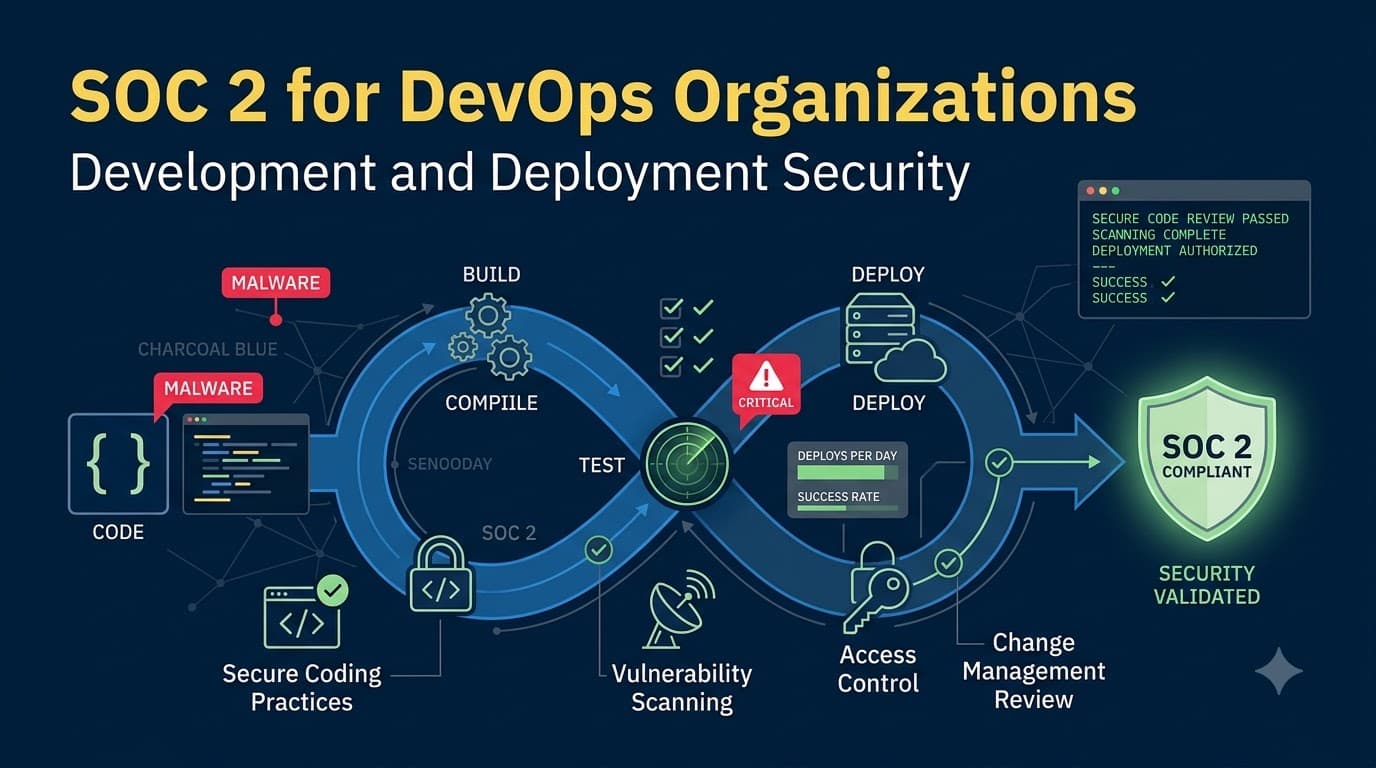
Every gate in this flow — review, testing, policy scanning, signing, deployment identity, and monitoring — maps to a specific criterion discussed above, and every arrow into the evidence pipeline at the bottom is a record an auditor can sample.
Common DevOps SOC 2 Anti-Patterns
Across dozens of DevOps readiness assessments, the same handful of mistakes recur. None of them require a redesign to fix, but all of them are guaranteed audit findings if left in place.
Anti-Pattern | Why It Fails an Audit | Fix |
|---|---|---|
"Temporarily" disabling branch protection during an incident and forgetting to re-enable it | No control was active during that window; sampling will likely catch a change from that period | Time-boxed exception with automated re-enable, or documented break-glass process |
Shared/generic CI service account used across all pipelines | No individual accountability, can't attribute actions | Per-pipeline, per-environment scoped service identities |
Policy documents that describe a process the team stopped following months ago | Auditor interviews staff, finds mismatch between policy and practice | Review and update policies whenever the pipeline configuration changes materially |
No process for reviewing/removing access when engineers change teams or leave | Stale access accumulates, fails CC6 access review testing | Quarterly (minimum) access review tied to HR offboarding/transfer triggers |
Terraform applied manually "just this once" to fix an urgent issue | Breaks the IaC-as-single-source-of-truth control, undetected without drift checks | Break-glass process + mandatory drift detection to catch and reconcile |
Test suite exists but isn't a required/blocking check | Doesn't function as a control even though it "runs" | Mark tests as required status checks in branch protection |
Break-Glass: The Emergency Change Exception
Every mature change management program needs a defined exception path for genuine emergencies — a production outage that can't wait for normal review cycles. SOC 2 doesn't penalize organizations for having an emergency process; it penalizes organizations that use "emergency" as an unlogged escape hatch from every other control. The distinguishing feature of a compliant break-glass process is that it's more visible, not less, than a normal change.
Break-Glass Step | Purpose |
|---|---|
Emergency access requires explicit activation (not standing access) | Ensures elevated capability is time-boxed and intentional |
Activation is automatically logged and alerts a second party | Creates real-time visibility, not just after-the-fact record |
Change is still made via version control where technically feasible | Preserves as much of the normal evidence trail as possible |
Mandatory retroactive review within a defined window (e.g., 24–48 hours) | Substitutes for the pre-approval that emergency timing prevented |
Root cause and control-gap analysis documented | Determines whether the emergency reveals a systemic gap to fix |
Frequency of break-glass use is tracked and reported | Excessive use signals the "emergency" process has become routine — an audit red flag |
Auditors typically ask two questions about break-glass activity during a Type II period: how often was it used, and was every instance retroactively reviewed as documented in policy? A break-glass process used twice in six months with clean retroactive reviews reads as healthy. The same process used weekly reads as a control that's being routinely circumvented — which is its own finding.
Subservice Organizations: Your Cloud and CI Vendors
Almost no DevOps organization runs its pipeline entirely on infrastructure it owns. Cloud providers, CI/CD SaaS platforms, artifact registries, and secrets management services are all subservice organizations whose own controls partially underpin your change management story. Under the carve-out method, you exclude their controls from your report's scope and instead rely on their own SOC 2 reports as assurance; under the inclusive method, their controls are tested as part of your examination — rare, and usually impractical for large public cloud providers.
Subservice Organization Type | Example | Assurance Approach |
|---|---|---|
Cloud infrastructure provider | AWS, Azure, GCP | Review provider's own SOC 2/SOC 3 report annually (carve-out) |
CI/CD SaaS platform | GitHub, GitLab, CircleCI | Review provider's SOC 2 report; confirm audit log retention terms |
Secrets/KMS provider | HashiCorp Vault Cloud, cloud-native KMS | Review provider's report; verify encryption and access control claims |
Artifact registry/package hosting | Container registry, npm/PyPI mirror providers | Verify integrity controls (signing support, immutability) contractually |
Relying on a subservice organization's report doesn't remove your responsibility — you still need to define your own complementary user entity controls that assume the subservice organization is doing its part, and you still need a process for reviewing their reports annually and flagging any exceptions that affect your environment.
The Auditor's Perspective: What Evidence They Actually Pull
Understanding what an auditor actually requests during fieldwork demystifies most of the anxiety DevOps teams bring into a first SOC 2 examination. For CC8 specifically, the request pattern is consistent across most engagements.
Auditor Request | What They're Verifying |
|---|---|
Full population/count of production changes during the audit period | Establishes the sampling universe |
Random sample of 20–30 changes from that population | Selected for detailed testing, not cherry-picked by the client |
For each sampled change: PR link, reviewer identity, test results, deploy record | Confirms the change followed the documented process end to end |
Branch protection / merge rule configuration (screenshot or API export) | Confirms the control was technically enforced, not just described in policy |
List of individuals with production deploy access at period start and end | Cross-references against access review and offboarding records |
Evidence of any control exceptions (bypassed checks, break-glass use) | Tests whether exceptions were handled per the documented process |
The pattern to internalize: auditors test the population, not a curated highlight reel. If nine out of ten changes are clean but the sample happens to catch the one that bypassed review, that's a finding — which is precisely why consistent, automated enforcement beats a well-intentioned but manually followed policy every time.
Building the DevOps SOC 2 Roadmap
Most DevOps organizations can move from "no formal controls" to "audit-ready pipeline" faster than they expect, because the underlying engineering work is usually configuration, not construction.
Timeframe | Focus | Key Activities |
|---|---|---|
Weeks 1–2 | Scoping and gap assessment | Inventory repos, pipelines, cloud accounts; map current state against CC8/CC6/CC7 |
Weeks 3–4 | Access and identity cleanup | Remove standing production access, migrate to scoped roles, enable SSO enforcement |
Weeks 5–6 | Branch protection and review enforcement | Enable required reviews, CODEOWNERS, disable self-approval and admin bypass |
Weeks 7–8 | Secrets remediation | Migrate to centralized secrets manager, rotate all long-lived credentials, enable secret scanning |
Weeks 9–10 | IaC and pipeline hardening | Restrict |
Weeks 11–12 | Evidence automation and monitoring | Stand up evidence pipeline, forward logs to SIEM, define break-glass process |
Month 4 onward | Observation period (Type II) | Operate controls consistently; conduct internal spot-checks; prep for fieldwork |
Type I examinations can follow closely behind the 12-week hardening sprint, since they test design at a single point in time. Type II requires the controls to operate consistently across a period, typically three to twelve months, which is why the roadmap above should be complete well before the observation window an organization intends to use for its first Type II report begins.
What This Actually Costs
Budgeting for a DevOps-focused SOC 2 program is different from budgeting for a policy-heavy compliance program, because most of the spend is engineering time and existing-tool configuration rather than new software purchases — though a few tooling gaps are common.
Cost Category | Typical Range (Illustrative) | Notes |
|---|---|---|
Engineering time (hardening sprint, 12 weeks) | 0.5–1.5 FTE-equivalent | Often absorbed into existing platform/DevOps team roadmap |
Secrets manager (if not already in place) | $0–$3,000/month | Scales with secret volume; several tools have generous free tiers |
Policy-as-code / IaC scanning tooling | $0–$2,000/month | Strong open-source options exist at zero license cost |
Compliance automation platform | $10,000–$40,000/year | Optional but significantly reduces manual evidence-gathering labor |
Readiness assessment (external) | $8,000–$25,000 | One-time, scoped to engagement size |
Type I audit fee | $10,000–$30,000 | Varies by system complexity and auditor firm |
Type II audit fee | $20,000–$60,000+ | Scales with number of in-scope systems, criteria, and sample complexity |
The biggest cost lever most DevOps organizations control directly is scope: a tightly defined system boundary that includes only the services and infrastructure actually relevant to the customer commitment reduces both audit fees and the internal evidence-gathering burden, without weakening the report's usefulness to prospects.
The DevOps SOC 2 Tooling Stack
There's no single required toolchain — SOC 2 is control-outcome-based, not tool-prescriptive — but most audit-ready DevOps organizations converge on a similar shape of stack, organized by the control area it supports.
Control Area | Representative Tool Categories |
|---|---|
Source control & review enforcement | GitHub, GitLab, Bitbucket (with branch protection/approval rules) |
CI/CD orchestration | GitHub Actions, GitLab CI, CircleCI, Jenkins |
Secrets management | HashiCorp Vault, cloud-native KMS/Secrets Manager services |
IaC policy-as-code | Open Policy Agent/Conftest, Checkov, tfsec, Terraform Cloud policy sets |
SAST/SCA scanning | Static analysis and dependency-scanning tools integrated as CI gates |
Artifact signing & SBOM | Sigstore/cosign-style signing, SBOM generation tools |
Monitoring & SIEM | Centralized log aggregation and alerting platforms |
Compliance evidence automation | Continuous-monitoring/GRC platforms that poll the above via API |
Tool selection matters far less than configuration and consistency. A modest open-source stack, correctly enforced across every repository and pipeline, will outperform an expensive enterprise suite that's only partially rolled out.
SOC 2 as a DevOps Competitive Advantage
It's tempting to treat SOC 2 as a tax on engineering velocity — a checklist imposed by sales and legal that engineers tolerate rather than benefit from. The organizations that get the most value flip that framing. A pipeline that enforces peer review, blocks merges on failing security scans, restricts deploy credentials to short-lived scoped tokens, and logs every production change isn't just audit-ready — it's a materially harder target for an attacker, a faster system to debug when something breaks (because every change is attributable), and a stronger story to tell in every enterprise sales cycle from here forward. Dana Whitfield's team didn't just win a $2.4 million contract; they now close enterprise deals in weeks instead of months, because "yes, we have a current SOC 2 Type II report with clean change management" ends a conversation that used to take a security questionnaire and three follow-up calls. In a market where every serious buyer's procurement team now asks the same question, a DevOps organization that has already answered it — with evidence, not just a policy binder — is the one that gets the signature first.
Many engineering-heavy organizations are asked about ISO 27001 in the same breath as SOC 2, particularly by enterprise and international customers. The good news is that the pipeline hardening described in this article — peer review, access control, monitoring, secrets hygiene — maps closely onto ISO 27001's Annex A technological controls, so teams pursuing both rarely have to duplicate the engineering work, only the documentation. If that's on your roadmap, ISO 27001 vs SOC 2: which one do you need and running ISO 27001 and SOC 2 together walk through how to sequence the two without re-litigating your change management program twice.
Get Audit-Ready Without Slowing Down
If your engineering organization is staring down its first SOC 2 examination and worried it means slowing your pipeline to a crawl, start with a gap assessment against your actual repository and pipeline configuration, not a generic policy template. PentesterWorld's SOC 2 Readiness Checklist walks through exactly the CC6/CC7/CC8 controls covered in this article, and the SOC 2 Control Matrix / RACI Template helps you assign clear ownership for each one across your platform and security teams before an auditor ever asks. Pair that with the SOC 2 Gap Analysis Tool to benchmark your current pipeline configuration, and the "Are You SOC 2 Ready?" Quiz if you're still scoping whether now is the right time to start. Book time with our team and we'll help you turn the pipeline you already have into the evidence file your auditor — and your next enterprise customer — is looking for.