Maria Delgado had eleven days. As VP of Engineering at Lumenlytics, a 90-person marketing analytics SaaS company, she'd just come out of a call with the company's biggest prospect to date — a $2.4M annual contract with a national retail chain — and the procurement lead had been polite but final: "We can't sign until we see a SOC 2 Type II report. No exceptions, that's our vendor policy." Lumenlytics didn't have a Type II. It didn't have a Type I. It didn't, as far as Maria could tell after a frantic Slack search, have a single written security policy that wasn't a Google Doc from 2021 with "DRAFT" still in the filename.
She did what most first-time founders and engineering leaders do at this point: she typed "SOC 2 certification how long does it take" into a search bar at 11 p.m. and got a wall of contradictory answers — three weeks, six months, a year, "it depends." The CFO wanted a number for the board deck. The CEO wanted to know if they could just pay someone to make it happen fast. Sales wanted to tell the retailer "yes" that week. Nobody in the building had been through this before, and the $2.4M deal — plus, Maria suspected, every enterprise deal after it — was sitting on the other side of a process nobody understood.
This guide is the process Maria eventually built, refined across dozens of first-time engagements I've run as a consultant, from three-person startups to 400-person scale-ups. It's the complete, ordered path from "we have no idea what SOC 2 even requires" to holding a signed Type II report that closes deals instead of stalling them.
One clarification before we start, because getting this wrong undermines your credibility with every prospect who reads your report closely: SOC 2 is not a certification. There is no badge, no pass/fail exam, no certifying body stamping your company "SOC 2 certified." SOC 2 is an attestation — an independent examination performed by a licensed CPA firm under AICPA standards, resulting in a report that expresses the firm's opinion on your controls. This guide uses "certification" in its title because that's the term the market — your prospects, your sales team, your board — actually searches for and says out loud, and fighting that usage in a headline helps no one find the guide. Everywhere else in this article, we'll use the accurate terms: report, examination, attestation. Once you understand that distinction, the rest of the process makes a lot more sense, because you'll understand why the entire exercise is about producing defensible, evidenced proof rather than passing a test.
Who This Guide Is For, and What You'll Walk Away With
This is written for the founder, VP of Engineering, Head of Security, or newly appointed "compliance owner" running their company's first SOC 2 engagement, with no prior audit experience on the team. You'll walk away with a complete phase-by-phase plan — scoping, readiness, control build, evidence, auditor selection, Type I, observation period, Type II fieldwork, and report distribution — plus the tables, timelines, RACI, and cost breakdowns I use with clients to turn "we need SOC 2" into a funded, dated, staffed project. If you already have a report and are managing renewal cycles, see our dedicated piece on continuous compliance instead — this guide is specifically the first-time path.
The First-Time Journey at a Glance
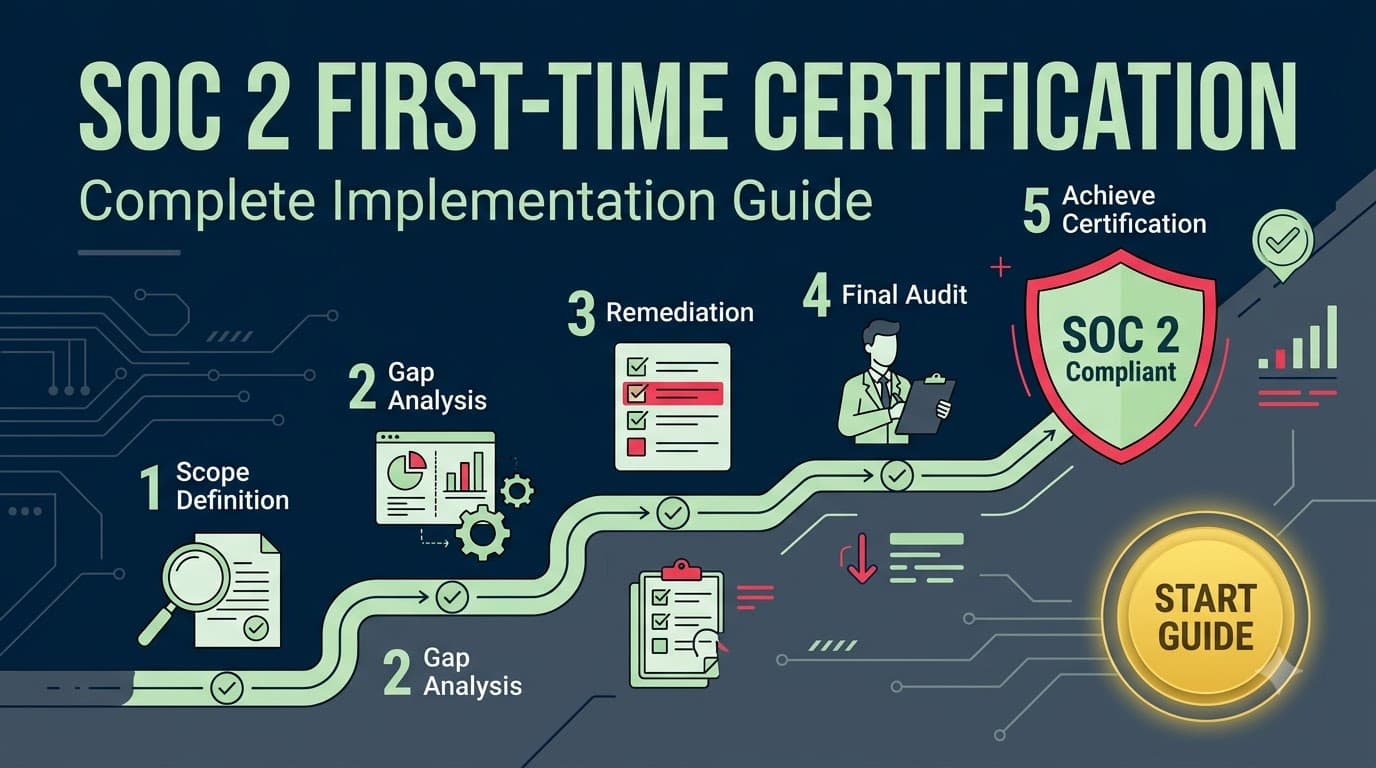
Before we go deep on any single phase, it helps to see the whole shape of the project. First-time engagements fail most often not because a single control is hard to build, but because leadership underestimates how many sequential phases sit between "we decided to do this" and "we have a report a customer will accept." There are no shortcuts through the sequence below — you can compress phases with more resourcing, but you cannot skip them.
flowchart LR
    A[Scope & TSC Selection] --> B[Readiness / Gap Assessment]
    B --> C[Control Design & Remediation]
    C --> D[Policy & Evidence Buildout]
    D --> E[Auditor Selection]
    E --> F[Type I Examination]
    F --> G[Observation Period 3-12 mo]
    G --> H[Type II Fieldwork]
    H --> I[Report Issuance]
    I --> J[Distribution & Continuous Monitoring]
    J -->|Following year| G
Table 1: SOC 2 First-Time Journey — Phases at a Glance
Phase | Primary Owner | Typical Duration (First-Timer) | Exit Criteria |
|---|---|---|---|
1. Scope & TSC selection | Security/Compliance lead + exec sponsor | 1–2 weeks | System boundary and criteria signed off by leadership |
2. Readiness / gap assessment | Internal team or readiness consultant | 2–4 weeks | Documented gap list with owners and target dates |
3. Control design & remediation | Engineering, IT, HR, Security | 6–14 weeks | All required controls designed and operating |
4. Policy & evidence buildout | Compliance lead + control owners | Runs parallel to Phase 3 | Policy set approved; evidence repository live |
5. Auditor selection | Exec sponsor + compliance lead | 2–4 weeks | Engagement letter signed with a licensed CPA firm |
6. Type I examination | Auditor + compliance lead | 3–6 weeks (fieldwork + report drafting) | Type I report issued |
7. Observation period | All control owners | 3–12 months | Evidence collected continuously across the window |
8. Type II fieldwork | Auditor + compliance lead | 3–6 weeks | Testing complete, draft report reviewed |
9. Report issuance | Auditor | 1–2 weeks | Final signed Type II report delivered |
10. Distribution & year 2 | Sales, Security, Compliance lead | Ongoing | Report shared under NDA; next observation period begins |
"The single biggest first-timer mistake I see is treating this like a project with a start and an end. It's a start and then a permanent operating rhythm. The company that plans for year one and forgets year two is the company scrambling again in eleven months." — Priya Nair, CPA, Partner, Nair & Voss LLP
Step 1: Understand Why You're Actually Doing This
Before touching scope or controls, get explicit about the business driver, because it shapes almost every downstream decision. Companies pursue their first SOC 2 report for a narrow set of reasons, and each one implies a different urgency and a different minimum viable scope.
Table 2: Common First-Time SOC 2 Drivers and What They Imply
Driver | Typical Urgency | Scope Implication |
|---|---|---|
A specific enterprise deal is blocked pending a report | High — deal-driven deadline | Scope to exactly what that customer's data touches; expand later |
Sales is losing deals generically to "no SOC 2" objections | Medium — competitive necessity | Broader scope covering your core product, likely Security + Availability |
Investors or board are requiring it as part of governance maturity | Medium — governance-driven | Full production environment, Security at minimum |
A competitor or category leader already has one | Low-medium — market positioning | Match category norms; check what peers include |
Cyber insurance renewal now asks about it | Low-medium — risk-driven | Security-focused, tied to insurance questionnaire scope |
Maria's case was driver one: a single named deal with a hard deadline. That reality shaped everything that followed — she scoped tightly to the production analytics platform that would process the retailer's data, rather than trying to cover every internal system Lumenlytics owned on day one.
Step 2: Choose Your Trust Services Criteria
Every SOC 2 report is built on the Trust Services Criteria (TSC), a set of five criteria categories published by the AICPA. Security — also called the Common Criteria or CC-series — is mandatory in every single SOC 2 report, with no exceptions. The other four are optional and selected based on the commitments you actually make to customers.
Table 3: Trust Services Criteria Selection Guide
Criterion | Required? | Include If… | Skip If… |
|---|---|---|---|
Security (Common Criteria) | Always required | N/A — mandatory baseline | Never optional |
Availability | Optional | You commit to uptime SLAs or your product's core value is "always on" | Your product is not uptime-sensitive (e.g., a batch reporting tool) |
Processing Integrity | Optional | You process transactions, calculations, or data transformations customers rely on being accurate | You're a pure storage/hosting play with no computation logic |
Confidentiality | Optional | You handle customer business data, IP, or contracts under confidentiality commitments | Your data is exclusively low-sensitivity or public |
Privacy (TSC) | Optional | You collect personal information directly from individuals and make specific privacy commitments | You only process data on behalf of a customer with no direct consumer relationship (Confidentiality often fits better here) |
A pattern I see constantly with first-timers: they either over-scope, adding all five criteria "to be safe," which multiplies control-mapping and evidence work for little practical benefit, or they under-scope, shipping Security-only when their sales deck explicitly promises "99.9% uptime" — a claim Availability, not Security, actually covers. Read your own marketing site and your top three customer contracts before finalizing this table. If you promise it externally, it likely belongs in scope.
"I ask every first-time client the same question before we talk about controls: what do you actually promise your customers in writing? Your TSC selection should mirror your contracts, not your ambitions." — Tom Whitfield, Founder, Ironclad Compliance Advisory
For a deeper walkthrough of each criterion's specific requirements once you've made your selection, see our dedicated breakdown of the Trust Services Criteria and, if Security is your only addition beyond the baseline, the companion piece on the Common Criteria that underpin every report.
Step 3: Define Your System Boundary
Your system boundary — sometimes called your audit scope — is the precise set of infrastructure, applications, people, and data flows your report will cover. Get this wrong and you either pay to audit systems nobody cares about, or you leave out the exact system your target customer needs covered.
Table 4: System Boundary Worksheet
Element | Question to Answer | Lumenlytics Example |
|---|---|---|
In-scope product(s) | Which product(s)/services does the report cover? | Core analytics platform only (not the internal admin tool) |
Infrastructure | Which cloud accounts, regions, environments? | Production AWS account, us-east-1 and us-west-2 |
Data | What customer data flows through the in-scope system? | Aggregated retail transaction and behavioral data |
People | Which teams touch the in-scope system? | Engineering, DevOps, Security, Support (tier 2+) |
Subservice organizations | Which vendors does the in-scope system depend on? | AWS, Auth0, Datadog, Stripe (billing only, carved out) |
Explicit exclusions | What is deliberately out of scope, and why? | Internal HR system, marketing website, sandbox environments |
Two scoping mechanics matter here. First, any subservice organization — a vendor your own system depends on, like AWS or a payroll processor — must be handled via either the carve-out method (excluding their controls from your report and relying on their own SOC 2, if they have one) or the inclusive method (including their controls directly, which is rare and heavyweight). Nearly every first-timer uses carve-out for major cloud infrastructure. Second, watch for scope creep — engineers volunteering "well, we should probably include the mobile app too" mid-project. Every addition after readiness begins resets evidence-collection timelines for the added system. Lock scope in writing, with executive sign-off, before Phase 2 begins. For the full mechanics of this decision, our companion article on scope definition goes deeper into boundary-setting edge cases like shared multi-tenant infrastructure.
Step 4: Run a Readiness (Gap) Assessment
With scope and criteria locked, the next move is a readiness assessment — a structured gap analysis comparing your current-state controls against every requirement the chosen TSC imply. This is the single highest-leverage phase in the entire journey: it's where you find out, cheaply and privately, everything your auditor would otherwise find expensively and on the record.
Table 5: Readiness Assessment Scoring Rubric
Score | Meaning | Typical Action |
|---|---|---|
0 — Absent | Control doesn't exist in any form | Design and implement from scratch |
1 — Ad hoc | Control exists informally, undocumented, inconsistent | Formalize, document, assign an owner |
2 — Defined but unproven | Control is documented but has no evidence of operating | Begin evidence collection immediately |
3 — Operating, evidence thin | Control operates but evidence is incomplete or manual | Automate or standardize evidence capture |
4 — Operating with strong evidence | Control operates consistently with clear, retrievable evidence | Maintain; candidate for Type I inclusion |
Run this scoring exercise against every control area implied by your TSC — access management, change management, risk assessment, vendor management, incident response, and so on — and you'll typically find first-time companies score mostly 0s and 1s in formal governance areas (documented risk assessments, vendor due diligence, a written incident response plan) while scoring 2s and 3s in technical areas, because engineering teams often already do access reviews or use MFA informally without ever having written it down. Whether you run this internally or bring in outside help, our readiness assessment guide walks through the full pre-audit checklist this scoring exercise should produce, and our companion readiness timeline piece lays out a week-by-week six-month plan if your deadline allows for one.
"A good readiness assessment should feel uncomfortable. If your gap list comes back short and clean on the first pass, either your company is unusually mature, or the assessment wasn't rigorous enough." — Derek Osei, Director of Security, Lumenlytics
Step 5: Map Controls to the Common Criteria
Because Security is mandatory, every first-time company needs to understand the nine Common Criteria categories (CC1–CC9), which trace back to the COSO internal-control framework's 17 principles. This mapping becomes your control inventory's backbone regardless of which additional TSC you selected.
Table 6: Common Criteria (CC1–CC9) to Control Focus Mapping
Category | COSO Principle Area | Typical Control Focus |
|---|---|---|
CC1 — Control Environment | Tone at the top, org structure, board oversight | Governance, code of conduct, org chart, board reporting |
CC2 — Communication & Information | Internal/external communication of objectives | Security policies published and acknowledged, customer-facing trust page |
CC3 — Risk Assessment | Objective-setting and risk identification | Formal risk assessment process, fraud risk consideration |
CC4 — Monitoring Activities | Ongoing/separate evaluations of controls | Internal audit function, control self-assessment |
CC5 — Control Activities | Policies and procedures that mitigate risk | Documented procedures, segregation of duties |
CC6 — Logical & Physical Access | Access restriction and protection | Access control, MFA, least privilege, badge access |
CC7 — System Operations | Detecting and responding to deviations | Monitoring, incident response, vulnerability management |
CC8 — Change Management | Managing system changes | Change management process, code review, deployment approvals |
CC9 — Risk Mitigation | Managing business disruption and vendor risk | Business continuity, vendor risk management |
Notice that CC6 through CC8 are where most engineering-heavy first-timers already have partial coverage (access controls, monitoring, code review are common practice), while CC1–CC5 and CC9 are where the governance work lives — the parts that feel less like "real security work" to engineers and are consequently the parts most often skipped by teams that assume SOC 2 is purely a technical exercise. It is not. A missing risk assessment document or an absent vendor risk review will stall your report exactly as fast as a missing firewall rule.
Step 6: Build Your Policy Set
Controls need to be written down before they can be tested. Every SOC 2 examination expects a baseline set of formal, approved, distributed policies — not because auditors love paperwork for its own sake, but because a policy is how you demonstrate that a control is intentional and governed rather than accidental.
Table 7: Core First-Time SOC 2 Policy Set
Policy | Maps Primarily To | Owner (typical) |
|---|---|---|
Information Security Policy | CC1, CC2 | CISO/Security lead |
Access Control Policy | CC6 | IT/Security |
Change Management Policy | CC8 | Engineering leadership |
Incident Response Policy | CC7 | Security |
Risk Assessment Policy | CC3 | Compliance/Security |
Vendor/Third-Party Risk Policy | CC9 | Procurement/Security |
Business Continuity & Disaster Recovery Policy | CC9 | IT/Operations |
Acceptable Use Policy | CC1, CC6 | HR/IT |
Data Classification & Handling Policy | CC6, Confidentiality | Security/Legal |
Code of conduct / Ethics Policy | CC1 | HR/Legal |
Whistleblower policy | CC1 | HR/Legal |
Writing eleven policies from scratch in a vacuum is a slow, painful way to spend six weeks, and it's the step where most first-timers either buy a template pack or bring in a consultant. Whichever path you choose, every policy needs three things to survive audit scrutiny: a named owner, a review/approval date, and evidence that employees actually read and acknowledged it (not just that it exists in a folder). Our full breakdown of what each document needs to contain — and the review cadence auditors expect — lives in the dedicated policy development guide; it's worth reading in full before you draft a single page, because rewriting policies mid-observation-period after an auditor flags gaps costs far more time than getting the structure right up front. Teams short on drafting time often start from our SOC 2 policy pack rather than writing all eleven documents from a blank page.
Step 7: Choose Your Compliance and Evidence Tooling
Manually screenshotting access lists and pasting them into folders every quarter does not scale past a handful of controls, and first-timers who try it burn enormous internal hours during the observation period. Most companies now run their first SOC 2 with some layer of compliance automation, though the degree varies with company size and budget.
Table 8: Compliance & Evidence Tooling Categories
Category | Purpose | First-Timer Guidance |
|---|---|---|
GRC / compliance automation platform | Maps controls to evidence, automates collection from cloud/HR/IT systems | High-value even for small teams; reduces observation-period manual effort significantly |
Cloud configuration monitoring | Continuously checks cloud settings against control baselines | Often bundled into the GRC platform via API integrations |
Identity provider / SSO | Centralizes authentication, enables access review automation | Foundational — implement before readiness assessment if not already in place |
Endpoint management (MDM) | Enforces device encryption, patching, screen-lock on employee devices | Required if any employee touches production systems from a laptop |
Ticketing/change system | Provides an audit trail for change approvals | Usually already in place (Jira, Linear, etc.) — just needs consistent process discipline |
Document/policy management | Version control, approval workflow, employee acknowledgment tracking | Can be as simple as a well-governed shared drive for very small first-timers |
Tooling isn't mandatory — I've run successful first-time Type II engagements for eight-person startups using spreadsheets and disciplined calendar reminders — but the larger your headcount and infrastructure footprint, the faster manual evidence collection becomes the project's bottleneck. Budget for tooling as part of your overall cost plan, which we break down fully in Step 15. If you're weighing GRC platforms for a first-time engagement, our roundup of the best compliance automation and GRC platforms compares the options most first-timers actually shortlist.
Step 8: Assign Roles and Build a RACI
SOC 2 fails as a side project with no accountable owner. Before controls get built, name who does what — not just "security team," but named individuals with deadlines.
Table 9: SOC 2 Implementation RACI (First-Time Engagement)
Activity | Responsible | Accountable | Consulted | Informed |
|---|---|---|---|---|
Scope & TSC selection | Compliance lead | Executive sponsor (CEO/CTO) | Sales, Legal | Board |
Readiness assessment | Compliance lead / consultant | Compliance lead | All control owners | Executive sponsor |
Policy drafting | Compliance lead | Compliance lead | Legal, HR, IT | All staff (post-approval) |
Access control implementation | IT/DevOps | Engineering leadership | Security | Compliance lead |
Evidence collection (ongoing) | Control owners | Compliance lead | — | Executive sponsor |
Auditor liaison | Compliance lead | Compliance lead | Control owners | Executive sponsor |
Remediation of findings | Control owner | Compliance lead | Engineering leadership | Executive sponsor |
Report distribution | Sales/Customer Success | Executive sponsor | Compliance lead, Legal | — |
Table 10: Roles You'll Need and When They Show Up
Role | When Needed | Full-Time or Fractional? |
|---|---|---|
Executive sponsor | Day one through report issuance | Fractional (steering, unblocking) |
Compliance/GRC lead (internal or fractional) | Day one, permanently | Often fractional for first-timers under 150 employees |
Readiness consultant (optional) | Phase 2 only | Project-based engagement |
Control owners (per department) | Phase 3 onward | Fractional, embedded in existing roles |
CPA firm / auditor | Phase 5 onward | External engagement |
Legal (NDA review, contract language) | Auditor selection, report distribution | Fractional/ad hoc |
Maria's mistake in her first month was trying to be the compliance lead, the sole control owner, and the executive sponsor simultaneously while still running engineering. She burned out in six weeks and Lumenlytics brought in a fractional compliance lead — a decision that, in hindsight, should have been made in week one, not week six. If you're building this RACI from scratch, our SOC 2 control matrix / RACI template is a faster starting point than a blank spreadsheet.
Step 9: Select Your CPA Firm
Only a licensed CPA firm — a firm that's a member of the AICPA and subject to its peer review requirements — can issue a SOC 2 report. This is not a decision to make on price alone; the wrong firm can turn a straightforward engagement into a months-long ordeal of miscommunication and re-work.
Table 11: CPA Firm Evaluation Scorecard
Evaluation Criterion | What to Ask | Red Flag |
|---|---|---|
AICPA peer review status | "Can you share your most recent peer review report?" | Refusal or an unresolved adverse peer review finding |
SOC 2 specialization | "How many SOC 2 engagements do you run per year, and in our industry?" | Firm primarily does financial statement audits with SOC 2 as a side offering |
Team continuity | "Will the same engagement team run both Type I and Type II?" | High staff turnover mid-engagement with no handoff plan |
Communication style | "What does the evidence request and review cadence look like?" | Vague answers, slow response times during the sales process itself |
Technology fit | "Do you integrate with or accept exports from [your GRC platform]?" | Insists on manual spreadsheet-only evidence submission |
Pricing transparency | "What's included, and what triggers additional fees?" | Quote with no scope detail, or refuses to break out Type I vs Type II pricing |
References | "Can I speak to two first-time clients you've worked with?" | No first-time-client references available |
"First-time clients should interview at least three firms. You're not just buying an opinion letter — you're buying a working relationship you'll maintain for years, through Type I, every Type II renewal, and every awkward question a prospect's security team throws at your report." — Janet Liu, Engagement Manager, Halloway & Pierce CPAs
For the full extended version of this evaluation — including how to read a proposal, negotiate scope, and avoid common contracting pitfalls — see our dedicated guide on auditor selection and choosing the right CPA firm.
Step 10: Why Type I Comes Before Type II
This is the sequencing decision first-timers get wrong most often, usually because a prospect's procurement team asked for "a SOC 2 report" without specifying which type, and the company assumes it should jump straight to the more impressive-sounding Type II.
Table 12: Type I vs Type II — What Each One Actually Proves
Dimension | Type I | Type II |
|---|---|---|
What's tested | Suitability of design of controls at a single point in time | Operating effectiveness of controls over a period |
Typical period covered | A single "as of" date | 3–12 months (an audit period) |
What it tells a customer | "These controls are designed correctly" | "These controls actually worked, consistently, over time" |
Market perception | Useful interim proof; rarely satisfies large enterprise procurement alone | The report most enterprise customers actually require |
Recommended for first-timers? | Yes — almost always the right starting point | Yes — as the follow-on, not the starting point |
Fieldwork effort | Lighter — one point-in-time walkthrough and evidence set | Heavier — sampling evidence across the entire period |
Going straight to Type II without a Type I is technically possible, but I advise against it for nearly every first-time client, for a concrete reason: your controls will not be perfectly designed on the first attempt. A Type I gives your auditor — and you — a clean opportunity to catch design flaws before you commit to operating them consistently for 3–12 months under observation. Catching a poorly designed access review process in a Type I costs you a redesign. Catching that same flaw six months into a Type II observation period costs you a redesign and a restarted clock. For the full comparison of when each type is the right call, including edge cases where an experienced company might skip Type I, our dedicated piece on Type I vs Type II is the deeper read.
Step 11: The Type I Examination
Once controls are designed and you have at least a snapshot of evidence that they're operating as of a given date, you engage your chosen firm for the Type I examination itself. This typically runs three to six weeks from kickoff to report.
The auditor will conduct walkthroughs of each control — literally sitting with your control owner and having them demonstrate, step by step, how the control works — and review a test of one instance of evidence per control, since Type I doesn't test operation over time. Expect a formal kickoff meeting, a PBC list (the "provided by client" evidence request list) delivered shortly after, and a review period where the auditor drafts findings before issuing the report. Any control deficiency found here is far cheaper to fix now than during Type II, because you haven't yet started the clock on the observation period. Our audit process guide covers the detailed timeline and milestone structure that applies equally to Type I and Type II fieldwork.
Step 12: The Observation Period
With Type I complete and any findings remediated, you enter the observation period — sometimes still called by its informal name, "the audit window" — the stretch of time over which your Type II will test operating effectiveness.
Table 13: Observation Period Length Guidance for First-Timers
Scenario | Recommended Period | Rationale |
|---|---|---|
Urgent single-deal deadline, controls newly built | 3 months (minimum practical) | Fastest path to a Type II, though some enterprise buyers prefer 6+ |
Standard first-time engagement | 6 months | Balances speed with a period long enough to demonstrate real consistency |
Mature company, controls operating well before engagement | 9–12 months | Aligns to a full annual cycle, sets up clean year-over-year renewals |
Company with highly variable/seasonal operations | 12 months | Captures a full seasonal cycle of change volume, access changes, incidents |
Three months is the practical floor most CPA firms will accept for a first Type II — shorter periods rarely provide enough sample size for meaningful audit sampling. During this window, every control must actually operate on its defined cadence: access reviews run on schedule, changes go through approval, incidents (if any) get logged and handled per your documented process, vendor reviews happen. This is not a passive waiting period — it's the phase where most first-timers realize how much evidence-collection discipline their day-to-day operations actually require.
Table 14: Evidence Collection Cadence Calendar (Illustrative)
Control Area | Evidence Type | Collection Frequency |
|---|---|---|
User access reviews | Signed access review reports | Quarterly |
New hire/termination access provisioning | Ticket + approval trail | Per event |
Change management | Pull request + approval + deployment log | Per event |
Vulnerability scanning | Scan reports with remediation tracking | Monthly (or per scan cadence) |
Security awareness training | Completion records | Onboarding + annually |
Vendor risk reviews | Vendor questionnaire/SOC report review | Annually, or per new vendor |
Incident response | Incident tickets + post-incident review | Per event |
Backup and recovery testing | Test logs and results | Quarterly |
Risk assessment | Updated risk register | Annually, or per material change |
"The companies that sail through their first Type II are the ones who treat evidence collection as a byproduct of how they already work, not a separate homework assignment done the week before fieldwork." — Elena Cruz, CISO, Bridgemont Health Tech
For the full mechanics of what "good" evidence looks like per control type, and how to avoid the scramble at the end of the window, our evidence collection guide is the natural next read, alongside our take on building an internal cadence in the continuous monitoring piece.
Step 13: Type II Fieldwork
Once the observation period closes, your auditor returns for Type II fieldwork — typically another three to six weeks. This time, instead of a test of one, they perform audit sampling across the full population of instances for each control over the period: a sample of access reviews from across the six or twelve months, a sample of code deployments, a sample of new-hire onboarding events.
Expect the auditor to perform re-performance on selected items — independently re-executing a control to confirm it worked as claimed, not just trusting your evidence at face value — and to calculate a deviation rate for each control tested. A single missed access review in a sample of twenty-five is a deviation your auditor will document and evaluate, not necessarily an automatic failure, but it needs an honest explanation and, ideally, a compensating control or clear root cause.
Step 14: Handling Exceptions and Findings
Almost no first-time Type II comes back with zero exceptions — and that's normal, not catastrophic. What matters is how you respond.
Table 15: Common First-Time Type II Exceptions and Responses
Exception Type | Example | Typical Response |
|---|---|---|
Missed periodic control | A quarterly access review skipped once | Document root cause, show it was caught and remediated, tighten calendar reminders |
Evidence gap | Screenshot evidence for a specific month wasn't retained | Implement automated evidence capture going forward |
Inconsistent application | Change approvals followed for most changes, skipped for two "urgent" hotfixes | Formalize an emergency-change exception process with retroactive approval |
New employee, incomplete training record | Onboarding training completed two weeks late | Tighten onboarding checklist, add training-completion gate to system access |
Vendor review not completed on schedule | Annual vendor review overdue by one quarter | Complete review immediately, document catch-up plan |
An honest, well-documented corrective action plan (CAP) with a named owner and a due date turns a potential qualified opinion into a manageable footnote most customers won't blink at. What sinks a first-time report is not having exceptions — it's having exceptions with no explanation, no owner, and no evidence they were fixed. For a full walkthrough of exception categories and how auditors weigh materiality, see our exception management guide, and for remediation planning specifically, remediation planning.
Step 15: Receiving Your Report and Understanding the Opinion
Table 16: Auditor Opinion Types
Opinion | Meaning | What It Means for You |
|---|---|---|
Controls were suitably designed and (for Type II) operated effectively | The clean outcome nearly every first-timer targets | |
Qualified opinion | One or more exceptions noted, but overall controls are still reasonably effective | Common on first Type IIs with minor findings; usually still customer-acceptable with context |
Adverse opinion | Controls were not suitably designed or did not operate effectively, in a material way | Rare, and usually signals the engagement should have been paused for further remediation first |
Disclaimer of opinion | Auditor could not obtain sufficient evidence to form an opinion | Very rare; typically points to a breakdown in evidence collection, not control failure |
Your finished report has a consistent structure: the auditor's opinion letter, management assertion, the system description, and — for Type II only — the description of tests performed and results. Read every page before it goes anywhere near a customer; you're the one who has to explain it in a security review call, not your auditor. Our full breakdown of report anatomy lives in report structure: understanding the auditor's report, and the final-stage view of what "done" looks like is covered in SOC 2 final report: understanding audit results and opinions.
Step 16: Distributing the Report
SOC 2 reports are restricted-use documents, not marketing collateral — this matters more than most first-timers expect. You control who sees it, typically via an NDA and, increasingly, a gated trust portal rather than emailing a PDF to anyone who asks.
Table 17: Report Distribution Practices
Practice | Why It Matters |
|---|---|
Require an NDA before sharing | The report contains sensitive control detail you don't want publicly indexed |
Use a trust portal with access logging | Tracks who requested and viewed the report; supports watermarking to deter unauthorized redistribution |
Share a SOC 3 for public-facing marketing | A SOC 3 is the freely distributable public summary — put that on your website, not the Type II itself |
Brief sales on how to talk about it | Sales should understand what "qualified opinion" or a noted exception means, so they don't overstate or panic in a customer call |
Track expiration and plan the next cycle | A Type II typically covers a fixed period; customers will ask for a bridge letter once it ages past a few months |
Step 17: Year Two and the Continuous Compliance Rhythm
The report you just earned has a shelf life. Once its period ends, customers evaluating you against it will start asking for a bridge letter — a gap letter management issues attesting that no material control changes have occurred since the report period ended — until your next report is ready. Most companies move to an annual (12-month) observation cycle after their first Type II, so the next audit period begins essentially the day the last one ends. Treat compliance as embedded operating discipline, not a once-a-year fire drill; our continuous monitoring and internal audit program guides both cover how mature second-year-and-beyond companies keep this rhythm without re-living the first-time scramble.
Costs Across the Full First-Time Journey
Table 18: Illustrative First-Time SOC 2 Cost Breakdown by Phase
Phase | Cost Driver | Illustrative Range (First-Timer, ~50–150 Employees) |
|---|---|---|
Readiness assessment | Internal time or consultant fees | $8,000 – $25,000 |
Policy development | Templates, consultant, or internal drafting time | $3,000 – $15,000 |
Compliance/GRC tooling | Annual platform subscription | $8,000 – $30,000/year |
Remediation (tooling, MDM, SSO, etc.) | New/upgraded security tooling to close gaps | $5,000 – $40,000, highly variable |
Type I audit fees | CPA firm engagement | $10,000 – $25,000 |
Type II audit fees | CPA firm engagement | $15,000 – $45,000 |
Internal labor (opportunity cost) | Compliance lead + control owner time across the year | Often the largest hidden cost — budget headcount hours explicitly |
These figures are illustrative and vary significantly by scope, criteria selected, and company complexity — a five-criteria report covering multiple products will sit well above these ranges. For a full cost model with sensitivity to company size, criteria count, and tooling choices, see our dedicated cost management and budgeting guide. The consistent lesson across every first-time client I've run this with: budget for the whole year, not just the audit fee line item — internal labor and tooling routinely outweigh what you pay the CPA firm itself. Our SOC 2 cost calculator can help turn these ranges into a company-specific number before you take a budget ask to the board.
Master Timeline for a First-Time Engagement
Table 19: Master 12–18 Month Timeline (Realistic First-Timer Pace)
Month | Milestone |
|---|---|
1 | Scope and TSC finalized; executive sponsor and compliance lead assigned |
2 | Readiness assessment complete; gap list published |
3–4 | Core remediation underway (access controls, tooling, initial policies) |
5 | Policy set finalized and approved; CPA firm selection begins |
6 | Auditor engaged; Type I kickoff |
7 | Type I fieldwork and report issuance |
8 | Observation period begins |
9–13 | Observation period continues; evidence collected on cadence |
14 | Observation period closes; Type II kickoff |
15 | Type II fieldwork |
16 | Draft report review, exception responses finalized |
17 | Final Type II report issued |
18 | Report distributed; next observation period begins |
Compressing this timeline is possible — Maria's team moved faster on the front end because the deal deadline forced it — but compression concentrates risk. A rushed readiness phase means gaps surface during Type I instead of before it; a three-month observation period instead of six leaves a thinner evidence sample for the auditor to test. If your board or sales team is pushing for a faster number, use this table to show them exactly which phase you're compressing and what that trades away, rather than silently absorbing an unrealistic date.
Top First-Time Mistakes and How to Avoid Them
Table 20: Top First-Timer Mistakes and Fixes
| Mistake | Consequence | Fix |
| Skipping Type I and going straight to Type II | Design flaws discovered mid-observation-period, forcing a restarted clock | Always run Type I first for a genuine first-time engagement | | No named executive sponsor | Project stalls when compliance lead hits a cross-department blocker | Assign a sponsor with authority to unblock other departments, day one | | Treating readiness assessment as a formality | Real gaps surface during paid audit fieldwork instead of privately beforehand | Run readiness rigorously, expect an uncomfortable gap list | | Scope creep mid-observation-period | Newly added systems have no evidence history, extending the timeline | Lock scope in writing before Phase 2; changes require formal re-scoping | | Manual evidence collection at scale | Evidence gaps and burnout during the observation period | Invest in compliance tooling proportional to company size | | Choosing an auditor on price alone | Poor communication, missed deadlines, unclear findings | Use a structured evaluation scorecard, check references | | No plan for year two | Scrambling to restart the process eleven months after the last report | Begin the next observation period immediately after report issuance | | Oversharing the full report publicly | Sensitive control detail exposed unnecessarily | Gate the Type II under NDA; use SOC 3 for public marketing |
Case Study: Lumenlytics — The Deal-Driven First Timer
Maria's team locked scope to the core analytics platform only, selected Security plus Availability (matching their public uptime commitment), and ran a four-week readiness assessment that surfaced 34 gaps — no formal risk assessment, no documented incident response plan, inconsistent offboarding, and access reviews that existed only in one engineer's head. They closed the highest-priority gaps in ten weeks, engaged a CPA firm in month three, and completed a Type I in month four. They ran a six-month observation period, closed two minor exceptions during Type II fieldwork (a missed quarterly access review and one late vendor risk review), and received an unqualified Type II opinion in month eleven — three weeks after the retailer's original hard deadline, close enough that the deal held with a short contractual extension. The $2.4M contract closed, and within the following two quarters, the same report helped close $6.1M in additional enterprise pipeline that had been silently stalling on the same objection.
Case Study: Bridgemont Health Tech — The Skipped Type I
Bridgemont, a healthcare scheduling SaaS company, was under pressure from a hospital-system prospect and decided to skip Type I entirely, going straight into a nine-month Type II observation period to "save time." Four months in, their auditor's interim check-in flagged that their change management control — code deployments — had no consistent, evidenced approval trail for roughly a third of production changes, a design flaw that would have been caught in a Type I walkthrough for a fraction of the cost. Bridgemont had to redesign the control mid-observation-period and restart the clock on that specific control area, effectively adding four months to their original plan. CISO Elena Cruz's team ultimately delivered a Type II with a documented, well-explained exception rather than a clean opinion — customer-acceptable, but a harder conversation than it needed to be, and a direct result of skipping the sequencing step this guide treats as non-negotiable.
Case Study: Vantage Cloud — Scope Discipline Under Growth Pressure
Vantage Cloud, a multi-product cloud platform, began its first SOC 2 scoped to a single core product with Security only. Mid-readiness-assessment, the sales team pushed to add two additional product lines and Confidentiality to the criteria set, arguing it would "future-proof" the report. VP of Customer Trust Sam Okafor pushed back, keeping the original scope locked for the first report and explicitly deferring the expansion to year two. That discipline kept their first Type II on a seven-month observation period instead of what internal modeling suggested would have been eleven-plus months with the expanded scope. Year two, with a working control environment already proven, they added the second product line and Confidentiality with comparatively little disruption — the lesson being that scope expansion is far cheaper once you have an operating baseline than when you're still building one.
"Everyone wants the bigger scope on day one because it feels efficient. It's the opposite. Prove the model small, then expand it once the machine is running." — Sam Okafor, VP Customer Trust, Vantage Cloud
"The clients who struggle are the ones who think of SOC 2 as an IT project. It's an operating-model project that happens to have a lot of IT controls in it. Get HR, Legal, and Engineering all rowing in the same direction, or the report stalls in whichever department was left out." — Tom Whitfield, Founder, Ironclad Compliance Advisory
SOC 2 as a Business Opportunity, Not Just a Gate
It's easy to experience your first SOC 2 journey purely as friction — a deal-blocking checkbox forced on you by someone else's procurement policy. I'd push back on that framing after fifteen years of watching companies go through this. The report itself is table stakes; the operating discipline you build to earn it is the actual asset. Companies that run this process well come out the other side with a real risk assessment practice, a real incident response capability, a real change-management discipline — the kind of operating maturity that reduces actual breach risk, not just audit risk. Sales teams that understand the report can turn "do you have SOC 2?" from a stall into a differentiator, walking security-conscious prospects through a trust portal instead of dodging the question. And once the machine is running, expanding into additional criteria, additional products, or a second framework like ISO 27001 becomes materially cheaper than building any of it from zero, because the governance foundation — CC1 through CC5, your risk register, your vendor management program — already exists and transfers.
Maria's board deck, eleven months after that panicked 11 p.m. search, didn't just show a signed contract. It showed a security program the company could point to in every future enterprise conversation, a compliance lead who no longer worked out of a spreadsheet, and a second observation period already underway before anyone had to ask for it.
If you're standing where Maria stood — no clear plan, a deadline you didn't set, and a dozen conflicting opinions about how long this takes — start with scope, run a real readiness assessment, and build the phased plan this guide lays out rather than improvising it department by department. PentesterWorld's compliance team runs first-time SOC 2 readiness assessments and control-implementation support for companies in exactly this position; reach out through our SOC 2 readiness checklist to see where your gaps sit today, or explore our SOC 2 gap analysis tool for a faster first read before you commit a budget line to the full engagement.