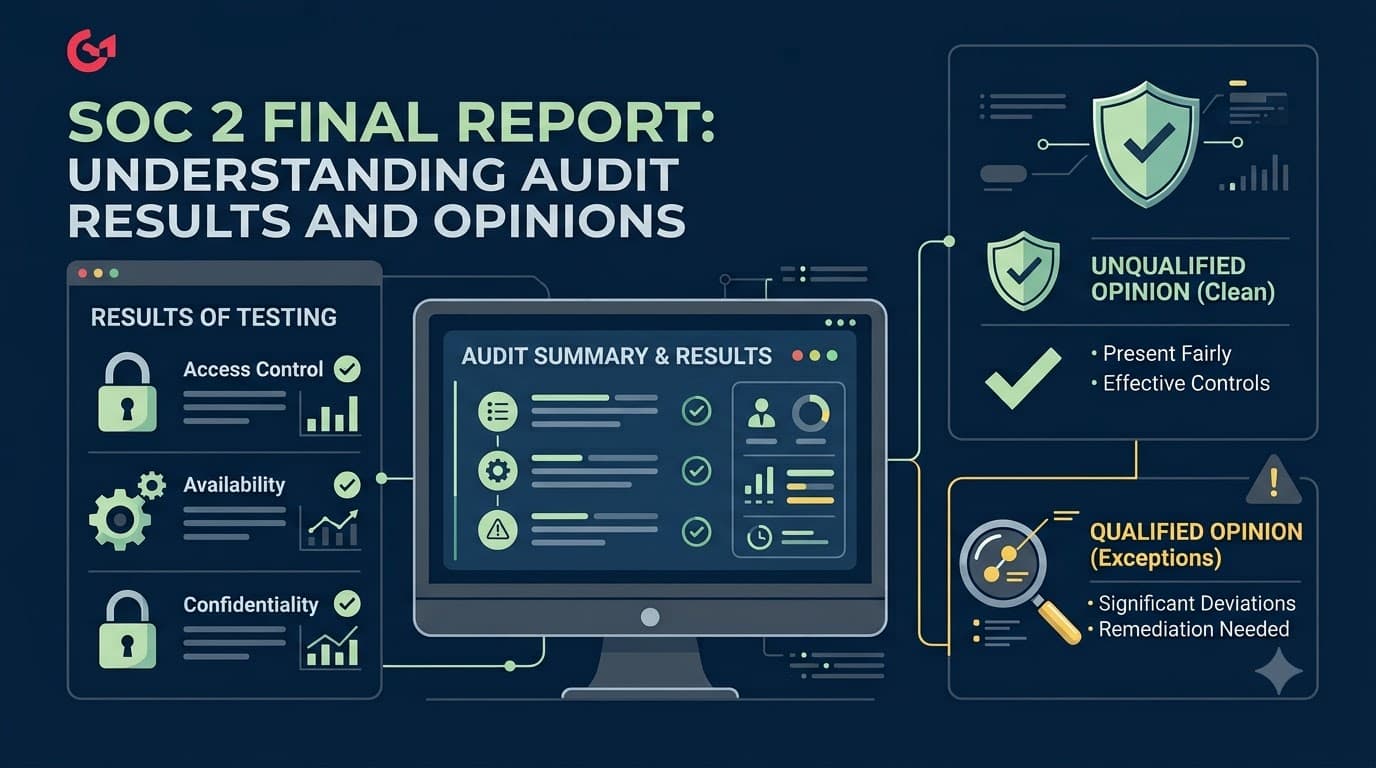
Priya Anand opened the PDF at 6:52 a.m., before her second coffee had finished brewing, because Halloran & Struve CPAs had promised delivery "by end of week" and it was now Friday. As Director of Security & Compliance at Cascade Ledger — a Denver-based accounts-payable automation platform processing roughly $4.1 billion a year in vendor payments for mid-market manufacturers — Priya had spent eleven months getting ready for this moment. A $3.1 million renewal with Brightpeak Bank, Cascade Ledger's largest customer and de facto reference account, was contractually contingent on a "current, unqualified SOC 2 Type II report" landing in Brightpeak's vendor risk portal before the end of the quarter. She scrolled past the cover page, past the table of contents, straight to Section I: Independent Service Auditor's Report. Her eyes caught on one phrase before anything else registered — "in our opinion" — and then she made herself slow down and read the whole sentence.
That sentence is where this article starts. Not the eleven months of control building, not the fieldwork, not the evidence requests — the moment the report exists and someone has to read it correctly, explain it accurately, and decide what to do next. A huge amount of confusion in the SOC 2 world happens right here, at the finish line, because people conflate "we got our SOC 2" with "we passed," treat any mention of an exception as a failure, or hand a 60-page restricted-use report to a prospect without understanding what they're allowed to say about it. This article is not about the mechanics of building the report — that's covered in SOC 2 Report Structure: Understanding the Auditor's Report. This article is about what happens after the report exists: how to read the opinion, how to read an exception without panicking, how to use the result in a sales conversation without overstating it, and how to plan your next cycle so this moment gets easier every year.
Who This Is For and What You'll Walk Away With
This is written for compliance leaders, founders, and sales/customer-success teams who now hold a signed SOC 2 report and need to act on it — plus procurement and vendor-risk professionals on the receiving end who need to read someone else's report correctly. You'll walk away knowing the four opinion types cold, how to distinguish a genuinely clean report from one carrying exceptions that still resulted in an unqualified opinion, how those distinctions play in a sales cycle, how long the report stays useful before you need a bridge letter, and how to turn "the audit is done" into "we're already working on next year's."
The Four Documents That Arrive Together
When people say "the SOC 2 report," they usually mean a single bundled PDF with four distinct components stitched together, each written by a different party and serving a different purpose. Section I is the auditor's independent opinion — the only part written by the CPA firm in their own voice as an assertion of fact. Section II is management's assertion — your organization, in your own words, asserting that the system description is accurate and the controls were suitably designed (and, for Type II, operated effectively). Section III is the system description itself — the narrative and structural detail about what's in scope. Section IV, present only in a Type II report, is the description of tests of controls and results, where the auditor lists every control tested, the procedure performed, the sample size, and the outcome.
Section | Written By | Core Question It Answers | Present in Type I? | Present in Type II? |
|---|---|---|---|---|
I — Independent Service Auditor's Report | CPA firm | What is the auditor's opinion? | Yes | Yes |
II — Management's Assertion | Service organization | Does management stand behind the description and controls? | Yes | Yes |
III — System Description | Service organization (auditor reviews) | What is in scope and how does the system work? | Yes | Yes |
IV — Tests of Controls and Results | CPA firm | Did each control operate effectively over the period? | No | Yes |
V — Other Information (optional) | Service organization | Management's response to findings, forward-looking commentary | Sometimes | Sometimes |
If you want the deep walkthrough of how each section is assembled and what belongs in it, that's the subject of SOC 2 Report Structure: Understanding the Auditor's Report. This article assumes you already have the finished document in hand and treats Section I — the opinion — as the center of gravity, because that's the part that determines everything downstream: whether the deal closes, whether procurement flags a risk, and whether your board asks uncomfortable questions.
The Four Opinion Types, Precisely Defined
Every SOC 2 report ends with one of four possible opinions. This is not marketing language and not a spectrum you can round up or down — it's a specific professional conclusion the auditor reaches after fieldwork, governed by SSAE 18 (AT-C section 205, applied through AT-C 105 and 320 for SOC 2 engagements specifically). Get the vocabulary exact, because customers' vendor risk teams will.
Opinion Type | What the Auditor Is Saying | Typical Trigger | How Common in Practice |
|---|---|---|---|
Unqualified (clean) | Controls were suitably designed and (for Type II) operated effectively throughout the period, in all material respects | No material issues found, or issues found don't rise to materiality | The large majority of delivered SOC 2 reports |
Qualified | Except for one or more specific, described matters, controls were suitably designed/operating effectively | One or more control failures that are material but not pervasive | Uncommon but not rare — often the result of a first-year audit or a known gap |
Adverse | Controls were not suitably designed or did not operate effectively, taken as a whole | Widespread, pervasive failures across multiple criteria | Rare — usually signals the organization should not have gone to audit yet |
Disclaimer of opinion | The auditor could not obtain sufficient evidence to form an opinion at all | Scope limitation, missing evidence, auditor independence issue, engagement terminated early | Rare — often reflects a process failure rather than a control failure |
The single most important thing to internalize: these four outcomes are not "A, B, C, D" grades on a smooth curve. Unqualified and qualified are both usable, deliverable reports that describe a real control environment with real evidence behind it. Adverse and disclaimer are functionally unusable for sales purposes and, in most cases, never see daylight outside the four walls of the company that received them — a mature compliance program manages the audit relationship precisely so it never reaches that point.
"I tell first-time clients the same thing every year: an unqualified opinion doesn't mean nothing happened during your audit period. It means whatever happened wasn't material enough to change my conclusion. Those are very different statements, and conflating them is where I see companies either panic unnecessarily or, worse, get overconfident." — Marcus Webb, Partner, Halloran & Struve CPAs
Unqualified (Clean): What It Actually Certifies
An unqualified opinion — sometimes called a "clean opinion," though that phrase appears nowhere in the professional standards — states that, in the auditor's professional judgment, the system description is fairly presented, the controls were suitably designed to meet the applicable trust services criteria, and (Type II only) those controls operated effectively throughout the specified audit period. Crucially, an unqualified opinion can still coexist with individually noted exceptions in Section IV. This is the nuance almost everyone outside the audit profession gets wrong: a handful of documented exceptions in the tests-of-controls section does not automatically demote the report to "qualified." The auditor evaluates each exception's frequency, root cause, and compensating controls, then makes a materiality judgment about the control environment as a whole. Two missed quarterly access reviews out of forty-eight controls tested, promptly remediated and documented, might still support an unqualified opinion with the exceptions simply disclosed in Section IV. A single control that failed in a way that undermines the whole access control environment might not.
Priya's report was exactly this case. Two exceptions were noted against CC6.2 (logical access provisioning) — a contractor account that wasn't deprovisioned within Cascade Ledger's stated five-business-day SLA, found in one of forty-five samples tested — but the overall opinion was unqualified, because the auditor concluded the control was designed appropriately, operated effectively in the other forty-four instances, and the single miss was remediated within the period with no evidence of broader breakdown.
What an Unqualified Opinion Confirms | What It Does NOT Confirm |
|---|---|
The system description is fairly presented | That the company has zero security incidents ever |
Controls were suitably designed for the criteria in scope | That controls outside the defined system boundary exist or work |
Controls operated effectively (Type II) over the stated period | That the company will pass next year automatically |
Any noted exceptions were evaluated and found immaterial | That there were no exceptions at all |
The auditor's independent, professional conclusion | A government certification, seal, or guarantee |
Reading Exceptions Without Panicking
Every Type II report you'll ever read has a Section IV table listing each control, the test performed, the sample size, and the result — and "no exceptions noted" is the most common result, but not the only acceptable one. Learning to read an exception entry correctly is the single most valuable skill in this whole exercise, both for reading your own report and for evaluating a vendor's.
Exception Language in the Report | What It's Signaling | Reasonable Reader Reaction |
|---|---|---|
"No exceptions noted" | Control operated as designed in every sample tested | No follow-up needed |
"1 of 25 samples tested did not evidence [X]; management remediated on [date]" | Isolated miss, already fixed, disclosed transparently | Ask about root cause if relevant to your risk profile, but not a red flag alone |
"Exception noted: the control did not operate as designed for [n] of [n] instances tested" | Systemic failure across the whole sample | Warrants direct questions to the vendor about compensating controls |
"Auditor was unable to test [control] due to [reason]" | Scope limitation, not necessarily a failure | Ask why — could be a legitimate timing issue or a real gap |
Qualified opinion language referencing a specific criterion | Auditor concluded materiality was crossed for that criterion | Read the "basis for qualified opinion" paragraph carefully; assess impact to your specific use of the vendor |
Exception Management as a discipline — how to triage, document, and remediate control deficiencies as they're found during the audit, not just read about them after the fact — is covered in depth in SOC 2 Exception Management: Handling Control Deficiencies. What matters for this article is how exceptions read once they're frozen in a final report: they're historical fact, not open items. By the time you're holding the PDF, the audit period is closed and the exceptions are exactly as described — the only live question is whether you've since fixed the underlying issue, and whether you can articulate that fix.
"The exceptions in your report are the most honest paragraph in the whole document, and I tell clients to stop being afraid of them. A report with zero exceptions across three consecutive years usually makes me ask harder questions about the sampling, not fewer." — Sam Whitcombe, Senior Manager, Halloran & Struve CPAs
Qualified Opinions: When One Thing Went Wrong
A qualified opinion states that, except for one or more specifically described matters, the controls were suitably designed and operating effectively. The report will contain a clearly labeled "Basis for Qualified Opinion" paragraph identifying exactly which criterion or control failed, why, and how pervasive the auditor judged it to be. This is materially different from an unqualified report with disclosed exceptions in Section IV — a qualification is a formal carve-out on the opinion itself, not a footnote buried in the tests-of-controls table.
Tomas Reyes led security at Ferrovia Logistics Analytics, a freight-visibility SaaS platform, through a first Type II audit that came back qualified. A production change had gone live without a documented, approved change ticket during month seven of a nine-month period — a single event, but one that the auditor concluded undermined the design assertion for the entire change-management criterion (CC8.1) because there was no compensating detective control that would have caught unauthorized changes generally. The auditor issued: "except for the matter described in the preceding paragraph regarding change management control CC8.1, in our opinion the controls were suitably designed and operating effectively."
Qualified Opinion Trigger (Illustrative) | Scope of the Carve-Out | Rest of the Report |
|---|---|---|
One control criterion failed materially | Narrow — that specific criterion only | Still opined on normally |
Multiple related controls under one criterion failed | Moderate — usually still confined to that trust services category | Still opined on normally |
Failure traced to a systemic process gap (e.g., no change approval process existed) | Can be broader if the gap undermines related controls | Depends on auditor judgment |
A qualified report is not a failed audit. It's an honest one. Ferrovia's leadership had a choice at that point: pull the report and delay delivery to remediate first (adding months), or accept the qualified opinion, fix the gap immediately, and be transparent with prospects about exactly what happened and what changed. They chose the latter — a decision covered in more detail in the case study below.
Adverse Opinions: When the Whole Control Environment Fails
An adverse opinion states that the controls were not suitably designed or did not operate effectively, taken as a whole, to provide reasonable assurance the criteria were met. This is reserved for pervasive, cross-cutting failures — not a single missed control, but a control environment where the auditor concludes the failures are so significant and widespread that a narrow qualification wouldn't fairly represent the situation. In fifteen-plus years around these engagements, I've seen exactly a handful of adverse opinions actually issued in final form, and in every case the real story was that the organization went to audit fieldwork before it was ready, usually against internal pressure to hit a sales deadline.
Signal During Fieldwork | Likely Trajectory |
|---|---|
One control criterion has scattered exceptions, rest are clean | Unqualified with disclosed exceptions |
One control criterion has a material, isolated failure | Qualified opinion |
Multiple criteria fail with a common root cause (e.g., no governance function existed all period) | Adverse opinion risk — escalate immediately |
Evidence is missing entirely for large parts of scope | Disclaimer risk, not adverse |
The good news: adverse opinions rarely make it to a final, distributed report, because a competent auditor flags the trajectory during fieldwork — often around the walkthrough and interim testing stage — well before the engagement concludes, giving management the chance to either narrow scope, extend the period, or in the worst case, withdraw and restart the following year rather than accept a report nobody can use.
Disclaimer of Opinion: When the Auditor Can't Conclude at All
A disclaimer of opinion is different in kind from the other three — it's not a judgment about your controls at all, it's a statement that the auditor could not gather enough evidence to form any opinion. This happens when there's a fundamental scope limitation: management restricts access to key evidence, a critical system goes down permanently mid-period with no backup of relevant logs, the engagement is terminated by either party before fieldwork completes, or an independence conflict is discovered too late to resolve. A disclaimer is rare, and when it happens it's almost always a process or access problem rather than evidence that the underlying controls were bad — but from a customer's perspective, a disclaimer is functionally as unusable as no report at all.
Opinion Type | Business Usability | Typical Root Cause |
|---|---|---|
Unqualified | Fully usable in sales, renewals, procurement | Controls worked as designed |
Qualified | Usable with context and a remediation narrative | One material control gap |
Adverse | Effectively unusable externally | Pervasive control environment failure |
Disclaimer | Effectively unusable externally | Auditor couldn't get sufficient evidence, not necessarily a control failure |
What a Clean Report Actually Signals to Customers
From a customer's chair — a procurement analyst, a vendor risk manager, a CISO doing third-party due diligence — an unqualified SOC 2 Type II report signals that an independent, licensed CPA firm examined the vendor's controls against a recognized criteria set over a real observation window and found them suitably designed and operating effectively, with any noted exceptions judged immaterial to that conclusion. It does not signal that the vendor is unhackable, that the vendor has never had an incident, or that every control in existence at the vendor was tested — only the controls mapped to the criteria actually in scope were. Leah Fitzgerald, who runs third-party risk for Brightpeak Bank, put it plainly to Priya during the renewal review.
"An unqualified opinion tells me the auditor's math checked out on the controls they tested. It doesn't tell me you're perfect, and I don't expect perfect — I expect honest. What actually moves my recommendation is whether the system description matches what you told me in the security questionnaire, and whether the exceptions, if any, are things I'd worry about for my specific use case." — Leah Fitzgerald, Vendor Risk Manager, Brightpeak Bank
Customer-Side Reader | Primary Question About the Opinion | What They'll Look at Next |
|---|---|---|
Procurement / vendor risk analyst | Is the opinion unqualified and the report current? | System boundary, subservice organizations, CUECs |
Security team / CISO | Which criteria are in scope and were any exceptions noted? | Section IV detail, criteria selected (Availability, Confidentiality, etc.) |
Legal / contracts | Does this satisfy the contractual audit clause? | Report date, audit period, auditor firm name |
Executive sponsor | Does this unblock the deal? | The one-line opinion type, nothing more |
What a Qualified Report Signals — and How to Talk About It
A qualified report is where the real skill of interpreting and communicating results lives. It signals to a sophisticated reader that a specific, bounded issue occurred and was disclosed transparently rather than hidden — which, paradoxically, can build more trust with an experienced vendor risk reviewer than a suspiciously spotless report, provided the vendor can speak to it clearly. What sinks a qualified report in a sales cycle isn't the qualification itself; it's a vendor who can't explain it, minimizes it, or gets defensive when asked.
Do When Presenting a Qualified Report | Don't |
|---|---|
Lead with what happened, in plain language, before the customer asks | Bury the qualification and hope no one reads Section I closely |
Explain the remediation already completed, with dates | Say "it's fixed" without evidence or a corrective action plan |
Offer the auditor's follow-up letter or next interim report if available | Argue with the customer about whether it "really matters" |
Show the rest of the report is otherwise clean | Let one qualification become the whole conversation |
Loop in your own auditor for a reference call if the deal is large enough | Promise a specific "clean by" date you can't control |
Tomas Reyes's team at Ferrovia built a one-page addendum — reviewed but not authored by their auditor — summarizing the change-management gap, the immediate remediation (a mandatory change-approval workflow with a second-approver gate), and the fact that the subsequent quarter's internal testing showed zero repeat occurrences. That addendum, distributed alongside the report itself under the same NDA terms, became the difference between deals stalling and deals closing.
Common Misreadings of the Final Report
Some misunderstandings recur often enough, on both the vendor and the customer side, that they deserve a dedicated table.
Misreading | Reality |
|---|---|
"We passed our SOC 2" / "we're SOC 2 certified" | SOC 2 is an attestation, not a certification — there's no pass/fail badge, and "certified" is inaccurate framing that can create liability |
"A qualified opinion means we failed" | It means one bounded, disclosed matter was found — the rest of the report still stands |
"No exceptions in Section IV means a stronger report than one with a few" | Not necessarily — auditor judgment and sample rigor matter more than a raw exception count |
"The report proves we're secure" | The report proves specific controls, within a specific boundary, operated over a specific period |
"Once we have a SOC 2, we're done" | The report has a limited validity window and expires; see the sections below |
"We can post our full SOC 2 report on our public website" | SOC 1 and SOC 2 reports are restricted-use; only SOC 3 is intended for public distribution |
That last point deserves emphasis because it's a genuine and recurring mistake: SOC 2 reports (Type I or Type II) are restricted-use documents intended only for parties who already understand the system and the criteria — typically existing or prospective customers under NDA, auditors, and regulators. Publishing the full report openly, or forwarding it outside a controlled channel, is both a contractual and professional-standards problem. The right way to manage who sees the report, under what agreement, and through what channel is covered fully in SOC 2 Report Distribution: Managing Confidential Information — worth reading in full before your first report goes anywhere near a prospect's inbox.
Using the Report in Sales: What You Can and Can't Say
The gap between "we have an unqualified SOC 2 Type II report" and "we're SOC 2 certified and totally secure" is where marketing teams get compliance leaders into trouble. Dana Okafor, VP of Sales at Cascade Ledger, worked with Priya to build language the sales team could actually use without a compliance review bottleneck on every deal.
Sales Claim | Accurate? | Better Version |
|---|---|---|
"We're SOC 2 certified" | No — SOC 2 is an attestation | "We've completed a SOC 2 Type II examination with an unqualified opinion" |
"We passed our SOC 2 audit with zero findings" | Overstates if any exceptions exist in Section IV | "Our most recent SOC 2 Type II report received an unqualified opinion" |
"Our SOC 2 covers everything we do" | Almost never literally true | "Our SOC 2 covers [system boundary] against the Security and Availability criteria" |
"We're more secure than [competitor] because we have SOC 2" | Unverifiable and risky | "Our SOC 2 report is available under NDA for your own evaluation" |
"Our SOC 2 is permanent" | False — it expires | "Our report covers [dates]; we re-audit annually and provide bridge letters between cycles" |
"The best thing that ever happened to our sales cycle wasn't getting the SOC 2 — it was training the AEs to say one accurate sentence about it instead of five inaccurate ones. Procurement teams trust precision. They get suspicious of superlatives." — Dana Okafor, VP of Sales, Cascade Ledger
A practical sales enablement checklist helps standardize this across a revenue team that turns over faster than the compliance function does.
Sales Enablement Item | Owner | Cadence |
|---|---|---|
One-page "how to talk about our SOC 2" sheet, reviewed by compliance | Compliance + Enablement | Refresh every audit cycle |
Approved boilerplate for RFPs referencing report type and opinion | Compliance | Refresh every audit cycle |
List of what's in scope vs out of scope, in plain English | Compliance | Refresh every audit cycle |
NDA-gated distribution process for the actual report | Legal + Compliance | Standing process |
Escalation path if a prospect asks about an exception | Compliance | Standing process |
Trust portal link kept current with latest report and bridge letters | Compliance + Sales Ops | Continuous |
Translating the Report for Non-Auditors
Most people who need to act on the report — an account executive, a customer success manager, a board member — will never read Section IV closely, nor should they have to. Part of your job after the report lands is producing a short, accurate executive translation that captures the substance without the audit-speak.
Audit Language | Plain-English Translation |
|---|---|
"Unqualified opinion" | Clean result — the auditor found our controls worked |
"Type II, [start]–[end]" | We were tested over [n] months, not just a single day |
"1 of 25 samples, remediated [date]" | One small miss, already fixed, disclosed for transparency |
"Carve-out method for [subservice org]" | That vendor's own controls are examined separately, not by our auditor |
"CUECs" | Things the customer themselves must do for our controls to fully work |
"Qualified opinion re: CC8.1" | One specific area — change approval — had a gap, now closed |
Building this translation layer once, and keeping it current every cycle, is what turns "the audit is done" into a reusable sales and customer-success asset rather than a document that only compliance can interpret.
The Trust Portal and Controlled Distribution
Once the report exists, where it lives and who can reach it matters almost as much as what it says. Most mature service organizations now route report requests through a gated trust portal rather than emailing PDFs — a page that requires an NDA click-through (or references an existing NDA on file), logs who requested access and when, and optionally applies watermarking so a leaked copy can be traced back to its source. This isn't paranoia; it's professional handling of a document that discloses real detail about your security architecture, and it's exactly the discipline procurement teams expect to see from a vendor that takes its own report seriously.
Distribution Channel | Control Level | Best Fit |
|---|---|---|
Direct email attachment | Low — no access log, easy to forward uncontrolled | Avoid for anything beyond internal use |
Shared drive link with expiry | Medium | Small deal volume, early-stage companies |
Gated trust portal with NDA click-through | High | Most SaaS/service organizations at scale |
Trust portal + per-document watermarking + access log | Highest | Regulated industries, high-value enterprise accounts |
The full mechanics of who should be allowed to see the report, how NDAs should be structured, what to do when a prospect wants to share it further with their own auditors, and how to handle a report leak are covered in SOC 2 Report Distribution: Managing Confidential Information — treat that article as the operational playbook and this section as the "why it matters at the moment the report is fresh."
How Long Is the Report Actually Good For?
A finished SOC 2 report is not evergreen. Its usefulness has a shelf life driven by two separate clocks: the audit period it covers (for Type II) or the point-in-time date (for Type I), and the practical staleness threshold most customers' vendor risk policies enforce.
Report Type | What "Validity" Means | Typical Customer Threshold Before It's Considered Stale |
|---|---|---|
Type I | Design assessed as of a single date | Often expected to be followed by a Type II within 6–12 months |
Type II | Operating effectiveness over a period (commonly 3–12 months, most often 12) | Most vendor risk policies want the report period end date within the last 12 months |
SOC 3 | Public summary tied to an underlying SOC 2 | Same staleness expectations as the underlying report |
The practical implication: if your Type II report covers January 1 – December 31, and a prospect's procurement cycle doesn't close until the following October, you're ten months past the period end date — inside most policies' tolerance, but getting close. This is exactly the gap a bridge letter is designed to cover, and it's worth planning for before a sales team discovers the problem mid-deal.
The Bridge Letter: Closing the Gap Between Cycles
A bridge letter — sometimes called a gap letter — is a short, management-issued (not auditor-issued) letter stating that, to the best of management's knowledge, no material changes to the control environment have occurred between the end date of the last report period and the date of the letter. It's not a substitute for the audit itself, it doesn't carry an opinion, and it can't be stretched indefinitely — but it's the standard, accepted tool for covering the window between your report's period-end and a customer's procurement deadline.
Solstice Health Analytics, a clinical-data analytics vendor, ran into exactly this timing gap: their Type II report covered April through March, but their single largest prospect needed assurance in September — six months past period-end, with the next audit not scheduled to conclude until the following April. Rather than losing the deal or rushing an off-cycle audit, Solstice's compliance lead issued a bridge letter covering April through September, referencing the prior report and confirming no material control changes, co-signed by the CEO. The prospect's procurement team accepted it as standard practice and closed the deal on schedule.
Situation | Right Tool |
|---|---|
Gap of 1–3 months past report period-end, no material changes | Bridge letter |
Gap of 6+ months with no next audit in sight | Bridge letter plus a firm commitment on next audit timing — some customers will push back here |
Material control change occurred during the gap (e.g., new subservice org, major system migration) | Disclose the change explicitly — a bridge letter should not paper over it |
Customer specifically requires audited assurance, no bridge letters accepted | You may need to accelerate the next audit or negotiate contract language |
The full mechanics — who signs it, what it must and must not claim, how many you can reasonably issue before a customer expects a fresh report instead — are covered in SOC 2 Bridge Letter: Maintaining Continuous Compliance. The point for this article: the final report is not a permanent asset, and treating the bridge letter as a routine, planned part of your compliance calendar — rather than a fire drill triggered by a sales rep's panicked Slack message — is what separates mature programs from reactive ones.
flowchart TD
    A[Final SOC 2 report delivered] --> B{What opinion type?}
    B -->|Unqualified| C[Distribute via trust portal under NDA]
    B -->|Qualified| D[Prepare remediation summary + talking points]
    B -->|Adverse or Disclaimer| E[Do not distribute externally; remediate and re-scope]
    C --> F{Report period-end within customer's staleness window?}
    D --> F
    F -->|Yes| G[Deliver report as-is]
    F -->|No, gap is short| H[Issue bridge letter]
    F -->|No, gap is long or material change occurred| I[Accelerate next audit or renegotiate timeline]
    G --> J[Plan next audit cycle]
    H --> J
    I --> J
    E --> J
Planning the Next Audit Cycle Starts the Day This One Ends
The single biggest lever for making next year's report read cleaner, land faster, and cost less: start planning the next cycle within days of receiving this one, not months later when the previous audit period has already lapsed. A well-run compliance function treats the final report as a planning artifact, not a finish line.
Next-Cycle Planning Task | Target Timing After Report Delivery |
|---|---|
Debrief with auditor on any exceptions and root causes | Within 2 weeks |
Open corrective action items for anything noted, even if immaterial | Within 2 weeks |
Confirm next audit period start date (ideally contiguous with prior period-end) | Within 1 month |
Update the risk assessment and control matrix for any environment changes | Within 1 month |
Re-confirm scope: any new products, subservice organizations, or criteria to add | Within 1–2 months |
Calendar interim testing / mid-period checkpoint with auditor | Within 2 months |
Refresh sales/CS enablement materials with the new report details | Immediately upon final delivery |
Keeping audit periods contiguous — this year's period starting the day after last year's ended — is what avoids report-validity gaps altogether and reduces how often you need a bridge letter in the first place. This is also the point where a genuinely mature program shifts from "audit as annual event" to continuous monitoring and continuous compliance, collecting evidence year-round rather than scrambling in the eight weeks before fieldwork — a shift covered more fully in SOC 2 Continuous Monitoring: Maintaining Controls Year-Round.
Responding to a Qualified or Adverse Opinion: The Path Forward
If your report comes back qualified — or, in the rare worst case, adverse — the instinct to panic is understandable but not useful. There's a well-worn path forward, and organizations that follow it methodically usually come out of the next cycle stronger than they went into this one.
Step | Purpose |
|---|---|
1. Get the auditor's precise "basis for qualification" language in writing | Understand exactly what was found, not the rumor version |
2. Perform root cause analysis, not just symptom fixing | Prevents the same exception recurring next period |
3. Build a corrective action plan with owner and due date | Gives customers and your own leadership a concrete commitment |
4. Decide on external communication strategy before customers ask | Controls the narrative rather than reacting to it |
5. Consider an interim letter or shortened next audit period to demonstrate remediation sooner | Rebuilds assurance faster than waiting a full year |
6. Debrief internally on why the gap wasn't caught pre-audit | Feeds back into readiness process for next cycle |
This is the operational core of SOC 2 Management Response: Addressing Auditor Findings and SOC 2 Remediation Planning: Addressing Audit Findings — both worth reading in full if you're navigating a qualified opinion right now rather than reading about it hypothetically.
Case Study: Cascade Ledger — Reading a Clean Report Correctly Under Deal Pressure
Cascade Ledger's Type II report, the one Priya opened that Friday morning, came back unqualified with two disclosed exceptions in Section IV, both tied to the same isolated contractor-deprovisioning miss. Rather than either hiding the exceptions or over-explaining them defensively, Priya's team took a third path: they proactively sent Brightpeak Bank's vendor risk team a one-paragraph note alongside the report, pointing directly to the Section IV entry, describing the automated deprovisioning workflow they'd since implemented (a Slack-triggered, ticketing-integrated offboarding flow replacing the manual checklist that had failed), and inviting a follow-up call if useful. Leah Fitzgerald's team closed their review in six business days — faster than the prior year's cycle, which hadn't included any proactive exception context — and the $3.1 million renewal closed two weeks ahead of the quarter-end deadline. Priya's own read on the lesson: "The exceptions didn't cost us the deal. Silence about the exceptions would have."
Case Study: Ferrovia Logistics Analytics — Turning a Qualified Opinion Into a Trust-Building Moment
Ferrovia's first Type II audit, as described above, came back qualified due to a single unauthorized production change during month seven of the period, tied to the change-management criterion. Tomas Reyes's team faced three enterprise prospects mid-cycle, two of whom had explicit "unqualified reports only" language in their vendor security policies. Rather than withholding the report and hoping the issue would quietly disappear next cycle, Ferrovia's leadership authorized full transparency: the report, plus the one-page remediation addendum, plus a standing offer for a reference call with their auditor. One of the three prospects held firm on their unqualified-only policy and paused the deal pending next year's report. The other two proceeded after a single clarifying call each, both citing the transparency and the concrete remediation (a second-approver gate on all production changes, verified in the following quarter's internal testing) as the deciding factor. Nine months later, Ferrovia's next Type II report came back unqualified, and they used the "we told you exactly what happened and fixed it" narrative as a differentiator in their next round of enterprise sales conversations.
Case Study: Solstice Health Analytics — Managing the Gap Between Cycles
Solstice's situation, introduced above in the bridge letter section, illustrates a different failure mode: not a bad opinion, but a timing mismatch between when their report was dated and when a customer needed assurance. Rather than treating the six-month gap as a crisis, Solstice's compliance lead had already built a standing bridge-letter template — reviewed once by outside counsel — that could be issued within 48 hours of a request, co-signed by the CEO, referencing the prior unqualified report and attesting to no material control changes. That preparedness turned what could have been a multi-week scramble into a same-week deliverable, and Solstice's next audit period was deliberately scheduled to start the day after the prior period ended, closing the recurring gap going forward.
A Reference Table: Every Term You'll Need in One Place
For anyone who wants the whole vocabulary in a single scan before a customer call.
Term | Plain Meaning |
|---|---|
Clean result; controls suitably designed and (Type II) operating effectively | |
Clean except for one or more specifically described, material matters | |
Adverse opinion | Controls not suitably designed/operating, taken as a whole |
Disclaimer of opinion | Auditor could not obtain sufficient evidence to conclude |
An instance where a control didn't operate as designed during testing | |
A control that is missing or not operating effectively | |
Management letter covering the gap between report period-end and a later date | |
Documented remediation plan with owner and due date | |
The CPA's formal conclusion in Section I of the report |
The Strategic Opportunity: Turning Report Literacy Into a Sales Advantage
Most competitors treat the final report as a compliance artifact to file away until next year. The organizations that consistently out-execute them treat it as a live sales and trust asset: a well-translated executive summary that account executives can use without a compliance bottleneck, a trust portal that makes the report easy (and controlled) to access, a bridge-letter process that never becomes a fire drill, and a next-cycle plan that starts the same week the current report lands rather than three months before the next deadline. None of that requires a bigger audit budget — it requires treating "understanding the result" as seriously as "getting the result" in the first place. That shift, done consistently across a few audit cycles, becomes a genuine differentiator in competitive enterprise sales cycles where every vendor in the room claims to be "secure" but only a few can explain precisely what their attestation actually says and why it should be trusted.
If you're heading into your own report-interpretation moment — whether that's your first Type II landing on your desk or your fifth — a structured, repeatable process for reading, communicating, and planning around the result is worth building deliberately rather than reinventing it under deal pressure every single cycle. PentesterWorld's compliance practice works with service organizations on exactly this: translating audit results into sales-ready language, building bridge-letter and distribution processes that hold up under procurement scrutiny, and planning audit cycles that stay continuously current. If your next report is coming back this quarter, reach out to PentesterWorld before it lands so you're ready the moment it does.
To go deeper on the report itself, our SOC 2 Report Reader's Guide walks through every section with annotated examples, our SOC 2 Glossary keeps the full vocabulary in one place for your sales and CS teams, and our "Are You SOC 2 Ready?" quiz is a fast way to gauge readiness heading into your next cycle. For teams weighing whether to pursue both frameworks, our SOC 2 vs ISO 27001 Comparison Guide lays out the decision clearly — and if you're running both simultaneously, Running ISO 27001 and SOC 2 Together and ISO 27001 vs SOC 2: Which One Do You Need are the right next reads on the ISO 27001 side of this pillar.