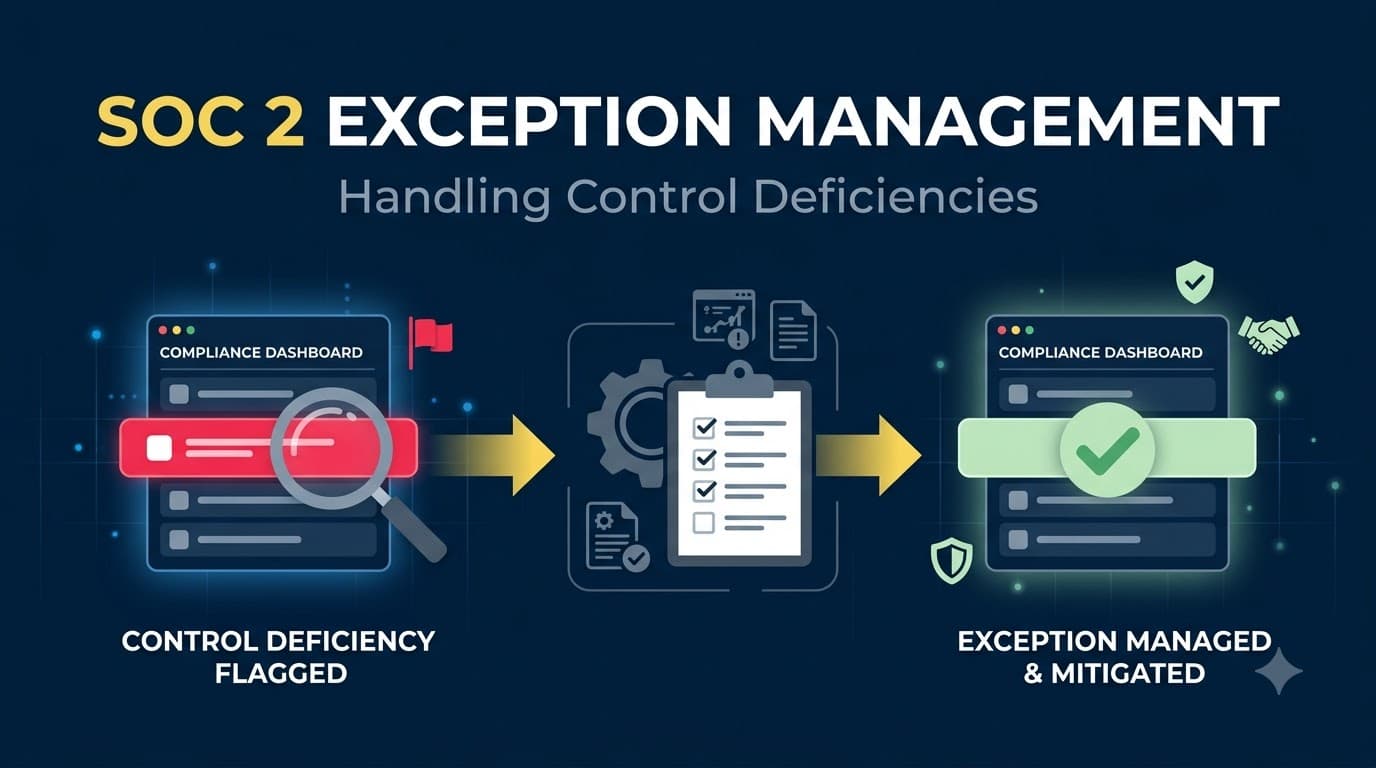
Priya Nandakumar found out about the exceptions on a Tuesday, in a two-line email from her auditor with the subject line "Draft report ready for review." She was VP of Security and Compliance at Lumenforge Analytics, a 210-person SaaS company that turned marketing data into predictive dashboards for retail chains, and she had spent eleven months building toward this Type II report. A $3.1 million multi-year renewal with Lumenforge's largest customer — a national grocery chain — was contractually tied to a clean SOC 2 report landing in the customer's inbox before the end of the quarter. The draft PDF had four exceptions in it: two employees whose access wasn't deprovisioned within the five-business-day SLA after termination, one quarter where a change to the production database schema went out without a documented approval ticket, and a vulnerability scan that ran nine days late in month seven of the twelve-month observation window.
Priya's first reaction was the one almost everyone has: panic, followed by the instinct to argue with the auditor about whether these "really counted." Her second, better reaction — after a call with her audit partner — was to recognize that none of this was a crisis. Exceptions are not a failure state. They are the normal, expected byproduct of testing real controls against real evidence over a real period of time, and how an organization responds to them tells a more accurate story about its security maturity than a spotless report ever could. This article is the guide Priya wishes she'd had eleven months earlier — before the audit, not after the draft.
Who This Is For / What You'll Walk Away With
This is written for the compliance managers, security leads, and founders who are staring at a draft report with findings in it, or who want to build a program that never gets there in the first place. You'll walk away understanding exactly how audit exceptions get identified during control testing, how the severity of an exception maps to the auditor's final opinion, how to draft a management response that reads as competent rather than defensive, and how to run root cause analysis and remediation so the next observation period produces a materially better result — and, just as important, how sophisticated customers actually read an exception-laden report instead of reflexively rejecting it.
What a SOC 2 Exception Actually Is
Strip away the anxiety and the definition is simple: an exception is an instance, identified during testing, where a control did not operate exactly as it was designed to operate. That's it. It is not an opinion, not a value judgment about your security program, and not automatically disqualifying. If your access review policy says quarterly reviews are completed within ten business days of the quarter closing, and the auditor pulls evidence showing one quarter's review was completed on day fourteen, that is an exception — a single data point where reality diverged from the documented control.
The confusion most first-time SOC 2 clients run into is conflating "exception" with "failure." A Type II report tests controls over an observation period — commonly three to twelve months — and pulls samples of evidence across that window. Testing real operations across real months, with real humans doing the work, will almost always surface at least a few instances of imperfect execution. Auditors expect this. The AICPA's attestation standards under SSAE 18 don't require perfection; they require that management fairly describes its system, that the control objectives are suitably designed, and — for Type II — that the controls operated effectively enough, and consistently enough, to support the auditor's conclusion.
"The clients who scare me are the ones who tell me before fieldwork even starts that they expect zero findings. That tells me they don't understand what a twelve-month look-back actually tests. I'd rather see three well-explained exceptions with a documented root cause than a suspiciously perfect population." — Marcus Ohlin, Audit Partner, Ohlin & Vance CPAs
How Exceptions Get Identified in the First Place
Exceptions surface almost exclusively during the testing phase covered in SOC 2 Control Testing: Auditor Procedures and Expectations — the stage where the auditor selects a sample from a defined population of control instances (every access review that quarter, every deployment that year, every new-hire onboarding event) and asks for evidence that each sampled instance actually happened as designed. The auditor is not testing your policy document; they're testing whether the policy was followed, using the artifacts your team actually produced — tickets, logs, screenshots, approval emails, system exports.
Exceptions typically emerge from one of four testing methods: inspection of documents (an approval ticket is missing a required signoff field), observation (watching a control being performed live, such as a walkthrough of the deployment pipeline), inquiry combined with corroboration (asking the control owner how a process works and checking that the answer matches the evidence), and re-performance, where the auditor independently redoes the control themselves — recalculating an access list, re-running a report — to confirm the same result. Controls that operate rarely, such as an annual disaster recovery test, are often tested with a test of one: if that single instance fails, the deviation rate for the entire population is 100%, which is why low-frequency controls carry outsized exception risk.
Table 1: Common Sources of SOC 2 Exceptions During Testing
Testing Method | What the Auditor Does | Typical Exception It Surfaces |
|---|---|---|
Inspection of evidence | Reviews tickets, logs, screenshots against the control statement | Missing approval field, undated document, incomplete access review record |
Re-performance | Independently redoes the control (e.g., recalculates access list) | Discrepancy between auditor's result and the control owner's output |
Observation | Watches a control performed live (e.g., deployment walkthrough) | Step skipped or performed out of documented sequence |
Inquiry + corroboration | Interviews control owner, checks answer against artifacts | Verbal description doesn't match actual system configuration |
System-generated evidence pull | Exports data directly from source system (ticketing, IAM, SIEM) | Timestamps outside SLA window, orphaned accounts, gaps in log retention |
Test of one (low-frequency controls) | Tests the single instance of an annual/rare control | One missed step = 100% deviation rate for that control |
The Exception vs. the Deficiency: Two Different Things
Practitioners — and, honestly, some junior auditors — use "exception" and "deficiency" interchangeably, which causes unnecessary alarm. It's worth holding the two concepts apart, because the response required is different for each.
An exception is the atomic unit: one instance, one sample, one deviation. A control deficiency is a broader conclusion — that the control itself, taken as a whole, either wasn't designed appropriately in the first place or didn't operate effectively across the period, based on the pattern the exceptions reveal. One exception in a sample of twenty five does not automatically mean the control is deficient; five exceptions in a sample of eight almost certainly does. The auditor's job is to look at the deviation rate, the nature of the items that failed, and whether there's a compensating factor, and then decide whether the underlying control still supports its objective.
Table 2: Exception, Pattern, and Deficiency — How They Relate
Concept | Definition | Example | Typical Auditor Conclusion |
|---|---|---|---|
Exception | A single instance where a control did not operate as designed | One terminated employee's access removed on day 7 instead of day 5 | Noted; evaluated for pattern and impact |
Pattern of exceptions | Multiple exceptions in the same control, same population | 4 of 25 sampled deprovisionings missed the SLA | Elevates risk of concluding the control is deficient |
Control deficiency | A conclusion that the control's design or operation doesn't achieve its objective | Deprovisioning consistently missed SLA across the period, no compensating review | Likely affects the auditor's opinion |
Isolated anomaly | A one-off caused by a documented, unusual circumstance (holiday outage, acquisition) | One review delayed by a system migration, explained and evidenced | Often noted but may not affect the opinion if isolated and well-explained |
Severity: Not All Exceptions Are Created Equal
Unlike SOC 1 examinations of financial reporting controls, SOC 2 reports under the Trust Services Criteria don't carry a formally defined severity taxonomy like "material weakness" versus "significant deficiency." What experienced auditors and compliance teams use instead is a practitioner-level severity heuristic — informal, but consistent across most reputable firms — that weighs how isolated the exception is, how central the control is to the criteria being tested, and whether a compensating control caught the gap before it caused harm.
I use a three-tier version of this heuristic with every client, and I'd encourage you to build your own version into your internal risk register so nothing surprises you at draft-report stage.
Table 3: Illustrative Severity Tiers and Typical Auditor Response
Tier | Description | Example | Typical Effect on Opinion |
|---|---|---|---|
Tier 1 — Isolated anomaly | Single instance, low-risk control, explainable, no compensating gap | One access review completed 2 days late out of 4 quarterly reviews | Usually noted in the exceptions narrative; opinion often stays unqualified |
Tier 2 — Recurring or moderate-risk exception | Multiple instances or a control central to a Common Criteria area | 3 of 15 terminated users retained access beyond SLA, no compensating detective control | May still be unqualified with the exception disclosed, or push toward qualified depending on scope |
Tier 3 — Pervasive or high-risk deficiency | Control effectively did not operate for a meaningful part of the period, high-impact criterion (e.g., access, change management) | No evidence of quarterly access reviews for 3 of 4 quarters | Strong candidate for a qualified opinion on that specific criterion |
"I tell every new compliance lead the same thing: the auditor isn't grading you on whether exceptions exist. They're grading you on whether you noticed them yourself, understood why they happened, and fixed the underlying process before I had to ask twice." — Felicia Adeyemi, Senior Auditor, Castleforth & Reyes CPAs
How Exceptions Change the Auditor's Opinion
This is the part every stakeholder actually cares about: does an exception sink the report? The honest answer is "usually not," but understanding the mechanics matters, because it's the difference between calmly explaining a finding to your CISO and a panicked all-hands call two days before a board meeting. The report's conclusion, formally called the auditor's opinion, sits in the independent service auditor's report section, and it comes in four flavors, covered in depth in SOC 2 Report Structure: Understanding the Auditor's Report.
An unqualified opinion — the "clean" outcome — is still perfectly compatible with a report that lists exceptions. The most common real-world result for a mature program is an unqualified opinion with exceptions noted in the description of tests and results: the auditor concludes the system description is fairly presented and the controls, taken as a whole, were suitably designed and operated effectively, while individual test results still show a handful of deviations. This is what happened to Priya's report at Lumenforge — four exceptions, zero effect on the overall opinion, because none of them rose to the level of undermining a full Common Criteria area.
A qualified opinion is what happens when one or more control deficiencies are serious enough, or pervasive enough within a specific criterion, that the auditor can't conclude the criterion overall was met — but the rest of the system is fine. The opinion language will explicitly carve out the affected area ("except for the matter described in the preceding paragraph regarding logical access controls, the controls were suitably designed and operating effectively..."). An adverse opinion is rare and severe: the auditor concludes the controls, taken as a whole, are not fairly presented or did not operate effectively — usually the product of a fundamentally broken control environment rather than a handful of exceptions. A disclaimer of opinion happens when the auditor simply couldn't gather enough evidence to form a conclusion at all, often due to scope restrictions rather than control failures.
Table 4: Auditor Opinion Types — Decision Matrix
Opinion Type | What It Means | Typical Trigger | How Common |
|---|---|---|---|
Unqualified (clean) | Controls suitably designed and operating effectively, system description fairly presented | No exceptions, or isolated/explained exceptions that don't undermine any criterion | Most common outcome for organizations with a mature program |
Unqualified with exceptions noted | Same clean conclusion, individual test exceptions disclosed in results section | Tier 1–2 exceptions that don't rise to a full criterion failure | Very common — the realistic "normal" result |
Qualified | Conclusion holds except for one specifically identified area | Tier 3 deficiency concentrated in one criterion (e.g., logical access) | Uncommon but not rare, especially for first-year Type II reports |
Adverse | Controls not fairly presented / not operating effectively overall | Pervasive, systemic failures across multiple criteria | Rare — usually signals a fundamentally immature program |
Disclaimer | Auditor could not obtain sufficient evidence to form an opinion | Scope restriction, missing evidence, denied access to systems | Rare — often a process/access problem, not a control problem |
Where Exceptions Show Up in the Report Itself
If you've read SOC 2 Report Structure: Understanding the Auditor's Report, you already know a SOC 2 report has several distinct sections: the independent auditor's report and opinion, management's assertion, the system description, and — for Type II — a detailed description of tests of controls and results. Exceptions live primarily in that last section, presented control by control: the control activity, the test the auditor performed, the sample size, and the result, including any deviations found.
This structure matters because it means exceptions are visible line by line to anyone who reads the full report closely — which sophisticated customers, especially in regulated industries, absolutely do. There's no hiding a finding inside a summary paragraph; it's presented next to the specific control it affects, which is exactly why the management response section (more on this shortly) needs to sit right alongside it and do real work.
Table 5: Where Exception Information Appears in a Type II Report
Report Section | What It Contains Related to Exceptions |
|---|---|
Independent auditor's report / opinion | The overall conclusion — unqualified, qualified, adverse, or disclaimer — and any qualifying language |
Management's assertion | Management's own statement about the system; does not typically detail individual exceptions |
System description | Describes the control environment and system boundary; provides context for interpreting exceptions |
Description of tests of controls and results | Control-by-control detail: test performed, sample size, results, and any deviations noted |
Management response (if included) | Management's narrative addressing each noted exception, root cause, and remediation status |
How Exceptions Actually Read to Customers
Here's the part that surprises first-time SOC 2 clients the most: a report with a few well-handled exceptions often reads better to a sophisticated security reviewer than a suspiciously spotless one. Enterprise procurement and vendor security teams review dozens of SOC 2 reports a year. They know what a real twelve-month look-back looks like, and a zero-exception report from a company with 200 employees and a complex tech stack sometimes triggers more scrutiny, not less — it can read as either an unusually small sample, a lenient auditor, or a report that hasn't been battle-tested.
What actually damages a vendor relationship isn't the presence of an exception — it's an exception with no management response, no evidence of root cause thinking, and no remediation timeline. That combination signals a company that doesn't understand its own control environment. A well-handled exception, by contrast, with a clear root cause, a completed fix, and a note that the control has operated cleanly since, often reads as evidence of a mature GRC function.
"When I'm reviewing a vendor's SOC 2 for a $2M contract, I skip straight to the exceptions and the management responses. If there's a gap and the vendor explains exactly what happened and what they changed, that tells me more about their security culture than a perfect report ever could." — Grant Okafor, VP Security, Parallel Freight Systems
Table 6: How Different Exception Patterns Read to a Customer Security Review
Pattern in the Report | Typical Customer Interpretation | Risk to the Deal |
|---|---|---|
Zero exceptions, small sample sizes | Neutral to mildly cautious — may prompt follow-up questions about audit rigor | Low, but can trigger extra due diligence questions |
1–3 isolated exceptions, strong management response, remediated | Positive — signals active monitoring and accountability | Very low; often accelerates trust |
Recurring exceptions in the same control across cycles | Negative — signals unresolved process weakness | Moderate to high; likely follow-up questions or contract conditions |
Exception with no management response at all | Very negative — reads as lack of ownership | High; can stall or kill a deal |
Qualified opinion on a criterion relevant to the customer's use case | Serious concern | High; often requires a CAP and a bridge letter before signing |
Writing the Management Response: Structure That Actually Works
The management response is the single highest-leverage piece of writing in the exception management process, and it's the part most compliance teams under-invest in. Auditors will often invite management to write a narrative response to each noted exception for inclusion in the report itself, or as a companion letter shared alongside it. A strong response does four things, in order: acknowledges the finding factually without minimizing it, states the root cause, describes the corrective action already taken (not just planned), and states the current control status.
The tone matters as much as the content. Defensive language — "this was a one-time fluke" or "the auditor misunderstood our process" — reads badly to anyone who has seen a hundred of these. Confident, specific, evidence-backed language reads well: "During Q3, two of twenty-five terminated employees had access removed on day 6 and day 7, one day beyond our five-day SLA, due to a manual handoff gap between HR and IT during a period of unusually high attrition. We have since automated deprovisioning triggers from our HRIS to our identity provider, reducing manual dependency to zero, and validated zero SLA misses in the two subsequent quarters."
Table 7: Management Response — Required Components
Component | Purpose | Weak Example | Strong Example |
|---|---|---|---|
Factual acknowledgment | Confirms the finding without dispute or minimization | "This is not really an issue." | "Two of twenty-five sampled deprovisionings exceeded the five-day SLA." |
Root cause statement | Explains why it happened, not just what happened | "Human error." | "Manual handoff between HR offboarding and IT deprovisioning had no automated trigger or secondary check." |
Corrective action taken | Describes the specific fix already implemented | "We will look into automation." | "We implemented an automated HRIS-to-IdP deprovisioning trigger, deployed on [date]." |
Current control status | States whether the control has since operated cleanly | (Often omitted entirely) | "Zero SLA misses observed in the two subsequent quarters post-remediation." |
Ownership | Names the accountable role/team | (Often omitted entirely) | "Owned by the IT Operations team, reviewed monthly by the Security team." |
"A management response that just restates the finding in nicer words is worse than no response at all. I want to see the sentence 'here is exactly what we changed and here is the evidence it worked' — that's the sentence that closes deals." — Tessa Kwan, Head of GRC, Anvilstack Cloud
Case Study: Lumenforge Analytics — Four Exceptions, Zero Deal Risk
Back to Priya. Her four exceptions — two late deprovisionings, one undocumented change approval, one late vulnerability scan — got the full treatment. For each, her team pulled the underlying ticket history, interviewed the control owner, and wrote a root cause: the deprovisioning misses traced to a manual Slack-based handoff between HR and IT that broke down during a hiring surge; the change approval gap traced to a hotfix pushed outside the normal release window during an incident; the late scan traced to a scanning tool license renewal that lapsed for eleven days.
Rather than treating these as three unrelated stories, Priya's team grouped them by underlying theme — manual processes with no system-enforced control — and wrote a management response that named that pattern explicitly, then described three concrete fixes: an automated HRIS-to-identity-provider deprovisioning workflow, a hard gate in the CI/CD pipeline that blocks any production deploy without a linked, approved ticket (even hotfixes), and a second scanning tool license with auto-renewal and a 30-day expiration alert. The auditor issued an unqualified opinion with the four exceptions disclosed and Lumenforge's response included verbatim. The grocery chain's security team read the report, asked two clarifying questions about the automation timeline, and signed the $3.1 million renewal three weeks later.
Table 8: Lumenforge Analytics — Exception-to-Resolution Metrics
Metric | Value |
|---|---|
Exceptions in draft report | 4 |
Exceptions grouped under one root cause theme | 3 of 4 (manual process gaps) |
Days from draft report to finalized management response | 9 |
Automated controls implemented as remediation | 3 |
Deviation rate on affected controls, following cycle | 0% |
Deal value contingent on report | $3.1M |
Time from report delivery to signed renewal | 21 days |
Root Cause Analysis: Going Past "It Won't Happen Again"
Every credible management response rests on real root cause analysis, not a surface-level description of the failure. The discipline here is directly comparable to the corrective action process defined in ISO 27001's management-system clauses, and organizations running both frameworks — as covered in Running ISO 27001 and SOC 2 Together — often reuse the same root cause methodology for nonconformities under ISO 27001 and exceptions under SOC 2, which cuts audit-prep effort substantially. I generally recommend a simple "five whys" pass for every exception: ask why the deviation happened, then why that cause existed, and repeat until you hit a systemic answer rather than a human-error answer. "The engineer forgot to file the ticket" is not a root cause; "the deploy pipeline allows production pushes without a linked ticket" is.
Root causes cluster into a small number of recurring categories across the hundreds of exceptions I've reviewed over the years, and knowing which bucket you're in shapes the right fix.
Table 9: Root Cause Categories and Example Findings
Root Cause Category | Description | Example Exception |
|---|---|---|
Manual process with no system enforcement | A control relies on a human remembering a step | Deprovisioning depends on a Slack message from HR to IT |
Tooling/automation gap | A tool exists but wasn't configured to enforce the control | CI/CD pipeline technically allows unapproved deploys |
Ownership ambiguity | No single accountable owner for the control | Vulnerability scan renewal wasn't clearly assigned to any role |
Policy-practice mismatch | Documented policy doesn't reflect how the team actually operates | Policy says weekly reviews; team has always done biweekly |
Volume/capacity strain | Control broke down under unusual load (growth, attrition, incident) | Access reviews slipped during a hiring surge |
Third-party/vendor dependency | Failure originated with a subservice organization or vendor | Vendor's patch SLA missed, affecting the service organization's control |
Building the Corrective Action Plan
Once root cause is understood, the fix gets formalized into a corrective action plan — a documented commitment with an owner, a due date, and a way to verify the fix actually worked. A CAP that just says "we will improve the process" is functionally useless to an auditor and to your own team six months later when nobody remembers what "improve" meant. Every CAP entry should be specific enough that a person who wasn't in the room could execute it, and measurable enough that you can prove, with evidence, that it closed the gap.
Table 10: Corrective Action Plan — Template Fields
Field | Purpose | Example |
|---|---|---|
Exception reference | Ties the CAP item to the specific finding | Exception #2 — deprovisioning SLA |
Root cause | The underlying systemic cause identified | Manual HR-to-IT handoff with no automated trigger |
Corrective action | The specific fix to be implemented | Automate deprovisioning trigger from HRIS to identity provider |
Owner | Individually accountable person, not a team name | Name of IT Operations lead |
Target completion date | Firm date, not "Q3" | Specific calendar date |
Verification method | How completion will be proven | Screenshot of automation config + zero-miss report over 2 subsequent cycles |
Status | Current state, updated regularly | Not started / In progress / Implemented / Verified effective |
"I've stopped accepting CAPs that don't name a person. 'The engineering team will address this' means nobody owns it, and six months later it's the exact same finding with a different date on it." — Reuben Castellano, CISO, Nordway Health Tech
Prioritizing Remediation: Not Everything Gets Fixed First
With more than one exception on the table, prioritization matters, because remediation resources — engineering time, tooling budget, process redesign effort — are always finite. I use a simple two-axis matrix: severity of the exception (how much risk it represents and how it maps to the Tier 1–3 heuristic above) against remediation effort (how much work the fix requires). High-severity, low-effort fixes go first; they're the fastest way to remove real risk. Low-severity, high-effort items often get scheduled for the following cycle rather than rushed.
Table 11: Remediation Priority Matrix
Low Effort | High Effort | |
|---|---|---|
High Severity (Tier 2–3) | Fix immediately — highest priority | Fix this cycle; escalate resourcing if needed |
Low Severity (Tier 1) | Fix opportunistically, batch with related work | Schedule for next cycle; document as accepted interim risk |
Remediation speed also varies meaningfully by control domain — access-related fixes tend to move fast because they're usually configuration changes, while fixes that touch vendor contracts or infrastructure redesign take longer by nature.
Table 12: Illustrative Remediation Timeline Benchmarks by Control Domain
Control Domain | Typical Fix Type | Illustrative Time to Remediate |
|---|---|---|
Access/deprovisioning | Automation trigger, policy update | 2–4 weeks |
Change management | Pipeline gate, approval workflow | 3–6 weeks |
Vulnerability/patch management | Tooling renewal, process ownership fix | 1–3 weeks |
Vendor/subservice organization gaps | Contract renegotiation, new monitoring | 6–12 weeks |
Policy-practice mismatches | Policy rewrite + training rollout | 2–4 weeks |
Physical/environmental controls | Facility or vendor coordination | 4–10 weeks |
Case Study: BrightHarbor Payments — Breaking a Repeat-Exception Cycle
BrightHarbor Payments, a payments-adjacent fintech, came to its second Type II audit with the same access review exception it had received the year before: quarterly access reviews for a legacy admin console consistently ran seven to ten days past the internal SLA. The prior year's management response had promised "additional reminders," which — predictably — didn't fix anything, because the root cause was never actually a reminder problem. Dana Whitfield, BrightHarbor's Director of Compliance, led a proper root cause pass in year two and found the real issue: the access list export was a manual SQL query only one engineer knew how to run, and that engineer was frequently traveling during review week.
The fix wasn't a reminder — it was eliminating the single point of failure. BrightHarbor built a scheduled, automated export job that generated the access list and opened a review ticket automatically every quarter, removing the dependency on one person's calendar entirely. The following cycle showed a 0% deviation rate on that control for the first time in the company's SOC 2 history, and the auditor's exceptions narrative for that control disappeared from the report altogether.
Table 13: BrightHarbor Payments — Before and After Remediation
Metric | Year 1 (Repeat Exception) | Year 2 (Post-Remediation) |
|---|---|---|
Deviation rate on access review control | 4 of 4 quarters late | 0 of 4 quarters late |
Root cause identified correctly | No (attributed to "human error") | Yes (single point of failure in manual process) |
Fix implemented | "Additional reminders" (ineffective) | Automated export + auto-generated review ticket |
Days average review completed past SLA | 8.5 days | 0 days |
Exception reappeared in report | Yes, second consecutive year | No |
Compensating Controls: A Legitimate Tool, Used Carefully
Sometimes a primary control has a genuine gap that can't be closed before the report is finalized, and the honest move is to point to a compensating control that reduces the residual risk in the meantime — a secondary detective mechanism that catches what the broken primary control missed. This is legitimate and auditors respect it, but it only works when the compensating control is real, evidenced, and independently effective — not a rhetorical device to wave away a finding.
Table 14: Compensating Controls — When They Help vs. When They Don't
Situation | Does a Compensating Control Help? | Why |
|---|---|---|
Primary access review is late, but a monthly automated orphaned-account scan independently catches stale accounts | Yes | The detective control genuinely limits exposure regardless of the primary control's timing |
Change approval is missing, and the team says "we would have caught it eventually" | No | No independently operating, evidenced control actually exists |
Vulnerability scan lapsed, but endpoint detection and response tooling continuously monitors the same assets | Yes | A different, evidenced control layer is actively covering the gap |
Deprovisioning is late, and management simply asserts "it's a small company, everyone would notice" | No | Not a documented, testable control — just an assumption |
Working With Your Auditor When Exceptions Surface Mid-Fieldwork
The worst way to handle an exception is to find out about it for the first time in the draft report. A better-run engagement, mapped out in SOC 2 Audit Process: Timeline and Milestone Management, surfaces likely exceptions during fieldwork, while there's still time to gather additional context, and — occasionally — while there's still time to remediate before the observation period closes. Ask your auditor, at kickoff, how they prefer to communicate findings as they come up rather than batching everything into the final draft. Most experienced auditors will happily flag a potential exception the same week they find it if you ask them to; they'd rather you not be blindsided either.
This also means your evidence collection process — covered in SOC 2 Evidence Collection: Documentation and Testing Requirements — needs to be organized well enough that you can respond quickly when the auditor asks a follow-up question about an item on the PBC list. A slow, scattered response to a follow-up request often turns an explainable one-off into an unexplained pattern, simply because nobody could produce the context fast enough.
Table 15: Fieldwork Communication Practices That Reduce Draft-Report Surprises
Practice | Why It Helps |
|---|---|
Weekly or biweekly sync calls during fieldwork | Surfaces likely exceptions early, while there's time to gather context |
A single internal owner tracking every auditor request | Prevents dropped follow-ups that turn explainable gaps into unexplained ones |
Pre-populated root cause notes for known process weak spots | Speeds up the management response once a finding is confirmed |
Asking the auditor for informal "heads up" flags | Removes the draft-report surprise entirely |
Internal control self-assessment before fieldwork starts | Surfaces likely findings before the auditor does, giving time to fix or prepare a response |
Continuous Monitoring and Control Self-Assessment: Avoiding the Next Cycle's Exceptions
The organizations that stop having the same exceptions year after year all share one habit: they don't wait for the auditor to tell them a control slipped. They run their own internal control self-assessment on a cadence tighter than the audit cycle — monthly or quarterly spot checks against the same evidence an auditor would pull — paired with continuous monitoring tooling that flags SLA misses (a deprovisioning that's about to breach its five-day window, a scan license about to lapse) before they become findings at all.
This discipline overlaps heavily with the ongoing work described in SOC 2 Monitoring Activities: Ongoing Assessment and Improvement — treating monitoring as a year-round program rather than an audit-season scramble is what separates organizations with declining exception counts from ones stuck repeating the same findings. This is where GRC platforms earn their budget line. Automated evidence collection that pulls directly from source systems — the identity provider, the ticketing system, the vulnerability scanner — closes the exact gap that caused most of the exceptions in this article's case studies: manual processes with no system-enforced check. It doesn't eliminate exceptions entirely (nothing does, and you shouldn't expect it to), but it catches slips while there's still time to self-correct instead of explaining them after the fact.
Table 16: Preventive Practices Checklist to Reduce Repeat Exceptions
Practice | Frequency | What It Catches |
|---|---|---|
Internal control self-assessment against the full control matrix | Quarterly | Slipping controls before the auditor sees them |
Automated SLA-breach alerting (deprovisioning, reviews, renewals) | Continuous | Near-misses before they become exceptions |
Evidence collection automation from source systems | Continuous | Manual-process gaps and human-dependency risk |
Root cause review of prior-year exceptions before fieldwork | Once, pre-audit | Repeat findings from unresolved root causes |
CAP status review in monthly security/GRC meeting | Monthly | Stalled remediation items before they resurface |
Mock walkthroughs of high-risk controls (access, change mgmt) | Semi-annual | Process drift between policy and practice |
"The single biggest predictor of a clean second-year report isn't how good your controls are — it's whether you actually closed the loop on last year's findings with evidence, not just a promise." — Marcus Ohlin, Audit Partner, Ohlin & Vance CPAs
Common Pitfalls in Exception Management
I've watched the same mistakes recur across dozens of engagements, almost always rooted in treating the exception as a communications problem rather than a process problem.
Table 17: Common Pitfalls vs. Better Practice
Pitfall | Why It Backfires | Better Practice |
|---|---|---|
Arguing with the auditor about whether a finding "counts" | Wastes fieldwork time; rarely changes the outcome; damages the working relationship | Accept well-supported findings; reserve pushback for genuine sampling or scope errors |
Writing a management response that minimizes the finding | Reads as lack of ownership to sophisticated customers | Acknowledge factually, focus energy on the fix |
Fixing the symptom, not the root cause | Same finding recurs next cycle, now looking like a pattern | Run a real root cause pass (five whys) before proposing a fix |
Vague CAPs with no named owner or date | Nothing gets done; finding resurfaces | Every CAP item needs a person, a date, and a verification method |
Treating remediation as done once implemented | Auditor and customers want evidence it worked, not just that it shipped | Track deviation rate post-fix for at least one subsequent cycle |
Hiding exceptions from customers instead of proactively explaining them | Customers find out anyway when reading the full report; feels evasive | Get ahead of it — a short cover note with the report often lands well |
The Exception Lifecycle, Visualized
The flow below captures how an exception moves from first identification through to a verified fix, and back into the next audit cycle's evidence base.
flowchart TD
    A[Control tested during fieldwork] --> B{Deviation found?}
    B -- No --> C[Control passes, no exception]
    B -- Yes --> D[Exception logged with sample detail]
    D --> E[Severity triage: isolated, pattern, or pervasive]
    E --> F[Root cause analysis - five whys]
    F --> G[Corrective Action Plan drafted: owner, date, verification]
    G --> H[Management response written for the report]
    H --> I[Remediation implemented]
    I --> J[Post-fix evidence collected over next cycle]
    J --> K{Deviation rate reduced to zero?}
    K -- Yes --> L[Control closed as remediated, verified in next report]
    K -- No --> F
Type I vs. Type II: How Exception Risk Differs
Organizations choosing between a Type I report and a Type II report, a decision covered fully in SOC 2 Type I vs Type II: Choosing the Right Audit Type, should understand that exception exposure is fundamentally different between the two. A Type I engagement evaluates suitability of design at a single point in time — there's no operating-effectiveness sample to pull, so there's very little surface area for exceptions beyond a control simply not existing or being poorly documented. A Type II engagement tests operation across the full observation window, which is exactly why real exceptions surface: more samples, more months, more opportunities for a manual process to slip once.
This isn't a reason to prefer Type I to dodge exceptions — quite the opposite. Customers increasingly discount or outright reject Type I reports for anything beyond an initial-year bridge, precisely because they know it can't demonstrate operating effectiveness. A Type II report with a few well-handled exceptions is a stronger trust signal than a spotless Type I report that never really tested anything under pressure.
Table 18: Type I vs. Type II Exception Exposure
Factor | Type I | Type II |
|---|---|---|
What's tested | Design suitability at a point in time | Operating effectiveness across the period |
Typical exception volume | Low — mostly design gaps | Higher — reflects real operational variance |
Customer perception of zero exceptions | Not unusual, limited comparative weight | Can prompt questions about sample rigor |
Value of a clean management response | Lower — fewer findings to respond to | High — a key trust signal for buyers |
Exceptions Involving Subservice Organizations and CUECs
Not every exception originates inside your own four walls. When a subservice organization is brought into scope under the inclusive method rather than carved out, its control failures become your exceptions — a missed patch SLA at your cloud hosting provider, for instance, can show up in your own report if that provider's patching control is tested as part of your system. This is a strong argument for understanding exactly how your subservice organizations are scoped before fieldwork starts, not after a surprise exception traces back to a vendor you don't directly control.
The mirror image also matters: exceptions can originate from your customers failing to operate their complementary user entity controls — for example, a customer that was supposed to enforce their own multi-factor authentication on top of your platform's SSO integration, and didn't. These aren't your exceptions in the same sense, but they're worth flagging clearly in your CUEC documentation so a customer reading the report understands where your control boundary ends and theirs begins.
Segregation of Duties and Fraud Risk in Exception Patterns
A specific category of exception deserves extra attention because auditors treat it with elevated scrutiny: anything touching segregation of duties. If the same engineer who requests a production change can also approve and deploy it, that's a segregation-of-duties gap that auditors will flag even if no actual harm occurred, because the control's entire purpose is preventing a single person from having unchecked power over a sensitive process. These exceptions get weighted more heavily than a routine SLA miss because they connect directly to fraud risk considerations that AICPA standards require auditors to evaluate as part of any examination.
If your root cause analysis on a change-management or financial-adjacent control traces back to a segregation-of-duties gap, the fix needs to be structural — a second approver requirement enforced by tooling, not a policy reminder — because a policy-only fix over a segregation-of-duties finding rarely satisfies an auditor on the following cycle.
Communicating Exceptions Internally: Board and Leadership Reporting
The management response that goes into the report is written for auditors and customers. A separate, shorter version needs to go to your own leadership and board, because a $3 million renewal contingent on a clean-enough report is a business risk conversation, not just a compliance one. I recommend a one-page internal exception summary alongside every draft report: what was found, the business risk in plain language, the fix and its status, and — critically — whether any customer-facing commitment (a contractual SLA, a signed security addendum) is affected.
Table 19: Internal Exception Reporting — What Belongs on the Board-Level Summary
Element | Purpose |
|---|---|
Exception count and severity tier | Quick risk read without requiring the full report |
Business risk in plain language | Connects the finding to revenue, contracts, or regulatory exposure |
Root cause (one sentence) | Shows leadership the team understands why, not just what |
Remediation status and owner | Accountability visible above the compliance team |
Customer/contract impact | Flags if any signed SLA or security addendum is at risk |
Opinion impact | Confirms whether the finding affects unqualified/qualified status |
Exceptions and the Bridge Letter
If an exception surfaces late in the observation period, or remediation is still in progress when a customer needs assurance between your report's end date and their renewal date, the bridge letter becomes the vehicle for communicating status. A well-written bridge letter, covered in SOC 2 Bridge Letter: Maintaining Continuous Compliance, can explicitly note that a prior exception has been remediated and describe the evidence supporting that claim, which is often enough to satisfy a customer's security team without waiting for the full next-cycle report to be issued.
Skipping this step — letting a customer's renewal date pass with a known, unaddressed exception and no bridge communication — is one of the more avoidable ways compliance teams damage trust. The fix costs almost nothing: a short letter, reviewed by your auditor, stating current status.
Building an Exception Register That Survives Audit Turnover
Every organization running SOC 2 year over year should maintain a living exception register — independent of any single audit's workpapers — that tracks every finding across cycles, its root cause, its CAP, and its verified-closed status. This is what makes the "did this happen last year too" question answerable in five minutes instead of a frantic search through two years of PDFs, and it's what lets a new compliance hire or a new auditor get up to speed on your control history immediately.
Table 20: Exception Register — Recommended Fields
Field | Why It Matters |
|---|---|
Exception ID and audit cycle | Enables year-over-year trend tracking |
Control/criterion affected | Groups findings by control area for pattern analysis |
Severity tier | Prioritization and board reporting |
Root cause category | Surfaces systemic themes (e.g., repeated manual-process gaps) |
CAP owner and status | Accountability tracking between audit cycles |
Verification evidence link | Proof the fix worked, ready for the next auditor |
Recurred in later cycle? (Y/N) | Flags root causes that weren't actually fixed |
Organizations running both ISO 27001 and SOC 2 in parallel often fold this register into the same corrective-action tracking they already maintain for ISO 27001 Clause 10 nonconformities — the root cause and verification discipline is nearly identical between the two frameworks, even though the terminology differs (ISO calls it a nonconformity and corrective action; SOC 2 calls it an exception and a corrective action plan). If that ISO 27001 nonconformity and corrective-action process isn't yet documented on your side, it's worth building it as one shared register rather than two parallel systems.
Exceptions as a Trust-Building Opportunity, Not a Liability
The framing I push hardest with clients is this: your competitors are not sending customers zero-exception reports either — not the ones with real, complex environments. What separates the vendors who close deals from the ones who lose them isn't the exception count; it's whether the report demonstrates a functioning feedback loop between testing, root cause, remediation, and verification. A customer's security reviewer isn't looking for perfection. They're looking for evidence that when something breaks, your organization notices, fixes it properly, and can prove the fix worked. That's a genuinely differentiating signal in a crowded vendor market, and it's one you can build deliberately rather than hope for.
Treat every exception as a small, contained pilot of your incident-response muscle: identify, contain, understand, fix, verify, communicate. Organizations that build this discipline into their SOC 2 program tend to find it pays off well beyond the audit — the same root cause and CAP process shows up in customer security questionnaires, in board risk reporting, and in how quickly the team responds when a real security incident, rather than a compliance finding, hits.
If you're heading into your next observation period and want a structured way to catch likely findings before your auditor does, PentesterWorld's SOC 2 Gap Analysis Tool walks your control matrix against the Trust Services Criteria and flags the same kind of manual-process weak spots that generate most real-world exceptions. Pair it with the SOC 2 Control Matrix / RACI Template to make sure every control has a single named owner before fieldwork starts — ownership ambiguity is, by a wide margin, the most common root cause behind repeat findings. And if you're preparing a management response for the first time, our SOC 2 Report Reader's Guide breaks down exactly how customers read the tests-of-controls section so you can write to that audience directly, not just to your auditor.
If you're earlier in the process and not yet sure how many likely exceptions your current control set is carrying, start with our SOC 2 Readiness Checklist or the interactive "Are You SOC 2 Ready?" Quiz — both are built to surface the same weak spots this article walks through, before an auditor's sample finds them for you.