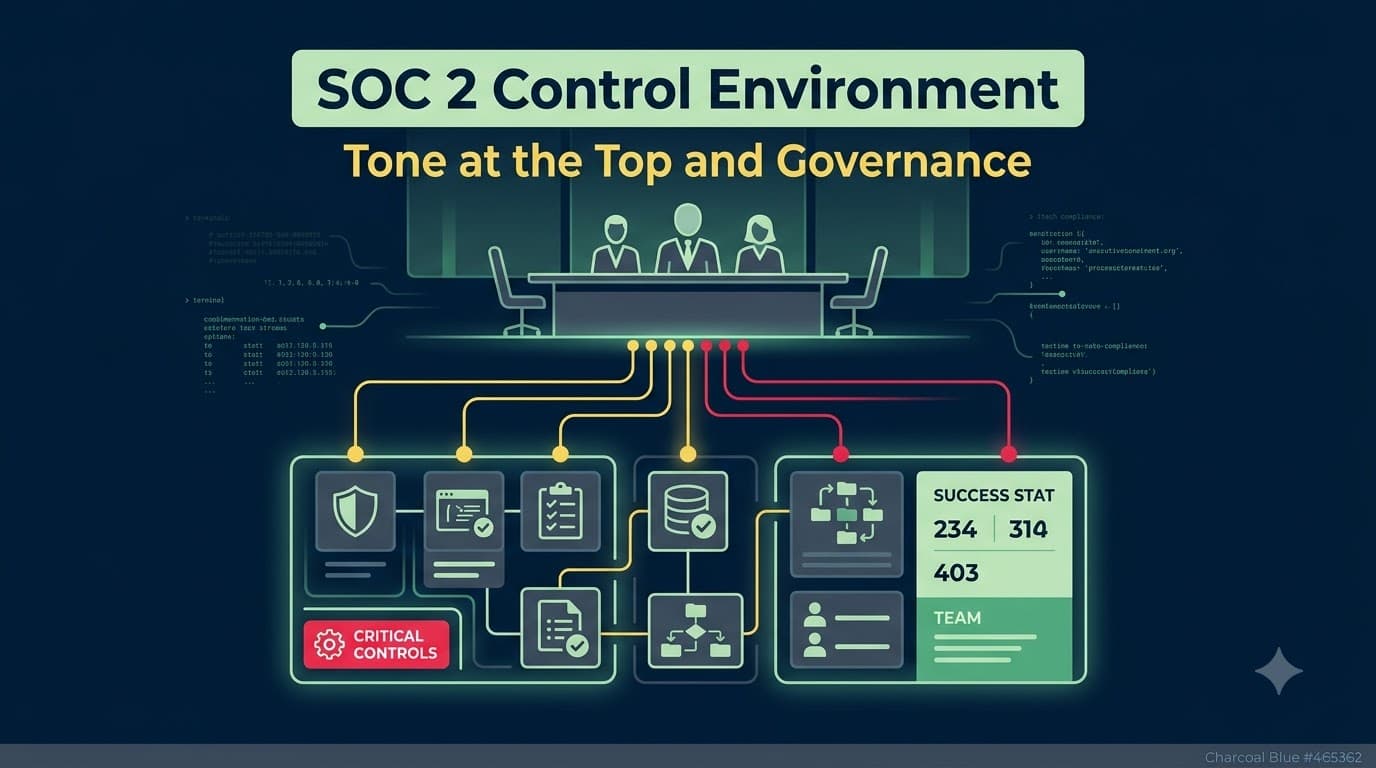
Elena Vasquez had built her career on shipping code, not writing HR policy, so when the board of Cascadia Cloud Systems asked her to take on "interim head of compliance" alongside her VP of Engineering title, she assumed it would mean tightening up a few access reviews and calling it done. Cascadia's workflow-automation platform had quietly become embedded in the back office of eleven regional banks and credit unions, and the twelfth — a $2.4 million, three-year contract with a mid-Atlantic bank holding company — was contingent on a clean SOC 2 Type II report. Elena spent four months getting the technical controls in shape: encryption, access reviews, vulnerability scanning, change management tickets. She was confident walking into fieldwork with Derek Okafor, the engagement partner from Fenwick & Orr CPAs.
Derek's first set of questions weren't about firewalls. He asked for the code of conduct and the attestation log showing which employees had signed it. He asked for board meeting minutes showing security was a standing agenda item. He asked for an org chart that tied job descriptions to actual security responsibilities, and background check records for the three engineers with production database access. Elena had none of it in audit-ready form. The code of conduct was a PDF from 2019 that nobody had re-issued since. There was no security committee, no minutes, no documented escalation path for the CEO's cousin who'd been hired as a contractor with root access and no background screen. Derek's draft management letter flagged five exceptions, all under CC1 — Control Environment — before he'd tested a single access control. The bank's procurement team had made it clear: any qualified opinion killed the deal. Elena had six weeks to fix in prose and process what she'd assumed was a technical checkbox.
What Elena learned the hard way is the subject of this article: the Control Environment isn't a formality bolted onto the "real" security controls. It's the foundation the AICPA's Trust Services Criteria and the underlying COSO framework are built on, and it's usually the first thing an experienced auditor probes — because if leadership doesn't take integrity, oversight, and accountability seriously, nothing downstream (access controls, change management, incident response) can be trusted to hold under pressure.
Who This Is For and What You'll Walk Away With
This is written for anyone standing where Elena stood — engineering leaders, first-time compliance owners, HR partners, and founders who've been told "you need a control environment" without a plain explanation of what that means or how it's evidenced. You'll leave with a working definition of CC1 mapped to its five underlying COSO principles, concrete controls and audit evidence for each principle, sample governance structures (board vs. security committee), a code-of-conduct blueprint, HR and background-check programs that hold up under testing, a realistic build timeline and cost range, and answers to the exceptions auditors cite most often. Nothing here requires you to be a lawyer or a career auditor — just someone willing to put tone-at-the-top on paper and prove it happened.
What Is the SOC 2 Control Environment (CC1)?
Under the AICPA's Trust Services Criteria, every SOC 2 examination — regardless of which optional categories (Availability, Processing Integrity, Confidentiality, Privacy) are in scope — must address the Security category, commonly called the Common Criteria or CC-series. The Common Criteria are organized into nine groups, CC1 through CC9, and each maps to a component of the COSO Internal Control–Integrated Framework. CC1, Control Environment, corresponds to COSO's Component 1 and its five foundational principles:
The entity demonstrates a commitment to integrity and ethical values.
The board of directors demonstrates independence from management and exercises oversight of the development and performance of internal control.
Management establishes, with board oversight, structures, reporting lines, and appropriate authorities and responsibilities in the pursuit of objectives.
The entity demonstrates a commitment to attract, develop, and retain competent individuals in alignment with objectives.
The entity holds individuals accountable for their internal control responsibilities in the pursuit of objectives.
Auditors sometimes describe CC1 as "tone at the top" because it's fundamentally about culture and governance rather than technology. But don't mistake that for soft or unimportant: in a Type II examination, weak CC1 evidence is one of the fastest routes to a qualified opinion, because it undermines the auditor's confidence in every other control they test. If a company can't show that leadership takes ethics and oversight seriously, an auditor has to ask harder questions about whether access reviews, change approvals, and incident response really happened the way the tickets say they did.
Why CC1 Is the Foundation Everything Else Rests On
Think of the nine Common Criteria groups as a building. CC1 is the foundation slab; CC2 (information and communication) and CC3 (risk assessment) are the framing that sits directly on it; CC4 through CC9 are the floors — monitoring, control activities, logical and physical access, system operations, change management, and risk mitigation — that only stand up straight if the slab underneath them is level. An auditor who finds a shaky CC1 doesn't stop testing, but they test everything else more skeptically, because a weak control environment is a leading indicator that documented controls and lived practice have drifted apart.
The cost of skipping CC1 rarely shows up as a single dramatic failure. It shows up as friction: more sample requests from the auditor, more follow-up questions in walkthroughs, a management letter with several small exceptions instead of zero, and a report that reads as "clean but thin" to a sophisticated customer security team doing its own review. None of that necessarily sinks a deal on its own, but in a competitive procurement process where a prospect is comparing your SOC 2 report against a competitor's, a control environment section full of easy, well-evidenced answers reads very differently than one with vague policy references and no board-level detail.
flowchart TD
    CC1["CC1 — Control Environment\n(Integrity, Board Oversight, Structure,\nCompetence, Accountability)"]
    CC2["CC2 — Information & Communication"]
    CC3["CC3 — Risk Assessment"]
    CC4["CC4 — Monitoring Activities"]
    CC5["CC5 — Control Activities"]
    CC6["CC6 — Logical & Physical Access"]
    CC7["CC7 — System Operations"]
    CC8["CC8 — Change Management"]
    CC9["CC9 — Risk Mitigation"]

    CC1 --> CC2
    CC1 --> CC3
    CC1 --> CC4
    CC1 --> CC5
    CC1 --> CC6
    CC1 --> CC7
    CC1 --> CC8
    CC1 --> CC9
    CC2 -.reinforces.-> CC4
    CC3 -.informs.-> CC5
"I don't test CC1 because a checklist tells me to. I test it because it tells me how much I can trust everything else in the report. If the board isn't reading security minutes and nobody's ever been fired for violating the code of conduct, I have to assume the access review logs might have the same gap between paper and practice." — Derek Okafor, Audit Partner, Fenwick & Orr CPAs
That's the practical reason CC1 sits first in the Common Criteria numbering and first in this article series: it's the lens through which every other control gets read.
The Five COSO Principles Behind CC1, at a Glance
Before diving principle by principle, it helps to see the whole picture in one place — the principle, what "good" looks like operationally, and the evidence an auditor will actually request.
Table 1: CC1 Principles 1–5 — Controls and Evidence
# | COSO Principle | Representative Controls | Evidence Auditors Request |
|---|---|---|---|
1 | Commitment to integrity and ethical values | Code of conduct; conflict-of-interest policy; whistleblower/reporting channel; disciplinary process | Signed acknowledgment log; policy version history; hotline/reporting tool screenshots; sample disciplinary case (redacted) |
2 | Board independence and oversight | Independent board members or advisors; security committee with defined charter; recurring security agenda item | Board/committee charter; meeting minutes showing security discussion; attendance records; director independence attestations |
3 | Management establishes structure, authority, responsibility | Org chart; job descriptions with security responsibilities; delegation of authority matrix; RACI for control ownership | Current org chart; sample job descriptions; approved authority matrix; control-ownership RACI |
4 | Commitment to competence | Role-based hiring criteria; background checks; security training program; role-specific technical training | Background check records; training completion logs; role competency matrices; certification tracking |
5 | Accountability | Performance reviews tied to control responsibilities; escalation and consequence model; termination/offboarding process | Performance review templates showing security objectives; sample escalation record; termination checklist and offboarding logs |
Each of these deserves its own deep dive — and its own evidence trail — because auditors will pull samples against every column in that table.
Principle 1: Commitment to Integrity and Ethical Values
Integrity, in COSO's language, isn't a poster in the break room. It's a demonstrable set of standards that the organization holds people to, communicates clearly, and enforces consistently — even when enforcement is inconvenient. For a SOC 2 audit, that means three things have to exist and be current: a written code of conduct, a documented process for reporting violations without fear of retaliation, and evidence that violations actually get investigated and resolved.
The trap most companies fall into — Cascadia included — is treating the code of conduct as a one-time document. It gets written during a compliance push, everyone signs it in their first week, and then it sits untouched for years while the company doubles in size, opens new offices, and adds contractor relationships the original document never anticipated. An auditor testing Principle 1 in a Type II period will ask: when was this last reviewed, who approved the current version, and can you show me that new hires during the audit period actually signed it (not just legacy employees)? A code of conduct with no version history and no attestation log for the current period is effectively unevidenced, even if it's well written.
"The code of conduct is the single most under-invested document in most companies I audit. It's usually good enough to pass a read-through, but nobody can produce a signature log tied to the current version. That's an automatic follow-up question, and often an exception." — Priya Raman, CISO, Solvent Analytics
Building a Real Code of Conduct
A code of conduct that survives audit scrutiny covers more ground than most first drafts. It should be specific enough to guide a real decision, not just state values in the abstract.
Table 2: Code of Conduct — Elements Auditors Expect to See
Element | What It Covers | Why Auditors Look for It |
|---|---|---|
Statement of values | Integrity, respect, legal compliance, client trust | Establishes the baseline standard the rest of the document enforces |
Conflict of interest disclosure | Financial interests, outside employment, family relationships in reporting lines | Prevents undisclosed influence over decisions and hiring |
Confidential information handling | Client data, trade secrets, internal financials | Ties directly into confidentiality and data-handling controls tested elsewhere |
Acceptable use of systems | Company devices, cloud accounts, personal device use | Links tone-at-the-top to technical access controls |
Anti-harassment and anti-discrimination | Workplace conduct standards | Demonstrates the ethical commitment extends to people, not just data |
Gifts, bribery, and anti-corruption | Limits on gifts from vendors/clients, anti-bribery statement | Relevant for vendor and government-adjacent relationships |
Reporting mechanism | Hotline, anonymous form, designated contact | Enables Principle 1's "speak up" expectation |
Non-retaliation clause | Protection for good-faith reporters | Makes the reporting mechanism credible, not theoretical |
Disciplinary consequences | Range of outcomes from coaching to termination | Connects Principle 1 to Principle 5 (accountability) |
Review and approval cycle | Owner, review cadence, approval authority | Shows the document is living, not static |
A workable rule of thumb: review and re-approve the code of conduct at least annually, re-issue it to the entire company (not just new hires) each time it changes materially, and keep a signature log that's queryable by date so you can prove exactly who attested to which version and when.
Principle 2: Board Independence and Oversight
This is the principle that surprises the most first-time SOC 2 candidates, particularly venture-backed startups and privately held companies with small or founder-controlled boards. COSO's Principle 2 asks whether the board — or, for companies without a formal board, an equivalent oversight body — is independent enough from day-to-day management to actually challenge it, and whether that body is exercising real oversight of internal control, not just financial performance.
For an early-stage company, "independence" doesn't require a public-company-style board with a majority of outside directors. What it does require is some structural separation between the people running the business day-to-day and the people evaluating whether controls are working. That's frequently solved by standing up a security committee or risk committee that reports into the board (or into an executive team member who isn't the one being evaluated) with a defined charter, a recurring cadence, and documented minutes.
"Boards love to say security is a priority, and then the actual board packet has one slide with a green checkmark. I ask for the minutes where someone pushed back, asked a hard question, or requested a follow-up. If every meeting is unanimous applause, that's not oversight — that's theater." — Janet Sorrentino, Independent Board Director, Meridian Health Software
Board vs. Security Committee: What SOC 2 Actually Requires
Companies often ask whether they need a full board-level security discussion or whether a delegated committee is sufficient. Both can satisfy Principle 2, provided the structure is documented and the oversight is real.
Table 3: Board-Level Oversight vs. Dedicated Security Committee
Dimension | Full Board Oversight | Dedicated Security/Risk Committee |
|---|---|---|
Best fit | Small boards, early-stage companies | Mid-size to large orgs with complex risk profiles |
Typical cadence | Quarterly, as standing agenda item | Monthly or bi-monthly |
Composition | All directors | Subset of directors + relevant executives (CISO, CTO, Legal) |
Independence signal | At least one non-management/independent director present | Committee chaired by non-executive or independent advisor where possible |
Evidence produced | Board minutes referencing security/risk updates | Committee charter, minutes, action item tracker |
Common failure mode | Security folded into a single generic "any other business" line item | Committee exists on paper but hasn't met during the audit period |
Whichever structure you choose, the auditor's core question is the same: is there a body with real authority that is not solely composed of the people whose performance it's overseeing, and can you show — with dated minutes — that it met, discussed security substantively, and asked follow-up questions?
Table 4: Governance Roles and Responsibilities for CC1
Role | Typical Owner | Core CC1 Responsibility |
|---|---|---|
Board of Directors / Advisory Board | Independent directors, founders, investors | Approves risk appetite; oversees management performance; reviews security posture quarterly |
Security/Risk Committee | CISO, CTO, General Counsel, 1–2 board members | Reviews control effectiveness, incident trends, audit findings between board meetings |
CEO | Chief Executive | Sets and models tone at the top; approves code of conduct; ultimate accountability owner |
CISO / Head of Security | Security or compliance leader | Operationalizes CC1 controls; owns policy library; reports to committee/board |
HR / People Ops | HR Director or VP People | Owns background checks, onboarding/offboarding, performance review integration |
Control Owners | Department managers | Execute and evidence day-to-day controls tied to their function |
Internal Audit / Compliance | Compliance Manager or outsourced GRC partner | Independently tests controls; escalates exceptions before external audit |
What a Security Committee Charter Should Include
A surprising number of companies stand up a security committee and never write down what it's actually for — which leaves the committee vulnerable to drifting into an informal status-update meeting rather than a real oversight body. A written charter, approved by the board, is what turns "we have a committee" into evidence an auditor will accept.
Table 4a: Security Committee Charter — Core Elements
Charter Element | What to Specify |
|---|---|
Purpose and authority | What the committee oversees and what decisions it can make vs. recommend |
Membership and composition | Named roles/individuals, including at least one independent voice |
Meeting cadence | Minimum frequency (e.g., monthly) and quorum requirements |
Standing agenda items | Incident review, audit findings, risk register updates, policy exceptions |
Reporting line | Who the committee reports to (full board, CEO, or both) |
Minute-taking and retention | Who records minutes, where they're stored, and for how long |
Escalation authority | When and how the committee can escalate directly to the board outside the normal cadence |
Annual charter review | Cadence for revisiting and re-approving the charter itself |
Treat the charter the same way you'd treat any other CC1 artifact: version it, date it, and have the board formally approve both the original and any subsequent revisions. An auditor who sees a charter that's never been touched since it was first drafted three years ago will ask the same "is this actually followed" question they'd ask about a stale code of conduct.
Principle 3: Management Establishes Structure, Authority, and Responsibility
Principle 3 asks a deceptively simple question: does everyone in the organization know what they're responsible for, who they report to, and what authority they have to make decisions — particularly security-relevant decisions? The evidence trail here is organizational, not technical: an accurate, current org chart; job descriptions that name security responsibilities explicitly rather than burying them in generic boilerplate; and a delegation of authority matrix that shows who can approve what (new vendor, production access grant, policy exception) at each level.
The failure mode auditors see constantly is organizational drift: the org chart in the data room is six months stale, three people have changed roles, and nobody updated the job description that supposedly assigns them database administration duties. Auditors will cross-reference the org chart against actual access-control lists (tested under CC6) — if the chart says the DBA role reports to Engineering but the access logs show a marketing contractor has the same production privileges, that's a structural gap, not just a documentation error.
"An org chart that hasn't been touched since the Series A is a red flag before I've even asked a question. Companies grow, roles split, and if the paperwork doesn't track it, I start wondering what else isn't tracked." — Sam Okwuosa, GRC Manager, Northlake Payments
Org Charts, Job Descriptions, and RACI
The most audit-resilient approach treats the org chart, job descriptions, and control ownership as one connected system rather than three separate artifacts maintained by different teams.
Table 5: RACI for Core Security Control Ownership
Control Area | Responsible | Accountable | Consulted | Informed |
|---|---|---|---|---|
Code of conduct maintenance | HR Director | CEO | General Counsel, CISO | All employees |
Access provisioning/deprovisioning | IT Manager | CISO | Department managers | HR (for offboarding triggers) |
Vendor security review | Procurement Lead | CISO | Legal, Engineering | Finance |
Incident response | Security Engineer(s) | CISO | Engineering leads, Legal | Executive team, affected customers |
Background check execution | HR Coordinator | HR Director | Hiring manager | CISO (for privileged roles) |
Security committee minutes | Committee Secretary | Committee Chair | CISO, CTO | Board of Directors |
Change approval | Engineering Lead | VP Engineering | Security | Affected teams |
Keep the delegation-of-authority matrix and RACI as living documents reviewed at least twice a year, and version them like code — auditors respond well to a changelog showing deliberate, documented updates rather than silent edits.
Principle 4: Commitment to Competence
Principle 4 is where governance meets HR. COSO defines competence as the knowledge and skills necessary to accomplish tasks that define an individual's role — and for SOC 2 purposes, that extends specifically to security-relevant knowledge. Auditors are testing whether the organization deliberately attracts, develops, and retains people capable of executing the controls the rest of the report describes, rather than relying on whoever happened to be available to fill a seat.
Concretely, this shows up in three control families: hiring criteria that name required skills and, where relevant, security clearance or specific certifications for sensitive roles; background screening scaled to role sensitivity; and an ongoing training program — both general security awareness and role-specific technical training — with completion tracked and enforced.
Background Checks and Hiring Controls
Background checks are the single most commonly tested Principle 4 control, and also one of the most commonly under-scoped. A blanket policy — "we background check everyone the same way" — often fails because it either over-screens low-risk roles (wasting money and slowing hiring) or under-screens high-risk ones (the exact gap that hurt Cascadia when the CEO's cousin got production access with no screen at all).
Table 6: Background Check Scope by Role Sensitivity
Role Tier | Example Roles | Typical Screen | Re-screen Cadence |
|---|---|---|---|
Tier 1 — Privileged/Production Access | DevOps, DBAs, senior engineers with prod access | Criminal history, employment verification, education verification | Every 2–3 years or on role change |
Tier 2 — Customer Data Access | Support, implementation, account management | Criminal history, employment verification | Every 3 years |
Tier 3 — Financial Access | Finance, accounting, payroll | Criminal history, credit check (where legally permitted), employment verification | Annually or per finance policy |
Tier 4 — General Staff | Marketing, non-technical roles without sensitive access | Criminal history | At hire only |
Contractors/Temp Staff with System Access | Contract engineers, outsourced support | Same tier as equivalent employee role | At engagement start; renewed for engagements over 12 months |
Table 7: Competence and HR Controls Supporting CC1
Control | Purpose | Evidence |
|---|---|---|
Role-based job requisitions | Ensures required skills/certifications are defined before hiring | Job posting and requisition records |
Background screening policy | Standardizes screening by role tier | Signed policy; screening vendor reports (redacted) |
Security awareness training (all staff) | Baseline knowledge of phishing, data handling, incident reporting | LMS completion reports, quiz scores |
Role-specific technical training | Deeper skills for engineers, admins, support with elevated access | Training certificates, internal completion logs |
Professional certification tracking | Verifies ongoing competence for specialized roles (e.g., cloud, security) | Certification registry with expiration dates |
New-hire security onboarding | Ensures Day 1 understanding of policies and responsibilities | Onboarding checklist, signed acknowledgments |
Contractor competence verification | Extends the same standard to non-employees with access | Contractor agreements referencing training/screening requirements |
A practical target for most mid-size service organizations: 100% background screen completion before system access is granted (not just before start date), and 95%+ annual security awareness training completion with automated escalation for stragglers.
Principle 5: Accountability
Accountability closes the loop. It's not enough to define structure (Principle 3) and hire competent people (Principle 4) — the organization has to actually hold individuals to their control responsibilities, and there have to be real consequences, positive and negative, tied to performance. Auditors test this by looking for evidence that security and compliance responsibilities show up in performance management, and that there's a documented, followed process when someone falls short — up to and including termination for serious violations.
The most common Principle 5 exception isn't a missing policy; it's a policy that exists but was never applied. An escalation procedure that's never been triggered during the audit period, a disciplinary process with no case history, or performance review templates that don't mention security responsibilities at all for roles that clearly have them — all of these tell an auditor that accountability is aspirational rather than operational.
"I once reviewed a company with a beautifully written escalation matrix — five tiers, clear owners, SLAs for each. Then I asked for one example where it was actually used. Nothing. Eighteen months, zero invocations, in a company that had definitely had at least one policy violation in that window. The document was real; the accountability wasn't." — Dr. Angela Ferris, Audit Committee Chair, Vantage Robotics
Performance Management and Consequences
Table 8: Accountability Mechanisms and What They Evidence
Mechanism | How It Works | Evidence for Auditors |
|---|---|---|
Performance review integration | Security/compliance objectives included in role-specific review templates | Sample completed reviews (redacted) referencing control responsibilities |
Escalation matrix | Defines who is notified and what action is taken for policy violations or incidents | Documented escalation instance with timestamps and resolution |
Disciplinary action log | Tracks violations and outcomes (coaching, warning, termination) | Redacted case log showing consistent application |
Manager accountability reviews | Managers assessed partly on whether their team follows control processes | Manager scorecards or 1:1 notes referencing compliance |
Recognition/incentive alignment | Positive reinforcement for strong security practice (not just punishment) | Recognition program records, bonus criteria documentation |
Offboarding accountability | Access and asset return verified and signed off at termination | Offboarding checklist with sign-off dates matched to termination date |
The offboarding row deserves emphasis: a delayed deprovisioning — access revoked days after termination instead of the same day — is one of the most frequently cited CC1/CC6 crossover exceptions in Type II reports, because it demonstrates a breakdown at the exact moment accountability matters most.
How Auditors Actually Test CC1
Unlike a technical control such as "MFA is enforced on all admin accounts," CC1 controls are largely inspected through document review, walkthroughs, and inquiry rather than automated evidence pulls — which means preparation quality matters enormously. A Type II examination tests operating effectiveness across the whole audit period (commonly 3–12 months), so a policy that looks good today but wasn't followed in month three of the period will still generate an exception.
Table 9: How Auditors Test Each CC1 Principle
Principle | Typical Test Procedure | Sample Size Approach |
|---|---|---|
1. Integrity/ethics | Inspect code of conduct version history; sample new-hire attestations; review any hotline reports and resolutions | Sample of new hires across the period; all reported incidents |
2. Board oversight | Inspect board/committee charter and minutes across the period; confirm independence of at least one member | All meetings scheduled during the period |
3. Structure/authority | Compare org chart to access-control listings; inspect job descriptions for sampled roles; test delegation-of-authority matrix against actual approvals | Sample of roles across departments, cross-checked against CC6 access data |
4. Competence | Inspect background check records for sampled hires; review training completion logs | Sample of hires and a sample of the active workforce for training |
5. Accountability | Inspect performance review templates; test any escalation/disciplinary instances during the period; verify offboarding timing | All disciplinary/escalation events; sample of terminations for offboarding timing |
Because these are largely inquiry- and inspection-based tests, the auditor's confidence hinges heavily on consistency: does the story told by the org chart match the story told by the access logs, the HR system, and the people interviewed in walkthroughs? Inconsistency — even innocent inconsistency from stale documentation — is what generates follow-up requests and, eventually, exceptions.
Auditor Interview Questions: What CC1 Walkthroughs Sound Like
Document review only tells an auditor half the story. Every CC1 examination also includes walkthrough interviews — conversations with a handful of employees at different levels, chosen specifically to test whether the paper trail matches what people actually experience day to day. First-time candidates are often caught off guard by how conversational these interviews feel, right up until a follow-up question exposes a gap between policy and practice.
Table 9a: Sample CC1 Walkthrough Questions by Principle
Principle | Sample Question Asked of Employees | What a Weak Answer Sounds Like |
|---|---|---|
1. Integrity/ethics | "If you saw a coworker misusing customer data, what would you do?" | "I guess I'd tell my manager?" (no known channel, no confidence in follow-through) |
2. Board oversight | "How does the board or leadership stay informed about security issues?" | "I'm not really sure what the board does" (from a manager who should know) |
3. Structure/authority | "Who approves a new hire getting access to production systems?" | Inconsistent answers between the requester and the approver |
4. Competence | "What training did you complete before you got system access?" | "I don't remember doing any training" |
5. Accountability | "Has anyone ever been let go or disciplined for a policy violation you're aware of?" | Long pause, or "I wouldn't know if that happened" |
The goal isn't to catch employees off guard — it's consistency. If five different employees describe the escalation process five different ways, that tells the auditor the process isn't well communicated even if the document itself is perfectly written. Before fieldwork, it's worth running a handful of practice interviews internally, particularly with newer hires and people outside the security/compliance function, since they're the ones most likely to reveal where communication actually breaks down.
"I always interview at least one person who's been at the company less than six months. If tone at the top only reaches people who were there when the policies were written, it isn't really tone at the top — it's institutional memory, and institutional memory doesn't survive turnover." — Derek Okafor, Audit Partner, Fenwick & Orr CPAs
Evidence Artifacts You'll Need for CC1
Before fieldwork starts, it's worth assembling a single evidence package mapped directly to the five principles so nothing gets requested cold during the audit.
Table 10: CC1 Evidence Artifact Checklist
Artifact | Principle(s) Covered | Owner | Refresh Cadence |
|---|---|---|---|
Code of conduct (current version) + signature log | 1 | HR / Legal | Annual review; log updated continuously |
Conflict of interest disclosures | 1 | HR / Legal | Annual, plus on role/relationship change |
Whistleblower policy / reporting channel logs | 1 | Legal / HR | Continuous; reviewed quarterly |
Board/security committee charter | 2 | Board Secretary / CISO | Reviewed annually |
Board/committee meeting minutes | 2 | Board Secretary | Per meeting |
Director independence attestations | 2 | Legal / Board Secretary | Annual |
Current org chart | 3 | HR / Executive team | Updated on any material change |
Job descriptions (security-relevant roles) | 3 | HR / Department heads | Annual review |
Delegation of authority matrix | 3 | Finance / Legal / CISO | Annual review |
Background check records | 4 | HR | Per hire; re-screen per policy |
Training completion logs | 4 | HR / L&D or LMS admin | Continuous |
Performance review templates and samples | 5 | HR | Annual cycle |
Escalation/disciplinary case log | 5 | HR / Legal | Continuous |
Offboarding checklist and sign-offs | 3, 5 | IT / HR | Per termination |
Store these centrally — a compliance automation platform, a well-organized shared drive, or a GRC tool — and tag each artifact with the review period it covers. The single biggest time cost auditors report in CC1 fieldwork isn't finding problems; it's chasing down scattered documents that exist somewhere but weren't organized for the audit period being tested.
Common CC1 Exceptions and How to Avoid Them
Certain CC1 findings show up again and again across engagements, largely because they're organizational rather than technical, and organizations change faster than paperwork. Knowing the recurring patterns lets you self-audit before an external auditor finds them for you.
Table 11: Common CC1 Audit Exceptions
Exception | Root Cause | Fix |
|---|---|---|
Code of conduct not re-attested during audit period | Attestation only captured at hire, never refreshed | Annual re-attestation campaign for all staff, logged with timestamps |
No evidence board discussed security | Security folded into generic board update with no minutes detail | Standing agenda item explicitly labeled "Security/Compliance Update," minuted separately |
Org chart doesn't match access records | Org chart updated manually and infrequently | Tie org chart updates to HRIS changes; reconcile quarterly against access-control lists |
Background check missing for privileged contractor | Contractors excluded from screening policy scope | Extend background-check policy explicitly to contractors/temp staff with system access |
Escalation procedure never tested during period | Policy written but no real incident occurred, or incidents handled informally | Run a tabletop exercise during the period to generate documented evidence of the process working |
Delayed access deprovisioning at termination | No same-day trigger between HR termination and IT offboarding | Automate offboarding trigger from HRIS termination event to access revocation ticket |
Job descriptions don't reflect actual duties | Descriptions never updated after role evolved | Annual job description review tied to performance review cycle |
No independent board member | Founder-only board with no external oversight | Add an independent advisor or investor-designated director with defined oversight role |
Most of these are fixable in weeks, not months — but only if you find them before the auditor does, since a Type II exception documented in a report is far more damaging to a sales cycle than a gap closed quietly during readiness work.
Building Your CC1 Program: A Realistic Roadmap
Companies frequently underestimate how long CC1 takes to stand up properly, in part because it touches HR, Legal, and the board — none of whom move at engineering speed. A phased build keeps the program from stalling.
Table 12: CC1 Build Roadmap
Phase | Timeframe | Key Activities | Primary Owner |
|---|---|---|---|
Phase 1 — Assessment | Weeks 1–2 | Gap analysis against all five principles; inventory existing policies, org chart, board cadence | Compliance lead / GRC consultant |
Phase 2 — Governance structure | Weeks 2–5 | Stand up or formalize security committee; define charter; schedule recurring meetings | CEO / Board |
Phase 3 — Policy and code of conduct | Weeks 3–6 | Draft/update code of conduct, conflict-of-interest policy, whistleblower channel | HR / Legal |
Phase 4 — HR controls | Weeks 4–8 | Define background-check tiers; select vendor; update hiring workflows | HR |
Phase 5 — Structure and accountability | Weeks 5–9 | Update org chart, job descriptions, delegation-of-authority matrix; embed security in performance reviews | HR / Department heads |
Phase 6 — Evidence assembly and dry run | Weeks 9–12 | Compile artifact package; run internal mock walkthrough against auditor test procedures | Compliance lead |
Twelve weeks is a realistic target for a mid-size organization building CC1 largely from scratch; companies with an existing HR function and some governance rhythm can often compress this to six to eight weeks. What can't be compressed is the observation period itself — Type II evidence has to be generated by living the controls, not backfilled after the fact.
What CC1 Actually Costs
CC1 is comparatively low-cost relative to technical controls like SIEM tooling or penetration testing, because most of the spend is time, not software — but it isn't free, and budgeting for it upfront avoids mid-project surprises.
Table 13: Illustrative CC1 Build Costs (Mid-Size Service Organization)
Cost Category | Illustrative Range | Notes |
|---|---|---|
GRC/compliance consultant (readiness support) | $8,000–$20,000 | One-time engagement, scoped to CC1 plus adjacent CC2/CC3 |
Background check vendor (per employee) | $30–$120 | Varies by tier and jurisdiction |
Security awareness training platform (annual, per seat) | $15–$40/seat/year | Often bundled with broader compliance training suite |
Policy management / GRC platform subscription | $6,000–$25,000/year | Scales with headcount and number of frameworks tracked |
Independent board advisor stipend (if added) | $10,000–$40,000/year | For companies without existing independent oversight |
Internal staff time (HR, Legal, CISO) | 150–300 hours | Largest true cost; mostly opportunity cost, not cash spend |
For a company already carrying cyber liability insurance or legal counsel on retainer, several of these line items (whistleblower channel, conflict-of-interest policy templates) may already be partially funded through existing relationships — worth checking before commissioning net-new work.
CC1 Maturity Model
Not every organization needs to build CC1 to the same depth on day one. A maturity model helps calibrate expectations for where you are and where a Type II audit requires you to be.
Table 14: CC1 Maturity Levels
Level | Characteristics | Audit Readiness |
|---|---|---|
Level 1 — Ad hoc | Policies exist informally or not at all; no board security discussion; hiring inconsistent | Not ready for Type I or Type II |
Level 2 — Documented | Core policies written and approved; governance body exists but meets irregularly | Marginal for Type I with likely exceptions |
Level 3 — Managed | Policies current and attested; committee meets on cadence with minutes; background checks tiered and enforced | Ready for Type I; borderline for Type II |
Level 4 — Operationalized | All CC1 controls evidenced continuously across a full period; performance reviews and offboarding integrated | Ready for Type II |
Level 5 — Optimized | CC1 controls automated and monitored (HRIS-triggered offboarding, automated attestation campaigns); used as a differentiator in sales | Ready for Type II with minimal exceptions; supports multi-framework reuse (e.g., alongside an ISMS built on ISO 27001) |
Most first-time Type II candidates should target Level 3 going into the observation period and Level 4 by the time fieldwork starts — Level 5 is an efficiency play worth pursuing only after you've been through at least one successful audit cycle.
Tone at the Top in Remote and Distributed Organizations
CC1 gets harder, not easier, when leadership and staff are distributed across time zones and the "top" isn't a hallway anyone walks down. A remote-first organization can absolutely satisfy CC1 — plenty of the strongest control environments I've reviewed belong to fully distributed companies — but it requires deliberately engineering the signals that used to happen by osmosis in an office.
That means recorded (not just live) all-hands sessions where leadership addresses ethics and security expectations directly, so the message reaches async employees with the same fidelity as those in the live meeting. It means a written escalation and reporting channel that doesn't depend on knowing which Slack channel the CISO happens to be active in that week. And it means background checks and onboarding attestations that are enforced identically regardless of whether HR has ever met the employee in person — a gap that shows up disproportionately with contractors and offshore hires who sometimes get fast-tracked around standard hiring workflows under deadline pressure.
"We're a distributed team across four countries, and our auditor specifically asked how we knew tone at the top actually reached someone in a different time zone who's never met our CEO in person. We ended up building a quarterly recorded address plus a written summary, both logged in our LMS with mandatory acknowledgment. That became some of our strongest CC1 evidence, ironically because it was more auditable than an in-person meeting ever was." — Tom Bellweather, Head of People Ops, Cascadia Cloud Systems
The upside of distributed-team CC1 evidence is that it's often more auditable than in-office equivalents by default — recorded, timestamped, and logged — provided you resist the temptation to let informal Slack messages substitute for documented policy communication.
CC1 in Regulated and High-Stakes Industries
The baseline CC1 expectations described so far apply across every service organization pursuing SOC 2, but the bar rises meaningfully for companies operating in regulated or high-trust industries, where customer due diligence teams read the Control Environment section of a report with an especially skeptical eye. Healthcare technology vendors, fintech and payments companies, and organizations handling government-adjacent data all tend to face deeper scrutiny on the same five COSO principles — not different criteria, just a higher evidentiary bar applied to each one.
A healthcare scheduling platform like Meridian, for example, is judged not only on whether its background-check policy exists but on whether it extends meaningfully to roles with any path to protected health information, including support staff and contracted implementation specialists who might never touch code but routinely see patient names and appointment details. A payments company faces similar pressure on Principle 2: bank and card-network customers frequently ask, informally or in a security questionnaire, whether the security committee includes anyone with a background in financial risk or regulatory compliance specifically, not just general technology governance.
Table 15a: CC1 Expectations by Industry Context
Industry Context | Heightened CC1 Expectation | Typical Customer Ask |
|---|---|---|
Healthcare / HealthTech | Background checks extended to any role with PHI exposure, including support and implementation | "Show us your screening policy covers contractors with data access" |
Financial services / Payments | Security committee includes financial-risk or regulatory expertise | "Who on your board or committee has a compliance background?" |
Government-adjacent / Public sector vendors | Formal conflict-of-interest and anti-corruption controls, documented independence of oversight | "Provide your conflict-of-interest policy and disclosure log" |
Multi-national / Distributed workforce | Consistent enforcement of CC1 controls across jurisdictions with different labor and privacy law | "Confirm background checks are legally permissible and consistently applied in each country" |
None of this changes the underlying five principles — it changes how deep the evidence trail needs to run, and how specifically it needs to map to the risks your particular customer base cares about. If your company sells into a regulated vertical, it's worth reviewing your CC1 evidence package with that customer's likely due-diligence questions in mind before the auditor ever shows up, since a sales-driven security review often probes harder than the SOC 2 examination itself.
HR Policies That Support CC1
HR is the operational engine behind most of CC1, even though security teams often own the audit relationship. Getting the underlying policy set right avoids scrambling to draft documents mid-audit.
Table 15: Core HR Policy Inventory for CC1
Policy | Principle(s) Supported | Owner | Review Cadence |
|---|---|---|---|
Code of conduct | 1 | HR / Legal | Annual |
Conflict of interest policy | 1 | Legal | Annual |
Anti-harassment and equal opportunity policy | 1 | HR | Annual |
Whistleblower / reporting policy | 1, 5 | Legal / HR | Annual |
Background check policy | 4 | HR | Annual |
Onboarding and security awareness policy | 4 | HR / Security | Annual |
Performance management policy | 5 | HR | Annual |
Disciplinary action policy | 5 | HR / Legal | Annual |
Termination and offboarding policy | 3, 5 | HR / IT | Annual |
Remote work and acceptable use policy | 1, 3 | IT / HR | Annual |
Bundle these into a single, indexed "employee handbook plus security addendum" so employees see one coherent document set rather than a scattered pile of PDFs — and so auditors can trace a clean line from policy to attestation to enforcement.
Common Pitfalls Beyond the Standard Exceptions
A few mistakes don't show up neatly as a single "exception" line item but quietly undermine CC1 credibility across the whole engagement.
The first is treating CC1 as a one-person job. Elena's original instinct — that a VP of Engineering could own the entire control environment — is common and understandable, but Principle 2 through Principle 5 inherently require cross-functional ownership across HR, Legal, and the board. A CC1 program run entirely out of engineering tends to under-invest in the people-and-governance controls that aren't naturally in an engineer's toolkit.
The second is confusing policy existence with policy operation. Auditors don't just want to see a document; they want to see it followed, with dated evidence spanning the full observation period. A whistleblower policy with zero reports over eighteen months isn't necessarily a red flag on its own, but combined with anecdotal evidence (from employee interviews) that people don't know the channel exists, it becomes one.
The third is neglecting the connective tissue between CC1 and the technical controls it underwrites. An org chart that isn't reconciled against actual access-control lists, or a background-check policy that isn't actually enforced before provisioning production credentials, creates exactly the kind of paper-versus-practice gap auditors are trained to hunt for.
The fourth, and probably the most avoidable, is waiting until the observation period is already underway to start fixing gaps. Because Type II evidence has to be generated across the whole period, a CC1 fix made in month nine of a twelve-month window still leaves three months of clean evidence — usually enough for an auditor to note improvement, but not enough to avoid the exception entirely for the months before the fix. Companies that build in a mid-period internal review, roughly halfway through the observation window, catch most of these gaps with enough runway left to close them cleanly before fieldwork starts.
How CC1 Connects to the Rest of the Common Criteria
CC1 doesn't operate in isolation — every other Common Criteria group either depends on it directly or is strengthened by it. Understanding these connections helps prioritize where to invest first and helps explain to skeptical stakeholders why "soft" governance work has hard downstream consequences.
Table 16: CC1's Influence on the Other Common Criteria Groups
Common Criteria Group | Focus | How CC1 Underwrites It |
|---|---|---|
CC2 — Information and Communication | Internal/external communication of objectives and responsibilities | Board and management communication channels established under CC1 carry security messaging |
CC3 — Risk Assessment | Identifying and analyzing risk | Risk appetite and objectives are set by the governance body established under Principle 2 |
CC4 — Monitoring Activities | Ongoing evaluation of control effectiveness | Accountability mechanisms (Principle 5) drive whether monitoring findings actually get acted on |
CC5 — Control Activities | Policies and procedures that mitigate risk | Structure and authority (Principle 3) determine who can approve and enforce these activities |
CC6 — Logical and Physical Access | Access control implementation | Background checks and role structure (Principles 3–4) directly gate who should have access at all |
CC7 — System Operations | Detecting and responding to operational issues | Competent, accountable staff (Principles 4–5) are the ones executing detection and response |
CC8 — Change Management | Controlling changes to systems | Delegation of authority (Principle 3) defines who can approve production changes |
CC9 — Risk Mitigation | Vendor and business disruption risk | Ethical standards (Principle 1) extend into vendor conduct expectations and vendor risk management |
If you're sequencing a broader Common Criteria build, our companion pieces on the SOC 2 Security Criteria, the SOC 2 risk assessment process, information and communication requirements, monitoring activities, and day-to-day control activities all build directly on the governance foundation described here.
Case Study 1: Cascadia Cloud Systems — From Five Exceptions to a Clean Report
When Derek Okafor's draft management letter landed with five CC1 exceptions, Elena Vasquez's six-week clock started immediately. The team split the work by principle: Legal and HR rewrote and re-issued the code of conduct with a mandatory e-signature campaign that captured 100% of the current workforce within nine days. The board — previously three founders and one investor — added an independent advisor with a cybersecurity background who chaired a newly chartered security committee meeting monthly, with minutes distributed to the full board. HR built a three-tier background check policy and immediately screened the four privileged users, including the CEO's cousin, who separately went through a documented conflict-of-interest disclosure given the family relationship. The org chart was rebuilt and reconciled line-by-line against the access-control export from the identity provider, closing two access mismatches in the process. By the time Fenwick & Orr returned to test evidence six weeks later, all five CC1 exceptions had closing evidence, and — critically — the auditors were testing evidence generated during the current audit period, not just policy documents. Cascadia's Type II report shipped with an unqualified opinion, the bank contract closed at $2.4 million over three years, and Elena's role converted from "interim" to permanent Head of Compliance within the quarter.
Case Study 2: Solvent Analytics — Building CC1 In Before It Was Required
Not every company gets the six-week scramble. Solvent Analytics, a fraud-analytics SaaS vendor serving mid-market banks, made a deliberate decision at 40 employees — well before its first SOC 2 engagement — to build its governance structure ahead of need rather than in reaction to audit pressure. CISO Priya Raman used the five COSO principles as a literal build checklist: a code of conduct drafted with outside counsel and re-attested every January; a security committee that met monthly from month one, chaired by an independent board observer brought on specifically for that purpose; background checks tiered from day one, before any customer contract required them; and security objectives written directly into every engineering and support role's quarterly review template. When Solvent engaged an audit firm for its first Type II examination, fieldwork on CC1 took four business days instead of the multi-week remediation cycle common for first-time candidates, and the report shipped with zero CC1 exceptions. Priya's team estimated the proactive build cost roughly 15% more calendar time upfront than a bare-minimum approach, but saved an estimated ten weeks of audit remediation and, more importantly, avoided any qualified-opinion risk during a fundraising round where the SOC 2 report was part of investor diligence.
Case Study 3: Meridian Health Software — Recovering from a Failed First Attempt
Meridian Health Software, a clinical scheduling platform, went into its first Type II examination confident based on a strong technical security posture — encrypted data, mature access controls, solid change management. Its CC1 program, however, existed almost entirely on paper: a code of conduct nobody had re-signed in three years, a board that discussed security only when an incident forced the conversation, and an HR function that had never formalized background-check tiers, relying instead on ad hoc judgment calls per hire. The audit firm issued a qualified opinion, citing insufficient evidence of board oversight and inconsistent background screening for two hires with database access during the period. The qualified report cost Meridian a signed healthcare-network contract that required an unqualified opinion as a condition of the deal. Independent board director Janet Sorrentino was brought on in the aftermath specifically to chair a new security committee, and Meridian spent the following observation period rebuilding CC1 from the ground up — including running a documented tabletop exercise specifically to generate evidence that its (previously untested) escalation policy actually worked. The second Type II examination, twelve months later, came back unqualified, and Meridian used the turnaround story itself as a credibility point in renewed sales conversations, framing the rebuild as proof of a mature, self-correcting governance program rather than hiding the earlier qualified opinion.
Table 17: Case Study Outcomes at a Glance
Organization | Starting Point | Key CC1 Interventions | Outcome |
|---|---|---|---|
Cascadia Cloud Systems | Five CC1 exceptions found mid-audit | Code of conduct re-attestation, independent advisor added, tiered background checks, org chart reconciliation | Unqualified opinion; $2.4M contract closed; compliance role made permanent |
Solvent Analytics | Built CC1 proactively pre-audit | Committee from month one, tiered screening from day one, reviews tied to security objectives from the start | Zero CC1 exceptions; 4-day CC1 fieldwork; supported investor diligence |
Meridian Health Software | Strong technical controls, weak CC1 | Independent board chair added, tabletop exercise for escalation evidence, full HR rebuild | Qualified opinion year one; unqualified year two; turnaround used as sales credibility |
Governance as a Competitive Advantage, Not a Compliance Tax
It's tempting to treat CC1 as the least interesting part of a SOC 2 program — no firewalls, no encryption keys, just policies and meeting minutes. But every practitioner quoted in this article arrived at the same conclusion from a different angle: a strong control environment is what lets a prospective customer's security team trust the rest of your report without re-verifying it line by line. When a bank's procurement team, a hospital system's vendor risk analyst, or an enterprise CISO reads "unqualified opinion" on your Type II report, CC1 is the part of that opinion that tells them your organization doesn't just have good controls today — it has a structure built to keep having them next year, under a different set of employees, after the person who wrote the original policy has moved on.
That durability is a genuine sales asset. Companies that treat governance as a strategic differentiator — publishing a clear trust story, pointing prospects to board-level security oversight, being able to answer "who's accountable if something goes wrong" without hesitation — consistently shorten security review cycles in enterprise deals. Solvent Analytics' four-day CC1 fieldwork wasn't just an audit efficiency; it became a talking point in its own sales process, evidence that the company's governance would hold up under the same scrutiny its prospective customers were about to apply.
It also compounds beyond a single audit cycle. Every one of the five COSO principles behind CC1 — integrity, oversight, structure, competence, accountability — is a muscle an organization either builds once and maintains cheaply, or lets atrophy and has to rebuild expensively under audit pressure every year. Elena Vasquez's six-week scramble at Cascadia cost real time and real stress that Priya Raman's team at Solvent never had to spend, precisely because Solvent treated CC1 as infrastructure rather than a pre-audit fire drill. The organizations that get the most value out of SOC 2, year after year, are the ones that stop thinking of the Control Environment as something an auditor checks and start thinking of it as how they actually want to run the company.
If you're building or repairing your control environment, don't go it alone. Our SOC 2 Readiness Checklist walks through every CC1 evidence artifact referenced in this article, the SOC 2 Control Matrix / RACI Template gives you a starting point for the ownership tables above, and our SOC 2 Policy Pack includes drafts of the code of conduct, background-check policy, and escalation procedures most first-time candidates need to write from scratch. If you're still mapping out which framework fits your business, PentesterWorld's consulting team has walked organizations of every size — from four-person startups to regulated enterprises — through exactly the CC1 build described here, and can shortcut months of trial and error into a structured, audit-ready program.