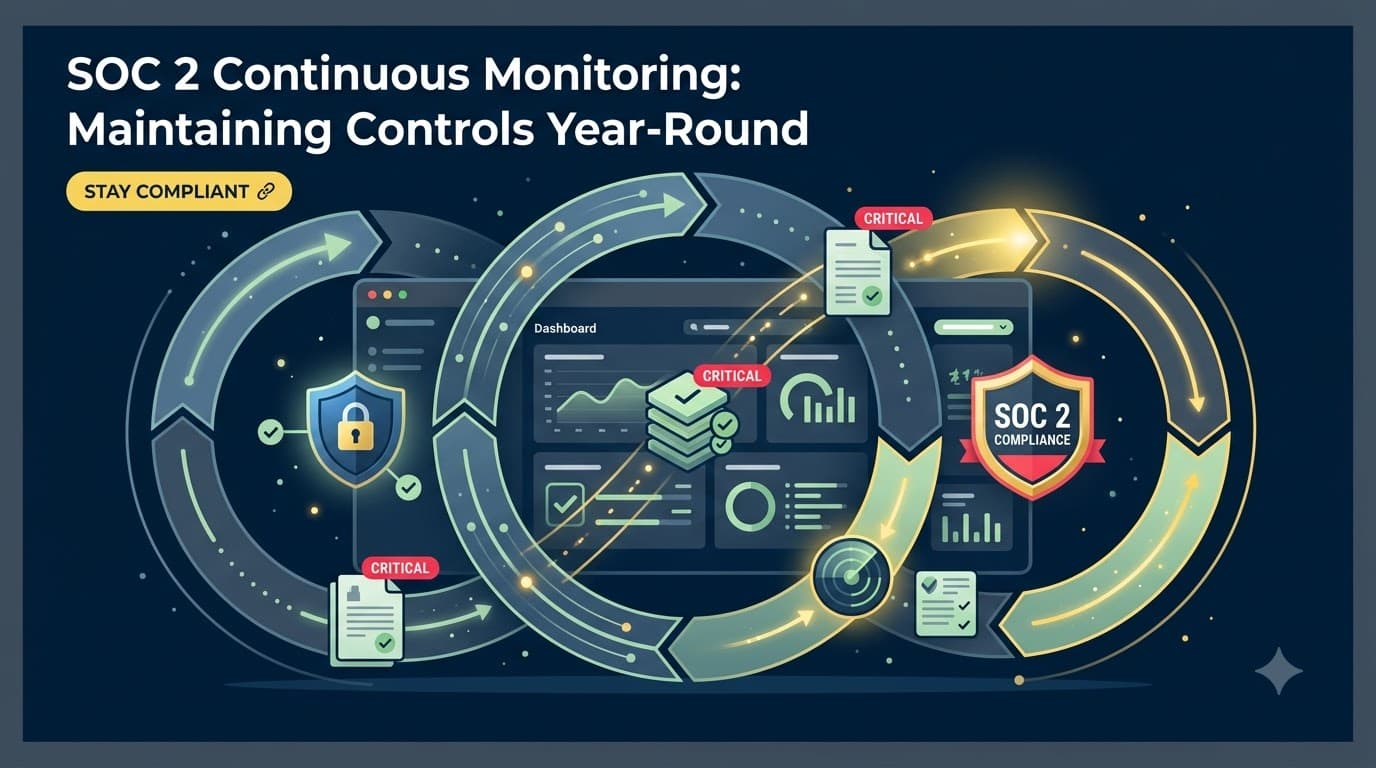
Priya Nandakumar had eleven days until the observation period closed, and a spreadsheet open in one monitor that made her stomach drop. She was Head of Security & Compliance at Kestrel Analytics, a 140-person data analytics SaaS company that had spent the last nine months courting a Tier-1 regional bank as a customer. The deal was worth $3.2 million in annual recurring revenue, and the bank's procurement team had been unambiguous: no clean SOC 2 Type II report, no signature. Priya's auditor had just sent a routine mid-period evidence pull — screenshots of MFA enforcement across all privileged accounts — and the export showed twenty-two accounts where multi-factor authentication had silently fallen off six weeks earlier, during a rushed identity-provider migration nobody had thought to check afterward.
Nothing had been exploited. No customer data was touched. But the control hadn't been operating for forty-two days of a ninety-day observation period, and Priya's auditor was going to write that down as an exception whether Priya liked it or not. She spent the next four days doing what compliance teams have done for a decade: chasing screenshots, reconstructing timelines from ticket logs, interviewing engineers about what they remembered from six weeks prior, and hoping the exception would read as "isolated and remediated" rather than "we don't actually know what our controls are doing between audits." The bank's deal closed — barely, and with a qualifying conversation about the exception that Priya never wants to have again.
That near-miss is the entire reason this article exists. Kestrel Analytics didn't have a design problem — their MFA policy was sound, their control statement was accurate, their access reviews were adequate on paper. They had a monitoring problem: nobody was watching the control operate between the quarterly access review and the annual audit. This is the single most common failure mode in SOC 2 programs, and it's entirely preventable with a continuous monitoring approach that treats compliance as a living, always-on system rather than a project that gets dusted off every twelve months.
Who This Is For / What You'll Walk Away With
This article is for security and compliance leaders, engineering managers, and control owners at service organizations who have already been through at least one SOC 2 audit cycle — or are deep into readiness — and are tired of the pre-audit fire drill. You'll walk away with a vendor-neutral map of the tooling categories that make continuous evidence collection possible, a control-by-control view of what can and can't be automated, a realistic cadence for control owners so monitoring doesn't become another full-time job, and a metrics scorecard you can put in front of leadership to prove the program is working. We'll also work through what "operating effectiveness" legally requires under a Type II examination, and how continuous monitoring changes the conversation you have with your auditor — from a defensive scramble to a confident walk through a system that's been watching itself all year.
The Myth of the "Point-in-Time" SOC 2
Most first-time SOC 2 candidates mentally model the audit as a single event: a week in the fall when the auditor shows up, pokes around, and issues a report. That mental model is roughly correct for a Type I report, which opines on whether controls are suitably designed as of a specific date. It is dangerously wrong for a Type II report, which is what the overwhelming majority of enterprise customers now require before they'll sign a contract. A Type II examination tests whether controls operated effectively across an entire observation window — typically three to twelve months — not whether they looked good on the day the auditor called.
That distinction sounds academic until you live through what happened to Priya: a control that was well-designed and functioning on day one of the period, and again on day ninety, but silently disabled for six weeks in the middle, still generates an exception. The auditor isn't testing your intentions. They're testing your evidence trail across the full audit period, and if you can't produce evidence for a stretch of that window, you can't prove the control operated — even if you're confident it did. We cover the mechanics of this choice in SOC 2 Type I vs Type II: Choosing the Right Audit Type, but the operational implication is the point of this article: if your evidence-gathering process is a once-a-year event, you are structurally incapable of proving a Type II claim with confidence, no matter how good your controls actually are.
Anatomy of the Q4 Scramble
Ask any compliance lead who has been through two or three audit cycles without a continuous monitoring program what the six weeks before fieldwork look like, and you'll hear a version of the same story. Here's what that scramble typically involves, and the real cost it imposes.
Scramble Activity | What It Actually Involves | Typical Time Cost | Downstream Risk |
|---|---|---|---|
Screenshot archaeology | Digging through ticketing systems, chat logs, and email to reconstruct evidence of events months old | 2–4 weeks of a compliance analyst's time | Evidence may not exist or may be unverifiable |
Access review reconciliation | Manually comparing HR termination dates against system access logs across a dozen tools | 1–2 weeks | Terminated users found still active = automatic exception |
Control owner chase-down | Emailing 15–30 control owners asking "can you confirm this happened in March?" | Days of back-and-forth, low response rates | Memory-based evidence is weak and often wrong |
Change log reconstruction | Pulling change tickets from four different systems (code, infra, config, vendor) into one narrative | 1 week | Gaps look like missing change approvals |
Vendor evidence requests | Asking subservice organizations for their own SOC reports and bridge letters at the last minute | 2–3 weeks lead time, often missed | Coverage gap in the system description |
Emergency remediation | Fixing drifted controls discovered only during the scramble, then hoping the fix "counts" | Variable, often rushed and undocumented | New control not tested for a full cycle |
Executive fire drill | Pulling engineering leaders off roadmap work to answer auditor questions under time pressure | 20–40 engineering hours | Morale cost, delayed product work |
Every row on that table represents work that a continuous monitoring program either eliminates or shrinks to a rounding error, because the evidence was already collected the day the control operated — not reconstructed months later under deadline pressure.
"I can tell within the first ten minutes of a kickoff call whether a client has been collecting evidence continuously or is about to spend six weeks doing archaeology. The tell is always the same: how fast they can answer 'show me the access review from March.' If it takes them a week to find it, we're going to have a long fieldwork." — Marcus DeWitt, Audit Partner, Ashgrove & Vance LLP
CC4 and the Auditor's Real Question: Did It Operate?
The Common Criteria that anchor every SOC 2 report map to the COSO internal-control framework's 17 principles, and CC4 — Monitoring Activities — is the criterion that speaks directly to this article's subject. CC4 asks whether the organization selects, develops, and performs ongoing and/or separate evaluations to ascertain whether the components of internal control are present and functioning, and whether it evaluates and communicates deficiencies in a timely manner to the parties responsible for corrective action. In plain terms: CC4 is the criterion that exists specifically to test whether you're watching your own controls, not just designing them well once.
We go deep on the criterion itself, its points of focus, and how auditors test it in SOC 2 Monitoring Activities: Ongoing Assessment and Improvement — this article is the operational companion, focused specifically on how to build the automated, always-on version of that monitoring rather than a manual quarterly check-in. It's worth internalizing that CC4 isn't optional or supplementary; it's one of the five Common Criteria components required in every single SOC 2 report regardless of which optional Trust Services Categories you pursue, because Security is mandatory in every engagement. A continuous monitoring program is, functionally, how you operationalize CC4 rather than merely documenting that it exists.
Continuous Monitoring vs. Continuous Compliance vs. Periodic Review
These terms get used interchangeably in vendor marketing, which causes real confusion when you're trying to scope a program. Here's how we define them for the rest of this article.
Term | Definition | Primary Focus | Typical Cadence |
|---|---|---|---|
Periodic review | A scheduled, manual check that a control is operating (e.g., quarterly access review) | Point-in-time confirmation | Monthly, quarterly, annually |
Ongoing, largely automated collection of security and compliance signals from systems as events happen | Detection and evidence capture | Real-time to daily | |
The broader program state where control effectiveness and evidence are maintained continuously, not just at audit time | Program-level posture | Always-on, org-wide | |
Control self-assessment | Control owners periodically evaluating their own controls against the control statement | Owner accountability | Monthly or quarterly |
Audit fieldwork | The auditor's formal testing of a sample or population of evidence | Independent verification | Once per report cycle |
Continuous monitoring is the mechanism; continuous compliance is the outcome. You can't claim the outcome without building the mechanism, and periodic manual review — while still valuable for judgment-based controls — cannot substitute for automated, event-driven monitoring on the controls that generate high volumes of evidence, like access provisioning, encryption configuration, or vulnerability remediation timelines.
"Continuous compliance isn't a tool you buy. It's a state your organization is in, and tools are how you get there and stay there. I've seen companies buy a GRC platform, plug in a few integrations, and declare victory — then get surprised six months later when nobody's actually looking at the dashboard." — Renata Silva, Compliance Automation Lead, Northfield Payments
What "Operating Effectiveness" Actually Demands
We cover the criterion itself in detail in SOC 2 Operating Effectiveness: Demonstrating Consistent Control Performance, but it's worth restating the core mechanics here because they drive every design decision in a continuous monitoring program. Operating effectiveness testing asks the auditor to answer three questions for each control in scope: did the control exist and function as described, did it function consistently across the full observation period, and is there sufficient audit evidence to support that conclusion. The auditor doesn't take your word for any of the three — they test it, typically through a combination of walkthrough procedures, inspection of evidence, and re-performance of the control itself.
For controls that operate frequently — a firewall rule evaluating every packet, an access control evaluating every login — auditors typically use audit sampling, pulling a representative subset of instances across the period rather than testing every single event. For controls that operate infrequently — an annual risk assessment, a board-level policy review — they may use a test of one, examining the single instance that occurred. Either way, the auditor needs evidence that's timestamped, attributable, and covers the full period — which is precisely what a continuous monitoring program is built to produce automatically, rather than reconstructed under deadline pressure the way Priya's team had to.
The Evidence Problem: Why Screenshots Don't Scale
Ask any veteran of manual SOC 2 programs what the single most time-consuming task is, and the answer is almost always evidence collection — not because the controls are hard to design, but because proving they operated, consistently, across months, at human scale, is brutal. A company running fifteen in-scope systems, each requiring monthly or quarterly evidence, generates hundreds of individual evidence artifacts per audit period. Collected manually, that's hundreds of screenshots, each one a point-in-time snapshot that proves a control worked at the moment someone remembered to take the screenshot — which is a much weaker claim than proving it worked continuously.
We go deep on evidence mechanics, formats, and what auditors expect in SOC 2 Evidence Collection: Documentation and Testing Requirements. The shift this article is arguing for is upstream of that: instead of a human remembering to capture evidence once a quarter, the systems themselves emit evidence continuously — an API call logs every access grant the moment it happens, a configuration scanner records every encryption setting daily, a vulnerability scanner timestamps every remediation the moment a patch lands. The evidence isn't reconstructed after the fact; it's a byproduct of the control operating. That single architectural shift is what separates organizations that dread their PBC list from ones that can generate it in an afternoon.
The Five Building Blocks of a Continuous Monitoring Program
Before touching tooling, it helps to separate what a mature program is actually made of. Vendors will try to sell you the whole stack as one SKU; in practice, these are five distinct capabilities, and you can build or buy each independently.
Building Block | What It Does | Failure Mode Without It |
|---|---|---|
Signal collection | Pulls raw data from source systems (IdP, cloud, ticketing, HR) via API or agent | Evidence has to be manually pulled per audit, every time |
Control mapping | Maps each raw signal to the specific control statement and Trust Services criterion it evidences | Evidence exists but nobody can prove which control it supports |
Drift detection | Continuously compares current state against the expected control state and flags deviation | Controls silently fail between manual checks, like Kestrel's MFA gap |
Evidence repository | Stores timestamped, immutable evidence with a clear chain of custody for the full audit period | Evidence is scattered across tools and disappears when logs rotate |
Workflow and escalation | Routes drift alerts to the right control owner with a deadline and tracks remediation to closure | Alerts fire into a channel nobody reads; nothing gets fixed |
Miss any one of these and the program breaks down in a predictable way: collection without mapping produces data nobody can use in an audit; mapping without drift detection produces a static inventory that still requires manual review; drift detection without workflow produces alert fatigue and ignored warnings. A functioning program needs all five working together.
Vendor-Neutral Tooling Categories
There is no single tool that does all of this, and any vendor claiming otherwise is glossing over integration gaps. Here's the realistic tooling landscape, organized by category and function rather than brand — evaluate any specific product against what it actually covers from this list.
Tooling Category | Core Function | Typical Evidence It Produces | Criteria It Primarily Supports |
|---|---|---|---|
Compliance automation / GRC platforms | Aggregates integrations, maps evidence to controls, tracks readiness score | Control status dashboards, evidence timestamps, policy attestations | Cross-criteria (orchestration layer) |
Cloud security posture management (CSPM) | Continuously scans cloud accounts for misconfigurations against a baseline | Configuration snapshots, drift alerts, encryption/network settings | CC6 (access), CC7 (operations) |
Identity governance and administration | Tracks provisioning, deprovisioning, access reviews, and privilege escalations | Access grant/revoke logs, review attestations, orphaned account reports | CC6 |
SIEM / centralized log management | Aggregates logs from endpoints, network, apps for detection and retention | Alert history, log retention proof, anomaly detection records | CC6, CC7 |
Vulnerability management platforms | Scans infrastructure and applications, tracks remediation SLAs | Scan history, remediation timestamps, aging vulnerability reports | CC7 |
Configuration management / infrastructure-as-code scanning | Detects drift between defined-as-code state and live infrastructure | Drift reports, unauthorized change detection | CC7, CC8 |
Change management / ticketing integration | Ties code and infra changes to approval records | Change tickets linked to deploys, approval chains | CC8 |
HRIS integration | Feeds employee lifecycle events (hire, role change, termination) into access workflows | Termination-to-deprovisioning timestamps | CC1, CC6 |
Endpoint management (MDM/EDR) | Confirms device encryption, patch status, and agent health across the fleet | Device compliance snapshots, patch/encryption status | CC6, CC7 |
Policy and training management | Tracks policy acknowledgment and security awareness completion | Attestation records, training completion timestamps | CC1, CC2 |
Vendor risk management platforms | Tracks subservice organization due diligence and their own attestation reports | Vendor SOC report status, questionnaire completion | CC9 |
"The mistake I see most often is buying the GRC platform first and figuring out integrations later. Do it backwards: map your actual control set, figure out which systems generate the evidence for each one, then buy the orchestration layer that connects to those systems — not the other way around." — Devon Okafor, Director of Platform Engineering, Bluepeak Cloud
Choosing Tools: Build, Buy, or Blend
Most mature programs end up blending purpose-built compliance automation with existing security tooling they'd have anyway. Here's how to think about the tradeoff.
Approach | Best Fit | Advantage | Watch-Out |
|---|---|---|---|
Buy a compliance automation platform | Companies pursuing their first Type II with limited internal tooling maturity | Fast time-to-evidence, pre-built integrations, auditor familiarity | Platform fatigue if it duplicates existing security tools |
Build on existing security stack (SIEM, CSPM already in place) | Companies with a mature security engineering function | No duplicate tooling spend, deeper customization | Requires internal engineering time to build the mapping layer |
Blend: automation platform for orchestration + existing tools as sources | Most mid-market and enterprise service organizations | Best of both — a control mapping layer over tools you already trust | Requires disciplined ownership of the integration layer itself |
Fully manual with spreadsheets and shared drives | Very early-stage companies pre-Type I, or teams with under 10 controls | Zero tooling cost | Does not scale past a handful of systems or one audit cycle |
There's no universally correct answer here, and a SOC 2 Gap Analysis Tool is a reasonable starting point to inventory what evidence sources you already have before committing budget to a new platform. If you're ready to evaluate specific products for the orchestration layer, our roundup of the best compliance automation and GRC platforms compares how the leading options handle continuous evidence collection and drift detection.
What to Automate: A Control-by-Control Map
Not every control benefits equally from automation. High-volume, system-generated controls are the best automation candidates; low-frequency, judgment-based controls generally aren't. Here's a representative map across the Common Criteria.
Criterion | Example Control | Automatable Evidence | Suggested Cadence |
|---|---|---|---|
CC1 – Control Environment | Code of conduct acknowledgment | Attestation completion logs from HRIS/training platform | Continuous (on hire), annual refresh |
CC2 – Communication | Security policy distribution and acknowledgment | Timestamped acknowledgment records | Continuous, annual refresh |
CC3 – Risk Assessment | Risk register updates tied to new systems/vendors | Ticket-triggered risk register entries | Event-driven |
CC4 – Monitoring Activities | Control self-assessment completion | Dashboard status pulled directly from control mapping layer | Continuous |
CC5 – Control Activities | Segregation of duties in deployment pipeline | CI/CD approval logs showing dual control | Continuous (per deploy) |
CC6 – Logical Access | MFA enforcement across privileged accounts | IdP configuration API pulls, daily posture check | Daily |
CC6 – Logical Access | Terminated-user deprovisioning | HRIS-to-IdP reconciliation job | Daily |
CC6 – Logical Access | Quarterly access review | Review completion logged, exceptions flagged automatically | Quarterly trigger, continuous tracking |
CC7 – System Operations | Vulnerability remediation SLAs | Scanner-to-ticket integration tracking time-to-remediate | Continuous |
CC7 – System Operations | Encryption at rest/in transit configuration | CSPM configuration scans | Daily |
CC7 – System Operations | Malware/EDR agent coverage | Endpoint management fleet coverage report | Daily |
CC8 – Change Management | Change approval before production deploy | Ticketing-to-deploy pipeline linkage | Continuous (per change) |
CC9 – Risk Mitigation | Subservice organization report currency | Vendor risk platform tracking SOC report expiration dates | Continuous |
For a deeper walk through change-specific automation, see SOC 2 Change Management: System and Application Updates, and for vulnerability-specific detail, see SOC 2 Vulnerability Management: Scanning and Remediation Programs.
What Should Stay Human: Judgment Controls
Automation-first thinking can go too far. Some controls are inherently judgment-based, and forcing a checkbox where genuine human evaluation belongs creates a paper compliance program rather than a real one.
Control Type | Why Automation Falls Short | Recommended Approach |
|---|---|---|
Board-level risk oversight | Requires strategic judgment, not a data point | Documented quarterly board minutes, human-authored |
Vendor risk acceptance decisions | Requires weighing business need against residual risk | Human sign-off, logged with rationale, tool-assisted tracking |
Incident severity classification | Requires contextual judgment on business impact | Human-led triage, tool-assisted timestamp/workflow logging |
Policy exception approvals | Requires risk-based tradeoff reasoning | Human approval workflow with automated audit trail |
Root cause analysis on control failures | Requires investigative reasoning | Human-authored, tool-assisted evidence gathering |
Hiring/background check decisions | Legal and ethical judgment required | Human decision, automated attestation logging only |
The right design pattern is "automate the evidence trail, keep the human in the decision." A tool can log that a risk acceptance happened, who approved it, and when — but it shouldn't be making the risk acceptance itself.
Defining Control Drift
Control drift is the gap between the control as designed and documented, and the control as it's actually operating in production at any given moment. It's the single concept a continuous monitoring program exists to detect, and it's worth defining precisely because it's the term auditors and practitioners increasingly use but that doesn't yet have a settled, universal definition: drift is any deviation — configuration change, process lapse, ownership gap, or tooling failure — that causes a previously operating control to stop meeting its control statement, whether or not anyone notices.
Priya's MFA gap at Kestrel Analytics is a textbook example: the control statement said "MFA is enforced for all privileged accounts," the control had been operating correctly, and then an unrelated infrastructure change (the identity-provider migration) silently broke the enforcement rule for a subset of accounts. Nobody changed the policy on purpose. Nobody was notified. The drift existed for six weeks before a routine evidence pull surfaced it — and that gap between when drift occurs and when it's detected is exactly what continuous monitoring is built to close.
Common Causes of Control Drift
Cause | Example | Typical Detection Lag Without Continuous Monitoring |
|---|---|---|
Infrastructure or platform migrations | IdP migration disables MFA enforcement rule silently | Weeks to months |
Employee turnover in control ownership | Control owner leaves, task falls through without reassignment | Until next audit cycle |
Third-party tool changes or outages | Vendor changes a default setting in a platform update | Days to weeks |
Manual process fatigue | A manual quarterly review gets skipped under deadline pressure | Until next scheduled review |
Scope changes without control updates | New system added to environment without extending existing controls | Months, often found by auditor |
Over-permissioned emergency access | "Just this once" access grant never revoked | Indefinite, until access review |
Configuration reverted during troubleshooting | Engineer disables a control temporarily to debug, forgets to re-enable | Hours to weeks |
Automation script or integration failure | The monitoring tool itself stops pulling data and nobody notices | Until the next manual spot-check |
Note the last row — it's the meta-risk of continuous monitoring itself. A drift-detection pipeline that silently breaks is just as dangerous as the manual process it replaced, which is why monitoring the monitoring system (heartbeat checks on your own integrations) belongs in the program design, not as an afterthought.
Designing Alerts That Don't Cry Wolf
The fastest way to kill a continuous monitoring program is to flood control owners with low-signal alerts until they start ignoring the channel entirely. Alert design deserves as much care as the detection logic itself.
Design Principle | What It Looks Like in Practice | Why It Matters |
|---|---|---|
Tie every alert to a specific control statement | "MFA enforcement gap on privileged account tier" not "IdP config changed" | Control owners know exactly what's at stake and what to check |
Set a materiality threshold | Don't alert on a single failed login attempt; alert on sustained enforcement gaps | Reduces noise from normal system behavior |
Route to the accountable owner, not a shared inbox | Alert goes to the named control owner in the RACI, with a CC to the compliance lead | Removes ambiguity about who acts |
Include remediation deadline in the alert itself | "Resolve or provide compensating control rationale within 5 business days" | Creates accountability and a paper trail automatically |
Auto-log every alert as evidence, resolved or not | Even resolved alerts become part of the CC4 evidence trail | Proves the monitoring itself is operating, which auditors test |
Periodically review alert-to-noise ratio | Compliance lead reviews monthly: how many alerts, how many were real | Prevents alert fatigue from setting in unnoticed |
Alert Severity and Escalation Tiers
Severity | Example Trigger | Response SLA | Escalation Path |
|---|---|---|---|
Critical | Privileged access control disabled org-wide | 4 hours | Control owner + CISO immediate page |
High | Termination-to-deprovisioning gap exceeds 24 hours | 1 business day | Control owner, escalates to manager if unresolved |
Medium | Vulnerability remediation SLA breached (non-critical severity) | 5 business days | Control owner, tracked in weekly compliance review |
Low | Policy acknowledgment overdue by one employee | 10 business days | Automated reminder, no escalation unless repeated |
Informational | Scheduled control self-assessment reminder | N/A | Logged for evidence, no action required unless overdue |
Tiering alerts this way keeps the "critical" designation meaningful — if everything is critical, control owners will (rationally) start treating nothing as critical.
Control-Owner Cadence: Daily, Weekly, Monthly, Quarterly
Continuous monitoring doesn't mean control owners are staring at dashboards all day. It means the system runs continuously; the human cadence stays reasonable if the automation is doing its job.
Cadence | Typical Task | Who Owns It | Time Investment |
|---|---|---|---|
Daily | Review and triage any critical/high severity drift alerts | Control owner | 10–15 minutes, only when alerts fire |
Weekly | Scan the compliance dashboard for medium-severity trends | Compliance analyst | 30–45 minutes |
Weekly | Confirm change management tickets are linked to approved deploys | Engineering lead | 15–20 minutes |
Monthly | Complete control self-assessment for owned controls | Each control owner | 20–30 minutes per control |
Monthly | Review access provisioning/deprovisioning reconciliation report | IT/security lead | 30 minutes |
Quarterly | Formal access review sign-off across all in-scope systems | System/application owners | 2–4 hours |
Quarterly | Vendor risk review — confirm subservice organization report currency | Vendor risk owner | 1–2 hours |
Quarterly | Compliance program review with leadership — metrics, drift trends | Compliance lead + CISO | 1 hour |
Annually | Full control statement review against current environment | Compliance lead with all control owners | 1–2 days, spread across the team |
"The cadence table is the thing I hand every new control owner on day one. It answers the question they're always too polite to ask in the kickoff meeting, which is: 'how much of my life is this going to eat?' The honest answer, once the automation is running, is about twenty minutes a week." — Lena Petrova, VP Engineering, Arclight Health Tech
RACI for a Continuous Monitoring Program
Ambiguity about who owns what is the second-fastest way to kill a monitoring program, right behind alert fatigue. A clear RACI prevents both the "I thought someone else was watching that" failure and the burnout that comes from one person owning everything.
Activity | Responsible | Accountable | Consulted | Informed |
|---|---|---|---|---|
Tool selection and integration build-out | Compliance automation lead | CISO / Head of Security | Engineering leads, IT | Executive leadership |
Control statement-to-evidence mapping | Compliance analyst | Compliance lead | Control owners | Auditor (at planning) |
Daily drift alert triage | Named control owner | Control owner's manager | Compliance analyst | Compliance lead |
Monthly control self-assessment | Control owner | Compliance lead | — | CISO |
Quarterly access review | System/application owner | IT/security lead | HR (for termination data) | Compliance lead |
Alert-to-noise ratio review | Compliance analyst | Compliance lead | Tool vendor/integration owner | CISO |
Metrics reporting to leadership | Compliance lead | CISO | Control owners | Executive leadership, Board |
Auditor evidence requests during fieldwork | Compliance analyst | Compliance lead | Control owners | Auditor |
A SOC 2 Control Matrix / RACI Template is a practical starting point for adapting this to your own control inventory rather than building the mapping from scratch.
Metrics That Matter: A Continuous Monitoring Scorecard
If you can't measure the program, you can't defend its budget or prove it's working before the auditor tells you either way. These are the metrics worth tracking and reporting on a recurring cadence to leadership.
Metric | Definition | Healthy Target | Reporting Cadence |
|---|---|---|---|
Control coverage rate | % of in-scope controls with automated evidence collection | 80%+ for high-volume controls | Monthly |
Mean time to detect drift | Average time between drift occurring and an alert firing | Hours to low single-digit days | Monthly |
Mean time to remediate (MTTR) | Average time from alert to confirmed remediation | Within the SLA defined per severity tier | Monthly |
Open drift alerts by severity | Current count of unresolved alerts, bucketed by tier | Zero critical/high open beyond SLA | Weekly |
Evidence freshness | % of controls with evidence collected within the last collection cycle | 95%+ | Monthly |
Access review completion rate | % of required access reviews completed on schedule | 100% | Quarterly |
Termination-to-deprovisioning lag | Average hours between HR termination event and access revocation | Under 24 hours | Monthly |
Alert-to-real-issue ratio | % of fired alerts that represented genuine control drift vs. noise | Trending upward over time | Quarterly |
Control deficiency count, period-to-date | Running total of confirmed deficiencies found by monitoring vs. by audit | More found internally than by the auditor | Quarterly |
Pre-audit evidence readiness | % of expected audit evidence available without ad hoc collection at fieldwork start | 90%+ | At audit kickoff |
That last metric is the one to put in front of the board: it's the direct, quantified opposite of the scramble Priya lived through, and it's the number that tells you whether the program is actually reducing audit-season pain or just generating dashboards nobody trusts.
Visualizing the Program: The Continuous Monitoring Loop
The diagram below shows how the five building blocks connect in practice — a closed loop where the same evidence stream serves both real-time drift detection and the auditor's eventual testing, rather than two separate processes.
flowchart LR
    A[Control Activity Executes in Production] --> B[Automated Collector / API Pull]
    B --> C[Evidence Repository - Continuous, Timestamped]
    C --> D{Drift Detection Engine}
    D -->|Operating as Designed| E[Evidence Tagged: Control Operating]
    D -->|Deviation Found| F[Alert Routed to Control Owner]
    F --> G[Remediation + Root Cause Analysis]
    G --> A
    G --> H[Corrective Action Plan Logged]
    H --> C
    E --> I[Auditor Draws Sample from Continuous Evidence]
    C --> I
The critical design point this diagram makes: the auditor at the bottom right isn't a separate evidence-gathering exercise bolted on in week fifty-one. They're pulling from the same repository that's been accumulating evidence since day one of the period — which is exactly what turns Type II fieldwork from an investigation into a confirmation.
Wiring Continuous Monitoring into Change Management
Change management is one of the highest-value places to wire in continuous monitoring, because a huge share of control drift originates in unreviewed or unapproved changes. When your deployment pipeline is integrated with your evidence collection layer, every production change automatically generates the evidence an auditor needs — the ticket, the approval, the deploy timestamp, and (critically) a link back to whichever controls that change touched. This closes the loop between SOC 2 change management practices and CC4 monitoring in a way manual change logs never can, because the evidence is generated by the pipeline itself rather than a person remembering to document it after the fact.
Practically, this means treating your CI/CD system as a compliance evidence source on equal footing with your identity provider or vulnerability scanner: every merge that touches a production system should carry metadata linking it to an approval record, and that metadata should flow into the same evidence repository as everything else. Emergency changes — the ones made outside the normal pipeline under incident pressure — need a defined, monitored path for retroactive approval, because these are disproportionately where drift and control gaps get introduced.
Wiring Continuous Monitoring into Incident Response
The connection between continuous monitoring and SOC 2 Incident Response: Security Event Management and Reporting runs in both directions. Monitoring feeds incident response by turning high-severity drift alerts — a disabled access control, an unexpected privilege escalation — into incident tickets the moment they're detected, rather than waiting for a human to notice weeks later. And incident response feeds monitoring: every incident, once resolved, should generate a root cause analysis that gets checked against the control inventory — did an existing control fail, or was there a genuine gap that needs a new control entirely? That feedback loop is how a monitoring program matures over time instead of staying static.
This is also where the corrective action plan discipline matters most. A drift alert without a documented, owned, deadline-bound corrective action plan is just a warning nobody acted on — and auditors specifically test whether deficiencies were identified and communicated and corrected in a timely manner, not just identified.
Monitoring Subservice Organizations Continuously
Your continuous monitoring program doesn't stop at your own infrastructure. Every subservice organization your system relies on — cloud hosting, payment processing, a background-check vendor — carries risk that flows into your own report, whether you've used the carve-out or inclusive method to handle it. Continuous vendor monitoring means tracking, on an ongoing basis rather than once a year at renewal: whether each critical vendor's own SOC report is current, whether their report covers the services you actually depend on, and whether any exceptions in their report create a gap in your own control environment.
Vendor Monitoring Activity | Automatable? | Recommended Cadence |
|---|---|---|
SOC report expiration tracking | Yes — vendor risk platform can flag upcoming expirations | Continuous |
New exception review in updated vendor reports | Partially — flagging is automatable, assessment is human | Upon each new report release |
Vendor security questionnaire refresh | Partially — distribution/tracking automatable | Annually, or on material change |
Vendor risk management tiering review | Human judgment | Annually |
Subservice organization inclusion in system description accuracy | Human review, tool-assisted tracking | At each report renewal |
From Sampling to Population: How Continuous Evidence Changes Audits
Traditional Type II fieldwork relies heavily on audit sampling — the auditor can't feasibly examine every single instance of a high-frequency control, so they pull a representative population and draw a conclusion from it, looking for an acceptable deviation rate. We cover the methodology in detail in SOC 2 Sample Selection: Audit Testing Methodology and SOC 2 Control Testing: Auditor Procedures and Expectations.
Continuous monitoring doesn't eliminate sampling — auditors are still professionally required to perform independent testing rather than simply trust your dashboard — but it changes the quality of what they're sampling from. Instead of pulling a sample from a patchwork of manually-gathered artifacts of uneven quality, they're pulling from a complete, timestamped population where every instance of the control's operation was captured as it happened. In practice, this tends to make walkthrough procedures faster, reduces the number of follow-up evidence requests during fieldwork, and — because a complete population with no gaps is inherently more defensible than a thin sample — often shortens the back-and-forth that used to stretch fieldwork over many weeks. It also means when something genuinely didn't operate correctly, like Kestrel's MFA gap, you find out from your own monitoring within days rather than from the auditor months later, giving you time to remediate and document a compensating control if needed before it ever reaches SOC 2 Exception Management: Handling Control Deficiencies as a surprise.
"I don't care how good your dashboard looks. I still test independently — that's the job. But I will say this: fieldwork with a client running real continuous monitoring takes me a fraction of the time, because I'm confirming evidence that already exists in a structured, complete form instead of hunting for it alongside the client's own team." — Marcus DeWitt, Audit Partner, Ashgrove & Vance LLP
Case Study: Kestrel Analytics — From Near-Miss to Painless Renewal
After the MFA scare, Priya Nandakumar got budget approval to build out a real continuous monitoring program at Kestrel Analytics over the following two quarters. The team mapped their 34 in-scope controls against evidence sources, wired their identity provider, CSPM, vulnerability scanner, and CI/CD pipeline into a compliance automation layer, and set up tiered alerting routed to eight named control owners. They also formalized the control self-assessment cadence from the table earlier in this article, so control owners were checking in monthly rather than discovering problems at audit time.
The results showed up in the next Type II cycle. Evidence-prep time before fieldwork dropped from roughly six weeks of scrambling to three days of final review. The report came back with zero exceptions, compared to four minor exceptions the prior year. Audit fieldwork itself — measured in auditor hours billed — dropped by about 18%, because Marcus DeWitt's team spent less time chasing evidence and more time efficiently confirming it. Most importantly for Priya's own credibility with the business: when the bank came back for the renewal conversation the following year, the SOC 2 report and a same-day answer to "can you show me your access control history" was part of the pitch, not a liability to manage around.
Case Study: The Company That Waited
Not every story ends this way, and it's worth being honest about the cost of inaction. Vantage Freight, a logistics SaaS provider with roughly 90 employees, treated their first two SOC 2 Type II cycles as annual fire drills — a spreadsheet-driven scramble each fall, no automated evidence collection, and control owners who found out they had compliance responsibilities only when the compliance team emailed them in September. Their second Type II report came back with eleven exceptions, ranging from inconsistent access reviews to gaps in vulnerability remediation timelines that nobody had been tracking between audits.
The fallout was concrete: two prospective customers, worth a combined $850,000 in first-year contract value, paused their deals pending a remediation review, and one ultimately walked. Vantage spent an additional $60,000 on emergency contractor support just to reconstruct evidence and build a corrective action plan fast enough to salvage the relationships that remained. The following nine months were spent doing, under pressure and at a premium cost, exactly the continuous monitoring build-out Kestrel had done proactively — the difference being that Vantage did it while actively bleeding revenue, rather than as a planned investment.
Case Study: An MSP's Multi-Framework Monitoring Backbone
Ferrovia Systems, a managed service provider supporting mid-market clients across finance and healthcare, faced a different problem: they needed to maintain both an ISO 27001 certification and a SOC 2 Type II report simultaneously, because different client segments demanded different assurance artifacts. Running two entirely separate evidence-collection efforts was consuming an outsized share of their security team's time — largely duplicate work, since many of the same technical controls (access management, vulnerability remediation, change control) mapped to both frameworks.
Ferrovia's CISO led a project to build a single continuous monitoring backbone with a shared control library, mapping each piece of automated evidence to both the relevant SOC 2 criterion and the corresponding ISO 27001 Annex A control. That single-source approach — a pattern explored further in Running ISO 27001 and SOC 2 Together and ISO 27001, SOC 2 & NIST CSF Crosswalk: Control Mapping — cut duplicate evidence-collection effort by roughly 40%, freeing up nearly half a full-time equivalent that had previously been spent maintaining parallel spreadsheets for two audits that were, in substance, testing much of the same underlying operational reality.
"We stopped thinking of it as 'the ISO evidence' and 'the SOC 2 evidence' and started thinking of it as just 'the evidence' — one control library, tagged against whichever framework needed it. It sounds obvious in hindsight, but most MSPs I talk to are still running two completely separate compliance programs for frameworks that overlap 70% at the control level." — Sam Whitfield, CISO, Ferrovia Systems
Pitfalls That Sink Continuous Monitoring Programs
Pitfall | Why It Happens | How to Avoid It |
|---|---|---|
Buying tooling before mapping controls | Vendor sales cycles move faster than internal control inventories | Complete the control-to-evidence map first, even in a spreadsheet |
Nobody owns the integrations themselves | Compliance team isn't technical, engineering team doesn't see it as their job | Assign a named integration owner with engineering skills, even part-time |
Alert fatigue from poor tuning | Every deviation treated as equally urgent from day one | Start conservative, tune thresholds over the first 90 days |
Dashboard theater | Leadership sees a green dashboard and assumes the program is complete | Tie metrics to independent audit outcomes, not just tool-reported status |
No monitoring of the monitoring tool | The integration silently breaks and nobody notices for weeks | Build heartbeat/health checks on every automated collector |
Control owners never trained on their role | Owners assigned in a RACI document nobody walked them through | Run a short onboarding session per control owner, not just an email |
Treating it as a one-time project | Program built for the current audit, not maintained afterward | Fund it as an ongoing operational cost, not a one-off audit prep line item |
Ignoring judgment-based controls | Over-rotating on automation leaves human-judgment controls unmonitored | Explicitly track self-assessment completion for non-automatable controls too |
Cost of Getting This Right
Costs vary widely by company size and existing tooling maturity, but here's a realistic illustrative band for budgeting conversations.
Cost Category | Early-Stage (under 50 employees) | Mid-Market (50–500 employees) | Enterprise (500+ employees) |
|---|---|---|---|
Compliance automation platform (annual) | $5,000–$15,000 | $15,000–$60,000 | $60,000–$150,000+ |
Internal FTE time (compliance/integration ownership) | 0.1–0.25 FTE | 0.5–1.5 FTE | 2+ FTE, often a dedicated team |
Additional security tooling (if not already owned) | $0–$10,000 | $10,000–$50,000 | Often already in place |
Estimated audit fieldwork savings (hours billed) | 10–20% reduction | 15–25% reduction | 15–30% reduction |
Estimated scramble-avoidance value (lost productivity, emergency contractors) | $10,000–$25,000/year avoided | $30,000–$100,000/year avoided | $100,000+/year avoided |
The SOC 2 Cost Calculator can help model these numbers against your own environment, and it's worth pairing any budget conversation with the broader picture in SOC 2 Cost Management: Budgeting for Compliance and Audits.
A 90-Day Roadmap to Continuous Monitoring
Phase | Weeks | Key Activities | Exit Criteria |
|---|---|---|---|
Phase 1: Inventory | 1–2 | Map all in-scope controls to current evidence sources and gaps | Complete control-to-evidence gap analysis |
Phase 2: Prioritize | 3–4 | Rank controls by automation feasibility and risk if drift goes undetected | Top 10–15 controls selected for first automation wave |
Phase 3: Tool selection | 5–7 | Evaluate build/buy/blend options against the prioritized list | Tooling decision made, integrations scoped |
Phase 4: Integration build | 8–11 | Connect source systems, build control mapping, configure initial alert thresholds | Evidence flowing automatically for priority controls |
Phase 5: Owner onboarding | 10–12 | Train control owners on cadence, alert response, and self-assessment process | RACI signed off by every named owner |
Phase 6: Tune and expand | 13+ (ongoing) | Adjust alert thresholds, reduce noise, extend automation to remaining controls | Alert-to-real-issue ratio improving quarter over quarter |
Ninety days won't get every control fully automated, especially judgment-based ones that shouldn't be — but it's a realistic window to stand up the highest-value automation and stop the worst of the scramble before your next observation period closes.
Continuous Monitoring as a Business Advantage
It's tempting to frame all of this purely as risk reduction — fewer exceptions, less scramble, a happier auditor. That's true, but it undersells the opportunity. A service organization that can answer "show me your access control history for the last six months" in an afternoon, the way Kestrel Analytics eventually could, is signaling something to prospective enterprise customers that a clean report alone doesn't fully capture: operational maturity. Procurement and security teams at your largest prospects have sat through enough vendor security reviews to recognize the difference between a company that treats compliance as an annual box-check and one that treats it as a genuine operating discipline. The latter closes deals faster, negotiates fewer security addenda, and fields fewer follow-up questionnaires — because the trust portal, the report, and the live conversation all tell the same consistent story.
There's also a quieter internal benefit worth naming: continuous monitoring gives your security and engineering teams real-time visibility into their own posture, independent of the audit calendar entirely. The same drift detection that protects your SOC 2 report also catches misconfigurations and access anomalies that matter regardless of whether an auditor ever sees them. Framed that way, a continuous monitoring investment isn't a compliance cost center — it's a security program upgrade that happens to also make your next Type II painless.
If you're still mapping your control environment before automating any of it, our SOC 2 Trust Services Criteria Mapping Template and SOC 2 Readiness Checklist are practical starting points, and PentesterWorld's advisory team can help you scope a continuous monitoring build-out that fits your existing tooling rather than forcing a rip-and-replace. Whether you're recovering from a near-miss like Kestrel's or trying to avoid becoming the next Vantage Freight, the earlier you move from point-in-time thinking to a year-round program, the less your next audit season will feel like a fire drill.