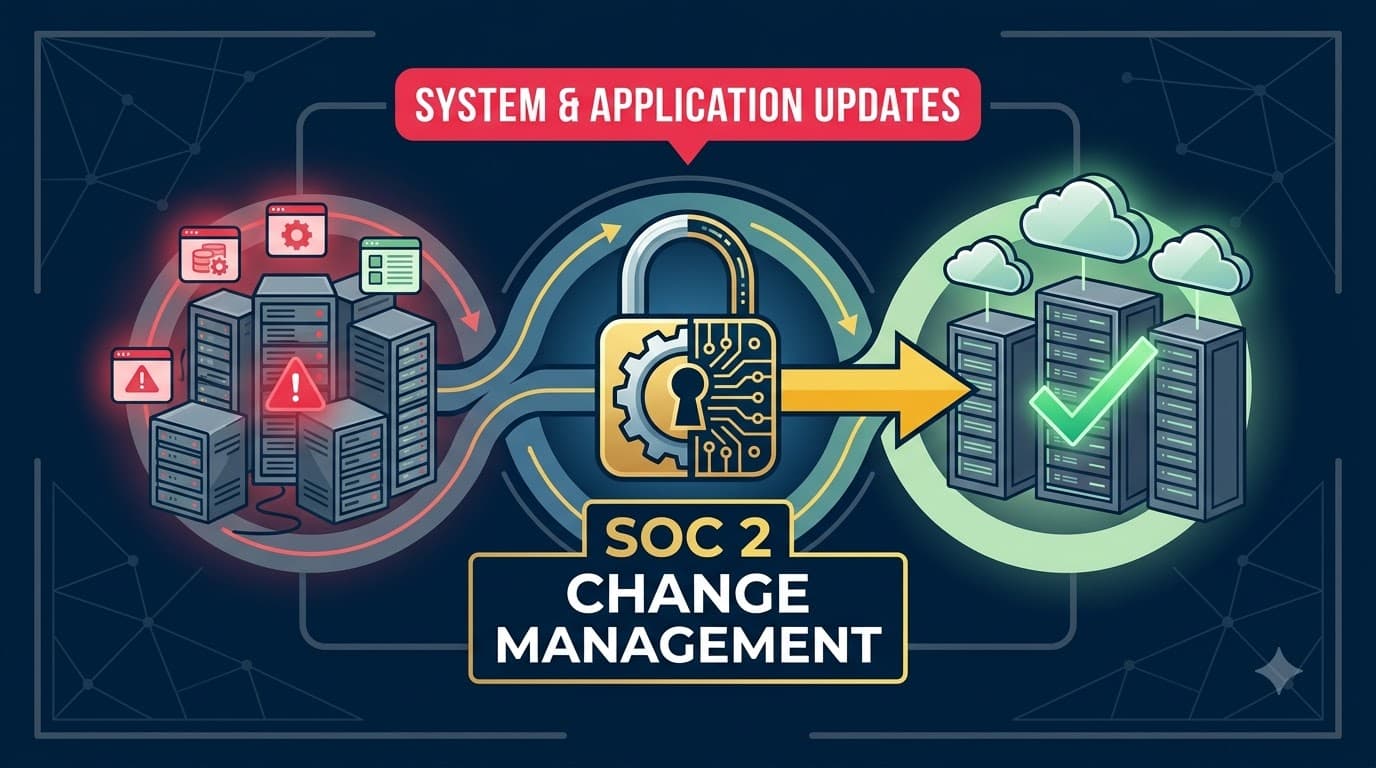
Priya Anand still remembers the Slack message that started the worst week of her career. It was 11:47 p.m. on a Thursday, and a one-line hotfix — "just swapping a feature flag, five-minute change" — had gone straight from a laptop in Austin to production at Corvid Analytics, the fraud-detection SaaS platform she ran engineering for. No pull request. No peer review. No ticket. The engineer who pushed it was good, senior, well-liked, and completely certain the change was safe. It wasn't. The flag flip silently disabled a transaction-scoring rule for one of Corvid's largest customers, a mid-market payments processor that was, at that exact moment, three weeks from signing a $2.4 million annual renewal contingent on Corvid's SOC 2 Type II report landing clean. By the time the on-call engineer noticed the anomaly in the fraud-alert volume, roughly 40,000 transactions had passed through unscored. The remediation, the customer notification, and the SLA credits cost Corvid just under $180,000. The auditor's sample, three months later, cost Corvid something worse: a documented control exception in CC8, change management, that took two full quarters to remediate and re-test before the renewal could close.
Priya's story is not unusual. In fifteen-plus years of guiding organizations through SOC 2 examinations, I have never once seen a first-time Type II engagement sail through change management without at least one exception on the table. Change management — Common Criteria 8, or CC8 in the AICPA's Trust Services Criteria — is the control area where the gap between "we have a process" and "we can prove the process operated, every time, for every change, across the entire audit period" is widest. It is also, not coincidentally, the control area auditors sample most aggressively, because a broken change process is the single fastest way for an unauthorized, untested, or unreviewed change to compromise the security, availability, or integrity of a production system.
This article is the practical playbook I wish someone had handed Priya before that Thursday night. We are going to build a change management program from the ground up: the request-to-deploy workflow, the segregation of duties between the people who write code and the people who can push it live, the testing and approval gates that stand between a pull request and a production system, the CI/CD pipeline controls that make evidence collection nearly automatic, and the emergency-change process that lets you move fast without leaving a hole in your control environment. Everything here is illustrative and tied to composite client experience — no invented statistics presented as external research — but every control, workflow stage, and piece of evidence described is exactly what I have watched service organizations build, and exactly what auditors ask to see.
Who This Is For and What You'll Walk Away With
This article is written for engineering leaders, DevOps and platform teams, and compliance managers at SaaS and technology companies preparing for a SOC 2 Type I or Type II examination who need a change-control process that survives real production pressure, not just a policy document. It assumes you already understand the basic shape of a SOC 2 engagement and are now trying to operationalize one specific Common Criteria domain: change management. You'll walk away with a complete change-control workflow (request, risk classification, testing, approval, deployment, rollback), a segregation-of-duties model for dev-versus-deploy access, a set of CI/CD pipeline controls mapped directly to the evidence an auditor will sample, an emergency-change process that won't blow up your control narrative, and a realistic view of the exceptions auditors find most often — so you can fix them before the sample does.
Why Change Management Is Its Own Common Criteria
The AICPA didn't fold change management into general access controls or system operations by accident. CC8 exists as its own criterion because uncontrolled change is a uniquely dangerous risk vector — it is the mechanism by which every other control gets quietly undone. A perfectly configured access control model, a well-tuned firewall, an airtight encryption policy — all of it can be unwound by a single unreviewed deployment that reconfigures a security group, disables a validation rule, or ships a dependency with a known vulnerability. Auditors treat CC8 as a proxy for engineering discipline: if change management is sloppy, they reasonably infer that other technical controls built and maintained by the same engineering organization are also at risk of drifting out of their designed state.
CC8 maps to COSO's broader control-activities principle and, within the Trust Services Criteria, is framed around a deceptively simple idea: the entity authorizes, designs, develops or acquires, configures, documents, tests, approves, and implements changes to infrastructure, data, software, and procedures to meet its objectives. Every word in that sentence becomes a control point an auditor can test. "Authorizes" means someone with the right authority approved the change before it happened, not after. "Tests" means there is evidence the change was validated somewhere other than production. "Documents" means there is a durable record — a ticket, a pull request, a change log entry — that exists independently of anyone's memory. Miss any one of those words in your actual process, and you have a gap CC8 testing will find.
What CC8 Actually Requires
The Trust Services Criteria describes CC8 through points of focus — illustrative considerations auditors use to judge whether the criterion is met, not a rigid checklist, but close enough to one that it's worth walking through directly. The points of focus touch change authorization, a systems development life cycle (SDLC) with defined stages, testing before deployment, approval prior to implementation, and — critically for anyone running infrastructure at scale — controls over emergency changes and the ability to track and document change history.
What trips people up is that CC8 doesn't care whether you use Scrum, Kanban, trunk-based development, or something homegrown. It cares whether your process, whatever it's called, consistently produces four things: a documented request, evidence of testing, a documented approval that happened before deployment, and a record of what was deployed and when. Everything else — your branching strategy, your ticketing tool, your deployment cadence — is implementation detail the auditor doesn't prescribe.
CC8 Point of Focus | Practical Control | Example Evidence |
|---|---|---|
Manages changes throughout the system life cycle | Documented SDLC with defined stages (request, design, build, test, approve, deploy) | SDLC policy document; workflow diagram in wiki/Confluence |
Authorizes changes | Named approver(s) sign off before deployment, not after | Approval field or required reviewer in ticketing/PR tool |
Designs and develops changes | Development standards, coding guidelines, peer review requirement | Branch protection rules; code review policy |
Documents changes | Every change traceable to a ticket, PR, and commit | Linked ticket ID in commit messages; PR templates |
Tests changes prior to implementation | Changes validated in a non-production environment | Test plan, CI test run logs, QA sign-off |
Approves changes prior to implementation | Approval gate blocks merge/deploy until granted | Required-reviewer setting; CAB minutes for high-risk changes |
Controls emergency changes | Separate, expedited but still-governed path for urgent fixes | Emergency change ticket with retroactive approval and post-hoc review |
Restricts change-deployment access | Deploy permissions limited to authorized roles | IAM/role audit; deploy pipeline access logs |
Change Types and Approval Paths
Not every change carries the same risk, and treating a documentation typo fix with the same ceremony as a database schema migration is how change processes collapse under their own weight — engineers route around heavy process, which is worse for your control environment than having no process at all. A mature change-management program classifies changes by type and risk, then routes each type through a proportionate approval path.
Change Type | Example | Risk Tier | Approval Path | Typical SLA |
|---|---|---|---|---|
Standard/pre-approved | Routine dependency patch, config value within approved range | Low | Peer code review only; pre-approved change template | Same day |
Normal change | New feature, API modification, moderate infrastructure change | Medium | Peer review + technical lead approval | 1–3 business days |
Significant/major change | Database schema migration, authentication system change, new production service | High | Peer review + technical lead + change advisory review | 3–10 business days |
Infrastructure-as-code change | Network topology, security group, IAM policy via Terraform/CloudFormation | High | Peer review + security review + technical lead approval | 2–5 business days |
Emergency change | Active incident remediation, critical security patch | Variable (expedited) | Verbal/async approval from on-call lead, formal review within 24–48 hours | Immediate, with retroactive review |
Vendor/third-party change | SaaS tool configuration affecting in-scope systems | Medium | Change owner approval; documented in vendor change log | 1–5 business days |
"The moment we stopped treating every pull request like it might take down the company, our engineers stopped hating change management. A one-line config tweak gets a lightweight template. A schema migration gets the full advisory review. Same rigor, proportionate ceremony — and our approval-cycle time dropped by more than half." — Devon Marsh, Director of Platform Engineering, Solvent Data Systems
The Change-Control Lifecycle, End to End
Every SOC 2-defensible change process, regardless of tooling, moves through the same six stages: request, risk classification, development and testing, approval, deployment, and post-deployment verification. The diagram below is the version I sketch on a whiteboard in nearly every readiness engagement, because it's the mental model auditors themselves use when they ask "walk me through what happens when an engineer wants to ship something."
flowchart TD
    A["Change Request Submitted<br/>(ticket created, business justification, requester ID)"] --> B["Risk Classification<br/>(standard / normal / significant / emergency)"]
    B --> C["Development<br/>(branch created, code written, linked to ticket)"]
    C --> D["Peer Code Review<br/>(second engineer, not the author)"]
    D --> E["Automated Testing<br/>(unit, integration, security scan in CI)"]
    E --> F{"Tests Pass?"}
    F -- "No" --> C
    F -- "Yes" --> G["Deployment to Staging/Non-Prod<br/>(QA / UAT validation)"]
    G --> H{"Staging Validation OK?"}
    H -- "No" --> C
    H -- "Yes" --> I["Approval Gate<br/>(technical lead / CAB sign-off, logged)"]
    I --> J{"Approved?"}
    J -- "No" --> C
    J -- "Yes" --> K["Deployment to Production<br/>(automated pipeline, deploy role only)"]
    K --> L["Post-Deployment Verification<br/>(monitoring, smoke tests, error-rate check)"]
    L --> M{"Issue Detected?"}
    M -- "Yes" --> N["Rollback<br/>(automated or manual, documented)"]
    M -- "No" --> O["Change Closed<br/>(ticket updated, evidence archived)"]
That diagram is also, not incidentally, close to exactly what I hand a designer when a client wants this workflow turned into a poster for the engineering floor — it's the single artifact that does the most to align engineers and auditors on what "good" looks like.
Stage One: Change Request Intake
Every change starts with a ticket. That sounds obvious, but the single most common CC8 exception I see in first-year Type II examinations is changes deployed without any corresponding ticket — usually small ones, usually urgent-feeling in the moment, usually completely reasonable from the engineer's point of view and completely invisible to the audit trail. The fix isn't more policy language; it's tooling that makes "no ticket, no deploy" the path of least resistance rather than an obstacle.
A well-formed change request captures who is requesting the change, what system or component it touches, why it's needed (business or technical justification), the proposed risk tier, and a rollback plan. That last field matters more than people think: requiring a rollback plan at request time — before anyone has written a line of code — forces the requester to think about blast radius before they're emotionally invested in shipping. I've watched this single field prevent more bad deployments than any approval gate downstream of it.
Link every ticket to the eventual pull request and to the deployment record. This traceability chain — ticket to PR to commit to deployment log — is exactly what an auditor pulls on when they sample a change: they'll pick a deployment from your release log, ask you to walk it back to the approving ticket, and confirm the dates line up in the right order (request before code, code before approval, approval before deploy). If any of those dates are out of sequence, that's your exception.
Stage Two: Risk Classification and Impact Assessment
Risk classification is where a lot of programs get lazy, defaulting every change to "standard" because classifying properly takes a moment of judgment. Don't. The classification you assign at intake determines the approval path, and an under-classified high-risk change is a control failure waiting to happen — it's also exactly the kind of thing a sharp auditor finds by cross-referencing your production incident log against your change log and noticing that the change tagged "standard" caused the outage tagged "major."
A workable classification rubric asks three questions: does this change touch authentication, authorization, encryption, or data handling; does this change affect a system in scope for your SOC 2 report; and does this change modify infrastructure shared across multiple customers or tenants. Any "yes" bumps the change up at least one risk tier. I recommend building this as a short, mandatory questionnaire in your ticketing tool rather than trusting memory — a dropdown with four questions takes fifteen seconds and produces a defensible, consistent classification every time.
Classification Factor | Question Asked at Intake | Effect on Risk Tier |
|---|---|---|
Security-sensitive surface | Does this touch auth, encryption, or access control logic? | +1 tier minimum |
In-scope system | Is the affected system within SOC 2 boundary? | Mandatory classification (never "standard" by default) |
Multi-tenant blast radius | Does this affect shared infrastructure across customers? | +1 tier, CAB review triggered |
Data model change | Does this alter schema, retention, or data structure? | +1 tier, DBA/data owner review required |
Reversibility | Can this be rolled back in under 15 minutes? | If no, +1 tier regardless of other factors |
Segregation of Duties: Development vs. Deployment
If there is one control auditors probe hardest within CC8, it's segregation of duties between the person who writes a change and the person — or system — with the authority to move it into production. The underlying risk is straightforward: a developer who can both write and deploy code, unilaterally, can introduce a change that benefits them or harms the organization with no independent check. This isn't a statement about trust; it's a control that protects the individual as much as the organization, because it removes the possibility of being the sole point of failure or suspicion when something goes wrong.
In small engineering teams this is genuinely hard, and auditors know it — a five-person startup doesn't have the headcount for a dedicated release team. The acceptable pattern at small scale is peer-based segregation: no engineer approves or deploys their own change, full stop, even if that means "whoever's online" reviews it. At larger scale, segregation is enforced structurally: deploy permissions live with a platform or release engineering role distinct from the feature-development org, and the deployment pipeline itself becomes the enforcement mechanism rather than a person remembering a rule.
The most durable version of this control is technical, not procedural: branch protection rules that require at least one approving review from someone other than the author, deploy credentials that individual developers simply do not hold, and a CI/CD pipeline that is the only path to production — meaning there is no server anyone can SSH into and manually push a change. When segregation of duties is enforced by the tooling, you don't need to trust that everyone remembers the policy; the system makes the unauthorized path unavailable.
Role | Can Write Code | Can Approve PR | Can Trigger Deploy | Can Access Prod Infra Directly |
|---|---|---|---|---|
Software Engineer | Yes | Yes (not own PRs) | No | No |
Technical Lead | Yes | Yes | No (unless also Release role) | Break-glass only, logged |
Release/Platform Engineer | Limited (pipeline config only) | N/A | Yes | Yes, scoped |
QA/Test Engineer | No (test code only) | No merge rights | No | No |
Security Reviewer | No | Yes (security-tagged PRs) | No | No |
Engineering Manager | Rarely | Escalation approval only | No | No |
"We used to have three engineers with standing production SSH access because it was 'faster.' Our auditor's sample found two deployments that never went through the pipeline at all — they were pushed directly. That was our only CC8 exception, and it was entirely self-inflicted. We closed the SSH access the same week." — Renata Kovač, VP Engineering, Fieldstone Logistics
Testing in Non-Production Environments
Testing is the point-of-focus auditors verify most literally: they want to see, for a sampled change, that it ran somewhere other than production before it ran in production. That sounds trivial until you remember how many organizations, especially fast-moving ones, treat staging as an afterthought — an environment that's perpetually out of sync with production, that nobody trusts, and that engineers route around because "it never matches prod anyway." A staging environment nobody uses is worse than no staging environment for audit purposes, because it creates a documented step in your process that isn't actually happening.
A defensible testing regime has automated tests running in CI on every pull request (unit and integration tests, plus a security/dependency scan), and a deployment to a non-production environment that mirrors production configuration closely enough that a human — QA, the requester, or both — can validate the change under realistic conditions before it ships. For significant changes, this should include a written test plan and a documented sign-off, not just "looked fine to me."
This is also the point where you tie change management to environment separation, a control area that shows up independently under CC6 and CC7 but does double duty here: if your development, staging, and production environments aren't meaningfully separated — different credentials, different network zones, different data (never real customer data in dev/test) — then "tested in non-production" doesn't actually reduce risk, because a compromise or defect in staging can bleed into production. Auditors increasingly ask to see the environment separation evidence alongside the change-testing evidence, because the two controls only work together.
Environment | Purpose | Data Used | Access Control | Production-Like Config |
|---|---|---|---|---|
Local/Development | Individual engineer iteration | Synthetic/mock data only | Individual dev machine | Partial |
CI/Build | Automated test execution | Synthetic/fixture data | Pipeline service account only | Partial (containerized) |
Staging/QA | Pre-production validation | Masked or synthetic data | Engineering + QA team | Close to full parity |
Production | Live customer traffic | Real customer data | Release/platform role only | Full |
Stage Three: Peer Code Review
Peer review is where testing and segregation of duties overlap, and it's one of the cheapest, highest-value controls in this entire program because most engineering teams are already doing some version of it — the work is making it consistent, mandatory, and evidenced. A reviewer who is not the author reads the diff, checks it against coding standards, looks for security issues (hardcoded secrets, missing input validation, injection risks), and either approves or requests changes. That approval, timestamped and attributed to a named individual, is itself a piece of audit evidence.
The failure mode I see most often isn't the absence of a review requirement — most engineering orgs have one — it's the "rubber stamp" review, where the required second approver clicks approve without meaningfully reading the diff, often because the branch-protection setting only checks that a review exists, not that it was substantive. You can't fully automate away rubber-stamping, but you can reduce it: require reviewers to leave at least one comment or explicitly note "no issues found, reviewed lines X–Y," keep review turnaround expectations reasonable so reviewers aren't rushed, and periodically audit review quality as part of your own internal control self-assessment, not just wait for the external auditor to notice a pattern of instant approvals.
Input validation checks specifically deserve a line item in your code review checklist, because they're both a security control and a processing-integrity control depending on your scope — a missing validation rule is exactly the kind of defect peer review is supposed to catch before it reaches production.
Stage Four: Approval Gates
Approval is distinct from review, even though the two often get conflated. Review is a technical, peer-level check on the quality and correctness of the change. Approval is an authority-level decision that the change is sanctioned to move forward — and for CC8 purposes, approval has to happen before deployment, be attributable to a specific named person or body, and be recorded somewhere durable.
For standard and normal changes, approval is usually the technical lead or engineering manager, and can be as lightweight as an "approve" click in the same tool used for peer review, provided the approver role is distinct from the reviewer role for anything above the lowest risk tier. For significant changes — schema migrations, authentication changes, anything touching multi-tenant infrastructure — I recommend a lightweight change advisory function: not a bureaucratic committee that meets weekly and creates a bottleneck, but a defined group (often just the engineering director, a security representative, and the relevant technical lead) who review high-risk changes asynchronously, typically within a day, and leave a documented decision.
Risk Tier | Required Approver(s) | Approval Evidence | Pre-Deployment Requirement |
|---|---|---|---|
Low/Standard | Peer reviewer (dual role acceptable) | PR approval timestamp | Passed CI tests |
Medium/Normal | Technical lead, distinct from author and reviewer | Ticket approval field + PR approval | Passed CI + staging validation |
High/Significant | Technical lead + change advisory review (security + eng director) | CAB decision log entry | Full staging sign-off, rollback plan documented |
Emergency | On-call lead (verbal/async), retroactive CAB review | Emergency ticket + post-hoc approval within 24–48 hrs | Post-deployment validation, root cause review |
Change Advisory Function: Right-Sized, Not Bureaucratic
"Change Advisory Board" tends to conjure images of a weekly meeting where twelve people argue about a config change for forty minutes. That version kills engineering velocity and, ironically, produces worse compliance outcomes because engineers learn to avoid the board entirely. The version that actually works at SaaS-scale organizations is asynchronous, small, and fast: a Slack channel or lightweight review queue where significant changes get a documented thumbs-up from two or three named individuals within a committed SLA, with a short weekly sync reserved only for genuinely contentious calls.
What the advisory function needs to produce, for audit purposes, is not minutes of a meeting but a decision log: which change, who reviewed it, what was discussed or flagged, and what was decided. I've built this as a simple structured field in the ticketing tool for clients who didn't want a separate system, and as a dedicated lightweight tool for larger clients running hundreds of significant changes a quarter. Either works. What doesn't work is an advisory function that exists on paper in the policy but that nobody can produce decision records for when the auditor asks for a sample.
CAB Composition Element | Typical Member | Responsibility |
|---|---|---|
Engineering authority | Director of Engineering or VP Eng | Final escalation, resource/timeline tradeoffs |
Security representative | Security engineer or CISO delegate | Flags security/compliance-relevant risk |
Domain owner | Tech lead for affected system | Technical feasibility and blast-radius assessment |
Change coordinator | Release/platform engineer | Schedules, tracks, and logs decisions |
Stage Five: Deployment and Release Management
Deployment is where all the upstream controls either hold or collapse, because it's the moment code actually reaches production. The control objective is simple to state and hard to enforce without good tooling: only changes that have completed testing and approval can be deployed, only authorized roles or automated pipelines can perform the deployment, and every deployment is logged with what was deployed, when, by what mechanism, and tied back to the originating change record.
Modern CI/CD pipelines are, frankly, the best thing that's happened to change-management compliance in the last decade, because a well-configured pipeline enforces segregation of duties, testing gates, and approval requirements structurally rather than procedurally — and it generates its own evidence as a byproduct of doing its job. A deployment pipeline that requires passing tests, a merged and approved pull request, and a protected branch before it will even attempt a release effectively makes it impossible to violate your own change policy through the normal path. The only way around it is a manual override, which is exactly why manual overrides need to be rare, logged, and reviewed.
Release versioning matters here too: every production deployment should correspond to an identifiable version — a git tag, a semantic version number, a build ID — so that when an auditor or an incident responder asks "what was running in production on March 14th," you have an unambiguous answer. I've seen organizations lose hours during incident response simply because they couldn't reconstruct what code was live at a given moment; a clean versioning scheme fixes that permanently, for both incident response and audit purposes.
CI/CD Pipeline Controls
The CI/CD pipeline is where change management stops being a policy and becomes an enforced system. Each stage of a well-built pipeline maps directly to a piece of evidence you'll want ready before an auditor asks for it — and because the pipeline generates this evidence automatically as part of running builds and deployments, this is the single highest-leverage area to invest in if you want change management to be low-friction for both engineers and evidence collection.
Pipeline Control | What It Enforces | Evidence Generated | Sampled Artifact |
|---|---|---|---|
Branch protection rules | No direct pushes to main/production branch | Repository settings export | Screenshot/config export of protection rules |
Required PR approval | Segregation of duties (author ≠ approver) | PR approval log with timestamps | Sampled PR showing distinct author/approver |
Automated test gate | No merge/deploy without passing tests | CI run logs, pass/fail status | CI build log for sampled change |
Static/dependency security scan | Known-vulnerability and secret-leak detection before deploy | Scan report per build | Scan output for sampled deployment |
Environment promotion gate | Changes flow dev → staging → prod in order | Pipeline stage history | Deployment pipeline log |
Deploy role restriction | Only authorized identity/service account can trigger prod deploy | IAM/pipeline access logs | Access review export |
Immutable build artifacts | Deployed artifact matches tested artifact (no drift) | Build hash/checksum comparison | Artifact registry record |
Deployment logging | Every prod change is recorded with who/what/when | Deployment history/audit log | Release log entry for sampled change |
Infrastructure-as-Code Changes
Infrastructure-as-code (IaC) — Terraform, CloudFormation, Pulumi, and similar tools — deserves its own control attention within CC8 because it collapses the traditional line between "application change" and "infrastructure change." A one-line Terraform edit can open a security group to the internet, delete a production database, or grant broad IAM permissions, with a blast radius far larger than a typical application code change and, historically, far less scrutiny, because infrastructure changes used to happen through consoles and tickets that felt separate from the software development lifecycle.
The good news is that IaC, treated correctly, is one of the easiest wins in a mature change program: because infrastructure changes now live in the same version-control system as application code, the same peer-review, testing, and approval gates apply directly. The addition that matters is a plan/preview step — terraform plan or equivalent — that shows exactly what will change before it's applied, reviewed as part of the pull request alongside the code diff. I require this on every IaC-touching client engagement without exception; skipping the plan review is how "just adding one tag" turns into an accidental resource deletion.
IaC Control | Purpose | Evidence |
|---|---|---|
Plan/preview review before apply | Reviewer sees exact resource-level impact before merge | Plan output attached to PR |
State file access restriction | Only pipeline service account can modify state | IAM policy on state backend |
Security-sensitive resource tagging | Flags changes to IAM, network, encryption resources for mandatory security review | Tag-based CI routing rule |
Drift detection | Detects manual out-of-band changes to infrastructure | Scheduled drift-check report |
Module/version pinning | Prevents unreviewed upstream module changes from auto-applying | Locked module version in config |
Versioning, Release Management, and Change History
CC8's requirement to document change history is easy to satisfy in theory and surprisingly easy to fail in practice, usually because the history exists but is scattered across three systems that don't talk to each other — a ticket in one tool, a PR in another, a deployment note in a third, with no consistent identifier tying them together. The fix is a consistent versioning and linking convention enforced from day one: every commit references a ticket ID, every pull request title includes that ID, every deployment log entry captures the version tag and links back to the same ID.
Semantic versioning (major.minor.patch) works well for externally consumed software; a simple date-and-sequence build ID works fine for continuously deployed internal services. What matters for audit purposes isn't which scheme you pick, it's that the scheme is consistent and that you can answer, for any point in the audit period, exactly what version was running and what changes it contained. I ask every client to be able to produce this answer for an arbitrary date within thirty seconds — if it takes longer than that, the versioning and logging discipline isn't there yet.
Versioning Element | Standard/Normal Change | Emergency Change |
|---|---|---|
Identifier format | Git tag / semantic version | Emergency ticket ID + hotfix tag |
Linked artifacts | Ticket, PR, CI build, deploy log | Incident ticket, retroactive PR, deploy log |
Change log entry | Auto-generated from merged PR titles | Manually logged within 24 hours |
Retention | Full audit period + prior year for trend comparison | Same, flagged for CAB retrospective review |
Rollback Procedures
A rollback plan that exists only in someone's head is not a rollback plan, and "we'll just redeploy the old version" is not a plan until you've actually verified that redeploying the old version works cleanly — including for changes that touched the database, where a naive code rollback can leave you running old application logic against a new, incompatible schema. Rollback planning has to happen at request time, not improvised during an incident, because incident-time improvisation under pressure is exactly when mistakes compound.
The strongest rollback posture separates two rollback mechanisms: application rollback (redeploying a prior build/version, which CI/CD pipelines typically support with a single command or button) and data rollback (reversing a schema migration or data change, which usually requires a pre-written down-migration script tested alongside the up-migration, before either ships). Any change classified as high-risk or significant should have its rollback path explicitly tested in staging, not just described in a ticket field.
Rollback Trigger | Decision Owner | Mechanism | Target Time to Rollback |
|---|---|---|---|
Elevated error rate post-deploy | On-call engineer | Automated pipeline rollback to prior artifact | Under 15 minutes |
Failed smoke test | Deploying engineer | Pipeline abort, auto-revert | Under 5 minutes |
Data integrity issue post-migration | Tech lead + DBA/data owner | Pre-tested down-migration script | Under 60 minutes |
Customer-reported critical defect | Engineering manager + on-call | Manual rollback decision, CAB notified | Under 30 minutes |
Security vulnerability introduced | Security lead | Immediate rollback, treated as security incident | Immediate |
"Our rollback plan used to be a sentence in the ticket nobody read again. Now it's a required field with an actual tested down-migration attached before we'll approve a schema-touching change. It added maybe twenty minutes to significant changes and it has saved us from at least two incidents becoming outages." — Tomas Berglund, Staff Engineer, Nimbus Ledger
Emergency Changes: Moving Fast Without Breaking the Control
Every organization needs an emergency-change path — a production outage, an actively exploited vulnerability, or a critical customer-impacting defect cannot wait for a normal multi-day approval cycle, and pretending otherwise just pushes engineers to bypass the process entirely, which is worse. The trick is designing an emergency path that's genuinely fast while still producing an audit trail, rather than treating "emergency" as a magic word that suspends change management altogether.
A defensible emergency-change process has three characteristics: a clear, narrow definition of what qualifies (active incident, security exploitation, not "we're behind schedule and want to skip review"); an expedited approval mechanism that still requires a named authorizer, even if that authorization happens verbally or in a chat message in the moment rather than through a formal ticket workflow; and a mandatory retroactive review within a short, fixed window — I recommend 24 to 48 hours — where the change is documented properly, reviewed by someone who wasn't part of the emergency response, and either ratified or flagged for follow-up.
This retroactive review is the piece organizations skip most often, usually because the fire is out and everyone wants to move on. Don't skip it. It's also the exact evidence an auditor samples for emergency changes: they'll pull an emergency change from your log and check that a post-hoc review happened, that it happened within your own stated SLA, and that whatever gap allowed the emergency in the first place got a follow-up action, not just a shrug.
Stage | Standard Change | Emergency Change |
|---|---|---|
Trigger | Planned feature/fix | Active incident, security exploit, critical defect |
Pre-deployment approval | Formal ticket + reviewer/CAB sign-off | Verbal/async approval from on-call lead or incident commander |
Testing | Full non-prod validation before deploy | Best-effort validation; may deploy with reduced testing under incident conditions |
Documentation timing | Before deployment | Real-time incident notes, formalized within 24–48 hrs |
Retroactive review | Not applicable | Mandatory, by someone outside the incident response, within fixed SLA |
Root cause follow-up | Not applicable unless linked to defect | Required — logged as a corrective action plan if a gap is identified |
Volume monitoring | N/A | Tracked monthly; a rising trend signals a process or stability problem |
One operational note worth stressing: track your emergency-change volume as its own metric. A healthy program sees emergency changes as a small single-digit percentage of total changes. When that number creeps up, it's rarely because the world got more chaotic — it's almost always a signal that your normal change process is too slow or too heavy, and engineers are relabeling normal changes as emergencies to route around it. That's a process problem worth fixing directly rather than a rule worth tightening.
Evidence Auditors Actually Sample
Everything above exists, from an audit perspective, to produce evidence. For a Type II examination, the auditor doesn't take your word that the process runs — they select a sample of changes from across the audit period (commonly twenty-five to forty, depending on population size and sampling methodology) and, for each one, ask you to produce the full trail: request, risk classification, peer review, test results, approval, deployment record, and — where applicable — rollback or emergency documentation.
The organizations that sail through this exercise are the ones where evidence collection is a byproduct of the normal workflow, not a separate exercise performed after the fact. If your engineers file tickets, review PRs, and deploy through a pipeline as their default way of working, the evidence already exists in your tools and the audit prep is mostly a matter of exporting it. If evidence collection means someone reconstructing what happened from memory and Slack scrollback three months later, you will find gaps — and so will the auditor.
Evidence Type | Where It Lives | What It Proves | Retention Recommendation |
|---|---|---|---|
Change ticket | Ticketing system (Jira, Linear, ServiceNow) | Request existed, was classified, had a justification | Full audit period + 1 year |
Pull request record | Version control (GitHub, GitLab, Bitbucket) | Code change, author, reviewer, approval timestamp | Full audit period + 1 year |
CI test/scan logs | CI/CD platform | Testing occurred prior to deployment | Full audit period |
Staging validation notes | Ticketing system or test management tool | Non-production validation occurred | Full audit period |
Approval record | Ticketing system, CAB log | Named approver authorized before deployment | Full audit period + 1 year |
Deployment log | CI/CD pipeline, release management tool | What was deployed, when, by what mechanism | Full audit period + 1 year |
Rollback record (if triggered) | Incident/ticketing system | Rollback occurred, was decided by an authorized owner | Full audit period |
Emergency change retroactive review | Ticketing system | Post-hoc review occurred within SLA | Full audit period + 1 year |
Access/permission export | IAM or pipeline admin console | Deploy access restricted to authorized roles | Point-in-time snapshots, quarterly |
Build a lightweight internal audit trail review into your quarterly cadence — pull five to ten changes yourself, walk the full evidence chain the way an auditor would, and fix whatever's broken before the real sample does. This is the single cheapest form of audit insurance available to you, and it doubles as a genuine control self-assessment rather than a paperwork exercise.
Common Exceptions and How to Avoid Them
I have sat in enough closing meetings to know the exception patterns by heart. None of them are exotic. All of them are avoidable with process design decisions made months before the auditor ever opens a sample. The five below account for the overwhelming majority of CC8 findings I've seen across mid-market SaaS engagements.
The first is the direct-push exception: a change reaches production without going through the pipeline at all, usually because someone retained standing infrastructure access "just in case" and used it under time pressure. The second is the missing-approval-before-deployment exception, where the dates don't line up — the deployment log shows a timestamp earlier than the approval record, meaning the change shipped before anyone signed off, even if approval technically happened later the same day. The third is the self-approved change, where the same individual authored and approved their own pull request, breaking segregation of duties even when every other step was followed correctly. The fourth is untested emergency changes with no retroactive review, where the emergency path was used appropriately in the moment but the required follow-up documentation never happened. The fifth is evidence gaps for older samples — the process was actually fine, but the ticket or PR was deleted, archived out of reach, or lived in a tool the organization stopped using mid-year, and nobody can reconstruct it six months later.
Exception Pattern | Root Cause | Prevention |
|---|---|---|
Direct push to production, bypassing pipeline | Standing infrastructure access retained by developers | Remove direct prod access; enforce pipeline-only deployment |
Approval timestamp after deployment timestamp | Verbal "go ahead" treated as sufficient, formal approval logged later | Require logged approval as a hard pipeline gate, not a formality |
Self-approved pull request | Branch protection doesn't enforce distinct approver | Configure required-reviewer rule to reject author's own approval |
Emergency change with no retroactive review | Team moves on after incident resolves, review forgotten | Auto-generate a review ticket with SLA countdown when emergency path is used |
Evidence unavailable for sampled change | Tool migration, ticket deletion, short retention settings | Set retention policy ≥ audit period + 1 year; export before tool migrations |
"Our first Type II had two exceptions, both self-approved PRs from the same two-person infrastructure team who'd been reviewing each other's code informally for years without anyone catching that GitHub let them approve their own merges. A ten-minute branch-protection fix closed the gap for the next period entirely." — Alicia Ferro, Head of Security, Kestrel Payments
Case Study: Corvid Analytics — From Exception to Clean Report
Priya Anand's team spent the two quarters after that midnight deployment rebuilding change management from the ground up rather than patching around the symptom. They removed standing production SSH access from all eleven engineers, moving deployment authority entirely into a CI/CD pipeline with required branch protection and a distinct-approver rule. They built a four-tier risk classification directly into their ticketing tool's intake form, so every new ticket forced a classification decision before it could be assigned. They stood up a lightweight, asynchronous change advisory function — three people, a shared Slack channel, a 24-hour decision SLA — for anything touching authentication or multi-tenant infrastructure. And they instituted a mandatory 48-hour retroactive review for any change deployed through the emergency path, with a running dashboard tracking emergency-change volume as a percentage of total changes.
The re-test, six months later, sampled thirty-two changes across the new observation period. Every one produced a complete evidence chain — ticket, PR, approval, deployment log — with no gaps and no out-of-sequence timestamps. Emergency changes had dropped from roughly 9% of total deployments to under 2%, evidence that the normal path had become fast enough that engineers stopped routing around it. The $2.4 million renewal closed on schedule, and Corvid's security team now cites the change-management rebuild as the single highest-leverage engineering investment of that year — not because it prevented a repeat of the midnight incident specifically, but because the same structural fix closed a dozen smaller gaps the team hadn't even been tracking.
Metric | Before Rebuild | After Rebuild (6 Months) |
|---|---|---|
CC8 exceptions in sample | 1 (direct-push deployment) | 0 |
Emergency changes as % of total | ~9% | ~2% |
Changes with complete evidence chain | Estimated 70–75% | 100% of sampled population |
Median time request-to-deploy (normal change) | 4.5 days | 2 days |
Engineers with standing prod access | 11 | 2 (release role only) |
Case Study: Solvent Data Systems — Scaling Without a Change Bottleneck
Solvent Data Systems, a data-integration platform growing from 40 to 130 engineers in eighteen months, faced the opposite problem from Corvid: their change process wasn't broken, it was too heavy for the team's new size, and engineers had begun quietly self-organizing around it — batching unrelated changes into single pull requests to reduce the number of times they had to go through review, which itself introduced new risk by making individual changes harder to test and roll back cleanly.
The fix wasn't loosening controls; it was right-sizing them by risk tier, the way described earlier in this article. Standard changes (roughly 60% of Solvent's total volume, mostly config-within-range and routine dependency updates) moved to a pre-approved template requiring only peer review, cutting their cycle time dramatically. Significant changes kept full CAB review but moved from a weekly synchronous meeting to an asynchronous 24-hour SLA, which alone cut significant-change turnaround from an average of six days to two. The result was a change program engineers stopped avoiding, which produced better evidence quality simply because people weren't finding workarounds.
Metric | Before Right-Sizing | After Right-Sizing |
|---|---|---|
Median cycle time, standard change | 3.2 days | 0.8 days |
Median cycle time, significant change | 6 days | 2 days |
Batched/bundled PRs (multiple unrelated changes) | ~18% of PRs | ~3% of PRs |
Engineer satisfaction with process (internal survey) | Low | Notably improved |
CC8 exceptions in subsequent Type II | 2 (bundled-change traceability) | 0 |
Tooling Landscape
You don't need an enterprise ITSM suite to run a defensible change-management program — plenty of the SaaS companies I work with run clean SOC 2 change management entirely on the same tools their engineers already use daily, provided those tools are configured with the right gates rather than left on default settings. What matters is coverage across the full lifecycle: ticketing/request intake, version control with review enforcement, CI/CD with test and deploy gates, and a durable log tying it all together.
Category | Representative Tools | What It Must Enforce for CC8 |
|---|---|---|
Ticketing / request intake | Jira, Linear, ServiceNow, Asana | Mandatory risk classification field, linked to PR |
Version control | GitHub, GitLab, Bitbucket | Branch protection, required distinct reviewer |
CI/CD pipeline | GitHub Actions, GitLab CI, CircleCI, Jenkins | Test gate, security scan gate, deploy-role restriction |
Infrastructure-as-code | Terraform, Pulumi, CloudFormation | Plan/preview review, state file access control |
Release/deployment management | Octopus Deploy, Spinnaker, Argo CD, native pipeline tooling | Immutable artifacts, environment promotion order, rollback trigger |
Change advisory / decision logging | Slack + structured template, dedicated CAB tool | Named decision, timestamp, linked change ID |
Monitoring / post-deploy verification | Datadog, New Relic, Grafana, PagerDuty | Automated smoke tests, error-rate alerting tied to deploy events |
Metrics That Matter
Change-management metrics serve two audiences at once: your own engineering leadership, who wants to know whether the process is healthy and fast, and your auditor, who wants to see that you monitor your own control environment rather than treating the annual audit as the only checkpoint. Monitoring your change process over time is itself evidence of a mature CC4-adjacent control activity, even though it lives operationally inside CC8.
Track cycle time by risk tier (not a single blended number, which hides problems), the ratio of emergency to normal changes, the percentage of changes with a complete evidence chain (aim for 100%, investigate any gap immediately rather than at audit time), the change failure rate (deployments requiring rollback or hotfix), and mean time to remediate when something does go wrong.
Metric | Definition | Healthy Range (Illustrative) | Why It Matters |
|---|---|---|---|
Cycle time by risk tier | Request-to-deploy duration, segmented | Low: <1 day; High: 3–10 days | Confirms proportionate process, flags bottlenecks |
Emergency change ratio | Emergency changes / total changes | Single-digit percentage | Rising trend signals process avoidance |
Evidence completeness rate | % of changes with full traceable chain | 100% | Direct proxy for audit sample outcome |
Change failure rate | % of deployments requiring rollback/hotfix | Low single digits | Signals testing/review effectiveness |
Avg. time from failed deploy to resolution | Under 1 hour for automated rollback | Measures operational resilience | |
CAB decision SLA adherence | % of significant changes reviewed within SLA | High 90s % | Confirms advisory function isn't a bottleneck |
Building Your Change Management Policy
A policy document is not the control — the workflow and the tooling are the control — but auditors will ask for a written change management policy as a foundational artifact, and it needs to actually describe what your team does, not an aspirational version of it. I've reviewed policies lifted wholesale from templates that describe a change advisory board meeting weekly with formal minutes, for organizations that have never once held such a meeting; that mismatch between paper and practice is its own audit risk, because the auditor tests the policy's stated process, not an idealized one.
Your policy should define change types and risk tiers, name the roles authorized to approve and deploy at each tier, describe the testing requirement before deployment, define what qualifies as an emergency change and the retroactive review requirement, state evidence retention periods, and specify how often the policy itself is reviewed and by whom. Keep it to the length that a new engineer could actually read and internalize in fifteen minutes — a sprawling forty-page policy nobody reads is functionally the same as no policy.
Policy Section | Must Define |
|---|---|
Purpose and scope | Which systems, environments, and change types are covered |
Change classification | Risk tiers and the criteria that assign a change to each |
Roles and authority | Who can request, review, approve, and deploy at each tier |
Testing requirements | Minimum non-production validation before deployment |
Approval requirements | Named approver types per tier, timing (before deployment) |
Emergency change process | Qualification criteria, expedited approval, retroactive review SLA |
Segregation of duties | Explicit statement that author ≠ approver ≠ deployer where required |
Evidence and retention | What's retained, where, for how long |
Review cadence | How often the policy is reviewed and updated, and by whom |
Tying Change Management to Environment Separation and Access Controls
CC8 doesn't operate in isolation, and auditors deliberately test it alongside adjacent controls, because a change process only reduces risk if the environments it deploys into are properly separated and the access controls governing who can do what are consistently enforced. If your SOC 2 environment separation is weak — shared credentials between staging and production, real customer data sitting in a test environment, or network paths that let a compromised dev machine reach production directly — then even a textbook-perfect change workflow doesn't deliver the risk reduction it's supposed to.
The same logic applies to your broader SOC 2 access controls program: deploy permissions are a specific, high-sensitivity subset of your overall privilege model, and they should show up explicitly in your periodic access reviews, not just live implicitly inside a pipeline configuration nobody revisits. I recommend reviewing deploy-role membership on the same cadence as your other privileged-access reviews — quarterly is typical — rather than treating it as a set-once configuration.
It's also worth connecting change management explicitly to your organization's risk assessment process: the risk classification criteria you use at change intake should trace back to the same risk categories your broader risk assessment identifies as significant, so that "high-risk change" means the same thing to your engineering team as "high-risk" means to the rest of your control environment. Disconnected risk vocabularies between teams are a subtle but real source of audit friction.
Change evidence also feeds directly into your SOC 2 monitoring activities and, for organizations running both frameworks, into a broader SOC 2 control activities program — the deployment logs and approval records generated by your pipeline are exactly the kind of continuous, system-generated evidence that makes ongoing control monitoring far less painful than point-in-time evidence scrambles.
How This Compares to ISO 27001's Change Management Control
If your organization is pursuing both frameworks — a common position for SaaS companies selling into enterprise and public-sector buyers — you'll find that SOC 2's CC8 and ISO 27001's equivalent change-management control (Annex A control 8.32) describe the same underlying discipline from different angles. ISO 27001 frames it as part of a certifiable information security management system with a formal management review cycle; SOC 2 frames it as a criterion an independent CPA firm tests for operating effectiveness over an observation period. The control activities you'd build — request, risk classification, testing, approval, deployment, rollback — are close to identical either way, which is exactly why organizations running both frameworks in parallel, as covered in running ISO 27001 and SOC 2 together, typically build one change-management process and map it to both sets of requirements rather than maintaining two.
If you're still deciding which framework to pursue first, or whether you need both, ISO 27001 vs SOC 2: which one do you need walks through the decision in more depth, and the broader ISO 27001, SOC 2 and NIST CSF crosswalk is a useful reference if you're trying to build one control set that satisfies multiple frameworks' auditors and assessors without duplicating effort.
"We built our change-management workflow once, against ISO 27001's 8.32 and SOC 2's CC8 side by side, mapped in a single spreadsheet. It took a week longer up front. It has saved us months every year since, because our engineers only ever have to follow one process regardless of which auditor is asking." — Owen Nakashima, Compliance Program Lead, Halcyon Cloud Services
Change Management as a Business Differentiator, Not Just an Audit Line Item
It's tempting to treat CC8 as pure compliance overhead — one more control area standing between engineering and shipping fast. I'd push back on that framing after watching this play out across enough organizations to see the pattern clearly: the companies with the cleanest change-management programs are, almost without exception, also the companies that ship faster and with fewer production incidents, because the controls that satisfy an auditor (testing before production, independent review, traceable approval, a real rollback plan) are the same disciplines that prevent 2 a.m. outages regardless of whether anyone is examining your controls that year.
That reframing matters commercially, too. Enterprise buyers doing vendor security reviews increasingly ask pointed questions about change management specifically — not just "do you have SOC 2," but "walk me through how a change reaches your production environment" — because they've been burned by vendors whose paper compliance didn't match their operational reality. A service organization that can answer that question crisply, with a diagram and real examples, closes deals faster and fields fewer follow-up security questionnaires. Priya Anand's team at Corvid didn't just fix a control exception; they turned their rebuilt change process into a standing slide in the sales engineering deck, because prospective customers kept asking for exactly this level of detail.
If you're building this program from scratch, don't try to design the perfect process before you've run any changes through it. Start with the workflow in this article at a proportionate scale for your team size, instrument your pipeline to generate evidence automatically, and tighten the gaps a quarterly internal review surfaces. That's a more durable path to a clean CC8 result than any policy document written in isolation from how your engineers actually ship code.
Ready to see where your own change process has gaps before an auditor finds them? PentesterWorld's SOC 2 Gap Analysis Tool walks through CC8 alongside every other Common Criteria domain and flags the exceptions most first-time Type II clients hit. Pair it with our SOC 2 Control Matrix and RACI Template to assign clear ownership across request, review, approval, and deployment roles, and our SOC 2 Policy Pack to get a change-management policy template you can adapt rather than write from nothing. If you're earlier in the process and still scoping your overall audit readiness, the SOC 2 Readiness Checklist is the right starting point before you dive into any single control domain in this much depth.