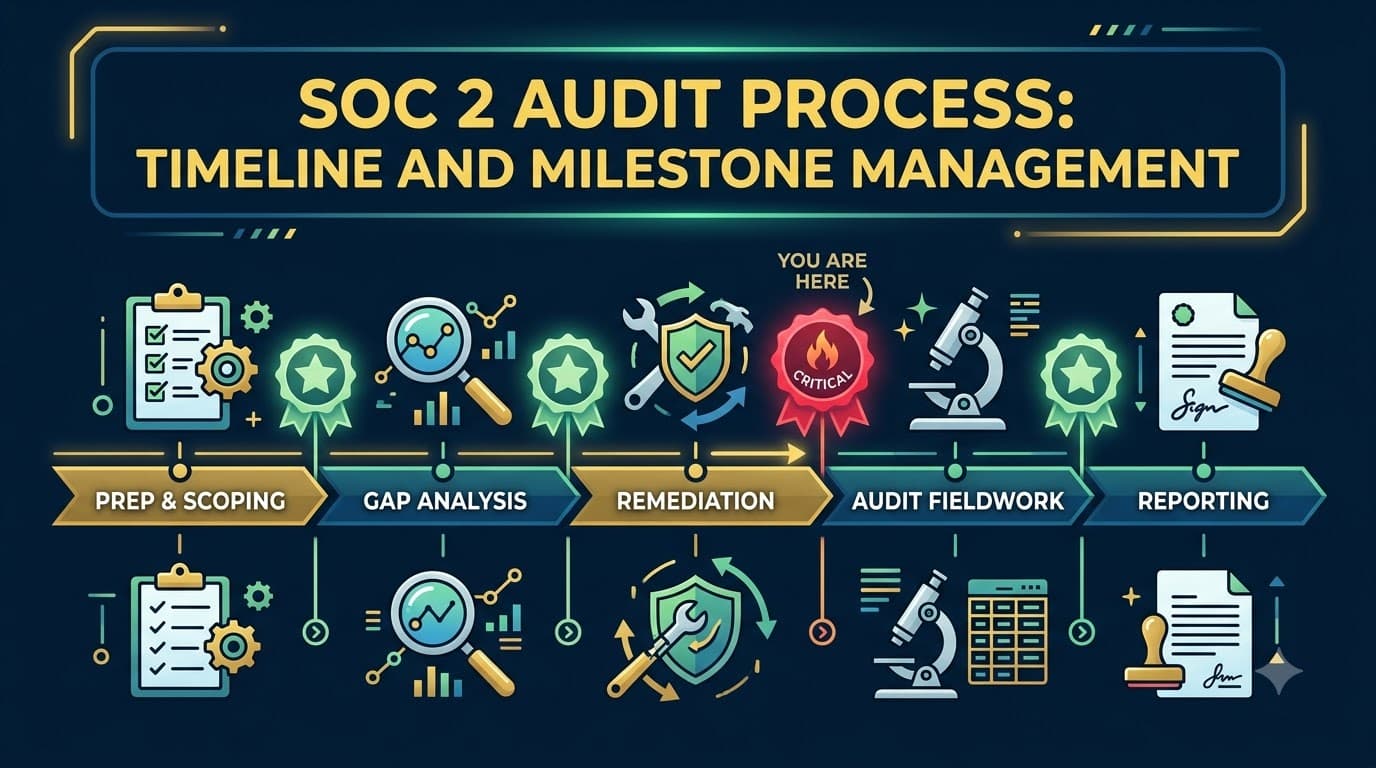
Priya Nandakumar found out her company's biggest prospect required a SOC 2 report on a Tuesday afternoon, in a Slack message from her VP of Sales that read, simply, "Do we have this? They won't sign without it." The prospect was a regional hospital network evaluating Fernbank Health Analytics' population-health dashboard for a $2.4 million, three-year contract. Legal at the hospital had already flagged the absence of a SOC 2 report as a blocker in procurement. Priya, who ran engineering and had inherited "compliance" as an unofficial fourth job title eighteen months earlier, did not have a report. She had a security policy folder nobody had opened since the last funding round, an AWS account with reasonably good hygiene, and no idea whether "SOC 2" took six weeks or sixteen months.
It takes, in Fernbank's case, just under ten months from the day Priya opened that Slack message to the day a signed report landed in the hospital's procurement portal — and that ten months was actually fast, because Priya understood by week three that a SOC 2 examination is not a single event with a due date. It is a sequence of phases, each with its own owner, its own deliverables, and its own failure modes, strung across a calendar that most first-timers wildly underestimate. Sales teams hear "SOC 2" and picture a certificate you buy. Auditors know it as an attestation engagement with a scoping phase, a selection phase, an optional design-only phase, a multi-month observation window, weeks of fieldwork, and a report that only exists because a licensed CPA firm formed an independent opinion. Understanding that sequence — and building a realistic project plan around it — is the difference between a nine-month audit and an eighteen-month one that burns out your control owners twice.
This article is the timeline map I wish someone had handed Priya on day one. It walks through every phase of the SOC 2 audit process in the order it actually happens, names who owns each milestone, and flags the delays that turn a six-month plan into a year-long slog.
Who This Is For and What You'll Walk Away With
This is written for the person who just became the accidental SOC 2 project manager — a VP of Engineering, a Head of IT, a first compliance hire, or a founder — who needs to build a credible timeline and defend it to a board or a sales team. You'll walk away with a phase-by-phase map of the SOC 2 audit process, realistic duration ranges for each phase, a RACI breakdown of who does what, a sample provided-by-client (PBC) list structure, and a catalog of the delays that most commonly blow up first-time audit timelines. This is not a sales pitch for any particular auditor or platform — it's a project-management playbook grounded in how licensed CPA firms actually run these engagements under AICPA attestation standards.
The SOC 2 Audit Journey at a Glance
Before the detail, the shape. Every SOC 2 audit — whether it's a company's first or its fifth — moves through the same six phases, though the calendar length of each varies enormously by organizational maturity. Table 1 gives the bird's-eye view; the rest of this article expands each row into a real project plan.
Table 1: The Six Phases of a SOC 2 Audit
Phase | Typical Duration | Primary Owner | Key Output |
|---|---|---|---|
1. Scoping and readiness | 4–12 weeks | Internal compliance/security lead | Defined system boundary, gap remediation plan |
2. CPA firm selection | 2–6 weeks (can run parallel to Phase 1) | Executive sponsor + compliance lead | Signed engagement letter |
3. Type I audit (optional) | 2–4 weeks fieldwork, point-in-time | CPA firm + control owners | Type I report |
4. Observation period (Type II) | 3–12 months | Control owners, monitored by compliance lead | Continuous evidence trail |
5. Fieldwork (evidence & testing) | 3–6 weeks | CPA audit team | Populated testing workpapers |
6. Report drafting and issuance | 2–5 weeks | CPA engagement partner | Final signed report with opinion |
A first Type II examination, start to finish — from the day you kick off readiness work to the day you hold the signed report — commonly runs seven to fourteen months. A well-prepared organization with a short observation window can compress that; an organization that treats readiness as an afterthought routinely doubles it. The variable that moves the needle more than any other is not the auditor's calendar — it's how early and how consistently control owners start generating evidence.
Phase 1: Scoping and Readiness — Setting the Foundation
Everything downstream depends on decisions made in the first few weeks, which is why rushing this phase is the single most expensive mistake first-timers make. Scoping answers two questions: which Trust Services Criteria will the report cover, and what is the system boundary — the specific services, infrastructure, data flows, and personnel that fall inside the examination? Security (the Common Criteria) is mandatory in every SOC 2; most companies add Availability if uptime is a customer commitment, and increasingly add Confidentiality or Processing Integrity depending on what they promise contractually. Scope decisions made loosely here — "let's just include everything" or "we'll figure out the boundary later" — are a leading cause of scope creep once fieldwork starts, when the auditor discovers a system nobody mentioned and has to expand testing mid-engagement.
Readiness work is the internal gap assessment that follows scoping: comparing your current control environment against the Trust Services Criteria you've chosen, and fixing what's missing before an outside auditor ever looks at it. A structured readiness assessment — covered in depth in SOC 2 Readiness Assessment: Pre-Audit Preparation Checklist — typically surfaces a punch list of policy gaps, missing logging, informal access reviews, and undocumented processes. None of that gets fixed overnight, which is why this phase commonly stretches four to twelve weeks depending on how mature the organization's security program already was going in.
Table 2: Readiness Assessment Workstreams
Workstream | Common Gaps Found | Typical Remediation Owner | Rough Time to Close |
|---|---|---|---|
Policy documentation | Missing or outdated information security policy, incident response plan | Compliance lead / CISO | 1–3 weeks |
Access management | No formal access review cadence, shared admin accounts | IT/Engineering manager | 2–4 weeks |
Logging and monitoring | Inconsistent log retention, no centralized SIEM | Security/DevOps | 3–6 weeks |
Change management | Ad hoc deployments, no approval trail | Engineering lead | 2–5 weeks |
Vendor management | No vendor risk register, missing subprocessor agreements | Procurement/Legal | 3–8 weeks |
HR/onboarding controls | No background check policy, inconsistent offboarding | HR | 1–3 weeks |
Risk assessment | No formal, documented risk assessment process | Compliance lead | 2–4 weeks |
"The companies that finish readiness in four weeks are the ones who treated their security program as a real program before anyone said the words 'SOC 2.' The companies that take twelve weeks are usually discovering, in real time, that half their controls only existed in someone's head." — Renata Oyelaran, Director of Compliance, Kestrel Cloud Systems
Priya's readiness phase took nine weeks. The two workstreams that ran longest were access management — Fernbank had no formal quarterly access review, just an engineering lead who "generally knew who had what" — and vendor management, since nobody had a current list of subprocessors touching patient-adjacent data. Both gaps would have surfaced during fieldwork anyway; finding them in week three instead of month seven saved Fernbank an entire audit cycle.
Phase 2: Selecting Your CPA Firm
A SOC 2 examination can only be performed by a licensed CPA firm — it is not something an ISO-style certification body, a consultancy, or a software vendor can issue on its own. This is a strict AICPA rule under SSAE 18: the report is an attestation that only a properly licensed and independent CPA can sign. Selecting that firm is its own milestone, and it can — and should — run in parallel with readiness work rather than after it, since firm calendars fill up and a good auditor wants to see your scope before quoting.
The detailed selection criteria, RFP process, and red flags to watch for are covered in SOC 2 Auditor Selection: Choosing the Right CPA Firm. For timeline purposes, what matters is that firm selection is a two-to-six-week process that ends in a signed engagement letter, and that letter is the actual milestone that unlocks scheduling for every phase after it.
Table 3: CPA Firm Selection — Evaluation Snapshot
Evaluation Factor | Why It Affects Timeline | Questions to Ask |
|---|---|---|
Industry familiarity | Faster scoping conversations, fewer education cycles | "How many SaaS/healthcare/fintech clients have you examined?" |
Team capacity | Determines when fieldwork can actually be scheduled | "What's your earliest fieldwork start date?" |
Engagement letter turnaround | Delays here push every downstream milestone | "How long from signed proposal to signed engagement letter?" |
Communication cadence | Slow auditor responses stretch fieldwork | "Who is our point of contact during the observation period?" |
Report format experience | Rework here delays final issuance | "Can we see a redacted sample report?" |
"I tell every prospective client the same thing: the audit doesn't start when we show up for fieldwork. It starts the day you sign the engagement letter, because that's when the observation period clock actually starts ticking for a Type II." — Marcus Delacroix-Webb, Engagement Partner, Solborne & Aldridge CPAs
The Type I Decision Point: Bridge or Skip?
Somewhere in weeks four through eight, most organizations hit a genuine fork in the road: do a Type I report first, or go straight into the observation period for a Type II? A Type I examines whether controls are suitably designed at a single point in time; a Type II report — what most enterprise customers actually want — examines whether those same controls operated effectively across a period, commonly three to twelve months. A deeper comparison lives in the pillar's dedicated piece on choosing between them; here the question is purely about timeline strategy.
Table 4: Type I vs. Type II — Timeline Trade-offs
Factor | Type I First, Then Type II | Skip Straight to Type II |
|---|---|---|
Time to first report in hand | Faster — weeks, not months | Slower — full observation period required |
Useful for stalled sales deals | Yes — gives sales something to show now | No — nothing to show until the full window closes |
Total elapsed time to Type II | Longer overall (two engagements) | Shorter overall (one engagement) |
Auditor cost | Higher (two fieldwork cycles) | Lower (one fieldwork cycle) |
Best fit | Urgent deal pressure, first-time program | Mature program, no immediate sales blocker |
Priya's case is the classic argument for skipping Type I: the hospital contract needed a Type II, a Type I report would not have satisfied procurement, and adding one would have added six to eight weeks and several thousand dollars in fees without moving her closer to the report she actually needed. Fernbank went straight into the observation period. Organizations without that kind of hard deadline, or those still nervous about whether their controls will hold up, often use Type I as a checkpoint — a lower-stakes dry run that catches design gaps before the clock starts on a longer Type II observation window.
Phase 3: The Type I Audit (When You Choose One)
If you do opt for a Type I, it behaves like a compressed version of everything that follows in Type II fieldwork, just without an observation period — the auditor evaluates whether controls are designed appropriately as of a specific date, not whether they've been operating that way for months. Fieldwork for a Type I typically runs two to four weeks: the auditor reviews policies, conducts walkthroughs with control owners, and confirms that each control statement maps cleanly to the criteria in scope.
Table 5: Type I Audit Milestones
Milestone | Typical Timing | Owner |
|---|---|---|
Kickoff call and document request | Week 1 | CPA firm + compliance lead |
Policy and evidence submission | Weeks 1–2 | Control owners |
Walkthroughs and interviews | Weeks 2–3 | Control owners + auditor |
Draft report review | Week 3–4 | Compliance lead + management |
Final Type I report issued | Week 4–5 | CPA engagement partner |
A Type I confirms suitability of design — it is not a lesser opinion, but a different question entirely than "did this operate reliably for six months." Organizations that go this route often use the design gaps flagged in the Type I as their punch list heading into the Type II observation period, effectively getting a second, cheaper readiness assessment with an outside auditor's eyes on it.
Phase 4: The Observation Period
This is the phase that defines your overall timeline more than any other, and the one most new SOC 2 candidates misunderstand. The audit period — commonly three to twelve months for a Type II — is the window during which your controls must actually operate, consistently, with evidence generated along the way. There is no shortcut through it: a Type II opinion is a statement about operating effectiveness over time, and time cannot be compressed after the fact. This phase gets its own dedicated deep dive in SOC 2 Observation Period: Understanding the Review Timeframe; here, the focus is on how it fits into the overall project calendar.
Table 6: Observation Period Length by Scenario
Scenario | Common Window | Rationale |
|---|---|---|
First-time Type II, sales urgency | 3 months | Minimum credible window; still satisfies most procurement teams |
First-time Type II, standard pace | 6 months | Balances speed with a fuller evidence trail |
Mature program, annual renewal | 12 months | Aligns to fiscal year, single annual audit cycle |
Complex/multi-product scope | 9–12 months | More systems and controls need more evidence cycles |
Three months is the practical floor most CPA firms will accept for a first Type II — shorter windows don't give monthly and quarterly controls (access reviews, vendor reviews, risk assessments) enough cycles to generate meaningful evidence. Fernbank chose a seven-month window: long enough to capture two quarterly access reviews and a full change-management cycle, short enough to close before the hospital's fiscal-year procurement deadline.
"Clients ask me constantly if we can 'shrink' a Type II window under pressure. We can't manufacture history. If your access reviews happen quarterly, a three-month window gives us exactly one cycle to test. That's thin. Six is comfortable. Twelve is bulletproof, but almost nobody has a year to spare on their first try." — Tobias Wren, Field Senior Auditor, Solborne & Aldridge CPAs
During this window, continuous monitoring matters more than any single audit-prep sprint. Control owners who generate evidence weekly — access review sign-offs, change tickets, vulnerability scanning reports — arrive at fieldwork with a clean trail. Control owners who scramble in month eleven to reconstruct nine months of evidence create the single most common cause of Type II delay: gaps the auditor cannot paper over because the evidence simply doesn't exist retroactively.
Building and Maintaining the PBC List
The provided-by-client (PBC) list is the operational backbone of the entire engagement — the auditor's running inventory of every document, screenshot, export, and sign-off they need from you, organized by control. It is issued early (often alongside the engagement letter) and updated throughout the observation period and into fieldwork. Treating the PBC list as a live project tracker, rather than a one-time homework assignment, is what separates smooth engagements from chaotic ones.
Table 7: Sample PBC List Categories
Category | Example Evidence Requested | Frequency | Typical Owner |
|---|---|---|---|
Access management | User access review sign-offs, termination tickets | Quarterly | IT/Security |
Change management | Pull requests, approval trails, deployment logs | Per release | Engineering lead |
Risk assessment | Documented risk register, treatment plan updates | Annually + updates | Compliance lead |
Vendor management | Vendor risk assessments, subprocessor agreements | Annually + on new vendor | Procurement |
Incident response | Incident tickets, post-mortems, response plan | Ad hoc + annual test | Security lead |
Monitoring | SIEM alert samples, uptime reports | Monthly | DevOps/SRE |
HR/onboarding | Background check confirmations, offboarding checklists | Per hire/termination | HR |
Backup and recovery | Backup success logs, disaster recovery test results | Monthly/annual | Infrastructure |
Policy governance | Signed policy acknowledgments, policy review dates | Annually | Compliance lead |
Physical/environmental | Data center attestations (if colocated), badge logs | Ongoing | Facilities/IT |
The best-run engagements assign a single internal PBC owner — usually the compliance lead — whose job is to track every line item against a status (not started, in progress, submitted, auditor-accepted, auditor-flagged) rather than leaving each control owner to self-manage their own slice. A shared tracker, refreshed weekly during the observation period and daily during fieldwork, turns what could be forty scattered email threads into one visible source of truth.
Case Study 1: Fernbank Health Analytics — The Deal-Driven Sprint
Fernbank's PBC list ran to 74 line items across nine control domains. Priya assigned a named owner to each category in week one of the observation period and ran a 20-minute biweekly PBC status check with those owners — not a full audit meeting, just a status roll call. By the time fieldwork opened in month seven, 71 of 74 items were already marked "auditor-accepted" from rolling submissions during the observation period itself, rather than being submitted cold at the end. Fieldwork, which the CPA firm had originally quoted at five weeks, closed in eighteen business days. The report reached Fernbank's sales team eleven days before the hospital's procurement deadline, and the $2.4 million contract closed the following month — with one exception noted (a single missed quarterly access review for a decommissioned admin account) that Fernbank remediated and documented in its corrective action plan before the report was finalized.
Roles and Responsibilities Across the Audit
A SOC 2 audit fails as a project management exercise more often than it fails as a security exercise. Nobody is confused about what "encrypt data at rest" means; plenty of teams are confused about who is supposed to produce the evidence that it happened. A clear RACI (Responsible, Accountable, Consulted, Informed) assignment, published at kickoff, prevents that.
Table 8: SOC 2 Audit RACI Matrix
Activity | Management/Executive Sponsor | Compliance Lead / Project Manager | Control Owners | CPA Auditor |
|---|---|---|---|---|
Scope and criteria selection | A | R | C | C |
CPA firm selection | A | R | I | — |
Readiness gap remediation | I | A | R | C |
Management assertion drafting | A | R | C | C |
Evidence generation (ongoing) | I | A | R | C |
PBC list tracking | I | R/A | R | C |
Fieldwork walkthroughs | I | A | R | R |
Exception response/CAPs | A | R | R | C |
Final report review | A | R | I | R |
Report distribution decisions | A | R | C | I |
Management carries ultimate accountability because the management assertion — the written statement about the system and its controls that anchors the whole report — is signed by management, not by the compliance lead and not by the auditor. That's a distinction worth internalizing early: the auditor tests and opines, but the assertion belongs to the company.
"The fastest audits I run are the ones where the CEO or a direct report is genuinely accountable for the assertion, not just aware of it. The slowest are the ones where compliance is one person's side project and nobody with budget authority is checking in until week ten." — Dana Achterberg, Head of GRC, Northfall Payments
Control owners — the engineering lead who owns change management, the IT manager who owns access, the HR lead who owns onboarding — are where the actual evidentiary work happens. Their time commitment is not evenly distributed: it spikes during readiness remediation, spikes again lightly every month or quarter during the observation period as recurring evidence comes due, and spikes hardest during fieldwork when the auditor is asking follow-up questions in real time.
Phase 5: Fieldwork — Evidence Collection and Testing
Fieldwork begins once the observation period closes (for a Type II) and is the phase where the auditor actively tests whether the controls described in the system description actually operated as claimed. This is covered in operational detail in SOC 2 Evidence Collection: Documentation and Testing Requirements and SOC 2 Control Testing: Auditor Procedures and Expectations; for timeline purposes, fieldwork typically runs three to six weeks and follows a predictable sequence: opening meeting, audit sampling against the population of evidence generated during the observation window, walkthroughs, follow-up requests, and a closing meeting.
Sample sizes vary by how frequently a control operates — a control that runs continuously needs a larger sample than one that runs once a year, since the auditor is trying to draw a statistically reasonable conclusion about the whole population from a subset of it.
Table 9: Illustrative Audit Sample Sizes by Control Frequency
Control Frequency | Illustrative Population (7-month window) | Illustrative Sample Size |
|---|---|---|
Annual | 1 | 1 |
Quarterly | 2–3 | 2–3 (often all) |
Monthly | 6–7 | 2–5 |
Weekly | ~28–30 | 5–10 |
Daily | ~150+ | 25–45 |
These figures are illustrative and firm-specific — every CPA firm applies its own sampling methodology consistent with professional standards, and actual sample sizes vary by risk assessment, not a fixed formula. The practical implication for your timeline is straightforward: high-frequency controls (daily backups, daily vulnerability alerts triaged) demand the most consistent evidence trail, because a thin population makes every gap disproportionately visible in the sample.
Table 10: Fieldwork Week-by-Week Structure (Typical 4-Week Fieldwork)
Week | Activity | Primary Actors |
|---|---|---|
Week 1 | Opening meeting, initial evidence pull, sample selection | Auditor + compliance lead |
Week 2 | Control owner walkthroughs, first-round follow-ups | Auditor + control owners |
Week 3 | Deep testing, exception identification, evidence gap resolution | Auditor + control owners |
Week 4 | Closing meeting, preliminary findings review | Auditor + management |
Fieldwork is also when the shared responsibility model between your company and any subservice organizations gets tested for real — if you're relying on the carve-out method for a cloud provider's data center controls, the auditor confirms that assumption is documented correctly rather than silently assumed.
Managing Exceptions During Fieldwork
An exception — a tested item where a control did not operate as designed — is not automatically a failed audit. It's the deviation rate and its context that matter: one missed quarterly access review out of three tested is a different story than a control that failed every time it was sampled. This is explored fully in SOC 2 Exception Management: Handling Control Deficiencies; for timeline purposes, how you respond to an exception in real time is what keeps fieldwork on schedule.
Table 11: Exception Severity and Typical Timeline Impact
Severity | Description | Typical Response | Timeline Impact |
|---|---|---|---|
Isolated | Single instance, low-risk control | Documented explanation, no report language change | Minimal — resolved same week |
Notable | Pattern across a few instances, moderate-risk control | Corrective action plan with owner and date | 1–2 weeks added to drafting |
Significant | Widespread failure or high-risk control | May result in qualified opinion or scope adjustment | 2–4+ weeks, possible re-testing |
Design flaw | Control never suitably designed for the criterion | Requires redesign; may push to next audit cycle | Can delay report by a full cycle |
"A single well-documented exception with a clean corrective action plan almost never scares a customer's security reviewer. What scares them is silence — a report that reads suspiciously perfect, or a company that can't explain what happened when something didn't work exactly as designed." — Marcus Delacroix-Webb, Engagement Partner, Solborne & Aldridge CPAs
The internal habit that prevents small exceptions from becoming timeline-killing ones is a lightweight root cause analysis the moment an issue surfaces — not weeks later, scrambling during the closing meeting. Fernbank's single exception (the decommissioned admin account with a missed access review) was flagged by the auditor on a Tuesday; Priya had a documented root cause, a corrective action, and evidence of remediation back to the auditor by Friday, keeping the drafting timeline intact.
Phase 6: Draft Report and Management Response
Once testing wraps, the auditor circulates a draft report for management review — a step that exists so factual errors, misattributed control owners, or unclear system-description language get caught before anything is final. This is also where management formally responds to any noted exceptions, typically in the form of a written management response describing the corrective action taken or planned. This phase commonly runs one to three weeks, driven mostly by how quickly management turns around its review — auditors are not the bottleneck here nearly as often as internal sign-off chains are.
Table 12: Draft-to-Final Report Turnaround Drivers
Driver | Speeds Up Turnaround | Slows Down Turnaround |
|---|---|---|
Management review process | Single named reviewer with authority | Multi-stakeholder committee review |
Exception count | Zero to few, well-documented | Multiple, requiring negotiation on language |
Legal review | Pre-agreed report language conventions | Legal reviewing SOC 2 language for the first time |
Auditor responsiveness | Dedicated engagement team, fast redlines | Auditor juggling multiple concurrent engagements |
Phase 7: Final Report Issuance and the Auditor's Opinion
The engagement closes with the CPA firm issuing the final signed report, which carries the auditor's opinion — the CPA's independent conclusion about whether controls were suitably designed (Type I) or suitably designed and operating effectively (Type II). The structure of that report — the independent auditor's report, management's assertion, the system description, and (for Type II) the description of tests of controls and results — is broken down fully in SOC 2 Report Structure: Understanding the Auditor's Report. What matters for milestone planning is which opinion you're heading toward, because it changes what "done" looks like.
Table 13: SOC 2 Auditor Opinion Types
Opinion | Meaning | Typical Trigger |
|---|---|---|
Clean opinion — controls suitably designed and (for Type II) operating effectively | No significant exceptions, or well-managed minor ones | |
Qualified opinion | Controls generally sound but one or more areas didn't meet the criteria | Notable or significant exceptions not fully remediated |
Adverse opinion | Controls did not achieve the criteria in a material way | Widespread, unaddressed control failures |
Disclaimer of opinion | Auditor could not obtain sufficient evidence to form an opinion | Severe scope limitations or evidence gaps |
The overwhelming majority of well-prepared engagements land an unqualified opinion, sometimes with a small number of documented, remediated exceptions noted in the tests-of-controls section rather than affecting the opinion itself. Report issuance itself — from final management sign-off to the CPA firm releasing the signed PDF — typically takes another few business days once all review cycles are complete.
The Master Milestone Timeline
Pulling every phase together into a single calendar view is the most useful artifact you can hand to an executive sponsor or a sales team asking "when will we have this." Table 14 lays out a realistic first-time Type II timeline using Fernbank's seven-month observation window as the reference case; adjust the observation-period row up or down based on the window your organization chooses.
Table 14: Master Milestone Timeline (First-Time Type II, 7-Month Observation Window)
Month | Milestone | Owner |
|---|---|---|
Month 1 | Scoping decisions finalized; readiness assessment kicks off | Compliance lead |
Month 1–2 | CPA firm RFP, selection, engagement letter signed | Executive sponsor + compliance lead |
Month 2 | Readiness gaps remediated; observation period begins | Control owners |
Month 2–3 | Policies finalized, evidence generation cadence established | Compliance lead |
Month 4 | First quarterly access review cycle completed and documented | IT/Security |
Month 5 | Mid-period PBC status review; early gap remediation | Compliance lead + control owners |
Month 7 | Second quarterly access review completed; PBC list ~95% complete | Control owners |
Month 8 | Observation period closes; fieldwork opening meeting | CPA auditor + compliance lead |
Month 8–9 | Fieldwork: testing, walkthroughs, exception resolution | CPA auditor + control owners |
Month 9 | Draft report circulated; management response drafted | Auditor + management |
Month 9–10 | Final report issued | CPA engagement partner |
flowchart LR
    A["Phase 1: Scoping & Readiness\n4-12 weeks"] --> B["Phase 2: Select CPA Firm\n2-6 weeks, parallel"]
    B --> C{"Type I first?"}
    C -- "Yes" --> D["Phase 3: Type I Audit\n2-4 weeks"]
    C -- "No" --> E["Phase 4: Observation Period\n3-12 months"]
    D --> E
    E --> F["Phase 5: Fieldwork\n3-6 weeks"]
    F --> G["Phase 6: Draft Report &\nManagement Response\n1-3 weeks"]
    G --> H["Phase 7: Final Report\n& Opinion Issued"]
Common Delays and How to Prevent Them
Nearly every SOC 2 timeline that blows past its original estimate does so for one of a small number of recurring reasons. Recognizing them in your own project plan early is far cheaper than discovering them in month nine.
Table 15: Common SOC 2 Timeline Delays
Delay Cause | Typical Impact | Prevention |
|---|---|---|
Scope creep after kickoff | 2–6 weeks | Lock system boundary in writing before observation period starts |
PBC list treated as one-time homework | 3–8 weeks at fieldwork | Weekly/biweekly status tracking throughout observation period |
No named control owner per domain | Ongoing friction, hard to quantify | Publish RACI at kickoff, review at each milestone |
Auditor capacity conflicts | 2–4 weeks | Confirm fieldwork dates in engagement letter, not verbally |
Late policy finalization | Pushes observation period start | Finalize policies in Phase 1, not during Phase 4 |
Undocumented subservice organization reliance | Delays scope sign-off, possible re-testing | Confirm carve-out vs. inclusive method during scoping |
Executive sign-off bottleneck on draft report | 1–3 weeks | Single named reviewer with delegated authority |
Turnover of a key control owner mid-period | Evidence continuity gaps | Cross-train a backup owner per critical control |
Case Study 2: Northfall Payments — The Six-Week Lesson
Northfall Payments, a payments-adjacent fintech, entered its first Type II observation period with an eight-month window and no single owner for its PBC list — each control owner was told to "keep evidence organized" independently. By month six, the compliance lead discovered that the engineering team's change-management evidence was scattered across three tools with no consistent approval trail, and two months of deployment records were effectively unusable for testing. Northfall's auditor flagged the gap during a mid-period check-in rather than at fieldwork, which limited the damage, but Northfall still had to extend its observation period by six weeks to rebuild a clean change-management evidence trail going forward, at an estimated $18,000 in additional auditor scoping and re-testing time. The corrective step that fixed it — a single shared change-management ticketing system with mandatory approval fields — is now a permanent part of Northfall's control environment, and its second-year audit closed two weeks ahead of schedule.
Timeline and Cost by Company Size
Duration and cost scale with the complexity of what's being examined — more systems, more employees, more subservice organizations, and more criteria in scope all add time to every phase. Table 16 offers illustrative ranges by company stage; actual figures depend heavily on scope and starting maturity, and should be confirmed with your chosen CPA firm rather than treated as a quote.
Table 16: Illustrative Timeline and Cost Ranges by Company Stage
Company Stage | Readiness Phase | Observation Period | Fieldwork | Total Elapsed (First Type II) |
|---|---|---|---|---|
Early-stage startup (under 25 employees) | 3–5 weeks | 3 months | 2–3 weeks | ~5–6 months |
Growth-stage SaaS (25–150 employees) | 5–9 weeks | 6 months | 3–4 weeks | ~8–9 months |
Mid-market (150–500 employees) | 8–12 weeks | 6–9 months | 4–5 weeks | ~10–13 months |
Enterprise/complex multi-product | 10–16 weeks | 9–12 months | 5–6 weeks | ~13–18 months |
Smaller, simpler organizations move faster largely because they have fewer systems and control owners to coordinate — not because the underlying process is different. A twelve-person startup with one production environment and one cloud provider can realistically compress readiness into a few weeks and choose a three-month observation window; a five-hundred-person company running multiple products across multiple regions is coordinating dozens of control owners across time zones, and that coordination overhead, not the audit standard itself, is what stretches the calendar.
Year Two and Beyond: Bridge Letters and Continuous Audits
The first SOC 2 audit is the hardest one, but it is not a one-time event — customers expect an updated report roughly annually, which means the observation-period-to-report cycle repeats. Between report periods, a bridge letter — covered in SOC 2 Bridge Letter: Maintaining Continuous Compliance — covers the gap between the end of one report's period and a customer's specific date need, without requiring a full new examination. Organizations that build continuous compliance habits during year one — evidence generated as a byproduct of normal operations rather than a special audit-season sprint — find that year two's observation period requires dramatically less manual coordination, because the evidence trail is already flowing.
"The second audit should never look like the first one. If it does, the client didn't actually build a program — they just survived one exam and started the clock over from zero." — Renata Oyelaran, Director of Compliance, Kestrel Cloud Systems
Case Study 3: Cambio Analytics — The Startup Fast Track
Cambio Analytics, a twelve-person data analytics startup chasing its first enterprise logo, deliberately chose the Type I-then-Type II path despite the extra cost, because its sales team needed something in hand within sixty days. Cambio's Type I closed in five weeks flat, giving sales a real, signed artifact to show prospects while the three-month Type II observation period ran in parallel with active deal conversations. By the time the Type II report issued at month five, Cambio had already used the Type I to keep two deals alive that would otherwise have stalled waiting for silence. Founder Sam Ilkay estimated the Type I route shortened the effective sales-cycle wait by roughly 40% compared to going dark for five months with nothing to show.
Software and Tooling for Milestone Management
Most organizations now run their PBC list, evidence collection, and control mapping through a dedicated GRC or compliance automation platform rather than spreadsheets, though spreadsheets remain a perfectly workable option for smaller scopes. What matters for timeline management is less which specific brand you choose and more whether the tool actually gets used consistently by every control owner.
Table 17: Tooling Categories for Milestone Tracking
Tool Category | Function | Timeline Benefit |
|---|---|---|
Compliance automation platforms | Continuous evidence collection via integrations | Reduces manual evidence-gathering during fieldwork |
Ticketing/project trackers | PBC list status, task ownership | Visibility into what's blocking |
Identity/access management systems | Automated access review workflows | Faster, more consistent quarterly evidence |
Document management systems | Central policy and evidence repository | Auditor self-service reduces back-and-forth |
Shared calendars | Milestone and deadline tracking | Keeps cross-functional owners aligned |
A governance, risk, and compliance (GRC) platform that auto-pulls evidence from cloud infrastructure, HR systems, and ticketing tools can meaningfully shrink the manual-collection burden during the observation period, but it does not replace the human accountability layer — someone still has to review flagged gaps, resolve automation false negatives, and own the PBC conversation with the auditor.
SOC 2 as a Business Accelerator, Not Just a Deadline to Survive
It's tempting, somewhere around month six of an observation period, to think of the whole exercise as a tax on your engineering team's time — a compliance obligation with no upside beyond unblocking a stalled deal. That framing undersells what actually happens to organizations that manage the timeline well. Priya's team at Fernbank didn't just get a report; they got a change-management process that caught two production incidents before they shipped, an access review cadence that would have caught a departing employee's lingering admin credentials months earlier than they otherwise would have, and a sales team that stopped losing enterprise deals to "no SOC 2" as a silent disqualifier. The milestone plan that gets you to a signed report is, almost as a side effect, the project plan that builds a real security operating rhythm — the kind that makes the second audit cycle, and the ISO 27001 conversation that often follows it for companies selling into more regulated or international markets, dramatically less painful. Organizations weighing both frameworks often start with the comparison in ISO 27001 vs SOC 2: Which One Do You Need, and many end up pursuing both in parallel once they see how much control evidence overlaps, a path mapped out in Running ISO 27001 and SOC 2 Together. Treat the timeline not as a countdown to survive, but as the scaffolding for a security program that keeps paying off long after the report is signed.
If you're staring down your own version of Priya's Tuesday-afternoon Slack message, the fastest way to get a realistic plan on paper is to run a structured gap review before you touch a calendar. PentesterWorld's SOC 2 Readiness Checklist walks through the same domains covered in Table 2 above, and the "Are You SOC 2 Ready?" quiz gives a fast directional read on how far your control environment is from audit-ready. For teams building out the RACI and PBC tracking structure described in this article, the SOC 2 Control Matrix / RACI Template is a practical starting point, and the SOC 2 Cost Calculator helps translate the timeline ranges in Table 16 into a budget conversation with finance. Once you're deep into evidence collection, the SOC 2 Report Reader's Guide is worth sharing with your own sales team so they can speak fluently to prospects about what the eventual report will and won't say.