Priya Malhotra had been the head of e-commerce operations at Larkspur & Vine, a mid-market home goods retailer doing about $9.4 million a year in card-not-present sales, for exactly eleven days when her acquiring bank's compliance portal flagged her account red. The notice said Larkspur & Vine had been submitting SAQ A every year since 2019 — the shortest, simplest self-assessment questionnaire in the PCI DSS toolkit, built for merchants who have fully handed off cardholder data to someone else. There was just one problem: eighteen months earlier, the company's front-end developers had rebuilt the checkout flow in-house to "make it feel more native," embedding the payment gateway's JavaScript directly into pages Larkspur & Vine's own servers controlled, rather than using the fully hosted redirect the gateway offered. Nobody looped in security. Nobody re-ran the SAQ eligibility check. For eighteen months, the company had been self-attesting to the wrong questionnaire — one that covered roughly three dozen requirements — when its actual architecture obligated it to SAQ A-EP, a questionnaire with well over five times that many. The acquirer wanted a remediation plan in thirty days or a $5,000-a-month non-compliance fee would start accruing, on top of the reputational exposure if a forensic investigator ever had to explain to a card brand why the wrong form was on file.
I got the call because I'd worked with Larkspur & Vine's previous CISO two roles ago, and Priya wanted someone who'd seen this exact failure mode before. I had — more times than I'd like to admit, across more than two hundred organizations in fifteen-plus years of consulting on cardholder data compliance. The SAQ isn't a paperwork exercise you fill in once and forget. It's a living reflection of your payment architecture, and the moment your architecture changes — a new checkout widget, a new POS integration, a new virtual terminal login for a remote sales rep — the SAQ you're entitled to use can change with it. Get the mapping wrong and you're either doing far more audit work than your risk profile requires, or, like Larkspur & Vine, quietly exposing the business to a compliance gap that only surfaces when someone finally checks.
This article is the reference I wish Priya's team had six months earlier. It walks through every current SAQ type, what makes a business eligible for each one, how many requirements each actually covers, and how to make the selection decision defensibly and repeatably — not just once during onboarding, but every time your payment channels shift.
Who This Is For / What You'll Walk Away With
This is written for merchants, service providers, compliance managers, and the consultants who advise them — anyone who has to decide, honestly and defensibly, which PCI DSS Self-Assessment Questionnaire applies to their organization. You'll walk away with a working understanding of all nine current SAQ types (A, A-EP, B, B-IP, C, C-VT, D for merchants, D for service providers, and P2PE), a decision framework you can apply to your own payment channels, an approximate requirement-count comparison so you know what you're signing up for, and a repeatable process for re-validating your SAQ choice whenever your environment changes. We'll also cover the mistakes I see most often — because in my experience, SAQ selection errors are far more common than SAQ completion errors, and they're the ones that get discovered at the worst possible time.
What an SAQ Actually Is — and Where It Fits in Validation
The Self-assessment questionnaire (SAQ) is one of two ways an organization validates its PCI DSS compliance to its acquirer or the card brands; the other is a Report on Compliance (ROC), typically produced by a Qualified Security Assessor (QSA) or an organization's own trained Internal Security Assessor (ISA). Whether a given organization is eligible to self-assess with an SAQ, or required to undergo the fuller ROC process, is governed primarily by merchant level — a classification driven by annual transaction volume that I cover in depth in PCI DSS Merchant Levels: Understanding Your Compliance Requirements. In short: most Level 2, 3, and 4 merchants are eligible to self-assess using an SAQ; Level 1 merchants and Level 1 service providers are generally required to undergo a formal ROC (though acquirers occasionally permit exceptions). Service providers at Level 2 typically have the option of an SAQ D for Service Providers or a ROC, depending on the acquirer's or requesting entity's requirements.
An SAQ is a structured set of yes/no (or "yes with a compensating control" or "N/A") questions, each one mapped to a specific PCI DSS sub-requirement, that an organization completes to attest that it has met the applicable controls. It is not a lighter version of PCI DSS — it's the same set of underlying technical and operational requirements, just scoped down to only the requirements that are relevant to a specific, narrowly defined type of payment environment. That's the entire premise of having nine different SAQ types instead of one: a merchant who has fully outsourced every card-data touchpoint to a validated third party genuinely has fewer applicable controls to demonstrate than a merchant running its own point-of-sale network across forty retail locations. The questionnaire follows the architecture.
Once the applicable SAQ is completed, the organization (or, for some SAQs, an ISA on the organization's behalf) signs an Attestation of Compliance (AOC) — a shorter, standardized form summarizing the assessment's scope, findings, and validation result — and submits both to the acquirer or requesting party. Get the SAQ type wrong, and everything downstream of it — scope, evidence, sign-off, the AOC itself — is built on a faulty foundation.
"I tell every merchant the same thing in the kickoff call: don't tell me what SAQ you filled out last year. Tell me how a card number actually moves through your business today. The SAQ is a conclusion, not a starting point." — Marcus Delacroix, Director of Payment Security, Brightline Retail Advisory
Why SAQ Type Is a Business Decision, Not Just a Compliance Checkbox
I've watched organizations make two opposite mistakes with roughly equal frequency, and both are expensive in their own way. The first is Larkspur & Vine's mistake: under-scoping. A business self-attests to a shorter SAQ than its architecture actually permits, either through inattention or because nobody re-checked eligibility after an infrastructure change. The exposure here isn't just the possibility of a fine — it's that if a breach occurs and forensic investigators determine the wrong SAQ was on file, the AOC itself becomes evidence of a misrepresentation, which acquirers and card brands treat far more seriously than an honest compliance gap.
The second mistake is over-scoping: a business defaults to the longest, most conservative SAQ — usually SAQ D — because nobody wants to be the person who picked "too short" a form and got it wrong. I've seen finance teams burn six to eight weeks of internal staff time working through a 300-plus-question SAQ D when their actual card-present environment, properly architected, would have qualified for a 40-to-80-question SAQ B-IP or SAQ C. That's not caution — it's wasted budget and wasted attention that could have gone toward controls that actually reduce risk. Picking the right SAQ is a genuine cost-and-risk optimization problem, and it deserves the same rigor you'd apply to any other resourcing decision.
"The number one question I ask a new client isn't 'what's your SAQ type' — it's 'who decided that, and when was it last reviewed?' Half the time the honest answer is 'a developer, three years ago, and never.'" — Renata Osei, Principal Consultant, Ironframe Security Partners
The Nine SAQ Types at a Glance
Before we go deep on each one, here's the full landscape. PCI DSS v4.0.1 — the version in force as of mid-2026, following v3.2.1's retirement on March 31, 2024 and the phase-in of previously future-dated v4.0 requirements on March 31, 2025 — defines nine SAQ types, each mapped to a specific payment-channel profile.
Table 1: SAQ Types Overview
SAQ Type | Who It's For | Electronic Storage of CHD Permitted? | Typical Channel |
|---|---|---|---|
A | Card-not-present merchants that have fully outsourced all cardholder data functions to PCI DSS validated third parties | No | Fully redirected or hosted-iframe e-commerce; mail/telephone order fully outsourced |
A-EP | E-commerce merchants that partially outsource payment processing but whose website can impact the security of the payment transaction | No | Direct-post or partially outsourced e-commerce where the merchant's own server hosts or controls the payment page |
B | Merchants using only imprint machines or standalone, dial-out payment terminals | No | Legacy imprint or standalone analog dial-up terminals with no internet connectivity |
B-IP | Merchants using only standalone, PCI PTS-approved point-of-interaction (POI) devices connected via IP | No | Standalone IP-connected terminals, not connected to any other systems |
C | Merchants with payment application systems connected to the internet | No | POS/payment applications on internet-connected systems (retail, restaurant, hospitality) |
C-VT | Merchants using a web-based virtual terminal, entering one transaction at a time manually | No | Call centers, mail-order desks, small merchants keying card data into a browser-based terminal |
D (Merchant) | All merchants not eligible for any other SAQ type | Yes (if applicable) | Merchants storing CHD electronically, multi-channel merchants, complex environments |
D (Service Provider) | Service providers eligible to self-assess rather than undergo a ROC | Yes (if applicable) | Payment gateways, hosting providers, and other eligible service providers |
P2PE | Merchants using a PCI SSC-listed, validated Point-to-Point Encryption solution | No (beyond the validated P2PE solution's encrypted flow) | Card-present merchants using a fully validated P2PE hardware/solution combination |
The Point-to-point encryption (P2PE) approach deserves a callout here because it's fundamentally different from the others: it's not defined by how you accept cards, but by whether you've adopted a specific, PCI SSC-validated technical control that changes your risk profile enough to earn its own streamlined questionnaire. I go deeper on how P2PE relates to the separate PCI PIN and P2PE program standards in PCI DSS vs PCI PIN vs PCI P2PE: Payment Security Standards Explained.
Approximate Number of Requirements Per SAQ
This is the number I get asked about most, because it's the number that determines how much internal effort a business is signing up for. The underlying PCI DSS standard has 12 requirements grouped under six goals, but each SAQ only pulls in the specific sub-requirement questions relevant to its scope — and under v4.0.1 those individual questionnaires expanded meaningfully compared to the older v3.2.1 forms, largely due to the standard's new customized-approach documentation, expanded multi-factor authentication (MFA) requirements, and targeted risk analysis provisions. The counts below are approximate — PCI SSC updates the exact question count with minor form revisions, so always confirm the precise total against the current SAQ form for the version in force — but the relative ordering is the important takeaway for planning purposes.
Table 2: Approximate Number of Requirements Per SAQ Type (PCI DSS v4.0.1)
SAQ Type | Approx. Question Count | Relative Effort | PCI DSS Requirements It Touches |
|---|---|---|---|
P2PE | ~33 | Lowest | Primarily Req 9 (physical security of POI devices) and Req 12 (policy) |
A | ~36 | Low | Primarily Req 2, 8, 9, 12 |
B | ~41 | Low | Primarily Req 4, 9, 12 |
C-VT | ~78 | Low-Moderate | Req 2, 4, 8, 9, 12 |
B-IP | ~82 | Moderate | Req 2, 4, 9, 11, 12 |
C | ~160 | Moderate-High | Req 1, 2, 3 (limited), 4, 5, 6, 7, 8, 9, 10, 11, 12 |
A-EP | ~191 | High | Req 1, 2, 3, 4, 6, 8, 9, 10, 11, 12 |
D (Merchant) | ~329 | Highest | All 12 requirements in full |
D (Service Provider) | ~356 | Highest | All 12 requirements in full, plus service-provider-specific sub-requirements |
Notice the gap between A-EP (~191) and full SAQ D (~329): that's the gap that catches merchants like Larkspur & Vine off guard. Moving from "fully outsourced" to "partially outsourced but the merchant's own infrastructure can affect the payment page" isn't a small step up in paperwork — it's roughly a fivefold increase from SAQ A's ~36 questions, and it usually means new technical controls have to exist, not just new documentation.
"Clients hear 'SAQ A-EP' and think it's one letter more than SAQ A, so it can't be that different. Then I show them the question count side by side and the room goes quiet." — Devon Achebe, PCI Compliance Lead, Ferrovia Consulting Group
SAQ A: The Fully Outsourced Card-Not-Present Merchant
SAQ A is built for merchants who genuinely never touch cardholder data — not because they're careless about it, but because they've architected it out entirely. To qualify, all cardholder data functions must be fully outsourced to PCI DSS validated third-party service providers, and the merchant's own systems must have no ability to receive, transmit, or store cardholder data electronically, beyond retaining paper reports or receipts that themselves contain no electronically stored CHD. In practice this almost always means a fully hosted payment page — the customer is redirected entirely off the merchant's domain to the payment processor's own hosted checkout — or a merchant that outsources mail/telephone order processing entirely to a validated third party with no CHD ever touching the merchant's own network.
Table 3: SAQ A Eligibility Checklist
Requirement | Detail |
|---|---|
Channel | Card-not-present (e-commerce, mail/telephone order) |
Outsourcing | All cardholder data functions handled by PCI DSS validated third parties |
Payment page control | Merchant website does not receive cardholder data and cannot affect the security of the payment transaction |
Electronic CHD storage | Not permitted anywhere in the merchant's environment |
Typical implementation | Full redirect to a hosted payment page (not an embedded iframe the merchant scripts control) |
Common disqualifier | Any merchant-controlled script, iframe manipulation, or direct-post form field that touches the payment page |
The critical, frequently misunderstood detail is the difference between a redirect and an iframe. A true redirect sends the shopper's browser entirely to the processor's domain; the merchant's own servers and JavaScript have zero interaction with the payment fields. Many merchants use an iframe instead — visually seamless, still hosted by the processor, but embedded inside a page the merchant controls. Whether that arrangement still qualifies for SAQ A depends on precise implementation details defined by PCI SSC guidance (specifically whether the merchant's website could, in principle, be used to impact the security of the iframe's payment transaction) — and it's exactly the kind of judgment call that belongs in a proper CDE scoping exercise, not a developer's best guess.
SAQ A-EP: Partially Outsourced E-Commerce
SAQ A-EP exists for the merchant that's outsourced most of the payment processing but whose own web infrastructure still has some ability to impact the security of the payment transaction — most commonly because the merchant's servers host the payment page itself, even if the actual card data submission is redirected or scripted to a third-party processor at the point of submission. The defining line: if the merchant's e-commerce website is not fully redirected off-domain for the entire payment collection experience, and the merchant's infrastructure could be manipulated to compromise the payment page (for example, through a supply-chain attack against a JavaScript library loaded on that page), SAQ A-EP is very likely the correct form — not SAQ A.
Table 4: SAQ A-EP Eligibility Checklist
Requirement | Detail |
|---|---|
Channel | E-commerce only |
Outsourcing | Payment processing partially outsourced (e.g., direct-post, some iframe implementations) |
Payment page control | Merchant's website can impact the security of the payment transaction |
Electronic CHD storage | Not permitted |
Typical implementation | Merchant-hosted checkout page that loads a payment field via script from a third party, or a direct-post integration |
Common driver | In-house checkout redesigns that move off a fully hosted, fully redirected flow |
This is the SAQ that catches growing e-commerce businesses the most often, because the trigger is usually a well-intentioned product decision — "let's make checkout feel native," "let's reduce cart abandonment by removing the redirect step" — made without anyone connecting it back to PCI scope. If your team is evaluating a checkout redesign, that conversation belongs in the same room as your security and compliance function, every time.
SAQ B: Imprint Machines and Standalone Dial-Out Terminals
SAQ B is the smallest-footprint card-present questionnaire, reserved for merchants using either manual imprint machines (the old carbon-copy "knuckle-buster" devices) or standalone terminals that connect via analog telephone line — no IP connectivity, no network connection to any other system, and no electronic storage of cardholder data anywhere in the business. It's increasingly rare in 2026 as dial-up infrastructure ages out, but it still applies to certain low-volume, legacy-hardware merchants — particularly in some retail, hospitality, and specialty verticals that haven't yet modernized terminal hardware.
Table 5: SAQ B Eligibility Checklist
Requirement | Detail |
|---|---|
Channel | Card-present |
Terminal type | Imprint machine or standalone dial-out terminal only |
Network connectivity | None — terminal is not connected to the internet or any other system |
Electronic CHD storage | Not permitted |
Common disqualifier | Any terminal with IP/broadband connectivity, or a terminal networked to a POS system |
SAQ B-IP: Standalone IP-Connected Terminals
SAQ B-IP is SAQ B's modern successor: it covers merchants using only standalone, PCI PTS-approved point-of-interaction devices that connect to the payment processor via an IP connection rather than a dial-up line, provided the terminal has no connection to any other system or network within the merchant's environment (it should sit on its own segmented connection, not share a network segment with the register, back office, or Wi-Fi guest network). No electronic cardholder data storage is permitted.
Table 6: SAQ B-IP Eligibility Checklist
Requirement | Detail |
|---|---|
Channel | Card-present |
Terminal type | Standalone PTS-approved POI device only |
Network connectivity | IP-connected, but isolated — no connection to other merchant systems |
Electronic CHD storage | Not permitted |
Common disqualifier | Terminal sharing a network segment with POS, back-office, or general business systems |
The isolation requirement is where B-IP eligibility most often breaks down in practice. I've done walkthroughs where a terminal was technically "standalone" from a software perspective but plugged into the same unsegmented switch as the store's point-of-sale registers — which, from a network architecture standpoint, means it isn't isolated at all, and the merchant should be completing SAQ C, not B-IP. Proper network segmentation isn't optional here; it's the entire basis for eligibility.
SAQ C: Payment Applications Connected to the Internet
SAQ C covers merchants running a payment application — typically an integrated POS system — on a system connected to the internet, with no electronic storage of cardholder data. This is the profile for most modern retail, restaurant, and hospitality merchants running commercial POS software that connects out to a payment processor over the internet, as opposed to an isolated standalone terminal. Because the payment application shares infrastructure (even loosely) with a broader internet-connected environment, SAQ C pulls in significantly more of the full PCI DSS requirement set than SAQ B or B-IP — including elements of network security controls, vulnerability management, and monitoring that simply don't apply to a fully isolated standalone terminal.
Table 7: SAQ C Eligibility Checklist
Requirement | Detail |
|---|---|
Channel | Card-present |
System type | Payment application on a system connected to the internet |
Electronic CHD storage | Not permitted |
Typical implementation | Integrated POS software, restaurant/retail management systems with payment integration |
Common disqualifier | Any electronic storage of full PAN or SAD after authorization |
SAQ C-VT: Virtual Terminals
SAQ C-VT is for merchants who process transactions by manually keying card data, one transaction at a time, into a web-based virtual terminal provided by a PCI DSS validated third-party service provider — accessed via a browser on a standard business computer, with no other payment application installed and no electronic storage of cardholder data. This is the profile for a small merchant's mail-order desk, a call center taking phone orders, or a solo practitioner keying in a client's card for a one-off invoice.
Table 8: SAQ C-VT Eligibility Checklist
Requirement | Detail |
|---|---|
Channel | Card-not-present, manually keyed |
System type | Web-based virtual terminal only, provided by a validated third party |
Transaction handling | One transaction at a time — no batch processing, no integration with other systems |
Electronic CHD storage | Not permitted |
Common disqualifier | Storing card numbers in a spreadsheet, CRM notes, or email alongside the virtual terminal workflow |
That last disqualifier is the one I flag hardest in every SAQ C-VT engagement. The virtual terminal itself is usually fine — it's the sales rep who pastes the card number into a CRM note "just in case the payment fails" that turns a clean SAQ C-VT environment into an unauthorized cardholder data storage incident.
SAQ D: All Other Merchants
SAQ D (Merchant) is the catch-all: any merchant not eligible for SAQ A, A-EP, B, B-IP, C, C-VT, or P2PE completes SAQ D, and it covers the full PCI DSS requirement set. Common triggers include electronic storage of cardholder data anywhere in the environment, multiple disparate payment channels operating without clean segmentation, custom-built payment applications that don't fit a standard profile, or an architecture too complex to map cleanly to a narrower questionnaire. SAQ D is not a punishment — plenty of legitimate, well-run businesses land here simply because their payment footprint is genuinely broad — but it is the highest-effort self-assessment path, and it's worth a serious scoping conversation before defaulting to it.
SAQ D (Service Provider) is a related but distinct form, used by service providers — payment gateways, hosting providers, managed service providers touching cardholder data on behalf of clients — who are eligible to self-assess rather than undergo a full ROC. It's built on the same "full requirement set" foundation as the merchant version but includes additional service-provider-specific sub-requirements, reflecting the reality that a compromise at a service provider can cascade to every merchant that relies on it.
Table 9: SAQ D (Merchant) vs. SAQ D (Service Provider)
Attribute | SAQ D — Merchant | SAQ D — Service Provider |
|---|---|---|
Who uses it | Merchants not eligible for any narrower SAQ | Service providers eligible to self-assess rather than complete a ROC |
Requirement coverage | All 12 requirements, merchant-focused sub-requirements | All 12 requirements, plus service-provider-specific sub-requirements |
Approx. question count | ~329 | ~356 |
Typical trigger | Electronic CHD storage, complex/multi-channel environments, custom payment applications | Providing services (gateway, hosting, processing) that touch client CHD, at a volume/level permitting self-assessment |
Alternative validation path | ROC via QSA (common at Level 1) | ROC via QSA (common at Level 1, and increasingly requested by large merchant clients regardless of level) |
"SAQ D isn't a failure state. It's an honest reflection of a complex business. What worries me is the merchant who should be on SAQ D but is self-attesting to SAQ A because nobody wants the paperwork." — Tomas Whitfield, VP of Risk & Compliance, Solenna Payments Group
SAQ P2PE: Validated Point-to-Point Encryption
SAQ P2PE is available to merchants using a solution formally listed as validated on the PCI SSC's Point-to-Point Encryption solution registry — meaning cardholder data is encrypted at the point of capture inside a secure, tamper-resistant device, and remains encrypted all the way to a separately managed decryption environment operated by the P2PE solution provider, such that the merchant's own systems never have access to the data in cleartext. Because the technical control does the heavy lifting, the SAQ itself is dramatically streamlined — among the shortest of all nine types — but eligibility is strict: the solution has to be on PCI SSC's current validated list, implemented exactly per the provider's Implementation Guide, with no deviations that would break the encrypted chain of custody.
Table 10: SAQ P2PE Eligibility Checklist
Requirement | Detail |
|---|---|
Channel | Card-present |
Solution | Must be a PCI SSC-listed, validated P2PE solution |
Implementation | Must exactly follow the provider's PCI SSC-approved Implementation Guide |
Electronic CHD storage | Not permitted outside the validated P2PE solution's encrypted flow |
Common disqualifier | Any deviation from the validated implementation guide, or mixing encrypted and non-encrypted capture devices |
I've had clients assume any "encrypted" payment terminal qualifies them for SAQ P2PE. It doesn't. If the solution isn't on PCI SSC's official validated list, or if the merchant's implementation deviates even slightly from the provider's approved guide — a different cabling setup, an unapproved network configuration, a bypassed device — the P2PE eligibility is void, and the merchant falls back to whatever standard SAQ its underlying architecture would otherwise require, usually SAQ C or SAQ D.
Building the Selection Decision: A Practical Framework
Selecting the right SAQ isn't a single yes/no question — it's a short sequence of architectural questions, answered in order, that narrows the field. I walk every client through the same sequence, roughly in this order: (1) Is a validated P2PE solution in use, end to end, with no deviation from the implementation guide? (2) Is the channel card-not-present or card-present? (3) For card-not-present: is the payment page fully outsourced with a true redirect, or does the merchant's own infrastructure retain some ability to affect the payment page? (4) For card-present: is the terminal standalone and isolated, or connected to a broader payment application environment? (5) Is cardholder data stored electronically anywhere in the business, under any channel? A "yes" to that last question, regardless of anything else, generally routes the business to SAQ D.
Table 11: SAQ Selection Decision Table
Business Scenario | Recommended SAQ |
|---|---|
E-commerce, fully redirected to a hosted, validated third-party payment page, no CHD stored | SAQ A |
E-commerce, merchant-hosted checkout page loading a third-party payment field via script (direct-post/some iframe setups) | SAQ A-EP |
Retail, imprint machine or dial-up standalone terminal only, no network connection | SAQ B |
Retail, standalone IP-connected PTS terminal, isolated from all other systems | SAQ B-IP |
Retail/restaurant, integrated POS payment application connected to the internet, no CHD stored | SAQ C |
Call center or mail-order desk keying transactions one at a time into a validated third-party virtual terminal | SAQ C-VT |
Any merchant using a PCI SSC-listed, validated P2PE solution implemented exactly per guide | SAQ P2PE |
Merchant storing CHD electronically, or with a multi-channel/complex environment not fitting any narrower profile | SAQ D — Merchant |
Service provider eligible to self-assess rather than complete a ROC | SAQ D — Service Provider |
Uncertain, mixed, or recently changed architecture | Full CDE scoping exercise before selecting any SAQ |
That last row matters more than it looks. If you genuinely aren't sure which row applies, the answer isn't to guess conservatively upward to SAQ D and move on — it's to do the scoping work first. I go through that process in detail in PCI DSS Scope Determination: Cardholder Data Environment (CDE) Mapping, and I'd rather a client spend a week mapping data flows properly than spend six weeks answering 329 questions for an environment that, correctly scoped, only needed 78.
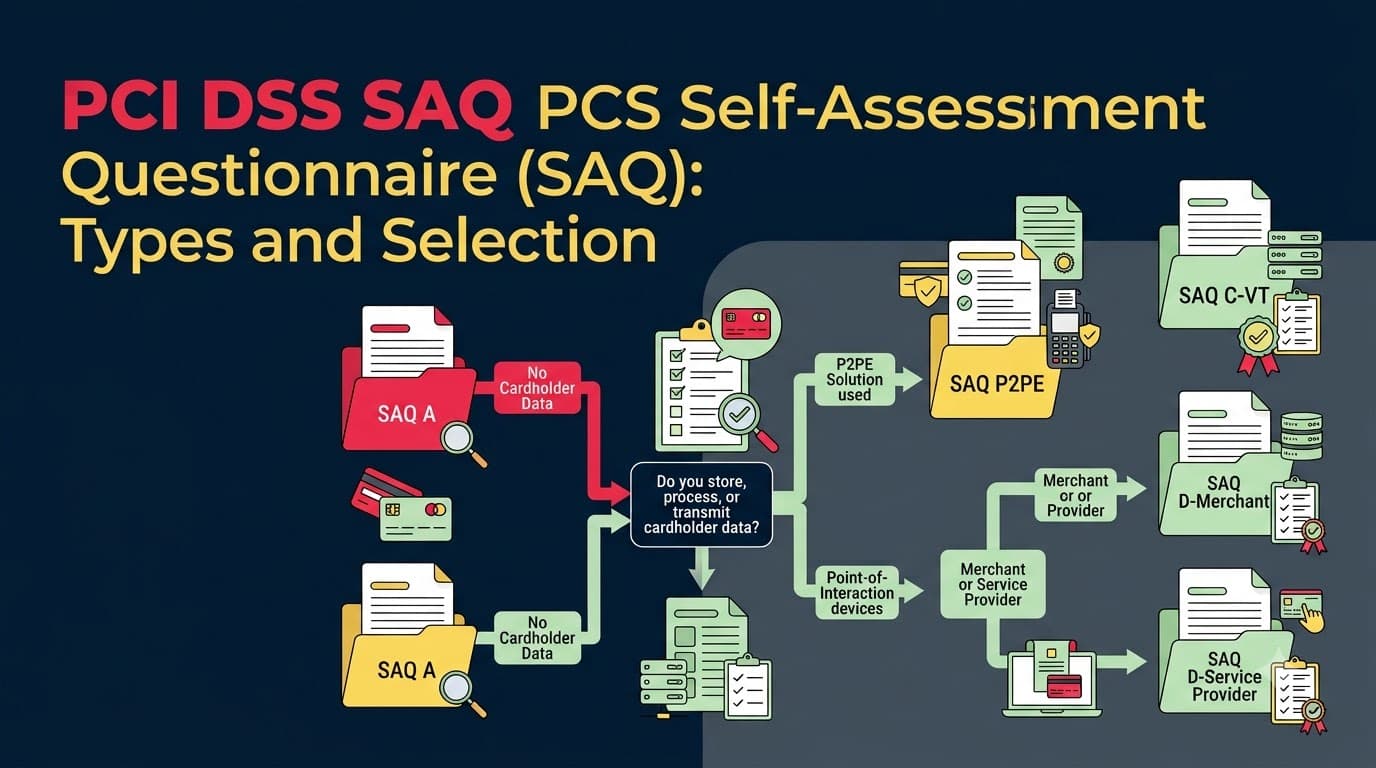
The SAQ Selection Decision Tree
Here's the same logic as a visual flow — the one I sketch on a whiteboard in almost every SAQ kickoff meeting.
flowchart TD
    A[Start: How does your business accept payment cards?] --> B{Validated P2PE solution in use end to end, per implementation guide?}
    B -->|Yes| C[SAQ P2PE]
    B -->|No| D{Card-not-present or card-present?}
    D -->|Card-not-present e-commerce| E{Fully redirected to a hosted third-party payment page?}
    E -->|Yes, no merchant control over payment page| F[SAQ A]
    E -->|No, merchant site can impact payment page security| G[SAQ A-EP]
    D -->|Card-not-present, manually keyed| H{Virtual terminal, one transaction at a time, third-party hosted?}
    H -->|Yes| I[SAQ C-VT]
    H -->|No| M
    D -->|Card-present, face-to-face| J{Terminal type and connectivity?}
    J -->|Imprint machine or dial-out terminal, no network| K[SAQ B]
    J -->|Standalone IP terminal, isolated from other systems| L[SAQ B-IP]
    J -->|POS/payment application connected to the internet| N[SAQ C]
    D -->|CHD stored electronically anywhere, or complex multi-channel environment| M[SAQ D - Merchant]
    O[Service provider eligible to self-assess] --> P[SAQ D - Service Provider]
Where SAQ Selection Intersects Merchant Level
SAQ eligibility and merchant level are related but distinct concepts, and I still see them conflated constantly. Merchant level — Level 1 through 4 — is determined by annual transaction volume and dictates whether self-assessment is even permitted, and how often external validation (like ASV scans) is required. SAQ type is determined by payment architecture and dictates which self-assessment form applies, assuming self-assessment is permitted at all. A Level 4 merchant with a fully outsourced e-commerce storefront and a Level 2 merchant with the exact same architecture both complete SAQ A — but the Level 2 merchant may face additional acquirer-driven requirements, like mandatory ISA training, that the Level 4 merchant doesn't.
Table 12: How Merchant Level Interacts With SAQ Eligibility
Merchant Level | Typical Validation Path | SAQ Eligibility |
|---|---|---|
Level 1 (>6M transactions/year, or flagged by a brand) | Annual ROC via QSA (or ISA, where permitted) | Generally not SAQ-eligible; acquirer may permit exceptions |
Level 2 (1M–6M transactions/year) | Annual SAQ (acquirer may require ISA involvement) or ROC | SAQ-eligible per architecture, subject to acquirer program |
Level 3 (20,000–1M e-commerce transactions/year) | Annual SAQ | SAQ-eligible per architecture |
Level 4 (below Level 3 thresholds) | Annual SAQ, per acquirer program | SAQ-eligible per architecture |
For the full mechanics of how those volume thresholds are calculated and how acquirers assign levels, see PCI DSS Merchant Levels: Understanding Your Compliance Requirements.
Where SAQ Selection Intersects CDE Scope
You cannot select an SAQ correctly without first understanding your cardholder data environment (CDE) — the systems that store, process, or transmit cardholder data (CHD) or sensitive authentication data (SAD), plus everything connected to them. Every SAQ eligibility criterion I've walked through above — "fully outsourced," "no electronic storage," "isolated from other systems" — is fundamentally a statement about scope. A merchant that thinks it's SAQ A-eligible but hasn't mapped its actual data flows might discover, mid-assessment, that a marketing analytics script on the checkout page technically has the ability to read form fields before the redirect fires — which would move that merchant into SAQ A-EP territory, or worse, reveal an unauthorized data flow that needs remediation before any SAQ can be honestly completed.
Table 13: CDE Scoping Questions That Drive SAQ Selection
Scoping Question | Why It Matters for SAQ Selection |
|---|---|
Does any merchant-controlled system receive, transmit, or store CHD/SAD, even transiently? | Determines A vs. A-EP vs. C eligibility |
Are payment terminals on a segmented network, isolated from POS/back-office systems? | Determines B-IP vs. C eligibility |
Is cardholder data stored electronically anywhere — including logs, backups, or support tickets? | Any "yes" typically routes to SAQ D |
Are all third parties touching CHD themselves PCI DSS validated? | Required for SAQ A, A-EP, C-VT eligibility |
Is the P2PE solution on the current PCI SSC validated list, implemented per guide with zero deviation? | Required for SAQ P2PE eligibility |
If your organization hasn't run a formal scoping exercise recently — or ever — that's the honest place to start, not the SAQ form itself. I walk through the full methodology, including data-flow diagramming and network segmentation validation, in PCI DSS Scope Determination: Cardholder Data Environment (CDE) Mapping.
Common SAQ Selection Mistakes I See in the Field
After fifteen-plus years of walking organizations through this process, the mistakes cluster into a fairly small set of recurring patterns. Recognizing them in your own environment before an acquirer does is the entire point of this section.
Table 14: Common SAQ Selection Mistakes
Mistake | Why It Happens | Consequence |
|---|---|---|
Reusing last year's SAQ without re-checking eligibility | Nobody owns the annual re-validation step | Architecture drifts silently out of alignment with the attested SAQ |
Assuming any iframe qualifies for SAQ A | Iframes "feel" outsourced even when merchant infrastructure retains influence | Misattestation; likely should be SAQ A-EP |
Treating "encrypted terminal" as equivalent to validated P2PE | Marketing language conflates encryption with PCI SSC's formal P2PE validation | SAQ P2PE eligibility is void; falls back to SAQ C or D |
Defaulting to SAQ D "to be safe" | Fear of picking a form that's later challenged | Wastes weeks of staff time better spent on control implementation |
Sales/support staff storing card numbers outside the sanctioned channel | Convenience, lack of awareness, no DLP controls | Disqualifies SAQ A, C-VT, or B eligibility; forces SAQ D |
Skipping CDE scoping before selecting an SAQ | SAQ selection treated as a form-picking exercise, not an architecture review | Wrong SAQ selected; gaps discovered during breach investigation |
Not re-validating after a checkout or POS redesign | Development and compliance functions don't talk to each other | Same failure mode as Larkspur & Vine — misattestation for months or years |
"Every SAQ misattestation I've ever investigated traces back to a change nobody flagged — a new plugin, a new POS vendor, a new call center script. The technology moved and the paperwork didn't." — Elias Fontaine, Forensic Investigator, Meridian Cyber Forensics
Working With Your Acquirer to Confirm SAQ Eligibility
Your acquirer — the bank or processor that handles your card transactions and, per its agreements with the card brands, mandates your PCI DSS compliance — is the final authority on which SAQ you're required to complete, not PCI SSC directly and not your own internal judgment alone. Acquirers vary in how actively they validate SAQ selection: some run their own compliance portals with automated eligibility questionnaires that flag inconsistencies (as happened to Larkspur & Vine), while others simply accept whatever AOC is submitted unless a dispute or breach forces a closer look. Either way, I recommend treating the acquirer relationship as a resource, not just a gatekeeper — a five-minute call to confirm SAQ eligibility before a checkout redesign ships is dramatically cheaper than a remediation notice eighteen months later.
Table 15: Questions to Ask Your Acquirer Before Finalizing SAQ Selection
Question | Why It Matters |
|---|---|
Does your compliance portal automatically validate SAQ type against reported architecture? | Determines how much self-policing your business needs to do |
Is ISA training required or recommended for our merchant level? | Affects internal resourcing for annual validation |
What's your process if our architecture changes mid-cycle? | Establishes the re-validation trigger and timeline |
Do you require quarterly ASV scans in addition to our SAQ, and does our SAQ type mandate them? | SAQ A-EP, B-IP, C, and D typically require quarterly external scans; confirm specifics |
What documentation do you expect alongside the AOC? | Avoids submission delays or rejected attestations |
Case Study: The Iframe That Wasn't a Redirect
Larkspur & Vine, the retailer from this article's opening, is worth returning to with the resolution. Once my team mapped the actual checkout data flow, the finding was unambiguous: the in-house checkout redesign loaded the payment gateway's tokenization script inside an iframe that the merchant's own servers rendered, and — critically — a marketing personalization script on the same page had broad DOM access, meaning it technically had the ability to interact with the payment iframe's surrounding page, even though it never actually touched card data. That combination disqualified the environment from SAQ A and squarely placed it in SAQ A-EP territory.
We spent four weeks closing the gap: hardening the content security policy to eliminate any script's ability to interfere with the payment iframe, formally documenting the architecture, and completing SAQ A-EP properly rather than trying to force-fit the environment back into SAQ A. Total incremental cost of the SAQ A-EP effort, including the CSP hardening: roughly $38,000 in contractor and internal staff time. Compare that to the $5,000-a-month non-compliance fee the acquirer had threatened, or the far larger exposure if a breach had occurred while the wrong AOC was on file — Priya's board considered it money well spent, and the exercise ultimately became the template Larkspur & Vine now runs after every checkout change.
Case Study: The "Standalone" Terminal That Wasn't Standalone
A regional restaurant group I worked with — twenty-two locations, primarily card-present — had been self-attesting to SAQ B-IP for three years, on the strength of standalone, IP-connected payment terminals at every register. During a routine network architecture review ahead of a POS vendor migration, we discovered that at six of the twenty-two locations, a well-meaning IT contractor had years earlier connected the payment terminals to the same switch as the restaurant's guest Wi-Fi and kitchen display systems, to simplify cabling during a renovation. The terminals were still, individually, standalone PTS devices — but they were no longer isolated, which is the actual legal basis for B-IP eligibility.
The fix was mostly physical and network-layer: dedicated, properly segmented cabling and VLANs for the payment terminals at all six affected locations, validated with a follow-up network segmentation test. Once remediated, SAQ B-IP eligibility was restored and reaffirmed across all twenty-two sites. The bigger win was procedural — the group now runs an annual network topology audit specifically checking terminal isolation, triggered automatically whenever a location undergoes any renovation or vendor change, so a future "simplify the cabling" decision can't silently break compliance again.
Case Study: The Service Provider That Outgrew Its SAQ
A payment gateway startup I advised had launched on SAQ D for Service Providers from day one — the right call for a young company still refining its architecture. Three years and a large enterprise client later, that same client's own security team, doing vendor due diligence, asked a question the gateway's compliance lead couldn't confidently answer: was the environment still genuinely SAQ-eligible, or had transaction volume and complexity crossed into territory where a full ROC via QSA was now the acquirer's expectation? A quick review of the acquirer's service-provider program rules confirmed it: the gateway's volume had crossed a threshold that shifted the expectation from self-assessed SAQ D to a QSA-led ROC.
Rather than treat it as a setback, the gateway leaned into it — engaging a QSA proactively rather than waiting to be told, and using the resulting ROC as a sales asset in enterprise deals where prospects specifically wanted a QSA's independent opinion rather than a self-attestation. Within a year, the ROC had become a competitive differentiator in the gateway's sales process, cited by name in three of their five largest new enterprise contracts that year. I cover the QSA-led assessment process in full in PCI DSS Qualified Security Assessor (QSA): Professional Assessment Process, and the ROC documentation itself in PCI DSS Report on Compliance (ROC): Documentation Requirements.
Compensating Controls Within an SAQ
Not every environment can meet a stated requirement exactly as written, and PCI DSS accounts for that through the compensating control mechanism — an alternative control that meets the intent and rigor of the original requirement when the original control genuinely can't be implemented due to legitimate technical or documented business constraints. Compensating controls show up inside SAQs (most commonly in SAQ C and SAQ D, given their broader technical scope) as a formal worksheet attached to the questionnaire, not as a casual "we do something similar" answer.
Table 16: Illustrative Compensating Control Scenarios in SAQ Completion
Original Requirement | Constraint | Illustrative Compensating Control |
|---|---|---|
Unique credential per system administrator | Legacy payment application only supports one shared admin account | Enhanced logging tied to physical/badge access correlation, plus quarterly access review |
Automatic session timeout after inactivity | Kiosk-mode POS terminal requires persistent session for operational reasons | Physical access restriction to the terminal plus continuous video monitoring of the terminal location |
Quarterly internal vulnerability scanning on a legacy system pending replacement | System scheduled for decommission within 90 days, scanning tool incompatible | Documented decommission timeline, network isolation of the legacy system, enhanced monitoring |
A word of caution I give every client: compensating controls are meant to be the exception, reviewed and justified in detail, not a permanent workaround for a control you'd simply rather not implement. Acquirers and QSAs scrutinize compensating-control worksheets closely, and an SAQ leaning heavily on them is a signal that deserves its own remediation roadmap.
The Annual SAQ Cycle: Timeline and Ownership
SAQ completion isn't a one-time event — it's an annual cycle, and the organizations that handle it smoothly treat it that way, with a named owner and a calendar, rather than a scramble triggered by an acquirer's reminder email.
Table 17: A Realistic Annual SAQ Cycle
Timeframe | Activity |
|---|---|
10–12 weeks before due date | Re-run CDE scoping check: has anything changed in payment architecture since last cycle? |
8–10 weeks before | Confirm SAQ type is still correct against current architecture; re-run the decision framework |
6–8 weeks before | Gather evidence against each applicable requirement (policies, configs, scan results, training records) |
4–6 weeks before | Complete the SAQ questionnaire; document any compensating controls |
2–4 weeks before | Internal review/sign-off (or ISA review, where applicable); complete quarterly ASV scans if required for the SAQ type |
1–2 weeks before | Complete and sign the AOC; submit to acquirer |
Due date | Submission confirmed with acquirer; non-compliance fee clock avoided |
Ongoing | Any mid-cycle architecture change triggers an off-cycle re-validation of SAQ eligibility |
The single highest-leverage line in that table is the first one. Organizations that build "re-check the architecture" into the cycle before they touch the questionnaire almost never end up in Larkspur & Vine's position. Organizations that jump straight to "open last year's form and update the dates" are the ones I get called about.
Tools, Templates, and Where to Get Help
You don't have to build the SAQ eligibility mapping from scratch every year. A properly maintained PCI DSS Scoping & CDE Worksheet turns the architecture questions in Table 13 into a repeatable checklist your team can run quarterly, not just at renewal time. For teams that want a guided path straight to the right form, our SAQ Selector walks through the same decision logic as the flowchart above and outputs a recommendation with the supporting rationale attached — useful both for internal sign-off and for showing your acquirer your reasoning if they ask. Pair that with the PCI DSS 12-Requirements Checklist to track evidence gathering against whichever SAQ you land on, and the Merchant Level / SAQ Reference to keep the level-and-SAQ interaction (Table 12, above) straight for your finance and compliance teams. If terminology ever gets murky mid-project, the PCI DSS Glossary is worth bookmarking.
Table 18: SAQ Selection and Completion Toolkit
Tool/Resource | Best Used For |
|---|---|
PCI DSS Scoping & CDE Worksheet | Mapping data flows before selecting an SAQ |
SAQ Selector | Walking the decision tree and documenting the rationale |
PCI DSS 12-Requirements Checklist | Tracking evidence gathering once the SAQ type is confirmed |
Merchant Level / SAQ Reference | Keeping level and SAQ interaction straight across teams |
PCI DSS Glossary | Resolving terminology questions during the assessment |
SAQ Selection as a Business Opportunity, Not Just a Compliance Task
It's tempting to treat SAQ selection as pure overhead — a form to get through once a year with minimum pain. I'd push back on that framing. Every conversation I've had about SAQ eligibility has doubled as an architecture review, and architecture reviews surface real business value beyond the compliance outcome: Larkspur & Vine's CSP hardening closed a genuine script-injection risk that had nothing to do with PCI DSS on paper but everything to do with protecting customer trust. The restaurant group's segmentation fix reduced its actual attack surface across twenty-two locations, not just its questionnaire length. The payment gateway's proactive move to a QSA-led ROC became a revenue-generating sales asset.
The businesses that get the most out of this process are the ones that treat "which SAQ are we on" as a standing architecture question, revisited every time the payment stack changes, rather than an annual form-filling chore assigned to whoever's available in Q1. Scope reduction — through clean outsourcing, validated tokenization, P2PE adoption, or disciplined network segmentation — isn't just a way to shrink your SAQ. It's a way to shrink your actual exposure if something goes wrong, which is the entire point of PCI DSS in the first place. For a full walkthrough of how SAQ selection fits into PCI DSS validation end to end, alongside merchant levels, ROC requirements, and the standard's twelve requirements, see our PCI DSS Complete Guide: Payment Card Industry Data Security Standard. And because PCI DSS rarely operates in isolation from an organization's broader security program, it's worth understanding how it complements frameworks like ISO 27001 or a SOC 2 program built for payment processors if your business sits at that intersection.
If your team is staring at nine SAQ types and isn't confident which one actually fits your architecture — or hasn't re-checked that fit since your last checkout redesign, POS migration, or new payment channel — PentesterWorld's compliance advisors can walk your environment through the same scoping and decision process outlined here, and help you build the evidence trail your acquirer, your QSA, and your own board will trust. Reach out to start a scoping conversation before your next attestation cycle, not after an acquirer flags it for you.