Dana Okafor had built her career on being the person who caught problems before they became disasters. Fifteen months into her role as Director of Information Security at Solstice Merchant Services — a payment facilitator processing roughly 22 million card-not-present transactions a year for 4,300 sub-merchants — she thought she had Requirement 12 handled. The information security policy was posted on the intranet. Employees clicked through an annual training module. There was, somewhere, a spreadsheet of vendors.
Then her Qualified Security Assessor (QSA), running the Level 1 assessment that Solstice's acquiring bank required before renewing a $6.8 million processing agreement with a national fitness retailer, asked a question that stopped the room cold: "Can you show me the documented evidence that your incident response plan was tested in the last twelve months, and walk me through your process for confirming each of your eleven third-party service providers is meeting the PCI DSS requirements you've delegated to them?"
Dana had run a tabletop exercise. She did not have a tabletop exercise with a dated after-action report, assigned remediation owners, and a revision history showing the plan had actually been updated based on lessons learned. She had a vendor list. She did not have a documented due diligence process for onboarding those vendors, current written agreements acknowledging each provider's PCI DSS responsibilities, or a monitoring cadence proving that each provider's own compliance status had been verified in the past twelve months. The QSA logged nine findings against Requirement 12 alone — more than any other requirement in the entire assessment. The retailer's contract carried a 45-day compliance cure clause. Solstice used 31 of those days, three external consultants, and a very long string of nights getting the program to a state the QSA could finally sign off on.
That gap — between having security policies and running a security program that produces evidence on demand, every time, without a scramble — is exactly what Requirement 12 exists to close.
Who This Is For
This guide is for security leaders, compliance managers, and IT directors at merchants and service providers who need to build — or rebuild — the governance layer of PCI DSS: the policy, risk analysis, training, screening, vendor management, and incident response program that Requirement 12 formalizes. You'll walk away with the actual sub-requirement structure of 12.1 through 12.10, the evidence a QSA or Internal Security Assessor (ISA) will ask for at each step, a reusable third-party service provider management framework, an incident response program you can test and defend, and a twelve-month calendar for keeping all of it current instead of scrambling every March.
Why Requirement 12 Is Different From Everything Else in PCI DSS
Requirements 1 through 11 are technical. They tell you to configure a firewall, encrypt stored data, patch systems, restrict access, and test your network. An assessor can point a scanner at a segment, pull a config file, or watch a control fire in real time. Requirement 12 is the odd one out — it is the only requirement under Goal 6, "Maintain an Information Security Policy," and instead of testing a technical control, it tests whether your organization has built a governance program around all of the technical work happening elsewhere in the standard.
That distinction matters because Requirement 12 is disproportionately where assessments fall apart. In my consulting work across payment facilitators, mid-market e-commerce merchants, and Level 1 service providers, Requirement 12 consistently produces more findings per sub-requirement than any of the technical requirements — not because the controls are technically hard, but because they require sustained organizational discipline: reviewing a policy on a calendar, running a risk analysis nobody remembers to schedule, confirming a vendor's compliance status a year after everyone forgot they signed the contract. Requirement 12 does not test whether you can build a firewall rule. It tests whether your organization, as an institution, actually operates the way its policies say it does.
"Requirement 12 is where I find out whether a company has a security program or a security binder. A binder has a policy dated three years ago that nobody's opened since. A program has a policy with a review date, a named owner, a training record tied to it, and a risk analysis that changed something. Those two things look identical on a shelf and completely different in an interview room." — Marcus Webb, QSA, Ironbridge Assurance Partners
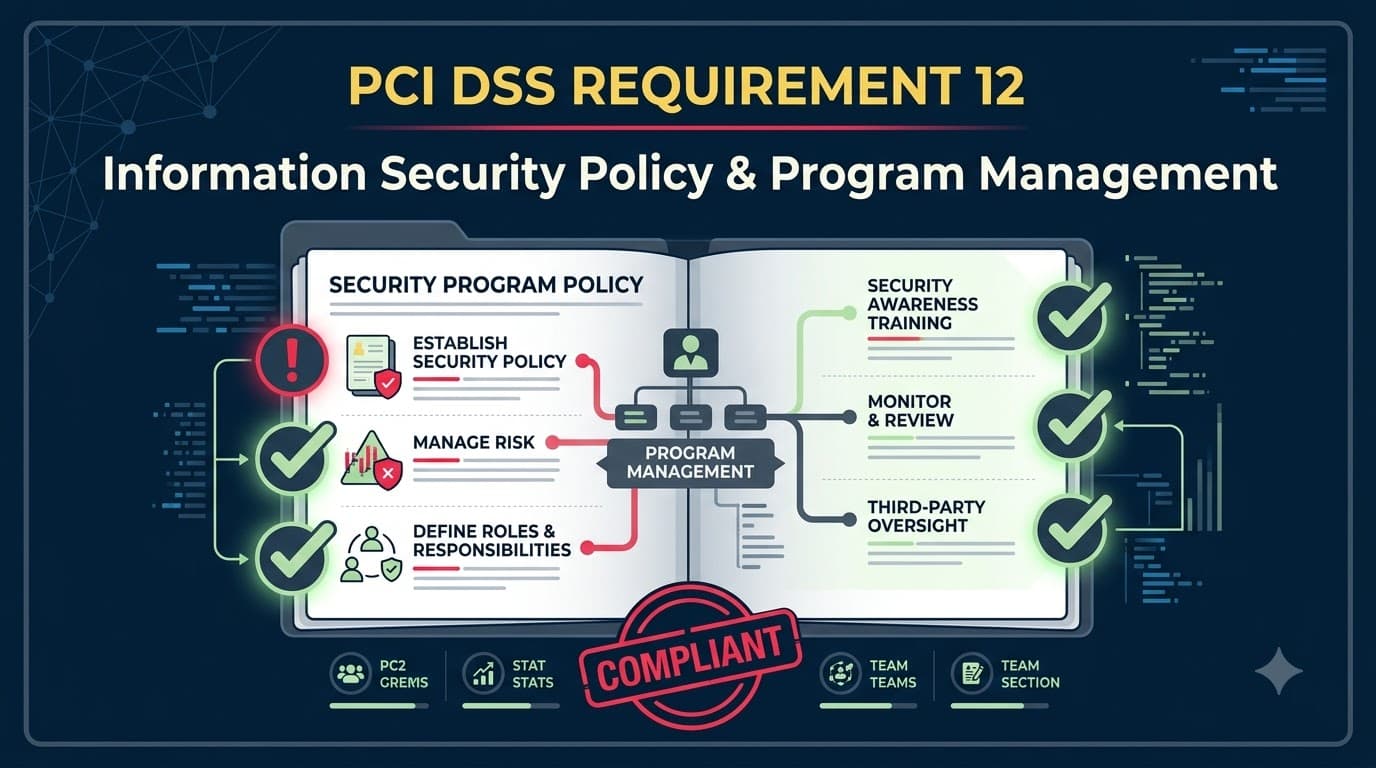
PCI DSS v4.0 and its limited revision, v4.0.1, organize Requirement 12 into ten control objectives, 12.1 through 12.10, spanning roughly 25 individual sub-requirements. The table below maps the whole territory before we go deep on each piece.
Table: Requirement 12 Control Objectives at a Glance
Control Objective | Focus Area | Primary Control | Key Evidence Reviewed |
|---|---|---|---|
12.1 | Overall information security policy | Documented, published, reviewed annually; roles assigned | Policy document, review log, org chart, CISO assignment memo |
12.2 | Acceptable use of end-user technologies | Documented AUPs covering approved tech, uses, and users | AUP document, employee acknowledgments, asset inventory |
12.3 | Formal risk analyses | Annual risk assessment; targeted risk analyses (TRA) for flexible controls | Risk register, TRA reports, sign-off records |
12.4 | PCI DSS compliance management | Executive accountability; quarterly reviews (service providers) | Charter document, quarterly review logs |
12.5 | PCI DSS scope documentation | Inventory maintained; scope confirmed at least annually | System inventory, scope diagram, confirmation memo |
12.6 | Security awareness program | Formal training program, delivered at hire and annually | Training curriculum, completion records, phishing metrics |
12.7 | Personnel screening | Background screening for CDE-access roles | Screening policy, screening records (redacted) |
12.8 | Third-party service provider management | Inventory, agreements, due diligence, annual monitoring | TPSP list, contracts, due diligence files, AOC tracking |
12.9 | TPSP support obligations (for providers) | Written acknowledgment of responsibility to customers | TPSP-to-customer agreement language |
12.10 | Incident response | Documented, tested plan with 24/7 coverage | IR plan, test records, on-call rosters, training logs |
Ten control objectives. One requirement. And unlike a firewall rule, none of them stay compliant on their own — every one of them decays the moment nobody owns it.
12.1 — The Overall Information Security Policy
The foundation of Requirement 12 is deceptively simple on paper: maintain a comprehensive information security policy that "governs and provides direction for protection of the entity's information assets," in the language PCI DSS v4.0 uses. In practice, this single control objective carries four separate sub-requirements, and QSAs test all four independently.
12.1.1 requires the policy to be established, published, maintained, and disseminated to all relevant personnel and relevant third parties — not just posted somewhere employees are theoretically supposed to find it, but actively communicated. 12.1.2 requires the policy to be reviewed at least once every twelve months and updated as needed to reflect changes to business objectives or risk environment. 12.1.3 requires roles and responsibilities for performing Requirement 12 activities to be documented, assigned, and understood by the people holding them — this is where "somebody probably does that" fails an assessment. 12.1.4 requires overall responsibility for information security to be formally assigned to a Chief Information Security Officer or another knowledgeable member of executive management, with that assignment documented, not implied by a job title.
Table: 12.1 Sub-Requirement Breakdown
Sub-Requirement | What It Requires | Common Evidence | Typical Gap I Find |
|---|---|---|---|
12.1.1 | Policy established, published, disseminated | Policy doc, distribution log, intranet/LMS record | Policy exists but was never actively pushed to new hires or contractors |
12.1.2 | Reviewed at least annually, updated as needed | Dated review log, version history, approval signature | Review happened but nothing was actually reassessed — a rubber stamp |
12.1.3 | Roles/responsibilities documented and understood | RACI chart, job descriptions, interview corroboration | Roles exist on paper but staff can't describe their own responsibilities in interview |
12.1.4 | Executive-level ownership formally assigned | Signed assignment memo, org chart, board minutes | Ownership assumed to sit with "IT" with no named accountable executive |
A policy that satisfies 12.1.1 but not 12.1.3 is common — organizations write a beautiful document and never translate it into who actually does what. I've sat in assessment interviews where a network administrator, asked who owns quarterly access reviews, answered "I think that's someone in compliance," and compliance pointed back at IT. Both statements can be true and the requirement still fails, because nobody could name the accountable person.
Acceptable Use Policies for End-User Technologies (12.2)
12.2.1 requires documented acceptable use policies (AUPs) for end-user technologies — the category covering laptops, remote-access tools, removable electronic media, personal mobile devices used for business, email, and internet access. This sub-requirement got noticeably more specific in v4.0. It's not enough to have a generic "use company resources responsibly" memo; the AUP must explicitly list approved technologies, define acceptable uses, identify the list of products and services approved for use, define a process for authorizing use, and identify which personnel are authorized to use each technology.
The practical effect is that organizations need a living inventory tied to the policy, not just prose. If your remote-access tool changes, or you approve a new file-sharing service, the AUP has to reflect that change — and the people using it need to acknowledge the updated version, not just the original one they signed three years ago.
Table: Acceptable Use Policy Coverage Checklist
Technology Category | Must Be Addressed | Typical Owner | Renewal Trigger |
|---|---|---|---|
Laptops and workstations | Approved configuration, encryption, physical security | IT operations | New device standard |
Remote access (VPN, VDI, RDP) | Approved tools, MFA requirement, session limits | IT security | New remote-access tool adopted |
Removable media (USB, external drives) | Approval process, encryption requirement, or prohibition | IT security | Policy change or incident |
Personal mobile devices (BYOD) | Enrollment in MDM, data separation, remote wipe consent | IT security / HR | New MDM platform |
Email and messaging | Acceptable business use, prohibited attachments, phishing reporting | IT security | New platform or incident trend |
Cloud file-sharing / SaaS | Approved services list, prohibited unsanctioned tools | IT security | New SaaS approved/retired |
I recommend reviewing the AUP on the same cadence as the shadow-IT discovery process — quarterly, at minimum — because the gap between "what's in the policy" and "what employees are actually using" grows fast in any organization running more than a handful of SaaS tools.
Risk Analyses — and the New Targeted Risk Analysis (12.3)
12.3 is where PCI DSS v4.0 made one of its most consequential changes to the standard, and it's the section that trips up organizations still thinking in v3.2.1 terms. There are two distinct kinds of risk analysis at play.
The first is the traditional annual risk assessment — a broad exercise identifying threats and vulnerabilities to the cardholder data environment (CDE), evaluating likelihood and impact, and producing a documented risk register that informs the rest of the security program. Most organizations already ran something like this under v3.2.1.
The second, introduced under v4.0, is the targeted risk analysis (TRA) — a much narrower, requirement-specific risk exercise. 12.3.1 requires a TRA for every PCI DSS requirement that gives an organization flexibility in how frequently to perform an activity (for example, requirements that say "periodically" rather than specifying a fixed interval). That TRA has to identify the assets being protected, the threat the frequency choice addresses, factors contributing to likelihood and impact, and a resulting frequency the organization commits to — reviewed at least annually. 12.3.2 requires a separate TRA for each requirement an organization meets using the customized approach, documenting how the customized control meets the requirement's stated objective. 12.3.3 requires documentation and annual review of the cryptographic cipher suites and protocols in use. 12.3.4 requires annual review of hardware and software technologies in use, including confirmation of whether each is still supported by its vendor — directly targeting the end-of-life software problem that quietly expands attack surface in payment environments.
"Targeted risk analysis is the single most misunderstood control in v4.0. Clients hear 'risk analysis' and hand me their enterprise risk register from three years ago. That's not it. A TRA is a specific, documented justification for a specific control decision — why you scan quarterly instead of monthly, why your compensating control meets the objective. If I can't trace the TRA back to one specific requirement, it doesn't count." — Renata Salib, Principal Consultant, Meridian Risk Advisory
Table: Risk Analysis Types Under PCI DSS v4.0
Type | Governed By | Purpose | Frequency | Output |
|---|---|---|---|---|
Enterprise/annual risk assessment | 12.3 (general practice) | Broad identification of threats to the CDE | At least annually | Risk register, treatment plan |
Targeted risk analysis — frequency-based | 12.3.1 | Justify a chosen frequency for a flexible control | At least annually, reviewed | Documented TRA report per requirement |
Targeted risk analysis — customized approach | 12.3.2 | Justify how a customized control meets a requirement's objective | Per implementation, reviewed | TRA report + customized-approach worksheet |
Cryptographic inventory review | 12.3.3 | Confirm cipher suites/protocols remain appropriate | At least annually | Cryptographic inventory document |
Technology inventory review | 12.3.4 | Confirm hardware/software is current and vendor-supported | At least annually | Technology inventory with EOL status |
The distinction between the defined approach and the customized approach matters directly here: organizations following the defined approach — the traditional, prescriptive way of meeting each PCI DSS requirement — still need TRAs wherever a requirement allows flexible frequency (12.3.1), but only organizations using the customized approach for a given control need the deeper 12.3.2 analysis for that control. I go into the full mechanics of choosing between them elsewhere; for Requirement 12 purposes, the takeaway is that risk analysis is no longer a once-a-year enterprise exercise you file away — it's a recurring, per-control documentation discipline.
12.4 — Who Owns PCI DSS Compliance
12.4 addresses accountability for the compliance program itself, and it applies with different weight depending on entity type. 12.4.1 applies specifically to service providers: executive management must establish responsibility for the protection of cardholder data and a PCI DSS compliance program, including defining channels for communicating up to the executive level. 12.4.2 and 12.4.2.1, also service-provider-specific, require quarterly reviews confirming that personnel are following security policies and operational procedures day to day — not just that the policies exist, but that a designated person is periodically checking that reality matches the document. Those quarterly reviews have to be documented, including the results and any remediation performed.
Merchants aren't held to the quarterly review cadence under 12.4.2, but I still recommend it as a practice — a light quarterly spot-check of a handful of daily operational procedures (log review, badge deactivation, backup verification) catches drift long before it becomes an audit finding, and it builds the muscle memory a QSA looks for in interviews.
12.5 — Documenting and Confirming PCI DSS Scope
Scope is the single most consequential decision in a PCI DSS program, because everything downstream — cost, assessment duration, control burden — is a function of how large the cardholder data environment is defined to be. 12.5 formalizes the discipline of keeping that definition current and defensible.
12.5.1 requires an inventory of system components in scope to be maintained and kept current — every server, workstation, network device, virtual instance, and cloud resource that stores, processes, or transmits cardholder data (CHD) or sensitive authentication data (SAD), plus anything connected to or that could impact the security of those systems. 12.5.2 requires that scope be documented and formally confirmed at least once every twelve months and upon any significant change to the in-scope environment — for merchants. Service providers face a tighter cadence: at least once every six months, reflecting the higher stakes of a compromised environment that touches many downstream customers. 12.5.2.1 adds an explicit requirement for service providers to perform this scoping validation specifically following a significant change. 12.5.3 requires that significant changes to organizational structure — a merger, acquisition, business unit restructuring — trigger a documented review of the impact on PCI DSS scope, not an assumption that nothing changed.
Table: Scope Documentation Requirements by Entity Type
Element | Merchants | Service Providers | Evidence Format |
|---|---|---|---|
System component inventory | Maintained, kept current | Maintained, kept current | Asset inventory / CMDB export |
Formal scope confirmation cadence | At least every 12 months | At least every 6 months | Signed scope confirmation memo |
Triggered re-scoping | Upon significant change | Upon significant change | Change-driven scope review record |
Org-structure change review | Not explicitly required | Required (12.5.3) | Documented impact assessment |
Network/data flow diagrams | Current, matches inventory | Current, matches inventory | Data flow diagram, network diagram |
I treat scope confirmation as the anchor event of the entire annual compliance cycle — it should happen before the risk analyses and control testing that follow, because a risk analysis performed against a scope diagram from eighteen months ago is analyzing the wrong environment. If your organization is still mapping the cardholder data environment manually every year, I'd point you toward the deeper mechanics in a dedicated scope-determination and CDE-mapping exercise; getting that boundary right is what makes every other Requirement 12 control defensible.
Security Awareness Training Program (12.6)
12.6 requires a formal security awareness program, not an annual video. 12.6.1 requires the program to be formally implemented — documented content, defined audience, and a delivery mechanism. 12.6.2 requires the program to be reviewed at least once every twelve months and updated to address new and evolving threats. 12.6.3 requires personnel to receive training upon hire and at least annually thereafter, with two content requirements called out specifically: 12.6.3.1 requires training to cover awareness of threats and vulnerabilities that could impact security, explicitly naming phishing and related social-engineering attacks, and 12.6.3.2 requires training to cover the organization's acceptable use policies.
Table: Security Awareness Training Program Design
Component | Requirement | Recommended Cadence | Audience | Evidence |
|---|---|---|---|---|
Core security awareness curriculum | 12.6.1 | Annual refresh | All personnel with CDE access or influence over it | Curriculum document, LMS content |
New-hire onboarding training | 12.6.3 | Within first 30 days of hire | All new hires with relevant access | Completion record with date |
Annual refresher training | 12.6.3 | At least every 12 months | All in-scope personnel | Completion record, quiz scores |
Phishing/social-engineering module | 12.6.3.1 | Annual + simulated phishing tests | All in-scope personnel | Module completion, phishing test metrics |
Acceptable use policy training | 12.6.3.2 | Annual, tied to AUP updates | All in-scope personnel | Acknowledgment tied to AUP version |
Role-based advanced training | Best practice, not explicit | Annual | Developers, DBAs, security team, executives | Specialized curriculum records |
Program content review | 12.6.2 | At least every 12 months | Program owner | Review log with dated changes |
The failure mode I see most often isn't skipping training — it's running the same training every year with no evidence the content was reviewed and updated. 12.6.2 exists precisely because threat patterns change fast; a 2023 phishing module that never mentions AI-generated business email compromise or QR-code phishing ("quishing") is technically "annual training" and substantively stale. Simulated phishing campaigns aren't explicitly mandated by the text of 12.6.3.1, but they're the most defensible way to demonstrate that awareness training changed actual behavior, and QSAs consistently respond well to click-rate trend data as supporting evidence.
Personnel Screening (12.7)
12.7.1 requires organizations to screen potential personnel who will have access to the cardholder data environment prior to hire, within the constraints of local labor and privacy law — a background check appropriate to the position, applied consistently, and documented. This is deliberately not a one-size-fits-all mandate; a cashier with no CDE access and a database administrator with production access to a payment gateway warrant different depth of screening, and the standard's flexibility acknowledges that jurisdictions vary widely in what background screening is legally permissible.
Table: Personnel Screening by Access Tier
Access Tier | Example Roles | Typical Screening Depth | Re-Screening Trigger |
|---|---|---|---|
No CDE access | General office staff, non-technical roles | Standard employment verification | Not typically required |
Indirect CDE access | Help desk, facilities with badge access to CDE spaces | Criminal background check, identity verification | Promotion into higher-access role |
Direct CDE access — operational | Support staff processing card data, call center agents | Criminal background check, credit history where legally permitted, reference checks | Role change, elapsed multi-year interval per policy |
Direct CDE access — privileged | System/database administrators, security engineers, developers with production access | Full background check, criminal history, verified employment history | Role change, periodic re-screening per policy |
Executive/fiduciary | CISO, finance leadership with payment oversight | Full background check plus any role-specific regulatory screening | Per governance policy |
Document the screening policy even more carefully than the individual screening results, since actual background-check records are themselves sensitive personal data that should be handled under HR retention and privacy controls, not stored loosely in a compliance folder. What a QSA needs to see is that the policy exists, defines the access tiers, specifies screening depth per tier, and that screening actually happened for a sample of relevant hires — not the raw background-check reports themselves.
Managing Third-Party Service Providers (12.8 and 12.9)
If Requirement 12 has a center of gravity, it's here. 12.8 governs how an organization manages risk from every third-party service provider (TPSP) that could affect the security of its cardholder data — payment gateways, hosting providers, managed security providers, call centers, SaaS platforms that touch CHD, even the cleaning contractor with badge access to a data center, where relevant. 12.9 flips the lens: it governs what a TPSP itself must do to support its customers' PCI DSS compliance.
12.8.1 requires a maintained list of all TPSPs, including a description of the service each one provides. 12.8.2 requires written agreements with each TPSP that include, at minimum, an acknowledgment that the provider is responsible for the security of the account data it possesses or otherwise stores, processes, or transmits on the entity's behalf — this closes a loophole that used to let vendors handle card data with only an informal understanding of who was accountable if something went wrong. 12.8.3 requires an established process for engaging TPSPs that includes proper due diligence prior to engagement — evaluating a vendor's security posture before signing, not after an incident forces the question. 12.8.4 requires a program to monitor TPSPs' PCI DSS compliance status at least once every twelve months. 12.8.5 requires the organization to maintain information about which PCI DSS requirements are managed by each TPSP, which are managed by the entity itself, and which are shared — the responsibility matrix that so many organizations discover they don't have only when an assessor asks for it.
"The question I ask every client during vendor due diligence is: 'If this provider had a breach tomorrow, could you tell me within an hour which of your PCI DSS requirements just failed?' Most can't, because nobody ever wrote down who owns what. That document — the responsibility matrix — is worth more than the vendor's SOC 2 report, because the SOC 2 tells you about them. The matrix tells you about your own exposure." — Andre Kowalski, VP of Third-Party Risk, Solstice Merchant Services
Table: Third-Party Service Provider Management Program
Control Area | Requirement | Key Activity | Evidence |
|---|---|---|---|
TPSP inventory | 12.8.1 | Maintain a current list of all TPSPs and services provided | Vendor register with service descriptions |
Written agreements | 12.8.2 | Contracts acknowledge TPSP responsibility for account data security | Signed contracts/addenda with security clauses |
Onboarding due diligence | 12.8.3 | Assess vendor security posture before engagement | Due diligence questionnaire, risk score, approval record |
Annual compliance monitoring | 12.8.4 | Confirm each TPSP's PCI DSS compliance status at least annually | |
Responsibility matrix | 12.8.5 | Document which requirements the TPSP owns, which the entity owns, which are shared | Shared responsibility matrix per vendor |
TPSP support obligation (if a provider) | 12.9.1 | Written acknowledgment to customers of account data responsibility | Standard customer contract clause |
TPSP information support (if a provider) | 12.9.2 | Support customer requests for 12.8.4/12.8.5 information within agreed timeframe | Defined SLA for information requests |
The responsibility matrix deserves a template of its own, because the same shape recurs across almost every vendor relationship I've reviewed. A simplified example:
Table: Sample TPSP Responsibility Matrix (Hosted Payment Gateway)
PCI DSS Requirement Area | Owned By Provider | Owned By Merchant | Shared |
|---|---|---|---|
Req 1–2: Network security, secure configuration of gateway infrastructure | Yes | — | — |
Req 3–4: Encryption of CHD in the provider's environment | Yes | — | — |
Req 3: Merchant's own retention/storage of any CHD outside the gateway | — | Yes | — |
Req 6: Secure development of the merchant's checkout page integration | — | — | Yes (provider secures gateway; merchant secures integration code) |
Req 7–8: Access control to the merchant's own gateway admin portal accounts | — | Yes | — |
Req 9: Physical security of provider's data centers | Yes | — | — |
Req 10–11: Logging/monitoring/testing of provider infrastructure | Yes | — | — |
Req 10–11: Logging/monitoring of merchant's own e-commerce environment | — | Yes | — |
Req 12: Provider's internal security program | Yes | — | — |
Req 12: Merchant's TPSP monitoring of this very provider | — | Yes | — |
Due diligence deserves a specific process, not a vague "we checked their website." A defensible due diligence workflow assesses the provider's PCI DSS validation status (SAQ or ROC/AOC), reviews the scope of their attestation against the services actually being purchased, evaluates financial and operational stability, checks for prior breach history where discoverable, and produces a documented risk rating that determines the depth of the contract's security terms and the frequency of ongoing monitoring. Annual monitoring under 12.8.4 then closes the loop — collecting a current AOC, confirming the provider's certification hasn't lapsed, and re-validating that the scope of their compliance still matches the services in use, since vendors do quietly narrow or change the boundaries of what they attest to.
Incident Response Plan and Testing (12.10)
12.10 is the requirement that determines how badly a bad day goes. 12.10.1 requires an incident response plan to exist, be implemented, and be ready to activate in the event of a suspected or confirmed security incident affecting the CDE. 12.10.2 requires the plan to be reviewed and tested — through a tabletop exercise, simulation, or similar — at least once every twelve months. 12.10.3 requires specific personnel to be designated and available on a 24/7 basis to respond to incidents. 12.10.4 requires the personnel responsible for incident response to be appropriately and periodically trained, at least annually. 12.10.5 requires the plan to include monitoring and responding to alerts from security monitoring systems, including intrusion detection/prevention systems, file integrity monitoring, and change-detection mechanisms. 12.10.6 requires the plan to be modified and evolved according to lessons learned and to incorporate industry developments — meaning a static plan that never changes after real incidents or exercises is itself a finding. 12.10.7 requires specific incident response procedures for the detection and response to a lost or stolen primary account number (PAN) — including if PAN is discovered in an unexpected location, such as an unencrypted log file or an email inbox.
Table: Incident Response Program Elements
Element | Requirement | What Good Looks Like | Common Failure |
|---|---|---|---|
Documented IR plan | 12.10.1 | Roles, escalation paths, containment/eradication/recovery steps, card-brand and acquirer notification steps | Generic template plan never customized to the environment |
Annual test | 12.10.2 | Tabletop exercise with a realistic scenario, dated report, findings, owners | "We talked about it in a meeting" with no documentation |
24/7 availability | 12.10.3 | Documented on-call roster with escalation tiers and contact verification | Single point of contact with no backup or verified reachability |
Responder training | 12.10.4 | Annual, role-specific training for IR team members, tracked completion | Training assumed from general security awareness, not IR-specific |
Alert monitoring integration | 12.10.5 | IR plan explicitly ties into SIEM, FIM, and IDS/IPS alerting workflows | IR plan and monitoring tooling operated by disconnected teams |
Continuous improvement | 12.10.6 | Plan revision log tied to real incidents, exercises, and threat intel | Plan version unchanged for multiple years |
Lost/stolen PAN procedure | 12.10.7 | Specific playbook for PAN found outside approved storage locations | No distinct procedure — treated as a generic incident |
"The tabletop exercise is not a checkbox, it's a rehearsal. I've run exercises where the 'incident commander' on paper had left the company eight months earlier and nobody updated the plan. That's not a documentation gap — that's a company that would have had zero effective incident response leadership during a real breach. The exercise is what catches that before a QSA does, and definitely before an attacker does." — Priya Chandrasekaran, Incident Response Lead, Cascadia Security Group
Card brand and acquirer notification timelines belong inside the plan itself, not in someone's memory — most acquirer agreements specify notification within 24 to 72 hours of a confirmed or suspected compromise involving cardholder data, and missing that window has independent contractual consequences beyond the PCI DSS finding itself.
The Security Program Lifecycle
Requirement 12's ten control objectives aren't a checklist to complete once — they're a cycle that has to run continuously, each stage feeding the next. The diagram below is how I map the annual rhythm for clients building this out for the first time.
flowchart TD
    A[Confirm PCI DSS Scope — 12.5] --> B[Update Policy & Roles — 12.1]
    B --> C[Run Risk Analyses & TRAs — 12.3]
    C --> D[Refresh Acceptable Use Policies — 12.2]
    D --> E[Deliver Awareness Training — 12.6]
    E --> F[Screen New & Transferring Personnel — 12.7]
    F --> G[Review & Monitor TPSPs — 12.8/12.9]
    G --> H[Test Incident Response Plan — 12.10]
    H --> I[Executive Review & Compliance Reporting — 12.4]
    I --> A
Notice that scope confirmation sits at the top of the loop rather than the bottom. In every rebuild I've run, starting the annual cycle anywhere other than "what is actually in scope right now" produces a program that's precisely calibrated to defend an environment that no longer exists.
Governance and Roles: Building Real Accountability
12.1.3 and 12.1.4 both come back to the same underlying problem: policies without named, accountable owners don't survive contact with an assessment. The organizations that pass Requirement 12 cleanly aren't the ones with the most elegant policy documents — they're the ones where every control objective has a specific human who can describe, unprompted, what they own and how they'd prove it's working.
I use a RACI structure (Responsible, Accountable, Consulted, Informed) to make this explicit, because "the security team owns it" collapses under questioning the moment you ask which specific person on the security team.
Table: Requirement 12 RACI Model (Representative Mid-Market Organization)
Control Objective | Responsible | Accountable | Consulted | Informed |
|---|---|---|---|---|
12.1 Policy | Security policy analyst | CISO | Legal, HR | All personnel |
12.2 Acceptable use | IT operations manager | CISO | HR, Legal | All personnel |
12.3 Risk analyses | Risk/compliance analyst | CISO | System owners, IT | Executive team |
12.4 Compliance management | Compliance manager | CISO / Executive sponsor | Board/audit committee | Executive team |
12.5 Scope documentation | Security architect | CISO | Network engineering, DevOps | QSA/ISA |
12.6 Awareness training | Security awareness lead | CISO | HR, People ops | All personnel |
12.7 Personnel screening | HR business partner | Head of HR | Legal, Security | Hiring managers |
12.8/12.9 Vendor management | Third-party risk manager | CISO / Procurement lead | Legal, Finance | Business unit owners |
12.10 Incident response | Incident response lead | CISO | Legal, Communications, Executive team | All personnel |
Small organizations will collapse several of these rows onto one or two people — that's fine, and expected below Merchant Level 1. What doesn't scale down is the documentation of who those people are. A five-person security function with clearly assigned ownership passes this cleanly; a fifty-person function with diffuse, undocumented ownership fails it.
The Evidence Auditors Actually Ask For
QSAs and ISAs don't test Requirement 12 by reading your policy manual cover to cover — they sample. They pick a handful of employees and ask what training they remember. They pick a vendor and ask to see the contract, the due diligence file, and last year's compliance confirmation. They pick a date on the incident response test log and ask who was in the room. Below is the evidence set I prepare clients to have ready, organized by control objective, before an assessor ever asks.
Table: Requirement 12 Evidence Checklist
Control Objective | Evidence to Have Ready | Who Should Be Able to Discuss It |
|---|---|---|
12.1 Policy | Current policy doc, prior version, dated review/approval record | CISO or policy owner |
12.2 Acceptable use | AUP document, technology inventory it references, sample employee acknowledgments | IT operations lead |
12.3 Risk analyses | Risk register, TRA reports mapped to specific requirements, cryptographic and technology inventories | Risk/compliance analyst |
12.4 Compliance management | Executive charter/assignment memo, quarterly review logs (service providers) | CISO, compliance manager |
12.5 Scope | Current system inventory, network/data flow diagrams, signed scope confirmation memo | Security architect |
12.6 Training | Curriculum, completion records for a personnel sample, phishing simulation results | Awareness training lead |
12.7 Screening | Screening policy, redacted screening confirmation for a hire sample | HR business partner |
12.8 TPSP management | Vendor list, contracts with responsibility clauses, due diligence files, current AOCs, responsibility matrix | Third-party risk manager |
12.9 TPSP obligations | Customer-facing contract language (if the entity is itself a TPSP) | Legal, account management |
12.10 Incident response | IR plan, most recent tabletop report, on-call roster, responder training records | Incident response lead |
The pattern across every row is the same: a document alone is never sufficient evidence. An assessor wants the document plus a person who can speak to it fluently, plus a record showing the activity actually happened on schedule. Missing any one of the three produces a finding even when the other two look perfect.
Where Requirement 12 Programs Fail
After walking dozens of organizations through Requirement 12 rebuilds, the failure patterns repeat with remarkable consistency. None of them are exotic technical gaps — they're organizational ones, which is precisely why they're so preventable and so persistently common.
Table: Common Requirement 12 Failures and Fixes
Failure Pattern | Root Cause | Typical Finding | Fix |
|---|---|---|---|
Policy exists but was never disseminated | No formal distribution/acknowledgment process | 12.1.1 finding — personnel unaware of policy content | Tie policy distribution to onboarding and an annual re-acknowledgment workflow |
"Annual review" is a rubber stamp | No structured review checklist, just a signature | 12.1.2 finding — no evidence content was reassessed | Build a review template forcing comparison against the prior year and current risk landscape |
Vendor list is out of date | No trigger tied to procurement for adding new TPSPs | 12.8.1 finding — TPSPs discovered that aren't on the list | Require security sign-off as a gate in the procurement/contracting workflow |
No responsibility matrix per vendor | Due diligence stopped at "they sent us an AOC" | 12.8.5 finding — can't show which requirements each TPSP owns | Build a matrix template required before any vendor contract is finalized |
Incident response plan never tested | Treated as a document project, not an operational capability | 12.10.2 finding — no test evidence in the last 12 months | Schedule the tabletop as a recurring calendar event owned by a named person, not "when we get to it" |
Training content unchanged year over year | No formal content review cycle | 12.6.2 finding — no evidence of updates addressing new threats | Assign a training content owner who reviews and refreshes annually, tied to current threat trends |
Screening policy exists, records don't | HR and security never aligned on evidence retention | 12.7.1 finding — can't demonstrate screening occurred for sampled hires | Formal handoff process between HR and security for CDE-access role hires |
Scope confirmation happens, but late in the cycle | Scope review scheduled after control testing, not before | Downstream findings across multiple requirements tested against stale scope | Move scope confirmation to the first step of the annual cycle |
Targeted risk analyses missing entirely | Organization still thinks in v3.2.1 terms | 12.3.1/12.3.2 findings — no TRA documentation for flexible/customized controls | Inventory every requirement using flexible frequency or the customized approach and build a TRA for each |
Roles assigned verbally, not documented | Reliance on institutional memory rather than written assignment | 12.1.3/12.1.4 findings — interview responses don't match any document | RACI chart maintained alongside the policy, updated on any org change |
"Every Requirement 12 finding I write down traces back to the same root cause: somebody assumed a process was happening because it used to happen, or because it was supposed to happen, and nobody was checking. Requirement 12 isn't hard. It's just the first requirement to fail the moment an organization stops paying attention to it." — Marcus Webb, QSA, Ironbridge Assurance Partners
Case Study: Solstice Merchant Services' 90-Day Remediation
Dana Okafor's nine findings didn't get fixed with a document sprint — they got fixed by rebuilding the accountability structure underneath the documents. In the first two weeks, Solstice assigned named owners to every control objective in the RACI model above, most of which had previously been informally split between Dana and a compliance analyst who reported to Finance. Week three brought a full TPSP inventory reconciliation: the "eleven vendors" on the old spreadsheet turned out to be fourteen active service providers once procurement records were cross-checked against actual payment traffic, including a chargeback-management SaaS tool nobody had flagged as touching cardholder data.
By day 45, Solstice had signed updated contract addenda with all fourteen vendors acknowledging account data responsibility under 12.8.2, built a responsibility matrix for each, and completed due diligence documentation retroactively for the six vendors that had been onboarded without it. By day 60, the incident response plan had been rewritten with a verified 24/7 on-call roster and run through a live tabletop exercise simulating a compromised payment gateway credential — the exercise itself surfaced that the documented "incident commander" had left the company eight months earlier, exactly the kind of gap a real breach would have exposed at the worst possible moment. By day 90, the QSA closed out all nine findings, and Solstice's acquiring bank released the retailer contract for signature. The total remediation cost, including consulting fees, ran approximately $215,000 — a fraction of the $6.8 million relationship it protected, but a cost Dana has since built into an ongoing budget line rather than treating Requirement 12 as a one-time fire drill.
"The thing that changed my mind about Requirement 12 wasn't the findings — it was realizing that every single one of them was preventable with about four hours of calendar discipline a month, spread across the right owners. We'd been treating governance as overhead. It's actually the cheapest insurance policy in the entire standard." — Dana Okafor, Director of Information Security, Solstice Merchant Services
Case Study: Cascadia Outfitters and the Subcontracted Call Center
Cascadia Outfitters, a mid-market outdoor apparel retailer running both e-commerce and a phone-order channel, had a clean PCI DSS history for six years running SAQ D as a merchant with a modest but real cardholder data footprint in its call center operations. The call center itself was outsourced to a third-party provider, contracted years earlier under a standard services agreement that had never been updated to include explicit PCI DSS responsibility language.
When that call center provider suffered a breach — a compromised remote-access credential used by an internal IT contractor — cardholder data belonging to roughly 38,000 Cascadia customers was exposed. Cascadia's own environment was never touched. But because the original vendor contract predated 12.8.2's requirement for written acknowledgment of account data responsibility, and because Cascadia's due diligence file for the vendor consisted of a single email confirming "yes, we're PCI compliant" with no supporting AOC ever collected, Cascadia's own QSA found the company could not demonstrate it had exercised the due diligence 12.8.3 requires or monitored the vendor's compliance status under 12.8.4. The card brands treated the incident as a joint failure. Cascadia's own PCI DSS assessment that cycle carried four Requirement 12 findings directly traceable to the vendor relationship, on top of breach notification costs, forensic investigation fees, and card-brand assessments that together exceeded $1.1 million — a cost that a documented due diligence and monitoring program, run at a fraction of that expense, would very likely have caught by surfacing the vendor's weak remote-access controls during onboarding review.
Table: What a Proper 12.8 Program Would Have Caught
12.8 Control | What Existed at Cascadia | What Should Have Existed |
|---|---|---|
12.8.1 Vendor inventory | Vendor listed informally, no formal register | Register entry with service description and CHD-handling scope |
12.8.2 Written agreement | Generic services contract, no security clause | Addendum acknowledging account data responsibility |
12.8.3 Due diligence | Single email confirmation | Documented questionnaire, AOC review, risk rating |
12.8.4 Annual monitoring | None | Annual AOC collection and scope re-validation |
12.8.5 Responsibility matrix | None | Documented split of requirement ownership |
Case Study: Awareness Training That Changed Behavior at Meridian Retail Group
Not every Requirement 12 story is a breach story. Meridian Retail Group, a regional grocery chain running point-of-sale terminals across 60 locations, had technically satisfied 12.6.3 for years with a single annual video module and a passing quiz score. Their security team, skeptical that the training was doing anything beyond generating completion certificates, ran a baseline phishing simulation before overhauling the program: 31% of employees clicked a simulated phishing link, and 9% submitted credentials to a fake login page.
The security awareness lead redesigned the program around the 12.6.3.1 requirement's explicit focus on phishing and social engineering — replacing the single annual video with quarterly micro-modules, role-specific scenarios for store managers versus corporate staff, and monthly simulated phishing tests with immediate, non-punitive feedback for anyone who clicked. Twelve months later, the click rate had fallen to 6% and credential submission to under 1%. More importantly for the compliance program, the redesign gave Meridian exactly the kind of longitudinal metrics — dated, trending, tied to specific content changes — that satisfies 12.6.2's requirement to show the program is reviewed and updated, rather than repeated unchanged.
"We used to treat the training module as something to survive once a year. Once we started measuring click-through rates instead of quiz completion rates, it stopped being a compliance exercise and became an actual security control. The QSA noticed the difference immediately — she said most companies show her a completion percentage, and we were the first that quarter to show her a trend line." — Josh Whitfield, Security Awareness Program Manager, Meridian Retail Group
Requirement 12 Across Frameworks: PCI DSS, SOC 2, and ISO 27001
Almost every security and compliance framework has some version of a "governance" requirement, and clients running more than one program at once consistently ask how much of the work overlaps. The honest answer is: a lot of the underlying activity overlaps, but the documentation artifacts and evidence expectations are framework-specific, so you can't simply point a SOC 2 auditor at your PCI DSS policy binder and expect it to satisfy both.
Table: Governance Requirements Compared Across Frameworks
Governance Area | PCI DSS Requirement 12 | SOC 2 (Common Criteria) | ISO 27001 |
|---|---|---|---|
Overall security policy | 12.1 — annual review, executive ownership | CC1/CC2 — policies supporting the control environment | Clause 5.2 Policy + Annex A control 5.1 |
Risk analysis | 12.3 — annual risk assessment + targeted risk analyses | CC3 — risk identification and assessment | Clause 6.1 + Clause 8.2 risk assessment |
Awareness training | 12.6 — annual, phishing-focused | CC1.4 — competence and training | Annex A control 6.3 |
Personnel screening | 12.7 — pre-hire screening for CDE access | CC1.4 — hiring practices | Annex A control 6.1 |
Third-party management | 12.8/12.9 — TPSP due diligence, agreements, monitoring | CC9.2 — vendor risk management | Annex A controls 5.19–5.23 |
Incident response | 12.10 — documented, tested, 24/7 | CC7.3–CC7.5 — incident detection/response | Annex A controls 5.24–5.28 |
Independent validation | ROC/SAQ + AOC, QSA/ISA assessment | Type I/II report, independent CPA | Certification audit, accredited certification body |
If your organization is running PCI DSS alongside a SOC 2 examination, the policy development and documentation discipline described in a dedicated guide to SOC 2 policy development and required documentation maps closely onto what 12.1 and 12.2 expect — the same underlying policy set can usually serve both programs with framework-specific annexes rather than two entirely separate policy libraries. The same is true on the ISO 27001 side: organizations building out Annex A control 5.1 under ISO 27001's information security policies control are doing conceptually the same governance work Requirement 12.1 demands, just validated through a certification audit rather than a QSA assessment. I generally advise clients running both programs to build one policy architecture with a mapping table showing which clause or requirement each policy section satisfies, rather than maintaining parallel, drifting document sets — the drift itself becomes an audit finding in both directions.
For the full six-goal, twelve-requirement structure Requirement 12 sits inside, the PCI DSS complete guide to the Payment Card Industry Data Security Standard is the right starting point if you're building a program from zero rather than remediating an existing one. And because Requirement 12's incident response and monitoring obligations depend directly on the technical testing performed elsewhere in the standard, it's worth reading 12.10 alongside the practices covered in PCI DSS Requirement 11's security testing program — the alerts your vulnerability scanning and penetration testing program generates under Requirement 11 are exactly what your Requirement 12.10.5 incident response plan is supposed to catch and act on.
Building a Twelve-Month Requirement 12 Calendar
Every Requirement 12 failure I've traced back to a root cause ends at the same place: nobody put the recurring activity on a calendar with a named owner and a hard date. The fix is almost embarrassingly simple — a single shared calendar mapping every recurring Requirement 12 obligation to a month, an owner, and the evidence it produces.
Table: Sample Twelve-Month Requirement 12 Calendar
Month | Activity | Control Objective | Owner |
|---|---|---|---|
Month 1 | Confirm PCI DSS scope; update system inventory and data flow diagrams | 12.5 | Security architect |
Month 2 | Review and update overall information security policy | 12.1 | CISO |
Month 3 | Executive compliance program review (service providers: quarterly) | 12.4 | CISO / Executive sponsor |
Month 3 | Run annual risk assessment | 12.3 | Risk/compliance analyst |
Month 4 | Complete targeted risk analyses for flexible/customized controls | 12.3.1/12.3.2 | Risk/compliance analyst |
Month 5 | Review cryptographic and technology inventories | 12.3.3/12.3.4 | Security architect |
Month 6 | Executive compliance program review (service providers: quarterly) | 12.4 | CISO / Executive sponsor |
Month 6 | Service provider scope re-confirmation (service providers only) | 12.5.2 | Security architect |
Month 7 | Refresh acceptable use policies against current technology inventory | 12.2 | IT operations manager |
Month 8 | Deliver annual security awareness training and phishing simulation | 12.6 | Awareness training lead |
Month 9 | Executive compliance program review (service providers: quarterly) | 12.4 | CISO / Executive sponsor |
Month 9 | Annual TPSP compliance monitoring — collect current AOCs, re-validate responsibility matrices | 12.8.4/12.8.5 | Third-party risk manager |
Month 10 | Incident response tabletop exercise | 12.10.2 | Incident response lead |
Month 11 | Incident response team training refresh | 12.10.4 | Incident response lead |
Month 12 | Executive compliance program review; year-end reporting to board/audit committee | 12.4 | CISO |
Ongoing | Personnel screening for new hires with CDE access | 12.7 | HR business partner |
Ongoing | TPSP due diligence for newly engaged vendors | 12.8.3 | Third-party risk manager |
This calendar is a starting template, not gospel — merchants without the 12.4.2 quarterly-review obligation can drop those rows, and organizations with a fiscal year that doesn't align to the calendar year should shift the months accordingly. What shouldn't change is the principle: every recurring Requirement 12 obligation gets a specific month and a specific owner, visible to the whole security and compliance function, not buried in one person's memory.
Budgeting for the Governance Program
Requirement 12 is often under-budgeted because none of its controls involve buying a technology product — there's no appliance, no license renewal, no obvious line item. That's precisely why it gets squeezed when budgets tighten, and precisely why it produces the most findings. The costs are almost entirely people-time and, periodically, external expertise for specialized pieces like penetration-test-style incident response tabletop facilitation or legal review of vendor contract language.
Table: Illustrative Annual Requirement 12 Program Costs (Mid-Market Organization)
Cost Category | Illustrative Annual Range | Notes |
|---|---|---|
Internal staff time (policy, risk, training, vendor management) | $60,000–$140,000 | Often a fraction of existing compliance/security FTEs, not new headcount |
External risk analysis / TRA facilitation | $8,000–$25,000 | Higher for organizations newly adopting the customized approach |
Security awareness training platform and content | $5,000–$20,000 | Scales with headcount; simulated phishing tools included |
Background screening services | $50–$150 per screened hire | Scales with hiring volume in CDE-access roles |
Third-party risk management tooling or consulting | $10,000–$40,000 | Vendor risk platforms or contracted due diligence support |
Incident response tabletop facilitation | $6,000–$18,000 per exercise | Often more valuable when facilitated by an independent party |
Legal review of vendor contract language | $5,000–$15,000 | One-time per contract template, lighter for renewals |
Total illustrative range | $95,000–$260,000 | Scales with organization size, vendor count, and CDE complexity |
Compare that range against the cost Dana Okafor's team absorbed reactively — roughly $215,000 in a 90-day emergency remediation, on top of the risk of losing a $6.8 million contract entirely. Budgeting Requirement 12 as an ongoing program line rather than an annual surprise is, in almost every case I've seen, the cheaper path.
Requirement 12 as a Business Opportunity, Not Just a Compliance Cost
It's tempting to treat Requirement 12 as pure overhead — the paperwork requirement in a standard otherwise built around technical controls. I'd push back on that framing hard. Every organization I've worked with that built a genuinely mature Requirement 12 program found it paid for itself in ways that had nothing to do with avoiding assessment findings.
A documented, tested incident response plan shortens the single most expensive phase of any real breach: the chaotic first 24 hours where nobody knows who's in charge. A rigorous third-party due diligence and monitoring program catches vendor security weaknesses during contract negotiation, when you still have leverage, instead of during a post-breach forensic review, when you don't. A security awareness program that measures behavior change rather than quiz completion actually reduces the phishing and social-engineering incidents that remain the leading initial access vector into payment environments industry-wide. And a governance structure with named, accountable owners for every control objective is the same structure that makes your organization defensible in front of a QSA, a cyber-insurance underwriter, a prospective acquirer during due diligence, and a board asking hard questions after a competitor's breach makes headlines.
Sales teams selling into enterprise retail, hospitality, and financial services increasingly get asked for evidence of governance maturity — not just "are you PCI DSS compliant," but "show me your incident response test results" and "show me how you manage your own vendors." A Requirement 12 program built to the standard described in this guide turns those questions from a scramble into a five-minute conversation backed by documentation you already have on hand. That's a sales enablement asset, not just an audit artifact.
If your team is heading into a Level 1 assessment, renewing a processing agreement that depends on clean findings, or simply tired of rebuilding the same governance evidence under deadline pressure every cycle, start with the twelve-month calendar in this guide and assign owners this week — not after the next QSA visit reveals the gaps for you.
PentesterWorld's PCI DSS Policy Pack gives you a starting template set for the 12.1 and 12.2 documentation this guide covers, and the PCI DSS 12-Requirements Checklist is a fast way to sanity-check your current program against the full standard before your next assessment window opens. If you're not yet sure where your organization's biggest Requirement 12 gaps are, our PCI DSS Gap Analysis Tool will flag them in under twenty minutes, and the "Are You PCI DSS Ready?" quiz is a good gut-check before you commit to a formal assessment timeline. For teams building out Level 1 documentation for the first time, our ROC/AOC Reader's Guide walks through exactly what a QSA's report expects to see, section by section.