Maria Delgado had eleven days left before her Report on Compliance was due, and her QSA had just flagged something that stopped her cold. The segmentation test her network team swore was airtight had, in fact, allowed a scanner sitting on the corporate LAN to reach three payment switches deep inside the cardholder data environment of Solstice Outfitters, a 340-store apparel chain processing roughly $180 million a year in card payments. The finding wasn't theoretical. It meant Solstice's entire corporate network — 2,200 endpoints across offices, warehouses, and store back-rooms — had effectively been in PCI DSS scope for at least the eight months since the last firewall change, and nobody had run a single scan or penetration test against that reality since. The acquiring bank's annual review of Solstice's $180 million processing relationship was scheduled for the following month, and a scope-busting segmentation failure discovered mid-assessment is exactly the kind of finding that turns a routine renewal into a probationary one, with higher per-transaction fees and a mandated remediation timeline attached.
Maria's team spent the next ten days doing what should have been done on a recurring quarterly and annual cadence all along: re-scoping the CDE, re-running the segmentation test, patching the firewall rule that had quietly opened the path, and rebuilding a testing calendar that didn't rely on tribal memory. They made the deadline, barely. The QSA's report on compliance shipped with a documented corrective action plan instead of an open segmentation failure, and Solstice kept its processing agreement intact. But the real fix wasn't the ten-day scramble — it was building the ongoing testing program that Requirement 11 actually demands, so that the next network change never again goes unchecked for eight months.
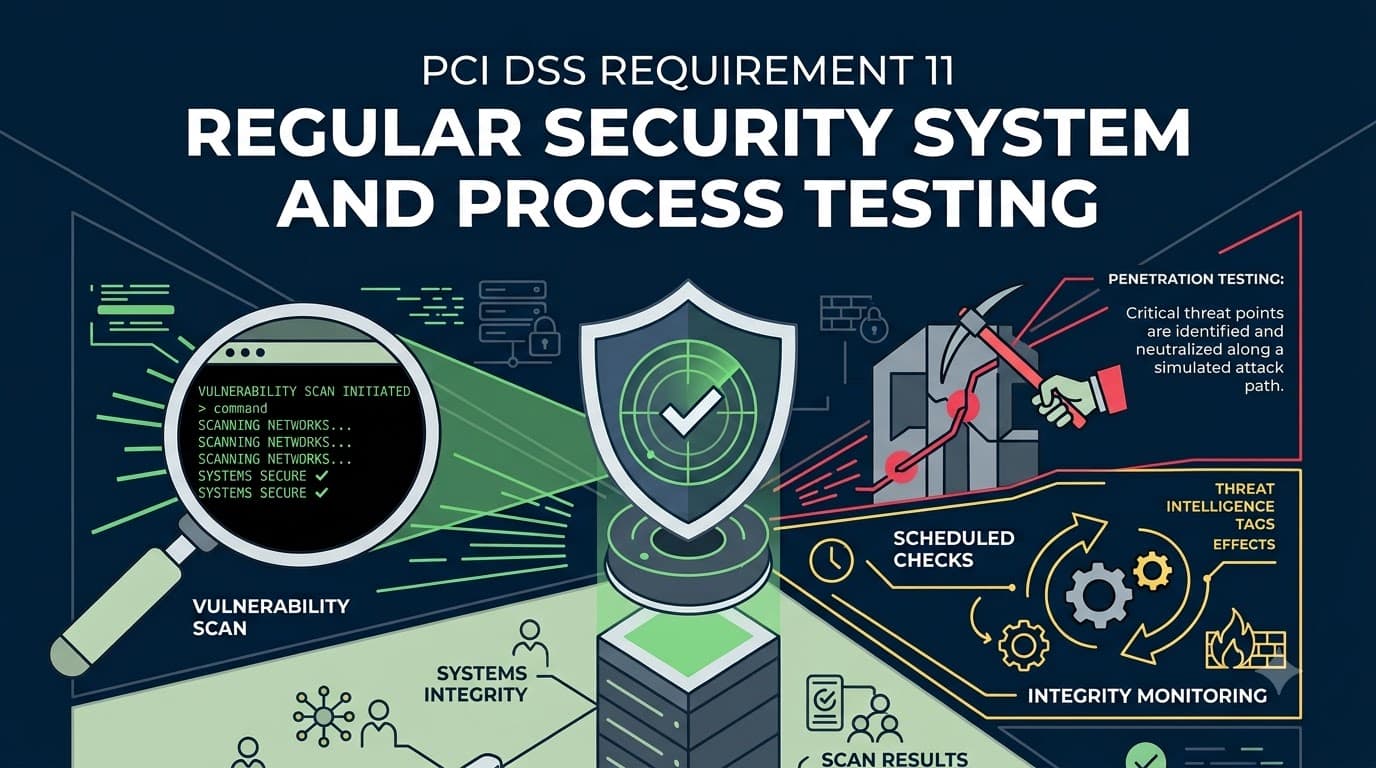
That's the requirement this article is about. PCI DSS Requirement 11, "Test Security of Systems and Networks Regularly," is the standard's proof-of-work clause: every other requirement describes controls you're supposed to have, and Requirement 11 makes you go verify, on a fixed cadence, that those controls actually function against real attackers and real scanners. It's also one of the most frequently failed requirements in Reports on Compliance, because it demands sustained operational discipline — quarterly scans, annual penetration tests, continuous monitoring — rather than a one-time documentation exercise.
Who This Is For / What You'll Walk Away With
This is written for CISOs, security engineers, network architects, and compliance managers responsible for building or running a PCI DSS testing program — whether you're a Level 1 merchant with an in-house red team or a Level 4 merchant relying entirely on outside vendors. You'll walk away with a clause-by-clause breakdown of Requirement 11.1 through 11.6 under PCI DSS v4.0.1, practical guidance on scan and penetration test cadence and scope, a working annual testing calendar you can adapt, and a clear picture of the evidence a Qualified Security Assessor (QSA) will expect to see. We'll also cover the two requirements most teams get wrong on their first v4.0 assessment: authenticated internal vulnerability scanning (11.3.1.2) and payment page change- and tamper-detection (11.6.1).
Requirement 11 at a Glance
Requirement 11 sits inside PCI DSS's fifth control goal, "Regularly Monitor and Test Networks," alongside Requirement 10 (logging and monitoring). Where Requirement 10 is about watching what already happened, Requirement 11 is about actively probing for what could go wrong. It breaks into six numbered sub-requirement families, each with its own cadence and evidence trail.
Sub-requirement | Focus area | Typical cadence |
|---|---|---|
11.1 | Processes and roles for security testing | Annual review, ongoing |
11.2 | Wireless access point detection | Quarterly + as needed |
11.3 | Internal and external vulnerability scanning | Quarterly + after significant change |
11.4 | Penetration testing (external, internal, segmentation) | Annual (6-monthly for service provider segmentation) + after significant change |
11.5 | Intrusion detection/prevention and file-integrity/change-detection | Continuous, weekly comparisons |
11.6 | Payment page change- and tamper-detection | Continuous, weekly evaluation minimum |
Every one of these sub-requirements shares a structure worth internalizing early: define the process, run the test or monitoring on a fixed schedule, document the results, remediate what's found, and retain evidence for the assessor. Miss any one of those five steps and you have a finding, even if the underlying technical control is sound.
"Requirement 11 is where compliance theater gets exposed fastest. You can write a beautiful vulnerability management policy, but if I ask for four consecutive quarters of passing external scans and you can only produce two, the paperwork doesn't matter anymore." — Devon Okafor, QSA, Meridian Assurance Partners
Why Testing Gets Its Own Requirement
New practitioners sometimes ask why vulnerability scanning and penetration testing need a dedicated requirement when Requirement 6 already covers secure development and Requirement 5 covers malware protection. The answer is that Requirements 1 through 10 describe controls; Requirement 11 verifies them under adversarial conditions. A firewall rule set documented under Requirement 1 can still have a misconfigured ACL that a scanner would catch in minutes. A patch management program under Requirement 6 can still leave a forgotten legacy server exposed that only an external scan would surface. Requirement 11 is the standard's built-in skepticism: it assumes your other controls will drift, decay, or get misconfigured over time, and it forces a recurring reality check.
This matters even more under v4.0's "continuous security" philosophy. Earlier PCI DSS versions were sometimes treated as an annual fire drill — patch everything, scan everything, pass the assessment, then relax until next year. v4.0 pushes hard against that pattern by tightening cadences (authenticated internal scanning, more explicit after-change triggers) and by adding two entirely new continuous-monitoring sub-requirements: 11.5.1.1 for service providers detecting covert malware channels, and 11.6.1 for payment page tamper detection. The intent is a testing program that runs in the background all year, not a scramble every twelve months.
11.1 — Processes and Policies for Security Testing
Requirement 11.1 is the governance layer underneath everything else in this requirement. It calls for documented processes covering all the activities in 11.2 through 11.6, with clearly assigned roles and responsibilities (11.1.1) that are known and understood by the people who hold them (11.1.2). In practice, QSAs look for a single security testing policy or program document — not scattered instructions in five different people's inboxes — that names who schedules scans, who triages results, who approves penetration test scope, and who signs off on remediation before it's marked closed.
A subtle but important design detail is organizational independence: internal vulnerability scans and internal penetration tests need to be performed by someone with enough separation from the team responsible for the systems under test that findings won't get quietly buried. That doesn't require a dedicated red team — a network engineer testing another team's segment, or a rotation between two internal security analysts, can satisfy it — but a system administrator scanning and self-attesting their own servers will draw scrutiny.
11.1 element | What it requires | Common evidence |
|---|---|---|
11.1.1 | Documented roles and responsibilities for all Requirement 11 activities | Security testing policy, RACI matrix |
11.1.2 | Roles/responsibilities are assigned and understood | Signed acknowledgments, interview evidence, job descriptions |
11.2 — Detecting Unauthorized Wireless Access Points
Rogue wireless access points remain one of the oldest and still most effective ways into a card data network — an employee plugs in a cheap consumer router for convenience, or an attacker drops a hidden AP in a supply closet, and suddenly there's an unmonitored bridge into the network. Requirement 11.2.1 requires authorized and unauthorized wireless access points to be identified and monitored at least once every three months, with a documented response when an unauthorized AP is found. Requirement 11.2.2 requires an inventory of authorized wireless access points, each with a documented business justification.
Detection methods vary by environment size. A single-location retailer might satisfy this with a quarterly manual walk-through using a handheld wireless scanner. A multi-site enterprise typically deploys a wireless intrusion detection system (WIDS) integrated with its wireless controllers, continuously fingerprinting nearby SSIDs and flagging anything not on the authorized list — which also happens to exceed the quarterly minimum and reduces dwell time from months to minutes.
Detection method | Best fit | Coverage | Effort |
|---|---|---|---|
Manual walk-through with handheld scanner | Single site, small footprint | Point-in-time | Low tooling cost, high labor per site |
Wireless intrusion detection system (WIDS) | Multi-site retail, large campuses | Continuous | Higher upfront cost, low ongoing labor |
Network access control (NAC) port monitoring | Wired-network rogue AP detection | Continuous | Moderate, complements WIDS |
Third-party managed wireless scanning service | Distributed franchise/retail chains | Quarterly or continuous | Outsourced, predictable cost |
"We treat wireless scanning as a physical security control as much as a technical one. Store managers get a laminated card showing what an authorized AP label looks like, because half our rogue-AP catches over the years came from a manager noticing an unfamiliar box, not from the scanner." — Ray Ferreira, Director of PCI Compliance, National Grocers Alliance
11.3 — Vulnerability Scanning: Internal and External
Requirement 11.3 is the workhorse of Requirement 11 and the sub-requirement most organizations touch every quarter. It splits cleanly into internal scanning (11.3.1 and its sub-clauses) and external scanning (11.3.2 and its sub-clauses), and the two have meaningfully different rules, evidence expectations, and — critically — who's allowed to run them.
Internal vulnerability scanning must happen at least once every three months and after any significant change (11.3.1). High-risk and critical vulnerabilities must be resolved, with a rescan confirming the fix (this is the part teams most often shortcut — a scan that finds critical findings but is never followed by a clean rescan doesn't satisfy the control). Lower-severity findings from 11.3.1.1 still need to be managed according to the organization's risk methodology, even though they don't require the same immediate rescan cadence. Internal scans must be performed by qualified personnel with organizational independence from the systems being scanned, exactly as described in 11.1.1's staffing model.
The headline new requirement in v4.0 is 11.3.1.2: internal vulnerability scans must be performed via authenticated scanning — using valid credentials on the target systems — rather than the older practice of unauthenticated network scans that only see what's exposed from the outside of each host. Authenticated scans see installed software versions, missing patches, and misconfigurations that an unauthenticated scan simply can't detect, which is why the Council made it mandatory (this requirement became enforceable on the standard 31 March 2025 timeline, alongside most other v4.0 future-dated items). Where authentication genuinely isn't feasible on legacy or appliance-style systems, the organization must document why and apply compensating scanning methods instead — this isn't a blanket opt-out, and QSAs expect to see that documentation for every system it applies to, not a generic exception covering the whole environment.
External vulnerability scanning (11.3.2) must be performed at least once every three months by a PCI SSC-Approved Scanning Vendor (ASV), and the quarterly scan must result in a passing scan per the ASV Program Guide's severity thresholds — vulnerabilities scored at a high enough CVSS level cause an automatic fail, requiring remediation and a rescan until a clean result is achieved (11.3.2.1). Unlike internal scans, external ASV scans are inherently unauthenticated black-box tests of what's visible from the public internet, mirroring what an outside attacker would see first. Scans triggered by a significant change (11.3.2.1) don't strictly have to be run by an ASV if performed by qualified internal or third-party staff, but the quarterly cadence scans that go into the compliance file must be ASV-certified.
Scan type | Who performs it | Scope | Cadence | Pass criteria |
|---|---|---|---|---|
Internal vulnerability scan (11.3.1) | Qualified internal or external staff, independent of system owners | All CDE and connected systems | Quarterly + after significant change | High/critical vulns resolved and rescanned clean |
Authenticated internal scan (11.3.1.2) | Same, using valid host credentials | Same, credentialed | Quarterly + after significant change | Same, deeper visibility into missing patches/misconfig |
External vulnerability scan (11.3.2) | Approved Scanning Vendor (ASV) only | Internet-facing CDE systems | Quarterly | ASV Program Guide passing scan |
Post-change external scan (11.3.2.1) | ASV or qualified internal/third-party staff | Changed systems | After significant change | Passing scan |
Scenario | Required action | SLA discipline |
|---|---|---|
Internal scan finds a critical CVSS finding | Remediate, then rescan | Rescan must show resolution before closing |
External ASV scan fails | Remediate, request ASV rescan | Repeat until a passing scan is obtained |
New segment added to CDE | Trigger internal + external scan of new scope | Before segment goes live in production, ideally |
Authenticated scan can't run (legacy appliance) | Document justification, apply compensating scan approach | Reviewed at least annually |
Choosing and Working With an ASV
Not every scanning vendor is an ASV — the designation comes from PCI SSC certification against a specific technical program, and only ASV-certified scans satisfy 11.3.2's quarterly requirement. Picking one is less about brand and more about fit: how well the vendor handles your specific mix of cloud, on-prem, and legacy internet-facing assets, how quickly they turn around rescans after remediation, and how clean their dispute process is for false positives, which are common enough with black-box scanning that a bad dispute process can cost you a passing quarter over a non-issue.
Responsibility | Internal team | ASV |
|---|---|---|
Define scan scope (all internet-facing CDE IPs) | Yes, and must keep it current | Scans only what's provided |
Run the quarterly scan | No | Yes, mandatory for the quarterly requirement |
Remediate findings | Yes | No |
Certify passing scan | No | Yes |
Dispute false positives | Submits evidence | Reviews and re-certifies if valid |
Rescan after remediation | Requests it | Performs it, often at added cost per cycle |
A detail worth flagging for anyone newly building a PCI DSS scoping and CDE mapping exercise: the ASV can only scan what you tell it to scan. If a forgotten subdomain or a shadow-IT cloud instance isn't on the target list, it never gets tested — which is exactly how organizations end up with a passing quarterly scan report and an unscanned, internet-facing system sitting quietly outside it. Reconciling the ASV scan scope against the actual CDE inventory should be a standing quarterly task, not a one-time setup step.
11.4 — Building a Penetration Testing Program
Vulnerability scanning tells you what's automatically discoverable. Penetration testing tells you what a motivated human attacker could actually chain together — pivoting from a low-severity finding on one host into a full compromise of another, or defeating a control that a scanner would never test because it requires judgment, not just signature matching. Requirement 11.4 governs this at both the program level (11.4.1) and through specific mandated test types.
Requirement 11.4.1 requires a documented penetration testing methodology based on an industry-accepted approach (think PTES, OWASP Testing Guide, or NIST SP 800-115), with defined coverage of the entire CDE and critical systems, testing from both outside and inside the network perspective, coverage of both application-layer and network-layer vulnerabilities, review of threats and vulnerabilities experienced in the preceding twelve months, and testing that specifically validates any segmentation controls used to reduce scope. Test results and remediation activities must be retained for at least twelve months.
11.4.1 methodology element | What the QSA checks for |
|---|---|
Industry-accepted approach | Named methodology referenced (PTES, OWASP, NIST 800-115, etc.) |
Full CDE + critical system coverage | Scope document maps to current CDE inventory |
Internal and external perspective | Evidence of both attacker vantage points tested |
Application-layer and network-layer testing | Web/API testing distinct from infrastructure testing |
Prior 12 months' threats reviewed | Threat intelligence or incident history referenced in scoping |
Segmentation validated | Segmentation test results included or cross-referenced |
12-month evidence retention | Reports and remediation tracking archived |
External penetration testing (11.4.2) and internal penetration testing (11.4.3) each must occur at least once every twelve months and after any significant change to the environment — a new payment application, a major network re-architecture, or a merger that brings a new CDE segment in-scope should all trigger an out-of-cycle test, not wait for the annual calendar slot. Requirement 11.4.4 closes the loop: exploitable vulnerabilities and security weaknesses found during testing must be corrected in line with the entity's risk assessment methodology, and the test must be repeated to verify the fix actually worked — an unremediated critical finding sitting in a year-old report is a finding in its own right.
Test type | Requirement | Cadence | Trigger for extra test |
|---|---|---|---|
External penetration test | 11.4.2 | At least annually | Significant change to internet-facing systems |
Internal penetration test | 11.4.3 | At least annually | Significant change to internal network/CDE |
Exploitable finding remediation | 11.4.4 | As found | Retest required to confirm fix |
Segmentation test (general entities) | 11.4.5 | At least annually | Significant change to segmentation controls |
Segmentation test (service providers) | 11.4.6 | At least every 6 months | Significant change to segmentation controls |
Multi-tenant provider support | 11.4.7 | Ongoing | Customer requests supporting evidence for their own external test |
"The organizations that pass their annual pen test cleanly are almost never the ones with the fanciest tooling. They're the ones who fixed last year's findings before this year's testers showed up. I can tell within the first hour of a retest whether remediation was real or cosmetic." — Priya Nair, Founder, Redshift Security Testing
Segmentation Testing: Proving the CDE Is Actually Isolated
If your organization uses network segmentation to shrink PCI DSS scope — keeping the corporate network, guest Wi-Fi, and back-office systems logically separated from the cardholder data environment — that segmentation only counts if you can prove it holds. That's what 11.4.5 (all entities using segmentation, at least annually) and 11.4.6 (service providers, at least every six months) require: a dedicated test, distinct from the general penetration test, that specifically attempts to cross the segmentation boundary from out-of-scope systems into the CDE and confirms it can't be done.
This was exactly the gap that caught Solstice Outfitters in the opening story. Their general penetration test the prior year had covered the CDE itself thoroughly, but the segmentation test — verifying that non-CDE systems genuinely couldn't reach it — had been treated as a checkbox rather than a real adversarial exercise, and a firewall rule change eight months earlier had quietly opened a path that nobody re-tested.
Segmentation test element | Detail |
|---|---|
Who requires it | Any entity relying on segmentation to reduce PCI DSS scope |
General entity cadence | At least once every 12 months |
Service provider cadence | At least once every 6 months |
Additional trigger | After any change to segmentation controls or the network architecture around them |
Test objective | Confirm out-of-scope systems cannot reach the CDE via any network path |
Scope | All segmentation controls (firewalls, VLANs, ACLs, cloud security groups) between in-scope and out-of-scope zones |
Failure implication | Previously "out of scope" systems may need to be reclassified into the CDE, expanding assessment scope significantly |
The scope-expansion risk is the part that gets underestimated. A failed segmentation test doesn't just produce a finding to remediate — it can retroactively pull hundreds or thousands of systems into scope for every other Requirement 11 activity (and every other requirement in the standard) until the segmentation gap is closed and re-verified. That's precisely why 11.4.5/11.4.6 exist as their own dedicated, mandatory test rather than being left as an implicit part of the general penetration test.
Building the Annual Testing Calendar
Requirement 11 only works as a program if its various cadences — quarterly, semi-annual, annual, and continuous — are mapped onto an actual calendar with owners and deadlines, rather than living as abstract policy language. The diagram below shows how a typical merchant's testing calendar lays out across a year, layering continuous monitoring underneath the periodic scan and test milestones.
gantt
    title PCI DSS Requirement 11 Annual Testing Calendar
    dateFormat  YYYY-MM-DD
    axisFormat  %b
    section Continuous
    IDS/IPS monitoring (11.5.1)            :active, ids, 2026-01-01, 365d
    File-integrity monitoring (11.5.2)     :active, fim, 2026-01-01, 365d
    Payment page tamper detection (11.6.1) :active, ppd, 2026-01-01, 365d
    section Quarterly
    Wireless AP scan Q1 (11.2.1)           :wifi1, 2026-01-15, 5d
    Internal vuln scan Q1 (11.3.1)         :ivs1, 2026-01-20, 5d
    External ASV scan Q1 (11.3.2)          :evs1, 2026-01-25, 5d
    Wireless AP scan Q2 (11.2.1)           :wifi2, 2026-04-15, 5d
    Internal vuln scan Q2 (11.3.1)         :ivs2, 2026-04-20, 5d
    External ASV scan Q2 (11.3.2)          :evs2, 2026-04-25, 5d
    Wireless AP scan Q3 (11.2.1)           :wifi3, 2026-07-15, 5d
    Internal vuln scan Q3 (11.3.1)         :ivs3, 2026-07-20, 5d
    External ASV scan Q3 (11.3.2)          :evs3, 2026-07-25, 5d
    Wireless AP scan Q4 (11.2.1)           :wifi4, 2026-10-15, 5d
    Internal vuln scan Q4 (11.3.1)         :ivs4, 2026-10-20, 5d
    External ASV scan Q4 (11.3.2)          :evs4, 2026-10-25, 5d
    section Annual / Semi-annual
    External penetration test (11.4.3)     :pen1, 2026-09-01, 15d
    Internal penetration test (11.4.2)     :pen2, 2026-09-01, 15d
    Segmentation test - general (11.4.5)   :seg1, 2026-09-20, 10d
    Segmentation test - service provider (11.4.6) :seg2, 2026-03-15, 10d
Two design choices in that calendar are deliberate and worth copying. First, the annual penetration test and segmentation test are scheduled roughly six to eight weeks before the anniversary of the ROC/AOC cycle, leaving a remediation-and-retest buffer instead of a hard deadline that collides with finding a critical vulnerability the week before the assessment. Second, quarterly scans are staggered slightly apart from each other within each quarter rather than bunched on the same week, so a failed scan in one category doesn't consume the same remediation window as a failed scan in another.
11.5 — Intrusion Detection, Prevention, and File-Integrity Monitoring
Requirement 11.5 covers two related but distinct continuous controls. Requirement 11.5.1 requires intrusion-detection and/or intrusion-prevention techniques (IDS/IPS) to detect and, where deployed as IPS, prevent intrusions into the network, with monitoring at the perimeter of the CDE and at critical internal points, personnel alerted to suspected compromises, and detection engines, baselines, and signatures kept current. Service providers carry an added obligation under 11.5.1.1 to specifically detect, alert on, and prevent covert malware communication channels — a nod to the reality that command-and-control traffic increasingly hides inside otherwise legitimate-looking protocols, which became enforceable on the same 31 March 2025 v4.0 timeline as most other future-dated additions.
Requirement 11.5.2 is the file-integrity monitoring (FIM) control: a change-detection mechanism deployed to alert personnel to unauthorized modification of critical system files, configuration files, content files, and log files, with comparisons performed at least weekly (or via a documented targeted risk analysis that justifies a different frequency). FIM tools work by hashing known-good file states and alerting when a monitored file's hash changes outside an approved change window — catching exactly the kind of unauthorized modification that signals a compromised system, a planted web shell, or a rootkit.
Control | Requirement | What it monitors | Alerting cadence | Common tooling |
|---|---|---|---|---|
Intrusion detection/prevention | 11.5.1 | Network traffic at CDE perimeter and critical internal points | Real-time | Network IDS/IPS, next-gen firewall IPS modules |
Covert channel detection (service providers) | 11.5.1.1 | Malware command-and-control traffic hidden in normal protocols | Real-time | Network detection and response (NDR), DNS analytics |
File-integrity/change-detection monitoring | 11.5.2 | Critical system, config, content, and log files | At least weekly | FIM agents, host-based intrusion detection (HIDS) |
Getting the most value from these controls means tuning them against your actual environment rather than accepting vendor defaults. An IDS flooding the security team with low-fidelity alerts trains people to ignore it — the opposite of what 11.5.1's "alert personnel to suspected compromises" language intends — and an out-of-the-box FIM policy monitoring every file on every server generates so much noise from routine patching that genuine tampering gets lost in it. The tuning work of scoping FIM to genuinely critical files, and IDS/IPS signatures to genuinely relevant traffic patterns for your CDE, is where most of the practical effort in 11.5 actually goes.
"A SIEM that ingests IDS and FIM alerts alongside Requirement 10 access logs is what turns these two controls from separate checkboxes into an actual detection capability. Looked at individually, an IDS alert and a FIM change might both be noise. Correlated together — a network alert followed ninety seconds later by an unexpected file change on the same host — that's a story." — Sarah Kim, CISO, Cascadia Payments
11.6 — Payment Page Change- and Tamper-Detection
Requirement 11.6.1 is the newest and, for e-commerce merchants, arguably the most consequential addition in PCI DSS v4.0. It requires a change- and tamper-detection mechanism to be deployed to alert personnel to unauthorized modification of the HTTP headers and the content of payment pages as received by the consumer's browser — evaluated at least once every seven days, or more frequently per a documented targeted risk analysis. This requirement became enforceable on the standard's 31 March 2025 future-dated timeline.
The threat model here is client-side, browser-based skimming — commonly called Magecart-style attacks — where an attacker compromises a third-party JavaScript library, a tag manager, or the payment page itself, and injects code that silently copies cardholder data out of the browser as a customer types it, before the transaction ever reaches your server-side controls. Because the malicious code executes in the customer's browser rather than on your infrastructure, server-side logging, network IDS, and even server-side file-integrity monitoring can all be running perfectly and never see it. 11.6.1 exists specifically to close that blind spot by monitoring the page as the browser actually renders it, not as it exists on the server.
This requirement is designed to work hand-in-hand with Requirement 6.4.3, which requires an inventory of all payment page scripts, a documented business justification for each one, and a method to confirm the integrity of each script (such as Subresource Integrity (SRI) hashing). Where 6.4.3 controls what scripts are authorized to run on the payment page, 11.6.1 continuously verifies that the page delivered to the browser hasn't been tampered with since — together they cover both the authorization and the detection sides of the same client-side skimming risk.
Mechanism type | How it works | What it catches | Coverage limitation |
|---|---|---|---|
Content Security Policy (CSP) reporting | Browser reports blocked/violating script sources back to a collector | Unauthorized script injection attempts | Only as good as the policy's strictness |
Synthetic browser monitoring | Automated headless browser periodically loads the payment page and diffs HTTP headers/DOM/scripts | Skimmer injection, unauthorized third-party script changes, header tampering | Sampling-based; frequency determines detection speed |
Real user monitoring (RUM) tag | Lightweight script on the live page reports observed script inventory from real visitor sessions | Skimmers that only fire under specific conditions (geo, cart value, device) | Adds another script to the page — must itself be inventoried under 6.4.3 |
Subresource Integrity (SRI) + inventory (6.4.3 pairing) | Hash-pins authorized third-party scripts; browser refuses altered scripts | Tampering with known, inventoried scripts | Doesn't detect wholly new unauthorized script injection on its own |
The practical build-out for most e-commerce merchants combines two of these: an SRI-backed script inventory to lock down what's authorized (satisfying 6.4.3), plus a synthetic or CSP-reporting-based monitoring service that checks the live, rendered payment page against that authorized baseline at least weekly, satisfying 11.6.1's evaluation cadence. Larger merchants with volatile marketing-tag environments often move to daily or even continuous synthetic checks via targeted risk analysis, since a week of undetected skimmer dwell time on a high-traffic checkout page can mean tens of thousands of harvested card numbers before anyone notices.
Case Study: The Segmentation Test That Almost Cost Solstice Its Contract
Returning to Maria Delgado's story: the root cause, once her team traced it fully, was mundane. A network engineer had added a firewall rule eight months earlier to let a new reporting tool on the corporate LAN pull inventory data from a server that happened to sit inside the CDE boundary, intending it as temporary. The rule was never removed, and because Solstice's segmentation test cadence had quietly slipped to "whenever the annual pen test vendor gets to it" rather than a firm, tracked annual date independent of the general test, the gap sat open for two full quarters before the QSA's pre-assessment review caught it.
Remediation took ten days: the firewall rule was replaced with a properly scoped, read-only data export that never touched the CDE network path, the segmentation test was rerun and passed, and the finding was documented as a corrective action with a closed-loop retest rather than an open gap. Solstice's acquirer accepted the AOC with the documented CAP attached, and the $180 million processing relationship renewed on schedule. The lasting change was procedural: segmentation testing was pulled out as its own line item on the compliance calendar, owned by the network security lead directly, with automated firewall-rule-change alerts feeding into a quarterly "did anything change that could affect segmentation" review rather than waiting for the annual test to find out.
"The scariest part wasn't the firewall rule. It was realizing we had no process that would have caught it before the QSA did. Now every firewall change that touches a CDE-adjacent segment automatically opens a ticket for someone to ask whether it needs a segmentation retest." — Maria Delgado, Director of Information Security, Solstice Outfitters
Case Study: Catching a Skimmer Before It Made Headlines
A separate incident, roughly eighteen months later, showed the flip side of Solstice's investment in continuous testing. A marketing team rolled out a new personalization vendor's tracking tag on the checkout flow — approved through the standard change process, but the vendor's script was compromised at the source two weeks after go-live, and a malicious update began quietly siphoning card numbers entered on the payment page.
Solstice's 11.6.1 monitoring service, running a weekly synthetic check against the authorized script inventory established under 6.4.3, flagged an unrecognized outbound request pattern during its Tuesday scan — the compromised script was making a call to a domain that wasn't on the approved list. The security team pulled the script within four hours of the alert, well inside the same business day, and forensic review confirmed the exposure window: roughly nine days, versus what could easily have run for months without the monitoring in place.
"Nine days of exposure is still nine days too many, but it's not the six-month dwell time we read about in other companies' breach notifications. That's the entire value of 11.6.1 in one sentence — it turns an invisible attack into a Tuesday alert." — Tom Bellweather, VP Engineering, Solstice Outfitters
Case Study: An ASV Scan Failure and the Rescan Discipline That Saved a Renewal
A third, smaller but instructive example: a Level 2 merchant's quarterly external ASV scan failed two weeks before a payment gateway contract renewal, flagging a high-severity TLS configuration issue on a legacy customer portal server that had been scheduled for decommission but was still internet-facing. Rather than treating the failed scan as a crisis, the team followed the documented rescan discipline required under 11.3.2.1: they patched the TLS configuration within 48 hours, requested an ASV rescan, received a passing result within the vendor's standard turnaround, and had four consecutive quarters of passing scans (three prior, one remediated) ready to hand the gateway provider's risk team on request. The renewal proceeded without incident, and the postmortem's real lesson was about decommissioning discipline — the "temporary" legacy server had been live eleven months past its planned retirement date, invisible to the team because nobody owned the shutdown ticket.
Common Requirement 11 Failures
Across QSA engagements, a small set of patterns account for the large majority of Requirement 11 findings. Recognizing them in your own program before an assessor does is the cheapest remediation available.
Common failure | Why it happens | Fix |
|---|---|---|
Segmentation test treated as part of the general pen test, not its own line item | No dedicated owner or calendar entry | Assign segmentation testing its own annual (or 6-monthly for service providers) schedule and owner |
Internal scans run unauthenticated | Legacy habit predating 11.3.1.2 | Deploy credentialed scanning, document exceptions per-system, not environment-wide |
Quarterly ASV scan scope missing new assets | CDE inventory not reconciled against scan target list | Quarterly reconciliation of CDE inventory vs. ASV scope before each scan |
Critical vuln found, never rescanned to confirm the fix | Remediation tracked in a ticketing system disconnected from the scan tool | Rescan-to-close workflow built into the vulnerability management process |
Pen test scope excludes newly added CDE segments | Scope document not updated after significant change | Trigger scope review on every significant-change event, not just annually |
11.6.1 monitoring covers only the checkout page, not upstream cart/login pages that also collect data | Narrow reading of "payment page" | Map every page where account data is entered, not just the final payment step |
FIM alerts ignored due to volume | Default policy monitors too much, generates noise | Scope FIM to genuinely critical files; tune before go-live |
IDS/IPS signatures not updated | No owner for signature/engine maintenance | Assign explicit ownership and a patch/update SLA for detection engines |
Evidence retention gaps (less than 12 months of pen test results) | No formal archive process | Centralize evidence retention with a defined 12-month-plus policy |
Roles and Staffing for a Requirement 11 Program
Requirement 11 spans network engineering, application security, and security operations, and small teams often struggle with the organizational-independence requirement baked into 11.1.1 and 11.3.1. A clear RACI, even for a five-person security function, resolves most of the ambiguity.
Activity | Typical owner (Responsible) | Accountable | Consulted | Informed |
|---|---|---|---|---|
Wireless AP scanning (11.2) | Network engineering | Security lead | Store/site operations | IT leadership |
Internal vulnerability scanning (11.3.1) | Security engineer (independent of system owners) | CISO/security lead | System owners | Compliance manager |
External ASV scanning (11.3.2) | Compliance manager, coordinating with ASV | CISO | Network engineering | Acquirer/QSA |
Penetration testing (11.4) | External pen test vendor or internal red team | CISO | Application/network owners | Executive leadership |
Segmentation testing (11.4.5/11.4.6) | Network security lead | CISO | Network engineering | QSA |
IDS/IPS management (11.5.1) | Security operations (SOC) | CISO | Network engineering | Incident response team |
FIM (11.5.2) | Security engineering | CISO | System owners | Compliance manager |
Payment page monitoring (11.6.1) | Application security / web engineering | CISO | Marketing/tag management owners | Compliance manager |
Tooling Landscape for Requirement 11
Most Requirement 11 activities map to distinct tooling categories, and the build-vs-buy decision usually comes down to team size and how much of the CDE is cloud-native versus on-prem legacy. For the internal authenticated scanning layer specifically, PentesterWorld's best vulnerability scanners comparison is a practical way to shortlist platforms capable of the credentialed, at-scale scanning 11.3.1.2 requires.
Tool category | Purpose | Buy vs. build note |
|---|---|---|
Wireless intrusion detection (WIDS) | Continuous rogue AP detection | Usually bundled with enterprise wireless controllers |
Authenticated vulnerability scanner | Internal scanning with credentials (11.3.1.2) | Commercial platforms dominate; agent-based options ease cloud/ephemeral coverage |
ASV-certified external scanner | Quarterly external scans (11.3.2) | Must be a PCI SSC-listed ASV; no substitute |
Penetration testing platform / vendor | Manual and semi-automated exploitation testing | Almost always outsourced to a specialist firm for independence |
Network IDS/IPS or NDR | Perimeter and internal traffic monitoring (11.5.1) | Often bundled into next-gen firewall or dedicated NDR platform |
File-integrity monitoring (FIM/HIDS) | Critical file change detection (11.5.2) | Host agent-based; frequently bundled with EDR suites |
Synthetic web/payment page monitoring | Payment page tamper detection (11.6.1) | Purpose-built e-commerce security vendors or CSP-reporting services |
SIEM / log aggregation | Correlating IDS, FIM, and scan alerts with Requirement 10 logs | Central nervous system tying all Requirement 11 signals together |
An endpoint detection and response (EDR) platform frequently does double duty here, feeding both malware detection under Requirement 5 and file-integrity signals that support 11.5.2, which is worth factoring into procurement so you're not buying overlapping tools for adjacent requirements.
Cost and Resourcing for a Mid-Size CDE
Budgeting for Requirement 11 is one of the more predictable line items in a PCI DSS program because most of its costs are recurring and quote-able in advance, unlike the more variable costs of remediation work. Figures below are illustrative, modeled on a mid-size merchant with a moderately complex CDE (a few dozen internet-facing IPs, a few hundred internal hosts, one primary e-commerce payment page).
Activity | Illustrative annual cost range | Cost driver |
|---|---|---|
ASV quarterly external scanning | $2,000 – $8,000 | Number of internet-facing IPs, rescan frequency |
Internal authenticated vulnerability scanning platform | $10,000 – $40,000 | Host/asset count, agent licensing |
Wireless AP scanning/WIDS | $3,000 – $15,000 | Number of physical sites |
Annual external + internal penetration test | $20,000 – $60,000 | CDE complexity, application count, retest cycles |
Segmentation testing | $8,000 – $25,000 | Network complexity, frequency (annual vs. 6-monthly) |
IDS/IPS and FIM tooling | $15,000 – $50,000 | Included in broader security stack for many organizations |
Payment page monitoring (11.6.1) | $3,000 – $12,000 | Number of monitored pages, check frequency |
Internal staff time (coordination, triage, remediation) | Often the largest hidden cost | FTE allocation, not usually itemized separately |
The line most organizations underbudget is internal staff time for triage and remediation — the scanning and testing costs above buy you findings, not fixed vulnerabilities, and the labor to actually close them out (and prove closure with rescans) is where programs quietly blow their timelines even when the tooling budget was accurate.
Evidence a QSA Expects to See
Coming into a Report on Compliance assessment with organized, complete evidence for Requirement 11 dramatically shortens the assessment and avoids the scramble Solstice experienced. The table below reflects the artifacts assessors most consistently request.
Sub-requirement | Evidence artifact |
|---|---|
11.1 | Documented security testing policy with named/role-based ownership |
11.2 | Four quarters of wireless scan results, authorized AP inventory with justifications |
11.3.1/11.3.1.2 | Four quarters of internal (authenticated) scan reports, remediation tickets, rescan confirmations |
11.3.2 | Four quarters of ASV attestation letters/passing scan reports |
11.4.1 | Documented penetration testing methodology |
11.4.2/11.4.3 | Most recent external and internal penetration test reports (within 12 months), retained prior years for trend evidence |
11.4.4 | Remediation and retest evidence for all exploitable findings |
11.4.5/11.4.6 | Segmentation test report(s), scoped and dated appropriately for entity type |
11.5.1 | IDS/IPS configuration, signature update logs, alert-to-ticket workflow evidence |
11.5.2 | FIM configuration showing at least weekly comparison, alert history, exception documentation |
11.6.1 | Payment page monitoring configuration, alert history, evidence tying to 6.4.3 script inventory |
Requirement 11 and the Customized Approach
PCI DSS v4.0's customized approach gives organizations flexibility to meet a control's underlying security objective through a method other than the defined approach, validated through a targeted risk analysis. Requirement 11 is a comparatively poor candidate for extensive customization — the Council deliberately kept most of its cadences (quarterly scans, annual penetration tests) as fixed defined-approach requirements rather than TRA-adjustable ones, precisely because testing frequency is the control here, not an implementation detail with multiple equally valid paths. Where the standard does leave room for a documented targeted risk analysis is around specific evaluation frequencies within 11.5.2 and 11.6.1 — for example, justifying more (or in narrow cases, differently-timed) frequent evaluation than the weekly minimum based on transaction volume, past incident history, or the sensitivity of a particular page. Organizations should treat that flexibility as a ceiling-raising option, not a way to relax below the defined minimums, and document any TRA rigorously, because it's exactly the kind of judgment call a QSA will want to see justified with real risk data rather than convenience.
Aligning Requirement 11 with Requirement 10 and Requirement 6
Requirement 11 doesn't operate in isolation. Its strongest pairing is with PCI DSS Requirement 10's logging and monitoring controls: an IDS alert or FIM change flagged under 11.5 becomes far more actionable when it can be correlated against the detailed access and system logs Requirement 10 mandates, turning two isolated signals into a coherent incident timeline. Its second strongest pairing is with Requirement 6's secure development controls, specifically 6.4.3's payment page script inventory feeding directly into 11.6.1's tamper detection, and Requirement 6's broader vulnerability remediation timelines governing how fast findings surfaced by 11.3 and 11.4 actually get fixed. Teams that build these three requirements as a connected detection-and-response pipeline — rather than three separately-owned compliance checkboxes — consistently report fewer year-over-year Requirement 11 findings, because issues get caught and corrected between assessments instead of accumulating until the next scan or test surfaces them.
The same logic extends across frameworks for organizations juggling more than PCI DSS. The technical discipline behind vulnerability scanning and remediation tracking translates closely to SOC 2's vulnerability management and remediation expectations and to ISO 27001's Annex A control 8.8 on technical vulnerability management — if your organization holds or is pursuing either, the scanning cadence, remediation SLAs, and evidence retention built for PCI DSS Requirement 11 can largely be reused rather than duplicated into a separate parallel process.
Requirement 11 as a Business Opportunity, Not Just a Checkbox
It's easy to frame Requirement 11 purely as overhead — a recurring bill for scans and pen tests that exists because the card brands mandate it. The more useful framing, and the one that tends to win executive support for adequate resourcing, is that Requirement 11 is the cheapest insurance policy against the two outcomes that actually threaten the business: a card-data breach and its associated fines, forensic costs, and reputational damage, and losing a processing relationship because an acquirer's risk review turns up a compliance gap during a contract renewal, exactly as nearly happened to Solstice.
A mature Requirement 11 program also becomes a genuine sales asset. Enterprise customers and payment partners increasingly ask detailed security questions during procurement — current penetration test summary, scan cadence, segmentation evidence — and an organization that can produce clean, current, well-organized answers moves through vendor security reviews faster than one scrambling to reconstruct a year's worth of scan history from scattered inboxes. Treating the testing calendar, the evidence archive, and the remediation-and-retest discipline as a standing operational capability, rather than an annual assessment-season fire drill, is what separates organizations that treat PCI DSS as a competitive advantage from those that treat it as a recurring cost center.
If you're building or maturing this program, PentesterWorld's PCI DSS Gap Analysis Tool is a practical starting point for benchmarking where your current scanning and testing cadence stands against the full Requirement 11 checklist, and our PCI DSS 12-Requirements Checklist gives your team a working reference to track evidence collection across the full standard, not just Requirement 11 in isolation. For teams estimating what a Requirement 11 build-out will actually cost against the budget figures above, the PCI DSS Cost Calculator helps translate scope size into a realistic annual number, and our PCI DSS Scoping & CDE Worksheet pairs directly with the segmentation testing guidance in this article to help you document exactly what needs testing before your next assessment cycle.
For a full picture of how Requirement 11 fits alongside the other eleven requirements, our PCI DSS Complete Guide to the Payment Card Industry Data Security Standard walks through all six goals end to end, and if you're still finalizing your merchant classification and validation path before scoping your testing program, our PCI DSS Merchant Levels guide is the right starting point.