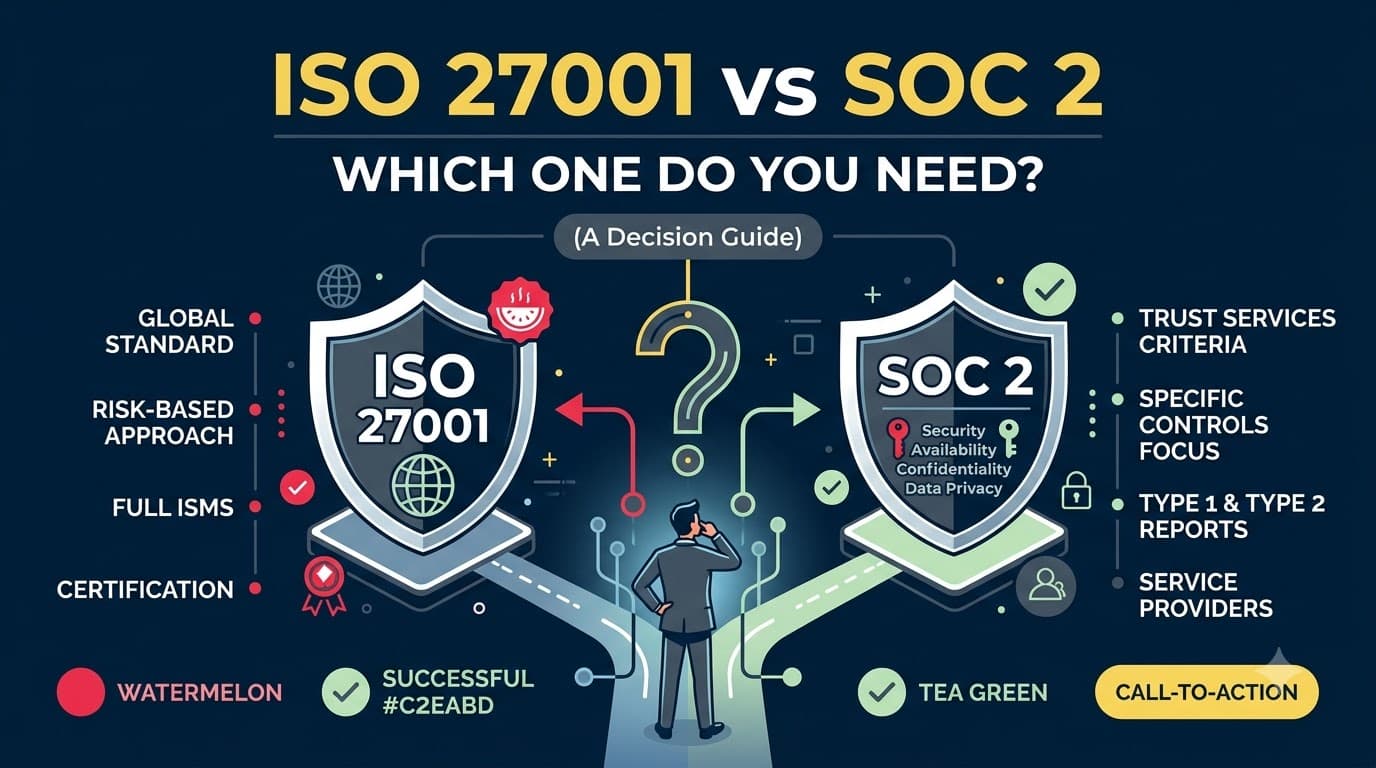
Dana Whitfield had two term sheets open in adjacent browser tabs and one very bad afternoon ahead of her.
Dana is the VP of Security & Compliance at Solstice Analytics, a 140-person project-management SaaS company doing about $18M in ARR. On Monday, the security team at a regional US bank — three weeks from signing a $1.4M annual contract — sent over their standard vendor questionnaire with one non-negotiable line item: "Please provide your current SOC 2 Type II report." On Wednesday, a German logistics conglomerate evaluating Solstice for a $900K, three-year platform deal sent their own requirement: "Kindly confirm ISO 27001 certification status; certificate required prior to contract execution." Same week. Same company. Two buyers, two frameworks, zero overlap in vocabulary, and $2.3M in combined pipeline sitting behind a compliance gate Dana didn't fully understand yet.
Dana did what most people in her position do first: she Googled "ISO 27001 vs SOC 2," read six blog posts that all said some version of "they're actually quite similar," and closed her laptop no closer to an answer. That's a familiar moment for me. In fifteen-plus years running security and compliance programs and advising well over 200 organizations through this exact fork in the road, I've watched the "just pick one" advice cause more wasted budget and blown sales cycles than almost any other compliance decision founders and security leaders make. The honest answer is that ISO 27001 and SOC 2 are not interchangeable, they are not solving the same problem, and the "right" one depends on facts about your buyers, your market, and your growth plan that no generic blog post can know. This guide is built to get you to that answer for your organization specifically, not a generic one.
Who This Guide Is For
This is written for founders, CISOs, heads of GRC, and VPs of security/compliance at SaaS and technology companies — usually mid-market or scaling — who are being asked for one framework, the other, or both, and need a defensible internal recommendation, not a coin flip. You should walk away from this article knowing exactly how ISO 27001 and SOC 2 differ in nature, structure, cost, timeline, and buyer expectation; which one your specific market and buyer profile points you toward; and, if the honest answer is "eventually both," how to sequence and combine them without duplicating eighteen months of work. If you want the wider four-framework view first — ISO 27001 alongside NIST and PCI DSS as well as SOC 2 — that's covered in our companion piece on how ISO 27001 compares to NIST, SOC 2, and PCI DSS; this article goes deep specifically on the two-way ISO-versus-SOC-2 decision that trips up more SaaS companies than any other framework comparison.
The One-Paragraph Answer
If you're going to make me answer before you finish reading, here it is: SOC 2 is the default expectation of US enterprise and mid-market SaaS buyers, particularly in financial services, healthtech, and other regulated-adjacent verticals, and it is usually the faster, cheaper first move if your pipeline is US-heavy. ISO 27001 is the default expectation of European, UK, Middle Eastern, and much of the APAC buyer base, of public-sector and government tenders almost everywhere, and of multinational enterprises running formal vendor-risk programs with a certification checklist — and it is the stronger long-term asset if you're selling internationally or into regulated industries that respect accredited certification. Most companies with a serious growth trajectory end up needing both within 24 months, and the good news buried in that fact is that ISO 27001 and SOC 2 share somewhere in the neighborhood of 80–90% of their underlying control activity — access control, change management, incident response, vendor risk, encryption, logging — which means the second framework, done right, should cost a fraction of the first. The rest of this guide walks through exactly why, and exactly how to sequence it for your situation.
The Core Difference: A Certification vs An Attestation
This is the distinction I correct most often in vendor calls, board decks, and even RFP responses, so let's get it exactly right before anything else. ISO/IEC 27001 is a certifiable management-system standard. You build an Information Security Management System (ISMS) that satisfies Clauses 4–10 of the standard and implement applicable controls from the 93-control Annex A, an accredited certification body audits it in a two-stage process, and if you pass, that body issues you a certificate with your organization's name on it, a scope statement, and a validity period tied to a three-year cycle with annual surveillance audits. It is genuinely a pass/fail certification, similar in structure to an ISO 9001 quality certificate — you either hold it or you don't.
SOC 2 is different in kind, not just in name. It is an attestation engagement performed under AICPA attestation standards by a licensed CPA firm. The output is not a certificate — it's a detailed report, written by the auditor, that expresses an opinion on whether your controls were suitably designed (Type I) or operating effectively over a review period, typically three to twelve months (Type II). There is no "SOC 2 certified" status to hold; the correct language is that an organization "has undergone a SOC 2 Type II examination" or "has a current SOC 2 report." I still see this described as a certification in vendor marketing pages and even in RFP language written by procurement teams who should know better — but if you say "SOC 2 certified" in front of a Big Four auditor or a sharp enterprise security reviewer, expect a raised eyebrow. Getting this distinction right in your own external communications is a small thing that signals real fluency to sophisticated buyers.
Dimension | ISO 27001 | SOC 2 |
|---|---|---|
What it fundamentally is | Certifiable international management-system standard | Attestation engagement under AICPA standards |
Who performs the assessment | Accredited certification body (auditors accredited by a national accreditation body) | Licensed CPA firm |
What you receive | Certificate + scope statement | Detailed audit report (SOC 2 Type I or Type II) |
Correct terminology | "ISO 27001 certified" | "Has a SOC 2 report" / "completed a SOC 2 Type II examination" — never "SOC 2 certified" |
Pass/fail nature | Binary: certified or not certified | Opinion-based: unqualified, qualified, adverse, or disclaimer of opinion |
Validity mechanic | 3-year certification cycle with annual surveillance audits | Report covers a fixed historical period; a new report is needed for continued currency |
Governing body | International Organization for Standardization (ISO) / IEC, enforced via accreditation bodies (e.g., UKAS, ANAB) | American Institute of CPAs (AICPA) |
For a plain-English refresher on this and other recurring terminology, our ISO 27001 glossary of key terms is worth bookmarking — and on the SOC 2 side, SOC 2 Complete Guide to the AICPA Trust Services Criteria covers the attestation basics in the same plain-English style.
Framework Structure: Annex A Controls vs the Trust Services Criteria
The two frameworks are also built on structurally different skeletons, and that shapes almost everything downstream — how you scope the work, how you write policy, and how an auditor evaluates you.
ISO 27001:2022 has two structural halves. Clauses 4–10 are the management-system requirements — context of the organization, leadership, planning, support, operation, performance evaluation, and improvement — and they are mandatory for every certified organization regardless of industry. Then there's Annex A, a reference set of 93 controls organized into four themes: Organizational (5.1–5.37, 37 controls), People (6.1–6.8, 8 controls), Physical (7.1–7.14, 14 controls), and Technological (8.1–8.34, 34 controls). Critically, you don't have to implement every Annex A control — you assess which are applicable to your context through risk assessment, document your reasoning in a Statement of Applicability, and justify any exclusions. ISO/IEC 27002:2022 provides the implementation guidance for the same 93 controls, plus five attributes per control (control type; the information security properties confidentiality/integrity/availability it supports; the cybersecurity concept it maps to — Identify, Protect, Detect, Respond, Recover; operational capability; and security domain) that help you slice the control set different ways for reporting.
SOC 2 has no equivalent to Annex A. Instead, the AICPA defines five Trust Services Criteria (TSC) categories: Security (the "Common Criteria," mandatory in every SOC 2 report), Availability, Processing Integrity, Confidentiality, and Privacy. You must include Security; the other four are optional and selected based on what's relevant to your service and what your customers actually care about — most SaaS companies include Security plus Availability and Confidentiality, and add Processing Integrity if they process financial or transactional data on customers' behalf, and Privacy if they handle sensitive personal data at scale. Within the criteria, there is no fixed numbered control list analogous to Annex A — your organization (with your auditor's input) defines the specific controls that satisfy each criterion, which gives SOC 2 more flexibility in how a control is worded but less of the "checklist" clarity that some buyers, especially outside the US, find reassuring.
Aspect | ISO 27001 | SOC 2 |
|---|---|---|
Governing structure | Clauses 4–10 (mandatory) + Annex A (93 controls, risk-based applicability) | Trust Services Criteria: Security (mandatory) + up to 4 optional categories |
Control specificity | Fixed, numbered control catalog (5.1–8.34) | Organization-defined controls mapped to criteria, no fixed numbering |
Scoping mechanism | ISMS scope statement + Statement of Applicability | Description of the system + selected TSC categories |
Flexibility in wording controls | Lower — controls map to standard Annex A language | Higher — controls are custom-written to your environment |
Formal management-system requirement | Yes — leadership, objectives, internal audit, management review are mandatory | No formal management-system clauses; focus is on control operation |
Implementation guidance standard | ISO/IEC 27002:2022 | AICPA Trust Services Criteria points of focus (guidance, not mandatory text) |
For deeper detail on how the TSC categories break down and how auditors evaluate them, see SOC 2 Trust Services Criteria Explained.
Geography: Where Each Framework Dominates
Neither framework is universal, and geography is one of the strongest predictors of which one your next twelve months of deals will actually require. This is illustrative pattern-matching from the deals I've watched close and stall over the years, not a scientific survey, but the pattern holds up remarkably consistently across the SaaS and tech clients I've advised.
In North America, SOC 2 is the default vendor-risk currency, especially for horizontal and vertical SaaS selling into other tech companies, financial services, and healthtech. US enterprise procurement teams have standardized their vendor questionnaires around SOC 2 report language for the better part of a decade, and it's often the very first thing a security reviewer asks for. In Europe, the UK, and much of the Middle East, ISO 27001 is the more universally recognized signal — it's an international standard with local accreditation bodies (UKAS in the UK, DAkkS in Germany, and equivalents across the EU) that European procurement and public-sector tender processes are built around. APAC is genuinely mixed and increasingly bimodal: Japan, Singapore, and government-adjacent buyers across the region lean ISO 27001, while multinational tech buyers in the same markets often still ask for SOC 2 if their own headquarters are US-based. Latin American enterprise buyers increasingly ask for either, largely mirroring whichever multinational parent company sets their vendor-risk policy.
Region | Dominant expectation (illustrative) | Why |
|---|---|---|
United States / North America | SOC 2 (Type II especially) | Decade-plus of enterprise procurement standardizing around AICPA reporting; CPA-firm ecosystem is mature and familiar |
European Union | ISO 27001 | Internationally accredited certification aligns with EU procurement norms, tender requirements, and cross-border recognition |
United Kingdom | ISO 27001 | UKAS-accredited certification widely referenced in public-sector and enterprise frameworks |
Middle East | ISO 27001 | Government and large-enterprise tenders frequently mandate ISO certification explicitly |
APAC (mixed) | Both, context-dependent | ISO 27001 favored by regional/government buyers; SOC 2 favored by US-headquartered multinational customers |
Latin America | Both, buyer-dependent | Often mirrors the vendor-risk standard of the buyer's own multinational parent |
Global public sector / government tenders | ISO 27001 (near-universal) | Formal certification with accredited third-party oversight fits procurement law and tender documentation requirements |
The practical implication: if you pull your last twelve months of closed-won and stalled deals and sort by buyer headquarters region, you'll usually see your answer before you finish reading this article. Our guide on who actually needs ISO 27001 breaks this down further by industry and geography if you want the fuller picture.
Who Actually Asks For Which: Reading Your Buyers
Geography is a strong signal, but buyer type sharpens it further. Over the years I've sorted requests into a handful of recurring patterns, and recognizing which one you're in usually resolves the ambiguity fast.
US-based enterprise SaaS buyers and mid-market financial institutions almost always want a SOC 2 Type II report, and they want it recent — most procurement teams treat a report more than twelve months old as effectively expired for new-vendor review, regardless of what the report itself says about validity. US healthtech and insurtech buyers frequently want SOC 2 alongside HIPAA-aligned attestation language. European enterprise buyers, especially in manufacturing, logistics, and the public sector, want an ISO 27001 certificate — often as a hard gate in the RFP itself, before technical evaluation even begins. Multinational enterprises running mature third-party risk-management programs increasingly want both, treating them as complementary evidence rather than substitutes — SOC 2 for depth of operating detail, ISO 27001 for independently certified governance. Investors and boards, particularly ahead of a Series C+ round or an eventual acquisition, increasingly ask about both as part of technical and security due diligence, less because they need the artifact itself and more because it signals program maturity. And government contractors and public-sector bidders will find ISO 27001 referenced directly in tender documentation far more often than SOC 2, which rarely appears in public procurement language outside North America.
Buyer type | Typically requests | Why it matters to them |
|---|---|---|
US enterprise SaaS buyers | SOC 2 Type II | Standardized vendor-risk questionnaire language; familiar CPA-firm assurance model |
US financial institutions / fintech | SOC 2 Type II (sometimes + ISO) | Regulatory examiner expectations lean on AICPA-style attestation evidence |
European enterprise / manufacturing / logistics | ISO 27001 certificate | Aligns with EU procurement and accredited-certification norms |
Government / public-sector tenders (global) | ISO 27001 certificate | Referenced directly in tender and procurement law in many jurisdictions |
Multinational enterprises (mature TPRM programs) | Both | Treats them as complementary rather than either/or |
Investors / board / M&A due diligence | Either or both, as a maturity signal | Demonstrates a functioning security and governance program, not just a document |
"I used to think the questionnaire was the obstacle. It wasn't — the obstacle was that our security story didn't match the language our buyer's procurement team was trained to look for. The day we mapped our controls to both SOC 2 and ISO 27001 language, our sales cycle for enterprise deals dropped by weeks, not because we did more security work, but because we stopped making the buyer translate for us." — Marcus Feld, CISO, Anthem Ridge Software
What You Get At The End: Certificate vs Report
The deliverable itself matters more than most teams expect, because it changes how you can (and can't) use it in sales. ISO 27001 gives you a public-facing certificate — typically one or two pages, naming your organization, the certification body, the scope of the ISMS, and the validity dates. Because it's a certificate rather than a report containing sensitive control detail, you can post it on your website, attach it to marketing materials, and reference it freely; the underlying audit findings and evidence stay private, but the fact of certification is meant to be shown.
SOC 2 produces a report — often 40 to 100+ pages — that includes a description of your system, the auditor's opinion, and (for Type II) detailed testing results across every control, including any exceptions noted during the review period. That level of detail is exactly why it's valuable to a sophisticated buyer doing real diligence, and exactly why it's not something you publish. SOC 2 reports are shared under NDA, typically gated behind a trust-center login or a signed agreement, restricted to prospective and existing customers with a legitimate need to review it — not posted publicly. Type I reports assess whether controls are suitably designed as of a specific date; Type II reports — the ones enterprise buyers actually want — assess whether those controls operated effectively over a review period, typically three, six, or twelve months, which is why a first-time SOC 2 program usually can't produce a Type II report faster than the length of its shortest viable observation window.
Element | ISO 27001 | SOC 2 |
|---|---|---|
Document name | Certificate of registration/certification | SOC 2 Type I or Type II report |
Typical length | 1–2 pages | 40–100+ pages |
Distribution | Public — can be published/shared freely | Restricted — shared under NDA, usually via a trust center |
What's disclosed | Certification status, scope, validity dates | Full system description, auditor opinion, detailed control testing results |
Point-in-time vs period | Point-in-time certification (backed by ongoing surveillance) | Type I = point-in-time design; Type II = operating effectiveness over a period |
Marketing usability | High — a visible trust badge for your website | Limited — summary/logo usable, full report is confidential |
If you're weighing which report format your sales team will actually get more mileage from, it's worth comparing directly against SOC 2 Type I vs Type II, since that distinction often matters as much as the ISO-vs-SOC-2 choice itself.
Cost: What Each Path Really Costs
Cost is where I see the most anxiety and the most misinformation, so let's ground this in a concrete illustrative example rather than abstract ranges. When Dana at Solstice Analytics got quotes for both paths, here's roughly the shape of what came back — these figures are illustrative, will vary by company size, scope, and region, and should not be treated as a quote, but they reflect realistic proportions I've seen across mid-market SaaS engagements.
For ISO 27001, first-year costs typically break down across a readiness/gap-analysis phase (often consultant-led), internal implementation labor, a GRC or compliance-automation tool, and the certification body's audit fees across Stage 1 and Stage 2. For SOC 2, first-year costs cover readiness work, the same category of internal labor and tooling, and the CPA firm's attestation fees — which typically scale with the number of TSC categories in scope and the length of the Type II observation window.
Cost component | ISO 27001 (illustrative, mid-market SaaS) | SOC 2 Type II (illustrative, mid-market SaaS) |
|---|---|---|
Readiness / gap analysis (consultant-led) | $8,000–$25,000 | $6,000–$20,000 |
Certification body / CPA firm fees | $12,000–$30,000 (Stage 1 + Stage 2, scope-dependent) | $15,000–$40,000 (scales with TSC categories + observation window) |
GRC / compliance automation tooling (annual) | $5,000–$20,000 | $5,000–$20,000 (often the same platform serves both) |
Internal labor (opportunity cost, not cash) | Meaningful — typically a fractional or full-time program owner for 3–6 months | Meaningful — similar, often overlapping if pursued alongside ISO |
Illustrative year-one total (external spend only) | $25,000–$75,000+ | $25,000–$70,000+ |
Ongoing annual cost | Surveillance audit fees, typically lower than initial certification | Recurring Type II examination fee, annually |
Two things tend to surprise first-timers. First, the certification/attestation fee is rarely the biggest cost — internal labor to actually build and operate the controls almost always dwarfs it. Second, cost scales far more with organizational complexity (number of systems, cloud environments, offices, employees, third parties) than with which framework you choose; a messy 300-person company doing SOC 2 alone can easily spend more than a tightly scoped 40-person company doing both frameworks together. For a fuller cost breakdown specific to ISO 27001, see our realistic ISO 27001 implementation cost guide, and our ISO 27001 Certification Cost Calculator can model your own numbers directly rather than relying on someone else's illustrative range. On the SOC 2 side, How Much Does a SOC 2 Audit Cost? covers the attestation-fee side in more depth.
"Founders always ask me for 'the number.' There isn't one — there's a shape. Your CPA or certification body fee is the smallest line item in the whole project. The real cost is the six months of engineering and IT time it takes to actually operate the controls consistently enough for an auditor to believe you." — Priya Nair, vCISO, Fieldstone Advisory
Timeline: How Long Each Path Takes
Timeline expectations are where I do the most expectation-resetting with new clients, because sales leadership almost always wants a date that predates what's realistically achievable.
ISO 27001 timelines are gated primarily by implementation depth and the certification body's audit calendar. A realistic first-time path runs gap analysis, then implementation (writing policies, standing up controls, running at least one internal audit and one management review — both mandatory before Stage 2), then a Stage 1 documentation review, then a Stage 2 certification audit assessing operating evidence, with the certificate issued shortly after a successful Stage 2. SOC 2 timelines are gated by a different constraint entirely: the Type II observation window itself. You cannot compress a six-month observation period into six weeks — the report literally cannot claim more history than actually happened, which is one of the most misunderstood facts about SOC 2 among first-time buyers of the service.
Phase | ISO 27001 (illustrative) | SOC 2 Type II (illustrative) |
|---|---|---|
Readiness / gap analysis | 3–6 weeks | 2–4 weeks |
Core implementation (policies, controls, evidence) | 3–6 months | 2–4 months (before observation window opens) |
Mandatory internal checkpoint | Internal audit + management review (both required pre-certification) | N/A — controls simply need to be operating |
Observation / audit period | N/A (point-in-time evidence) | 3–12 months (Type II observation window; shorter windows are common for first-timers) |
External audit | Stage 1 (documentation) + Stage 2 (certification audit) | Single fieldwork engagement at end of observation window |
Output issued | Certificate, typically within days to a few weeks of a successful Stage 2 | Report, typically issued 4–8 weeks after fieldwork concludes |
Realistic total time to first output (first-timer) | 6–12 months | 6–15 months (readiness + observation window + reporting) |
Note that a first Type II SOC 2 report can, ironically, take longer than a first ISO 27001 certificate purely because of the observation-window mechanic — a fact that surprises founders who assume SOC 2 is the "quick" option. Many first-time SOC 2 programs sensibly start with a Type I report to get an artifact into the sales conversation faster, then roll straight into the Type II observation period. Our step-by-step ISO 27001 certification roadmap and realistic ISO 27001 certification timelines go deeper on the ISO side of this; on the SOC 2 side, The SOC 2 Audit Process and Timeline covers the mechanics of the observation window in more detail.
Effort and Internal Resourcing
Cost and timeline get the attention, but internal effort is what actually determines whether either project survives contact with a busy engineering org. Both frameworks demand real operational change, not paperwork alone — but the shape of that demand differs.
ISO 27001 places heavier emphasis on documented management-system activity: a defined ISMS scope, leadership commitment evidenced through actual management review meetings, a formal risk assessment methodology applied consistently, a Statement of Applicability justifying every included and excluded Annex A control, and at least one completed internal audit cycle before you're eligible for Stage 2. This is genuinely more process-heavy up front, and it disproportionately requires time from leadership and whoever owns the ISMS, not just engineering. SOC 2 places heavier emphasis on control operation and evidence collection consistency over the observation window — meaning the real burden lands on engineering, IT, and DevOps to make sure access reviews, change tickets, vulnerability scans, and logging actually happen on schedule, every period, with evidence an auditor can sample and verify after the fact. If your controls lapse for even part of the window, that shows up as an exception in the final report.
Resource dimension | ISO 27001 | SOC 2 |
|---|---|---|
Heaviest early burden | Leadership + ISMS/program owner (documentation, governance) | Engineering/IT (operating controls consistently) |
Ongoing evidence discipline | Required continuously, tested via internal audit + surveillance | Required continuously across the full observation window |
Formal internal audit required | Yes — mandatory before certification | No formal internal-audit requirement (though good practice) |
Management review required | Yes — mandatory, documented | Not formally mandated, though governance evidence helps |
Cross-functional involvement | Broad — HR, legal, facilities, IT, leadership | Primarily IT/engineering, narrower functional footprint |
Typical program owner | Dedicated ISMS manager, vCISO, or compliance lead | Compliance/security engineer, often overlapping with ISO owner |
Renewal, Surveillance, and Staying Certified/Attested
Neither framework is a one-and-done event, and underestimating the ongoing commitment is one of the most common regrets I hear a year after initial certification or attestation.
ISO 27001 certification runs on a three-year cycle. In years one and two after initial certification, the certification body conducts annual surveillance audits — narrower in scope than the original Stage 2, but real audits that can raise nonconformities if your ISMS has drifted. At the end of year three, a full recertification audit, comparable in depth to the original Stage 2, renews the certificate for another three-year cycle. SOC 2 has no multi-year cycle at all — each report only covers its own stated period, so most organizations commission a new Type II examination annually to keep a current report in circulation for sales; a report older than twelve months is treated by most enterprise buyers as stale, even though nothing in the framework itself technically "expires" it.
Cycle element | ISO 27001 | SOC 2 |
|---|---|---|
Cycle length | 3-year certification cycle | No fixed cycle — report covers only its stated period |
Interim checks | Annual surveillance audits (years 1 and 2) | None formally, but consistent evidence needed continuously |
Full renewal | Recertification audit at end of year 3 | New Type II examination, typically commissioned annually |
Consequence of lapses found | Minor/major nonconformities, corrective action required, possible certificate suspension | Exceptions noted directly in the report; can undermine buyer confidence |
"Staying current" in practice | Maintain ISMS operation between audits | Commission a new report before the prior one exceeds ~12 months old |
For more on what the surveillance and recertification cycle actually involves, see our guides on ISO 27001 surveillance audits and the 3-year recertification cycle.
Who Performs the Assessment: Certification Bodies vs CPA Firms
The people doing the actual assessment come from entirely different professional worlds, and that shapes how each engagement feels.
ISO 27001 audits are conducted by accredited certification bodies — organizations themselves accredited by a national accreditation body (such as UKAS in the UK, ANAB in the US, or DAkkS in Germany) to certify against ISO management-system standards. The individual auditors carry ISO 27001 lead auditor credentials and are evaluated for competence and independence under the accreditation body's oversight, but the certifying entity is the certification body itself, not an individual professional license. SOC 2 attestation must be performed by a licensed CPA firm, operating under AICPA attestation standards (many of these firms also carry additional accreditation for SOC engagements specifically). The individual signing the report is a licensed CPA bound by professional independence rules that are, frankly, stricter in some respects than what governs ISO auditors — a CPA firm generally cannot both design your controls and attest to them, for instance, which is why "readiness consulting" and "attestation" are typically kept as separate engagements or separate firms entirely.
Element | ISO 27001 | SOC 2 |
|---|---|---|
Who performs it | Accredited certification body | Licensed CPA firm |
Individual credential | ISO 27001 lead auditor certification | Licensed CPA (often with SOC-specific specialization) |
Accreditation authority | National accreditation body (UKAS, ANAB, DAkkS, etc.) | AICPA peer review + state CPA licensing boards |
Independence rules | Certification body must be independent of implementation consulting | CPA firm independence rules are especially strict; readiness and attestation are often deliberately separated |
How you select one | Compare scope, industry experience, accreditation, and turnaround | Compare SOC practice depth, industry vertical experience, and Type II capacity |
Choosing the right certification body matters as much as passing the audit itself — our guide on how to choose an ISO 27001 certification body walks through the selection criteria in detail, and on the SOC 2 side Choosing a SOC 2 Auditor / CPA Firm covers the equivalent decision.
flowchart TD
    A[Start: Which framework do you need?] --> B{Where are most of your buyers/prospects headquartered?}
    B -->|Primarily US / North America| C{Are buyers explicitly requesting a SOC 2 report today?}
    B -->|Primarily EU / UK / APAC / Middle East| D{Are buyers requiring a certificate for tenders/RFPs?}
    B -->|Global / mixed markets| E[Plan for both — sequence by nearest-term deal]
    C -->|Yes, now| F[Start with SOC 2 Type II]
    C -->|Not yet, building pipeline| G[Start with SOC 2 Type I, roadmap to Type II]
    D -->|Yes, hard gate| H[Start with ISO 27001 certification]
    D -->|Informal ask only| I[Evaluate cost/benefit — may delay]
    E --> J[Build one shared ISMS-based control set]
    F --> J
    G --> J
    H --> J
    J --> K[Pursue the second framework on the shared foundation within 6-12 months]
"Boards ask me which one is 'better.' Wrong question. ISO 27001 tells a certifying body your governance holds up under an independent, internationally recognized standard. SOC 2 tells a CPA firm your controls actually worked, day after day, for months. Those are different claims, and mature buyers want both claims made, not just one." — Tom Okafor, Head of InfoSec, Cascade Ledger
The Overlap: Why You Don't Have to Choose Blind
Here's the fact that should change how you think about this whole decision: ISO 27001 and SOC 2 overlap heavily at the control level, even though they diverge structurally. Both frameworks are, underneath the paperwork, asking the same practical questions — do you know what access to systems and data exists and is it appropriately restricted, do you patch and manage vulnerabilities, do you log and monitor your environment, do you manage change safely, do you vet and monitor vendors, do you have a real incident response capability, do you encrypt what needs encrypting. The vocabulary differs; the underlying operational reality that satisfies an auditor is remarkably similar.
This is why I always tell clients to build their control environment once, against the more detailed framework (usually Annex A, given its specificity), and then map that same evidence outward to whichever second framework's language a buyer needs. A single access-review process, run consistently and evidenced properly, can satisfy ISO 27001 Annex A control 5.18 (Access rights) and the access-related Common Criteria in SOC 2's Security category simultaneously — you're not doing the work twice, you're just labeling and reporting the same work twice.
ISO 27001 Annex A control family | Representative controls | Related SOC 2 TSC criteria area |
|---|---|---|
Access control (Organizational/Technological) | 5.15 Access control, 5.16 Identity management, 5.18 Access rights, 8.2 Privileged access rights, 8.5 Secure authentication | Security (Common Criteria) — logical access controls |
Change management | 8.32 Change management | Security (Common Criteria) — change management controls |
Vulnerability & patch management | 8.8 Management of technical vulnerabilities, 8.7 Protection against malware | Security (Common Criteria) — system operations |
Logging & monitoring | 8.15 Logging, 8.16 Monitoring activities | Security (Common Criteria) — monitoring activities |
Incident management | 5.24–5.28 Incident management planning, response, learning, evidence | Security (Common Criteria) — incident response |
Supplier / vendor risk | 5.19–5.23 Supplier relationship controls | Security (Common Criteria) — vendor management |
Cryptography | 8.24 Use of cryptography | Security / Confidentiality — encryption controls |
Business continuity & availability | 5.29–5.30 Disruption & ICT readiness | Availability (optional TSC category) |
Data handling & masking | 8.10–8.12 Information deletion, data masking, DLP | Confidentiality / Privacy (optional TSC categories) |
HR security | 6.1–6.8 People controls | Security (Common Criteria) — personnel security |
Because the overlap is this substantial, we've flagged two pieces of content for our backlog that would help teams execute on this directly: a dedicated guide on "Running ISO 27001 and SOC 2 Together" walking through a unified implementation plan, and an "ISO 27001, SOC 2 & NIST CSF Crosswalk" mapping all three frameworks control-by-control — neither exists on the site yet, but both are natural next steps for teams navigating exactly the decision this article covers. In the meantime, your Statement of Applicability is actually a great starting artifact for this kind of cross-mapping — once you've documented your Annex A applicability decisions and rationale, translating that same reasoning into SOC 2 criteria language is a mapping exercise, not a rebuild.
Decision Framework: Matching the Framework to Your Situation
With the mechanics covered, here's how I actually walk a client through the decision in a working session — a structured set of situational questions, each pointing toward a recommendation.
Your situation | Recommended path |
|---|---|
US-based buyers, no international pipeline yet, first-time compliance program | Start with SOC 2 (Type I → Type II) |
EU/UK-based buyers or active government/public-sector tenders | Start with ISO 27001 |
Selling into both US enterprise and EU/international markets today | Build a shared control set and pursue both, sequenced by nearest-term deal |
Early-stage startup, limited budget, one or two enterprise deals driving urgency | Match the framework to the specific deal(s) at risk — don't build for a market you don't have yet |
Series B+ SaaS scaling internationally within 12–18 months | Plan for both now; sequence the first based on current pipeline, but scope the ISMS to make the second cheap |
Regulated industry (fintech, healthtech) with US and EU exposure | Both, generally with SOC 2 first if the immediate revenue is US-based, though this reverses often |
Government contractor or public-sector bidder | ISO 27001, often non-negotiable for tender eligibility |
Company already has informal security practices but no formal program | Either is viable as a first framework — decision should follow buyer demand, not framework preference |
Board/investor pressure ahead of a raise or exit, no specific buyer request driving urgency | ISO 27001 tends to read as the stronger governance signal to investors and acquirers; SOC 2 signals operational discipline — many pick ISO first for this reason |
Two categories of company deserve a closer look before deciding: startups with limited runway, where the right-sized approach differs meaningfully from an enterprise program (our guide on a lean ISO 27001 implementation approach for startups is built for exactly this situation), and SaaS companies specifically, where product architecture (multi-tenancy, cloud infrastructure, subprocessor chains) shapes scope decisions regardless of which framework you pick — see ISO 27001 for SaaS companies for the SaaS-specific considerations, and ISO 27001 for cloud service providers if you're the infrastructure layer rather than the application layer.
"Every founder wants a universal answer. There isn't one. There's a spreadsheet — every deal in your pipeline over $250K, sorted by what the buyer's security team actually asked for. That spreadsheet is smarter than any framework comparison article, including this one." — Elena Vasquez, VP Compliance, Northbeam Data
Sequencing Strategies: ISO-First, SOC 2-First, or Parallel
If you've concluded you need both eventually, the next question is order of operations, and there are really three viable strategies.
ISO-first makes sense when your nearest-term revenue risk is international or public-sector, or when you want the more rigorous management-system foundation (mandatory risk assessment, internal audit, management review) in place before layering SOC 2's evidence-heavy operating requirements on top. Many clients find it easier to build the governance scaffolding once, under ISO's more structured Clause 4–10 requirements, and then let SOC 2 slot into an ISMS that already has policy, ownership, and risk assessment sorted. SOC 2-first makes sense when a specific, dated US enterprise deal is the forcing function and you need an artifact in front of a buyer within a shorter window — a Type I report can be produced faster than an ISO certificate in some scoping scenarios, since it doesn't require a completed internal audit cycle or a certification body's Stage 1/Stage 2 sequence. Parallel pursuit — running both readiness efforts concurrently on one shared control set — is increasingly common among Series B+ companies with pipeline pressure on both sides of the Atlantic, but it demands more internal capacity up front and is genuinely harder to run without a dedicated program owner or outside support.
Strategy | Best fit | Trade-off |
|---|---|---|
ISO 27001 first, SOC 2 second | International/public-sector pipeline is nearest-term; want formal governance foundation first | Slower to first US-facing artifact if US deals are also urgent |
SOC 2 first, ISO 27001 second | Dated US enterprise deal driving urgency; want fastest first artifact | Less formal governance scaffolding in place when you add ISO later (though the gap is smaller than starting from zero) |
Parallel (shared control set, both readiness tracks running together) | Balanced international pipeline; sufficient internal capacity or outside support | Higher near-term internal effort and coordination overhead; requires disciplined program management |
Sequential, second framework within 6–12 months of the first | Most common real-world pattern for scaling SaaS companies | Requires deliberately scoping the first framework's ISMS/control set to make the second cheap, not scoping narrowly for speed alone |
The mistake I see most often is a company scoping their first framework as narrowly as possible to hit a deadline, without any thought to reusability — which technically works for framework one, but means framework two starts from close to zero anyway, defeating the entire cost advantage of doing both.
Doing Both Efficiently: One Control Set, Two Outputs
If the honest read of your buyer landscape says "eventually both," here's the operating model that actually delivers on the 80–90% overlap I mentioned earlier, rather than just gesturing at it.
Start by building your ISMS and control environment against ISO 27001's more granular Annex A structure — it's the more detailed of the two frameworks, so building to that level of specificity naturally produces evidence and documentation that's a superset of what SOC 2 requires, not a subset. Assign each control a secondary tag mapping it to the relevant SOC 2 TSC criterion at the same time you document it in your Statement of Applicability — this single habit is what makes the second framework fast instead of a rebuild. Choose (or confirm) a GRC/compliance-automation platform that natively supports multi-framework mapping, so evidence collected once (an access review, a vulnerability scan result, a signed policy acknowledgment) automatically satisfies both frameworks' evidence requirements rather than being re-collected twice under two different folder structures — our review of the best compliance automation / GRC platforms is a useful reference when you're comparing vendors specifically on that multi-framework capability. Keep a single risk register, a single incident response process, and a single vendor-management process — frameworks should consume your operational reality, not fragment it. And sequence your audits so the CPA firm's SOC 2 fieldwork and the certification body's Stage 2 audit aren't competing for the same internal stakeholders' time in the same quarter, if you can help it.
Shared foundation element | Feeds ISO 27001 | Feeds SOC 2 |
|---|---|---|
Risk assessment & risk register | Clause 6 planning requirement; SoA justification | Informs which TSC categories and controls are relevant |
Access control & identity management processes | Controls 5.15–5.18, 8.2, 8.5 | Security (Common Criteria) — logical access |
Change management process & tickets | Control 8.32 | Security (Common Criteria) — change management |
Vulnerability scanning & patch cadence evidence | Control 8.8 | Security (Common Criteria) — system operations |
Logging/monitoring configuration & alerts | Controls 8.15–8.16 | Security (Common Criteria) — monitoring |
Vendor risk assessments & contracts | Controls 5.19–5.23 | Security (Common Criteria) — vendor management |
Incident response plan & drill records | Controls 5.24–5.28 | Security (Common Criteria) — incident response |
Security awareness training records | Control 6.3 | Security (Common Criteria) — personnel security |
Policy library & acknowledgments | Control 5.1 and related | Security (Common Criteria) — policy evidence |
For teams building this shared foundation from scratch, our Complete ISO 27001 Implementation Guide eBook and ISO 27001 Gap Analysis Tool are both built to support exactly this kind of "build once, map twice" approach — the gap analysis in particular is a fast way to see how much of your current environment already satisfies both frameworks before you spend a dollar on either audit.
"We stopped asking 'ISO or SOC 2' about eighteen months ago. Now we ask 'which one do we need evidence for first,' because operationally we'd already decided to build for both. That mental shift alone cut our second-framework timeline by more than half." — Sarah Lindqvist, Audit Partner, Lindqvist & Cole CPAs
Common Misconceptions
A handful of misunderstandings show up in nearly every ISO-vs-SOC-2 conversation I have, often stated with total confidence by someone who read one blog post too few.
Misconception | Reality |
|---|---|
"SOC 2 certified" is a real status | SOC 2 is an attestation, not a certification — there is no "SOC 2 certified" designation, only a current report |
ISO 27001 certification means you're GDPR/HIPAA/DORA compliant | ISO 27001 supports and evidences good practice relevant to regulatory goals, but certification alone never equals legal or regulatory compliance |
You have to pick one forever | Most scaling companies with international or mixed buyer bases eventually need both; the choice is about sequencing, not permanent exclusion |
SOC 2 is always faster than ISO 27001 | A first-time Type II report is gated by the observation window (often 3–12 months) and can take longer than a first ISO certificate |
ISO 27001 requires implementing all 93 Annex A controls | Applicability is risk-based; you document inclusions and justified exclusions in the Statement of Applicability |
A SOC 2 report is a public trust badge like an ISO certificate | SOC 2 reports are confidential and shared under NDA; only a certificate (ISO) is meant for public display |
Doing both means doubling the work | With a shared control set, the second framework typically requires a fraction of the first framework's build effort |
Small companies don't need either | Buyer demand, not company size, drives the requirement — plenty of 20-person SaaS startups need one or both to close their first six-figure deal |
Our ISO 27001 myths and misconceptions article covers the ISO-specific myths in more depth if you want the fuller list beyond the ISO-vs-SOC-2 confusion covered here.
Presenting Your Evidence: How Sophisticated Buyers Actually Read It
Getting certified or attested is only half the job — the other half is presenting that evidence in a way that actually accelerates a deal instead of just checking a box. I've sat in on enough vendor security reviews to know that how you package your ISO 27001 certificate or SOC 2 report matters almost as much as the underlying substance, especially once a buyer's security team is comparing you against three or four competitors who all hold roughly equivalent credentials.
For ISO 27001, that means putting the certificate itself, the certification body's name, and your scope statement somewhere a prospect's security reviewer can find in under thirty seconds — a trust center page, not a buried PDF in a data room. Sophisticated buyers will independently verify certification status against the certification body's public register, so don't overstate scope or claim certification before Stage 2 has actually concluded. For SOC 2, package a redacted executive summary or a one-page "report card" alongside the full report behind NDA, so a buyer's security team can get a fast qualitative read (which TSC categories are in scope, exception count, auditor firm) before committing to the full document review. And regardless of framework, keep a standing FAQ or crosswalk document mapping your controls to common buyer frameworks — CAIQ, VSA, SIG Lite — since a large share of enterprise vendor-risk reviews now run through one of those standardized questionnaires rather than a bespoke one, and a pre-mapped answer set turns a two-week review into a two-day one.
Evidence type | Where it should live | Common mistake to avoid |
|---|---|---|
ISO 27001 certificate + scope statement | Public trust center page, verifiable against the certification body's register | Claiming certification before Stage 2 concludes, or omitting scope exclusions |
SOC 2 report (full) | Gated trust center / NDA-protected data room | Sending a stale report (>12 months old) without flagging a renewal is already underway |
SOC 2 executive summary | Public trust center page (redacted) | Failing to offer any pre-NDA summary, forcing every prospect through a full NDA cycle just to see a TSC category list |
Standardized questionnaire responses (CAIQ, VSA, SIG Lite) | Pre-filled and versioned in your trust center or sales enablement tools | Answering each buyer's bespoke questionnaire from scratch instead of mapping once to a standard format |
Case Study: Solstice Analytics — Closing Both Deals Without Doubling the Work
Back to Dana. After the initial scramble, Solstice Analytics ran a structured version of the decision process in this guide: they pulled their pipeline, confirmed the US bank deal ($1.4M ACV) needed SOC 2 Type II specifically and the German logistics deal ($900K ACV, three-year term) needed ISO 27001 certification as a contractual gate, and recognized a further six deals in active pipeline that would likely surface the same requirements within the next two quarters. That made the decision straightforward in hindsight, even though it hadn't felt that way on the Wednesday Dana got the second questionnaire: build one shared control environment, scoped against ISO 27001 Annex A for maximum reusable detail, and pursue SOC 2 Type I immediately as a bridge artifact for the bank deal while the ISO 27001 Stage 1/Stage 2 process and the SOC 2 Type II six-month observation window ran in parallel.
The bank deal closed nine weeks later on the strength of the SOC 2 Type I report plus a documented roadmap commitment to Type II — a compromise their procurement team accepted given the contract's renewal-based structure. The German logistics deal closed roughly seven months later, timed to Solstice's ISO 27001 certificate issuance following a clean Stage 2 audit. The SOC 2 Type II report followed about five months after that, drawing on the same evidence base and control operation that had already been running continuously since the ISO implementation began — meaning the second framework's incremental cost came in well under half of what the first one cost, largely limited to the CPA firm's attestation fee and a modest amount of report-specific documentation work. Eighteen months after that first bad afternoon, Solstice held both a current ISO 27001 certificate and a SOC 2 Type II report, had closed $2.3M of the originally at-risk pipeline plus a further $3.1M in deals that surfaced the same requirements afterward, and — Dana's favorite detail — had never had to explain to a single buyer why they only had "the other" framework.
Metric | At the start | 18 months later |
|---|---|---|
Frameworks held | Neither | ISO 27001 certified + current SOC 2 Type II report |
At-risk pipeline | $2.3M (2 deals blocked) | $2.3M closed + $3.1M additional pipeline closed on the strength of both artifacts |
Second-framework incremental cost vs. first | N/A | Well under half of the first framework's total cost |
Sales-cycle friction from compliance questionnaires | High — manual, ad hoc responses per deal | Low — both artifacts referenced directly in trust-center responses |
"The thing nobody told me at the start was that the second framework isn't a second project. If you build the first one right, it's closer to a paperwork exercise layered on top of work you're already doing." — Dana Whitfield, VP Security & Compliance, Solstice Analytics
Case Study: Cascade Ledger — ISO-First for a European Expansion
Cascade Ledger, a mid-market payments-adjacent fintech with roughly 90 employees, had a healthy US customer base already comfortable with the company's existing SOC 2 Type II report when leadership set a goal of opening a European operating entity within the year, targeting logistics and manufacturing clients across Germany and the Netherlands. Every early conversation with European prospects surfaced the same requirement, stated far more rigidly than any US buyer had ever stated SOC 2: ISO 27001 certification, not "in progress," not "roadmap committed," but held, before serious commercial conversations would proceed. Tom Okafor, the head of InfoSec quoted earlier in this piece, made the case internally that Cascade's existing SOC 2 control environment gave them a real head start rather than a from-scratch project — the access control, change management, vendor risk, and incident response processes underpinning their SOC 2 program mapped cleanly to a majority of the Annex A controls they'd need.
The gap analysis confirmed it: roughly two-thirds of applicable Annex A controls were already substantively satisfied by existing SOC 2-driven operations, with the real net-new work concentrated in formal ISMS governance — a documented risk assessment methodology, a Statement of Applicability, a completed internal audit cycle, and management review meetings, none of which SOC 2 had required in the same explicit form. Cascade reached Stage 2 certification in just under seven months, materially faster than a from-scratch ISO 27001 program typically runs, specifically because they weren't starting the control-operation work from zero — they were formalizing governance on top of controls that had already been operating and evidenced for years. Their first EU logistics contract, worth roughly €680,000 over three years, closed within six weeks of certificate issuance.
"Our SOC 2 program didn't feel like it was preparing us for ISO 27001 at the time — it just felt like running a security program. In hindsight, that's exactly why the ISO project moved so fast. We weren't building controls, we were building governance on top of controls we already had." — Tom Okafor, Head of InfoSec, Cascade Ledger
Case Study: BrightPath HR — Staying SOC 2-Only, Deliberately
Not every company needs both, and BrightPath HR is a useful counter-example to keep the decision grounded. BrightPath, an HR-tech platform serving roughly 300 US-based mid-market employers, evaluated ISO 27001 seriously after a board member suggested it would "look more credible internationally." A pipeline review told a different story: zero active international deals, no government or public-sector prospects, and a sales motion entirely concentrated in US mid-market HR and finance buyers whose security questionnaires were, without exception, built around SOC 2 language. The company ran a lean gap analysis against ISO 27001 anyway, mostly to validate the board's instinct, and concluded that pursuing certification would have consumed budget and internal capacity — a compliance program owner, roughly two quarters of engineering time, and a five-figure external spend — against a buyer base that had never once asked for it.
BrightPath's leadership made the deliberate call to stay SOC 2-only, redirecting the budget they'd modeled for an ISO 27001 program into deepening their existing SOC 2 scope (adding the Availability and Confidentiality categories on top of Security) and shortening their Type II observation window cadence to keep reports fresher for faster-moving deals. Eighteen months later, no lost deal had ever cited ISO 27001 as a blocker, and the company had avoided what would have been, by their own later estimate, a largely unused certification maintained purely for optics rather than buyer demand.
Company | Situation | Path chosen | Outcome |
|---|---|---|---|
Solstice Analytics | Mixed US + EU pipeline, two blocked deals in the same week | Both, built on a shared ISMS-based control set (SOC 2 Type I bridge, then parallel build to ISO cert + SOC 2 Type II) | $2.3M at-risk pipeline closed + $3.1M additional pipeline; second framework cost under half of the first |
Cascade Ledger | Existing SOC 2 program, new EU expansion goal | ISO 27001, built on top of existing SOC 2-driven controls | Stage 2 certified in under 7 months; €680K EU contract closed within 6 weeks of certificate issuance |
BrightPath HR | 100% US mid-market pipeline, no international or public-sector demand | SOC 2 only, deliberately deferred ISO 27001 | Avoided an estimated 5-figure spend and two quarters of engineering time on a certification no buyer had requested |
This is the pattern worth internalizing: the right answer isn't "more compliance is always better." It's "match the framework, or framework combination, to the evidence your actual buyers are asking for" — which is exactly what BrightPath did by choosing restraint, and exactly what Solstice and Cascade did by choosing to build for both.
The Strategic Close: Compliance as a Sales Enablement Decision, Not Just a Security One
If there's one reframe I want you to leave with, it's this: the ISO-27001-vs-SOC-2 decision is not primarily a security decision. Your security posture, if you're doing the work honestly, ends up in roughly the same place either way — access controlled, vulnerabilities managed, incidents handled, vendors vetted. What actually differs between the two frameworks is which buyers will accept your evidence of that posture, in what format, and how fast. Treated that way, this becomes a sales-enablement and market-strategy decision as much as a compliance one — which is exactly why it belongs in the same planning conversation as your go-to-market strategy, not buried in an engineering backlog.
The organizations that get the most return from this work — measured the way Solstice and Cascade measured it, in closed pipeline and shortened sales cycles, not just in a framed certificate on a wall — are the ones that treat the first framework as an investment in reusable infrastructure rather than a one-time deliverable to placate one difficult buyer. Our broader piece on ISO 27001 certification benefits and the business case for ROI makes this case in more depth if you need to build internal buy-in beyond your own team.
If you're still not sure which side of this decision you're on, the fastest way to find out isn't another article — it's an honest look at your own control environment against both standards. Our "Is Your Organization ISO 27001 Ready?" quiz takes ten minutes and gives you a directional read, and our ISO 27001 vs SOC 2 vs NIST CSF Comparison Guide eBook goes deeper into the three-way comparison if NIST CSF is also on your radar. And when you're ready to move from decision to execution, PentesterWorld's compliance advisory team has walked more than 200 organizations through exactly this fork in the road — whether that means a lean first ISO 27001 program, a fast-tracked SOC 2 Type II, or a coordinated dual-framework build on one shared control set. Reach out and let's figure out, specifically, which one your buyers are actually asking for.