Marcus Webb made the promise on a Tuesday afternoon call he thought was going well.
Marcus was the CEO of Trellisworth Analytics, an 85-person SaaS company that sold underwriting analytics to mid-market insurance carriers. His biggest prospect, a regional carrier worth $1.8 million in annual recurring revenue if the deal closed, had one non-negotiable condition buried in the vendor security addendum: ISO 27001 certification, in hand, before the contract's data-sharing clauses could go live. The carrier's VP of vendor risk asked Marcus directly, on that call, "If we sign this quarter, can you be certified by the end of Q3?" It was April. Q3 ended in September. Marcus did the mental math — five months felt generous — and said yes.
He said yes without having asked anyone who had actually run an ISO 27001 project. He'd read a certification body's marketing page that mentioned "certification in as little as 8 weeks" and a LinkedIn post from a compliance vendor promising "audit-ready in 30 days." Five months sounded conservative by comparison. He hung up, told his head of engineering to "get the security stuff sorted," and moved on to the next fire.
By June, Trellisworth had a shiny new information security policy, a risk register with forty rows, and almost nothing else. No internal audit had happened. No incident had been logged, responded to, and closed out with a paper trail. No access review had ever been run and evidenced. The consultant Marcus finally hired in July delivered the sentence that every ISO 27001 practitioner has delivered at least once: "Your controls need to exist, and then they need to run long enough to produce evidence that they're working. You can't audit evidence that doesn't exist yet." Trellisworth wasn't five months from certified. It was closer to eleven — and Marcus had to go back to the carrier's vendor risk team and renegotiate, converting the ISO 27001 clause into a $400,000 holdback tied to an actual certificate date instead of a promised one.
I've watched some version of this conversation happen at more than a few of the 200-plus organizations I've advised on ISO 27001 over the last fifteen-plus years. The question "how long will this take" is asked early, answered optimistically, and then re-litigated painfully in front of a customer, a board, or an investor. This article exists so you don't have to re-litigate it. I'm going to give you real, illustrative ranges — not official ISO figures, because no such official duration exists — broken down by the phases every certification project actually goes through, the variables that move the needle in either direction, and the specific reason "certified in 30 days" claims almost always describe something narrower than what your customers actually need to see.
Who this is for
This is for the founder, CISO, compliance lead, or project sponsor who has been asked "when will we be certified" and needs a defensible answer — not a hopeful one. It's for anyone building a project plan, a board slide, or a customer commitment around ISO 27001 and wants to know which levers actually change the timeline versus which ones are marketing noise. You'll walk away with phase-by-phase duration ranges, a way to place your own organization on the maturity spectrum, a list of what genuinely speeds up or slows down certification, and language you can use with stakeholders who are hearing "30 days" from somewhere else.
The Honest Answer: "It Depends" — And Here's What It Depends On
I'll give you the caveat up front because every practitioner who's honest with you will give you the same one: there is no single, official duration for ISO 27001 certification. ISO does not publish a required timeline, and neither does any certification body, because the standard is deliberately silent on how long implementation should take — it specifies what your management system must do, not how many weeks it should take you to build it. Anyone quoting you a fixed number without first asking about your organization is quoting you a marketing number, not a practitioner estimate.
What actually determines your timeline is a specific, knowable set of variables. I walk every new client through these before I'll commit to a range, because the range is meaningless without them.
Variable | Why it moves the timeline | Typical impact |
|---|---|---|
Organization size (headcount, sites, business units) | More people and locations means more processes to document, more evidence to collect, more interviews for auditors to conduct | Can add 2–6+ months at scale |
Scope of the ISMS | A narrowly scoped ISMS (one product, one data center, one team) is dramatically faster than "the whole company" | Can swing the timeline by 3–9 months |
Starting security maturity | Organizations with existing access control discipline, logging, and incident handling have a head start on evidence | Can cut 2–4 months off implementation |
Existing management system experience | Teams that already run ISO 9001, SOC 2, or similar have muscle memory for policies, audits, and management review | Can cut 1–3 months |
Availability of internal resources | A dedicated project owner beats a part-time volunteer working evenings | Can swing the timeline by 2–5 months |
Use of consultants or dedicated tooling | Experienced guidance avoids false starts and rework, but doesn't eliminate the operating period | Can cut 1–3 months of elapsed (not calendar) time |
Certification body scheduling | Auditor availability, especially for a Stage 2 in a specific quarter, is a real-world constraint | Can add weeks to months |
Number and severity of nonconformities found | Major nonconformities require closure and, in some cases, a follow-up visit before certification | Can add 1–3 months |
Notice what's not in that table: a single universal number. Everything below is framed against these variables, and I'll flag repeatedly where a range depends on where you land on each one.
"The first question I ask every prospective client isn't 'when do you want to be certified.' It's 'how many people, how many sites, and what does your access review process look like today.' I can't give an honest range until I know those three things — and neither can anyone else." — Renata Alcazar, Lead Auditor, Alderbrook Assurance Certification Body
Timeline by Organization Size and Starting Maturity
The single biggest predictor of your timeline isn't headcount alone — it's headcount combined with how mature your security practices already are. A 300-person company that has run vulnerability scans, access reviews, and incident tickets for years will move faster than a 40-person startup with no formal process at all. The table below gives illustrative, practitioner-level ranges for time from kickoff (post-decision, post-scoping) to certificate in hand. Treat these as planning bands, not guarantees — I've seen organizations beat their band and I've seen organizations blow through it by a factor of two when leadership attention evaporated mid-project.
Organization profile | Illustrative range (kickoff to certificate) | What typically drives the low vs. high end |
|---|---|---|
Small, single-product, cloud-native startup (under ~50 people) with decent existing hygiene (MFA, basic logging, a real incident process already) | 4–7 months | Low end: tight scope, dedicated owner, few suppliers. High end: distracted founders, no dedicated owner |
Small-to-mid company (50–150 people), first formal ISMS, moderate maturity | 6–10 months | Low end: consultant-guided, focused scope. High end: multiple product lines, legacy tooling |
Mid-size company (150–500 people), multiple departments, some legacy systems, first-time certification | 9–14 months | Low end: strong exec sponsorship, existing SOC 2 program to build on. High end: multiple offices, immature supplier management, high staff turnover |
Larger or more complex organization (500+ people, multiple business units, regulated industry, global footprint) | 12–18+ months | Low end: mature IT governance already in place. High end: broad scope covering many business units, decentralized IT, M&A-driven complexity |
Any organization pursuing an aggressive "narrow scope" strategy (one team, one product, one data flow) regardless of overall company size | 3–6 months | Narrow scope is the single fastest lever available, but it certifies only what's in scope — see the scoping caution below |
Two things to flag about that table. First, "low end" almost never means low-effort — it means focused effort, sustained without interruption, on a scope that was deliberately kept tight. Second, the widest lever in that table isn't size at all; it's scope. A 2,000-person enterprise that certifies a single 30-person business unit handling one product's data can move faster than a 60-person company that insists on certifying "the whole organization" on day one. Scope decisions belong early in the ISO 27001 certification process, and they're worth revisiting specifically through a timeline lens, not just a cost or effort lens.
Phase-by-Phase: Where the Time Actually Goes
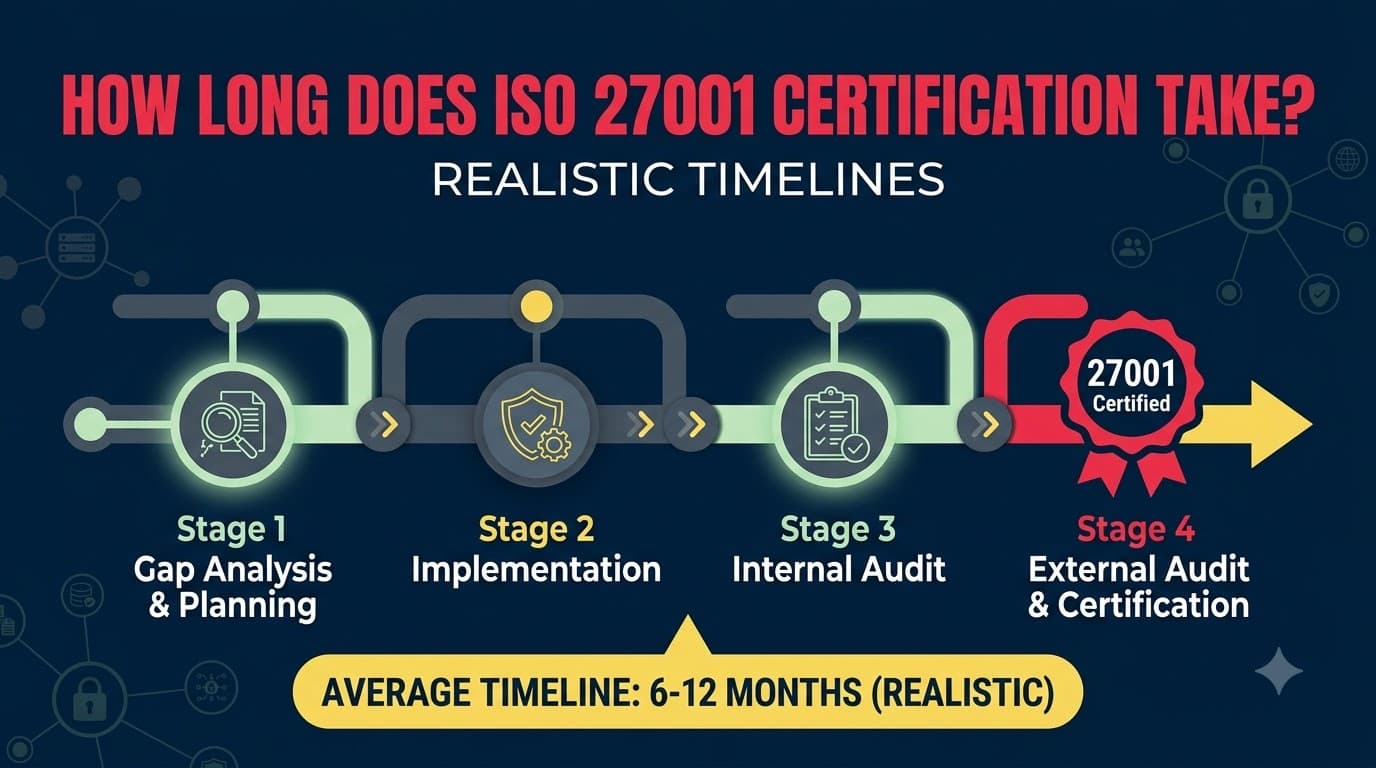
Every certification journey I've run breaks into the same seven phases, whether the organization is 30 people or 3,000. What varies is how long each phase takes and, critically, how much they can overlap. The diagram below shows an illustrative sequence for a mid-size, moderate-maturity organization — treat the specific week counts as one plausible scenario, not a commitment.
gantt
    title Illustrative ISO 27001 Timeline — Mid-Size, Moderate Maturity (durations are examples, not guarantees)
    dateFormat  YYYY-MM-DD
    axisFormat  %b %Y
    section Foundation
    Gap analysis & scoping            :a1, 2026-01-01, 4w
    Leadership sign-off & planning    :a2, after a1, 2w
    section Build
    Risk assessment & treatment plan  :b1, after a2, 6w
    Policy & control implementation   :b2, after a2, 12w
    Training & awareness rollout      :b3, after a2, 8w
    section Operate (evidence period)
    ISMS operating period             :c1, after b2, 12w
    Internal audit                    :c2, after c1, 2w
    Management review                 :c3, after c2, 1w
    section Certify
    Stage 1 audit                     :d1, after c3, 1w
    Remediation of Stage 1 gaps       :d2, after d1, 3w
    Stage 2 audit                     :d3, after d2, 1w
    Certification decision            :d4, after d3, 3w
That diagram compresses to roughly nine to ten months end-to-end for a moderate-maturity mid-size company — consistent with the table above — but the phase order matters more than the exact week counts. Note especially that the "operate" section, where the ISMS runs long enough to generate real evidence, sits after implementation and before the audits. That's not a scheduling quirk. It's the phase most fast-track pitches quietly skip, and I'll come back to why that's the single most important phase in this whole article.
Here's the same phases as a reference table, with illustrative duration ranges you can use to build your own plan.
Phase | What happens | Illustrative duration range | Can it overlap with other phases? |
|---|---|---|---|
Gap analysis & scoping | Assess current state against Clauses 4–10 and Annex A; define ISMS scope and boundaries | 2–6 weeks | Can start before leadership sign-off is finalized |
Risk assessment & treatment planning | Identify assets, threats, and risks; decide how each risk will be treated; build the Statement of Applicability | 4–8 weeks | Overlaps heavily with policy implementation |
Policy & control implementation | Write and approve mandatory documents; deploy technical and procedural controls across the 93 Annex A controls in scope | 8–16 weeks | Runs in parallel with risk treatment and training |
Training & awareness rollout | Roll out security awareness training, role-specific competence, and communication of policies | 4–10 weeks | Runs in parallel with implementation |
ISMS operating period (evidence generation) | Controls run in production long enough to generate logs, tickets, review records, and other proof they work | 8–16+ weeks | Cannot meaningfully overlap with implementation — it starts once controls exist |
Internal audit | An independent internal audit of the ISMS against the standard, per Clause 9.2 | 1–3 weeks | Should occur near the end of the operating period, not before it |
Management review | Leadership formally reviews ISMS performance per Clause 9.3 | 1–2 weeks | Follows internal audit closely |
Stage 1 audit | Certification body reviews documentation and readiness | 1–2 weeks (on-site/remote time) plus scheduling lead time | N/A — a discrete audit event |
Stage 1 → Stage 2 gap | Time to close any findings from Stage 1 before Stage 2 can proceed | 2–8 weeks | Depends entirely on what Stage 1 finds |
Stage 2 audit | Certification body assesses operating effectiveness of the ISMS | 1–3 weeks (on-site/remote time) plus scheduling lead time | N/A — a discrete audit event |
Certification decision | Certification body's internal review and decision issuance | 2–6 weeks | Administrative — runs after Stage 2 regardless of your effort |
A few phase-specific notes worth calling out individually, because I get the same follow-up question about each one on nearly every engagement.
Gap analysis and scoping is where the whole project either gets a realistic foundation or gets set up to blow its deadline. Organizations that rush this phase to "get to the real work" almost always pay for it later, when implementation reveals a scope decision or a resourcing gap that a proper gap analysis would have surfaced in week one. I've never seen a rushed gap analysis save time net of the whole project — it just moves the pain downstream.
Risk assessment and treatment planning is where most first-timers underestimate effort. Building a defensible risk register and a coherent risk treatment plan for even a modest asset inventory takes real cross-functional time — you need input from IT, HR, facilities, and often legal, and getting all of them in a room (or a shared document) repeatedly is a scheduling problem as much as a technical one.
Stage 1 to Stage 2 gap is the phase most project plans get wrong, because it's the one most contingent on someone else's findings. A clean Stage 1 with only minor observations might mean a two-week gap. A Stage 1 that surfaces a genuine documentation hole — a missing mandatory document, an incomplete Statement of Applicability, an unaddressed clause — can mean two months, because you need to fix the gap and, in some cases, produce fresh evidence that the fix is working before Stage 2 will pass. Read the Stage 1 audit guidance closely before you build your Stage 1 date into a customer commitment.
"Clients ask me to shave weeks off the Stage 1 to Stage 2 gap all the time. I tell them the honest lever isn't negotiating with the certification body — it's arriving at Stage 1 with a Statement of Applicability and mandatory documents so clean there's nothing left to find. The gap shrinks when the prep work was thorough, not when you push the auditor." — Tomas Berg, ISO 27001 Lead Implementer, Northfield Risk Partners
Factors That Speed Things Up vs. Slow Things Down
I keep a running list, updated after every engagement, of what actually moved a project's timeline in one direction or the other. None of these are exotic. Most are organizational discipline, not technical sophistication.
Speeds it up | Slows it down |
|---|---|
A single, empowered project owner with real authority to pull people into meetings | A "committee" owning the project with no single accountable lead |
Tightly scoped ISMS boundary agreed early and held firm | Scope creep — adding business units or products mid-project |
Existing technical controls already in place (MFA, centralized logging, endpoint management) | Building foundational security tooling from zero while also building the ISMS |
Executive sponsorship that shows up in calendars, not just kickoff slides | Leadership treating the project as a delegated IT task with no visible sponsorship |
Reusing existing management-system muscle memory (ISO 9001, SOC 2, prior audits) | First time the organization has ever run a formal audit of any kind |
A realistic, published internal deadline with buffer built in | An externally imposed deadline (a customer's date) driving internal planning |
Dedicated time allocated for policy writing and evidence collection, not "as time allows" | Security work competing with product deadlines for the same people's attention |
Early, honest conversation with the chosen certification body about audit scheduling | Waiting until the last month to book Stage 1 and Stage 2, then discovering auditor availability doesn't match the deadline |
A internal audit and management review done thoroughly and early enough to catch issues | Internal audit treated as a formality days before Stage 1 |
Using structured tooling (a gap analysis tool, templates, a readiness checklist) to avoid reinventing documents from scratch | Building every document from a blank page with no template or prior reference |
The pattern across almost every "slowed down" row is the same: work that should have been continuous became compressed into a scramble right before an audit date. Certification bodies notice compressed scrambles. Evidence that was clearly generated in the two weeks before Stage 2 — a burst of access reviews, a sudden flurry of incident tickets — tends to draw more auditor scrutiny, not less, because it looks exactly like what it is.
The "Operating Evidence" Reality — Why You Can't Skip the Waiting
This is the section I wish every prospective client read before signing a contract with a certification date attached, because it's the piece that "fast-track" marketing consistently glosses over: an ISMS has to run, in production, for long enough to generate real evidence that it works, before a Stage 2 audit can meaningfully assess it.
Think about what a Stage 2 auditor is actually there to verify. Stage 1 largely checks whether your documentation exists and describes a coherent system — policies written, scope defined, a Statement of Applicability that maps to your risk treatment decisions. Stage 2 checks whether that system is operating — whether the access reviews you said would happen quarterly actually happened, whether the incident you logged was actually triaged and closed per your own procedure, whether the internal audit turned up findings and those findings were tracked to resolution. None of that can be evidenced on day one of implementation, because none of it has happened yet. You can write a beautiful access review procedure on a Tuesday; you cannot produce a completed access review with sign-off, remediation actions, and a closed loop until you've actually run one — and ideally more than one, so the auditor can see a pattern rather than a single data point.
This is precisely why the phase diagram earlier in this article puts an operating period after implementation and before internal audit. Skipping it, or compressing it to a token few days, doesn't just risk an audit finding — it defeats the purpose of the certification. A certificate is supposed to tell your customers "this organization's information security management system works, in practice, over time." An organization that raced from zero to Stage 2 in six weeks flat, no matter how good its policies read, hasn't given its own controls a chance to prove that yet.
How long does the operating period actually need to be? There's no official minimum published by ISO, and the honest answer depends heavily on the type of control and how often it's supposed to run. A control that operates continuously (logging, monitoring) can show evidence almost immediately once deployed. A control that operates on a cycle — quarterly access reviews, periodic supplier assessments, an annual risk assessment refresh — can't show a completed cycle until that cycle has actually elapsed. Practitioners commonly plan for a meaningful operating window, often in the range of a few months, specifically so that at least one full cycle of the most frequent recurring controls (monthly or quarterly activities) has completed and been evidenced before Stage 2. This is a planning judgment based on your own control cadence, not a fixed rule — but treat any pitch that promises certification without acknowledging this constraint at all as a red flag.
"I've had prospective clients ask me to schedule Stage 2 for six weeks after policies were signed. I ask them one question back: 'Show me the completed quarterly access review.' There isn't one yet, because a quarter hasn't passed. That's not a paperwork problem I can solve for them — it's math." — Diego Fuentes, vCISO, Ironclad Advisory Group
Control activity | Typical operating cadence | Implication for evidence timing |
|---|---|---|
Logging and monitoring (Controls 8.15–8.16) | Continuous | Evidence available almost as soon as deployed and configured |
Access reviews (supporting Controls 5.15–5.18) | Often monthly or quarterly | Needs at least one full cycle elapsed before a completed review exists |
Incident management (Controls 5.24–5.28) | Event-driven, ideally with at least one real or simulated incident worked end-to-end | Needs at least one incident (or tabletop exercise) fully triaged, resolved, and reviewed |
Internal audit (Clause 9.2) | Typically annual, but a first internal audit is often run specifically to precede certification | Must occur, findings tracked, before Stage 2 |
Management review (Clause 9.3) | Typically at planned intervals, at least annually | At least one review with documented inputs/outputs needed before Stage 2 |
Supplier security reviews (Controls 5.19–5.22) | Often annual or triggered by onboarding | Needs evidence of at least the initial assessment cycle for in-scope suppliers |
Vulnerability management (Control 8.8) | Ongoing, often monthly scan cycles | Needs a demonstrated scan-to-remediation cycle, not just a scan report |
This is also the section where I bring up a useful cross-pillar comparison. If your organization has been through a SOC 2 Type II engagement, this concept won't be new — SOC 2 Type II reports explicitly cover an observation window (commonly several months) during which an auditor tests operating effectiveness over time, versus a Type I report that only assesses design at a point in time. ISO 27001's Stage 2 audit plays a structurally similar role to a SOC 2 Type II observation period: it's checking that controls operated, not just that they were designed. If you're weighing both frameworks, our SOC 2 Type II observation period and audit timeline coverage lays out that timeline logic in more depth, and the parallel is worth understanding before you commit to a date for either.
"Fast-Track" Claims vs. Reality
I want to be fair to the vendors and certification bodies making fast-track claims, because some of them are describing something real — just not the thing most buyers assume they're describing. When you see "certified in 30 days" or "audit-ready in 8 weeks," it usually refers to one or more of a few narrower things: the time to complete documentation for a very small, tightly scoped organization that already had strong technical controls in place; the time between a completed internal audit and a scheduled Stage 1; or, less charitably, a marketing hook designed to get you into a sales conversation where the real timeline gets explained later.
None of that makes the underlying math different. A meaningful operating period, an internal audit, a management review, a Stage 1, a possible gap, and a Stage 2 still have to happen in sequence, no matter what a landing page says. What "fast-track" providers can genuinely compress is the build phase — the time spent writing policies and configuring controls — especially with strong templates, an experienced implementer, and a very narrow scope. What they cannot compress, no matter how good the tooling is, is the calendar time required for controls to run long enough to generate evidence and for two independent audits to actually occur.
Claim you'll see in marketing | What's usually actually true | What it doesn't include |
|---|---|---|
"Certified in 30 days" | Documentation and control deployment completed in 30 days for a very small, very narrow scope | The operating period, internal audit, management review, Stage 1, and Stage 2 — which still take additional months |
"Audit-ready in weeks" | Mandatory documents and Statement of Applicability drafted quickly using templates | "Audit-ready" documentation isn't the same as an ISMS with evidence of having operated |
"Guaranteed certification" | A vendor's confidence in their own preparation process | No template or consultant can guarantee a certification body's independent decision |
"Skip the wait with our compliance automation platform" | Automated evidence collection can genuinely reduce the manual effort of gathering logs and screenshots | Automation collects evidence of controls operating — it can't manufacture months of operating history that hasn't happened yet |
"Fast-track Stage 1 and Stage 2 back-to-back" | Some certification bodies will schedule Stage 1 and Stage 2 close together if Stage 1 finds no major issues | This is only viable if the operating period was already sufficient before Stage 1 — it doesn't shorten that period |
The distinction that matters most to a founder like Marcus, or to your board, is the difference between "ready" and "certified." Ready means your policies are written, your controls are deployed, and your team believes the ISMS reflects reality. Certified means an accredited, independent certification body has examined the evidence, run its own audit, and issued a decision. You can be genuinely ready and still be months from certified, because certified requires evidence that ready alone doesn't produce yet. Selling "ready" to a customer as if it were "certified" is how Marcus ended up renegotiating a contract instead of signing one.
"I tell every client the same thing in the kickoff call: I can help you get ready faster than almost anyone. I cannot make your evidence period shorter than it needs to be, and if someone promises you that, ask them how." — Sarah Kim, Head of Compliance, Corsair Fintech
Building a Credible Project Plan
The clients who hit their dates are the ones who build a plan backward from the certification decision and forward from a realistic gap analysis, meeting in the middle with an honest operating-period estimate — rather than picking a date and hoping the project bends to fit it. Here's the sequence I use to build a credible plan with a new client, regardless of size.
Run the gap analysis first, before promising anyone a date. You cannot responsibly commit to a timeline until you know your starting point. This is non-negotiable, even under commercial pressure.
Decide scope deliberately, with timeline as one explicit input. A broader scope is a legitimate business decision, but make it with your eyes open to the months it adds.
Size the operating period based on your actual control cadence, not a generic assumption — if your riskiest recurring control runs quarterly, your plan needs to accommodate at least one completed cycle, ideally two, before Stage 2.
Book your certification body earlier than feels necessary. Auditor availability, especially for specific quarters, is a real constraint that has derailed more "on schedule" projects than any documentation gap I've seen.
Build in a deliberate buffer between Stage 1 and Stage 2 rather than assuming Stage 1 will be clean. A buffer you don't need is a pleasant surprise; a buffer you didn't build and suddenly need is a broken customer commitment.
Communicate a range, not a date, to external stakeholders until you're past Stage 1 with no major nonconformities. "Q3, with a fallback into early Q4" survives reality better than "September 30" does.
Here's an illustrative month-by-month plan for a mid-size, moderate-maturity organization, matching the phase table and Gantt diagram earlier in this article. Use it as a starting skeleton, not a template to copy verbatim — your gap analysis findings should reshape every row.
Month | Primary focus | Key milestone |
|---|---|---|
1 | Gap analysis, scope definition, leadership sign-off | Signed project charter and defined ISMS boundary |
2 | Risk assessment kickoff, asset inventory, policy drafting begins | Draft risk register underway |
3 | Risk treatment plan, Statement of Applicability, continued policy work | Draft SoA circulated for review |
4 | Control implementation across technical and procedural controls | Majority of Annex A controls in scope deployed |
5 | Training rollout, remaining control implementation, evidence collection begins | All in-scope controls operating |
6 | ISMS operating period continues; first monthly/quarterly cycles complete | First completed access review cycle evidenced |
7 | Operating period continues; internal audit preparation | Internal audit scheduled and scoped |
8 | Internal audit executed; findings tracked; management review held | Internal audit report and management review minutes complete |
9 | Stage 1 audit; remediation of any findings | Stage 1 complete, findings closed |
10 | Stage 2 audit; certification decision pending | Stage 2 complete |
11 | Certification decision issued | Certificate in hand |
That plan assumes a dedicated project owner and a moderately narrow scope. Widen the scope, remove the dedicated owner, or start from weak baseline maturity, and every one of those months can reasonably extend by two to six weeks — which is exactly how a nine-month plan becomes a fourteen-month reality if nobody re-forecasts along the way.
Resourcing model matters just as much as calendar planning. The table below reflects what I've seen across engagements with different staffing approaches — not because one model is universally "faster," but because each carries a different risk profile for the timeline.
Resourcing model | Typical timeline effect | Main risk to watch |
|---|---|---|
Fully in-house, part-time project owner | Often the slowest path unless the owner has real protected time | Project competes with day job and loses, repeatedly |
Fully in-house, dedicated full-time project owner | Comparable to consultant-led timelines if the owner has ISMS experience | First-timer learning curve can add weeks of rework |
External consultant or vCISO leading, internal team executing | Often the most predictable timeline — experienced guidance avoids false starts | Cost is higher; internal team must still show up for evidence generation |
Compliance automation platform plus light internal ownership | Can meaningfully speed evidence collection and documentation | Tooling doesn't replace the need for genuine operating history or a knowledgeable interpreter of findings |
Hybrid: consultant for gap analysis and SoA, internal team for day-to-day operation | A common, cost-effective middle ground | Requires clean handoff and clear internal ownership after the consultant's initial phase ends |
Whichever model you choose, run the numbers through a cost lens as well as a timeline lens — the two are connected, since compressed timelines usually mean paying for more concurrent external help. Our ISO 27001 implementation costs breakdown helps you see where that tradeoff actually sits for your organization before you commit to either a resourcing model or a date.
Common Mistakes That Wreck a Timeline
I see the same handful of mistakes recur across engagements, industries, and company sizes. None of them are exotic; all of them are avoidable with a small amount of upfront discipline.
Mistake | Why it derails the timeline | The fix |
|---|---|---|
Promising a certification date before running a gap analysis | The date is guesswork disguised as a commitment | Run the gap analysis first, even under commercial pressure — a delayed promise beats a broken one |
Treating internal audit as a formality days before Stage 1 | A rushed internal audit misses the findings a real one would catch, which surface instead in front of the certification body | Schedule internal audit with enough runway to actually remediate what it finds |
Compressing or skipping the operating period | Evidence doesn't exist yet; Stage 2 auditors notice freshly manufactured records | Build the operating period into the plan as a fixed, non-compressible phase |
Expanding scope mid-project | Every added business unit or product resets parts of the risk assessment and control implementation | Lock scope after gap analysis; handle expansion as a phase-two project |
No single accountable project owner | Decisions stall waiting for consensus; deadlines drift without anyone noticing until it's late | Name one owner with real authority and calendar priority |
Booking Stage 1 and Stage 2 at the last responsible moment | Certification body scheduling isn't instant, especially for a specific quarter | Contact your chosen certification body early and lock provisional dates well ahead |
Assuming a template or platform purchase equals a finished ISMS | Templates accelerate documentation, not adoption, training, or evidence generation | Budget real time for the human work — training, review, and actually running the controls |
Communicating a hard date externally too early | Customers and boards remember commitments, not caveats | Communicate a range until Stage 1 is behind you cleanly |
The single most expensive mistake on that list, in my experience, is the first one — because it's the one that creates every other mistake downstream. Once a hard external date exists, every subsequent decision gets made under pressure to hit it rather than pressure to get it right, and that's exactly the environment where scope creep, skipped internal audits, and compressed operating periods happen.
"The projects that finish on time aren't the ones with the most aggressive schedule. They're the ones where somebody had the discipline to say 'we're not ready to commit to a date yet' during the very first conversation." — James Okafor, Internal Audit Manager, Brightloom Retail
How Scope and Industry Complexity Change the Math
Two organizations of identical headcount can have wildly different timelines because of what's actually inside their ISMS boundary. A 200-person company whose entire product runs on a handful of well-managed cloud services looks nothing like a 200-person manufacturer running a mix of on-premises industrial systems, legacy Windows servers, and a patchwork of regional offices. Scope and industry complexity deserve their own line item in your planning, separate from raw headcount.
Complexity factor | Timeline impact | Why |
|---|---|---|
Single cloud environment, modern stack | Neutral to favorable | Centralized logging, access control, and configuration management are often already partially in place |
Legacy on-premises infrastructure | Adds time | Retrofitting logging, patching cadence, and access control on older systems is slower and often manual |
Multiple physical office locations | Adds time | Physical controls (perimeter, entry, equipment security) must be assessed and evidenced per site |
Heavily regulated industry (finance, healthcare, insurance) | Can add time for control depth, but can also shorten timelines where existing regulatory controls overlap with Annex A | Existing compliance programs sometimes provide ready-made evidence; other times they add layers of required sign-off |
Complex supplier and subcontractor chain | Adds time | Supplier security controls (5.19–5.23) require assessment and evidence across every in-scope third party |
Frequent M&A or organizational change | Adds time | Scope boundaries and asset inventories struggle to stay current amid ownership changes |
Single product, single team, well-documented data flows | Shortens time | Narrower boundary means fewer assets, fewer interviews, less to evidence |
If your organization sits toward the "adds time" end of that table on multiple factors at once, plan toward the higher end of the size/maturity ranges earlier in this article — and resist the temptation to compress the schedule to compensate. Complexity doesn't respond well to being rushed; it tends to surface as nonconformities instead.
When Multiple Standards Are in Play
A growing number of organizations I work with aren't pursuing ISO 27001 in isolation — they're layering it alongside SOC 2, ISO 9001, or an existing privacy program, either because different customers demand different frameworks or because leadership wants one integrated management system rather than several parallel compliance efforts. This changes the timeline math in ways worth planning for explicitly, rather than discovering midway through the project.
Situation | Effect on ISO 27001 timeline | Why |
|---|---|---|
Pursuing ISO 27001 and SOC 2 Type II concurrently, first time for both | Often longer than either alone, but shorter than running them fully sequentially | Overlapping evidence (access reviews, incident records, vendor assessments) can serve both frameworks if the control cadence is planned jointly |
Already SOC 2 Type II certified, adding ISO 27001 | Meaningfully shorter than a first-time ISO 27001 project | Existing operating evidence, audit discipline, and a functioning security program transfer directly into ISO 27001's evidence expectations |
Already ISO 9001 certified, adding ISO 27001 | Shorter for management-system mechanics (document control, internal audit, management review), unchanged for control-specific evidence | Clause structure and audit rhythm are familiar; Annex A control evidence still has to be built and operated from scratch |
Building an integrated management system covering multiple standards from day one | Longer upfront design phase, shorter ongoing maintenance | More coordination needed across framework requirements initially, but shared processes reduce duplicate effort in every audit cycle after the first |
The practical takeaway: if you're already running a mature SOC 2 or ISO 9001 program, say so explicitly during your gap analysis, because it can genuinely move your ISO 27001 timeline toward the faster end of the ranges in this article — Fernhollow Data's case study earlier is a direct example of that effect. If you're building from zero across multiple frameworks simultaneously, resist the temptation to assume the frameworks "share" enough evidence to compress either timeline meaningfully in year one; that payoff shows up in year two and beyond, not in the first certification cycle.
Case Studies: Three Real Timeline Patterns
Case Study 1: Trellisworth Analytics — recovering from an overpromised date
Marcus Webb's company, the 85-person SaaS analytics firm from the opening of this article, is worth returning to because the recovery is as instructive as the original mistake. Once the consultant Marcus hired ran a proper gap analysis in July, the picture clarified fast: policies needed writing, but more importantly, no evidence existed yet for access reviews, incident handling, or internal audit, because none of those processes had ever run. Rather than compress the plan further, the team renegotiated with the carrier — converting the "certified by end of Q3" promise into a phased contract with a $400,000 holdback released on certificate issuance, and a target date pushed to the following February.
The revised project locked scope to the specific product line the carrier's data would touch (not the whole company), which cut months off the original all-hands ambition. Trellisworth ran a focused seven-month build-and-operate cycle: six weeks of gap analysis and risk assessment, ten weeks of control implementation and training, twelve weeks of operating period covering two monthly access review cycles and one simulated incident exercise, then internal audit, management review, Stage 1 (one minor nonconformity, closed in three weeks), and Stage 2. The certificate arrived in month eight from the July restart — eleven months after Marcus's original April promise, but on time against the renegotiated date. The carrier's contract closed. The lesson Marcus took away, which he now repeats to other founders in his network: never put a certification date in a contract before a gap analysis has told you what your actual starting point is.
Case Study 2: Fernhollow Data — the genuine fast track
Fernhollow Data was a 38-person, single-product startup selling API-based fraud detection to e-commerce platforms. Unlike Trellisworth, Fernhollow had strong baseline hygiene going in: MFA everywhere, centralized logging through their cloud provider, a real (if informal) incident process, and a founding team that had been through a SOC 2 Type II audit the year before. Their ISMS scope covered exactly one product and one AWS environment — no legacy systems, no additional offices, no complex supplier chain beyond a handful of well-documented cloud vendors.
Fernhollow's timeline was close to the fastest end of any range in this article: two weeks of gap analysis, four weeks of risk assessment and treatment planning running in parallel with policy drafting, six weeks of control implementation (much of it configuration rather than net-new tooling), and a nine-week operating period — shorter than Trellisworth's, but still long enough to complete one full monthly access review cycle twice and log two real (minor) security incidents through to closure. Internal audit and management review took ten days combined. Stage 1 found no nonconformities. Stage 2 followed three weeks later. Total elapsed time from kickoff to certificate: five months. Fernhollow's founder credited two decisions: keeping the scope surgically narrow, and reusing the discipline (documented procedures, evidence habits) their SOC 2 process had already built.
Case Study 3: Castellan Manufacturing — the honest long timeline
Castellan Manufacturing was a 340-person industrial equipment manufacturer with a head office, two regional plants, and a mix of modern office IT alongside legacy operational technology on the plant floor. Castellan had never run a formal information security management system, had no centralized logging across all three sites, and had a supplier base of over sixty vendors, several of them subcontracted fabrication shops with no formal security posture of their own. Leadership wanted the "whole organization" certified in one pass, including plant floor systems, to satisfy a new aerospace customer's vendor security requirements.
The realistic plan took sixteen months. Gap analysis alone took six weeks given the three-site assessment. Risk assessment and treatment planning took twelve weeks because the asset inventory spanned IT and OT systems with very different risk profiles. Implementation ran five months, largely because centralizing logging and access control across three previously independent site IT setups required real infrastructure work, not just policy writing. The operating period ran four months to capture at least one full cycle of quarterly access reviews and supplier assessments across all sixty-plus vendors. Stage 1 surfaced two nonconformities — one around incomplete supplier risk assessments for four subcontractors, one around inconsistent asset inventory across the plant sites — that took six weeks to remediate and re-evidence before Stage 2 could proceed. Castellan's compliance lead described the sixteen-month timeline, honestly, as "longer than the board wanted to hear, but shorter than it would have been if we'd tried to fake our way through Stage 1." The aerospace contract closed the month after certification.
Case study | Org profile | Elapsed time (restart/kickoff to certificate) | Key timeline driver |
|---|---|---|---|
Trellisworth Analytics | 85-person SaaS, first-time ISMS, narrowed scope after restart | ~8 months (from realistic restart) | Scope narrowing plus an honest operating period after an overpromised date |
Fernhollow Data | 38-person single-product startup, strong existing hygiene, prior SOC 2 experience | ~5 months | Narrow scope, existing maturity, reused management-system discipline |
Castellan Manufacturing | 340-person multi-site manufacturer, legacy OT, complex supplier base, first-time ISMS | ~16 months | Multi-site scope, OT/IT asset complexity, extensive supplier chain |
"Castellan's board wanted the fast-track story. What they got instead was the true story — sixteen months, two nonconformities we actually fixed instead of argued about, and a certificate the aerospace auditor didn't blink at. I'd take that trade every time." — Priya Chandrasekaran, CISO, Vantable Health (advising Castellan's leadership team as an external ISMS steering committee member)
Setting Stakeholder Expectations: What to Say (and Not Say)
Marcus's original mistake wasn't optimism — it was communicating a single hard date to a customer before he had any evidence to support it. Every audience around your certification project needs a version of the timeline, but they don't all need the same version, and conflating them is how commitments get made that the project can't keep.
Audience | What they actually need to hear | What to avoid saying |
|---|---|---|
Board or executive sponsor | A range with named milestones (gap analysis complete, Stage 1 scheduled, Stage 2 scheduled) and the variables that could shift it | A single date with no caveats, presented as if it were guaranteed |
Sales team and customers with contractual deadlines | A conservative range with an explicit "no hard date until Stage 1 is behind us cleanly" caveat | Committing a specific certificate date inside a signed contract before Stage 1 has occurred |
Internal project team | The real phase-by-phase plan, including the operating period, so nobody treats evidence generation as optional | A compressed internal deadline that quietly assumes the operating period won't be needed |
Investors or acquirers (due diligence context) | Current phase, realistic remaining range, and what's already evidenced vs. still pending | Overstating "readiness" as equivalent to "certified" |
New hires or department leads asked to own evidence for their area | The specific cadence their control needs to run before Stage 2 (e.g., "this access review needs to happen and be evidenced twice before we're ready") | A vague instruction to "get compliant" with no cadence attached |
The through-line across every row is the same discipline: separate what you're confident about (the plan, the phases, the variables) from what you can't promise yet (the exact date), and say so explicitly. Stakeholders forgive a range that moves. They remember, and hold you to, a specific date that was never realistic to begin with.
Cost and Timeline Are Linked — Plan for Both Together
Compressing a timeline almost always costs more, and stretching a budget almost always costs time — the two variables trade against each other constantly, and treating them separately in your planning is a common source of surprise later. A rushed nine-month project with heavy external consultant support to hit a hard customer date will cost meaningfully more than the same certification pursued on a natural fourteen-month timeline with lighter internal resourcing. Neither approach is wrong; the mistake is not deciding which tradeoff you're making on purpose.
Approach | Typical timeline effect | Typical cost effect |
|---|---|---|
Natural pace, internal team, modest external support | Longer elapsed time, closer to the higher end of your size/maturity band | Lower direct spend, higher opportunity cost of internal time |
Compressed timeline, heavy consultant or vCISO involvement | Shorter elapsed time, closer to the lower end of your band | Higher direct spend, concentrated over fewer months |
Narrow scope, either resourcing model | Meaningfully shorter regardless of resourcing choice | Lower overall spend — smaller scope means less to document, implement, and evidence |
Broad scope, compressed timeline | Rarely achievable without real nonconformity risk | Highest cost, often followed by additional spend to remediate Stage 1 findings |
If you're building a business case alongside your timeline, it's worth running your own numbers through an ISO 27001 certification cost calculator so the budget conversation and the timeline conversation happen together rather than as two separate surprises for your CFO. Our dedicated ISO 27001 implementation costs breakdown — covering certification body fees, internal labor, tooling, and consultant costs by organization size — is a natural companion to this article.
Are You Actually Ready for Stage 1? Signals vs. Wishful Thinking
Readiness is the most misjudged variable in the entire timeline, because it's assessed internally by people who are, understandably, motivated to believe the project is further along than it is. I've sat across the table from project owners who were certain they were "basically ready" and were, in fact, three completed evidence cycles away from a defensible Stage 1. The table below is the same lens I use on a readiness call before I'll agree a Stage 1 date is realistic.
Genuine readiness signal | Common false signal (looks ready, isn't) |
|---|---|
At least one full cycle of your most frequent recurring control (often access reviews) completed and evidenced | Policy document exists describing the control, but it has never actually run |
Internal audit completed, with findings tracked to closure or a documented remediation plan | Internal audit "scheduled" or treated as a checkbox exercise days before Stage 1 |
Management review held with real inputs (audit results, incident trends, risk status) and documented outputs | A meeting called "management review" with no ISMS performance data actually discussed |
Statement of Applicability that maps cleanly to your risk treatment decisions, with justifications for exclusions | A Statement of Applicability copied from a template with generic justifications never tailored to your risk assessment |
At least one incident (real or simulated) worked through the full incident management lifecycle | An incident response policy that has never been tested, even as a tabletop exercise |
Employees can describe, in their own words, their role in the ISMS when asked | Training records show 100% completion, but staff can't explain what the policy actually requires of them |
If more than one or two rows on the right feel familiar, you're not yet at the point where booking Stage 1 is a sound decision — regardless of how complete your documentation looks. Running your organization through a structured ISO 27001 readiness quiz or working through a formal certification readiness checklist before you commit to a Stage 1 date is one of the cheapest insurance policies available in this entire process — far cheaper than a failed or delayed Stage 1 audit with a certification body already on the calendar.
"The documentation always looks readier than the organization actually is. I've learned to ask for the evidence, not the policy, before I'll bless a Stage 1 date." — Tomas Berg, ISO 27001 Lead Implementer, Northfield Risk Partners
The Clock Doesn't Stop at Certification
One planning mistake I see even in organizations that got the initial timeline right: treating the certificate date as the finish line. It isn't. The three-year certification cycle includes periodic surveillance audits, typically at least annually, that check whether the ISMS is still operating — not just whether it was operating well enough to pass Stage 2 once. Organizations that treat certification as a project with a defined end, rather than an ongoing operating rhythm, often find themselves scrambling again before their first surveillance visit, for exactly the same reason Marcus scrambled before his original Stage 2: evidence that should have accumulated continuously didn't.
Building your initial project plan with this in mind changes one thing in particular — who owns ISMS operation after the consultant or project team disbands. If the answer is "nobody, specifically," budget time in your plan for defining that ownership before certification, not after. Our coverage of surveillance audits and the three-year recertification cycle walks through what that ongoing rhythm actually looks like once the initial certificate is in hand.
A Realistic Timeline Checklist Before You Set a Date
Before you put any certification date in front of a board, a customer, or a contract, run it against this checklist. If you can't check every box, you're working with a guess, not a plan — and it's worth saying so out loud before the guess becomes a commitment.
Checklist item | Why it matters before you commit to a date |
|---|---|
A gap analysis has been completed, not assumed | Everything else in this article depends on knowing your actual starting point |
ISMS scope is defined and locked | Scope changes are the single most common source of timeline slippage |
The operating period length is sized to your actual control cadence, not a generic guess | A quarterly control needs a quarter to evidence — no plan can shortcut that math |
A named, accountable project owner exists with real calendar authority | Diffuse ownership is a leading cause of stalled projects |
Your chosen certification body has been contacted about scheduling, not assumed available | Auditor availability is a real-world constraint, especially near quarter-end |
Internal audit and management review are scheduled with enough runway to act on findings | Findings need time to be remediated before Stage 1, not just discovered |
External stakeholders have been given a range with milestones, not a single hard date | Ranges survive reality; single dates create renegotiations |
A buffer exists between Stage 1 and Stage 2 | Assuming a clean Stage 1 is the most common planning overreach I see |
Running through this list takes fifteen minutes. Skipping it is how a five-month promise turns into an eleven-month scramble — which is exactly the gap Marcus Webb had to close the hard way.
The Strategic Close: Timeline Honesty Is a Competitive Advantage
Here's what fifteen-plus years of these projects has taught me about the timeline question specifically: the organizations that treat "how long will this take" as a hard engineering question, deserving a real answer built from their own gap analysis, consistently outperform the organizations that treat it as a sales question, deserving whatever answer keeps a deal moving. Marcus's mistake wasn't ambition — plenty of successful certification projects start with an aggressive internal deadline. His mistake was skipping the step that would have told him whether that deadline was achievable before he put it in front of a customer.
The upside of getting this right is bigger than avoiding an awkward renegotiation. Organizations that can state, credibly, "we are six weeks from Stage 2 and here's the evidence trail proving it" are demonstrating exactly the kind of operational maturity that ISO 27001 certification is meant to signal to customers, insurers, and partners in the first place. A realistic timeline, communicated honestly, is itself a small demonstration of the discipline the certificate is supposed to represent. If your sales team, your board, or your own instincts are pulling you toward promising a date you haven't tested against a real gap analysis, that pull is worth naming and resisting — it's the single highest-leverage decision in this entire process, and it costs nothing to get right.
If you're earlier in the decision, still weighing whether ISO 27001 is the right investment for your organization at all, our breakdown of who actually needs ISO 27001 is a useful companion to this article — timeline and business case tend to get decided together, not separately.
Ready to build your own realistic project plan instead of guessing at one? Start with a structured ISO 27001 gap analysis tool to establish your actual starting point, run your numbers through our ISO 27001 certification cost calculator to pair the budget conversation with the timeline conversation, and work through our Complete ISO 27001 Implementation Guide eBook for the phase-by-phase detail this article doesn't have room to cover. PentesterWorld's team has walked this exact timeline conversation with organizations at every size and maturity level — reach out when you're ready to build a plan you can actually defend to your board, your sales team, and your biggest customer.