Priya Nair had eleven days to answer a question she didn't fully understand herself.
She was the newly appointed Head of Compliance at Northbeam Analytics, a 140-person B2B SaaS company that processed payroll and HR data for mid-market employers. Northbeam's sales team had spent seven months chasing a $2.4 million multi-year contract with a national retail chain — the kind of logo that would double the size of the company's enterprise book almost overnight. Three days after the retailer's legal team sent over a term sheet, Northbeam's champion in procurement forwarded a two-line email: "Before we can execute, we need your SOC 2 report. Type II, minimum six-month window. Can you send it by the 25th?"
Northbeam didn't have a SOC 2 report. Of any kind.
Priya's CFO, reading the email over her shoulder, asked the question every finance leader asks at exactly this moment: "Can't we just get the fast one — the 'Type I' one?" It was a reasonable question, and also the wrong one to lead with, because the retailer's vendor risk team had already told Northbeam's sales rep, in writing, that a Type I report wouldn't satisfy their vendor onboarding policy for a contract this size. Priya had four business days to figure out whether that was a hard rule or a negotiable one, what a realistic timeline actually looked like for each option, and how to explain the tradeoff to a CEO who wanted the deal closed this quarter and a CFO who wanted the audit fee justified before he'd approve it.
This article is the conversation Priya needed to have on day one, compressed into the time it takes to read it. I've run this exact conversation with something north of 200 organizations over fifteen-plus years of security consulting — usually at the exact moment a deal is stalled on a compliance question nobody budgeted time to answer. The good news: the decision is more structured than it feels when you're staring down a deadline.
Who This Is For / What You'll Walk Away With
This is for founders, compliance leads, security engineers, and finance leaders staring at a customer security questionnaire, a vendor risk addendum, or a board directive that says "go get SOC 2" without specifying which kind — and who need to make that call correctly the first time, because getting it wrong costs months you may not have. You'll walk away knowing exactly what a Type I report tests versus what a Type II report tests, how to pick an audit period length that fits your sales calendar without burning out your engineering team, what each option actually costs and how long it takes end to end, and how the common "Type I now, Type II in six months" sequencing plays out in practice — including the paperwork that keeps you covered in the gap between reports.
One framing note before we go further, because getting this wrong undermines everything else: SOC 2 is an attestation, not a certification. A licensed CPA firm examines your controls and issues an opinion — there is no pass/fail badge, no certificate to frame, and no governing body stamping you "SOC 2 certified." If a vendor, a salesperson, or a headline tells you otherwise, they're using the wrong word. That distinction matters more than it sounds like it should, and we'll come back to it.
The Short Answer, Then the Long One
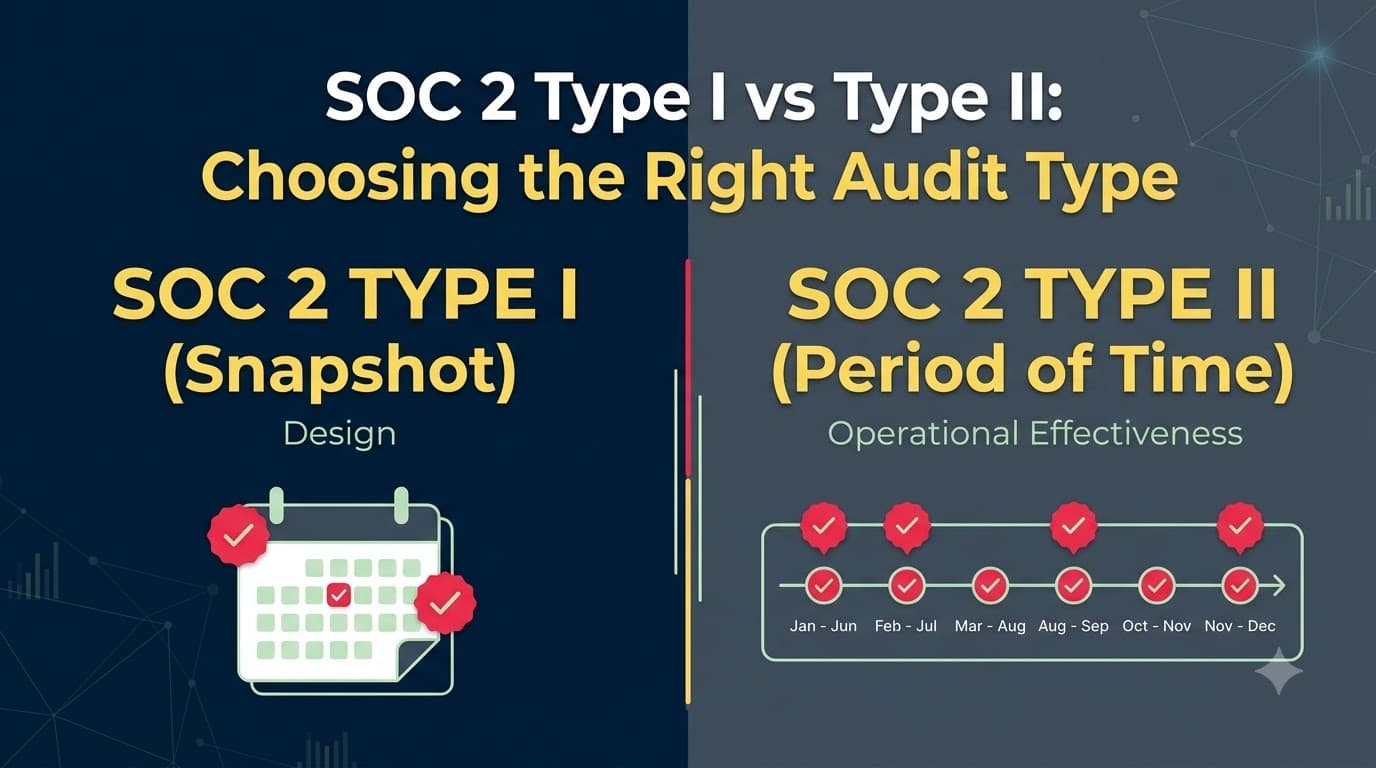
If you need one sentence: a Type I report tells a reader "these controls were designed correctly as of this date," and a Type II report tells a reader "these controls actually operated correctly, every day, for this many months." Everything else in this article is the long version of that sentence — because the short version, on its own, is exactly specific enough to get an unprepared compliance lead into trouble in a procurement call.
Both report types examine the same underlying thing: your organization's controls, evaluated against the Trust Services Criteria (TSC), the AICPA's framework of principles covering security and, optionally, availability, processing integrity, confidentiality, and privacy — if you haven't already, our SOC 2 complete guide to the AICPA Trust Services Criteria is a useful primer before diving into the type decision, and our deep dive on the five Trust Services Criteria walks through how to scope which ones apply to you. Both are performed by an independent CPA firm under SSAE 18. Both result in a formal attestation report with the auditor's signed opinion. Where they diverge is the dimension of time — and that single variable changes almost everything downstream: what evidence you need, how long the engagement takes, what it costs, and — critically — whether the report will actually satisfy the person reading it.
What SOC 2 Type I Actually Tests: Design, at a Single Point in Time
A Type I examination answers one question: as of a specific date, were your controls suitably designed to meet the criteria they claim to address? The auditor reviews your policies, your system architecture, your access management approach, your change management process, and so on, and forms an opinion on whether those controls — as designed — would be capable of achieving their stated objectives if they operated as described.
Think of it as an architectural review, not a stress test. If Northbeam's access control policy states that new employee access requires manager approval and is provisioned through a centralized identity system, a Type I auditor confirms that the policy exists, that the described process is logically sound, and that the technical controls referenced (say, an identity and access management platform with role-based provisioning) are actually configured the way the policy claims. What the auditor does not do is pull six months of access logs to confirm every single new hire in that window actually went through manager approval before getting a login. That's a different examination entirely — one we cover in the next section.
A Type I report is dated as of a single "as of" date — for example, "as of March 31, 2026." There is no observation window, no sample testing across a period, and no "description of tests of controls and results" section, because there's nothing to sample: the report is a snapshot, not a video. That's precisely why it can move faster than a Type II — sometimes in as little as four to eight weeks from a clean readiness assessment to a signed report — and why, as you'll see shortly, it satisfies a narrower set of readers than most companies initially assume.
What SOC 2 Type II Actually Tests: Operating Effectiveness, Over a Period
A Type II examination answers a harder, more useful question: over a defined period — commonly three to twelve months — did your controls actually operate as designed, consistently, with evidence to prove it? This is where the audit period comes in. Instead of a single "as of" date, a Type II report covers a range: "October 1, 2025 through March 31, 2026," for instance.
During that window, your controls have to run in production, generating real evidence — access logs, ticket trails, change approval records, vulnerability scan results, security awareness training completion records, termination checklists — that an auditor can later sample and test. The auditor doesn't take your word that access reviews happen quarterly; they pull the population of access reviews performed during the period, sample a defensible subset, and verify each one actually occurred, on time, with the right approvers, and with any exceptions properly remediated. If a control is supposed to fire every time (say, MFA enforcement on every login), the auditor tests for consistency across the full period, not a single instance.
This is also where a Type II report earns its extra section: the description of tests of controls and results. Where a Type I report simply lists the controls and the auditor's opinion on their design, a Type II report lists each control, describes exactly what test the auditor performed against it, states the sample size, and reports the result — including any exceptions found and how (or whether) they were remediated. A handful of well-managed exceptions in a Type II report is normal and, frankly, a sign of a real audit rather than a rubber stamp. Zero exceptions across a twelve-month period, sampled properly, is rare enough that experienced buyers sometimes view it with mild suspicion.
Side-by-Side: Type I vs Type II
Dimension | Type I | Type II |
|---|---|---|
What's tested | Suitability of control design | Control design and operating effectiveness |
Time dimension | Single "as of" date (a snapshot) | A period, typically 3–12 months (a track record) |
Evidence required | Point-in-time documentation and configuration proof | Population-level evidence sampled across the full period |
Report includes tests of controls & results? | No | Yes — the defining extra section |
Typical timeline to report | 4–8 weeks post-readiness | 3–12 months of observation + 6–10 weeks of fieldwork/reporting after |
Relative cost | Lower | Higher (longer engagement, more sampling, more fieldwork) |
What it proves to a reader | "We built the right controls" | "We ran the right controls, consistently, and can prove it" |
Common use case | First report, speed to market, interim proof | Renewal cycles, enterprise procurement, ongoing assurance |
Auditor's opinion covers | Design suitability only | Design suitability + operating effectiveness |
Standard governing both | SSAE 18 (AT-C sections), AICPA | Same |
Why the Difference Matters More Than People Think
I've watched founders treat "Type I vs Type II" as a formality — a checkbox difference, like choosing between two shipping speeds for the same package. It isn't. The two reports answer categorically different questions, and conflating them creates real business risk.
Here's a concrete version of the problem. Imagine Northbeam's engineering team writes a beautifully documented access deprovisioning policy: terminated employees lose all system access within 24 hours, enforced through an automated workflow tied to the HR system. A Type I auditor reviews that policy, checks that the automated workflow exists and is configured as described, and issues a clean opinion on design. Meanwhile, three departed contractors from four months ago still have active VPN credentials because the automation had a silent failure mode nobody caught. A Type I report would not surface that gap — it isn't designed to. Only a Type II examination, sampling actual terminations against actual access logs over a real period, would catch it.
This is the entire reason the distinction exists, and it's the reason experienced buyers ask for Type II by default: a well-written policy proves intent, not behavior. Type I tells a customer you built the right car. Type II tells them you drove it for six months without the wheels falling off.
The gap between design and behavior shows up in less dramatic ways too, and those are often the more instructive examples. A multi-factor authentication policy that's technically enforced but has a documented exception process used sixty times in a quarter looks identical at the design level to one used twice — the policy text doesn't change. Only operating-effectiveness testing surfaces the difference, and only a Type II report tells a buyer which situation they're actually walking into. The same logic applies to vendor reviews that are scheduled quarterly on paper but slip to twice a year in practice, or patch management SLAs that hold for critical vulnerabilities but quietly slide for medium-severity ones. None of these are necessarily disqualifying findings — they're exactly the kind of normal, disclosed exceptions a mature Type II program surfaces and remediates — but a Type I would never catch them in the first place, because catching them requires watching the control run, not reading its description.
"I've seen founders show up to a renewal call with a gorgeous Type I report and act surprised when the customer's procurement team barely looks at it. A Type I answers 'did you build the right thing.' Our clients almost always need someone to answer 'does it actually work' — and that's a different report, full stop." — Marcus Webb, CPA, Partner, Ferrington & Cole LLP
Why Most Enterprise Buyers Insist on Type II
If you sell into mid-market or enterprise accounts, security and procurement teams have almost certainly standardized on requiring Type II reports — and usually a specific minimum period length, commonly six or twelve months. There are three practical reasons this has become the default rather than the exception.
First, vendor risk teams have been burned before by vendors whose documented controls didn't match reality, and a Type II's tested evidence is the closest thing the industry has to a check against that. Second, larger buyers are themselves frequently subject to their own audits — SOC 2, ISO 27001, financial audits — and their own auditors expect them to have evidence that critical vendors' controls were tested, not just designed, over a period comparable to their own reporting cycle. Third, once a buyer's procurement team has written "Type II, minimum six months" into a standard vendor security policy, exceptions require someone senior to sign off on residual risk — a conversation most procurement analysts would rather avoid than initiate.
None of this means Type I reports are worthless — we'll get to exactly where they still earn their keep — but it does mean you should treat "Type II eventually" as close to a given for any company selling into regulated industries, financial services, healthcare, or enterprise IT buyers, and plan your first audit cycle with that endpoint in mind rather than being surprised by it a year in.
What Buyers Actually Accept, By Deal Profile
Buyer Profile | Typical Requirement | Will a Type I Satisfy Them? |
|---|---|---|
Early-stage startups, SMB buyers | Security questionnaire, sometimes no SOC 2 at all | Often yes, or no report required |
Mid-market SaaS buyers | SOC 2 report of some kind, type often unspecified initially | Frequently yes, at least as interim proof |
Enterprise / Fortune 1000 procurement | Type II, minimum 6-month period, sometimes 12 | Rarely — usually accepted only as a bridge with a committed Type II date |
Financial services, fintech, banking partners | Type II, often 12-month period, plus SOC 1 in some cases | No — Type II treated as a hard gate |
Healthcare / health-tech (handling PHI-adjacent data) | Type II, sometimes paired with HIPAA attestation | No — same as financial services |
Government and public-sector adjacent | Often FedRAMP, StateRAMP, or agency-specific frameworks in addition to or instead of SOC 2 | Case by case — verify against specific requirements |
Regulated-industry auditors (buyer's own compliance team) | Type II required to satisfy their own third-party risk management program | No |
When a Type I Report Actually Makes Sense
Given all of that, why does anyone commission a Type I report at all? Because speed has real value, and a Type I is the fastest legitimate way to put a signed CPA opinion in front of a customer. Three scenarios where I actively recommend it:
You need something on the table now, and a Type II observation period hasn't started yet. If Priya's team at Northbeam had started their control implementation eight weeks before that retailer's email arrived, a Type I would have been physically impossible to skip past — there's no substitute for banking real days in an audit period. In that situation, a Type I, delivered fast, can keep a deal alive as a good-faith interim artifact while the Type II clock runs in parallel.
You're a very early-stage company proving program maturity to smaller or less sophisticated buyers. Not every customer's security review requires Type II-grade evidence. If your buyer base skews SMB or mid-market and typically just wants confirmation that some independent party looked at your controls, a Type I can clear that bar at a fraction of the cost and time.
You want an external gut-check on control design before you commit to a 6–12 month observation period. Running a Type II period and then discovering your access review process has a structural gap is expensive — you may have to restart the clock. A Type I acts as a checkpoint: fix design flaws now, at Type I cost, rather than during Type II fieldwork when an auditor finds the same flaw baked into six months of evidence.
Decision Matrix: Which Audit Type Fits Your Situation
Your Situation | Recommended Path |
|---|---|
Enterprise deal explicitly requires Type II | Skip Type I; start the Type II observation period immediately |
First-ever SOC 2, no existing evidence trail, deal pressure this quarter | Type I now, Type II observation period starts in parallel |
Well-established security program, 12+ months of consistent control evidence already exists informally | Skip straight to Type II — you likely already have the evidence |
Series A/B startup, buyers are SMB-to-mid-market | Type I may be sufficient short-term; plan Type II within 12 months |
Renewing an existing SOC 2 relationship | Type II only — Type I renewals are rare and signal a lapse |
Regulated industry (fintech, healthtech, gov-adjacent) | Type II from the outset; do not lead with Type I |
Uncertain control maturity, new compliance hire, no readiness assessment done | Run a readiness assessment before committing to either type |
When to Skip Straight to Type II
There's a version of this decision that gets missed constantly: sometimes the "safe" choice of starting with a Type I actually costs you more time overall. If your controls have already been running consistently for months — even informally, without a Type I to prove it — you may be sitting on enough evidence to go straight into a Type II engagement.
I ask three questions to figure out if a company can skip Type I entirely. Has your access provisioning and deprovisioning process been consistent, documented, and enforced for at least the length of your target audit period? Do you already have systematic evidence — ticketing records, log retention, change management approvals — going back that far? And is there no external deadline forcing you to produce any report before that evidence window closes?
If the answer to all three is yes, a Type I is often a wasted six-to-eight-week detour and an unnecessary audit fee. You pay for a design opinion you're going to immediately supersede with a stronger one. The exception: if your board, your cyber insurance renewal, or a specific customer needs a signed report today and your Type II window won't close for another four months, a Type I still earns its cost as a bridge — covered in the sequencing section below.
Case Study: Vantage Ledger's Type I-First Sequencing
Vantage Ledger, a fictional 60-person fintech processing B2B invoice financing, had zero formal audit evidence when their first enterprise client — a regional bank piloting the platform — asked for a SOC 2 report as a condition of moving past pilot into a production contract worth roughly $680,000 in year-one revenue. Vantage's engineering team had reasonably solid controls (SSO enforced, encryption at rest and encryption in transit, a documented incident response plan) but nothing tested and nothing evidenced over time.
Vantage's compliance lead, working with an outside auditor, made a deliberate call: commission a Type I with an "as of" date six weeks out, while simultaneously starting the clock on a parallel six-month Type II observation period covering the same control set. The Type I report went to the bank as interim proof, accompanied by a signed letter committing to deliver a Type II report within seven months. The bank's risk committee accepted the arrangement — largely because Vantage could show the Type II period had already started, not just been promised.
Seven months later, Vantage delivered the Type II report with three minor exceptions (two late access reviews, one vulnerability remediated four days past SLA) — all disclosed, all remediated, none disqualifying. The bank converted the pilot to a three-year contract. Total elapsed time from "we need a SOC 2" to signed Type II: just under eight months, run in parallel rather than sequentially — the sequencing choice that made the Type I worth its cost.
"The mistake I see constantly is treating Type I and Type II as sequential when they don't have to be. If you're going to need Type II eventually — and almost everyone does — start that clock on day one. The Type I can run alongside it as a bridge document, not a prerequisite you have to finish first." — David Okonjo, VP of Security & Compliance, Vantage Ledger
Choosing Your Audit Period Window (3–12 Months)
Once you commit to a Type II, the next decision is the length of the observation period — and this is where a lot of first-time compliance leads guess wrong. The AICPA doesn't mandate a specific length; the norm across the industry runs from three to twelve months, with six and twelve being the two most common anchor points buyers ask for by name.
A three-month period is the fastest way to get a Type II report on paper, and it's a legitimate strategy for a company under acute deal pressure that has no existing evidence trail — but treat it as a floor, not a target. Some enterprise buyers explicitly reject anything shorter than six months, and a three-month report reads, fairly or not, as "the minimum we could get away with."
A six-month period is the most common sweet spot for companies past their first report: long enough to satisfy the majority of enterprise vendor risk policies, short enough that a full annual cycle (six months of evidence plus roughly six to ten weeks of fieldwork and reporting) still leaves room to start the next period without a coverage gap.
A twelve-month period aligns your SOC 2 cycle with a full fiscal year and satisfies the strictest buyers (financial services, some healthcare partners) outright — but it means a full year passes between report refreshes, which increases your reliance on bridge letters for customers whose contract dates fall outside your report window, and it means any control gap discovered mid-period has to be carried and disclosed for the rest of the year rather than reset on a shorter cycle.
"Companies fixate on getting the shortest possible Type II window to save time, then get surprised a year later when their biggest customer's security team rejects a six-month report because their internal policy says twelve. Ask your two or three largest active and prospective customers what they actually require before you pick a window — don't guess." — Tanya Brooks, Director of Third-Party Risk, a national retail enterprise buyer
Audit Period Length: Tradeoffs at a Glance
Period Length | Time to First Report | Buyer Acceptance | Best For |
|---|---|---|---|
3 months | Fastest — evidence window closes soonest | Accepted by some mid-market buyers; rejected by many enterprise policies | Urgent first report, deal pressure, limited evidence history |
6 months | Moderate — the most common default | Broadly accepted; satisfies most enterprise vendor risk policies | Second report onward; balances speed and rigor |
9 months | Longer runway, less common as a first choice | Accepted almost everywhere 6 months is | Companies syncing toward a 12-month cycle without jumping straight there |
12 months | Slowest to first report | Required by the strictest buyers (finance, healthcare, some government-adjacent) | Mature programs; aligns with fiscal year and annual renewal cycles |
Evidence Implications During the Observation Window
This is the part first-time compliance teams underestimate most: a Type II audit period isn't something you prepare for and then wait out passively. It's an active collection exercise that runs the entire length of the window, and the evidence has to exist as the controls run, not be reconstructed afterward. Auditors can tell the difference between a screenshot taken during the actual event and one manufactured retroactively to look right, and a discovered fabrication doesn't just produce an exception — it can produce a qualified opinion or worse, and it damages trust with the auditor for every future cycle.
Practically, this means assigning evidence owners before day one of the period, not during fieldwork. Someone owns quarterly access reviews and needs to actually complete and document them on schedule, not just describe the process in a policy. Someone owns the vulnerability scanning cadence and remediation SLA tracking. Someone owns onboarding and offboarding checklists tied to HR system triggers. Someone owns change management approvals for every production deployment. None of this is exotic — it's operational discipline — but it has to survive contact with a busy engineering team's actual sprint cadence for the entire audit period, which is exactly where I've watched companies quietly fail their own control set without realizing it until an auditor's sample turns up the gap.
A Type I sidesteps almost all of this. Because there's no period to sustain, the evidence burden is a single point-in-time collection exercise: show me the current access control list, show me the current encryption configuration, show me the current incident response plan. It's why a Type I can be assembled in weeks rather than months, and why it proves far less.
Evidence Requirements: Type I vs Type II, by Control Category
Control Category | Type I Evidence | Type II Evidence |
|---|---|---|
Access provisioning/deprovisioning | Current policy + current access control list snapshot | Every provisioning/deprovisioning event during the period, sampled against HR triggers |
Change management | Current change approval workflow config | Sampled population of production changes with approval trail across the period |
Vulnerability management | Current scan tooling configuration, most recent scan results | Full scan history and remediation-SLA tracking across the period |
Security awareness training | Current training program materials and enrollment | Completion records for all staff across the period, including new hires |
Incident response | Current documented IR plan | Any incidents during the period plus evidence the plan was actually followed |
Logging and monitoring | Current SIEM/logging configuration | Alert history, investigation records, and response evidence across the period |
Backup and recovery | Current backup configuration and schedule | Backup success/failure logs and at least one restoration test during the period |
Vendor risk management | Current vendor risk management policy and vendor list | Evidence of vendor reviews actually performed during the period |
Cost and Timeline Comparison
Cost is the question every CFO asks first, and it's fair — SOC 2 engagements are a real line item, and the range is wide enough that a vague answer isn't useful. The figures below are illustrative ranges based on the kinds of engagements I've scoped and supported over the years; your actual quote depends heavily on company size, scope (how many Trust Services Criteria beyond the required Common Criteria), number of systems and locations in scope, and which CPA firm you engage.
A Type I engagement typically runs a fraction of a Type II's cost — you're paying for a design review and a shorter fieldwork cycle, not months of sampled testing. A Type II costs more for two structural reasons: the auditor's fieldwork is genuinely more labor-intensive (larger evidence populations, more sampling, more walkthroughs), and most companies pair their first Type II with a compliance automation platform subscription and often a fractional compliance consultant to manage the observation period — costs that don't show up on the audit invoice but absolutely show up in the budget.
Timeline follows the same logic. A Type I's clock is bounded by how fast you can close design gaps and assemble point-in-time evidence — often eight to twelve weeks from a standing start, faster if a readiness assessment already flagged and closed the obvious gaps. A Type II's clock has a hard floor: you cannot compress the observation period itself. A six-month window is six calendar months, full stop, regardless of budget — the only thing money buys you is faster readiness before the window starts and faster fieldwork after it ends. To model your own numbers against the ranges below, PentesterWorld's SOC 2 Cost Calculator lets you plug in company size and TSC scope for a tailored estimate.
Cost Comparison (Illustrative Ranges)
Cost Component | Type I | Type II |
|---|---|---|
Readiness assessment (optional but recommended) | $5,000–$15,000 | $8,000–$20,000 (slightly more scope) |
Audit firm fee | $10,000–$25,000 | $20,000–$60,000+ (scales with period length and TSC scope) |
Compliance automation platform (annual) | $0–$10,000 (often skipped for a fast Type I) | $7,000–$25,000/year |
Internal labor (compliance lead, IT/eng time) | Weeks of part-time effort | Months of sustained part-time-to-full-time effort |
Total illustrative range, first engagement | ~$15,000–$40,000 | ~$35,000–$100,000+ |
Timeline Comparison (Illustrative)
Phase | Type I | Type II |
|---|---|---|
Readiness assessment | 2–4 weeks | 2–6 weeks |
Gap remediation | 2–6 weeks | 4–10 weeks (deeper process changes often needed) |
Observation/audit period | None — point-in-time only | 3–12 months (the defining phase) |
Fieldwork (auditor testing) | 1–3 weeks | 4–8 weeks |
Report drafting and issuance | 2–4 weeks | 3–6 weeks |
Total, start to signed report | ~2–4 months | ~6–18 months, driven mostly by period length |
Report Structure Differences: What's Actually Inside Each Report
(A quick scoping note: everything in this section describes SOC 2 report structure specifically — if you're also fielding questions about how SOC 2 relates to SOC 1 or SOC 3, our guide on the SOC report family — SOC 1, SOC 2, and SOC 3 — covers that adjacent decision in full.) Both report types share a common skeleton, laid out by SSAE 18 conventions, but a Type II report is structurally longer and denser because of one added section. Both reports open with the independent auditor's report — the auditor's opinion itself, stating whether controls were suitably designed (Type I) or suitably designed and operating effectively (Type II). Both include management's assertion, a signed statement from your organization's leadership describing the system description and asserting that the controls described did (or, for Type I, would) meet the criteria. Both include the system description, a detailed narrative of your infrastructure, people, processes, and the boundaries of what's in scope.
The divergence is the fourth section. A Type I report typically has three main sections and stops there. A Type II report adds a fourth: the description of tests of controls and results, control by control, listing exactly what the auditor did to test each one — inquiry, observation, inspection of documentation, re-performance — the sample size used, and the outcome, including any exceptions. This section is usually the longest part of a Type II report and the part sophisticated buyers actually read closely, because it's the only place in either report type where you can see the auditor's actual testing methodology rather than just their conclusion. If your own team needs to get comfortable reading a report you receive from a vendor rather than one you're issuing, PentesterWorld's SOC 2 Report Reader's Guide walks through each section in plain language.
Report Section Contents, By Type
Report Section | In Type I? | In Type II? | What It Contains |
|---|---|---|---|
Independent auditor's report/opinion | Yes | Yes | The CPA's signed conclusion on design (Type I) or design + operation (Type II) |
Management assertion | Yes | Yes | Leadership's written statement about the system and controls |
System description | Yes | Yes | Narrative of infrastructure, people, processes, and scope boundaries |
Description of tests of controls and results | No | Yes | Control-by-control testing methodology, sample sizes, and results/exceptions |
Complementary user entity controls (CUECs) | Sometimes referenced | Yes, typically detailed | Controls the customer itself must operate |
Subservice organization disclosures | Yes, if applicable | Yes, if applicable | Carve-out or inclusive treatment of vendors relied upon |
Auditor Opinion Types (Applies to Both Report Types)
Opinion | Meaning | What It Signals to a Reader |
|---|---|---|
Clean opinion — controls suitably designed (and, for Type II, operating effectively) | The standard, expected outcome; what almost every published report shows | |
Qualified opinion | One or more specific exceptions noted, rest of the report otherwise clean | Read the exception carefully; often manageable but requires disclosure |
Adverse opinion | Controls not suitably designed or not operating effectively, in a material way | Serious — rarely published; usually resolved before a report is finalized |
Disclaimer of opinion | Auditor unable to obtain sufficient evidence to form an opinion | Rare; typically reflects a scoping or access problem during fieldwork |
Bridge Letters: Covering the Gap Between Report Periods
Here's a scenario every compliance lead eventually runs into: your Type II report covers January through June, but a prospect's contract needs to close in September, three months after your report period ended and before your next one is finished. You haven't done anything wrong — audit periods can't run continuously without a gap for fieldwork and report drafting — but the customer's risk team still wants assurance that nothing material changed in the interim.
That's what a bridge letter is for. It's a short letter, typically from your organization (sometimes co-signed or reviewed by your auditor), attesting that no material changes have occurred to your control environment since the end of the last report period, and that the next audit is scheduled and on track. It is explicitly not a substitute for the report itself — it doesn't carry an auditor's tested opinion — but it's a widely accepted stopgap that most enterprise procurement teams recognize and will accept for a defined gap window, usually no more than a few months.
Bridge letters work when they're specific, timely, and honest: they name the exact gap period covered, they're signed by an accountable executive (often the CISO or Head of Compliance), and — this is the part people skip — they're only credible if nothing material actually did change. If you had a security incident, a major infrastructure migration, or a control failure during the gap, the bridge letter needs to disclose it, not paper over it. A bridge letter that later turns out to have concealed a material change is worse for your credibility than no bridge letter at all.
Bridge Letter Do's and Don'ts
Do | Don't |
|---|---|
State the exact gap period covered (e.g., "July 1 – September 30") | Leave the covered period vague or open-ended |
Have it signed by an accountable executive (CISO, Head of Compliance) | Send it unsigned or from a generic team inbox |
Disclose any material changes, incidents, or control failures during the gap | Imply "no changes" if something material did happen |
Reference the next audit's scheduled start/completion dates | Send a bridge letter with no committed next-audit timeline |
Use it only for short gaps (typically 1–3 months) | Rely on bridge letters indefinitely instead of closing the next audit |
Keep language aligned with what your last report actually covered | Overstate assurance the bridge letter doesn't actually provide |
Case Study: Meridian Health Analytics Skips Straight to Type II
Meridian Health Analytics, a fictional 90-person health-tech company building population health dashboards for hospital systems, made the opposite call from Vantage Ledger. Meridian's leadership knew from day one that every realistic customer — hospital systems and health insurers — would demand a twelve-month Type II report as a hard gate, no exceptions, because that was already standard practice among the vendors those buyers already used.
Rather than spend budget and calendar time on an interim Type I that no target customer had asked for or would accept as more than a courtesy, Meridian's compliance lead ran a thorough readiness assessment, spent ten weeks closing design gaps (centralizing logging, formalizing a change management workflow that had previously lived in Slack threads, implementing systematic access reviews), and then started a twelve-month Type II observation period directly. They used the twelve months productively: two sales cycles closed on the strength of a signed engagement letter and a bridge-letter-style "audit in progress" attestation, with contracts structured to convert or renew once the Type II report was delivered.
When the report landed — clean, with two disclosed and remediated exceptions around patch timing — Meridian converted both pilot accounts to full contracts within six weeks, worth a combined $410,000 in year-one revenue, and used the same report to close three additional deals in the following quarter without a single vendor risk team asking for anything more. Skipping the Type I saved Meridian roughly $20,000 in direct audit fees and, more importantly, avoided a wasted six-to-eight-week detour toward a document their buyers were never going to accept as sufficient.
"We wasted zero time on a report our buyers had told us, explicitly, they wouldn't accept. The hardest part wasn't the technical control work — it was convincing our own board that skipping the 'easy' report first was actually the faster path to revenue." — Elena Struss, CISO, Meridian Health Analytics
The Type I → Type II Sequencing Playbook
For most companies who don't fit Meridian's clean-slate scenario, the practical sequencing looks like this, and it's worth mapping out explicitly rather than deciding phase by phase under deadline pressure.
Phase one: readiness assessment. Before committing to either report type, run a gap analysis against the Trust Services Criteria you're scoping (at minimum the required Common Criteria). This tells you how far your actual control environment is from audit-ready and surfaces design flaws while they're cheap to fix.
Phase two: close design gaps, then decide. If deal pressure demands a report in the next two to three months and your Type II period hasn't started, commission a Type I now. If there's no acute pressure and your controls have already been running consistently, skip straight to starting the Type II observation period.
Phase three: start the Type II clock, ideally in parallel with Type I fieldwork rather than after it. This is the sequencing insight most companies miss — the Type I engagement and the start of your Type II observation period don't have to be sequential. The same control set that's being reviewed for the Type I's design opinion can simultaneously begin accumulating the operational evidence a Type II will need.
Phase four: bridge the gap with a letter if a deal closes before the Type II is finished. Use the bridge letter conventions above rather than promising a report you can't yet deliver.
Phase five: deliver the Type II, then plan the next cycle before the current report goes stale. Most companies settle into an annual Type II cadence after their first one, timing the next observation period to start immediately (or with a short bridge gap) after the prior one ends, so there's never more than a few months without either a live report or a bridge letter covering the gap.
flowchart TD
    A[Start: customer or board asks for SOC 2] --> B{Readiness assessment done?}
    B -- No --> C[Run readiness assessment / gap analysis]
    C --> D{Deal deadline inside 3 months and no evidence period started?}
    B -- Yes --> D
    D -- Yes --> E[Commission Type I report]
    D -- No --> F[Skip Type I]
    E --> G[Start Type II observation period in parallel]
    F --> G
    G --> H{Deal closes before Type II period ends?}
    H -- Yes --> I[Issue bridge letter covering the gap]
    H -- No --> J[Wait for period to complete]
    I --> J
    J --> K[Auditor fieldwork: sampling and testing]
    K --> L[Type II report issued]
    L --> M[Plan next observation period to start immediately]
Back at Northbeam, this is roughly the path Priya landed on once she'd worked through the tradeoffs: a Type I with a six-week "as of" date to hand the retailer's procurement team something concrete before the deadline, run in parallel with a six-month Type II observation period that started the same week the Type I fieldwork kicked off. The retailer's vendor risk team accepted the arrangement once Priya could point to a signed engagement letter and a documented control set already generating evidence — the same pattern that worked for Vantage Ledger. The $2.4 million contract didn't wait for a finished Type II; it moved forward on the strength of a credible, time-bound commitment backed by an audit already in motion.
How Auditors Actually Test Operating Effectiveness
Understanding what "sampling" actually means changes how you prepare for a Type II, so it's worth demystifying. Auditors don't review every single instance of a control firing across your entire audit period — that would be impractical for high-frequency controls and unnecessary for the auditor's purpose. Instead, they use statistically defensible sampling methodologies that scale with how often a control operates.
For controls that fire continuously or very frequently — every login attempt, every access request — auditors typically pull a sample from the full population, sized according to firm-specific sampling guidelines that generally increase with population size and control risk. For controls that operate periodically — quarterly access reviews, annual penetration tests, disaster recovery test exercises — the auditor often tests the entire population, simply because there are few enough instances across the period that full coverage is practical. For one-time or setup-style controls — initial system configuration, policy approval — the auditor typically inspects the single instance directly, similar to Type I testing.
This is also where walkthroughs matter: for key controls, auditors don't just review documentation after the fact — they interview the control owner and walk through the actual process step by step, comparing what's described against what the evidence shows. A control owner who can't clearly explain their own process during a walkthrough is a bigger red flag to an experienced auditor than a single missed ticket in a sample.
Sampling Approach by Control Frequency
Control Frequency | Example | Typical Testing Approach |
|---|---|---|
Continuous / high-frequency | Login authentication, MFA enforcement | Statistical sample from full population |
Daily/weekly | Backup jobs, vulnerability scans | Sample across the period, weighted toward consistency checks |
Monthly | Patch management cycles | Sample of monthly instances across the period |
Quarterly | Access reviews, vendor risk reviews | Often full population tested (few instances exist) |
Annual/one-time | Penetration test, policy approval, DR test | Full inspection of the single instance |
Ad hoc / event-driven | Incident response, terminations | Full population tested against the triggering events (e.g., every termination in HR records) |
Common Mistakes Companies Make Choosing Between Type I and Type II
The same handful of mistakes show up across nearly every organization I've advised through this decision, regardless of industry or size.
Assuming a Type I is "SOC 2 lite" that upgrades automatically into a Type II. It doesn't. A Type II requires its own full observation period; a Type I doesn't shorten that clock by a single day.
Starting the Type II observation period only after the Type I report is delivered, instead of in parallel. This is the single most common unforced delay I see — often adding two to three unnecessary months to the overall timeline.
Picking a period length based on internal convenience rather than what actual buyers require. Guessing "six months feels reasonable" without checking your two largest active or prospective customers' actual vendor risk policies.
Treating the observation period as passive waiting rather than active evidence collection. Companies that don't assign evidence owners on day one of the period routinely discover, at fieldwork time, that entire quarters of evidence simply don't exist.
Letting a report go stale without planning the next cycle or a bridge letter. A Type II report with an end date eight months in the past, and no bridge letter, no scheduled next audit, reads as a lapsed program to a sophisticated buyer — sometimes worse than never having a report at all.
Confusing "attestation" with "certification" when talking to customers or the board. This isn't just semantic pedantry — an inflated claim in a sales deck or a board memo can become a genuine misrepresentation issue if a customer later relies on language your organization never should have used.
Common Mistakes and Fixes
Mistake | Consequence | Fix |
|---|---|---|
Treating Type I as a prerequisite that must finish before Type II starts | Adds months of unnecessary delay | Start the Type II observation period in parallel with Type I fieldwork |
Guessing at audit period length | Report gets rejected by a key buyer's policy | Ask your top 2–3 active/prospective customers what they require |
Passive evidence collection during the period | Gaps discovered too late to fix before fieldwork | Assign named evidence owners before day one of the period |
No plan for report expiration | Program looks lapsed to sophisticated buyers | Schedule next observation period before the current report goes stale |
Overstating SOC 2 as "certification" | Credibility and potential misrepresentation risk | Use "attestation" and "report" consistently, internally and externally |
No readiness assessment before committing to a report type | Design flaws surface mid-audit, sometimes forcing a restart | Run a gap analysis first, regardless of which type you choose |
"The companies that struggle aren't the ones with imperfect controls — imperfect is normal, and a few disclosed exceptions in a Type II report doesn't scare a good buyer. The companies that struggle are the ones who treat the audit period like a waiting room instead of an active program." — Sam Whitfield, Senior Audit Manager, independent SOC 2 practice
Signs Your Organization Isn't Ready for Either Report Yet
Before you argue about Type I versus Type II, it's worth honestly checking whether you're ready for either one — because committing to an audit engagement before your control environment can support it is a more expensive mistake than picking the "wrong" report type. I look for the same handful of red flags across almost every organization that ends up restarting a stalled engagement.
If your access control list lives in someone's memory rather than a system of record, if your change management process is "ask in Slack and get a thumbs-up emoji," if nobody can produce evidence of your last vulnerability scan without digging through email, or if your incident response plan has never been tested even informally, you're not ready for a paid audit engagement of either type yet — you're ready for a readiness assessment, and only that. Committing to a Type I under these conditions usually surfaces enough design gaps mid-engagement that the auditor pauses fieldwork, and committing to a Type II under these conditions is worse: you'll burn real calendar time in an observation period generating evidence for a control that doesn't actually exist in a testable form, then have to restart the clock once it's built properly.
Readiness Signal Check
Signal | What It Means |
|---|---|
Access list exists only informally, no system of record | Not ready — build a documented, centralized access control process first |
Change approvals happen ad hoc with no audit trail | Not ready — formalize a change management workflow with logged approvals |
No one owns evidence collection as a defined responsibility | Not ready — assign evidence owners before starting any engagement |
Vulnerability scanning happens irregularly or not at all | Not ready — establish a regular cadence with tracked remediation |
Core policies exist and are followed, evidence trail exists but untested by a third party | Ready for Type I or Type II — proceed based on the decision matrix above |
Controls have been running consistently for 3+ months with real evidence | Ready to start (or already mid-way through) a Type II observation period |
Readiness Assessment: The Step Before Either Audit Type
Regardless of which report you ultimately choose, I don't recommend skipping a formal readiness assessment — an internal or third-party gap analysis measuring your current control environment against the Trust Services Criteria before an actual auditor's clock starts running. It costs a fraction of the audit itself and it's the single highest-leverage step for avoiding an expensive surprise mid-engagement, whether that's a Type I design flaw or a Type II exception that could have been prevented.
A good readiness assessment produces three things: a scored gap list against each criterion in scope, a remediation plan with owners and dates, and a realistic recommendation on which report type and period length actually fits your evidence maturity today — not the one you'd prefer in theory. I've seen more than one company walk into a readiness assessment assuming they were Type II-ready and walk out realizing their access review process existed only in someone's head, not in any system of record. Better to learn that in a readiness assessment than in front of a paying auditor. If you want a structured starting point, PentesterWorld's SOC 2 Readiness Checklist and SOC 2 Gap Analysis Tool are built for exactly this pre-audit step.
Readiness Assessment Checklist
Area | What "Ready" Looks Like |
|---|---|
Policies | Written, approved, current versions for all in-scope control areas |
Access control | Centralized IAM, least privilege enforced, documented provisioning/deprovisioning |
Change management | Formal approval workflow for production changes, tracked in a system of record |
Vulnerability management | Regular vulnerability scanning, documented remediation SLAs |
Logging and monitoring | Centralized logging, alerting configured, retention meets audit period length |
Incident response | Documented plan, tested, with evidence of at least one tabletop or real exercise |
Vendor/subservice management | Inventory of subservice organizations, risk review process documented |
Training | Security awareness training program with tracked completion |
Evidence infrastructure | A system (spreadsheet at minimum, compliance platform ideally) to capture evidence continuously |
Working With Subservice Organizations During the Audit Period
Almost no modern SaaS company operates entirely on its own infrastructure — you're relying on a subservice organization: cloud hosting providers, payment processors, HR platforms, and similar vendors whose own controls affect your system's overall security posture. Your report has to address this reliance explicitly, using one of two treatments.
The carve-out method excludes the subservice organization's controls from your report's testing scope — you disclose that you rely on them, but the auditor doesn't test their controls directly, relying instead on that vendor's own attestation (their SOC 2 report, typically) as indirect assurance. The inclusive method brings the subservice organization's relevant controls directly into your report's scope, meaning the auditor actually tests them as part of your engagement — usually reserved for smaller, less-established vendors who don't have their own SOC 2 report to point to.
For most companies, carve-out is the practical default for major infrastructure providers (who almost universally maintain their own current SOC 2 reports you can reference), while inclusive treatment is reserved for smaller or newer vendors without independent attestation. Either way, your system description needs to name the subservice organizations in scope and specify which treatment applies — and if you're relying on carve-out, you should be collecting your vendors' own SOC 2 reports annually as part of your vendor risk management program, not waiting for your own auditor to ask.
Carve-Out vs Inclusive Method: Considerations
Factor | Carve-Out Method | Inclusive Method |
|---|---|---|
Who tests the subservice org's controls | Not tested directly in your report; rely on their own attestation | Your auditor tests them directly, as part of your engagement |
Best suited for | Established vendors with their own current SOC 2 report (major cloud providers, etc.) | Smaller or newer vendors without independent attestation |
Your ongoing obligation | Collect and review the vendor's SOC 2 report annually | Provide the auditor access to test the vendor's environment directly |
Cost/complexity impact | Lower — leverages existing third-party assurance | Higher — expands your audit's testing scope and fieldwork |
Disclosure requirement | Must name the vendor and the carve-out treatment in your system description | Must name the vendor and describe the inclusive scope |
Case Study: Cloudscape DevOps and the Bridge Letter Gap
Cloudscape DevOps, a fictional 45-person infrastructure tooling company, learned the bridge letter lesson the expensive way. Their first Type II report covered a six-month period ending in March. Business was healthy, and nobody flagged the calendar risk: their largest customer's annual vendor re-certification fell in October — seven months after the report period ended, and well past the point a bridge letter could credibly cover on its own without a next report already scheduled.
Cloudscape's compliance function had quietly stalled between audits — no readiness work had started on the next Type II period, no auditor engagement letter was signed, and nobody owned the calendar risk. When the customer's annual re-certification request landed, Cloudscape had nothing better to offer than a vague assurance email, not a proper bridge letter, and certainly no scheduled next audit to point to. The customer's vendor risk team flagged the account for review, and the renewal — worth roughly $155,000 in annual recurring revenue — was paused pending a resolution.
Cloudscape recovered by immediately starting a new six-month Type II period, issuing a properly constructed bridge letter naming the specific gap, disclosing that no material control changes had occurred, and committing to a firm delivery date for the next report — but the account sat in a frozen, at-risk state for nearly ten weeks while that got sorted out, and it required an escalation from Cloudscape's CEO to keep the relationship intact. The fix afterward was structural, not just a one-time scramble: Cloudscape built a standing calendar linking every major customer's re-certification date to their own audit period planning, so the next gap, if one ever opened again, would be covered by a scheduled bridge letter before a customer had to ask.
Budgeting and Resourcing for the Audit Period
A Type II observation period isn't something compliance can run alone in a corner. It touches engineering, IT, HR, and sometimes legal, and underestimating the internal time commitment is one of the more common budget-planning mistakes I see, because the audit firm's invoice is easy to quote and the internal labor cost is easy to forget.
Build the internal resourcing plan the same way you'd staff any other cross-functional project with a hard external deadline: name the people, not just the roles, before the observation period starts, and get explicit time allocation agreement from their managers — not just a verbal "sure, I'll help out when needed." The single biggest predictor of a smooth Type II fieldwork phase I've observed across dozens of engagements isn't the sophistication of the tooling in place, it's whether the compliance lead had genuine authority to pull engineering and IT time away from feature work when evidence collection needed it. Where that authority is missing or informal, evidence gaps accumulate quietly through the period and surface all at once during fieldwork, at exactly the point where they're hardest and most expensive to fix.
Internal Resourcing by Role, During the Observation Period
Role | Typical Time Commitment During the Period | Primary Responsibility |
|---|---|---|
Compliance lead / program owner | 30–50% of time, ongoing | Evidence collection oversight, auditor liaison, control owner coordination |
Engineering lead(s) | A few hours per week, spikes around change/access reviews | Change management evidence, access control configuration |
IT/security admin | 5–10 hours per week | Access provisioning/deprovisioning evidence, endpoint/logging controls |
HR | A few hours per month, spikes at hiring/termination events | Onboarding/offboarding evidence tied to access triggers |
Executive sponsor (CISO/CTO/CEO) | A few hours per month | Management assertion sign-off, escalation authority for blockers |
External readiness consultant (optional) | Project-based, front-loaded | Gap analysis, remediation planning, evidence framework setup |
SOC 2 Timing Alongside an ISO 27001 Program
If your organization is also pursuing ISO 27001 certification — common among companies selling into both U.S. enterprise and international markets — the Type I/Type II decision has a natural rhythm that pairs with an ISO 27001 timeline. ISO 27001's certification audit cycle (Stage 1 and Stage 2 audits, followed by annual surveillance audits) shares a lot of underlying control work with a SOC 2 Type II's observation period: access management, change management, risk assessment, incident response, and logging all show up in both frameworks, even though the two are structured differently — one an attestation, one a certifiable management system.
Many of the companies I've worked with sequence a SOC 2 Type I as a fast early proof point while ISO 27001 Stage 1 documentation review is still underway, then let a SOC 2 Type II observation period run in parallel with the gap between ISO 27001's Stage 1 and Stage 2 audits, so both programs mature on a similar calendar rather than doubling the total evidence-collection burden across two disconnected timelines. If you're weighing whether to pursue ISO 27001 or SOC 2 first, or whether your organization needs both, that decision interacts directly with the Type I/Type II timing question covered here, and it's worth reading alongside guidance on running ISO 27001 and SOC 2 together before you lock in either audit calendar. For readers newer to the ISO side entirely, a beginner's overview of ISO 27001 is a useful companion piece, and PentesterWorld's SOC 2 vs ISO 27001 Comparison Guide eBook lays the two frameworks side by side in more depth than we have room for here.
"Clients ask me constantly which framework to start with. My answer is usually neither in isolation — map the control overlap first, then sequence your SOC 2 report type and your ISO 27001 stage audits so the same evidence does double duty instead of your team collecting everything twice." — Priya Nair, Head of Compliance, Northbeam Analytics
SOC 2 as a Business Opportunity, Not Just a Deal Blocker
It's easy to experience the Type I/Type II decision purely as friction — a gate standing between your sales team and a signature. Our broader look at the business benefits of SOC 2 for service organizations makes the fuller case, but the short version applies directly here too. I'd push back on that framing, because in every organization I've worked with that treated its audit type decision strategically rather than reactively, the report became a genuine sales asset rather than a compliance tax. A well-timed Type II, with a sensible audit period aligned to your actual buyer base, shortens security review cycles across every deal in your pipeline, not just the one that triggered the decision. It gives your sales team a document to hand over on day one of a security review instead of six weeks into one. And the operational discipline required to sustain a Type II observation period — real evidence owners, real cadences, real accountability — tends to make the underlying security program measurably better, independent of what the report itself says.
The mistake is treating the choice between Type I and Type II as a one-time fire drill instead of a recurring capability you build once and then maintain. Companies that get this right stop asking "which report do we need this quarter" and start asking "what's our standing audit cadence" — and that shift, more than any single report, is what actually earns durable trust with the buyers who matter most to your growth.
If you're at the point Priya was — staring at a deadline, unsure which report will actually satisfy the person asking for it — that's exactly the conversation PentesterWorld's compliance advisory team has on a near-weekly basis with growing SaaS and technology companies. Whether you need a fast readiness read on where your controls stand today, help scoping a realistic Type I or Type II timeline, or hands-on support running the observation period itself, reach out to discuss your specific deal timeline and audit-readiness gap before your next customer's deadline forces the decision for you.