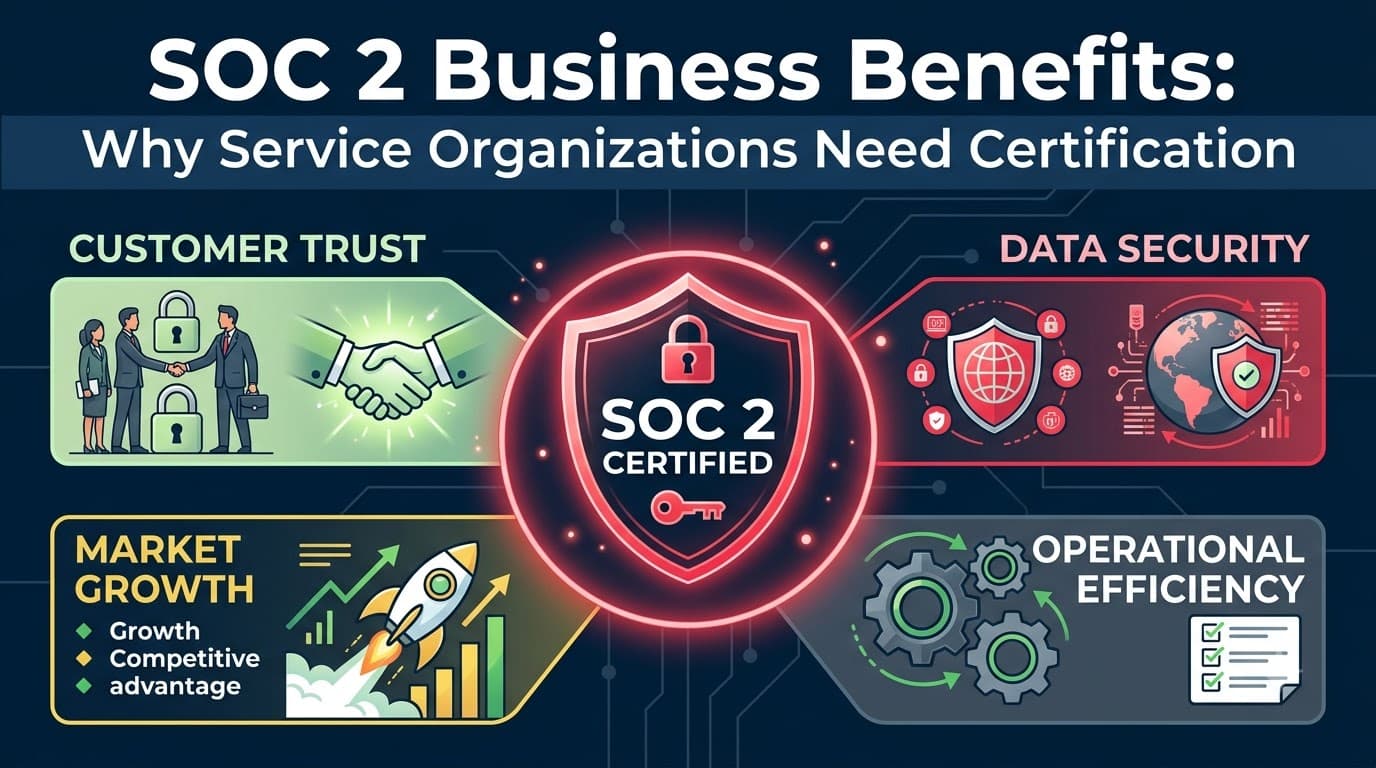
Priya Nandakumar had eleven minutes before the board call, and she spent them staring at a single line item in a stalled deal: $340,000 in annual recurring revenue, sitting in "security review" for the fourth week running. Priya was VP of Sales at Ledgerline, a 65-person fintech SaaS platform that helped mid-market accounting firms automate reconciliations. The deal — a regional bank holding company with 40 branches — had cleared every technical evaluation, every product demo, every reference call. It was dying in procurement, buried under a 190-question security questionnaire that Ledgerline's two-person engineering-adjacent "security function" was answering by hand, one Google Doc at a time, at a pace of about twelve questions a day.
Her counterpart at the losing end of three other deals that quarter told her the same story: no security incident, no product gap, no pricing objection. Just a vendor risk team that said, in some polite variation, "come back when you have a SOC 2 report." Ledgerline's CEO had been treating the idea of a SOC 2 examination as a compliance cost — something the engineering team would "get to" after the next two feature releases. Priya's eleven minutes were spent building the slide that reframed it: not a cost center, but the single highest-leverage investment available to unblock $1.8 million in pipeline sitting behind the same procurement wall.
This is the conversation almost every growing service organization eventually has, usually later than it should. I've sat on both sides of it — as the consultant brought in to build the control environment, and as the person handed the unenviable job of explaining to a founder why "we're secure, trust us" stopped being a sufficient answer to a buyer's procurement team sometime around their Series B. This article is the business case, not the audit mechanics: why customers demand SOC 2, how it changes deal cycles, what it's actually worth, and what it costs to get there.
Who This Is For — And What You'll Walk Away With
You're a founder, sales leader, CISO, or compliance manager trying to answer one question for your leadership team: is a SOC 2 examination worth the money and the six-to-twelve-month runway it takes to get one? You'll walk away with a stakeholder-by-stakeholder breakdown of the benefits, real numbers on how SOC 2 changes deal-cycle length, a framework for building your own ROI case, an honest look at costs (with pointers to a dedicated cost article), and a clear-eyed comparison of SOC 2 against ISO 27001 for organizations weighing both. This is not an audit-mechanics guide — it's the business case you take to the people who sign the check.
A Quick Note on the Word "Certification"
You'll see this article's own title use the word "certification" — that's deliberate, because it's how buyers, procurement teams, and search engines actually talk about SOC 2 in the wild. It's worth being precise before we go further, because precision here matters in vendor risk conversations: SOC 2 is not a certification. It is an attestation — a formal examination and opinion issued by a licensed CPA firm, governed by AICPA standard SSAE 18, resulting in a report, not a certificate or a pass/fail badge. There's no seal you hang on a wall the way you can with an ISO 27001 certification, which is a genuine third-party certification issued by an accredited body. SOC 2 gives you a detailed report a qualified reader can actually study — the auditor's opinion, management's assertion, the system description, and (for a Type II report) a description of tests of controls and their results. Getting this distinction right in customer conversations builds credibility; getting it wrong in front of a sophisticated buyer's audit team is an unforced error. From here on, I'll use "SOC 2 report" or "SOC 2 examination" — and I'll flag the one place later in this article where "certification" creeps back in because that's genuinely what a related standard is.
"The first time a customer's procurement lead corrected me on the difference between an attestation and a certification, I knew we'd hired the right auditor. It's a small thing, but it's the difference between sounding like a vendor who understands its own compliance posture and one who's reciting a sales deck." — Derek Osei, CISO, Northlight Payments
Why Customers Demand SOC 2 Today
Ten years ago, a security questionnaire was a formality — a box a procurement analyst checked before routing a contract to legal. Today, for any service organization that touches customer data, processes transactions, or sits in a customer's cloud environment, that questionnaire is a full-blown vendor risk management exercise, often run by a dedicated third-party risk team with its own budget, its own tooling, and its own veto power over the deal.
Three forces are driving this shift, and understanding them is the foundation of your business case:
Regulatory pressure has moved downstream. Banks, insurers, healthcare payers, and public companies face regulatory expectations — from bodies overseeing financial services, healthcare privacy, and public-company controls — that explicitly require them to manage risk from the vendors they rely on, not just their own internal environment. A data breach at a SaaS vendor is, in the eyes of a regulator, still the buying company's problem. That pressure doesn't stay at the top of the supply chain; it cascades down to every vendor those regulated companies touch, and then to every vendor of those vendors.
Breach fatigue has made "trust me" unacceptable. Every buyer's security team has a mental (or literal) list of vendor breaches that started as headlines and ended as their own incident response process. A procurement team that approves a vendor with no independent evidence of controls, and that vendor later causes a breach, owns that decision internally. SOC 2 gives them a defensible answer to "why did we approve this vendor" — an independent CPA firm examined the controls and issued an opinion.
The questionnaire itself has become unscalable. As more of the economy runs on SaaS, the average enterprise buyer now evaluates dozens of vendors a year, each requiring a security review. Vendor risk teams have responded by standardizing: if you have a current SOC 2 Type II report, many procurement gates streamline dramatically; if you don't, you get the full 150-to-300-question questionnaire, follow-up calls, and often a required remediation plan before the deal can close.
The result is that SOC 2 has quietly become table stakes in exactly the industries and deal sizes most SaaS and service companies are trying to grow into: fintech, healthtech, HR tech, and any B2B platform selling to companies with a formal vendor risk program. It's not that customers love audits. It's that SOC 2 is the fastest, cheapest way for them to discharge their own risk-management obligation regarding you.
Table 1: Why Each Buyer Stakeholder Cares About SOC 2
Buyer Stakeholder | What They're Actually Worried About | How a SOC 2 Report Answers It |
|---|---|---|
Procurement / vendor risk analyst | Meeting internal vendor approval policy without a six-week manual review | Report satisfies the standard evidence requirement; questionnaire shrinks or is waived |
CISO / security team (buyer side) | Inheriting risk from a vendor's weak access controls, change management, or incident response | Common Criteria cover exactly these domains with tested evidence |
Legal / contracts | Ability to negotiate liability, breach notification, and audit-rights clauses from a position of evidence, not promises | System description and control matrix give legal concrete terms to reference |
Finance / audit committee (buyer side) | Their own SOC 1 or financial-controls audit not being derailed by an unvetted vendor | Vendor's report can be referenced in the buyer's own control narrative |
End users / internal champion | Getting the tool approved without becoming the person who "skipped security review" | A ready SOC 2 report turns a multi-week blocker into a same-week approval |
Board / executive sponsor (buyer side) | Defensible due diligence if the vendor relationship is ever questioned post-incident | Independent third-party opinion, not just the vendor's self-attestation |
Procurement Gates: Where SOC 2 Actually Sits in the Buying Process
If you've never sat inside an enterprise procurement process, it's worth understanding exactly where the SOC 2 report request lands, because the timing explains why a missing report is so disproportionately damaging to a deal. Vendor risk review typically happens after the technical and commercial evaluation is functionally complete — after the champion is sold, after the demo has landed, after pricing has been roughly agreed. It is very often the last gate before contract signature, which means it's the gate where deals die the most expensively: after months of sales investment, not before.
A mature vendor risk program will ask for your SOC 2 report as the first artifact, before it even opens a bespoke questionnaire. If you can produce a current Type II report covering a relevant audit period, many programs will accept it as sufficient evidence for the majority of their control questions, reserving the custom questionnaire for company-specific items (data residency commitments, sub-processor lists, specific contractual carve-outs). If you can't produce one, you get the full questionnaire — and in regulated-adjacent buyers, you may also trigger a requirement for an on-site or virtual audit, additional insurance attestations, or a formal risk exception signed by a buyer-side executive, which is its own internal political cost for your champion to absorb.
"I tell every founder the same thing: your champion inside the buying company is spending political capital to push your deal through procurement. Every week that review drags on is a week they have to keep justifying it to their own boss. A SOC 2 report doesn't just speed up your sales cycle — it protects your champion." — Marcus Villanueva, Head of Revenue Operations, Ledgerline (fictional composite)
From Bespoke Questionnaires to One PDF: Replacing the Security Review
Before Ledgerline had a SOC 2 report, every enterprise deal triggered the same ritual: a spreadsheet or a portal-based questionnaire, anywhere from 80 to 300 questions, covering encryption standards, access control policies, incident response procedures, sub-processor lists, background-check practices, and disaster recovery testing — often in bespoke formats unique to each buyer's GRC platform. Answering it required pulling in engineering, HR, and legal, none of whom had spare capacity for it, and the answers were rarely stored anywhere reusable for the next questionnaire, which asked 80% of the same questions in a different order.
A current SOC 2 Type II report changes that dynamic structurally, not just cosmetically. It doesn't eliminate every question — buyers still ask about data residency, specific integrations, and contractual terms the report doesn't cover — but it converts the majority of a generic questionnaire from "answer this from scratch" to "here's independently tested evidence, please review." Many procurement platforms now have a specific workflow for this: upload the SOC 2 report, and the vendor risk tool auto-maps report sections to its own control library, flagging only the gaps that need a human answer.
Table 2: What a SOC 2 Report Typically Replaces vs. What Still Needs a Direct Answer
Questionnaire Category | Typically Covered by SOC 2 Report | Still Needs a Bespoke Answer |
|---|---|---|
Access control & authentication | Yes — CC6 series controls, tested | MFA enforcement for specific customer-facing roles |
Change management | Yes — CC8 series controls, tested | Customer-specific change notification SLAs |
Incident response | Yes — CC7 series controls, tested | Contractual breach notification timelines |
Encryption practices | Often — if scoped as a criterion or control | Specific key management for a customer's data |
Data residency / sub-processors | Rarely | Always requires a direct answer + DPA review |
Business continuity / disaster recovery | Yes, if Availability (TSC) is in scope | Recovery time objective for the customer's specific tier |
Background checks & HR security | Yes — CC1 control environment | Role-specific screening requirements |
Subprocessor risk management | Partially — depends on carve-out method vs inclusive method | Full subprocessor list and flow-down terms |
Deal-Cycle Impact: How Much Time SOC 2 Actually Saves
This is the number that gets a founder's attention, so it's worth being specific and honest about it. The deal-cycle compression from SOC 2 isn't uniform — it's concentrated almost entirely in the security-review phase of the sales process, and it scales with how mature the buyer's own vendor risk program is. A small business buyer with no formal vendor risk process barely notices whether you have a SOC 2 report. A regulated mid-market or enterprise buyer with a dedicated third-party risk team can turn a six-week security review into a five-day one.
Using illustrative, rounded figures consistent with what I've seen across dozens of B2B SaaS sales motions in the mid-market and enterprise segment, here's the shape of the impact:
Table 3: Illustrative Deal-Cycle Impact — With vs. Without a Current SOC 2 Report
Sales Cycle Stage | Without SOC 2 Report | With Current SOC 2 Type II Report | Illustrative Time Saved |
|---|---|---|---|
Initial vendor risk intake | 3–5 business days | 1–2 business days (report pre-screens) | ~3 days |
Bespoke questionnaire completion | 2–6 weeks (cross-functional effort) | 2–5 business days (gap items only) | ~2–5 weeks |
Follow-up security calls / evidence requests | 2–4 calls, 3–4 weeks elapsed | 0–1 call, under 1 week | ~2–3 weeks |
Legal review of security terms | 1–2 weeks (uncertainty drives caution) | 3–5 days (terms map to tested controls) | ~1 week |
Executive risk exception (if required) | Often required, adds 1–3 weeks | Rarely required | 1–3 weeks (when applicable) |
Total illustrative security-review phase | 6–12 weeks | 1.5–3 weeks | ~4–9 weeks |
That compression doesn't just shorten the sales cycle on paper — it changes forecast accuracy and win rates. Deals stuck in security review for months don't just close late; a meaningful share of them never close at all, because champions change roles, budget cycles reset, or a competitor with a report already in hand gets there first. Shortening the security-review phase from a multi-month unknown to a predictable two-to-three-week step is often the difference between a deal that slips a quarter and one that closes on schedule.
SOC 2 as a Sales Accelerator
flowchart LR
    A[Prospect enters<br/>evaluation] --> B[Technical & commercial<br/>evaluation]
    B --> C{Vendor risk /<br/>procurement gate}
    C -->|No SOC 2 report| D[Bespoke questionnaire<br/>6-12 weeks]
    D --> E[Follow-up calls,<br/>evidence requests]
    E --> F{Risk exception<br/>needed?}
    F -->|Yes| G[Executive sign-off<br/>1-3 weeks delay]
    F -->|No| H[Legal review]
    G --> H
    C -->|Current SOC 2<br/>Type II report| I[Report accepted as<br/>primary evidence]
    I --> J[Gap-only questions<br/>1-2 weeks]
    J --> H[Legal review]
    H --> K[Contract signed]
    D -.->|Some deals stall<br/>and never close| L[Lost / delayed<br/>revenue]
The diagram makes the business case visible in one glance: SOC 2 doesn't change whether a serious buyer will vet your security — it changes which branch of that flow you land on. One branch is predictable and measured in days; the other is unpredictable, cross-functionally expensive, and has a real leak of deals into "lost or delayed revenue."
Competitive Differentiation: Winning Before the RFP Is Written
In a crowded category, security posture has become one of the few genuinely differentiating signals left in a B2B RFP, because feature parity is so common. When two vendors are functionally similar, the one who can hand over a current SOC 2 report on request — versus the one who says "we're working on it" — wins a disproportionate share of head-to-head evaluations, especially in categories where a breach at any single vendor becomes a category-wide news story.
The differentiation shows up earlier than most founders expect. Sophisticated buyers increasingly pre-screen vendor shortlists using security posture as a filter before the RFP is even issued — a procurement team scanning a market for a new platform will often ask "do they have SOC 2" as a qualifying question before inviting a vendor to bid at all. Missing that bar doesn't just slow you down inside a deal you're already in; it can mean you never get invited to the deal.
There's a second, subtler differentiation effect: a SOC 2 report signals operational maturity well beyond security specifically. A buyer's procurement team reads a clean Type II report as evidence that the vendor has documented processes, a functioning change management discipline, and management oversight — the kind of operational rigor that correlates, in a buyer's mind, with reliability as a long-term partner, not just a secure one. It's common for sales teams to find that a SOC 2 report gets referenced in finance and legal diligence conversations too, not only security ones.
"We stopped putting 'SOC 2 Type II' on a bullet point in the deck and started putting the actual report — redacted appropriately — into the data room for every enterprise deal. Deals that used to take a full quarter of back-and-forth started closing in six weeks. It wasn't a messaging change. It was removing the single biggest source of buyer uncertainty in the whole process." — Renata Falk, VP Sales, Cascadia Health Analytics (fictional composite)
Trust and Brand: The Compounding Asset
Deal-cycle compression is the number that gets a board's attention in the short term, but the longer-run benefit is what a SOC 2 report does to brand trust, and it compounds in ways that are harder to put a single number on but are just as real. A public "we maintain a SOC 2 Type II report, available on request" line on a website, in a security page, or in a sales deck changes how prospects perceive the company before a single sales call happens. It signals that security isn't an afterthought bolted on after a customer asked for it — it's part of how the company operates.
That trust compounds across three audiences simultaneously. Prospects self-select more favorably, arriving at first contact already less skeptical, which shortens the trust-building phase of every sales conversation. Existing customers renew with more confidence, particularly the ones whose own vendor risk programs re-review suppliers annually — a lapsed or missing report at renewal time is a genuine churn risk in regulated-adjacent verticals. And investors and acquirers, particularly in fintech, healthtech, and infrastructure categories, increasingly treat a current SOC 2 report as a basic diligence artifact; its absence in a fundraise or M&A process becomes its own flag, adding friction and skepticism at exactly the moment a company most needs a clean story.
None of this is about the report itself being inherently valuable — it's about what the report represents to a skeptical, time-constrained buyer: independently verified evidence that a third party looked closely and didn't find reasons to walk away.
Retention and Renewal: The Benefit Nobody Puts in the Deck
Most of the SOC 2 conversation, understandably, focuses on new-logo sales — it's the visible, easily quantified pipeline story. But a quieter, equally real benefit shows up at renewal time, and it's one leadership teams consistently underweight because it doesn't announce itself the way a lost deal does. Existing customers in regulated-adjacent industries very often run annual or biennial vendor re-reviews as part of their own compliance obligations, and a lapsed, missing, or never-obtained SOC 2 report can surface as a genuine renewal risk years into a customer relationship that started long before the vendor risk conversation existed.
I've seen this play out at renewal in a specific, recognizable pattern: a customer's procurement or security team, refreshing its vendor inventory, asks for a "current" SOC 2 report as part of an annual attestation cycle. If the vendor doesn't have one, the account moves onto a formal risk-exception list, which triggers additional scrutiny, sometimes a compensating-controls questionnaire, and occasionally a contractual requirement to obtain a report within a defined window or risk non-renewal. None of this is dramatic in any single quarter — but compounded across a growing base of enterprise and regulated customers, it becomes a quiet churn risk that a SOC 2 program directly forecloses.
There's an upside version of this too: customer success and account management teams increasingly use a current SOC 2 report as a proactive trust-building touchpoint during renewal and expansion conversations, particularly when trying to expand a contract into new business units or a customer's own downstream customers. A report becomes part of the account team's toolkit, not just the new-logo sales team's.
"We almost lost a seven-figure renewal not because of anything we did wrong operationally, but because our SOC 2 report had lapsed by four months and nobody on our side had flagged the re-examination date. Now the renewal date for our audit sits on the same calendar as our biggest account renewals, on purpose." — Renata Falk, VP Sales, Cascadia Health Analytics (fictional composite)
Risk Reduction and Operational Maturity: The Internal Benefit
Everything so far has been about the external, revenue-facing case for SOC 2. But the readiness process itself — the work of preparing for a Type II report, not just receiving one — produces a genuine internal benefit that leadership teams consistently underweight when they think of SOC 2 purely as a sales-enablement expense. Getting audit-ready forces a level of operational discipline that most growing companies haven't had a reason to build yet: documented access control policies, a real change management process, formal onboarding and offboarding procedures, tested backup and recovery processes, and a functioning incident response plan that's actually been rehearsed rather than written once and forgotten.
I've watched this readiness work catch real problems before they became real incidents — a set of dormant admin credentials nobody remembered granting, a backup process that had silently been failing for months, a change process where production deploys bypassed code review under deadline pressure. None of these were found by a penetration test; they were found by the unglamorous work of mapping evidence to controls and discovering the evidence didn't exist. That's risk reduction that shows up on a balance sheet as fewer incidents, not just on a sales deck as a faster close.
Table 4: Risk Categories a SOC 2-Aligned Control Environment Typically Reduces
Risk Category | How It Shows Up Without Controls | How SOC 2 Readiness Addresses It |
|---|---|---|
Unauthorized access | Orphaned accounts, excessive standing privilege, no least privilege discipline | CC6 access-control criteria force provisioning/deprovisioning review |
Unreviewed changes | Production changes deployed without review or rollback plan | CC8 change-management criteria require documented approval workflows |
Undetected incidents | No formal detection or escalation path; incidents found by customers first | CC7 system-operations criteria require monitoring and response procedures |
Vendor/subservice exposure | No visibility into what sub-processors can access or do | Subservice organization review via carve-out/inclusive method |
Recovery failure | Backups untested, recovery time unknown until a real outage | Availability (TSC) criteria (if in scope) require tested continuity plans |
Insider risk | No structured background screening or termination access removal | CC1 control-environment criteria cover HR security practices |
Undocumented risk decisions | Risk accepted informally, no audit trail if something goes wrong | CC3/CC9 risk assessment and mitigation criteria require documented risk process |
"Our SOC 2 readiness project found more real risk in ninety days than two years of ad hoc security effort had. Not because our engineers were careless — because nobody had ever been forced to prove, with evidence, that a control actually worked every time, not just the time someone remembered to do it." — Devon Achebe, Director of Engineering, Northlight Payments (fictional composite)
When SOC 2 Becomes Effectively Mandatory to Sell Upmarket
There's a point in a growing service organization's life where SOC 2 stops being a nice-to-have differentiator and becomes a hard floor — a deal-qualifying requirement rather than a deal-accelerating one. Recognizing when you've crossed that line, or when you're about to, is one of the more useful things I can offer a leadership team weighing the investment, because it reframes the question from "should we ever do this" to "how much revenue are we currently forfeiting by not having done it yet."
Table 5: Signals That SOC 2 Has Become Non-Negotiable for Your Pipeline
Signal | What It Looks Like | Why It's a Hard Floor, Not a Nice-to-Have |
|---|---|---|
Deal size crosses a mid-market/enterprise threshold | Average contract value moves from four figures to six figures | Larger buyers have formal vendor risk programs almost universally |
Buyers are regulated or regulated-adjacent | Selling into banking, insurance, healthcare payers, or public companies | Their own regulatory obligations require vendor due diligence |
RFP templates start including a SOC 2 field as standard | "Attach your most recent SOC 2 Type II report" appears as a fixed line item | Absence disqualifies the bid before evaluation even starts |
Competitors in the category already have a report | Category leaders list SOC 2 on their security pages | Buyers use it as a baseline comparison point across the shortlist |
You handle sensitive data classes at scale | Financial data, health data, or large volumes of PII | Higher inherent risk triggers stricter procurement gates |
Sales cycles are stalling specifically at security review | Deals reach late stage then stall for weeks with no other objection | Direct evidence the report, not the product, is now the bottleneck |
Investors or acquirers begin asking for it in diligence | Due diligence checklists include current attestation reports | Its absence becomes a valuation or deal-risk flag |
When two or more of these signals are present, the conversation with leadership shouldn't be "can we afford to do SOC 2" — it should be "can we afford the deals we're already losing by not having it." That reframing, more than any other single argument, is what moved Ledgerline's board from treating the SOC 2 project as a Q3 engineering nice-to-have to funding it as a Q1 strategic priority with an executive sponsor.
Type I vs. Type II From a Sales Lens
A quick note that matters for the business case specifically, distinct from the full comparison of SOC 2 Type I vs Type II: most sophisticated buyers, especially at the enterprise and regulated end of the market, want a Type II report, not a Type I report. A Type I only attests that controls were suitably designed on a single date; a Type II attests that those controls actually operated effectively over an audit period, commonly three to twelve months. Vendor risk teams know the difference, and many will explicitly request Type II or treat a Type I as a stepping-stone rather than sufficient evidence on its own.
That said, a Type I isn't worthless in the sales narrative — it's a legitimate first milestone that lets a sales team say "we have an unqualified SOC 2 report in hand, with our Type II observation period underway," which is a materially stronger position than "we're planning to start a SOC 2 project." Many organizations run a Type I first specifically to have something to show mid-cycle deals while the longer Type II observation window completes.
Building the ROI Case (Illustrative Framing)
Leadership teams don't fund compliance projects on trust; they fund them on numbers. The good news is that SOC 2's ROI case is unusually easy to build compared to most security investments, because the primary benefit — deal-cycle compression and unblocked pipeline — is directly observable in your own CRM data. Here's the framework I walk clients through, using illustrative figures modeled on Ledgerline's situation to show the shape of the math; your own numbers will differ, and that's the point — you plug in your real pipeline data.
Step 1: Quantify blocked or slowed pipeline. Pull every deal from the last 12 months that stalled, slipped a quarter, or was lost with "security review" or "vendor risk" cited as a factor. For Ledgerline, that was $1.8 million in pipeline across the quarter Priya was reviewing.
Step 2: Apply a realistic recovery rate, not 100%. Not every stalled deal was purely a security-review problem, and not every one would close even with a report in hand. A conservative illustrative recovery assumption — say, 30–50% of identified stalled pipeline becoming closable within two quarters of having a report — keeps the case credible to a skeptical CFO.
Step 3: Add cycle-time value, not just win/loss value. Even deals that would have closed anyway have a time-value cost when they close a quarter late. Modeling the revenue-recognition timing benefit (not just win-rate benefit) captures a second, often-overlooked source of ROI.
Step 4: Net against total cost. Combine the readiness assessment, any tooling, internal labor, and audit fees (see the cost breakdown below) into a single first-year cost figure, then compare against the recovered/accelerated pipeline value.
Table 6: Illustrative ROI Model (Modeled on a $10M ARR Mid-Market SaaS Company)
ROI Input | Illustrative Figure | Note |
|---|---|---|
Pipeline stalled/lost to security review (trailing 12 months) | $1,800,000 | Pulled from CRM stage-change and loss-reason data |
Conservative recovery rate assumption | 35% | Deliberately conservative to keep the case credible |
Illustrative recovered/accelerated pipeline value | $630,000 | Step 1 × Step 2 |
Estimated first-year total cost of SOC 2 program | $95,000–$140,000 | Readiness, tooling, audit fees, internal labor (loaded) |
Illustrative first-year net benefit | ~$490,000–$535,000 | Recovered pipeline value minus total program cost |
Illustrative payback period | Under 6 months post-report issuance | Based on deal-cycle data above |
The exercise isn't meant to produce a precise number — it's meant to produce a defensible, conservative order of magnitude that reframes the leadership conversation from "what does compliance cost" to "what is the cost of not having this evidence available to our sales team." That reframing is almost always the more persuasive one.
"The CFO didn't approve the SOC 2 budget because he suddenly cared about access control policies. He approved it because I showed him the pipeline number next to the program cost number, and the ratio did the talking." — Priya Nandakumar, VP Sales, Ledgerline (fictional composite)
Costs at a High Level
A full cost breakdown deserves its own dedicated treatment — audit firm fee ranges, readiness assessment costs, GRC tooling, and internal labor all vary significantly by company size, number of Trust Services Criteria in scope, and whether you're pursuing a Type I report first or going straight to Type II. We cover that in detail in a dedicated cost guide (SOC 2 Cost Guide: Budgeting for Readiness, Audit Fees, and Tooling). At a high level, though, the business case needs to account for four cost buckets:
Table 7: SOC 2 Cost Categories at a High Level (Illustrative)
Cost Category | What It Covers | Illustrative Range (First Year) |
|---|---|---|
Readiness assessment / gap analysis | Pre-audit review identifying control gaps before the formal examination | $10,000–$30,000 |
GRC / compliance automation tooling | Evidence collection, control monitoring, questionnaire automation | $5,000–$25,000/year |
Remediation labor (internal or contracted) | Building missing policies, implementing missing controls | Highly variable; often the largest hidden cost |
CPA firm audit fees (Type II) | The formal examination and report issuance | $20,000–$60,000+ depending on scope and criteria |
Ongoing maintenance (Year 2+) | Continuous monitoring, annual re-examination, evidence upkeep | Typically lower than Year 1 once processes are established |
These figures are illustrative and vary widely by company size, number of criteria in scope beyond the required Common Criteria, and audit firm. The point for a business-case conversation isn't the exact figure — it's that the cost is finite, front-loaded, and largely one-time relative to the recurring, compounding nature of the revenue benefit.
Table 8: Cost vs. Benefit Summary
Dimension | Cost Side | Benefit Side |
|---|---|---|
Timing | Front-loaded (6–12 months to first report) | Compounds annually once report exists |
Predictability | Fairly predictable once scope is set | Directly tied to sales pipeline, varies by GTM motion |
Owner | Compliance/security + finance (budget) | Sales, revenue, and brand (realized value) |
Recurring nature | Ongoing but declining maintenance cost | Recurring deal-cycle and renewal benefit each year |
Risk if skipped | None directly (no penalty for not having SOC 2) | Ongoing pipeline leakage, competitive losses, churn risk |
SOC 2 vs. ISO 27001 for the Business Case
This is the question I get most often from companies selling into multiple geographies or industries: should we pursue SOC 2, ISO 27001, or both? I've written a detailed comparison of ISO 27001 vs SOC 2 covering the mechanical differences, and a guide to running ISO 27001 and SOC 2 together for organizations that eventually need both. Here, the relevant question is business-case-specific: which one moves your revenue needle faster, and for whom?
The honest answer is that they solve overlapping but distinct trust problems, and the right framework — market, not merit — determines which to pursue first. ISO 27001 is a genuine, accredited certification against an international standard, with a certificate you can display, and it carries particular weight with European, government, and multinational buyers who are used to ISO frameworks generally. SOC 2 is a US-originated attestation that's become the default expectation among American SaaS buyers, particularly in tech-forward and fintech-adjacent procurement processes. A company selling primarily to US mid-market and enterprise SaaS buyers will usually see faster ROI from SOC 2 first; a company selling into European enterprises, government contracts, or multinational conglomerates will often find ISO 27001 opens doors SOC 2 doesn't.
Table 9: SOC 2 vs. ISO 27001 — Business-Case Comparison
Dimension | SOC 2 | ISO 27001 |
|---|---|---|
Nature of the deliverable | Attestation report from a CPA firm | Accredited certification with a certificate |
Governing body | AICPA (SSAE 18) | International standard, certified by accredited bodies |
Primary buyer geography | Strongest recognition in the US | Strongest recognition in Europe, government, multinational |
Typical first-time timeline | Type I: 1–3 months prep; Type II: 3–12 month observation period | Typically 6–12 months to certification audit |
Public display | Report is restricted-use, shared under NDA (or SOC 3 for public use) | Certificate is publicly displayable |
Renewal cycle | Re-examination typically annually | Certification cycle of 3 years with annual surveillance audits |
Best-fit business case | Unblocking US SaaS/enterprise procurement quickly | Winning European/multinational/government deals; broader ISMS maturity |
Can they coexist? | Yes — many mature vendors maintain both | Yes — see running ISO 27001 and SOC 2 together |
Crosswalk resource | See the ISO 27001, SOC 2, and NIST CSF control crosswalk for control-level mapping | Same resource — shared control mapping reduces duplicate effort |
For a leadership team building a single business case, the practical guidance is: start with whichever framework your actual, named, in-pipeline deals are asking for, and treat the other as a phase-two expansion once the first is generating recognizable ROI. A comparison guide covering ISO 27001, SOC 2, and NIST CSF is useful if you're weighing more than these two frameworks against each other. And if you're earlier in the journey and unsure what either framework actually requires operationally, a beginner's guide to ISO 27001 is a good primer alongside our own SOC 2 Complete Guide to the AICPA Trust Services Criteria.
Buyer Expectations by Segment
Not every buyer weighs SOC 2 the same way, and calibrating your business case to your actual customer base matters more than treating "the market" as monolithic. A seed-stage startup selling to other startups faces almost no SOC 2 pressure; a company selling to regulated mid-market and enterprise buyers faces it as a near-universal gate. Understanding where your buyer base sits on this spectrum tells you not just whether to pursue SOC 2, but when.
Table 10: Buyer Expectations by Market Segment
Buyer Segment | Typical Vendor Risk Maturity | SOC 2 Expectation | Business-Case Implication |
|---|---|---|---|
Small business / SMB (under ~$10M revenue) | Informal, often no dedicated function | Rarely required; occasionally asked about | Low urgency; monitor if segment mix is shifting upmarket |
Mid-market ($10M–$500M revenue) | Semi-formal; a security or IT lead often owns vendor review | Frequently required, especially in regulated-adjacent verticals | Moderate-to-high urgency if this is your core ICP |
Enterprise ($500M+ revenue) | Formal vendor risk management function, dedicated tooling | Standard requirement; often a hard procurement gate | High urgency; treat as a pipeline-qualifying prerequisite |
Regulated industries (banking, insurance, healthcare payers) | Formal program tied to regulatory obligations | Near-universal requirement, sometimes plus additional attestations | Highest urgency; likely already losing deals without it |
Government / public sector | Formal, framework-specific (often not SOC 2 alone) | SOC 2 helpful but often insufficient alone; other frameworks (e.g., FedRAMP) may apply | Evaluate whether SOC 2 is the right primary framework for this segment |
International / EU-heavy buyer base | Formal, often ISO-framework-oriented | ISO 27001 frequently preferred or required alongside/instead of SOC 2 | Consider ISO 27001 as the lead framework for this segment |
Industry Lens: How the Business Case Differs by Vertical
The size and shape of the SOC 2 business case shifts meaningfully depending on what you sell and to whom. A generic "SOC 2 is good for business" pitch is weaker than a version tailored to your specific vertical's procurement dynamics, so it's worth walking through how the case typically presents across the industries I see most often.
Fintech and payments infrastructure. This is the vertical where SOC 2 is closest to a hard requirement rather than a differentiator. Banks, payment processors, and financial platforms almost universally require independent evidence of controls before integrating a vendor, often citing their own regulatory obligations around third-party risk. The business case here is usually less "will this help us win deals" and more "we are currently ineligible for an entire category of deals."
Healthtech and health-data platforms. Health systems and payers layer SOC 2 expectations on top of their own regulatory obligations around protected health information, and a report — particularly one that scopes in Confidentiality — is frequently a prerequisite to even being invited to bid, as Cascadia's case study illustrated above.
Horizontal B2B SaaS and dev tools. Here the case is more segmented: a tool selling primarily to other startups and SMBs may see limited urgency, while the same tool selling into IT, security, or engineering leadership at mid-market and enterprise accounts will hit the vendor-risk wall as soon as deal size crosses a few hundred thousand dollars in annual contract value.
Managed service providers and IT outsourcers. MSPs occupy an unusual position: they're often the subservice organization referenced in their customers' SOC 2 reports, which means their own customers may require them to have a SOC 2 report as a condition of the inclusive method versus carve-out method decision. An MSP without its own report can quietly become the reason a customer's audit gets more complicated.
E-commerce and consumer-adjacent platforms. SOC 2 pressure here tends to be lighter unless the platform is processing payment data directly or storing significant volumes of PII, in which case it converges with the fintech pattern above.
Table 15: Industry Lens on the SOC 2 Business Case
Vertical | Typical SOC 2 Urgency | Primary Business-Case Driver | Common TSC Beyond Common Criteria |
|---|---|---|---|
Fintech / payments | Very high — often a hard gate | Deal eligibility, not just deal speed | Availability (TSC), Confidentiality |
Healthtech / health data | Very high | RFP eligibility, regulatory alignment for buyers | Confidentiality, sometimes Privacy (TSC) |
Horizontal B2B SaaS | Moderate to high, segment-dependent | Deal-cycle compression at mid-market/enterprise tier | Availability (TSC) commonly added |
MSPs / IT outsourcers | High — affects customers' own audits | Enabling customers' inclusive-method reporting | Availability (TSC), Confidentiality |
E-commerce / consumer platforms | Low to moderate, payment-data dependent | Payment processor and partner requirements | Confidentiality if PII volume is high |
Talking to Skeptical Leadership: Common Objections
Even with a strong ROI model, most leadership teams raise a predictable set of objections before approving a SOC 2 investment. Having direct, honest answers ready — not defensive ones — is often what separates a business case that gets funded from one that gets tabled for "next quarter" indefinitely.
Table 11: Common Objections and Evidence-Based Responses
Objection | Evidence-Based Response |
|---|---|
"We haven't lost a deal to this yet." | Pull CRM loss-reason and stage-duration data — the pattern is often present but unlabeled as "security" in the CRM. |
"Can't we just answer questionnaires as they come in?" | Show the cross-functional hours spent per questionnaire and the inconsistency across answers — the marginal cost per deal is often higher than amortized SOC 2 cost. |
"It's too expensive for our stage." | Compare program cost against a single quarter of stalled pipeline identified in Step 1 of the ROI model above. |
"We'll just do it later, once we're bigger." | Show the deal-cycle data on how many deals are currently stalling — "later" often means forfeiting revenue now that a report would unblock. |
"Won't the audit just find a bunch of problems?" | Reframe: finding gaps during readiness, privately, is the benefit — it's cheaper than a customer or incident finding them first. |
"Our engineers don't have bandwidth for this." | A readiness assessment scopes actual effort; much of the work (documentation, evidence collection) doesn't require senior engineering time. |
"We're not sure which Trust Services Criteria to include." | Start with the required Common Criteria (Security) only; add Availability (TSC), Confidentiality, or others only if customers specifically require them. |
Building Internal Buy-In: A Stakeholder RACI
SOC 2 readiness fails to launch, or stalls midway, more often because of unclear internal ownership than because of technical difficulty. Before you take the business case to leadership, it's worth mapping who actually needs to be responsible, accountable, consulted, and informed — because the project touches engineering, HR, legal, sales, and finance simultaneously, and no single team can carry it alone.
Table 12: Internal Stakeholder RACI for a SOC 2 Program
Activity | Responsible | Accountable | Consulted | Informed |
|---|---|---|---|---|
Business case & budget approval | CISO / Head of Security | CEO or CFO | Sales leadership, Legal | Board |
Readiness assessment & gap analysis | Compliance manager / security lead | CISO | Engineering leads, IT | Executive team |
Policy documentation | Compliance manager | CISO | Legal, HR, Engineering | All employees (post-approval) |
Control implementation (technical) | Engineering / IT | Engineering leadership | Security | CISO |
Evidence collection & audit liaison | Compliance manager | CISO | Auditor (CPA firm) | Executive sponsor |
Sales enablement on the report | Sales enablement / RevOps | VP Sales | CISO, Legal | Full sales team |
Ongoing monitoring & renewal | Compliance manager | CISO | Engineering, IT | Executive team, sales |
What the First 12 Months Typically Look Like
Leadership teams weighing the business case want a sense of the timeline, not just the end state, because the value doesn't arrive all at once — it arrives in stages, and knowing which stage unlocks which benefit helps set realistic expectations with sales and the board.
Table 17: Illustrative 12-Month SOC 2 Program Timeline and Milestones
Phase | Approximate Timing | Key Activity | Business Value Unlocked |
|---|---|---|---|
Readiness assessment / gap analysis | Months 1–2 | Identify control gaps against the Common Criteria | Internal risk visibility; realistic budget and timeline |
Remediation | Months 2–4 | Build missing policies, implement missing technical controls | Reduced operational risk begins immediately |
Type I examination (optional milestone) | Month 3–4 | CPA firm examines control design at a point in time | Early proof point for mid-cycle deals |
Type II observation period begins | Month 4–5 | Controls operate and evidence accumulates over the audit period | "Report in progress" becomes a credible sales statement |
Type II observation period (ongoing) | Months 5–10 (commonly 6 months minimum) | Continuous evidence collection, monitoring | Growing internal maturity; sales enablement prep |
Type II examination & report issuance | Months 10–12 | Auditor tests operating effectiveness, issues opinion | Full deal-cycle compression benefit becomes available |
Sales enablement rollout | Month 12+ | Train sales, publish security page updates, brief legal | Realized ROI begins showing in CRM data |
Annual re-examination cycle | Ongoing, annually | Renewed audit period, refreshed report | Sustained trust; avoids report going stale |
The practical implication for the business case: leadership should expect the first visible deal-cycle benefit around the Type I milestone (if pursued) or once the Type II observation period is publicly communicable, with the full benefit landing once the Type II report is in hand — typically somewhere in the ten-to-twelve-month range for a first-time program, faster for organizations with an already-mature control environment.
Expanding Scope Over Time: Beyond the Common Criteria
The Common Criteria (Security) are required in every SOC 2 examination, but many organizations eventually add one or more of the optional Trust Services Criteria — Availability (TSC), Processing Integrity, Confidentiality, or Privacy (TSC) — as their buyer base matures. The business-case discipline here is the same as scoping the initial project: add a criterion when a real, recurring customer requirement justifies it, not because it looks more comprehensive on a cover page.
Availability is the most commonly added criterion, usually driven by customers with uptime-sensitive use cases who want independent evidence of tested business continuity and disaster recovery practices, not just a contractual SLA. Confidentiality follows close behind for vendors handling sensitive business or health data. Processing Integrity and Privacy are added more selectively — typically by payment processors, healthcare-adjacent platforms, or companies with specific regulatory exposure around personal data handling — because they add meaningful audit scope and cost without broad buyer demand in most other categories.
KPIs to Track After the Report Is Issued
The business case doesn't end when the auditor issues an unqualified opinion. The value of SOC 2 is realized over the following year, and it's worth tracking a small set of metrics so the next budget conversation — renewal, expanded scope, adding Availability (TSC) or another criterion — is backed by the same kind of evidence that justified the first investment.
Table 13: KPIs to Track Post-Report
KPI | What It Tells You | Where to Pull It |
|---|---|---|
Average security-review duration (before vs. after) | Direct measure of deal-cycle compression | CRM stage-duration reports |
Win rate on deals citing security/vendor risk as a factor | Whether the report is actually converting, not just speeding up, deals | CRM win/loss analysis |
Number of bespoke questionnaires avoided or shortened | Operational time saved across sales, legal, engineering | Sales ops / deal desk tracking |
Renewal rate among regulated-industry customers | Whether the report is protecting existing revenue, not just new | Customer success / renewal data |
Number of RFPs where SOC 2 was a stated qualifying criterion | Whether the report is opening doors pre-sales | Sales/marketing RFP tracking |
Number of control exceptions or findings at re-examination | Whether the underlying control environment is maturing or stagnating | Auditor's report year-over-year |
Time and cost to prepare for annual re-examination | Whether readiness work is becoming more efficient | Compliance program tracking |
Case Studies: Quantified Outcomes
The following three case studies are illustrative composites built from patterns I've seen repeatedly across engagements — the company names, individuals, and exact figures are fictional, but the shape of the outcome is representative of what a well-run SOC 2 program produces.
Case Study 1: Ledgerline (Fintech SaaS, ~65 employees). Ledgerline entered its SOC 2 Type II readiness project with $1.8 million in quarterly pipeline stalled at the vendor-risk-review stage. Nine months after the Type II report was issued, the average security-review phase for enterprise deals dropped from an average of 9.5 weeks to 2 weeks. Within two quarters, $640,000 of previously stalled pipeline closed, and the average enterprise deal cycle overall shortened by roughly 25%. The readiness process also surfaced a set of dormant administrator credentials tied to a former contractor, which was revoked as part of remediation — a real risk closed as a side effect of the sales-driven initiative.
Case Study 2: Cascadia Health Analytics (Healthtech data platform, ~140 employees). Cascadia had been losing an estimated three enterprise deals per year specifically at the health-system procurement stage, each averaging $220,000 in annual contract value, with "no current SOC 2 report" cited directly in two of three loss debriefs. After obtaining a Type II report covering Security and Availability (TSC), Cascadia's win rate against incumbents in competitive health-system RFPs rose from roughly 20% to 38% over the following year, and the company was invited to bid on two RFPs where a SOC 2 report was listed as a mandatory qualifying document — bids it would not previously have been eligible for.
Case Study 3: Northlight Payments (Payments infrastructure, ~90 employees). Northlight's leadership initially framed SOC 2 purely as a defensive, check-the-box exercise for a single large banking prospect. The readiness assessment instead became the catalyst for a broader operational maturity push: formalized change management, a tested incident response plan, and a documented access control review cadence. The banking deal closed as expected, but the unplanned benefit was a 40% reduction in the average time to close all enterprise deals over the following year, as the sales team began proactively sharing the report earlier in every relevant sales cycle rather than waiting to be asked.
Table 14: Case Study Outcomes Summary
Company (Composite) | Industry | Primary Illustrative Outcome | Secondary Benefit |
|---|---|---|---|
Ledgerline | Fintech SaaS | Security-review phase: 9.5 weeks → 2 weeks; $640K stalled pipeline recovered | Dormant admin credentials identified and revoked |
Cascadia Health Analytics | Healthtech data platform | Win rate in competitive RFPs: ~20% → ~38% | Newly eligible for RFPs requiring SOC 2 as a qualifying document |
Northlight Payments | Payments infrastructure | Average enterprise deal-cycle time reduced ~40% | Formalized change management and incident response as a byproduct |
The Sales Team's Playbook: Using the Report Inside a Live Deal
Getting the report is only half the business case; the other half is whether your go-to-market team actually knows how to use it. I've seen companies obtain a clean unqualified opinion and then leave most of the deal-cycle benefit on the table simply because nobody built a repeatable process for deploying it inside live deals. A few practices consistently separate the companies that realize the full ROI from the ones that only realize part of it.
Lead with it, don't wait to be asked. The strongest sales teams introduce the SOC 2 report proactively, early in the evaluation — often in the first security-adjacent conversation — rather than waiting for a procurement team to request it during a formal review. This front-loads trust and often preempts the bespoke questionnaire altogether.
Have a redaction-ready and full version prepared. Some prospects will accept an executive summary or a redacted version early in the cycle, reserving the full report (often under NDA) for later-stage diligence. Having both ready, with a clear internal process for who can release which version, avoids delay at exactly the point in the deal where speed matters most.
Know the scope cold. Sales and solutions engineering should be able to state, without checking, which Trust Services Criteria are in scope, the audit period covered, and whether any subservice organizations are carved out or included. A rep who fumbles this in front of a buyer's security team undoes much of the credibility the report was supposed to build.
Route gap questions to the right owner fast. Even a strong report doesn't answer every question a sophisticated buyer asks. Sales needs a fast internal escalation path to security/compliance for the residual questions, rather than guessing or stalling.
Table 16: Sales Playbook — Do's and Don'ts With a SOC 2 Report
Situation | Do | Don't |
|---|---|---|
Early-stage conversation with a security-conscious prospect | Proactively mention the report exists and offer to share it | Wait for the prospect to ask |
Prospect requests the full report | Route through an NDA process defined in advance | Send the full report ad hoc without an NDA |
Prospect asks what's "not" covered | Answer honestly about scope limits and gap items | Imply the report covers more than it does |
Prospect's security team asks about subservice organizations | Explain the carve-out or inclusive method clearly | Avoid or deflect the question |
Deal stalls despite having the report | Escalate to compliance/security for a direct technical conversation | Let the deal sit unaddressed in the pipeline |
Contract Negotiation and Legal Leverage
A less-discussed but material benefit of a SOC 2 report shows up during contract redlines, particularly around security and liability terms. Buyer-side legal teams negotiating security exhibits, breach-notification clauses, and audit-rights provisions do so more efficiently, and often less aggressively, when they have concrete, tested control evidence to reference rather than negotiating against an unknown. A vendor with a current Type II report can often point directly to relevant control evidence to satisfy a requested contractual commitment, rather than negotiating from a blank slate or over-promising in the contract language to compensate for the absence of evidence.
This matters most in two clause categories. Audit-rights clauses — where a customer wants the contractual right to audit the vendor directly — are frequently softened or replaced entirely by a commitment to provide the current SOC 2 report annually, which is far less operationally burdensome for the vendor than fielding bespoke customer audits. Breach-notification and liability terms become easier to negotiate to reasonable, defensible timelines when the vendor can point to a tested incident response process as the Common Criteria require, rather than negotiating a notification window with no operational process behind it.
Common Pitfalls That Erode the Business Case
I've also watched organizations undercut their own SOC 2 investment through avoidable mistakes, and it's worth naming them explicitly so the business case includes a plan to avoid them, not just a plan to get the report.
Letting the report go stale. A Type II report has a defined audit period, and buyers expect a current one — typically issued within the last 12 months, with a bridge letter covering any gap. A company that gets a report and then treats the program as "done" will find the report loses credibility with sophisticated buyers within a year.
Scoping too broadly, too soon. Including Processing Integrity or Privacy (TSC) criteria because they sound impressive, without a customer actually requiring them, adds cost and audit complexity without adding proportional deal-cycle benefit. Start with the required Common Criteria and expand only when a real deal or segment demands it.
Treating it as an engineering-only project. SOC 2 readiness that's delegated entirely to engineering, without sales, legal, and HR involvement, tends to produce a report that technically passes but doesn't get used — sales teams unaware the report exists, or unsure how to position it, leave the deal-cycle benefit on the table.
Not training sales on how to use the report. A report sitting in a shared drive delivers none of its value. Sales teams need to know when to proactively offer it (early, not just when asked), how to handle the redacted-vs-full-report question, and how to talk about scope (which Trust Services Criteria are covered) without overstating what it means.
Underestimating the subservice organization question. Buyers increasingly ask not just "do you have a SOC 2 report" but "does your cloud provider" — and how you've handled that via carve-out method or inclusive method matters to sophisticated reviewers. Being unable to answer this cleanly undercuts an otherwise strong report.
SOC 2 as a Business Opportunity, Not a Compliance Tax
The framing I push back on hardest, in every leadership conversation, is "compliance cost." It's the wrong mental model, and it leads to the wrong decisions — under-resourcing the project, delegating it entirely to engineering, treating the report as a finish line instead of an asset. The organizations that get the most value from SOC 2 are the ones that treat it as a go-to-market investment with a compliance component, not a compliance project with an incidental sales benefit.
That reframing changes concrete decisions. It means the project gets an executive sponsor from revenue, not just security. It means sales is trained on the report before it's even finished, so the moment it's issued, every rep knows how to use it. It means the Trust Services Criteria scope is chosen based on what customers actually ask for, not what looks most impressive. And it means the KPIs tracked after the report is issued are revenue and deal-cycle metrics, sitting right next to the audit-readiness metrics, because that's the whole point.
Priya's board call, the one that started this article, ended with the SOC 2 project approved in nine minutes — less time than she'd spent building the case. The board didn't fund a compliance initiative. They funded the removal of a structural blocker sitting between Ledgerline and $1.8 million in pipeline. That's the pitch. It's not about fear of a breach headline, and it's not about chasing a badge for the website. It's about recognizing that in a market where every serious buyer now runs a vendor risk process, an independent, credible answer to "prove it" has become one of the highest-leverage investments a growing service organization can make.
If you're weighing this decision for your own organization, the fastest way to move from "should we" to "here's the plan" is to run your own numbers through the same exercise laid out here: pull your stalled pipeline, apply a conservative recovery rate, and put it next to a realistic cost estimate. In nearly every case I've walked through this with a leadership team, the ratio speaks for itself.
Where to Go Next
If your leadership team is ready to move from business case to execution, start with a readiness assessment to understand your actual gap before committing to a timeline or budget — PentesterWorld's SOC 2 Readiness Checklist is a practical starting point for scoping that conversation internally. If you're still deciding between Type I and Type II as your first milestone, our SOC 2 Type I vs Type II guide walks through the trade-offs in detail, and the SOC 2 Trust Services Criteria breakdown helps you scope which criteria beyond the required Common Criteria actually matter for your buyers. For teams still untangling the SOC report family entirely, SOC 2 vs SOC 1 vs SOC 3: Understanding the SOC Framework Family is the clearest starting point.
Want a structured way to map your current controls against the Trust Services Criteria before you talk to an audit firm? PentesterWorld's SOC 2 Trust Services Criteria Mapping Template and SOC 2 Control Matrix / RACI Template are built for exactly this scoping exercise, and our SOC 2 Gap Analysis Tool can help quantify the readiness work ahead before you build your own board-ready business case.