I remember sitting across from Marcus, the CEO of a 120-person fintech startup, when he dropped the bomb: "Our biggest prospect just told us they won't sign without ISO 27001 certification. We have six months. Can we do it?"
I took a deep breath. "Six months is aggressive, but I've seen it done. Here's the thing though—if we rush it just to get certified, you'll fail your first surveillance audit. If we do it right, you'll build something that actually protects your business and makes you stronger."
Marcus leaned back. "Tell me how."
That conversation happened three years ago. Today, that company not only maintains their ISO 27001 certification, but they've closed over $40 million in enterprise deals specifically because of it. More importantly, they've prevented two potentially catastrophic breaches because of the controls we implemented.
I've now guided 23 organizations through ISO 27001 certification over the past decade. Some took 6 months. Others took 18. But they all succeeded because they followed a structured roadmap. This is that roadmap.
Why ISO 27001 Is Worth the Investment (Beyond the Certificate)
Let me share something that surprised me early in my career: the organizations that get the most value from ISO 27001 are the ones who care least about the certificate itself.
I worked with two companies that started their ISO 27001 journey at the same time. Company A was focused on "getting certified fast"—they wanted the badge for their website and the logo for their proposals. Company B wanted to "build a security program that would scale with them for the next decade."
Company A got certified in 7 months. They failed their first surveillance audit 9 months later because nothing was sustainable. They eventually lost certification and had to start over.
Company B took 13 months to certify. Three years later, they're still certified, they've scaled from 80 to 400 employees, and their CISO told me: "ISO 27001 became our operating system for security. Everything we do traces back to those controls."
"ISO 27001 certification is the byproduct of building an excellent security program. Chase excellence, and certification follows naturally."
The Real Timeline: What Year 1 Actually Looks Like
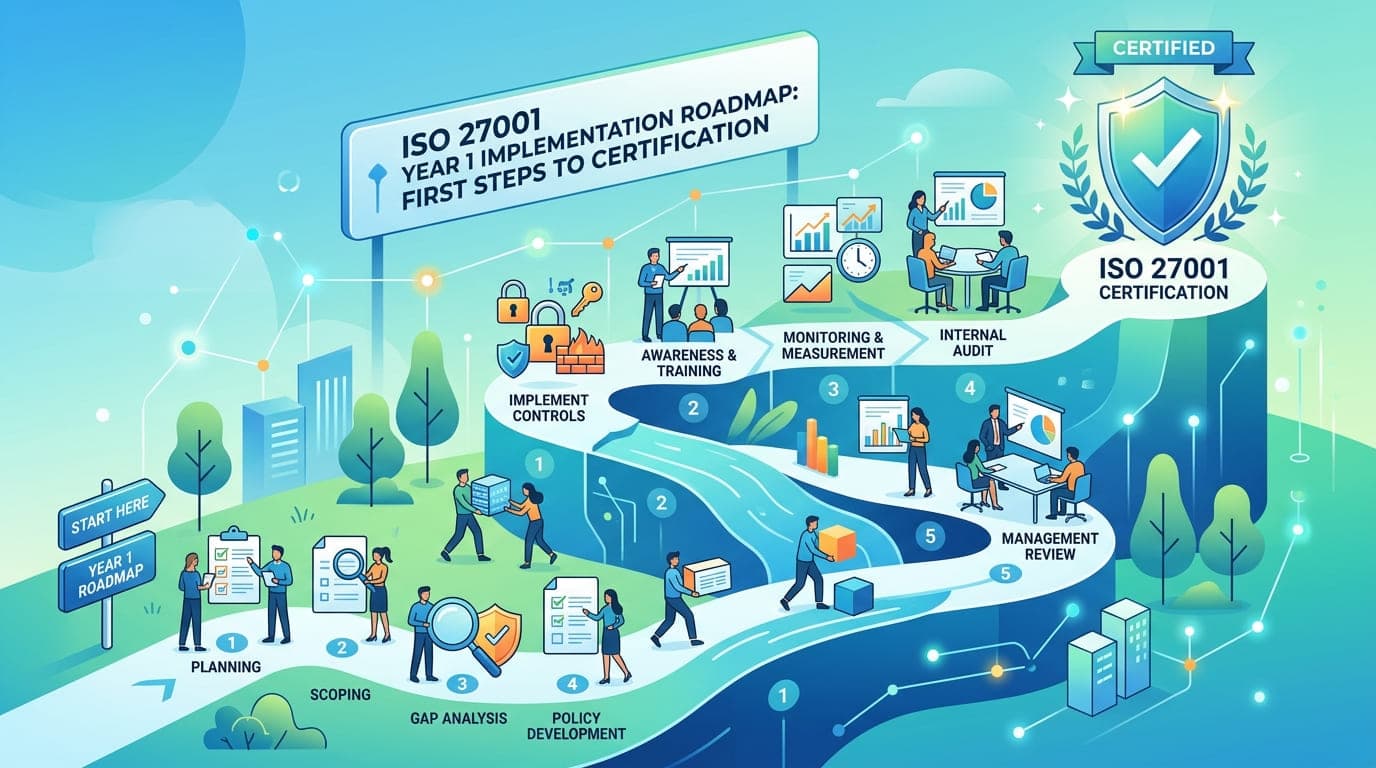
Here's the truth nobody tells you: you don't spend a year "implementing ISO 27001." You spend about 3-4 months building the foundation, 2-3 months refining and documenting, and 2-3 months preparing for and completing your certification audit.
Let me break down what actually happens in each phase:
Phase | Timeline | Focus Area | Key Deliverables |
|---|---|---|---|
Phase 1: Foundation | Months 1-2 | Understanding and Planning | Gap analysis, scope definition, resource allocation |
Phase 2: Framework Build | Months 3-5 | Core Implementation | ISMS documentation, policy creation, control deployment |
Phase 3: Operationalization | Months 6-8 | Making It Real | Risk assessments, evidence collection, internal testing |
Phase 4: Audit Prep | Months 9-10 | Refinement | Internal audits, management review, remediation |
Phase 5: Certification | Months 11-12 | External Validation | Stage 1 audit, Stage 2 audit, certification decision |
I've seen companies try to compress this. It never ends well. The organizations that succeed give themselves 12-15 months and use any extra time to strengthen their program before the audit.
Month 1-2: Building Your Foundation (The Make-or-Break Phase)
This is where most implementations succeed or fail. Not during the audit—during month one.
Week 1-2: Securing Leadership Buy-In
I cannot stress this enough: if you don't have genuine executive sponsorship, stop right now. I've watched three implementations collapse because leadership thought ISO 27001 was "an IT project" that could happen in the background.
Here's what I do in week one with every client:
Executive Workshop (Half Day)
I bring together the CEO, CFO, CTO, and key department heads. We discuss:
What ISO 27001 actually requires (not what they think it requires)
Real resource commitments needed (people, time, money)
Business benefits beyond the certificate
Risks of half-hearted implementation
I remember one CEO interrupting me 20 minutes into this presentation: "Wait, you're telling me our head of HR needs to be involved?"
"Absolutely," I said. "ISO 27001 covers everything from employment agreements to exit procedures. If HR isn't engaged, you'll fail the audit."
That CEO almost cancelled the project. Instead, he doubled down, assigned a full-time project manager, and gave every department head quarterly objectives tied to ISO implementation. That company certified in 11 months with zero non-conformities.
"ISO 27001 isn't an IT project that other departments support. It's a business transformation project that IT helps implement."
Week 3-4: Defining Your Scope
Here's a mistake I see constantly: companies try to certify everything on day one. Their scope statement reads like "all information systems and processes across all locations supporting all business functions."
That's a recipe for disaster.
I worked with a software company that had offices in four countries, 300 employees, and 15 distinct product lines. They initially wanted to certify everything. We sat down with their leadership team and asked tough questions:
"Which products generate revenue?" "Which systems actually handle sensitive customer data?" "Which locations have critical operations?"
We narrowed their scope to their core SaaS platform, the engineering and operations teams that supported it, and two primary locations. They certified in 10 months. Two years later, after building maturity and confidence, they expanded the scope to include additional products and locations.
Smart Scope Definition:
Consider | Don't Include Yet |
|---|---|
Core revenue-generating products/services | Experimental or beta products |
Systems processing sensitive customer data | Internal-only systems with no external access |
Primary business locations | Remote office locations with <5 employees |
Critical business processes | Supporting functions that can be added later |
Key customer-facing teams | Back-office functions that don't touch customer data |
Week 4: Conducting Your Gap Analysis
This is where reality hits. You need to understand how far you are from ISO 27001 compliance.
I use a structured approach across all 93 controls (in Annex A). For each control, I assess:
Current state (not implemented / partially implemented / fully implemented)
Evidence available (none / insufficient / adequate)
Effort required (low / medium / high)
Business priority (critical / important / nice-to-have)
Here's what a typical gap analysis reveals for a mid-stage tech company:
Control Status | Typical Percentage | What This Means |
|---|---|---|
Fully Implemented | 15-25% | You have some foundation to build on |
Partially Implemented | 30-40% | Lots of good practices that need formalization |
Not Implemented | 35-45% | Significant work ahead, but this is normal |
Not Applicable | 5-10% | Some controls genuinely don't apply to your scope |
One company I worked with was devastated when their gap analysis showed only 18% of controls fully implemented. Their CTO felt like they'd been lying to customers about their security.
"You haven't been lying," I told him. "You have good security practices. You just haven't formalized them into a management system. That's what we're building."
Eighteen months later, they were certified and using their ISO 27001 program as a competitive differentiator.
Month 3-5: Building Your ISMS (Where the Real Work Happens)
The Information Security Management System (ISMS) is the heart of ISO 27001. It's not just documentation—it's the entire framework for how you manage information security.
Month 3: Creating Your Core Documentation
You need several foundational documents. Here's what I prioritize:
Critical Documents (Create in This Order):
Document | Purpose | Typical Length | Effort Required |
|---|---|---|---|
Information Security Policy | High-level commitment and direction | 2-4 pages | 1-2 weeks |
Scope Statement | What's covered by your ISMS | 1-2 pages | 1 week |
Risk Assessment Methodology | How you identify and evaluate risks | 3-5 pages | 2-3 weeks |
Statement of Applicability (SOA) | Which controls apply and why | 10-15 pages | 2-3 weeks |
Risk Treatment Plan | How you're addressing identified risks | Varies | 2-4 weeks |
I learned something critical about documentation early in my career: nobody reads 50-page policies. I worked with one company that had a 73-page Information Security Policy. Nobody had read past page 12. Nobody could find anything in it. It was useless.
Now I push clients toward concise, practical documents. Your Information Security Policy should fit on 2-3 pages and actually communicate:
Management's commitment to information security
High-level security objectives
Key roles and responsibilities
How the ISMS integrates with business operations
I have a test: give your policy to a new employee. If they can read and understand it in 10 minutes, it's good. If they get confused or bored, rewrite it.
Month 4-5: Implementing Priority Controls
You can't implement 93 controls overnight. You need to prioritize based on risk and audit requirements.
Here's the prioritization framework I use:
Tier 1 Controls (Implement First - Months 3-4):
Access control (A.9)
Cryptography (A.10)
Physical and environmental security (A.11)
Operations security (A.12)
Communications security (A.13)
These are table stakes. Auditors will scrutinize them heavily, and they address the most common threat vectors.
Tier 2 Controls (Implement Next - Months 5-6):
Human resource security (A.7)
Asset management (A.8)
System acquisition, development and maintenance (A.14)
Supplier relationships (A.15)
Tier 3 Controls (Implement Last - Months 7-8):
Information security policies (A.5)
Organization of information security (A.6)
Incident management (A.16)
Business continuity (A.17)
Compliance (A.18)
I worked with a healthcare technology company that flipped this priority. They spent months 3-4 perfecting their policy documents and governance structure. When they got to month 6 and started working on access controls, they discovered massive gaps that required architectural changes.
They had to pause implementation for two months while they rebuilt core infrastructure. Had they started with technical controls, they would have discovered these issues in month 3 and had time to address them properly.
"Implement the hard stuff first. Policies are easy to write but meaningless if they don't reflect actual security controls in production."
Month 6-8: Making It Real (The Operationalization Phase)
This is where theory becomes practice. You have documentation and controls—now you need to prove they actually work.
Month 6: Your First Real Risk Assessment
ISO 27001 requires risk-based thinking. You need to identify risks to your information assets and show how your controls mitigate them.
I use a practical approach:
Step 1: Identify Information Assets
Create an asset inventory. I mean everything:
Customer databases
Application source code
Employee records
Financial systems
Development environments
Backup systems
Third-party services
One company I worked with identified 247 information assets. We prioritized the top 50 based on business criticality and sensitivity.
Step 2: Identify Threats and Vulnerabilities
For each asset, consider:
External threats (hackers, malware, DDoS)
Internal threats (malicious insiders, negligence)
Environmental threats (fire, flood, power outage)
Technical vulnerabilities (unpatched systems, misconfigurations)
Step 3: Assess Risk
I use a simple matrix:
Risk Level | Likelihood + Impact | Action Required |
|---|---|---|
Critical | Very High + High Impact | Immediate treatment required, executive attention |
High | High Likelihood or High Impact | Formal treatment plan, quarterly review |
Medium | Moderate + Moderate | Standard controls, annual review |
Low | Low + Low | Accept or monitor, no immediate action |
Step 4: Define Treatment
For each significant risk, you decide:
Mitigate: Implement controls to reduce likelihood or impact
Transfer: Use insurance or outsourcing
Accept: Document why the risk is acceptable
Avoid: Stop the activity creating the risk
Here's a real example from a fintech client:
Risk: Unauthorized access to customer financial data through compromised employee credentials
Assessment: High Likelihood (credential attacks are common) + Critical Impact (regulatory penalties, customer loss) = CRITICAL RISK
Treatment Plan:
Implement MFA for all systems with customer data access (Mitigate)
Deploy privileged access management solution (Mitigate)
Implement continuous monitoring and behavioral analytics (Mitigate)
Increase cyber insurance coverage (Transfer)
Quarterly access reviews and certifications (Mitigate)
They spent $120,000 implementing these controls. Six months after certification, their behavioral analytics detected a compromised account within 4 minutes. The controls they'd implemented for ISO 27001 prevented what could have been a catastrophic breach.
Month 7-8: Evidence Collection and Documentation
This is the most tedious part of ISO 27001, but it's critical. Auditors don't trust what you tell them—they verify what you can prove.
You need evidence for every control. Here's what that looks like:
Access Control Evidence Examples:
Control | Evidence Types | Collection Frequency |
|---|---|---|
User access provisioning | Access request tickets, approval emails, system logs | Monthly snapshots |
Access reviews | Quarterly review reports, manager sign-offs, remediation records | Quarterly |
Password policy enforcement | System configuration screenshots, audit logs, policy documents | Annual + on change |
Privileged account management | PAM system reports, session recordings, approval workflows | Monthly |
Terminated user access removal | HR termination notices, system deprovisioning logs, final access audit | Per incident |
I learned about evidence the hard way. Early in my career, I was helping a company prepare for their Stage 2 audit. The auditor asked for evidence of quarterly access reviews. The CISO said, "Oh, we do those religiously!"
"Great," said the auditor. "Show me the last four quarters."
The CISO couldn't produce them. They'd done the reviews—they just hadn't documented them. The auditor had no choice but to mark it as a non-conformity.
Now I tell every client: If it's not documented, it didn't happen. I don't care how religious you are about security practices—if you can't prove it to an auditor, it doesn't count.
Month 9-10: Internal Audits and Management Review (The Dress Rehearsal)
This is your safety net. Internal audits catch problems before external auditors do.
Month 9: Conducting Internal Audits
ISO 27001 requires an internal audit program. This isn't optional, and it's not a checkbox exercise.
I structure internal audits like this:
Week 1-2: Audit Planning
Select audit team (must be independent from audited areas)
Define audit scope and objectives
Create audit schedule
Prepare audit checklists
Week 3-4: Conducting Audits
Interview process owners
Review documentation
Examine evidence
Test control effectiveness
Week 5-6: Reporting and Follow-Up
Document findings
Classify issues (observation / minor non-conformity / major non-conformity)
Develop corrective action plans
Track remediation
I worked with a company that discovered 23 issues during their internal audit. The CEO was panicking: "We're going to fail the certification audit!"
"No," I said. "This is exactly what's supposed to happen. We found these issues with time to fix them. That's the whole point."
They spent month 10 addressing every finding. When their external audit came, the auditor found only two minor observations. They certified with flying colors.
"The quality of your internal audit determines the outcome of your external audit. Find your problems before the auditor does."
Month 10: Management Review
ISO 27001 requires top management to review the ISMS performance. This isn't a formality—it's a strategic checkpoint.
Your management review should cover:
Review Element | What to Present | Why It Matters |
|---|---|---|
Audit Results | Internal and external audit findings | Shows commitment to improvement |
Security Incidents | Number, severity, response times | Demonstrates monitoring effectiveness |
Performance Metrics | KPIs against defined objectives | Proves you're measuring what matters |
Stakeholder Feedback | Customer, employee, partner input | Shows external perspective |
Risk Assessment Updates | New risks, changed risk ratings | Keeps risk treatment current |
Improvement Opportunities | Lessons learned, optimization ideas | Drives continuous improvement |
I remember a management review where the CISO presented 14 PowerPoint slides of dense technical details. Eyes glazed over. The CEO checked his phone.
I stopped the presentation. "Let me try something different."
I put up one slide with three numbers:
100%: Percentage of critical systems now using MFA
0: Number of successful unauthorized access attempts this quarter
$2.3M: Value of enterprise deals requiring ISO 27001 that we can now pursue
The CEO looked up. "Now you have my attention."
Make your management review matter. Show business impact, not just technical compliance.
Month 11-12: The Certification Audit (The Main Event)
You've built your ISMS. You've tested it internally. Now comes external validation.
Understanding the Two-Stage Audit Process
ISO 27001 certification involves two distinct audits:
Stage 1 Audit (Document Review)
This is a readiness assessment. The auditor reviews:
Your ISMS documentation
Scope and boundaries
Risk assessment methodology
Statement of Applicability
Key policies and procedures
They're checking if your system is designed correctly, not whether it works yet.
Typical Duration: 1-2 days for companies under 200 employees
I always tell clients: Stage 1 is your friend. The auditor isn't trying to find major problems—they're helping you avoid them in Stage 2. I've had auditors point out documentation gaps or unclear procedures during Stage 1, giving us 4-6 weeks to fix them before the real audit.
Stage 2 Audit (Implementation Review)
This is the comprehensive audit. The auditor:
Interviews staff across departments
Reviews evidence of control implementation
Tests control effectiveness
Validates that practice matches documentation
Assesses management system maturity
Typical Duration: 2-5 days depending on company size and scope
This is where everything comes together. The auditor will pick random samples and drill deep.
I was in a Stage 2 audit when the auditor asked a junior developer: "When you commit code, what happens?"
The developer explained the entire process: code review requirements, automated security scanning, approval workflow, deployment controls. It matched perfectly with their documented change management procedure.
The auditor smiled. "Thank you. That's exactly what I needed to hear."
That company certified because their procedures weren't just documents—they were how people actually worked.
Common Audit Findings (And How to Prevent Them)
In my experience, 80% of audit findings fall into predictable categories:
Common Finding | Why It Happens | How to Prevent |
|---|---|---|
Incomplete risk assessment | Rushed the process, missed assets or threats | Start risk assessment in Month 6, review quarterly |
Missing evidence | Good practices but poor documentation habits | Implement evidence collection early, make it routine |
Inconsistent policy application | Different teams interpret procedures differently | Clear communication, training, regular internal audits |
Insufficient management review | Treated as checkbox, not strategic activity | Engage leadership from day one, make reviews meaningful |
Incomplete vendor assessments | Forgot about third-party services | Create comprehensive vendor inventory in Month 3 |
Access control gaps | Focus on employee access, miss service accounts | Include all access types in access reviews |
I once had a client receive a major non-conformity because they couldn't demonstrate that terminated employees had their access removed. They did remove access—they just didn't document it.
We implemented a simple process: HR sends termination notice to IT, IT documents deprovisioning in a tracking spreadsheet, quarterly audits verify completeness. Problem solved.
The Investment: What ISO 27001 Actually Costs
Let's talk money. Every CEO asks me: "What's this going to cost?"
Here's the honest breakdown for a typical mid-sized technology company (50-200 employees):
Cost Category | Estimated Range | Notes |
|---|---|---|
Consultant Support | $40,000 - $120,000 | Depends on maturity and internal capability |
Certification Body Fees | $15,000 - $35,000 | Varies by scope and company size |
Internal Labor | $80,000 - $200,000 | Staff time across multiple departments |
Technology Controls | $20,000 - $150,000 | Depends on existing infrastructure |
Training and Awareness | $5,000 - $20,000 | Staff education and certification |
Documentation and Tools | $3,000 - $10,000 | GRC platforms, templates, resources |
Total First Year | $163,000 - $535,000 | Wide range based on starting point |
That seems like a lot. But let me put it in perspective:
I worked with a SaaS company that spent $220,000 on their ISO 27001 implementation. Three months after certification, they closed a $4.7M enterprise deal that explicitly required ISO 27001. The client's procurement team told them: "You were our preferred vendor technically, but we couldn't move forward without the certification."
ROI: 2,140% in the first year.
Another company spent $180,000 implementing ISO 27001. Six months later, they suffered a security incident that could have been catastrophic. The controls they'd implemented for ISO 27001 contained the incident within 20 minutes and prevented any data loss.
Their cyber insurance company estimated they avoided $3-5M in direct costs and probably double that in indirect costs (customer churn, reputation damage, lost deals).
"ISO 27001 is expensive until you price the alternatives: losing deals you can't close, paying ransoms you could have prevented, or explaining breaches you could have stopped."
Beyond Certification: Making ISO 27001 Sustainable
Here's what nobody tells you: getting certified is actually the easy part. Maintaining certification is where most organizations struggle.
I've seen companies lose their certification during surveillance audits (typically 6-9 months after initial certification) because they treated ISO 27001 as a project instead of a program.
The Three Pillars of Sustainable ISO 27001
1. Integrated Processes
ISO 27001 can't be something extra that people do on top of their real work. It has to become how they actually work.
One client integrated ISO 27001 controls into their existing workflows:
Security reviews became part of their sprint planning (not a separate process)
Access reviews happened during quarterly business reviews (not isolated security events)
Risk assessments tied to project kickoffs (not annual exercises)
Two years later, their team doesn't even think about "doing ISO 27001 stuff"—they just work according to processes that happen to be ISO 27001 compliant.
2. Clear Ownership and Accountability
Every control needs an owner. Every process needs someone responsible.
I use a simple RACI matrix:
Control Area | Responsible | Accountable | Consulted | Informed |
|---|---|---|---|---|
Access Management | IT Operations | CISO | HR, Department Heads | All Staff |
Vendor Security | Procurement | CFO | CISO, Legal | Department Heads |
Incident Response | Security Team | CISO | IT, Legal, PR | Executive Team |
Business Continuity | IT Infrastructure | CTO | All Departments | All Staff |
3. Continuous Improvement Culture
ISO 27001 requires continuous improvement. That means:
Tracking metrics that matter
Learning from incidents and near-misses
Updating controls based on new threats
Optimizing processes based on feedback
One client implemented a simple practice: every quarter, each department proposes one improvement to their security processes. These don't have to be massive changes—small optimizations compound over time.
Over two years, they've implemented 31 improvements that collectively saved over 200 hours per month in manual work while improving security.
Your Month-by-Month Action Plan
Let me give you a practical checklist you can actually use:
Months 1-2: Foundation
[ ] Secure executive sponsorship and budget
[ ] Assign project team and ISMS owner
[ ] Define certification scope
[ ] Select certification body
[ ] Conduct gap analysis
[ ] Develop project plan and timeline
[ ] Engage consultant (if needed)
Months 3-5: Build
[ ] Create ISMS documentation (policies, procedures)
[ ] Implement Tier 1 controls (access, crypto, physical, operations, communications)
[ ] Develop Statement of Applicability
[ ] Begin evidence collection processes
[ ] Launch security awareness training
[ ] Implement Tier 2 controls (HR, assets, development, suppliers)
Months 6-8: Operationalize
[ ] Conduct comprehensive risk assessment
[ ] Create risk treatment plan
[ ] Implement Tier 3 controls (policies, organization, incident, continuity, compliance)
[ ] Establish ongoing evidence collection
[ ] Test incident response procedures
[ ] Validate control effectiveness
Months 9-10: Prepare
[ ] Conduct internal audits
[ ] Address internal audit findings
[ ] Complete management review
[ ] Finalize all documentation
[ ] Train staff on audit procedures
[ ] Conduct mock audit (optional but recommended)
Months 11-12: Certify
[ ] Schedule and complete Stage 1 audit
[ ] Address Stage 1 findings
[ ] Complete Stage 2 audit preparation
[ ] Conduct Stage 2 audit
[ ] Address any non-conformities
[ ] Receive certification decision
[ ] Celebrate and plan for maintenance!
The Mistakes That Will Cost You Months
Let me save you some pain by sharing the mistakes I've seen organizations make:
Mistake #1: Starting Without Executive Buy-In One company spent 4 months implementing ISO 27001 before their CFO asked, "How much is this costing?" When they told him, he killed the project. Four months wasted.
Mistake #2: Choosing the Wrong Scope A software company initially scoped all 23 of their products. They got overwhelmed and stalled at month 5. We rescoped to their top 3 revenue-generating products and certified 8 months later.
Mistake #3: Treating It as an IT Project ISO 27001 requires involvement from HR, Legal, Facilities, Operations, Finance—not just IT. Organizations that silo it in the IT department fail.
Mistake #4: Copying Templates Without Customization I've seen companies download ISO 27001 policy templates and change nothing but the company name. Auditors spot this instantly. Your documentation must reflect your actual organization and practices.
Mistake #5: Neglecting Evidence Collection Start collecting evidence from day one. Don't wait until month 10 to realize you can't prove what you've been doing for the past 9 months.
"The organizations that succeed at ISO 27001 treat it as business transformation, not compliance theater. They build something real, not something that looks good on paper."
Final Thoughts: The Journey Worth Taking
I started this article with Marcus, the fintech CEO who had six months to get certified. Want to know how that story ended?
We made a deal. I told him, "We'll work toward your six-month deadline, but we're going to build this right. If we're not ready at month six, we delay the audit. No shortcuts."
We hit month six and realized we needed two more months. Marcus had a hard conversation with his prospect, explaining they'd be ready by month eight and here's why the extra time mattered.
The prospect respected the honesty. They gave him the extra time. He certified in month 8 with zero non-conformities.
Here's the kicker: that prospect became their biggest customer ($6.2M annual contract). Two years later, during a renewal negotiation, the prospect's CISO told Marcus: "Part of why we trust you is because you didn't cut corners on security to close our deal faster. That told us everything we needed to know."
That's what ISO 27001 done right looks like. It's not about the certificate on your wall. It's about building something that protects your customers, empowers your team, and grows your business.
The roadmap I've laid out here will get you there. It's based on a decade of implementation experience, 23 successful certifications, and more lessons learned than I care to count.
Will it be easy? No. Will it be worth it? Absolutely.
Now get started. Your future certified self will thank you.