"We ship code 47 times a day. How are we supposed to do ISO 27001?"
The CTO of a rapidly growing fintech startup asked me this question in 2020, frustration evident in his voice. His engineering team was practicing continuous deployment, moving fast, breaking things (intentionally), and generally operating in a way that seemed fundamentally incompatible with a formal security standard.
I smiled. I'd heard this concern at least a hundred times before.
"What if I told you," I replied, "that the most successful ISO 27001 implementations I've seen are at companies that ship even faster than you do?"
His skepticism was palpable. But eighteen months later, his company achieved ISO 27001 certification without slowing down their deployment velocity. In fact, their release cycle actually got faster—down to 63 deployments per day—because the framework forced them to automate away their manual security bottlenecks.
That's the paradox of ISO 27001 for technology companies. Done wrong, it feels like dragging an anchor. Done right, it's like adding a turbocharger to your development engine.
Why ISO 27001 Matters More for Tech Companies Than You Think
After fifteen years working with software companies—from scrappy startups to enterprise giants—I've learned something crucial: ISO 27001 isn't a burden for technology companies. It's a competitive weapon.
Here's why: your enterprise customers are drowning in vendor security questionnaires. Every procurement department has horror stories about supply chain breaches. When you hand them an ISO 27001 certificate, you're essentially saying: "An independent auditor has verified that we take security seriously. You can trust us."
I watched a SaaS company close a $3.2 million deal with a Fortune 100 company in record time—eight weeks instead of their usual six months—specifically because they had ISO 27001 certification. Their competitor, who had arguably better technology, got stuck in a nine-month security review process.
"In enterprise sales, ISO 27001 isn't just a certification. It's a shortcut to trust, and trust is the currency that matters most."
But here's the thing: generic ISO 27001 implementation guides are written for banks and insurance companies. They don't speak the language of software development. They don't understand continuous deployment, microservices, or infrastructure as code.
This article is different. I'm going to show you how to implement ISO 27001 in a way that actually works for modern software companies.
The Technology Company Challenge: Speed Meets Security
Let me paint a picture of the typical tech company I work with:
The Development Reality:
Multiple deployments per day
Microservices architecture across cloud providers
Distributed teams across time zones
Rapid experimentation and iteration
APIs connecting to dozens of third-party services
Infrastructure defined in code
Containers orchestrated at scale
The ISO 27001 Perception:
Change approval boards that meet weekly
Detailed documentation for every change
Formal separation of development and production
Lengthy testing cycles before release
Paper-based processes
Manual security reviews
See the disconnect?
The good news: ISO 27001 doesn't require any of that waterfall-era baggage. The standard is actually quite flexible. The problem is that most auditors and consultants learned security in the pre-cloud era and try to force modern tech companies into outdated practices.
Let me show you the right way.
Mapping ISO 27001 to Modern Software Development
Here's how the critical ISO 27001 controls actually map to modern development practices:
A.8: Asset Management for Software Companies
Traditional interpretation: "Maintain a spreadsheet of all IT assets."
Modern tech reality: You have thousands of ephemeral containers, auto-scaling infrastructure, and microservices that spin up and down constantly.
The Smart Approach:
Traditional Method | Modern Tech Approach | Tools |
|---|---|---|
Manual asset inventory | Infrastructure as Code | Terraform, CloudFormation |
Quarterly asset reviews | Continuous discovery | AWS Config, Azure Resource Graph |
Spreadsheet tracking | Service mesh visibility | Istio, Linkerd, Consul |
Static documentation | Dynamic asset tagging | Cloud provider tagging |
Annual classification reviews | Automated data classification | Macie, Cloud DLP, Microsoft Purview |
I implemented this approach with a cloud-native startup in 2021. Instead of maintaining spreadsheets, we used their Infrastructure as Code repositories as the single source of truth. Every resource was tagged automatically at creation. Their compliance dashboard pulled live data from their cloud provider APIs.
The auditor initially pushed back. "Where's your asset register?" she asked.
I pulled up a dashboard showing real-time visibility into every resource across three cloud providers, automatically classified by data sensitivity, business criticality, and owner. "This is our asset register," I said. "And unlike a spreadsheet, it's never out of date."
She approved it. And that tech company became her reference example for other modern clients.
A.12: Operations Security in a DevOps World
Traditional interpretation: "Separate development, testing, and production environments with formal change control."
Modern tech reality: Developers deploy directly to production after automated testing. Changes happen continuously.
The Smart Approach:
ISO 27001 Requirement | Traditional Approach | DevOps Approach |
|---|---|---|
Change management | Weekly CAB meetings | Automated CI/CD pipelines |
Change approval | Manager sign-off | Automated gates + peer review |
Testing before production | Manual QA cycles | Automated testing in pipeline |
Production monitoring | Weekly reports | Real-time observability |
Rollback procedures | Manual restoration | Automated rollback + feature flags |
Separation of duties | Separate teams | Code review + automated controls |
Here's a real example from a company I advised in 2022:
Their previous consultant told them they needed a Change Advisory Board that met twice weekly to review and approve changes before production. For a team deploying 40+ times per day, this was absurd.
Instead, we implemented:
Automated gates: Security scanning, dependency checking, and policy validation in the CI/CD pipeline
Peer review requirements: No code reaches production without approval from two other developers
Progressive rollout: Canary deployments with automatic rollback on error rate increases
Comprehensive logging: Every change tracked automatically with deployment metadata
Real-time alerting: Anomaly detection flagging suspicious deployments immediately
The result? More control, better security, and 10x faster deployment velocity.
The auditor loved it because we could demonstrate:
Every change was reviewed (by automation and humans)
Every deployment was logged and traceable
Failed deployments were automatically rolled back
Security policies were consistently enforced
Separation of duties was maintained (developers couldn't approve their own code)
"Modern software development isn't less secure than waterfall—it's more secure. You just need to implement controls that match your reality, not controls from 1995."
A.14: System Acquisition, Development and Maintenance
This is where ISO 27001 gets really interesting for software companies. The standard requires secure development practices, but it doesn't prescribe how to achieve them.
Core Requirements Translated for Modern Development:
ISO Control | What It Actually Means | How To Implement |
|---|---|---|
A.14.1: Security in development | Security requirements defined | Threat modeling + security user stories |
A.14.2: Secure development procedures | Consistent secure coding | SAST/DAST in pipeline + coding standards |
A.14.3: Test data protection | Production data not in development | Synthetic data generation + data masking |
Let me share a story about a healthcare tech company I worked with in 2023.
They were building a patient management system and needed ISO 27001 for their enterprise hospital clients. Their challenge: they were moving fast, building an MVP, and had a small team of eight engineers.
We integrated security into their development lifecycle without adding bureaucracy:
Security Requirements Phase:
Instead of: 50-page security requirements document
We did: Lightweight threat modeling sessions (2 hours per major feature)
Output: Security user stories added directly to their sprint backlog
Development Phase:
Instead of: Manual code reviews for security issues
We did: Automated SAST scanning in GitHub Actions
Result: Security issues caught in minutes, not days
Testing Phase:
Instead of: Manual penetration testing before each release
We did: Automated DAST scanning + quarterly penetration testing
Result: Continuous security validation without deployment delays
Deployment Phase:
Instead of: Security sign-off meetings before production
We did: Automated security gates in CI/CD pipeline
Result: Deployments blocked automatically if security issues detected
The outcome? They achieved ISO 27001 certification in 11 months without hiring additional security staff or slowing down development.
The Software Development-Specific Controls You Can't Ignore
Based on my experience auditing and implementing ISO 27001 at dozens of tech companies, here are the controls that consistently trip up software developers:
1. Source Code Management (A.12.1.2 - Change Management)
What auditors want to see:
Version control for all code
Access controls on repositories
Code review evidence
Audit trails of changes
Common mistakes I see:
Developers with admin rights to all repositories
No branch protection rules
Code merged without review
Secrets committed to version control
What actually works:
Control Area | Implementation | Tool Examples |
|---|---|---|
Access control | Role-based repository permissions | GitHub Teams, GitLab Groups |
Branch protection | Required reviews + status checks | Branch protection rules |
Secret management | Secrets never in code | AWS Secrets Manager, HashiCorp Vault |
Audit logging | All repo activities logged | Git audit logs, GitHub Enterprise audit |
Code signing | Signed commits required | GPG signing, sigstore |
I worked with a fintech company where developers had been committing AWS credentials directly to their repository for years. When we discovered this during the gap analysis, the CTO went pale.
We implemented automated secret scanning that blocked any commit containing credentials. Within three months, we'd rotated over 200 exposed secrets and eliminated the practice entirely. The auditor specifically called this out as an exemplary control.
2. Production Access Controls (A.9.2 - User Access Management)
This is where technology companies often struggle. Your developers need to debug production issues, but ISO 27001 requires strict access controls.
The wrong approach: Ban developers from production entirely (then watch them find workarounds).
The right approach: Implement just-in-time access with comprehensive logging.
Here's a framework that's passed audit at every company I've implemented it:
Access Type | Control Mechanism | Approval Required | Duration | Logging |
|---|---|---|---|---|
Emergency access | Break-glass accounts | Post-access review | 1 hour | All actions logged + reviewed |
Scheduled maintenance | Temporary elevation | Manager approval | 4 hours | Full session recording |
Read-only access | Standard for senior engineers | Automatic | Permanent | Query logging |
Administrative access | Service accounts only | Automated approval | N/A | All changes logged |
A SaaS company I advised implemented temporary elevated access using AWS SSM Session Manager with automatic expiration. When a developer needed production access, they:
Requested access through Slack bot
Specified reason and duration (max 2 hours)
Received temporary credentials automatically
All actions logged to centralized SIEM
Access automatically revoked after time limit
Weekly review of all production access
The result? Developers could still debug production issues quickly, but every action was traceable. The auditor loved it because it demonstrated both operational necessity and security control.
3. Third-Party Code Management (A.14.2.8 - System Security Testing)
Modern software is mostly other people's code. Your application might have 500+ dependencies, each with their own dependencies.
What auditors want to see:
Inventory of third-party components
Vulnerability management for dependencies
Policy for dependency approval and updates
Reality check: Manual tracking is impossible. Automation is essential.
Practical Implementation:
Challenge | Solution | Tools |
|---|---|---|
Dependency discovery | Automated SBOM generation | Syft, Trivy, Dependency-Track |
Vulnerability scanning | Continuous dependency scanning | Snyk, Dependabot, WhiteSource |
License compliance | Automated license checking | FOSSA, Black Duck |
Update management | Automated PR for updates | Renovate, Dependabot |
Policy enforcement | Dependency approval workflows | Custom CI/CD gates |
I implemented this at a company that had over 800 npm packages and 400+ Python dependencies across their microservices. Manual tracking was impossible.
We set up automated scanning that:
Generated a Software Bill of Materials (SBOM) for each service
Scanned for vulnerabilities daily
Automatically created pull requests for security updates
Blocked deployments if critical vulnerabilities detected
Maintained a dashboard of all dependencies
The auditor's comment: "This is more thorough than 90% of the implementations I see, including at much larger companies."
Cloud Security: Where Traditional ISO 27001 Guidance Fails
Here's where I see technology companies struggle most: implementing ISO 27001 controls in cloud environments.
Traditional ISO 27001 resources were written for on-premises data centers. They talk about physical access controls, network perimeters, and hardware security. None of that translates directly to AWS, Azure, or GCP.
Cloud Control Mapping for ISO 27001
ISO 27001 Control | Traditional Approach | Cloud-Native Approach |
|---|---|---|
A.11 Physical security | Badge readers, security guards | Inherit from cloud provider + verify SOC 2 |
A.13 Network security | Firewalls, network segmentation | Security groups, VPCs, service mesh |
A.9 Access control | Active Directory, VPN | IAM, SSO, zero-trust architecture |
A.12.3 Backup | Tape backup, off-site storage | Automated snapshots, cross-region replication |
A.18.1.3 Records | On-premises log servers | CloudWatch, CloudTrail, centralized logging |
Let me tell you about a cloud-native company I worked with in 2021. They had zero on-premises infrastructure—everything ran in AWS across three regions.
Their previous auditor wanted them to document physical security controls for their "data center." They tried to explain they didn't have a data center. The auditor insisted they needed to implement physical controls.
We switched auditors to someone who understood cloud computing.
For physical security, we documented:
AWS SOC 2 Type II report (demonstrating AWS physical controls)
AWS ISO 27001 certificate (showing AWS compliance)
Shared responsibility model (clarifying what AWS controls vs. what we control)
Our controls for logical access (IAM, MFA, access logging)
The new auditor understood that in the cloud, physical security is inherited from your provider. Your responsibility is logical access control, which we demonstrated thoroughly through IAM policies, CloudTrail logging, and AWS Config rules.
Pro tip: Use the shared responsibility model to your advantage. Don't try to audit AWS's physical data centers. Focus on the controls you actually manage.
Continuous Compliance: The Only Way That Works for Tech Companies
Here's a dirty secret about ISO 27001: most companies only comply during the two weeks before their audit.
I've seen it countless times. Teams scramble to update documentation, run security scans they've been postponing, and desperately try to demonstrate twelve months of evidence they don't actually have.
This doesn't work for technology companies that operate in continuous deployment mode.
The Continuous Compliance Framework
Compliance Activity | Traditional (Fails) | Continuous (Works) |
|---|---|---|
Security scanning | Pre-audit panic scan | Every commit scanned |
Access reviews | Annual spreadsheet exercise | Automated quarterly reviews |
Policy updates | Updated before audit | Version controlled, regularly reviewed |
Training | Annual compliance training | Ongoing security education |
Evidence collection | Manual document gathering | Automated audit trail |
Risk assessment | Annual workshop | Quarterly threat modeling |
I implemented continuous compliance at a fintech company in 2022. Here's what we built:
Automated Evidence Collection:
CI/CD pipeline automatically logged all deployments with security scan results
Access review system generated quarterly reports of who had access to what
Training platform tracked completion and automatically assigned refresher courses
SIEM collected and retained all required logs automatically
Continuous Monitoring:
Real-time dashboard showing compliance status
Automated alerts when controls drifted from baseline
Weekly compliance reports to leadership
Monthly security metrics review
The result? When audit time came, we generated 90% of required evidence with a single script. The audit that typically takes 4-6 weeks took 10 days. The auditor commented that it was the smoothest audit he'd conducted all year.
"Continuous compliance isn't about doing more work—it's about doing the right work automatically so you're always audit-ready."
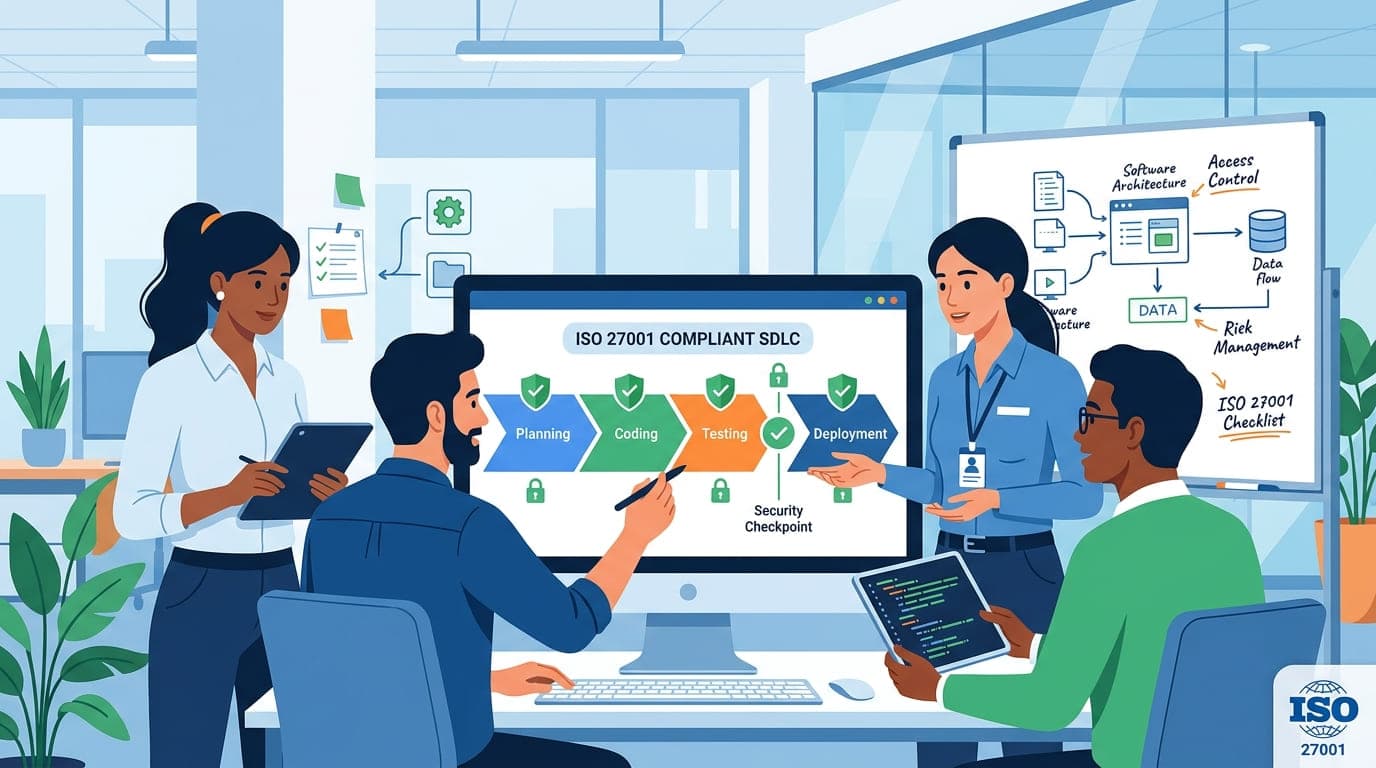
DevSecOps: The Secret to ISO 27001 Success
The companies that implement ISO 27001 most successfully are those that embrace DevSecOps—integrating security into every stage of development and operations.
The DevSecOps Pipeline for ISO 27001 Compliance
┌─────────────────────────────────────────────────────────────────┐
│                     SECURE DEVELOPMENT PIPELINE                  │
├─────────────────────────────────────────────────────────────────┤
│                                                                   │
│  Code → Secret Scan → SAST → Dependency Check → Unit Tests →    │
│  → Container Scan → DAST → Deploy to Staging →                  │
│  → Integration Tests → Security Tests → Deploy to Production    │
│                                                                   │
│  ▼ All steps automated    ▼ Security gates enforced             │
│  ▼ Every failure logged   ▼ Every deploy traceable              │
└─────────────────────────────────────────────────────────────────┘
Real Implementation Example:
Pipeline Stage | Security Control | ISO 27001 Requirement | Tool Example |
|---|---|---|---|
Pre-commit | Secret scanning | A.9.4.3 Password management | git-secrets, TruffleHog |
Commit | Static analysis | A.14.2.1 Secure development | SonarQube, Checkmarx |
Build | Dependency scanning | A.14.2.8 System security testing | Snyk, OWASP Dependency-Check |
Package | Container scanning | A.14.2.8 System security testing | Trivy, Clair |
Deploy to staging | Dynamic analysis | A.14.2.8 System security testing | OWASP ZAP, Burp Suite |
Pre-production | Integration testing | A.14.2.8 System security testing | Custom security tests |
Production | Runtime protection | A.12.6 Technical vulnerability | Falco, AWS GuardDuty |
A company I worked with in 2023 implemented this full pipeline. Here's what happened:
Before DevSecOps:
Security testing happened manually before releases
Security team was bottleneck (5-day delay average)
Issues found late were expensive to fix
Deployment happened weekly due to security reviews
After DevSecOps:
Security testing automated in every commit
Security issues caught within minutes
Developers fixed issues immediately (cheaper and easier)
Deployment velocity increased to multiple times daily
The compliance impact:
A.14.2.1 (Secure development policy): Enforced automatically
A.14.2.5 (Secure system engineering): Built into pipeline
A.14.2.8 (System security testing): Executed on every build
A.12.6 (Vulnerability management): Continuous scanning
The auditor's response? "This is the future of compliance. Every company should do this."
Common Pitfalls and How to Avoid Them
After helping 50+ technology companies through ISO 27001 certification, I've seen the same mistakes repeatedly. Here are the big ones:
Pitfall #1: Over-Documentation
The mistake: Creating massive policy documents that nobody reads or follows.
The reality: ISO 27001 requires documented procedures, but it doesn't specify how long or detailed they must be.
What works:
Traditional Approach | Modern Tech Approach |
|---|---|
200-page security policy manual | One-page policy + detailed runbooks in wiki |
Quarterly policy review meetings | Policies in Git with PR-based reviews |
Separate documents for each process | Single source of truth in Confluence/Notion |
PDF documents emailed around | Living documentation auto-generated from code |
I worked with a startup whose previous consultant had them create 47 separate policy documents. Nobody could find anything. Policies were out of date the day they were written.
We consolidated to:
12-page Information Security Policy (high-level)
Technical implementation in their wiki (detailed, searchable)
Runbooks stored with the code they described
Policies version-controlled in Git
Result: Documentation people actually used, always up to date, easy to maintain.
Pitfall #2: Treating Security as Separate from Development
The mistake: Having a separate security team that "does security" while developers "do development."
The reality: In modern tech companies, developers ARE your security team. They make security decisions with every line of code.
What works:
Doesn't Work | Does Work |
|---|---|
Security team as gatekeeper | Security team as enablers |
Security review before deployment | Security built into pipeline |
Security training once per year | Security champions in each team |
Security tools developers don't use | Security tools integrated into workflow |
A company I advised had a security team of three people trying to review every change from 40 developers. The security team was drowning, and developers were frustrated by delays.
We shifted the model:
Trained developers in security best practices
Designated security champions in each squad
Automated 95% of security checks
Security team focused on architecture review and tooling
Outcome: Faster releases, better security, happier teams.
Pitfall #3: Ignoring API Security
The mistake: Focusing on application security while APIs remain the weakest link.
The reality: Your application is probably an API. Everything connects to everything else.
Critical API Security Controls for ISO 27001:
API Security Aspect | ISO Control | Implementation |
|---|---|---|
Authentication | A.9.4 System and application access | OAuth 2.0, API keys with rotation |
Authorization | A.9.2.3 Management of privileged access | Scope-based permissions, RBAC |
Rate limiting | A.12.1.4 Separation of development | API gateway with rate limits |
Input validation | A.14.2.1 Secure development policy | Schema validation, sanitization |
Logging | A.12.4.1 Event logging | All API calls logged with context |
Encryption | A.10.1 Cryptographic controls | TLS 1.3, encrypted data in transit |
I discovered a critical gap at a company in 2022: they had excellent security for their web application but had completely overlooked their API security. Their APIs had:
No rate limiting (vulnerable to DoS)
Inconsistent authentication
Minimal logging
No input validation
We implemented comprehensive API security:
API gateway with centralized authentication
Automated schema validation
Rate limiting per client
Comprehensive API logging
Regular API security testing
The auditor specifically asked about API security (they usually do for tech companies). We demonstrated controls that exceeded requirements.
Measuring Success: Metrics That Actually Matter
ISO 27001 requires you to measure security program effectiveness (A.18.2.3). Here are the metrics that actually work for technology companies:
Development Security Metrics
Metric | Target | Why It Matters |
|---|---|---|
Time to detect vulnerabilities | <1 hour (automated scanning) | Faster detection = cheaper fixes |
Time to remediate critical issues | <24 hours | Reduces exposure window |
% of deployments blocked by security | <5% | Too high = process problem |
Security issues found in production | <2 per quarter | Catch issues earlier |
% code coverage for security tests | >80% | Comprehensive testing |
Mean time to deploy security patches | <48 hours | Faster patching reduces risk |
Operational Security Metrics
Metric | Target | Why It Matters |
|---|---|---|
% of systems with latest patches | >95% | Unpatched systems = easy targets |
Failed login attempts (anomalous) | <10 per day | Indicates attack attempts |
Time to detect security incidents | <15 minutes | Faster detection = less damage |
Time to contain security incidents | <1 hour | Faster containment = less damage |
% of workforce completed security training | 100% annually | Security is everyone's job |
Security incidents caused by human error | Decreasing trend | Training effectiveness |
A company I worked with implemented these metrics and discovered that their mean time to remediate critical vulnerabilities was 18 days. Leadership was shocked—they assumed it was much faster.
We set a target of 48 hours and implemented:
Automated vulnerability detection
Slack alerts for critical issues
Dedicated security on-call rotation
Automated patch deployment where possible
Within six months, MTTR dropped to 36 hours. The security posture improved dramatically, and they had concrete metrics to show the auditor.
The Real Cost and Timeline for Tech Companies
Let's get practical. What does ISO 27001 actually cost for a technology company, and how long does it take?
Cost Breakdown (Based on Company Size)
Cost Component | Startup (10-50 people) | Growth Stage (51-200) | Enterprise (200+) |
|---|---|---|---|
Gap assessment | $5,000 - $15,000 | $15,000 - $30,000 | $30,000 - $60,000 |
Consultant/implementation | $30,000 - $80,000 | $80,000 - $150,000 | $150,000 - $300,000 |
Tooling (annual) | $10,000 - $30,000 | $30,000 - $80,000 | $80,000 - $200,000 |
Certification audit | $15,000 - $25,000 | $25,000 - $40,000 | $40,000 - $80,000 |
Annual surveillance | $8,000 - $12,000 | $12,000 - $20,000 | $20,000 - $40,000 |
Total first year | $68,000 - $162,000 | $162,000 - $320,000 | $320,000 - $680,000 |
Ongoing annual | $18,000 - $42,000 | $42,000 - $100,000 | $100,000 - $240,000 |
Realistic Timeline
Phase | Duration | Key Activities |
|---|---|---|
Gap assessment | 2-4 weeks | Current state analysis, scope definition |
Planning | 2-4 weeks | Resource allocation, roadmap creation |
Implementation | 6-12 months | Control implementation, documentation |
Pre-audit preparation | 4-6 weeks | Evidence collection, internal audit |
Certification audit | 2-3 weeks | Stage 1 and Stage 2 audits |
Remediation (if needed) | 2-4 weeks | Addressing non-conformities |
Total timeline | 8-15 months | From start to certification |
Real example: A 75-person SaaS company I worked with:
Budget: $180,000 (consultant, tools, audit)
Timeline: 11 months from kickoff to certification
Internal effort: 0.5 FTE security lead + 0.2 FTE from each team
Outcome: Certified on first attempt, closed 3 major deals within 6 months
Their CEO told me the ROI was achieved in the first enterprise deal alone.
Your Implementation Roadmap
Based on my experience, here's the roadmap that works for technology companies:
Phase 1: Foundation (Months 1-2)
Week 1-2: Discovery
Conduct gap assessment
Define scope (which systems, which locations)
Identify applicable controls
Assess current maturity
Week 3-4: Planning
Assign roles and responsibilities
Create implementation roadmap
Allocate budget and resources
Select auditor
Week 5-8: Quick Wins
Implement basic hygiene (MFA, password policies)
Set up centralized logging
Document existing processes
Establish security awareness program
Phase 2: Core Implementation (Months 3-8)
Security Controls:
Implement access control framework
Deploy security monitoring tools
Establish vulnerability management
Create incident response procedures
Development Security:
Integrate security into CI/CD
Implement SAST/DAST scanning
Set up dependency management
Create secure coding standards
Documentation:
Write policies and procedures
Document system architecture
Create process flowcharts
Maintain evidence repository
Phase 3: Testing and Refinement (Months 9-10)
Internal Assessment:
Conduct internal audit
Test incident response procedures
Review all documentation
Verify control effectiveness
Gap Remediation:
Address internal audit findings
Update documentation
Strengthen weak controls
Prepare evidence
Phase 4: Certification (Months 11-12)
Stage 1 Audit:
Documentation review
Scope confirmation
Address any document issues
Stage 2 Audit:
On-site/remote assessment
Control testing
Evidence review
Management interview
Certification:
Address minor findings
Receive certificate
Celebrate success!
Real Talk: Is It Worth It?
I'm going to be brutally honest with you. ISO 27001 is expensive, time-consuming, and sometimes frustrating.
So why do I recommend it to almost every B2B technology company?
Because the alternatives are worse.
Option 1: Don't pursue any formal compliance.
Result: Locked out of enterprise deals, higher insurance costs, constant customer questionnaires
Option 2: Do security ad-hoc without a framework.
Result: Inconsistent practices, gaps in coverage, no way to demonstrate compliance
Option 3: Build a custom security program from scratch.
Result: More work, no industry recognition, still need to explain everything to customers
Option 4: Implement ISO 27001.
Result: Industry-recognized certification, comprehensive security program, faster enterprise sales
The math works out. Every technology company I've worked with has achieved positive ROI from their ISO 27001 certification within 12-24 months.
Final Thoughts: Making ISO 27001 Work for You
Let me leave you with the most important lesson I've learned in fifteen years:
ISO 27001 is a framework, not a straitjacket.
The standard tells you WHAT to do, not HOW to do it. You can implement ISO 27001 in a way that accelerates your development velocity, strengthens your security posture, and supports your business objectives.
The key is to:
Automate everything possible
Integrate security into development workflows
Use modern tools and practices
Focus on outcomes, not checkbox compliance
Treat it as continuous improvement, not a one-time project
I opened this article with a CTO who was skeptical about ISO 27001 compatibility with rapid deployment. Eighteen months later, his company was deploying faster than ever, had achieved certification, and had closed multiple enterprise deals that would have been impossible without it.
His parting words to me: "I thought ISO 27001 would slow us down. Instead, it made us faster, more secure, and more successful. Best investment we made."
"ISO 27001 done right doesn't slow down technology companies—it gives them the structure to move faster with confidence."
That's the opportunity in front of you. The question isn't whether you can afford to implement ISO 27001. It's whether you can afford not to.
Ready to start your ISO 27001 journey? At PentesterWorld, we provide detailed implementation guides, templates, and real-world examples specifically for technology companies. Subscribe to our newsletter for weekly insights on securing modern software development.
Next in this series: "ISO 27001 Cloud Security: Extending Controls to Cloud Environments" - Learn how to implement ISO 27001 controls in AWS, Azure, and GCP.