I still remember my first ISO 27001 audit like it was yesterday. I was 28, overconfident, and convinced our organization was ready. We had implemented every control, documented everything, and our internal audits had gone smoothly.
Then the auditor asked his third question, and I watched our CEO's face turn pale.
"Can you show me evidence of management review from the last three months?"
We had management reviews. We just hadn't... documented them properly. That one gap cascaded into twelve findings, delayed our certification by four months, and cost us a $380,000 contract we'd been counting on.
That painful lesson fifteen years ago taught me something invaluable: preparing for an ISO 27001 audit isn't about having good security—it's about proving you have good security, consistently, with evidence an auditor can verify.
After guiding over 40 organizations through successful ISO 27001 certifications, I've learned that the difference between a smooth audit and a nightmare isn't usually your security posture—it's your preparation.
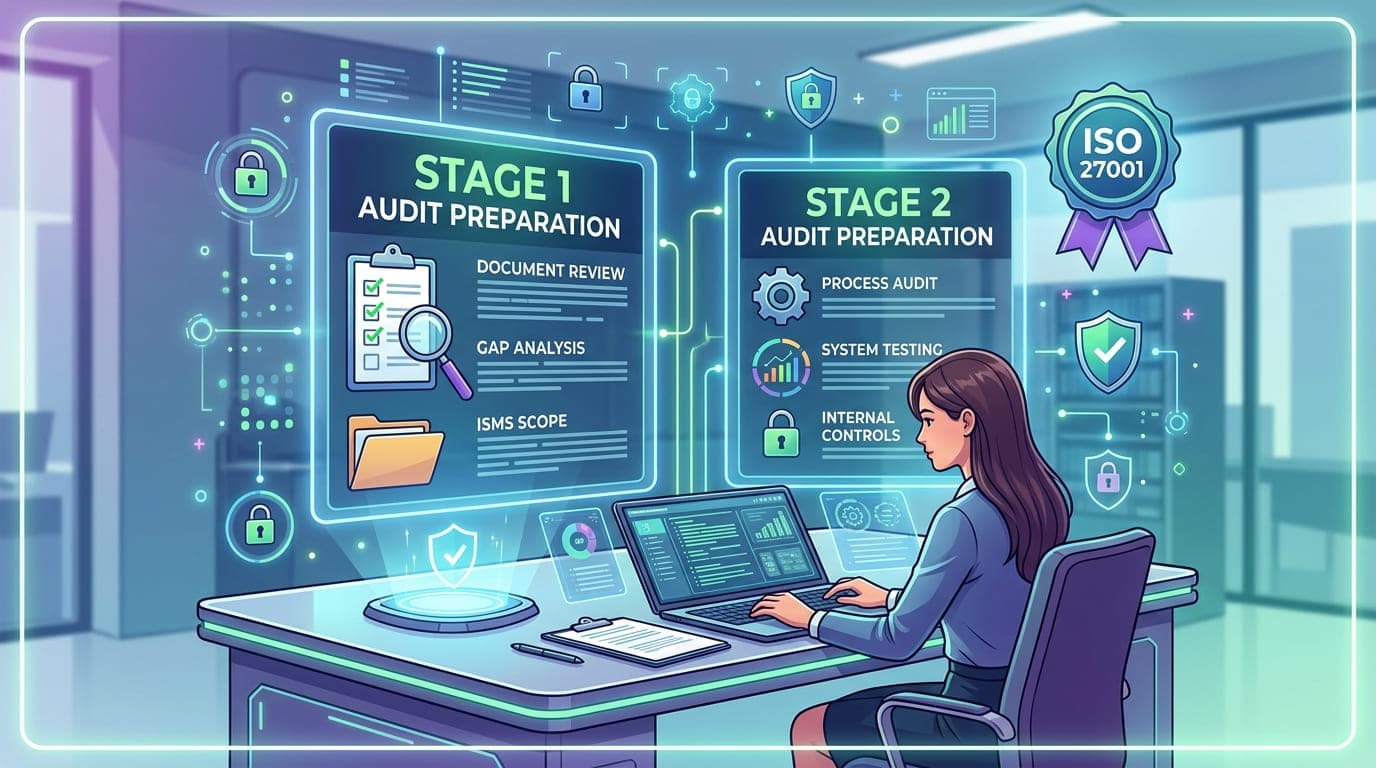
Understanding the Two-Stage Audit Process (And Why It Matters)
Let me start with something that trips up first-timers: ISO 27001 certification isn't a single audit. It's a two-stage process, and each stage has a completely different purpose.
Think of Stage 1 as a reconnaissance mission and Stage 2 as the actual battle.
Stage 1: The Documentation Review
Stage 1 is all about your Information Security Management System (ISMS) documentation. The auditor wants to verify that:
You've documented a complete ISMS
Your documentation aligns with ISO 27001 requirements
You understand what you've built
You're ready for Stage 2
Here's what most people miss: Stage 1 isn't about implementation—it's about documentation readiness.
I worked with a healthcare company in 2021 that had phenomenal security practices. Their access controls were tight. Their monitoring was sophisticated. Their incident response was battle-tested.
They failed Stage 1.
Why? Because they couldn't produce documented evidence of their risk assessment methodology. They did risk assessments—they just hadn't formally documented the process. The auditor couldn't verify compliance without documentation.
"In ISO 27001 audits, if it's not documented, it doesn't exist. No exceptions."
Stage 2: The Implementation Audit
Stage 2 is where the auditor verifies that you're actually doing what your documentation says you're doing. They'll:
Interview employees across the organization
Test your controls in action
Review evidence of ongoing compliance
Verify that your ISMS is operating effectively
This is where I've seen confident organizations crumble. Their documentation was perfect, but their implementation was inconsistent.
The Timeline Reality Check
Here's a table that shows what actually happens during each stage, based on my experience with dozens of audits:
Audit Stage | Duration | Auditor Focus | Your Preparation Time | Common Pitfalls |
|---|---|---|---|---|
Stage 1 | 1-2 days | Documentation completeness, ISMS scope, risk assessment methodology | 3-6 months before audit | Incomplete documentation, unclear scope, inadequate risk assessment |
Gap Period | 1-6 months | N/A - Organization fixes Stage 1 findings | Varies based on findings | Underestimating remediation time, poor tracking of corrective actions |
Stage 2 | 2-5 days | Control implementation, evidence collection, employee interviews | 2-3 months before audit | Inconsistent practices, missing evidence, untrained staff |
Surveillance | 1-2 days annually | Ongoing compliance, management review, continuous improvement | Ongoing | Letting practices slip, poor change documentation |
The gap period between Stage 1 and Stage 2 is critical. I've seen organizations race through it in 30 days and regret it. I've also seen organizations take nine months and lose momentum.
The sweet spot? 90-120 days between Stage 1 and Stage 2, assuming you had minimal findings.
Stage 1 Preparation: The Documentation Sprint
Let me walk you through exactly what you need to prepare for Stage 1, based on what I've learned from 15+ years of doing this.
Month 1-2: Core Documentation Development
Your Stage 1 preparation should start at least 3-4 months before the audit. Here's your critical documentation checklist:
Document | Why It Matters | Common Mistakes | Time to Develop |
|---|---|---|---|
ISMS Scope | Defines what's covered by your certification | Too broad (can't implement), too narrow (doesn't cover business) | 2-3 weeks |
Information Security Policy | Top-level commitment from management | Generic templates, no customization, missing executive approval | 1-2 weeks |
Risk Assessment Methodology | How you identify and evaluate risks | No clear criteria, inconsistent approach, missing asset inventory | 3-4 weeks |
Risk Treatment Plan | How you address identified risks | Vague actions, no ownership, unrealistic timelines | 2-3 weeks |
Statement of Applicability (SoA) | Which controls apply and why | Copy-paste from standard, poor justification for exclusions | 3-4 weeks |
Asset Inventory | What information assets you're protecting | Incomplete list, missing classifications, no ownership | 2-4 weeks |
Risk Register | Documented risks and treatments | Theoretical risks, missing impact analysis, no residual risk | 3-4 weeks |
I learned the hard way that you can't rush the Statement of Applicability (SoA). In 2019, I helped a fintech company prepare for their audit. They waited until two weeks before Stage 1 to complete their SoA.
The result? A hastily prepared document that excluded critical controls without proper justification. The auditor spent 90 minutes grilling them on why they excluded network monitoring controls when they clearly had network infrastructure to protect.
We had to reschedule Stage 1, properly justify every exclusion, and add $40,000 in unexpected consulting costs.
The ISMS Scope: Get This Wrong and Everything Fails
Let me share a war story about scope.
In 2020, I consulted for a software company pursuing ISO 27001. They defined their scope as "all information systems and data."
Sounds comprehensive, right? Wrong.
During Stage 1, the auditor asked about their HR system. "Is that in scope?"
"Uh... we didn't think about that."
"What about your financial systems?"
"Those are handled by corporate IT..."
"But the data flows into your systems, correct?"
You can see where this went. Their scope was simultaneously too broad (they couldn't possibly implement all controls across everything) and too specific (they'd excluded critical dependencies).
Here's my hard-won advice on defining scope:
Good Scope Definition:
"All systems, processes, and data related to the development, delivery, and support of [Product Name] SaaS platform, including customer data processing, application infrastructure, and corporate systems that support platform operations."
Bad Scope Definition:
"The company's information security"
"All IT systems"
"Cloud infrastructure"
The difference? Specificity, boundaries, and clear inclusion/exclusion criteria.
The Risk Assessment: Where Most Organizations Stumble
Here's something nobody tells you: your risk assessment methodology matters more than your actual risks.
I've seen auditors accept risk assessments with surprisingly low-severity risks, as long as the methodology was sound, consistent, and properly documented.
I've also seen auditors reject risk assessments with legitimate high-severity risks because the methodology was unclear or inconsistently applied.
A manufacturing company I worked with in 2022 had an elaborate risk assessment with 247 identified risks. Impressive, right?
The auditor asked: "How did you calculate the risk severity for item 47?"
The security manager pulled up their spreadsheet. The formula was: (Likelihood × Impact) + Business_Criticality - Existing_Controls
The auditor then asked about item 89. Different formula: Likelihood × (Impact + Compliance_Requirement)
Finding: "Inconsistent risk assessment methodology."
We spent six weeks standardizing their entire risk assessment process before they could proceed to Stage 2.
"Your risk methodology doesn't need to be perfect. It needs to be documented, justifiable, and consistently applied. Pick one approach and stick with it religiously."
Here's a risk assessment framework that's passed every audit I've used it in:
Risk Component | Scale | Definition | Example |
|---|---|---|---|
Likelihood | 1-5 | How probable is this risk? | 1=Rare, 3=Possible, 5=Almost Certain |
Impact | 1-5 | What's the business consequence? | 1=Negligible, 3=Moderate, 5=Catastrophic |
Risk Score | 1-25 | Likelihood × Impact | Score 15-25 = Critical, 10-14 = High, 5-9 = Medium, 1-4 = Low |
Risk Appetite | Threshold | What level is acceptable? | Our organization: Scores >10 require treatment |
Residual Risk | 1-25 | Risk after controls applied | Must be below risk appetite threshold |
Month 3-4: Internal Readiness Assessment
About 6-8 weeks before Stage 1, you need to test your own readiness. Here's my battle-tested preparation checklist:
The Documentation Completeness Test
I use this exact checklist with every client. Print it out, go through it line by line:
Critical Documents (Must Have):
[ ] ISMS Scope (approved by top management)
[ ] Information Security Policy (signed by CEO/Board)
[ ] Risk Assessment Methodology (documented process)
[ ] Asset Inventory (complete with classifications)
[ ] Risk Register (all identified risks with treatments)
[ ] Statement of Applicability (all 93 controls addressed)
[ ] Risk Treatment Plan (with owners and timelines)
[ ] Evidence of management review (at least one completed)
Supporting Documents (Should Have):
[ ] Access control policy and procedures
[ ] Incident response procedures
[ ] Business continuity plan
[ ] Backup and recovery procedures
[ ] Change management procedures
[ ] Vendor management procedures
[ ] Employee security training records
[ ] Internal audit reports
A financial services company I worked with in 2023 thought they were ready. We went through this checklist together, and they discovered they were missing documented procedures for 8 of their implemented controls.
The operations manager said, "But we do all of this! It's just not written down."
Exactly. And in an ISO 27001 audit, that means you don't do it.
We spent three weeks documenting their existing processes. The Stage 1 audit? Zero findings.
The Mock Stage 1 Audit
Here's something that's saved my clients countless times: conduct your own Stage 1 audit 4-6 weeks before the real one.
Get someone who wasn't involved in building your ISMS—maybe an external consultant, maybe someone from another department—and have them:
Review your ISMS scope for clarity and completeness
Verify your risk assessment follows your documented methodology
Check that your SoA addresses all 93 controls
Confirm all excluded controls have proper justification
Verify management review has occurred
Test that documentation is accessible and organized
I did this for a healthcare tech company in 2021. Our mock audit identified 11 documentation gaps. We fixed all of them in three weeks.
Their actual Stage 1 audit? Two minor observations, both cosmetic. The auditor actually complimented their preparation.
Stage 1 Day: What Actually Happens
Let me walk you through a typical Stage 1 audit day, based on what I've experienced dozens of times:
Hour 0-1: Opening Meeting
Auditor introduces themselves and explains the process
You present your organization and ISMS scope
Auditor asks clarifying questions about scope and operations
Pro tip: Have your ISMS scope on one slide. Clear, visual, specific. I've seen organizations fumble this 15-minute section and set a bad tone for the entire audit.
Hours 1-4: Documentation Review The auditor will methodically review:
Your ISMS policy
Risk assessment methodology and results
Statement of Applicability
Evidence that the ISMS is established
Here's what they're really looking for:
What Auditor Reviews | What They're Actually Checking | Red Flags That Cause Findings |
|---|---|---|
ISMS Scope | Is it clear and appropriate? | Vague boundaries, missing critical systems, scope that doesn't match operations |
Risk Assessment | Is the methodology sound and applied consistently? | Inconsistent risk scoring, missing assets, theoretical risks not tied to actual business |
Statement of Applicability | Are all controls addressed with proper justification? | Controls excluded without justification, copy-paste from standard, generic explanations |
Management Review | Has leadership actually reviewed the ISMS? | No evidence of review, generic minutes, no executive involvement |
Documentation | Is it complete, current, and accessible? | Version control issues, outdated documents, conflicting information |
Hours 4-6: Site Tour and Interviews The auditor wants to see your operations and verify that your documented ISMS reflects reality. They might:
Tour your data center or office
Interview key personnel
Verify that people know about the ISMS
Check that security controls are actually in place
Hour 6-7: Findings Discussion and Closing The auditor will:
Summarize their findings
Categorize them (minor non-conformities, observations, opportunities)
Discuss timeline for Stage 2
Answer your questions
The Finding Categories Explained
Understanding finding severity is critical:
Finding Type | What It Means | Impact on Certification | Example | Typical Resolution Time |
|---|---|---|---|---|
Major Non-Conformity | Complete absence of required element or systematic failure | Stage 2 cannot proceed until resolved | No risk assessment exists | 2-4 months |
Minor Non-Conformity | Isolated lapse in requirement | Stage 2 can proceed with remediation plan | One control in SoA lacks justification | 2-6 weeks |
Observation | Potential future issue or opportunity for improvement | No impact on progression | Risk assessment could be more detailed | Optional |
Opportunity for Improvement | Suggestion, not a requirement | No impact on progression | Consider additional metrics for management review | Optional |
I once worked with a company that got 3 major non-conformities in Stage 1. They had documentation, but it was so generic and disconnected from their actual operations that the auditor couldn't verify they had a functioning ISMS.
We had to spend four months rebuilding their documentation from scratch. They missed two major sales opportunities that required ISO 27001 certification.
Don't be that company.
Between Stage 1 and Stage 2: The Critical Gap Period
This is where I see organizations either set themselves up for success or sabotage their entire certification.
Addressing Stage 1 Findings
You need a systematic approach to remediation:
Document every finding - Create a tracking spreadsheet
Assign ownership - Specific people, not departments
Set realistic deadlines - Better to under-promise and over-deliver
Gather evidence - Document everything you do
Verify completion - Internal review before submitting to auditor
Submit for review - Give auditor time to review before Stage 2
Here's a remediation tracking template I use:
Finding ID | Finding Description | Root Cause | Corrective Action | Owner | Due Date | Status | Evidence Location |
|---|---|---|---|---|---|---|---|
S1-01 | Risk assessment missing 3 critical assets | Asset inventory incomplete | Complete full asset discovery, update risk assessment | CISO | 2024-02-15 | Closed | /Evidence/S1-01/ |
S1-02 | Management review minutes lack detail | Template too generic | Implement detailed review template | Security Mgr | 2024-02-10 | Closed | /Evidence/S1-02/ |
Preparing for Stage 2
While addressing findings, you should simultaneously prepare for Stage 2. Here's your 90-day preparation timeline:
Days 1-30: Remediation Focus
Address all Stage 1 findings
Submit evidence to auditor for verification
Begin Stage 2 evidence collection
Days 31-60: Evidence Collection
Gather proof of control implementation
Conduct employee training refreshers
Perform internal control testing
Days 61-90: Final Preparation
Mock Stage 2 interviews
Evidence organization and accessibility review
Staff readiness verification
"The organizations that ace Stage 2 are the ones that treat the gap period as preparation time, not vacation time."
Stage 2 Preparation: Proving Your Implementation
Stage 2 is completely different from Stage 1. The auditor isn't reading documentation—they're testing your controls in the real world.
The Evidence Collection Challenge
Here's something that causes massive stress: you need evidence that your controls have been operating for at least 3 months before Stage 2.
This catches people off-guard. You can't implement a control the week before the audit and claim it's operational.
I worked with a SaaS company in 2022 that implemented their access review process six weeks before their Stage 2 audit. When the auditor asked for evidence of quarterly access reviews, they had... one review.
"But we're doing it going forward!" they protested.
The auditor was sympathetic but firm: "I need evidence of consistent, ongoing implementation. One review doesn't demonstrate that."
Finding: "Insufficient evidence of access control implementation."
They had to delay certification by three months to gather evidence of consistent implementation.
The Evidence Matrix
Here's a framework for organizing evidence that's worked for every audit I've supported:
Control Category | Required Evidence | Format | Retention Period | Who Owns It |
|---|---|---|---|---|
Access Control | User access reviews, provisioning/deprovisioning records, privileged access logs | System reports, screenshots, approval emails | 12 months | IT Manager |
Change Management | Change requests, approvals, test results, rollback plans | Tickets, approval workflows, test reports | 12 months | DevOps Lead |
Incident Management | Incident tickets, response actions, root cause analysis, lessons learned | Ticketing system exports, post-incident reports | 24 months | Security Ops |
Business Continuity | BCP testing results, backup verification, recovery exercises | Test reports, backup logs, exercise documentation | 12 months | IT Manager |
Vendor Management | Vendor risk assessments, contract reviews, SLAs, security questionnaires | Assessment forms, contracts, correspondence | Duration of contract | Procurement |
Training | Training attendance, completion records, assessment results, awareness campaigns | LMS reports, sign-in sheets, quiz results | 3 years | HR/Security |
Vulnerability Management | Scan results, remediation tracking, patch management records | Scanner reports, tracking spreadsheets, patch logs | 12 months | Security Ops |
The Interview Preparation Nobody Talks About
Here's a truth bomb: Your employees will make or break your Stage 2 audit.
The auditor will interview people across your organization—not just your security team. They want to verify that:
People know the ISMS exists
They understand their security responsibilities
They follow documented procedures
Security is embedded in daily operations
A financial services company I consulted for in 2023 had perfect documentation. Their controls were solid. But they didn't prepare their staff for interviews.
The auditor interviewed a customer service representative and asked, "Are you aware of the company's information security policy?"
"Um... I think so? Is that the thing IT sent around last year?"
"Do you know where to find it?"
"Probably on the shared drive somewhere?"
"Have you received any security training?"
"We had that boring video we had to watch during onboarding..."
Three interviews like this, and the auditor started questioning whether the ISMS was actually integrated into operations.
The Interview Preparation Playbook
Here's what I do with every client 2-3 weeks before Stage 2:
1. Identify potential interview candidates Think about who the auditor might talk to:
Department heads
System administrators
Developers
Customer service
HR
Anyone with access to sensitive data
2. Conduct mock interviews Ask them questions the auditor might ask:
"What is ISO 27001 and why is the company pursuing it?"
"Where can you find the information security policy?"
"What do you do if you suspect a security incident?"
"Have you received security training? When?"
"How do you handle sensitive customer information?"
"What's your process for requesting system access?"
3. Create simple talking points I give employees a one-page reference sheet:
What is ISO 27001 (one sentence)
Why we're doing this (business benefit)
Key security policies relevant to their role
How to report security incidents
Where to find security documentation
4. Build confidence, not scripts You don't want people reciting rehearsed answers. You want them comfortable discussing their actual work practices in the context of security.
Stage 2 Day: The Main Event
Let me walk through what a typical Stage 2 audit looks like, based on dozens I've supported:
Day 1: Deep Dive Begins
Hour 0-1: Opening Meeting
Recap of Stage 1
Confirmation that findings were addressed
Stage 2 agenda and logistics
Questions and clarifications
Hours 1-8: Control Testing The auditor will systematically test controls. Here's a typical pattern:
Time Block | Focus Area | What Auditor Does | What You Need Ready |
|---|---|---|---|
Morning Block 1 | Access Controls | Tests user provisioning, reviews access logs, verifies MFA | Access review reports, provisioning tickets, authentication logs |
Late Morning | Risk Management | Validates risk assessment, checks treatment status | Risk register, treatment evidence, asset updates |
Lunch | Informal observations | May tour facilities, casual conversations | Be natural, don't be evasive |
Afternoon Block 1 | Technical Controls | Reviews vulnerability scans, patch management, monitoring | Scan reports, patch logs, SIEM screenshots |
Afternoon Block 2 | Employee Interviews | Talks to staff about practices and awareness | Prepared but not scripted employees |
Day 2-3: Continued Testing and Evidence Review
Morning: Operational Controls
Change management review
Incident response verification
Backup and recovery validation
Business continuity testing evidence
Afternoon: Compliance and Governance
Management review evidence
Internal audit results
Corrective action tracking
Policy compliance verification
End of Day: Daily Debrief Good auditors provide daily updates on progress and preliminary findings. This is your chance to:
Clarify any misunderstandings
Provide additional evidence if needed
Understand emerging issues
The Closing Meeting: Your Moment of Truth
The closing meeting is where the auditor presents final findings. Here's what to expect:
Positive Scenarios:
"No major non-conformities identified"
"Minor non-conformities that can be addressed within 90 days"
"Several opportunities for improvement noted"
Challenging Scenarios:
"Major non-conformity identified in [control area]"
"Systematic failure in [process]"
"Insufficient evidence of implementation"
Understanding Stage 2 Findings
Here's what different finding levels mean for your certification:
Finding Level | Certification Impact | Resolution Required | Timeline | Example from My Experience |
|---|---|---|---|---|
Zero Findings | Immediate recommendation for certification | None | 2-4 weeks for certificate issuance | Rare but achievable - I've seen it 3 times in 15 years |
Minor Non-Conformities Only | Certification recommended with 90-day corrective action | Submit corrective action plan and evidence | Certificate issued after evidence review | Most successful audits fall here - 70% of my clients |
One Major Non-Conformity | Certification delayed pending resolution | Full resolution with verified evidence | 3-6 months typical | Usually fixable - saw this with incomplete incident response evidence |
Multiple Major Non-Conformities | Certification denied, Stage 2 must be repeated | Systematic fixes required, possible re-audit | 6-12 months | Saw this with a company that faked their implementation |
The Real-World Preparation Timeline
Based on 15+ years of experience, here's the realistic timeline you should plan for:
Milestone | Timeline | Key Activities | Budget Range |
|---|---|---|---|
Initial Assessment | Month 0 | Gap analysis, scope definition, resource planning | $15,000 - $40,000 |
Documentation Phase | Months 1-4 | ISMS development, policy creation, risk assessment | $30,000 - $80,000 |
Implementation Phase | Months 4-8 | Control deployment, employee training, evidence collection | $40,000 - $120,000 |
Pre-Audit Preparation | Months 8-10 | Internal audits, mock assessments, remediation | $20,000 - $50,000 |
Stage 1 Audit | Month 10 | Documentation review, initial verification | $8,000 - $15,000 |
Gap Remediation | Months 10-12 | Address findings, collect additional evidence | $10,000 - $30,000 |
Stage 2 Audit | Month 12 | Implementation verification, control testing | $12,000 - $25,000 |
Total Program | 12-15 months | Complete certification journey | $135,000 - $360,000 |
These numbers are based on organizations with 50-200 employees. Smaller organizations can do it for less; larger ones should budget more.
The Mistakes That Cost Certifications
Let me share the top mistakes I've seen derail certification efforts:
Mistake #1: Treating It Like a Checklist
A tech startup I worked with in 2021 bought a compliance automation tool that promised "ISO 27001 in 90 days."
They imported templates, filled in some forms, and scheduled their Stage 1 audit.
The auditor asked them to explain their risk assessment methodology.
Silence.
They had completed the templates, but they didn't understand the underlying risk management principles. They couldn't explain why certain risks were rated the way they were, or how they'd chosen their treatment strategies.
Finding: "Risk assessment process not understood or properly implemented."
"ISO 27001 isn't a checkbox exercise. It's a management system. If you don't understand the 'why' behind each requirement, auditors will know immediately."
Mistake #2: Documentation That Doesn't Match Reality
I consulted for a manufacturing company that copied policies from a consulting firm template. Beautiful documents. Comprehensive procedures.
Completely disconnected from how they actually operated.
The auditor asked a developer: "Your change management procedure requires three levels of approval before production deployment. How does that work?"
Developer: "Three levels? We just push to production after the team lead reviews. We're agile."
When your documented procedures don't match your actual practices, you have two options:
Change your practices to match your documentation
Change your documentation to match your practices
What you can't do is pretend they match when they don't.
Mistake #3: Last-Minute Evidence Scrambling
The worst audit I ever witnessed involved a company that did everything right—except collect evidence.
They had great controls. Their security was solid. But they hadn't systematically collected evidence of implementation.
Two weeks before Stage 2, they realized they needed proof of:
Quarterly access reviews (they'd done them, just never documented)
Management reviews (happened in verbal meetings, no minutes)
Security training (conducted, but no attendance records)
Vulnerability remediation (patched, but didn't track closure)
We spent 80 hours reconstructing evidence from email threads, chat logs, and system logs. It was painful, expensive, and incomplete.
The audit? Delayed by three months while they implemented proper evidence collection.
The Success Formula
After shepherding over 40 organizations through successful ISO 27001 certification, here's the formula that works:
3-6 months before Stage 1:
Finalize your ISMS scope
Complete risk assessment with documented methodology
Develop all required policies and procedures
Create your Statement of Applicability
Conduct internal document review
6-8 weeks before Stage 1:
Mock Stage 1 audit
Address all gaps
Organize evidence systematically
Verify management review completion
Prepare presentation materials
1-2 weeks before Stage 1:
Final documentation review
Print/organize materials for auditor
Prep leadership for opening meeting
Confirm logistics
Between Stage 1 and Stage 2:
Address all findings within 30 days
Continue evidence collection
Conduct mock interviews
Perform internal control testing
Update documentation as needed
4-6 weeks before Stage 2:
Mock Stage 2 audit
Employee interview preparation
Evidence accessibility verification
Control testing validation
Final preparations
1-2 weeks before Stage 2:
Evidence organization and indexing
Staff briefings
Logistics confirmation
Final control verification
Your Day-Before Checklist
The day before your audit, print this checklist and verify everything:
Documentation:
[ ] Complete ISMS manual (current version)
[ ] All policies and procedures (approved, current)
[ ] Risk assessment and register (updated)
[ ] Statement of Applicability (complete)
[ ] Asset inventory (current)
[ ] Evidence folders organized and indexed
[ ] Management review minutes (recent)
[ ] Internal audit reports (completed)
Physical Preparation:
[ ] Conference room reserved
[ ] Network access for auditor (if needed)
[ ] Laptop/projector tested
[ ] Evidence access verified
[ ] Staff notified and prepared
[ ] Lunch arrangements made
[ ] Emergency contact list ready
People Readiness:
[ ] Key personnel briefed
[ ] Interview candidates prepared
[ ] Management availability confirmed
[ ] IT support on standby
[ ] Backup contacts identified
The Post-Audit Reality
Let's say your audit went well—minor findings, certification recommended. What happens next?
Weeks 1-2: Finding Resolution Submit your corrective action plan and evidence to the auditor for review.
Weeks 3-4: Technical Review The certification body reviews the audit report and your responses.
Weeks 4-6: Certification Decision The certification committee makes the final decision.
Weeks 6-8: Certificate Issuance You receive your official ISO 27001 certificate (valid for 3 years).
But here's what nobody tells you: getting certified is easier than staying certified.
You'll have surveillance audits every year. You'll need to maintain your controls, update your risk assessment, conduct management reviews, and continuously improve.
The organizations that succeed are the ones that treat ISO 27001 not as a project, but as a way of doing business.
Final Thoughts: The Audit Mindset
After 15+ years and dozens of audits, I've learned that the difference between a smooth certification and a painful one comes down to mindset.
Bad Mindset: "We need to pass this audit" "Let's show the auditor only what they ask for" "We'll fix things after we're certified"
Good Mindset: "We're building a sustainable security program" "Let's be transparent and learn from the process" "Certification is the beginning, not the end"
The companies I've worked with that approached audits as learning opportunities, rather than tests to game, universally had better experiences and better outcomes.
They asked auditors questions. They sought clarification on findings. They viewed observations as valuable improvement opportunities.
And you know what? They built better security programs.
"The audit isn't your enemy. It's a mirror that shows you where your security program actually stands versus where you think it stands. That reflection is invaluable."
Your Next Steps
If you're preparing for your ISO 27001 audit, here's what I recommend:
This Week:
Assess your current readiness using the checklists in this article
Identify your biggest gaps
Create a realistic timeline
Budget appropriately
This Month:
Finalize your ISMS scope
Begin or complete your risk assessment
Start documenting your controls
Consider engaging an experienced consultant
This Quarter:
Complete all required documentation
Implement missing controls
Begin evidence collection
Conduct internal assessments
Remember: the companies that succeed don't try to take shortcuts. They invest the time, resources, and effort required to build a genuine information security management system.
And when they walk into that audit room, they're not nervous—they're confident. Because they know they've built something real.
That's the feeling I want you to have when your auditor arrives.
Good luck. You've got this.
Need help preparing for your ISO 27001 audit? At PentesterWorld, we provide detailed guides, templates, and real-world advice for every stage of your certification journey. Subscribe for expert insights delivered to your inbox.