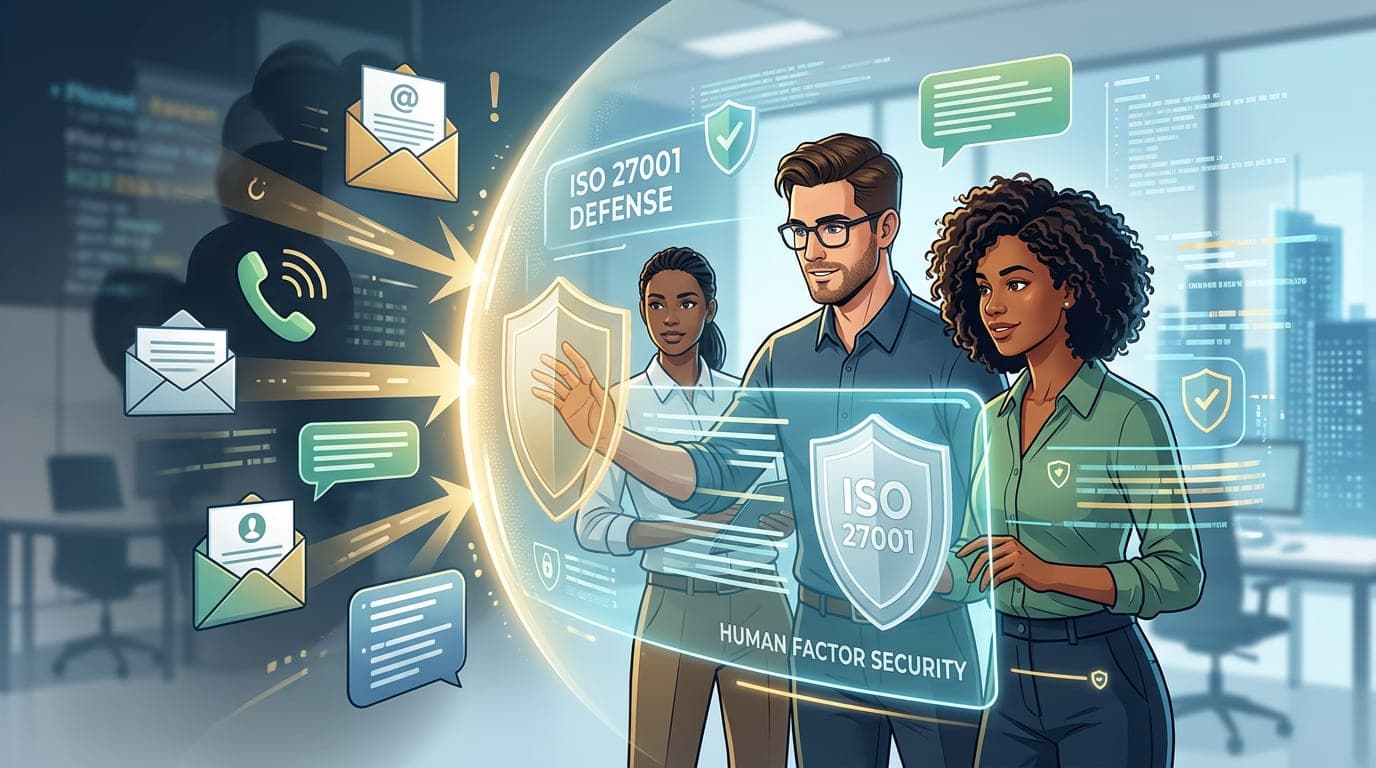
The email looked perfect. The CEO's signature, the company logo, even the writing style matched exactly. It landed in the Finance Director's inbox at 4:47 PM on a Friday—classic timing. "Urgent: Wire transfer needed for acquisition closing. Confidential. Please process immediately."
She almost clicked. Her mouse hovered over the link. Then she remembered our training from two weeks earlier: "When in doubt, pick up the phone."
One phone call saved that company $2.3 million.
After fifteen years of implementing ISO 27001 across dozens of organizations, I can tell you with absolute certainty: your most sophisticated firewall, your most expensive EDR solution, your entire security infrastructure—none of it matters if your people can be manipulated into bypassing it all.
And here's the uncomfortable truth: social engineering works. It works disturbingly well. I've watched seasoned IT professionals fall for phishing emails. I've seen security-conscious executives hand over credentials to attackers. I've witnessed entire organizations compromised because one person believed a convincing story.
Why ISO 27001 Gets the Human Factor Right
I remember reviewing a security program in 2019 that had invested over $4 million in technical controls. They had everything: next-gen firewalls, SIEM, DLP, EDR, the works. Their CISO showed me their security dashboard with pride.
Then I sent a test phishing email to 50 employees. Within four hours, 37 people had clicked the malicious link. Fourteen had entered their credentials. Three had downloaded and opened an attachment.
That CISO's face went pale. "How is this possible?" he asked. "We have all the right tools."
"You do," I replied. "But you don't have the right controls on your humans."
"The most vulnerable component in any security system sits between the keyboard and the chair. ISO 27001 recognizes this fundamental truth."
ISO 27001 doesn't just throw some security awareness training requirements into the mix and call it a day. It weaves human factor security throughout the entire framework, recognizing that people are both your greatest vulnerability and your strongest defense.
The Social Engineering Kill Chain: How Attackers Exploit Humans
Let me share what I've learned from studying hundreds of successful social engineering attacks—both in real incidents I've responded to and in penetration tests I've conducted.
The Anatomy of Social Engineering
Attack Phase | What Happens | Real Example from My Experience |
|---|---|---|
Research | Attacker gathers information about target | Found CEO's vacation photos on Facebook showing dates away; used this timing for CFO attack |
Pretext Development | Creates believable story/identity | Impersonated IT support using actual internal terminology scraped from company blog |
Initial Contact | Makes first approach to target | Called reception claiming to be from "corporate IT" doing "security audit" |
Building Trust | Establishes credibility through details | Referenced real projects, used real employee names, mimicked company communication style |
Exploitation | Gets target to take desired action | Convinced employee to install "remote support tool" (actually backdoor malware) |
Execution | Uses gained access for attack objectives | Used backdoor to deploy ransomware across network |
I watched this exact sequence unfold during an incident response engagement in 2021. The attacker spent three weeks researching the company before making first contact. By the time they called, they knew more about the organization's structure than some employees did.
ISO 27001 Controls That Address Human Vulnerabilities
Here's where ISO 27001 gets brilliant. Rather than treating human security as an afterthought, it integrates people-centric controls across multiple categories. Let me break down the key ones I've implemented countless times:
Control 6.3: Information Security Awareness, Education and Training
This isn't about boring PowerPoint presentations once a year. ISO 27001 demands:
Baseline Training Requirements:
Training Element | Frequency | ISO 27001 Alignment | My Recommended Enhancement |
|---|---|---|---|
Security awareness induction | Upon hiring | Control 6.3 | Add role-specific scenarios within first week |
Regular security updates | Ongoing | Control 6.3 | Monthly 5-minute security moments in team meetings |
Specialized training | Role-dependent | Control 6.3 | Quarterly deep-dives for high-risk roles |
Social engineering defense | Annual minimum | Control 6.3 | Quarterly with real attack simulations |
Incident reporting procedures | Upon change | Control 5.24 | Monthly refreshers through different channels |
Acceptable use reinforcement | Annual | Control 6.3 | Embedded in routine communications |
I learned the hard way that training frequency matters. A financial services client did annual training every December. In June, their click rate on phishing tests averaged 41%. Right after training? It dropped to 8%. By October? Back up to 38%.
We switched to quarterly training with monthly micro-learning. Their average click rate over the following year? 11%. The data doesn't lie.
Control 5.24: Information Security Incident Management Planning and Preparation
Here's something most organizations miss: the best time to teach someone how to report a social engineering attempt is before they encounter one.
I implemented a system at a healthcare organization where reporting suspected social engineering became:
Dead simple (one-click button in email client)
Immediate (security team notified in real-time)
Positive (reporters got thanked, not blamed)
Educational (they received immediate feedback)
Within six months, suspicious email reports increased 340%. But here's the kicker: actual successful phishing attempts dropped to near zero. Why? Because attackers couldn't complete their kill chain. Every attempt got reported and neutralized before the exploitation phase.
Control 5.16: Identity Management
Social engineering often targets the identity verification process. I've seen attackers:
Call help desk claiming to be locked out (password reset attack)
Email HR pretending to be new employee (credential creation attack)
Message IT claiming to be executive (privilege escalation attack)
ISO 27001's identity management controls force you to implement verification procedures that resist social engineering. Here's a comparison:
Verification Method | Social Engineering Resistance | ISO 27001 Compliance | Implementation Difficulty |
|---|---|---|---|
Security questions | Low - easily researched | Partial | Easy |
Email verification | Low - email may be compromised | Partial | Easy |
SMS verification | Medium - requires SIM swap | Yes | Medium |
In-person verification | High - requires physical presence | Yes | Hard |
Multi-channel verification | Very High - multiple attack vectors needed | Yes | Medium |
Cryptographic authentication | Very High - requires stolen device + knowledge | Yes | Hard |
I worked with a company that fell victim to a $1.2 million CEO fraud attack because their wire transfer process only required email approval. We implemented multi-channel verification (email + phone callback + SMS confirmation) aligned with ISO 27001. Cost to implement? About $3,000 in process changes and tools. Value? Priceless.
The Psychology Behind Why Social Engineering Works
Let me tell you about the most successful phishing campaign I ever witnessed—not as an attacker, but as someone studying why it worked so devastatingly well.
A retailer got hit during the holiday season. The email appeared to come from their scheduling system, saying "Your holiday shift schedule has changed—view details here." It hit inboxes at 6:02 AM on a Monday morning in November.
Click rate? 67%.
Why did it work?
The Six Principles of Influence (And How Attackers Exploit Them)
Influence Principle | How Attackers Use It | ISO 27001 Defensive Control | Real Example I've Seen |
|---|---|---|---|
Authority | Impersonate executives, IT staff, vendors | Control 5.16 - Identity verification | "CEO" email requesting urgent wire transfer |
Urgency | Create time pressure to bypass normal checks | Control 5.24 - Clear escalation procedures | "Your account will be suspended in 1 hour" |
Social Proof | "Others have already done this" | Control 6.3 - Training on manipulation tactics | "Your colleagues have already updated their information" |
Likability | Build rapport and trust | Control 5.16 - Verify identity regardless of relationship | Attacker spent weeks building relationship before exploitation |
Reciprocity | Offer something to create obligation | Control 6.3 - Awareness of manipulation | "I helped you, now I need this favor" |
Scarcity | Limited opportunity creates panic | Control 5.24 - Reporting procedures | "Only 3 spots remaining for mandatory training" |
I once watched an attacker spend six weeks building a relationship with an accounts payable clerk through LinkedIn. Casual messages, industry talk, nothing suspicious. On week seven, they messaged: "Hey, my company's payment portal is down. Can I send you invoice details via direct message for processing? Would really help me out."
She said yes. Why? Reciprocity. He'd been "helpful" for weeks, sharing industry insights and advice. When he needed a favor, she felt obligated.
That "favor" cost her company $340,000.
"Social engineers don't break into your systems. They're invited in. They don't crack passwords; they're given them. They don't exploit technical vulnerabilities; they exploit human nature."
Building an ISO 27001-Compliant Social Engineering Defense Program
Let me walk you through what actually works, based on implementing these programs dozens of times.
Phase 1: Assessment and Baseline (Weeks 1-4)
Step 1: Understand Your Current State
I always start with a realistic assessment. Here's the framework I use:
Assessment Area | What to Measure | ISO 27001 Reference | Baseline Target |
|---|---|---|---|
Phishing susceptibility | % clicking test emails | Control 6.3 | <15% click rate |
Credential entry | % entering credentials on fake sites | Control 6.3 | <5% submission rate |
Malicious attachment opening | % opening suspicious files | Control 6.3 | <3% open rate |
Social engineering reporting | % reporting suspicious contacts | Control 5.24 | >60% report rate |
Policy awareness | % correctly identifying security policies | Control 5.1 | >80% accuracy |
Incident response knowledge | % knowing who to contact | Control 5.24 | >90% awareness |
I ran this assessment at a manufacturing company in 2022. Initial results were sobering:
43% clicked phishing links
18% entered credentials
9% opened malicious attachments
12% reported suspicious emails
34% knew security policies
41% knew incident response contacts
The CEO wanted to fire people. I convinced him to train them instead.
Step 2: Identify High-Risk Roles
Not everyone in your organization faces equal social engineering risk. ISO 27001 recognizes this through role-based training requirements.
Role Category | Risk Level | Why They're Targeted | Required Training Frequency |
|---|---|---|---|
Executive Team | Critical | CEO fraud, business email compromise | Monthly |
Finance/Accounting | Critical | Wire fraud, invoice manipulation | Bi-weekly |
HR/Recruiting | High | Credential harvesting, data theft | Monthly |
IT/Help Desk | High | Privilege escalation, access bypass | Monthly |
Sales/Customer Service | High | Information disclosure, social proof building | Monthly |
General Staff | Medium | Entry point, lateral movement | Quarterly |
Contractors/Vendors | Medium | Trusted third-party exploitation | Upon engagement + quarterly |
I worked with a law firm where we focused 70% of our security training resources on partners and paralegals. Why? They had access to the most sensitive client information and were constantly being social engineered by opposing counsel, journalists, and threat actors.
Phase 2: Technical Controls Implementation (Weeks 5-12)
ISO 27001 requires technical controls that support human decision-making. Here's what I implement:
Email Security Enhancement Matrix:
Control Type | Technology Solution | ISO 27001 Control | Effectiveness Rate | Cost Range |
|---|---|---|---|---|
SPF/DKIM/DMARC | Email authentication protocols | Control 5.14 | 40% reduction | Free |
Advanced email filtering | Cloud email security gateway | Control 8.20 | 65% reduction | $5-15/user/year |
Link protection | URL rewriting and sandbox | Control 8.20 | 55% reduction | $3-8/user/year |
Attachment sandboxing | Detonation chamber for files | Control 8.20 | 70% reduction | $8-20/user/year |
Impersonation protection | Display name/domain verification | Control 8.20 | 80% reduction | $2-5/user/year |
Phishing reporting button | One-click suspicious email reporting | Control 5.24 | N/A - Detection tool | $1-3/user/year |
Here's a real example: A financial advisory firm implemented these controls in layers over three months. Their results:
Before Implementation:
1,200 phishing emails reached inboxes monthly
340 clicks on malicious links (28% click rate)
3-7 compromised accounts per month
Average incident response cost: $18,000 per month
After Implementation:
180 phishing emails reached inboxes monthly (85% blocked)
21 clicks on malicious links (12% click rate)
0-1 compromised accounts per month
Average incident response cost: $2,400 per month
Total investment: $14,000 for implementation + $8,000 annually Monthly savings: $15,600 ROI: Break-even in 0.9 months
Phase 3: Training Program Development (Weeks 13-20)
Here's where most organizations fail: they make training boring, irrelevant, or worse—both.
Effective Training Framework:
Training Component | Delivery Method | Duration | Frequency | ISO 27001 Alignment |
|---|---|---|---|---|
Security fundamentals | Interactive e-learning | 45 minutes | New hire + annual | Control 6.3 |
Social engineering tactics | Video scenarios + quiz | 20 minutes | Quarterly | Control 6.3 |
Phishing identification | Interactive simulations | 15 minutes | Monthly | Control 6.3 |
Reporting procedures | Hands-on walkthrough | 10 minutes | New hire + changes | Control 5.24 |
Role-specific threats | Live instructor-led | 60 minutes | Bi-annual | Control 6.3 |
Incident response drills | Tabletop exercises | 90 minutes | Annual | Control 5.24 |
Executive security briefings | Boardroom presentation | 30 minutes | Quarterly | Control 6.3 |
I've learned that the best training tells stories. At a tech company, I replaced their dry compliance training with real case studies from similar companies (names changed, of course). Engagement scores went from 3.2/10 to 8.7/10. More importantly, their phishing click rate dropped from 31% to 9% over six months.
Phase 4: Simulated Attack Program (Ongoing)
ISO 27001 doesn't explicitly require phishing simulations, but Control 8.8 (Management of technical vulnerabilities) and Control 8.29 (Security testing in development and acceptance) support this approach.
Here's my simulation program structure:
Monthly Phishing Simulation Calendar:
Month | Attack Type | Difficulty Level | Target Audience | Learning Objective |
|---|---|---|---|---|
January | Fake IT alert | Easy | All staff | Recognize urgency pressure |
February | CEO fraud | Medium | Finance team | Verify unusual requests |
March | Vendor impersonation | Medium | Procurement | Authenticate vendor communications |
April | HR phishing | Easy | All staff | Spot credential harvesting |
May | Industry-specific threat | Hard | Department-specific | Advanced tactics awareness |
June | SMS phishing (smishing) | Medium | Mobile users | Extend awareness beyond email |
July | Voice phishing (vishing) | Hard | Front desk/reception | Phone-based social engineering |
August | Physical security | Hard | All staff | Tailgating and badge sharing |
September | Compromised account | Medium | All staff | Recognize anomalous behavior |
October | Supply chain attack | Hard | IT/Security | Third-party risk awareness |
November | Holiday-themed | Easy | All staff | Seasonal awareness |
December | Year-end finance scam | Hard | Finance team | Year-end pressure tactics |
Critical rule I always implement: Never punish people for falling for simulations. Instead:
Immediate micro-training (2-3 minutes explaining what they missed)
Private, constructive feedback
Recognition for those who report simulations
Department-level metrics (not individual shaming)
A retail company I worked with initially shamed "clickers" in company-wide emails. Their reporting rate was 8%. We switched to positive reinforcement—public recognition for reporters, private coaching for clickers. Within four months, reporting rate hit 67%.
Advanced Social Engineering Defense: Beyond the Basics
After you've got the fundamentals covered, here are advanced strategies I've implemented for mature ISO 27001 programs:
The "Red Flag" System
I developed this at a healthcare organization after they nearly fell for a sophisticated attack. We trained staff to recognize red flag combinations:
Red Flag Category | Warning Signs | Required Action |
|---|---|---|
Communication Anomalies | Unusual sender, strange greeting, off-brand language | Verify sender through known contact method |
Request Anomalies | Unusual request, bypasses normal process, time pressure | Escalate to supervisor + security team |
Technical Anomalies | Suspicious links, unexpected attachments, QR codes | Report to security team before opening |
Emotional Manipulation | Fear, urgency, curiosity, greed appeals | Pause, verify, report |
Information Requests | Requests for credentials, financial data, personal info | Never provide via email/phone |
The system is simple: One red flag = verify. Two red flags = report immediately.
Social Engineering Kill Chain Interruption
Remember that kill chain I mentioned earlier? Here's how to break it at each phase:
Attack Phase | Defensive Control | ISO 27001 Alignment | Implementation Example |
|---|---|---|---|
Research | Limit public information exposure | Control 5.13 | Social media policy, website information review |
Pretext Development | Industry-specific awareness training | Control 6.3 | Train on common pretexts in your industry |
Initial Contact | Contact verification procedures | Control 5.16 | Callback policies, multi-channel verification |
Building Trust | Healthy skepticism culture | Control 6.3 | "Trust but verify" organizational value |
Exploitation | Technical controls + user awareness | Controls 8.20, 6.3 | Email filtering + phishing education |
Execution | Rapid detection and response | Control 5.24 | Incident response procedures, user reporting |
The "Security Champion" Network
One of my most successful implementations was at a 400-person technology company. We created a network of 40 "Security Champions"—volunteers from each department who received extra training and became the go-to security resource for their teams.
Security Champion Program Structure:
Component | Description | Time Investment | Impact Measured |
|---|---|---|---|
Extra training | Monthly 1-hour sessions on advanced topics | 12 hours/year | Knowledge scores |
Peer education | Lead department security moments | 1 hour/month | Department metrics |
Threat intelligence | Receive early warning of relevant threats | 30 min/week review | Incident prevention |
Incident triage | First-line assessment of security reports | As needed | Response time |
Culture building | Promote security awareness organically | Ongoing | Survey results |
Results after one year:
Incident reporting up 290%
Average time to report suspicious activity down from 4.2 hours to 12 minutes
Department phishing click rates dropped 63% on average
Security culture survey scores increased from 4.2/10 to 8.1/10
"The best security awareness program doesn't come from the security team. It comes from peers teaching peers, embedded in the natural workflow of the organization."
Measuring Success: KPIs That Actually Matter
ISO 27001 requires you to measure the effectiveness of your information security management system. Here are the human factor security metrics I track:
Core Performance Indicators
Metric | Target | Measurement Method | Review Frequency |
|---|---|---|---|
Phishing simulation click rate | <10% | Automated simulation platform | Monthly |
Credential submission rate | <3% | Automated simulation platform | Monthly |
Suspicious email reporting rate | >70% | Help desk ticketing system | Monthly |
Time to report | <1 hour | Timestamp analysis | Monthly |
Training completion rate | 100% | Learning management system | Monthly |
Training effectiveness score | >80% | Post-training assessments | Quarterly |
Social engineering incidents | Trending down | Incident management system | Monthly |
Cost per prevented incident | Decreasing | Financial analysis | Quarterly |
Leading vs. Lagging Indicators
One mistake I see constantly: organizations only track lagging indicators (incidents that already happened). You need leading indicators too.
Balanced Scorecard Approach:
Indicator Type | What It Measures | Examples | Value |
|---|---|---|---|
Lagging | Past performance | Successful attacks, breaches, losses | Shows what went wrong |
Leading | Future risk | Training completion, reporting rates, simulation performance | Predicts what might go wrong |
Diagnostic | Root causes | Click reasons, common mistakes, control gaps | Explains why things go wrong |
Preventive | Defensive posture | Control coverage, training currency, tool effectiveness | Shows how you're preventing problems |
Real-World Success Story: Transformation in Action
Let me share a complete case study from 2022-2023. I'm changing identifying details, but the numbers and outcomes are real.
The Challenge: Mid-sized financial services company, 280 employees, handling sensitive client financial data. They'd experienced three social engineering incidents in six months:
$180,000 wire fraud loss
Ransomware infection from phishing
Data breach via compromised credentials
Their existing program:
Annual 30-minute security video
Basic email filtering
No phishing simulations
Reactive incident response
The Implementation: We built an ISO 27001-aligned human factor security program over 12 months.
Investment Breakdown:
Category | Year 1 Cost | Ongoing Annual Cost |
|---|---|---|
Email security platform | $12,000 | $8,400 |
Training platform and content | $18,000 | $14,000 |
Phishing simulation service | $8,400 | $8,400 |
Security awareness tools | $6,000 | $4,200 |
Consulting and implementation | $45,000 | $12,000 (quarterly reviews) |
Internal staff time (allocated) | $28,000 | $20,000 |
Total | $117,400 | $67,000 |
Results After 12 Months:
Metric | Baseline | After 12 Months | Improvement |
|---|---|---|---|
Phishing click rate | 38% | 7% | 82% reduction |
Credential submission rate | 14% | 2% | 86% reduction |
Malicious attachment opening | 11% | 1% | 91% reduction |
Reporting rate | 9% | 73% | 711% increase |
Time to report | 6.3 hours | 18 minutes | 95% reduction |
Social engineering incidents | 3 in 6 months | 0 in 12 months | 100% reduction |
Incident response cost | $312,000 (6 months) | $0 | $624,000 annualized savings |
ROI Calculation:
Year 1 investment: $117,400
Avoided losses (conservative estimate): $624,000
Net benefit Year 1: $506,600
ROI: 432%
But here's what the numbers don't show: The cultural transformation. Security went from "IT's problem" to "everyone's responsibility." Employees started proactively reporting suspicious activity outside the simulations. The security team's relationship with business units shifted from adversarial to collaborative.
The CFO told me: "I was skeptical about spending six figures on 'people security.' Now I realize it's the best security investment we've ever made."
Common Pitfalls and How to Avoid Them
After implementing dozens of these programs, I've seen the same mistakes repeatedly. Learn from others' pain:
Pitfall #1: Treating Training as a Compliance Checkbox
The Mistake: Annual 30-minute video, everyone clicks through, nobody learns anything.
The Fix:
Micro-learning: 5-10 minute sessions monthly
Scenario-based: Real examples from your industry
Interactive: Quizzes, simulations, discussions
Relevant: Role-specific content that matters to their jobs
Pitfall #2: Punishing Victims
The Mistake: Public shaming, disciplinary action, fear-based culture.
The Fix:
Blameless reporting culture
Private, constructive feedback
Celebrate reporters, coach clickers
Leadership models vulnerability (even executives fall for sophisticated attacks)
I watched a company fire an employee who clicked a phishing link. Result? Reporting dropped to near zero. Nobody wanted to admit mistakes. The next attack spread undetected for three days because employees were afraid to report they'd been compromised.
Pitfall #3: One-Size-Fits-All Approach
The Mistake: Same training for everyone, regardless of role or risk.
The Fix:
Risk-based training intensity
Role-specific scenarios
Graduated difficulty based on performance
Executive-specific programs (they need different content than general staff)
Pitfall #4: Set It and Forget It
The Mistake: Implement program, move on, wonder why it stops working.
The Fix:
Continuous measurement and adjustment
Regular content updates (attackers evolve, your training must too)
Quarterly program reviews
Annual comprehensive assessment
Pitfall #5: Technology Without Training
The Mistake: Buy expensive security tools, skip the human element.
The Fix:
Balance technical and human controls
Remember: tools enable people, they don't replace them
Train people on how to use security tools effectively
Integrate user reporting into technical workflows
The Future of Social Engineering Defense
Social engineering is evolving rapidly. Here's what I'm seeing and preparing for:
Emerging Threats
Threat Type | Description | Current Prevalence | Preparation Strategy |
|---|---|---|---|
AI-Generated Deepfakes | Video/audio impersonation of executives | Early stages | Multi-channel verification, code words |
Sophisticated SMS Phishing | Mobile-targeted attacks bypassing email filters | Growing rapidly | Mobile security awareness training |
Supply Chain Social Engineering | Attacking via trusted vendors | Increasingly common | Vendor verification procedures |
AI-Personalized Attacks | Highly targeted, researched approaches | Emerging | Enhanced skepticism training |
Cryptocurrency Scams | Financial fraud via crypto channels | Mature threat | Financial transaction verification |
I recently saw a deepfake video attack where attackers used AI to create a video call that looked and sounded exactly like a company's CFO, requesting an urgent wire transfer. Only the verification procedures saved them.
"Yesterday's advanced attack is tomorrow's commodity tool. Your defense must evolve faster than the threats."
Your Action Plan: Starting Today
You don't need to implement everything at once. Here's my recommended phased approach:
30-Day Quick Start
Week 1:
[ ] Assess current phishing susceptibility (simple test)
[ ] Document current training program
[ ] Identify high-risk roles
[ ] Review incident reporting procedures
Week 2:
[ ] Implement one-click phishing reporting
[ ] Create simple reporting poster/guide
[ ] Send all-staff reminder on social engineering
[ ] Set up basic email authentication (SPF/DKIM/DMARC)
Week 3:
[ ] Launch first phishing simulation
[ ] Provide immediate feedback to clickers
[ ] Recognize first reporters publicly
[ ] Schedule monthly security awareness meetings
Week 4:
[ ] Review simulation results
[ ] Create 90-day improvement plan
[ ] Get leadership buy-in and budget
[ ] Select training platform and content
90-Day Foundation Building
Implement technical email security controls
Launch regular training program (monthly minimum)
Establish Security Champion network
Create role-specific training paths
Implement monthly phishing simulations
Set up measurement dashboard
Conduct first tabletop exercise
12-Month Maturity Path
Advanced simulation scenarios
Executive-specific training program
Vendor/contractor security requirements
Automated security workflows
Cultural transformation initiatives
Advanced threat intelligence integration
Comprehensive program audit and optimization
Final Thoughts: The Human Element is Your Superpower
I started this article with a story about a Finance Director who almost lost $2.3 million but saved it with a phone call. Let me end with why that matters.
That Director wasn't a security expert. She didn't have a cybersecurity degree. She was just someone who paid attention in training, remembered the principles, and trusted her instincts when something felt wrong.
That's the goal of human factor security within ISO 27001: not to turn everyone into security experts, but to equip every person to make security-conscious decisions in the moment.
After fifteen years, I've learned that the most secure organizations aren't the ones with the biggest security budgets or the most advanced tools. They're the ones where security is everyone's job, where people look out for each other, where reporting suspicious activity is as normal as reporting a broken printer.
ISO 27001 provides the framework. Technology provides the tools. Training provides the knowledge.
But culture—that emerges from leadership commitment, consistent reinforcement, and the belief that every person matters in the security equation.
Your employees aren't your weakest link. They're your strongest defense—if you invest in making them one.
Start today. Start small. But start.
Because somewhere, right now, an attacker is researching your organization, crafting their pretext, preparing their approach. The question isn't whether you'll be targeted. The question is whether your people will be ready.
Want to build an ISO 27001-compliant human factor security program? At PentesterWorld, we provide implementation guides, training resources, and expert consultation. Subscribe for weekly insights on turning your workforce into your security advantage.