The conference room fell silent as the CFO leaned back in his chair. "So you're telling me," he said slowly, "that we need to spend $400,000 on security improvements, but you can't tell me which risks we're actually solving for?"
I was three months into a consulting engagement with a financial services firm, and we'd just presented our security roadmap. The CFO's question was fair—and it exposed a critical gap. The IT team had been making security decisions based on gut feeling, vendor pitches, and whatever threats made headlines that week.
What they needed—what every organization needs—is a systematic approach to understanding and managing information security risks. That's exactly what the ISO 27001 risk assessment framework provides.
After fifteen years of implementing ISO 27001 across dozens of organizations, I've learned that risk assessment isn't just a compliance checkbox. It's the foundation that determines whether your security program protects what actually matters or just creates expensive theater.
Why Most Risk Assessments Fail (And How to Avoid It)
Let me share a painful truth: I've reviewed over 80 risk assessments in my career, and roughly 60% of them were essentially useless.
They weren't technically wrong. They followed the ISO 27001 requirements. They had all the right documents. But they failed at the fundamental purpose: helping organizations make better security decisions.
Here's what I typically found:
Risk registers with 300+ identified risks that nobody ever looks at
Generic threat descriptions copied from templates
Risk ratings that don't reflect actual business impact
Mitigation strategies that were never implemented
Assessments gathering dust while real security decisions happened elsewhere
The problem? These organizations treated risk assessment as a documentation exercise instead of a strategic tool.
"A risk assessment that doesn't change how you allocate resources isn't a risk assessment—it's just expensive paperwork."
The ISO 27001 Risk Assessment Philosophy
Before we dive into methodology, let's understand what makes ISO 27001's approach different.
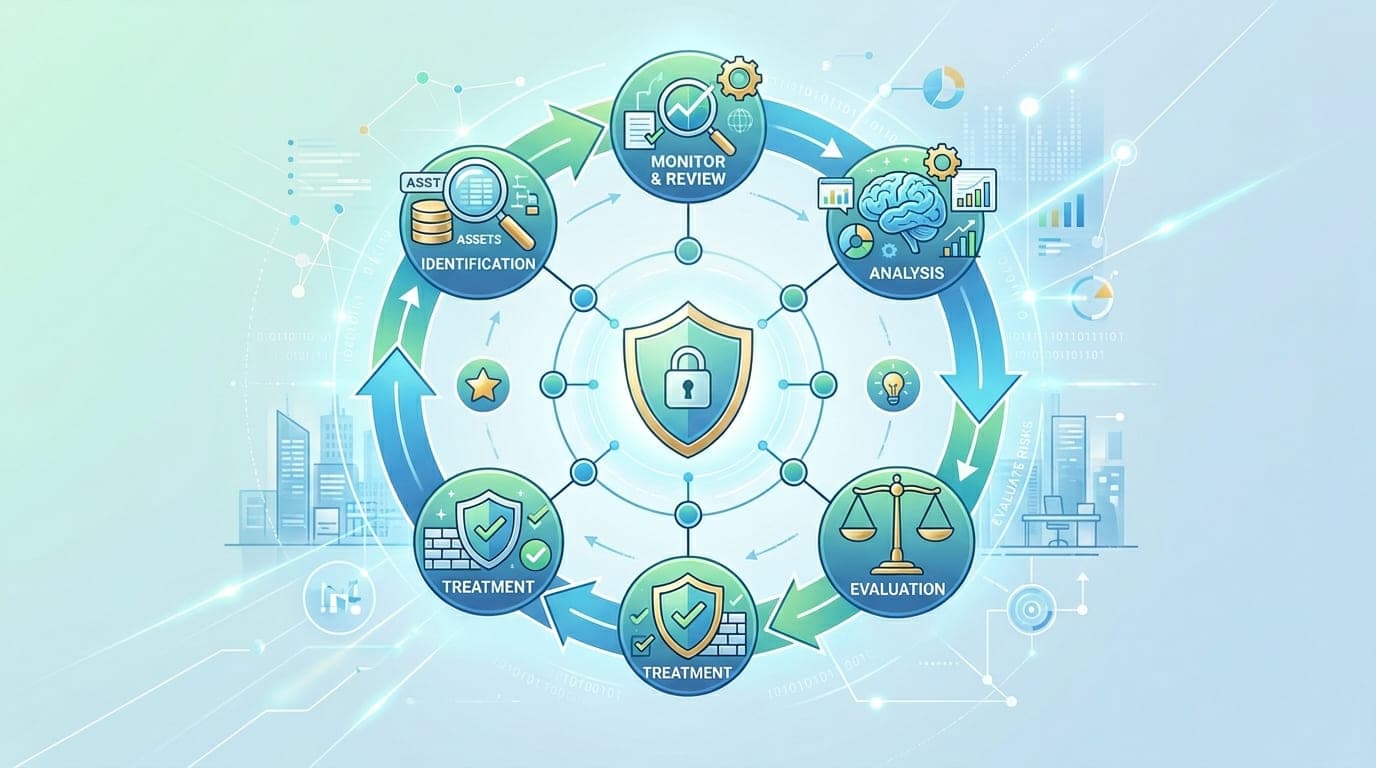
ISO 27001 doesn't prescribe a specific risk assessment method. Instead, it requires you to:
Establish risk criteria that reflect your organization's context
Identify risks to information assets systematically
Analyze risks to understand their potential impact
Evaluate risks against your acceptance criteria
Treat risks with appropriate controls
Monitor and review risks continuously
This flexibility is powerful—but it's also where organizations get lost. Let me walk you through a methodology I've refined over 15 years that actually works in the real world.
Phase 1: Establishing Context (The Step Everyone Skips)
I learned this lesson the hard way in 2016. A manufacturing client asked me to conduct a risk assessment for their organization. I dove straight in, identifying assets, mapping threats, calculating risk scores. Three months later, we had a beautiful 47-page risk register.
The CEO looked at it for about thirty seconds before asking: "Which of these risks could actually put us out of business?"
I had no idea. I'd assessed everything with equal rigor but no business context.
Understanding Your Organization's Risk Appetite
Here's what I now do before identifying a single risk:
Map Business-Critical Assets
Not all information assets are equal. Start by understanding what actually matters to your organization.
Asset Category | Business Impact | Example Assets | Critical Questions |
|---|---|---|---|
Revenue-Generating | Loss = immediate revenue impact | E-commerce platform, payment systems, customer database | Could we process orders without this? |
Compliance-Critical | Loss = legal/regulatory penalties | Patient records, financial data, audit logs | What regulations govern this data? |
Reputation-Critical | Loss = brand damage, customer trust | Customer PII, intellectual property, confidential communications | What would the media say if this leaked? |
Operations-Critical | Loss = business operations halt | Manufacturing systems, supply chain data, internal tools | How long can we operate without this? |
I worked with a healthcare provider where we identified 847 information assets initially. After business context analysis, we focused detailed risk assessment on 43 critical assets that represented 90% of their actual business risk. The rest got standard baseline controls.
Define Your Risk Tolerance
Every organization has a different risk appetite. A startup might accept risks that would terrify a bank. A healthcare provider faces different compliance pressures than a retailer.
Here's a framework I use:
Risk Level | Definition | Typical Response | Decision Authority |
|---|---|---|---|
Critical | Could cause business failure or severe legal consequences | Must mitigate immediately regardless of cost | Executive leadership required |
High | Significant business disruption or compliance violation | Mitigate within 30-90 days, business case required | Department heads with CISO approval |
Medium | Moderate business impact, manageable consequences | Mitigate within 6-12 months, cost-benefit analysis | CISO or designated security team |
Low | Minimal impact, nuisance level | Accept or mitigate opportunistically | Security team discretion |
"Risk appetite isn't about being brave or cautious—it's about being honest about what your organization can actually absorb."
Establishing Risk Assessment Criteria
Before you assess anything, document how you'll measure risk. I use this framework:
Impact Criteria:
Impact Level | Financial Loss | Operational Disruption | Legal/Compliance | Reputation |
|---|---|---|---|---|
5 - Catastrophic | >$5M | Complete shutdown >7 days | Criminal charges, license revocation | National media, customer exodus |
4 - Major | $1M-$5M | Critical systems down 2-7 days | Major fines, regulatory sanctions | Industry press, significant customer loss |
3 - Moderate | $100K-$1M | Significant disruption 1-2 days | Compliance violations, moderate fines | Local press, some customer complaints |
2 - Minor | $10K-$100K | Limited disruption <1 day | Minor compliance issues | Internal concern only |
1 - Negligible | <$10K | Minimal impact | No compliance issues | No external visibility |
Likelihood Criteria:
Likelihood Level | Frequency | Threat Intelligence | Control Maturity |
|---|---|---|---|
5 - Almost Certain | Multiple times per year | Active exploitation in the wild | No controls or failed controls |
4 - Likely | Once per year | Known vulnerabilities being exploited | Weak or inconsistent controls |
3 - Possible | Once every 1-3 years | Theoretical vulnerabilities exist | Basic controls implemented |
2 - Unlikely | Once every 3-5 years | Rare attacks or difficult to exploit | Strong controls with regular testing |
1 - Rare | Less than once per 5 years | No known attacks or extremely difficult | Multiple layers of mature controls |
Customize these to your organization. A $50M company and a $5B company have very different definitions of "catastrophic" financial loss.
Phase 2: Asset Identification and Valuation
I once worked with a software company that insisted their source code was their most valuable asset. It wasn't.
Their most valuable asset was the customer database containing payment information for 340,000 active subscribers generating $68 million annually. Losing the source code would be painful and expensive. Losing that customer database—with the resulting breach notification costs, PCI DSS fines, and customer churn—would potentially end the company.
Creating a Comprehensive Asset Inventory
Here's the asset classification approach I've found most effective:
Primary Asset Categories:
Asset Type | Description | Valuation Factors | Example |
|---|---|---|---|
Information Assets | Data and information in any format | Revenue impact, compliance requirements, competitive value | Customer databases, financial records, intellectual property |
Software Assets | Applications and operating systems | Replacement cost, business dependency, alternatives available | ERP systems, custom applications, productivity software |
Physical Assets | Hardware and infrastructure | Replacement cost, data contained, criticality to operations | Servers, workstations, mobile devices, storage systems |
Services | External services and utilities | Business dependency, recovery time, alternative providers | Cloud services, internet connectivity, payment processing |
People | Human resources and knowledge | Specialized knowledge, role criticality, replaceability | Key personnel, specialized skills, institutional knowledge |
The Asset Valuation Matrix I Actually Use
Forget complex formulas. Here's a practical approach:
Asset Value = (Confidentiality Impact + Integrity Impact + Availability Impact) / 3
For each asset, rate confidentiality, integrity, and availability using your impact scale (1-5).
Real Example: E-commerce Customer Database
CIA Attribute | Rating | Justification |
|---|---|---|
Confidentiality | 5 (Catastrophic) | Contains PII, payment info. Breach = PCI fines, notification costs, customer loss. Estimated impact: $8M+ |
Integrity | 5 (Catastrophic) | Corrupted data = incorrect orders, billing errors, operational chaos. Could halt business operations for days |
Availability | 5 (Catastrophic) | System down = no orders processed. Revenue loss: ~$47K per hour downtime |
Overall Value | 5 (Critical Asset) | All three attributes are catastrophic. This is a crown jewel that demands maximum protection |
Real Example: Marketing Website Content
CIA Attribute | Rating | Justification |
|---|---|---|
Confidentiality | 1 (Negligible) | Public information, no confidential data |
Integrity | 3 (Moderate) | Defacement would be embarrassing and damage trust, but limited business impact |
Availability | 2 (Minor) | Downtime noticeable but not business-critical. Prospects can still contact us other ways |
Overall Value | 2 (Standard Protection) | Important but not critical. Standard web security controls sufficient |
Phase 3: Threat and Vulnerability Identification
This is where I see most organizations either go too generic ("hackers might attack us") or too paranoid (endless lists of theoretical threats).
Here's a story that illustrates the right approach: In 2020, I worked with a legal firm convinced their biggest threat was sophisticated nation-state hackers targeting their high-profile cases.
After analyzing their actual security posture, I identified their real top threats:
Employees accidentally sharing confidential documents (happened 23 times in the past year)
Weak passwords on email accounts (37% of passwords in breach databases)
No encryption on partner file exchanges (standard practice for the firm)
Unpatched vulnerabilities in document management system (6 critical vulnerabilities over 90 days old)
The exotic threats? Possible, but unlikely given their actual profile and security maturity. We focused on realistic threats that aligned with their actual vulnerabilities.
Threat Source Classification
Threat Source | Characteristics | Common Motivations | Typical Capabilities |
|---|---|---|---|
Cybercriminals | Financially motivated, opportunistic | Ransomware, data theft for sale, cryptocurrency theft | Moderate to high, use automated tools and exploit known vulnerabilities |
Insider Threats | Current/former employees, contractors | Financial gain, revenge, ideology, negligence | High (legitimate access), know systems and data locations |
Nation-State Actors | Government-sponsored, highly skilled | Espionage, intellectual property theft, strategic advantage | Very high, custom malware, zero-day exploits |
Hacktivists | Ideologically motivated groups | Political statements, reputation damage, service disruption | Variable, typically moderate |
Competitors | Business rivals | Trade secrets, competitive intelligence, customer data | Variable, often use insiders or social engineering |
Natural Disasters | Environmental events | N/A - accidental | N/A |
Human Error | Unintentional mistakes | N/A - accidental | Low intent, high occurrence |
Practical Threat Scenario Development
Instead of generic threats, develop specific, realistic scenarios. Here's my template:
Threat Scenario: Ransomware Attack on Financial Systems
Element | Details |
|---|---|
Threat Actor | Cybercriminal group using commodity ransomware |
Target Asset | Accounting and ERP systems containing financial data |
Attack Vector | Phishing email with malicious attachment |
Vulnerability Exploited | 1) Insufficient email filtering, 2) Lack of employee training, 3) Excessive user privileges, 4) No backup isolation |
Potential Impact | Financial systems encrypted and unavailable, ransom demand of $500K, 5-7 day operational disruption, estimated total cost: $2.3M |
Current Likelihood | High (4/5) - Multiple successful phishing tests, privileged access not restricted, backups on same network |
I create 5-10 of these detailed scenarios for each critical asset, focusing on the most realistic threats based on the organization's industry, size, and security maturity.
"Don't prepare for the threats you find interesting. Prepare for the threats you're most likely to face with your current security posture."
Phase 4: Risk Analysis and Evaluation
Now comes the critical part—actually calculating and prioritizing risks.
I've seen organizations use incredibly complex risk calculation formulas. In my experience, simplicity wins. Here's what actually works:
The Risk Calculation Method That Actually Works
Risk Level = Impact × Likelihood
That's it. Don't overcomplicate it.
Using our 1-5 scale for both impact and likelihood:
Risk Score | Risk Level | Interpretation |
|---|---|---|
20-25 | Critical | Immediate action required, potential business failure |
15-19 | High | Priority mitigation, significant business impact |
8-14 | Medium | Planned mitigation, moderate business impact |
4-7 | Low | Monitor or accept, minimal business impact |
1-3 | Very Low | Accept, negligible business impact |
Real Risk Assessment Example
Let me walk you through an actual risk assessment I conducted for a healthcare technology company:
Risk #1: Patient Data Breach via Unpatched Application Vulnerability
Factor | Rating | Justification |
|---|---|---|
Impact | 5 (Catastrophic) | HIPAA breach affecting 50K+ patients. Estimated cost: $6.2M (HHS fines, notification, credit monitoring, lawsuits, customer churn) |
Likelihood | 4 (Likely) | Critical vulnerability in patient portal (CVSS 9.1), public exploit available, vulnerability scan found it, patch delayed 45 days due to "testing concerns" |
Risk Score | 20 (Critical) | This became our #1 priority. We fast-tracked patching, implemented WAF rules as compensating control, and accelerated patch management process |
Treatment Decision | Mitigate immediately | Emergency patch deployed within 72 hours with enhanced testing protocol |
Risk #2: Data Loss Due to Inadequate Backup
Factor | Rating | Justification |
|---|---|---|
Impact | 4 (Major) | Loss of operational data would halt business 3-5 days. Estimated cost: $1.2M (recovery efforts, lost revenue, regulatory issues) |
Likelihood | 3 (Possible) | Backups exist but: not tested in 8 months, some systems excluded, no offline/immutable copies (ransomware risk) |
Risk Score | 12 (Medium) | Significant risk but not immediate. Scheduled for next quarter implementation |
Treatment Decision | Mitigate within 90 days | Implemented immutable backup solution, monthly restore testing, expanded backup scope |
Risk #3: Social Engineering Leading to Credential Compromise
Factor | Rating | Justification |
|---|---|---|
Impact | 4 (Major) | Compromised admin credentials could lead to data breach, system manipulation, or ransomware deployment |
Likelihood | 4 (Likely) | Recent phishing simulation: 31% click rate, 18% credential entry. No MFA on admin accounts. Industry sees frequent attacks |
Risk Score | 16 (High) | High priority for mitigation |
Treatment Decision | Mitigate within 30 days | Implemented MFA on all privileged accounts, enhanced email filtering, launched security awareness program |
Creating Your Risk Register
Here's the structure I use for risk registers that actually get used:
Risk ID | Asset | Threat Scenario | Impact | Likelihood | Risk Score | Risk Level | Current Controls | Residual Risk | Treatment Plan | Owner | Due Date | Status |
|---|---|---|---|---|---|---|---|---|---|---|---|---|
R-001 | Customer Database | SQL injection attack | 5 | 4 | 20 | Critical | Basic input validation | 20 | Implement WAF, code review, parameterized queries | AppSec Lead | 30 days | In Progress |
R-002 | Email System | Business email compromise | 4 | 3 | 12 | Medium | Spam filtering | 12 | Deploy DMARC, security awareness training | IT Manager | 60 days | Planned |
R-003 | Office Network | Unauthorized physical access | 3 | 2 | 6 | Low | Badge access, security desk | 4 | Add security cameras, visitor logs | Facilities | 90 days | Planned |
Pro tip: Keep your risk register to 25-40 risks maximum. More than that and it becomes unmanageable. Focus on what actually matters.
Phase 5: Risk Treatment (Where Theory Meets Reality)
Risk treatment is where your assessment becomes action. ISO 27001 defines four treatment options, but in reality, you'll use all four in combination.
The Four Treatment Options Explained
Treatment Option | When to Use | Real-World Example | Typical Cost Range |
|---|---|---|---|
Avoid | Risk too severe, no acceptable mitigation | Decided not to expand into high-risk jurisdiction with impossible data protection requirements | $0 (opportunity cost) |
Reduce | Cost-effective controls available, business requirement exists | Implemented MFA to reduce account compromise risk from score 16 to 4 | $15K-$50K per year |
Transfer | Risk financial impact high, insurance available | Purchased $5M cyber insurance policy for residual breach risk | $45K annual premium |
Accept | Low risk level, mitigation cost exceeds impact | Accepted risk of physical theft of 10-year-old archived paper records with no PII | $0 |
The Risk Treatment Decision Matrix I Use
Here's my practical framework for treatment decisions:
Risk Level | Default Treatment | Decision Authority | Timeline | Budget Consideration |
|---|---|---|---|---|
Critical (20-25) | Must Mitigate | Executive Leadership | Immediate (0-30 days) | Budget not a constraint - find the money |
High (15-19) | Should Mitigate | CISO / Department Heads | Priority (30-90 days) | Business case required, typically approved |
Medium (8-14) | Planned Mitigation | Security Team | Planned (90-180 days) | Cost-benefit analysis, competing priorities |
Low (4-7) | Accept or Opportunistic | Security Team | As resources allow (>180 days) | Only if resources available |
Very Low (1-3) | Accept | Security Team | N/A | Document acceptance, no budget needed |
Real Treatment Plan Example
Let me show you how this works with a real scenario from 2022:
Organization: Healthcare clinic with 45 employees Risk: Ransomware attack on patient records Initial Risk Score: 20 (Impact: 5, Likelihood: 4)
Treatment Strategy (Layered Defense):
Control | Type | Implementation Cost | Annual Cost | Risk Reduction | Timeline |
|---|---|---|---|---|---|
Endpoint Detection & Response (EDR) | Reduce | $8,500 | $12,000 | Likelihood: 4→3 | Week 1 |
Immutable Backups | Reduce | $15,000 | $6,000 | Impact: 5→3 | Week 2 |
Email Security Gateway | Reduce | $3,500 | $4,800 | Likelihood: 3→2 | Week 3 |
Security Awareness Training | Reduce | $2,000 | $2,000 | Likelihood: 2→2 | Week 4 |
Cyber Insurance | Transfer | $0 | $18,000 | Transfer residual financial risk | Week 6 |
Incident Response Retainer | Transfer | $5,000 | $8,000 | Reduce recovery time/cost | Week 6 |
Results:
Initial Risk: 20 (Critical)
Residual Risk: 6 (Low) - Impact reduced to 3, Likelihood to 2
Total First-Year Cost: $84,800
Annual Ongoing Cost: $50,800
Estimated Risk Reduction Value: $4.2M (cost of breach prevented)
ROI: 4,954% (considering just one prevented incident)
This clinic implemented all controls within 6 weeks. Eight months later, they detected and blocked a ransomware attack that would have been catastrophic without these controls.
"Risk treatment isn't about eliminating all risk—it's about reducing risk to an acceptable level at a reasonable cost."
Phase 6: Statement of Applicability (The Document Nobody Reads, But Everybody Needs)
The Statement of Applicability (SoA) is ISO 27001's way of documenting your treatment decisions for all 93 Annex A controls.
Most organizations create useless SoAs that auditors hate. Here's what makes a good one:
SoA Best Practices
For EACH Annex A control, document:
Element | What to Include | Bad Example | Good Example |
|---|---|---|---|
Applicability | Is this control relevant? | "Applicable" | "Applicable - we handle credit card data and must protect cardholder information" |
Implementation Status | How is it implemented? | "Implemented" | "Implemented via Palo Alto firewall with IPS, rules reviewed quarterly, managed by network team" |
Justification for Exclusion | Why excluded? (if N/A) | "Not applicable" | "Not applicable - we have no physical data center (100% cloud infrastructure with AWS)" |
Gaps | What's missing? | "None" | "MFA implemented for admin access but not yet deployed for all users (planned Q3 2024)" |
Example SoA Entry I Actually Use:
Control A.8.23: Web Filtering
Status: Partially Implemented
Description: DNS-based web filtering deployed via Cisco Umbrella, blocks malware/phishing domains
Implementation Details:
Covers all corporate devices (managed endpoints)
Policy blocks: malware, phishing, adult content, high-risk domains
Exceptions process: security team approval required, logged
Gap: BYOD devices not covered (addressed via separate mobile device policy requiring VPN)
Risk Assessment Reference: Addresses risks R-007 (malware infection via web), R-012 (data exfiltration)
Evidence Location: Umbrella admin console, policy documentation
Review Date: 2024-03-15
Owner: IT Security Manager
Phase 7: Monitoring and Review (The Part That Keeps It Alive)
Here's a sobering statistic: in my experience, about 70% of risk assessments become outdated within 6 months because organizations don't build in proper review mechanisms.
I learned this lesson in 2017. A retail client had a beautiful risk assessment from January. By July, they'd:
Migrated their e-commerce platform to the cloud (new assets)
Suffered a credential stuffing attack (new threat realized)
Implemented new payment processing (new compliance requirements)
Acquired a smaller competitor (inherited their infrastructure)
Their risk register reflected none of this. It had become historical fiction.
Building a Living Risk Assessment Program
Here's the monitoring framework I implement:
Continuous Monitoring Triggers:
Trigger Type | Frequency | What to Review | Owner |
|---|---|---|---|
New Assets | Immediate | Assess risks for new systems, data, services | Asset owners |
Significant Changes | As occurred | Cloud migrations, architecture changes, new vendors | Security team |
Incidents | Immediately after | Risk assumptions, control effectiveness, likelihood ratings | CISO |
Control Failures | Weekly | Why controls failed, risk rating impacts, mitigation plans | Security operations |
New Vulnerabilities | Weekly | Critical CVEs affecting your environment, exploit availability | Vulnerability management |
Threat Intelligence | Monthly | Industry-specific threats, attack trends, TTPs | Threat intelligence |
Formal Review | Quarterly | Top 10 risks, treatment progress, emerging risks | Risk committee |
Complete Reassessment | Annually | Full methodology review, all risks reevaluated | CISO + leadership |
The Risk Review Meeting That Actually Works
I run quarterly risk review meetings with this agenda:
1. Quick Wins (5 minutes)
What risks were successfully reduced this quarter?
What controls proved effective?
2. New or Escalating Risks (15 minutes)
What changed that increases risk?
New threats or vulnerabilities discovered?
Business changes affecting risk profile?
3. Top 10 Risk Review (30 minutes)
Are risk ratings still accurate?
Is treatment on track?
Do we need to reprioritize?
4. Resource Allocation (10 minutes)
Where should security budget go next quarter?
What's the ROI of proposed mitigations?
5. Action Items (5 minutes)
Clear owners and deadlines
The meeting is 65 minutes maximum, with pre-read materials distributed 3 days prior. No death by PowerPoint. Just decisions.
Common Pitfalls (And How to Avoid Them)
After 15 years, I've seen every mistake possible. Here are the killers:
Pitfall #1: Analysis Paralysis
The Mistake: Attempting to assess every possible risk in excruciating detail.
The Fix: Focus on critical assets and realistic threats. I use the 80/20 rule: 20% of your risks represent 80% of your actual exposure.
Real Example: A software company wanted to assess risks for 1,200 assets. We narrowed it to 35 critical assets that represented 92% of business value. Completed in 6 weeks instead of 6 months.
Pitfall #2: Generic, Template-Driven Assessments
The Mistake: Copying risk scenarios from templates without customization.
The Fix: Every risk should be specific to YOUR organization, assets, threats, and controls.
Bad: "Hackers might breach our systems" Good: "External attackers exploiting CVE-2024-1234 in our unpatched customer portal (v3.2.1) to access customer PII database, estimated impact $3.2M based on similar breaches in our industry"
Pitfall #3: Ignoring the Human Factor
The Mistake: Focusing only on technical risks while ignoring human behavior.
Real Story: A financial services firm spent $800K on technical controls. Then an employee's laptop with unencrypted customer data got stolen from their car. The risk assessment never considered endpoint encryption or remote work policies.
The Fix: Include human-factor risks: social engineering, accidental disclosure, insider threats, policy non-compliance.
Pitfall #4: Static Documents
The Mistake: Treating risk assessment as an annual compliance exercise.
The Fix: Build triggers for reassessment. In my implementations, any of these automatically triggers risk review:
New system deployment
Significant architecture change
Security incident
Major business change (acquisition, new product, etc.)
Critical vulnerability affecting your environment
Pitfall #5: No Connection to Reality
The Mistake: Risk assessments that don't influence actual security decisions.
The Fix: Every security project should reference the risk register. Every budget request should show risk reduction. If your risk assessment isn't guiding decisions, fix it or abandon it.
Tools and Templates You Can Actually Use
Let me save you time. Here are the tools I actually use (not theoretical "best practices"):
Essential Tools
Tool Type | My Recommendation | Why | Approximate Cost |
|---|---|---|---|
Risk Register | Google Sheets or Excel | Everyone can access, familiar interface, version control | Free |
GRC Platform | ServiceNow, LogicGate, or Hyperproof (for enterprises) | Automation, workflow, integration | $15K-$100K/year |
Asset Discovery | Qualys, Rapid7, or Axonius | Automated asset inventory, reduces manual effort | $10K-$50K/year |
Vulnerability Management | Tenable, Qualys, or Rapid7 | Identifies technical vulnerabilities at scale | $15K-$75K/year |
Threat Intelligence | Recorded Future, Anomali, or free OSINT sources | Context for likelihood assessment | $0-$50K/year |
Pro Tip: Start simple. I've seen organizations succeed with nothing but Excel, regular meetings, and disciplined follow-through. Fancy tools don't fix poor process.
The Risk Assessment Template I Use
Here's my starter template structure (simplified for this article):
1. Executive Summary (1 page)
Risk assessment scope and methodology
Top 5 critical risks
Overall risk posture (improving/stable/declining)
Key recommendations
2. Risk Assessment Details (10-20 pages)
Context and assumptions
Asset inventory summary
Top 20 risks with detailed scenarios
Risk treatment plan with timeline and budget
3. Statement of Applicability (5-10 pages)
All ISO 27001 Annex A controls
Implementation status
Gaps and remediation plans
4. Appendices
Complete risk register
Detailed risk calculations
Control testing results
Threat intelligence summary
Keep it concise. Nobody reads 100-page risk assessments.
Integration with ISO 27001 Implementation
Your risk assessment drives your entire ISO 27001 implementation. Here's how it connects:
ISO 27001 Requirement | How Risk Assessment Feeds It |
|---|---|
Clause 4: Context | Risk assessment defines organizational context and scope boundaries |
Clause 6: Risk Assessment | This is literally the risk assessment process we've discussed |
Clause 6: Risk Treatment | Your treatment decisions determine which controls to implement |
Annex A Controls | Selected based on risk treatment requirements in your risk register |
Statement of Applicability | Directly derived from risk treatment decisions |
Clause 9: Monitoring | Risk register defines what to monitor and measure |
Clause 10: Improvement | Risk review identifies gaps and drives improvements |
Without a solid risk assessment, your ISO 27001 implementation is just guesswork dressed up as a management system.
Real-World Success Story
Let me close with a success story that shows the power of doing this right.
In 2021, I worked with a 200-person healthcare technology company preparing for SOC 2 and ISO 27001 certification. Their previous "risk assessment" was a 5-page document listing generic threats like "hackers" and "viruses."
We spent 8 weeks doing it properly:
Week 1-2: Context establishment, asset identification, business impact analysis Week 3-4: Threat modeling, vulnerability assessment, risk calculation Week 5-6: Risk treatment planning, control selection, budget development Week 7-8: Documentation, stakeholder review, approval
The result? A 35-page risk assessment identifying 28 critical risks across their environment.
The Impact:
Six months later:
Blocked a ransomware attack that specifically targeted a vulnerability we'd identified and patched
Passed SOC 2 Type I audit with zero findings
Reduced cyber insurance premium by 35% by demonstrating mature risk management
Gained 3 major enterprise customers who required ISO 27001 certification
One year later:
Achieved ISO 27001 certification
No security incidents resulting in data breach
Security program budget increased 40% based on demonstrated ROI
Risk assessment process became embedded in business operations
The CISO told me: "Before, we were spending money on security and hoping we were making the right choices. Now we know exactly what our risks are, what we're doing about them, and how to talk about it with the board. The risk assessment changed everything."
Your Next Steps
If you're ready to implement ISO 27001 risk assessment properly, here's your roadmap:
Week 1: Preparation
Get executive buy-in and resource commitment
Identify your risk assessment team
Download or create your initial templates
Schedule kickoff meeting
Weeks 2-3: Context and Assets
Define risk criteria and appetite
Identify and classify assets
Determine asset owners
Document business context
Weeks 4-5: Threats and Vulnerabilities
Identify realistic threat scenarios
Assess vulnerabilities
Calculate initial risk scores
Prioritize risks
Weeks 6-7: Treatment Planning
Select treatment options
Design control implementations
Develop budget and timeline
Assign ownership
Week 8: Documentation and Approval
Complete risk register
Draft Statement of Applicability
Present to leadership
Obtain approval to proceed
Ongoing: Implementation and Monitoring
Implement controls per treatment plan
Monitor and review quarterly
Update for changes
Annual complete reassessment
Final Thoughts
After fifteen years of implementing ISO 27001, I've learned that risk assessment isn't about perfect accuracy—it's about making informed decisions systematically.
You won't identify every risk. You won't prevent every incident. But you will:
Understand what you're protecting and why
Focus resources on what actually matters
Respond faster when incidents occur
Make defensible decisions based on data, not fear
Build security into business operations
The organizations that succeed aren't the ones with the most sophisticated risk models or expensive tools. They're the ones that commit to a disciplined process, involve the right people, and actually use their risk assessment to guide decisions.
"A good risk assessment doesn't eliminate uncertainty—it helps you make better decisions despite uncertainty."
Start simple. Be consistent. Focus on what matters. Improve continuously.
That's the methodology that actually works.
Need help implementing ISO 27001 risk assessment in your organization? At PentesterWorld, we provide detailed guides, templates, and practical advice based on real-world implementations. Subscribe for weekly insights on cybersecurity compliance.