The email from our certification body landed in my inbox on a seemingly ordinary Wednesday morning: "Your ISO 27001 re-certification audit is scheduled in 4 months."
My stomach dropped.
This was back in 2017, and I was working as the Information Security Manager for a mid-sized financial services firm. We'd achieved our initial certification three years prior with blood, sweat, and more than a few tears. Since then, we'd passed two surveillance audits without major issues. I thought we were golden.
I was wrong. Dangerously wrong.
We'd made the classic mistake: treating surveillance audits like the main event while letting our documentation drift, our risk assessments gather dust, and our management reviews become rubber-stamp exercises. When the re-certification audit came, we failed—not catastrophically, but enough to require significant remediation before the auditor would recommend certification renewal.
That failure taught me more about ISO 27001 lifecycle management than the previous three years combined. Today, after guiding over 30 organizations through re-certification processes, I can tell you exactly what works, what doesn't, and how to navigate the three-year cycle without the panic attacks I experienced.
Understanding the Three-Year Certification Cycle
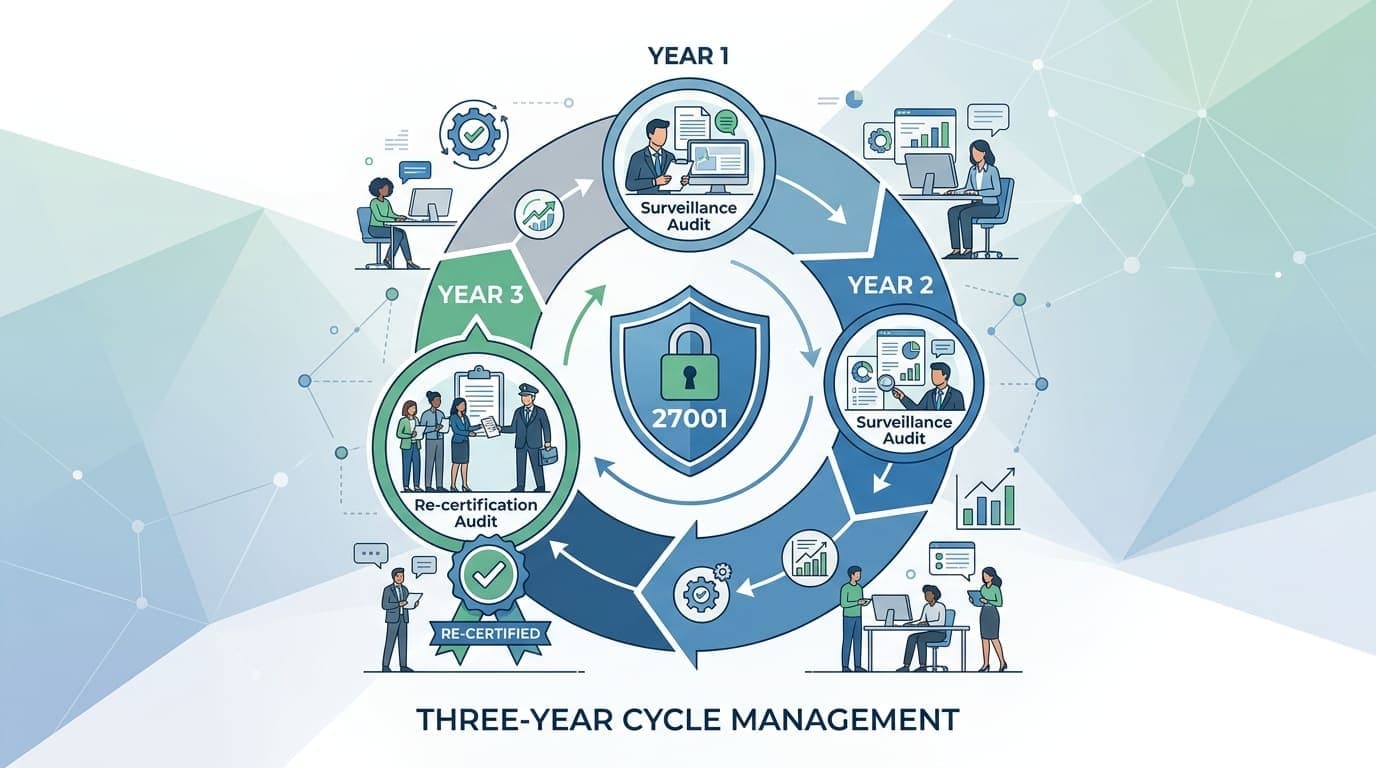
Let me start with the framework that nobody explains clearly enough. ISO 27001 certification isn't a one-time achievement—it's a three-year commitment that looks like this:
Year | Audit Type | Duration | Focus Areas | Outcome |
|---|---|---|---|---|
Year 1 | Initial Certification / Re-certification | 3-5 days | Complete ISMS review, all controls, documentation | Full 3-year certificate |
Year 2 | Surveillance Audit 1 | 1-2 days | Selected controls, changes since last audit, non-conformities | Certificate maintained |
Year 3 | Surveillance Audit 2 | 1-2 days | Different control sample, management review, effectiveness | Certificate maintained |
Year 4 | Re-certification Audit | 3-5 days | Complete ISMS review, three-year performance, maturity | New 3-year certificate |
Here's what most people miss: the re-certification audit is fundamentally different from surveillance audits. It's not just bigger—it's deeper, broader, and significantly more rigorous.
"Surveillance audits check if you're maintaining compliance. Re-certification audits assess whether you've actually improved over three years. There's a massive difference."
Why Re-certification Feels Different (And Why It Should)
I remember talking to a CISO in 2019 who'd just received his re-certification audit report. "We've passed every surveillance audit," he told me, frustration evident in his voice. "Why are they asking us to demonstrate continuous improvement now?"
Because that's the entire point of ISO 27001.
The standard isn't designed to be a static checklist. It's built on the principle of continuous improvement—the famous Plan-Do-Check-Act (PDCA) cycle. During your first three years of certification, auditors expect to see:
Evidence of maturity, not just maintenance Process improvements based on lessons learned Risk assessment updates reflecting a changing threat landscape Measurable outcomes from your security controls Management engagement beyond annual reviews
Let me share a real example. A healthcare technology company I consulted with had maintained their ISO 27001 certification for three years. They'd passed both surveillance audits with minor non-conformities. But when re-certification came around, the auditor identified a critical issue:
Their risk assessment hadn't materially changed in three years. Same risks. Same treatments. Same ratings. Despite operating in one of the most dynamic threat environments imaginable.
The auditor's feedback was brutal but fair: "Your ISMS is frozen in time. You're compliant with your own outdated understanding of risk, but you're not actually managing information security effectively."
They had to delay re-certification by six months to demonstrate genuine risk management improvement.
The Hidden Timeline: What Happens Behind the Scenes
Here's something that caught me completely off guard during my first re-certification: the process actually starts 12-18 months before the audit date, not 3-4 months.
Let me break down the real timeline:
18 Months Before Re-certification: The Foundation Phase
What Should Be Happening:
Comprehensive review of ISMS documentation
Assessment of control effectiveness over the past 18 months
Identification of improvement opportunities
Strategic planning for demonstrable maturity gains
What Actually Happens in Most Organizations:
Nothing. Absolutely nothing.
Teams focus on the surveillance audit
Documentation updates are reactive, not strategic
Management reviews become checkbox exercises
I learned this the hard way. Now when I work with clients, I build a structured 18-month preparation program that prevents the last-minute scramble.
12 Months Before Re-certification: The Evidence Building Phase
This is where you need to start collecting proof of continuous improvement. The auditor will want to see:
Evidence Category | What Auditors Look For | Common Gaps I've Seen |
|---|---|---|
Risk Assessment Evolution | Multiple iterations showing changing risk landscape | Single assessment unchanged for 3 years |
Control Effectiveness | Measurable improvements in security metrics | No metrics or baseline comparisons |
Incident Management | Lessons learned and process improvements | Incidents tracked but not analyzed for trends |
Management Reviews | Strategic decisions and resource allocation | Perfunctory quarterly meetings with no actions |
Internal Audits | Increasing audit depth and finding actionable items | Same checklist repeated quarterly |
Corrective Actions | Root cause analysis and prevention measures | Quick fixes without addressing underlying issues |
A financial services company I worked with in 2021 had beautiful metrics dashboards. Gorgeous visualizations. Real-time data. But when the re-certification auditor asked, "How have these metrics changed your control implementations over three years?" they had no answer. The metrics existed in a vacuum—measured but never acted upon.
We spent three months retrospectively documenting how metrics had influenced decisions. It was painful and could have been avoided with better preparation.
6 Months Before Re-certification: The Documentation Sprint
By six months out, you should be in documentation mode. But here's what makes re-certification different from initial certification:
Initial Certification Documentation:
Policies and procedures
Current risk assessment
Statement of Applicability
Asset inventory
Current controls
Re-certification Documentation:
All of the above, plus...
Three years of management review minutes
Three years of internal audit reports
Three years of risk assessment iterations
Trend analysis of security metrics
Evidence of process improvements
Records of training and awareness programs
Third-party audit reports
Incident response records and lessons learned
The volume is staggering. I once helped a company that realized at the 4-month mark that they'd lost the meeting minutes from Year 1. We had to reconstruct them from emails and memory. It was a nightmare and completely avoidable.
3 Months Before Re-certification: The Pre-Assessment
Here's a practice that's saved my clients thousands of dollars and countless headaches: conduct your own pre-assessment audit at the 3-month mark.
Bring in someone who wasn't involved in your day-to-day ISMS management. Give them the same scope as the re-certification audit. Let them find your gaps while you still have time to fix them.
I worked with a manufacturing company in 2020 that skipped this step to save money. Their re-certification audit identified 7 major non-conformities that required a 4-month remediation period and a follow-up audit. The additional costs:
Extended audit: $8,500
Consultant remediation: $23,000
Follow-up audit: $6,500
Opportunity cost of delayed certification: Immeasurable
A pre-assessment would have cost them $12,000 and caught everything while they had time to fix it properly.
The Re-certification Audit: What's Actually Different
Let me walk you through what makes re-certification audits more intense than surveillance audits, based on having witnessed or managed over 25 of them.
Scope and Depth
Surveillance Audit Approach:
Sample 30-40% of controls
Focus on changes since last audit
Review recent management review (usually one)
Check recent internal audits (usually one or two)
Interview 3-5 key personnel
Duration: 1-2 days for most organizations
Re-certification Audit Approach:
Review 100% of controls (or close to it)
Assess three-year trajectory and improvement
Examine all management reviews from three years
Review all internal audits from the cycle
Interview 8-15 personnel across all levels
Deep dive into risk management maturity
Assessment of ISMS culture and integration
Duration: 3-5 days for most organizations
The Questions That Expose Weakness
Surveillance auditors ask: "Can you show me your backup logs from last month?"
Re-certification auditors ask: "Show me how backup reliability has changed over three years, what you learned from backup failures, and how that's influenced your disaster recovery strategy."
See the difference? One is compliance checking. The other is maturity assessment.
I'll never forget a re-certification audit where the auditor asked our IT Director: "Your incident response plan has been updated 7 times in three years. Walk me through what triggered each update and how the plan improved."
We couldn't answer it. We'd updated the plan reactively, but never documented the reasoning or measured the improvements. The auditor marked it as a minor non-conformity, but the lesson stuck with me: documentation without narrative is just noise.
Common Re-certification Pitfalls (And How to Avoid Them)
After consulting on dozens of re-certifications, I've identified patterns in what trips organizations up. Here are the big ones:
Pitfall #1: The "Set It and Forget It" ISMS
The Scenario: An organization achieves certification, passes their surveillance audits, and assumes they're golden. Their ISMS becomes a compliance exercise rather than a living management system.
Real Example: I worked with a tech company whose risk assessment was literally identical in Year 3 to Year 1. Same risks, same ratings, same treatments. Meanwhile, they'd:
Migrated to cloud infrastructure
Doubled their employee count
Entered three new markets
Launched a mobile app handling sensitive data
None of this was reflected in their risk assessment.
The Solution: Implement quarterly risk assessment reviews—not full reassessments, but structured check-ins asking:
What's changed in our business?
What new threats have emerged?
Are our existing controls still effective?
What incidents have we seen industry-wide?
"Your risk assessment should be a living document that reflects reality, not a compliance artifact that reflects the past."
Pitfall #2: Management Review Theater
The Scenario: Quarterly management reviews become perfunctory meetings where the same PowerPoint slides get presented, everyone nods, and nothing changes.
Real Example: A retail company I assessed had held 12 management reviews over three years. Every single one concluded with "ISMS is operating effectively" and no action items. When the re-certification auditor asked about strategic security decisions made by senior management, they couldn't identify any.
The auditor's feedback: "This isn't management review—it's management notification. Senior leadership isn't engaged in information security governance."
The Solution: Make management reviews matter by including:
Review Element | Purpose | Expected Outcome |
|---|---|---|
Security metrics trends | Show performance over time | Identification of positive/negative trends |
Resource allocation decisions | Prioritize security investments | Budget approval or reallocation |
Risk appetite statements | Define acceptable risk levels | Clear risk acceptance decisions |
Policy exceptions and their rationale | Governance oversight | Documented executive decisions |
Strategic security initiatives | Long-term planning | Roadmap approval and funding |
Compliance status across all frameworks | Holistic view | Cross-framework optimization decisions |
Every management review should result in at least 2-3 actionable decisions that require senior leadership authority.
Pitfall #3: Stale Documentation
The Scenario: Policies and procedures written during initial certification never get meaningfully updated. They describe an ISMS that no longer exists.
Real Example: A financial services firm had an "Access Control Policy" that described a manual provisioning process managed through email requests. In reality, they'd implemented an automated IAM system two years prior. When the auditor asked employees about the access control process, their descriptions didn't match the documented procedure.
Outcome: Major non-conformity for having an ISMS that didn't reflect actual practice.
The Solution: Implement annual documentation reviews with these questions:
Does this procedure describe what we actually do?
Have we found better ways to achieve these objectives?
Do new employees understand this document?
Does this align with our current technology stack?
I recommend scheduling documentation reviews in the month following each surveillance audit, when you're already in "compliance mode."
Pitfall #4: The Evidence Gap
The Scenario: Organizations implement excellent security practices but fail to generate evidence that auditors can assess.
Real Example: A healthcare company had monthly security meetings where they discussed vulnerabilities, planned remediation, and tracked progress. But they didn't keep formal minutes. When the re-certification auditor asked for evidence of vulnerability management governance, they had nothing to show.
The practices were excellent. The evidence was non-existent. And in ISO 27001 auditing, if it isn't documented, it didn't happen.
The Solution: Build evidence generation into your processes from day one:
Process | Required Evidence | Retention Period | Storage Location |
|---|---|---|---|
Management Review | Meeting minutes, decisions, action items | 3+ years | SharePoint/Quality Management System |
Internal Audit | Audit plans, findings, corrective actions | 3+ years | Audit management system |
Risk Assessment | Assessment reports, treatment plans, reviews | 3+ years | Risk management platform |
Incident Response | Incident reports, lessons learned, improvements | 3+ years | Incident management system |
Change Management | Change requests, approvals, implementation records | 3+ years | Change management system |
Training | Attendance records, assessment results, certifications | 3+ years | Learning management system |
Pitfall #5: The Improvement Illusion
The Scenario: Organizations make changes and claim improvement without measuring actual outcomes.
Real Example: A manufacturing company proudly told their re-certification auditor about implementing multi-factor authentication across all systems. "We've significantly improved our access security," they claimed.
The auditor asked: "How do you know? What metrics showed the improvement? Have you seen a reduction in credential compromise? Fewer failed login attempts? Changed user behavior?"
Silence. They'd implemented a control but couldn't demonstrate it improved anything.
The Solution: For every significant change, establish:
Baseline Metrics (before implementation) Implementation Timeline (what you did and when) Post-Implementation Metrics (after implementation) Analysis (what the data shows) Lessons Learned (what you'd do differently)
The Re-certification Audit: Day by Day
Let me walk you through what a typical re-certification audit looks like, based on my experience managing and observing them:
Day 1: Opening Meeting and Documentation Review
Morning:
Opening meeting with audit scope, schedule, and ground rules
Auditor reviews ISMS documentation
First interviews with CISO/Information Security Manager
Review of three-year management review records
Afternoon:
Deep dive into risk assessment methodology and evolution
Review of internal audit program and findings
Assessment of Statement of Applicability changes
Interviews with risk owners
What Catches Organizations Off Guard: The auditor wants to understand the why behind changes, not just see that changes occurred. I've watched organizations stumble when asked "Why did you add this control in Year 2?" and receiving blank stares in response.
Day 2: Technical Control Testing
Morning:
Access control implementation review
Network security assessment
Cryptography and data protection controls
Change management process review
Afternoon:
Vulnerability management evidence
Incident response procedure validation
Business continuity and disaster recovery testing
Physical security controls
What Trips People Up: Re-certification auditors test controls more rigorously than surveillance auditors. They're not just verifying the control exists—they're assessing whether it's effective and has improved over three years.
One auditor told me: "During surveillance, I verify you're doing backups. During re-certification, I verify your backups actually work, you've tested them, and your recovery processes have improved based on test results."
Day 3: Organizational and Operational Review
Morning:
Human resources security processes
Security awareness training effectiveness
Third-party management and vendor security
Asset management procedures
Afternoon:
Operations security controls
Monitoring and logging systems
Compliance assessment processes
Interviews with end users and operational staff
The Critical Difference: Re-certification audits involve more interviews with frontline staff. Auditors want to verify that security isn't just documented—it's embedded in organizational culture. They'll ask developers about secure coding practices, HR staff about onboarding security, and help desk personnel about incident reporting.
Day 4: Management System Assessment and Closing
Morning:
Review of continuous improvement evidence
Assessment of corrective action effectiveness
Management system integration review
Final evidence collection
Afternoon:
Audit team deliberation
Preparation of findings
Closing meeting with findings presentation
Discussion of next steps and timeline
The Moment of Truth: The closing meeting can go three ways:
Recommendation for certification - No major non-conformities, only minor issues that can be addressed in next surveillance audit
Conditional recommendation - Minor non-conformities that require evidence of correction before certification
Non-recommendation - Major non-conformities requiring significant remediation and follow-up audit
I've sat through all three types. Trust me, you want option #1.
Building a Sustainable Re-certification Process
After experiencing both failed and flawless re-certifications, I've developed a framework that works. Here's the system I implement for every client:
The 18-Month Rolling Preparation Model
Instead of cramming for re-certification, build it into your ongoing operations:
Timeline | Activity | Owner | Deliverable |
|---|---|---|---|
Continuous | Maintain evidence repository | All control owners | Up-to-date evidence library |
Quarterly | Risk assessment review | Risk Manager | Updated risk register |
Quarterly | Management review with strategic focus | CISO | Documented decisions and actions |
Semi-Annual | Internal audit with rotation | Internal Audit Team | Comprehensive audit findings |
Annual | Documentation comprehensive review | ISMS Manager | Updated policies and procedures |
18 Months Pre-Audit | Re-certification gap assessment | External consultant | Gap analysis report |
12 Months Pre-Audit | Improvement initiative implementation | Project teams | Demonstrable maturity gains |
6 Months Pre-Audit | Evidence compilation and review | ISMS Team | Complete evidence package |
3 Months Pre-Audit | Pre-assessment audit | External auditor | Pre-audit findings report |
1 Month Pre-Audit | Final preparation and dry runs | All teams | Audit-ready organization |
The Evidence Repository Strategy
One of my most successful implementations was creating an "always audit-ready" evidence repository for a tech company. Here's how it worked:
Automated Evidence Collection:
Logs automatically archived to compliance storage
Training completions synced from LMS
Vulnerability scans stored centrally
Change tickets preserved with approvals
Incident records maintained with outcomes
Structured Evidence Organization:
Evidence Repository/
├── Year 1/
│   ├── Q1/
│   │   ├── Management Review/
│   │   ├── Internal Audit/
│   │   ├── Risk Assessment/
│   │   └── Incidents/
│   ├── Q2/
│   ├── Q3/
│   └── Q4/
├── Year 2/
└── Year 3/
Evidence Metadata: Every piece of evidence tagged with:
Control reference (A.8.1.2, etc.)
Evidence type (minutes, logs, reports)
Date created
Retention requirement
Review frequency
Owner
When re-certification came, we spent 2 days compiling evidence instead of the 2 weeks I'd experienced previously. The auditor commented that it was one of the most organized evidence packages he'd seen.
"Audit preparation isn't about working harder during audit season—it's about working smarter all year long."
The Cost-Benefit Analysis of Proactive Management
Let me share some numbers that illustrate why proactive re-certification management pays off:
Traditional Reactive Approach:
Cost Element | Amount | Notes |
|---|---|---|
Last-minute documentation updates | $25,000 | Consultant fees for 2 months |
Evidence reconstruction | $15,000 | Staff time gathering historical records |
Failed initial audit | $8,500 | Additional audit day and findings |
Remediation period | $35,000 | Consultant + staff time for 3 months |
Follow-up audit | $6,500 | Additional certification body fees |
Delayed certification impact | $50,000+ | Lost opportunities, customer concerns |
Total Cost | $140,000+ | Plus stress and reputation impact |
Proactive Continuous Approach:
Cost Element | Amount | Notes |
|---|---|---|
Evidence management system | $12,000 | Annual subscription |
Quarterly consultant reviews | $24,000 | $2k/quarter for 3 years |
Pre-assessment audit | $12,000 | At 3-month mark |
Staff time (distributed) | $18,000 | 2 hours/week vs. crisis mode |
Re-certification audit | $15,000 | Standard fees, clean pass |
Total Cost | $81,000 | With minimal stress and first-pass success |
The proactive approach costs 42% less and delivers significantly better outcomes. Plus, you're actually improving your security posture instead of just chasing compliance.
Real-World Success Story: From Crisis to Confidence
Let me share a transformation I'm particularly proud of.
In 2020, I started working with a healthcare technology company that had just barely passed their first surveillance audit with 8 minor non-conformities. Their CISO was stressed, their team was burned out, and they were terrified of re-certification in 18 months.
We implemented the system I've described here:
Month 1-3: Built the evidence repository and established continuous collection processes
Month 4-6: Restructured management reviews to focus on strategic decisions and improvement
Month 7-9: Implemented quarterly risk assessment reviews that actually reflected business changes
Month 10-12: Overhauled the internal audit program to add depth and rotate focus areas
Month 13-15: Conducted comprehensive improvement initiatives with before/after metrics
Month 16-18: Prepared documentation, conducted pre-assessment, addressed gaps
When re-certification came:
Zero major non-conformities
Two minor non-conformities (both easily addressed)
Auditor specifically commended the maturity of their ISMS
Completed in 3.5 days instead of expected 5 days
Team felt confident throughout the process
The CISO sent me a text after the closing meeting: "I actually enjoyed that audit. I never thought I'd write those words."
Lessons I've Learned the Hard Way
After fifteen years and multiple re-certifications under my belt, here are the truths I wish someone had told me:
1. Surveillance audits are rehearsals, not the performance Treat them as opportunities to test your evidence collection, refine your processes, and identify gaps before they become re-certification problems.
2. Your auditor relationship matters Build a collaborative relationship with your certification body. They should feel like partners in your security journey, not adversarial inspectors. Good auditors give guidance during surveillance that helps you prepare for re-certification.
3. Documentation tells a story Your three years of records should tell the story of an organization that's learning, adapting, and improving. If they just show static compliance, you're doing it wrong.
4. Management engagement is non-negotiable I've never seen a successful re-certification where senior leadership wasn't genuinely engaged. Their participation in management reviews, their security decisions, their resource allocation—it all comes under scrutiny.
5. The best re-certifications are boring If your re-certification audit is dramatic, exciting, or nail-biting, something went wrong in your preparation. The goal is a smooth, almost mundane process where everything is exactly where it should be.
Your Re-certification Roadmap
If you're facing re-certification in the next 6-18 months, here's your action plan:
Immediate Actions (This Week):
Calendar Check: Confirm your exact re-certification date
Gap Assessment: Schedule a preliminary internal review
Evidence Audit: Verify you have three years of required records
Team Alignment: Brief your team on the re-certification timeline
Budget Planning: Allocate resources for preparation and audit
12-Month Actions:
Commission an external gap assessment
Implement identified improvements
Establish improvement metrics
Update all documentation
Conduct comprehensive internal audits
6-Month Actions:
Compile complete evidence package
Conduct pre-assessment audit
Address pre-assessment findings
Brief all personnel involved in audit
Finalize documentation
3-Month Actions:
Conduct dry-run interviews
Review and organize evidence one final time
Prepare opening meeting presentation
Ensure all corrective actions are closed
Rest and be confident
The Bottom Line: Re-certification as a Strategic Opportunity
Here's the mindset shift that changed everything for me: re-certification isn't a compliance burden—it's a strategic milestone that validates three years of security improvement.
When approached correctly, re-certification:
Demonstrates your security maturity to customers and stakeholders
Validates your security investments and improvements
Identifies opportunities for further enhancement
Energizes your security team around measurable achievements
Differentiates you from competitors who let certifications lapse
I've seen organizations transform their security posture through the discipline of continuous preparation. I've watched teams evolve from compliance-focused to security-minded. I've observed how the three-year cycle, when managed well, creates a rhythm of improvement that benefits the entire organization.
"The three-year re-certification cycle isn't a burden to endure—it's a framework for excellence to embrace."
Final Thoughts: You've Got This
If you're feeling anxious about upcoming re-certification, you're normal. I've felt that anxiety. I've lost sleep over it. I've lived through failed audits and triumphant ones.
What I've learned is this: preparation beats panic every single time.
Start early. Build evidence continuously. Treat improvement as an ongoing practice, not a pre-audit sprint. Engage your management. Tell your security story through documentation. And remember that the auditor isn't your enemy—they're verifying that you've done what you said you'd do.
The organizations that succeed at re-certification are the ones that stopped treating ISO 27001 as a certificate on the wall and started treating it as a framework for genuinely excellent information security management.
You've maintained your certification for three years. You've passed surveillance audits. You've built security practices and processes. Now it's time to showcase three years of improvement and earn that renewed certificate.
And when you do—and you will—you'll join the ranks of organizations that don't just comply with ISO 27001, but leverage it to build world-class security programs.
The three-year cycle starts again the moment you achieve re-certification. But this time, you'll know exactly how to navigate it from day one.
Need help preparing for ISO 27001 re-certification? At PentesterWorld, we provide detailed guides, templates, and expert insights for every stage of the certification lifecycle. Subscribe to our newsletter for practical ISO 27001 advice from security professionals who've been through it all.