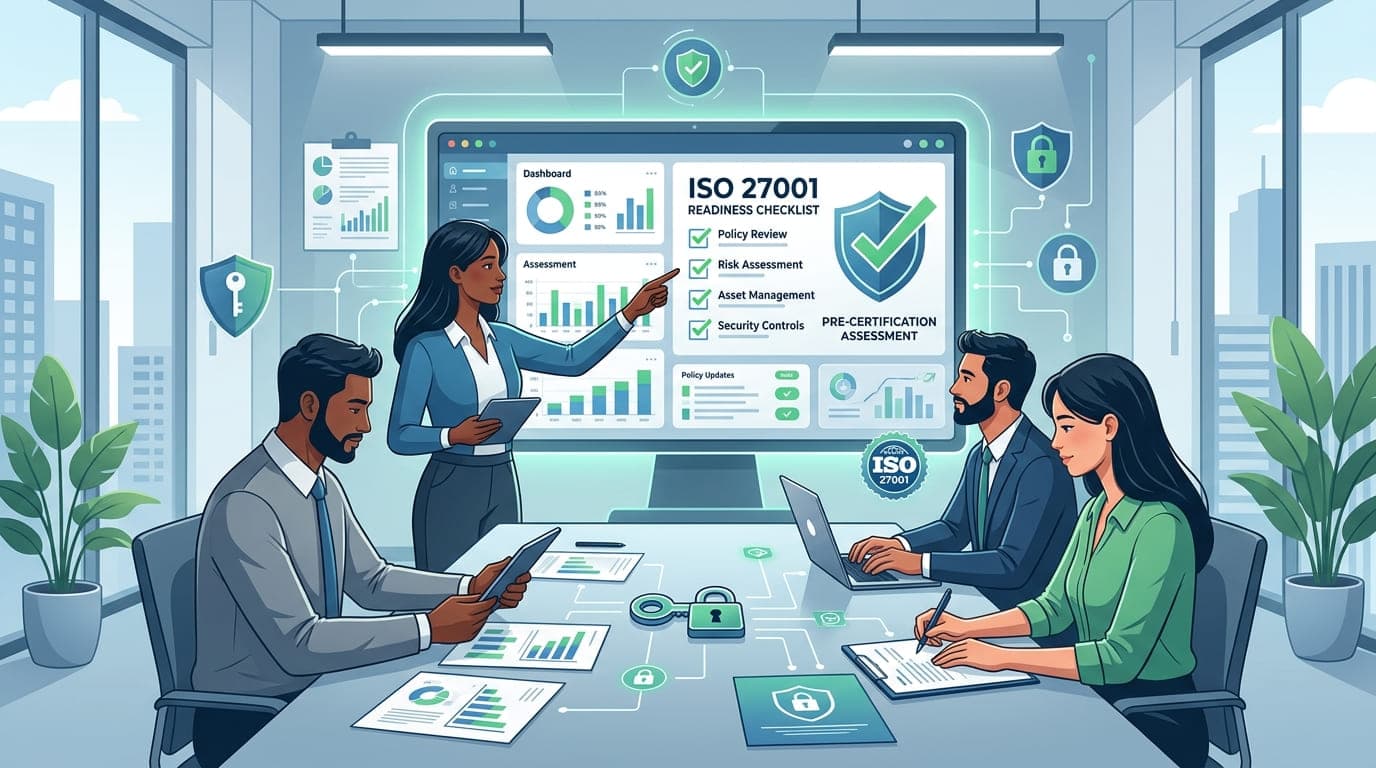
I'll never forget the look on the CFO's face when the external auditor handed back our ISO 27001 certification attempt in 2016. "Not ready," the report said. Three months of preparation. $85,000 in consulting fees. Weeks of employee time. All for a two-word verdict that felt like a punch to the gut.
The worst part? We thought we were ready. We had checked every box, documented every process, and genuinely believed we'd sail through. But we'd skipped the most critical step: a thorough internal readiness assessment.
That expensive lesson taught me something invaluable: the organizations that succeed at ISO 27001 certification aren't necessarily the most secure—they're the ones who honestly assess their readiness before inviting external auditors to judge them.
After guiding 40+ organizations through successful ISO 27001 certifications over the past fifteen years, I can tell you with certainty: the pre-certification assessment is where certification success is actually won or lost.
Why Most Organizations Fail Their First Certification Attempt
Here's a statistic that should terrify you: approximately 60% of organizations fail their first ISO 27001 certification audit. Not because they have bad security. Not because they lack investment. But because they walked into the audit unprepared for what would actually be evaluated.
I consulted with a financial services company in 2021 that had spent nearly a year preparing for ISO 27001. They had:
Implemented a $200,000 security information and event management (SIEM) system
Hired three additional security engineers
Deployed multi-factor authentication across the organization
Encrypted everything that could be encrypted
They failed the Stage 1 audit.
Why? Their documentation didn't match their actual practices. Their risk assessment was superficial. Their management review meetings had no documented evidence. They had built impressive security controls but failed to demonstrate the management system that ISO 27001 actually requires.
"ISO 27001 certification isn't about having the best security tools. It's about proving you have a systematic, documented, and continuously improving approach to information security management."
What a Pre-Certification Assessment Actually Reveals
Think of a pre-certification assessment like a dress rehearsal before opening night. You want to discover every problem, every gap, every misalignment while you still have time to fix it—not when the paying audience (your certification auditor) is watching.
Here's what I assess when I conduct internal readiness reviews:
The Three Layers of ISO 27001 Readiness
Layer 1: Documentation Completeness Does the paperwork exist, and does it say what it needs to say?
Layer 2: Implementation Evidence Can you prove you're actually doing what your documentation claims?
Layer 3: Cultural Integration Has ISO 27001 become part of how you operate, or is it just a compliance theater?
Most organizations focus exclusively on Layer 1. They create beautiful policies, detailed procedures, and comprehensive manuals. Then they wonder why they fail audits.
The truth? Auditors spend about 20% of their time reviewing documentation and 80% looking for evidence that you actually follow it.
The Pre-Certification Assessment Framework I've Used for 15 Years
Let me share the exact framework I use to assess readiness. This approach has helped organizations avoid costly failed audits and, more importantly, build security programs that actually work.
Phase 1: Documentation Gap Analysis (Week 1-2)
The first step is understanding what documentation you need versus what you have.
Required ISO 27001 Documentation | Why It Matters | Common Gaps I See |
|---|---|---|
Scope of ISMS | Defines boundaries of your certification | Too broad (impossible to implement) or too narrow (misses critical systems) |
Information Security Policy | Top-level commitment from leadership | Generic templates not tailored to actual business |
Risk Assessment Methodology | How you identify and evaluate risks | Inconsistent criteria, no clear decision framework |
Statement of Applicability (SoA) | Which controls apply and why | Boilerplate justifications, controls marked N/A without proper reasoning |
Risk Treatment Plan | How you're addressing identified risks | Vague action items, no ownership or timelines |
Internal Audit Program | Self-assessment procedures | No actual audit schedule or qualified auditors |
Management Review Records | Leadership oversight evidence | Meeting minutes exist but lack required elements |
Competence Records | Staff training and qualifications | Training completed but not documented |
Operational Procedures | Day-to-day security operations | Procedures exist but aren't actually followed |
Monitoring and Measurement | How you track effectiveness | Metrics collected but never analyzed |
I remember working with a healthcare technology company that was convinced their documentation was complete. We did a gap analysis and discovered they had 14 of the 18 mandatory documents, but only 3 were actually usable. The rest were either outdated, generic templates, or described processes they didn't actually follow.
We spent six weeks fixing the documentation before even thinking about scheduling the audit. That preparation saved them from a failed certification attempt.
Phase 2: Control Implementation Verification (Week 3-4)
This is where most organizations discover uncomfortable truths. You need to verify that the 93 ISO 27001 Annex A controls you claim to have implemented actually exist and function as documented.
Here's my assessment approach:
Evidence Collection Table:
Control Category | Assessment Method | Evidence Required | Red Flags to Watch For |
|---|---|---|---|
A.5: Policies | Document review + interviews | Approved policies with review dates | Policies older than 1 year, no evidence of communication |
A.6: Organization | Org chart review + role interviews | Defined roles with security responsibilities | Security duties unclear or unassigned |
A.7: Human Resources | HR process review + sample records | Background checks, training records, exit procedures | Inconsistent application, missing documentation |
A.8: Asset Management | Asset inventory audit | Current asset register with classifications | Outdated inventory, unclassified assets |
A.9: Access Control | IAM system review + sample testing | Access provisioning/deprovisioning evidence | Orphaned accounts, excessive privileges |
A.10: Cryptography | Encryption verification | Key management procedures + implementation proof | Weak algorithms, poor key storage |
A.11: Physical Security | Site walk-through + records | Access logs, visitor records, environmental controls | Undocumented access, controls not monitored |
A.12: Operations Security | Process observation + logs | Change records, backup tests, malware protection evidence | Procedures exist but not followed |
A.13: Communications | Network architecture review | Segmentation evidence, secure transfer mechanisms | Flat networks, unencrypted sensitive data transmission |
A.14: Acquisition & Development | SDLC review + code samples | Security requirements in projects, testing evidence | Security bolted on, not built in |
A.15: Supplier Relations | Vendor assessment records | Supplier agreements with security clauses, evaluations | No vendor risk assessments, generic contracts |
A.16: Incident Management | Incident log review + simulation | Documented incidents, response procedures tested | Incidents not logged, untested procedures |
A.17: Business Continuity | BCP/DR documentation + test results | Recovery procedures, test evidence, off-site backups | Plans untested, backups unverified |
A.18: Compliance | Legal register + audit records | List of applicable requirements, evidence of compliance | Incomplete legal inventory, no compliance verification |
Let me share a war story. In 2019, I assessed a manufacturing company that claimed full implementation of access controls (A.9). Their documentation was pristine—detailed procedures for access provisioning, regular access reviews, termination processes.
Then I asked to see evidence. I selected 10 terminated employees from the past six months and checked their account status. Seven still had active accounts. Four had privileged access. One former employee had logged in the previous week.
The CISO went pale. "We have the procedure," he said. "HR is supposed to notify IT when someone leaves."
"They do notify IT," I told him. "I reviewed the emails. But IT doesn't have a ticketing system for tracking terminations, so they get lost in inboxes."
We implemented a simple automated workflow connecting their HR system to their identity management platform. Problem solved. But imagine if they'd discovered this during the certification audit instead of the internal assessment.
"Your documentation describes your intentions. Your evidence reveals your reality. Auditors care far more about reality."
Phase 3: Management System Effectiveness (Week 5-6)
This is the layer that separates organizations that get certified from those that fail—and it's the layer most companies completely overlook.
ISO 27001 isn't just a security standard. It's a management system standard. That means you need to demonstrate that your leadership actively manages information security as a business process.
Management System Readiness Checklist:
Management System Element | What Auditors Look For | Evidence Required | Failure Indicators |
|---|---|---|---|
Management Commitment | Leadership actively involved in security decisions | Management review meeting minutes with ISMS agenda items | Security delegated entirely to IT, no executive participation |
Security Objectives | Measurable security goals aligned with business | Documented objectives with metrics and targets | Vague objectives, no measurement, no business alignment |
Risk Assessment Process | Regular, systematic risk identification and evaluation | Risk registers updated quarterly, methodology consistently applied | One-time risk assessment, inconsistent criteria, no updates |
Risk Treatment Decisions | Management decisions on how to handle risks | Risk treatment plans with approvals and timelines | Risks identified but no treatment decisions |
Resource Allocation | Budget and people assigned to security initiatives | Budget approvals, headcount, training investments | Security team understaffed, no budget for improvements |
Internal Audits | Self-assessment program with qualified auditors | Audit schedule, audit reports, corrective actions | No audits conducted, or audits by unqualified personnel |
Management Reviews | Regular senior leadership reviews of ISMS performance | Meeting records covering all required topics (see below) | Meetings happen but don't cover ISMS, or no documentation |
Continual Improvement | Evidence that the ISMS evolves based on findings | Corrective actions implemented, processes improved | Same problems persist, no learning from incidents |
Performance Metrics | KPIs that measure security effectiveness | Regular reports showing trends and analysis | Metrics collected but never reviewed or acted upon |
I worked with a SaaS company in 2022 that had excellent security controls but weak management system evidence. Their CEO was supportive of security but rarely involved in details. Management review meetings discussed security for 10 minutes once a quarter.
I sat in on their next management review and asked the CEO pointed questions:
"How many security incidents did we have last quarter?"
"What percentage of employees completed security training?"
"Are we meeting our security objectives?"
"What's the status of high-priority risks identified in our risk assessment?"
He couldn't answer any of them. Not because he didn't care, but because the ISMS wasn't integrated into business management.
We restructured their management reviews to include a standing ISMS agenda with required reporting:
Management Review Agenda Template:
Agenda Item | Information Required | Decision/Action Expected |
|---|---|---|
Previous Meeting Actions | Status of all action items from last review | Close completed items, update ongoing items |
Changes in External Issues | New threats, regulatory changes, market conditions | Assess impact on ISMS scope and controls |
Changes in Internal Issues | Organizational changes, new systems, business strategy shifts | Update risk assessment, adjust controls |
Security Performance | Metrics dashboard, KPI trends, objective status | Review trends, approve metric changes |
Feedback from Interested Parties | Customer concerns, partner requirements, employee feedback | Address concerns, update controls |
Risk Assessment Results | New risks, changed risk ratings, emerging threats | Approve risk treatment plans |
Audit Results | Internal audit findings, external audit results | Approve corrective actions, allocate resources |
Nonconformities and Corrective Actions | Policy violations, control failures, remediation status | Validate effectiveness of corrections |
Improvement Opportunities | Suggestions from team, efficiency gains, new technologies | Approve improvements, allocate budget |
Resource Adequacy | Budget status, staffing needs, tool requirements | Approve resource requests |
After three months of structured management reviews, the CEO told me: "I finally understand what ISO 27001 is about. It's not an IT project—it's a governance framework that happens to focus on information security."
Exactly.
The Internal Audit: Your Certification Dress Rehearsal
If there's one element of the pre-certification assessment that predicts success, it's conducting a rigorous internal audit using external auditor methodology.
Here's how I run internal audits that actually prepare organizations for certification:
The Internal Audit Process
Step 1: Audit Planning (2-3 weeks before audit)
Create an audit plan that mirrors what external auditors will do:
Audit Area | Sample Size | Audit Method | Evidence to Review |
|---|---|---|---|
Documentation Review | 100% of mandatory docs | Document analysis | All required policies, procedures, records |
Control Implementation | 20% sample per control | Testing + interviews | Implementation evidence, system configurations |
Personnel Interviews | 15-20 staff across functions | Structured interviews | Understanding of roles, procedures, and responsibilities |
System Reviews | All in-scope systems | Technical assessment | Configurations, logs, access controls |
Process Observations | 3-5 critical processes | Direct observation | Real-time adherence to procedures |
Step 2: Conducting the Audit (1-2 weeks)
I use the same approach external auditors use:
Interview Question Categories:
Role Being Interviewed | Sample Questions | What I'm Really Testing |
|---|---|---|
Executive Management | "What are the top three security risks facing the organization?" "How do you measure security program effectiveness?" | Management commitment and awareness |
ISMS Manager/CISO | "Walk me through your risk assessment process." "How do you handle nonconformities?" | Process knowledge and implementation |
IT Operations | "Show me how you provision access for a new employee." "What happens when you detect suspicious activity?" | Procedure adherence and competence |
Developers | "How do you incorporate security requirements into new features?" "Describe your code review process." | Secure development practices |
HR Personnel | "What security checks do you perform during onboarding?" "How is security training tracked?" | HR security controls |
Regular Employees | "What do you do if you receive a suspicious email?" "Where do you store sensitive customer data?" | Security awareness and culture |
Step 3: Findings Documentation
I categorize findings exactly like certification auditors do:
Finding Type | Definition | Impact on Certification | Example |
|---|---|---|---|
Major Nonconformity | Critical gap in required controls or management system | Automatic certification failure | No risk assessment conducted, required documentation missing |
Minor Nonconformity | Isolated failure of a control or process | Can be certified with corrective action plan | One terminated employee's access not removed, single backup test not documented |
Observation | Potential weakness or improvement opportunity | No impact on certification | Inconsistent naming conventions in documentation |
Opportunity for Improvement | Better practices or efficiencies | No impact, but valuable feedback | Could automate manual compliance checks |
A major nonconformity in an internal audit is a blessing in disguise—you found it before the external auditor did. I've seen organizations identify and fix major nonconformities during internal audits, then achieve certification without any major findings.
Step 4: Corrective Action Management
This is where the rubber meets the road. Findings without corrective actions are worthless.
Corrective Action Tracking Table:
Finding ID | Finding Description | Root Cause | Corrective Action | Owner | Due Date | Status | Verification Evidence |
|---|---|---|---|---|---|---|---|
IA-2024-001 | 3 of 15 terminated employees still have active accounts | No automated deprovisioning workflow | Implement HR-to-IAM integration | IT Director | 2024-06-30 | In Progress | System integration documentation, test results |
IA-2024-002 | Backup restore testing not conducted for 8 months | No calendar reminder, responsible person changed roles | Add quarterly backup tests to audit calendar, assign new owner | Operations Manager | 2024-05-15 | Complete | Q1 2024 restore test report |
IA-2024-003 | 4 policies not reviewed within required annual timeframe | Review dates not tracked systematically | Create policy review calendar with automated reminders | Compliance Manager | 2024-05-30 | Complete | Updated policy review schedule, reminder configuration |
I tell clients: your internal audit corrective actions should be complete before you schedule the certification audit. If you can't fix the problems you found internally, external auditors will find them too—and they won't give you time to fix them before making their decision.
The Readiness Scorecard: Are You Actually Ready?
After fifteen years of pre-certification assessments, I've developed a scoring system that predicts certification success with about 85% accuracy.
ISO 27001 Certification Readiness Scorecard:
Assessment Category | Weight | Evaluation Criteria | Your Score (0-10) | Weighted Score |
|---|---|---|---|---|
Mandatory Documentation | 15% | All 18 required documents exist, are current (reviewed within 12 months), and reflect actual practices | ___ | ___ × 0.15 |
Statement of Applicability | 10% | All 93 Annex A controls addressed with clear justification for inclusion/exclusion | ___ | ___ × 0.10 |
Risk Assessment | 15% | Comprehensive risk assessment using documented methodology, updated within 6 months | ___ | ___ × 0.15 |
Control Implementation | 25% | Evidence available for all applicable controls, controls functioning as designed | ___ | ___ × 0.25 |
Management System | 15% | Management reviews conducted quarterly, documented decisions, resource allocation | ___ | ___ × 0.15 |
Internal Audit | 10% | Complete internal audit conducted, findings documented, corrective actions implemented | ___ | ___ × 0.10 |
Personnel Competence | 5% | Staff understand roles, can explain procedures, training documented | ___ | ___ × 0.05 |
Continual Improvement | 5% | Evidence of learning from incidents, process improvements, corrective actions effective | ___ | ___ × 0.05 |
Total Readiness Score | 100% | _____ / 10 |
Scoring Interpretation:
Score Range | Readiness Level | Recommendation |
|---|---|---|
9.0 - 10.0 | Excellent | Schedule certification audit with confidence |
7.5 - 8.9 | Good | Address minor gaps, then schedule audit |
6.0 - 7.4 | Fair | 2-3 months additional preparation needed |
4.0 - 5.9 | Poor | 4-6 months significant work required |
Below 4.0 | Not Ready | 6-12 months fundamental implementation needed |
I assessed a technology company in 2020 that scored 5.2 on this scale. The CEO wanted to schedule the certification audit anyway—they had a customer deadline.
I told him bluntly: "You'll fail. It won't be close. You'll waste $40,000 on audit fees and still need to fix these problems before trying again."
He didn't believe me. They scheduled the audit. They scored 5.4 in the actual audit and failed with 3 major nonconformities and 14 minor nonconformities.
Six months later, after following the remediation plan we'd outlined, they scored 9.1 on the readiness assessment. The certification audit found zero major nonconformities, two minor nonconformities, and they achieved certification.
The CEO sent me an email afterward: "You were right. We should have listened. The extra six months was frustrating, but failing the first audit was humiliating—and expensive."
"Certification readiness isn't about being perfect. It's about being honest about gaps and fixing them before an auditor charges you $15,000 to point them out."
The Two-Week Crash Assessment (When You Don't Have Time)
Sometimes organizations discover late that they need ISO 27001 certification. Maybe a major customer demands it. Maybe a funding round requires it. Maybe a competitor just got certified and sales is feeling the pressure.
When you absolutely must assess readiness quickly, here's my accelerated approach:
Day 1-2: Critical Documentation Check
Focus on the "must-haves":
Information Security Policy (with management approval)
ISMS Scope definition
Risk Assessment & Treatment Plan
Statement of Applicability
At least one completed Internal Audit
At least one Management Review
If any of these are missing or fundamentally flawed, stop. You're not ready, period.
Day 3-5: High-Risk Control Verification
Test the controls that auditors always scrutinize:
Access management (user provisioning/deprovisioning)
Change management (evidence of controlled changes)
Backup and recovery (recent test results)
Incident response (documented incidents and responses)
Vendor management (security assessments of critical suppliers)
Day 6-8: Personnel Interviews
Interview 10-15 people across different roles:
Do they know their security responsibilities?
Can they locate and explain relevant procedures?
Do they understand how to report incidents?
Are they aware of recent security training?
Day 9-10: Evidence Spot Check
Select 5 controls at random and demand complete evidence:
Does documentation exist?
Does it describe actual practices?
Is there evidence of implementation?
Is evidence current (within the last 3-6 months)?
If you can get through this accelerated assessment without finding major gaps, you might be ready. But honestly? If you're doing a two-week assessment, you probably started too late and should expect to find problems.
Common Pre-Certification Gotchas I See Repeatedly
After conducting hundreds of readiness assessments, certain problems appear over and over. Here are the top 10:
The Fatal Flaws Table:
Gotcha | Why It Happens | How to Fix It | Time to Remediate |
|---|---|---|---|
Documentation-Reality Gap | Procedures written to sound good, not to reflect actual practices | Rewrite documentation to match reality, or change practices to match documentation | 4-8 weeks |
Stale Risk Assessment | Initial risk assessment never updated | Establish quarterly risk review process, update risk register | 2-3 weeks |
Generic Statement of Applicability | Copy-paste from template without customization | Review each control for actual applicability, provide real justifications | 3-4 weeks |
No Evidence Trail | Controls implemented but not documented | Implement logging, save approvals, document decisions going forward | 8-12 weeks |
Fake Management Reviews | Security discussed briefly in broader meetings, not properly documented | Structure dedicated ISMS management reviews with required agenda | 1-2 weeks |
Untested Procedures | Incident response, BCP/DR plans exist but never tested | Conduct tabletop exercises, document results | 2-4 weeks |
Orphaned Accounts | Terminated employees with active system access | Audit all accounts, implement automated deprovisioning | 2-3 weeks |
Inadequate Internal Audits | Internal audit was checkbox exercise, not thorough assessment | Conduct proper internal audit using external auditor methodology | 4-6 weeks |
Missing Competence Records | Training happened but not documented | Gather historical training records, implement training tracking system | 1-2 weeks |
No Corrective Action System | Problems identified but no systematic remediation process | Implement findings tracking system with ownership and deadlines | 2-3 weeks |
I remember assessing a logistics company that had what I call "conference room compliance"—everything looked perfect in their documentation, but nothing worked in practice.
Their access control procedure said: "All access requests must be approved by the data owner and the employee's manager before provisioning."
I asked to see evidence. They showed me a folder with 40 access request forms from the past six months. I selected 10 randomly and asked their identity management team about them.
Six had only one approval (not two). Three had no approvals at all—someone had just submitted a ticket to IT. One was for an employee who had left the company.
"How is this possible?" I asked the IT manager. "Your procedure is very clear."
He shrugged. "The procedure is what the compliance consultant wrote. But we don't actually have a system to enforce two approvals, so we just try to remember. Sometimes we forget."
We spent two weeks implementing automated workflow that enforced the procedure. Problem solved. But that's two weeks they would have lost if they'd discovered this during the certification audit.
The Pre-Certification Assessment Timeline
Here's a realistic timeline for a thorough readiness assessment based on organization size:
Organization Size | Assessment Duration | FTE Effort Required | Recommended Team |
|---|---|---|---|
Small (< 50 employees) | 3-4 weeks | 0.5 FTE | 1 security lead + 1 compliance specialist |
Medium (50-500 employees) | 6-8 weeks | 1-2 FTE | 1 CISO + 2 security engineers + 1 compliance manager |
Large (500-2000 employees) | 10-12 weeks | 2-3 FTE | 1 CISO + 3-4 security team members + 2 compliance specialists + department representatives |
Enterprise (2000+ employees) | 12-16 weeks | 3-5 FTE | 1 CISO + 5-6 security team + 3-4 compliance team + cross-functional steering committee |
Don't rush this. I've seen organizations try to compress a 12-week assessment into 3 weeks. They always miss critical gaps.
Your Pre-Certification Assessment Roadmap
If you're preparing for ISO 27001 certification, here's exactly what I recommend:
Weeks 1-2: Documentation Gap Analysis
Inventory all existing security documentation
Compare against ISO 27001 mandatory requirements
Identify missing or inadequate documents
Prioritize documentation remediation
Weeks 3-4: Control Implementation Verification
Create evidence collection plan
Sample controls across all Annex A categories
Gather implementation evidence
Identify controls with weak or missing evidence
Weeks 5-6: Management System Assessment
Review management review records
Evaluate risk assessment current state
Assess resource allocation and budget
Check internal audit program status
Weeks 7-8: Internal Audit Execution
Conduct comprehensive internal audit
Document all findings (major, minor, observations)
Create corrective action plans
Assign owners and deadlines
Weeks 9-10: Corrective Action Implementation
Execute remediation plans
Gather evidence of corrections
Verify effectiveness of corrective actions
Update documentation as needed
Weeks 11-12: Final Readiness Validation
Score against readiness scorecard
Conduct executive readiness briefing
Make go/no-go decision on certification audit
Schedule certification audit if ready
The Investment That Pays for Itself
"How much will this cost?" is usually the first question I get about pre-certification assessments.
Here's my honest answer:
Internal Resource Investment:
Resource | Time Commitment | Estimated Cost (fully loaded) |
|---|---|---|
ISMS Manager/CISO | 50-60 hours | $7,500 - $12,000 |
Security Team (2-3 people) | 40-50 hours each | $8,000 - $15,000 |
Compliance Specialist | 60-80 hours | $6,000 - $10,000 |
Department Representatives | 10-15 hours each | $3,000 - $5,000 |
Total Internal Cost | $24,500 - $42,000 |
External Support (Optional but Recommended):
Service | Typical Cost | Value Proposition |
|---|---|---|
Pre-Assessment Consultant | $15,000 - $35,000 | Expert gap identification, faster timeline |
Internal Audit Support | $8,000 - $15,000 | Objective assessment, auditor perspective |
Documentation Review | $5,000 - $10,000 | Quality assurance, best practice alignment |
Total External Cost | $28,000 - $60,000 |
Total Pre-Certification Investment: $52,500 - $102,000
That sounds expensive until you compare it to the alternative:
Cost of Failed Certification Audit:
Certification audit fees (wasted): $25,000 - $45,000
Re-audit fees: $25,000 - $45,000
Additional consulting to fix problems: $30,000 - $60,000
Delayed customer contracts: Potentially millions
Team morale impact: Priceless (in a bad way)
Total Cost of Failure: $80,000 - $150,000+ plus opportunity cost
I worked with a company that spent $65,000 on a thorough pre-certification assessment. They identified and fixed 23 gaps before the certification audit.
Their certification audit? One minor nonconformity. Certified on first attempt.
Their CEO told me: "Best $65,000 we ever spent. We'd budgeted $100,000 for potential re-audit costs that we never needed."
"A pre-certification assessment is insurance against failure. And unlike most insurance, it has a positive ROI even if nothing goes wrong."
Final Thoughts: The Readiness Mindset
After fifteen years of helping organizations achieve ISO 27001 certification, I've learned that readiness is as much about mindset as it is about documentation and controls.
The organizations that succeed approach pre-certification assessment with genuine curiosity: "What don't we know? What have we missed? Where are we fooling ourselves?"
The organizations that struggle approach it with defensiveness: "We've worked so hard, we must be ready. The assessment is just a formality."
I remember a healthcare company's CISO who, during our readiness assessment, responded to every gap I identified with "But we're doing our best" or "That seems like an unreasonable expectation."
I finally stopped the assessment and said: "You're right, you are doing your best. But your best right now isn't ISO 27001 compliant. The question is: do you want to know that now while you can fix it, or during the certification audit when you can't?"
He took a deep breath. "Show me everything. I want to know the truth."
We found 31 gaps. We fixed all 31. They achieved certification six months later.
Your pre-certification assessment is not the enemy. It's your ally. It's the dress rehearsal that lets you fix problems while the stakes are low. It's the honest mirror that shows you what you really look like, not what you hope you look like.
Embrace it. Learn from it. Use it to build not just a certified ISMS, but a genuinely effective one.
Because at the end of the day, ISO 27001 certification is wonderful. But what's even better is having an information security management system that actually protects your organization, your customers, and your reputation.
The pre-certification assessment is where you ensure you're building the latter, not just achieving the former.
Ready to assess your ISO 27001 readiness? Download our comprehensive Pre-Certification Assessment Checklist and Scorecard. At PentesterWorld, we provide practical tools and real-world guidance from cybersecurity professionals who've been in the trenches. Subscribe for weekly insights on compliance implementation that actually works.