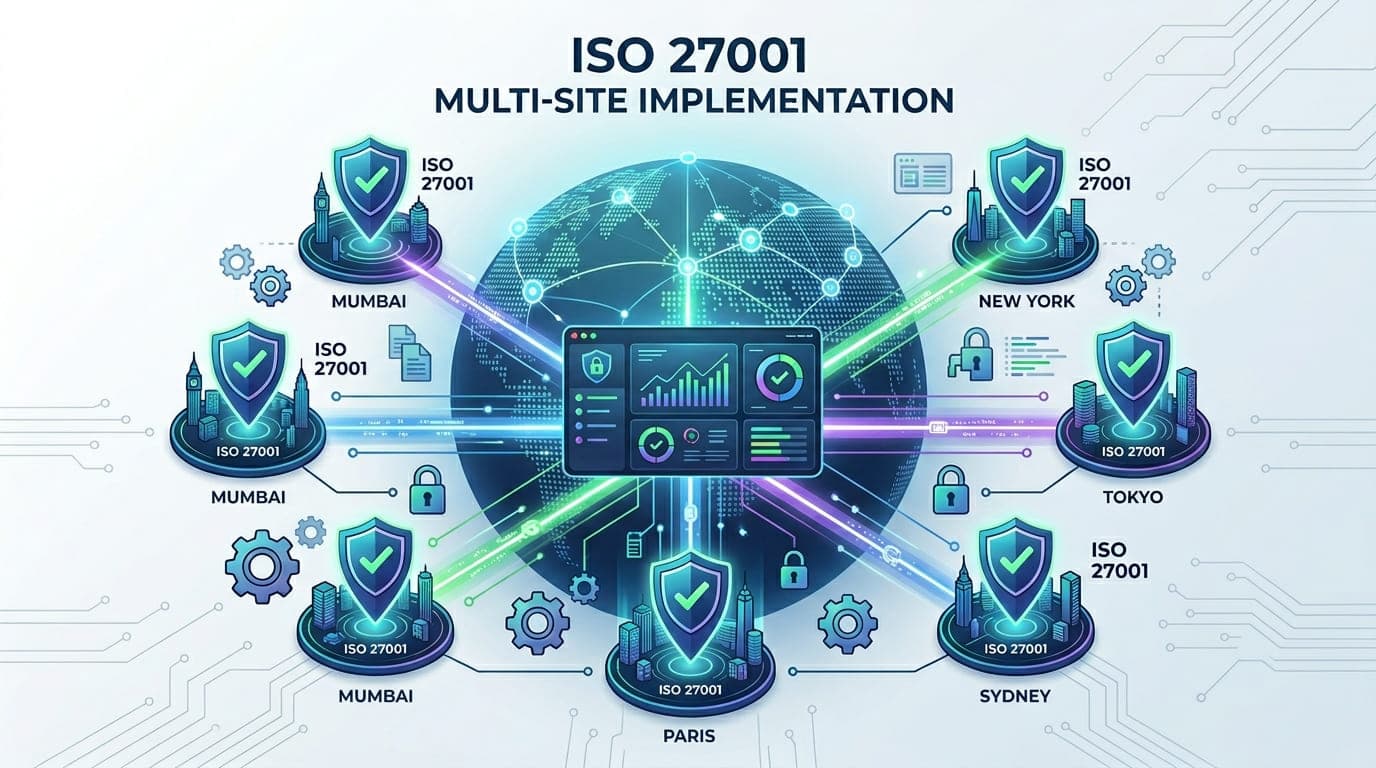
I still remember the panic in the room when the Global CISO of a multinational manufacturing company asked me, "How do we get all 23 locations certified under one ISO 27001 certificate?" His team looked exhausted. They'd been trying to coordinate implementation across offices in 12 countries for eight months, and it was falling apart.
The London office was using one set of policies. The Singapore team had created their own procedures. The New York office was somewhere in between. Meanwhile, their certification audit was scheduled for three months out, and nobody was confident they'd pass.
That was in 2017. By the end of that year, they achieved certification for all 23 sites. More importantly, they built a scalable framework that allowed them to add 11 more locations over the next three years without missing a beat.
Multi-site ISO 27001 implementation isn't just challenging—it's an entirely different animal from single-site certification. After managing over 30 multi-site implementations across my career, I've learned that the organizations that succeed don't just replicate their processes everywhere. They build intelligent frameworks that balance consistency with local flexibility.
Let me show you how.
The Multi-Site Challenge: Why It's Harder Than You Think
Here's what catches everyone off guard: managing multiple locations isn't just "single-site times N." It's an exponential complexity problem.
The Coordination Nightmare I Walked Into
In 2019, I was brought in to rescue a failing multi-site implementation for a financial services company. They had seven offices across North America and Europe. Six months into their project, here's what I found:
The Problems:
Each location had interpreted the same ISO 27001 requirement differently
Access control policies varied wildly (London required biometrics, Chicago used badge systems, Toronto had... a receptionist)
Incident response procedures existed in three languages with conflicting workflows
Nobody knew which version of which document was current
Risk assessments used different methodologies and scoring systems
The kicker? They'd spent over $400,000 and were nowhere near ready for certification.
"Multi-site implementation fails not because sites can't implement controls, but because organizations can't maintain consistency while respecting necessary local differences."
Understanding Your Multi-Site Options
Most organizations don't realize they have choices in how they approach multi-site certification. Let me break down what I've seen work in practice:
Certification Approach | Best For | Pros | Cons | Typical Cost Range |
|---|---|---|---|---|
Single Certificate (All Sites) | Mature organizations with standardized processes | Lower annual costs, unified management, stronger brand | All sites must maintain standards, one failure affects all | $45,000-$120,000 initial |
Main Site + Sampled Sites | Growing organizations (10+ locations) | Cost-effective, scalable, allows variance | Rotation creates uncertainty, unsampled sites may drift | $35,000-$90,000 initial |
Individual Certificates | Highly diverse operations or acquisitions | Maximum flexibility, isolated risk | Expensive, management overhead, brand confusion | $30,000-$80,000 per site |
Regional Groupings | Geographic or operational divisions | Balanced approach, clear ownership | Coordination between regions needed | $40,000-$100,000 per region |
The Decision Framework I Use With Clients
When a client asks me which approach to choose, I walk them through these questions:
Question 1: How similar are your operations?
I worked with a hotel chain that had 45 locations. Each hotel ran nearly identical operations—same property management system, same payment processing, same guest data handling. They were perfect for single certificate covering all sites.
Contrast that with a healthcare company I advised: three hospitals, two research labs, and a corporate office. Wildly different operations, different risks, different controls needed. They went with individual certificates for each major facility type.
Question 2: What's your growth trajectory?
A fast-growing SaaS company came to me with four offices and plans to open 10 more in two years. We implemented main site certification with sampling. As they opened new offices, they'd get rotated into the sample during surveillance audits without needing complete recertification each time.
Question 3: What's your risk tolerance?
Here's the hard truth: with a single certificate, one site's compliance failure can jeopardize your entire certification. I've seen it happen.
A retail company with 18 stores lost their ISO 27001 certification because one location failed to properly dispose of documents containing customer data. One store, one control failure, entire certificate suspended.
If that level of risk makes you uncomfortable, individual or regional certificates provide isolation.
The Framework That Actually Works: My Battle-Tested Approach
After managing 30+ multi-site implementations, I've developed a framework that consistently succeeds. Here's what works:
Phase 1: Establish Your Core (Months 1-2)
Think of this as building your central nervous system. Everything else connects to this.
Create Your Master ISMS Documentation:
Document Type | Centralized Elements | Local Adaptation Allowed |
|---|---|---|
Information Security Policy | Policy statements, objectives, commitment | Local language translation, local contact information |
Risk Assessment Methodology | Scoring criteria, risk matrix, treatment options | Asset identification, local threat analysis |
Statement of Applicability (SoA) | Control applicability decisions, implementation approaches | Site-specific implementation details |
Mandatory Procedures | Incident response framework, change management, access control principles | Local escalation paths, site-specific tools |
Supporting Procedures | Templates, guidelines, best practices | Complete local adaptation with approval |
I learned this structure the hard way. In 2016, I worked with a logistics company that tried to centralize everything. Their London warehouse needed different physical security controls than their Miami facility (different threats, different regulations, different infrastructure).
We were two months from certification when we realized the centralized physical security procedure didn't work for any site. We had to start over.
The solution? Define what must be consistent (the "what" and "why") and allow flexibility in execution (the "how").
Phase 2: Build Your Site Implementation Teams (Month 2-3)
Multi-site implementation lives or dies on local ownership. Here's the team structure I've seen succeed:
Central Governance Team:
ISMS Manager (1 person): Overall program owner
Lead Auditor (1 person): Internal audit coordination
Documentation Manager (1 person): Version control and distribution
Technical Security Lead (1 person): Technical controls standardization
Site Implementation Teams (per location):
Site Security Coordinator (0.25-0.5 FTE): Local champion and liaison
Site Management Sponsor (executive oversight): Budget and authority
Key Department Representatives (2-4 people): HR, IT, Operations, Facilities
A telecommunications company I advised tried to manage 12 sites with just a central team. They burned out in four months. When we restructured with empowered site coordinators, implementation accelerated by 300%.
"The secret to multi-site success isn't control from the center—it's orchestrating empowered local teams toward a common standard."
Phase 3: Implement in Waves (Months 3-9)
Never try to implement all sites simultaneously. Trust me on this one.
Wave 1: Pilot Site (Months 3-5)
Choose your most mature location
Full implementation and documentation
Identify and fix issues in your approach
Create reusable templates and tools
I always recommend piloting at your headquarters or most mature site. Why? Because that's where you'll have the most support, the best resources, and the ability to iterate quickly.
A manufacturing company I worked with piloted at their newest facility "because it was smaller." Disaster. The new site lacked mature processes, experienced staff, and institutional knowledge. We spent twice as long on the pilot than if we'd started at headquarters.
Wave 2: Fast Followers (Months 5-7)
2-3 sites representing different scenarios
Validate your approach across varying conditions
Refine templates and procedures
Build your knowledge base
Wave 3: Broad Rollout (Months 7-9)
Remaining sites in parallel groups of 3-4
Use lessons learned from previous waves
Site coordinators support each other
Central team provides oversight and guidance
Phase 4: Unified Internal Audit (Months 9-10)
This is where multi-site implementations often stumble. Your internal audit needs to verify consistency across all sites while respecting local adaptations.
My Multi-Site Audit Approach:
Audit Focus Area | What I Examine | Why It Matters |
|---|---|---|
Core Controls (100% of sites) | Access control, incident response, risk assessment, management review | Non-negotiable requirements that must be consistent |
Process Controls (Sample of sites) | Change management, asset management, document control | Important but can vary in implementation |
Physical Controls (Site-specific) | Physical security, equipment security, environmental controls | Highly dependent on local context |
Supporting Controls (Risk-based) | Mobile device management, remote access, development security | Varies based on site activities |
I worked with a retail chain that tried to audit every control at every site. With 28 stores, they estimated 400 hours of audit time. We restructured to focus audits based on risk and got it down to 120 hours with better coverage.
The Sampling Strategy That Works:
For organizations with 10+ similar sites, smart sampling saves time without sacrificing quality:
Year 1: Audit 3-4 representative sites plus headquarters
Year 2: Audit 3-4 different sites (rotation ensures all sites audited over 3 years)
Year 3: Complete the rotation
Ongoing: Risk-based selection plus any sites with previous issues
Phase 5: Certification Audit Preparation (Months 10-11)
Here's what most organizations miss: certification audits for multi-site implementations work differently than single-site audits.
Understanding the Site Sampling Methodology:
Certification bodies use ISO/IEC 17021 guidelines for multi-site sampling. Here's the typical formula:
Sites to Audit = √(Total Sites) + 1
So for a 25-site organization: √25 + 1 = 6 sites will be audited during Stage 2.
But here's the critical part I always emphasize: the auditor chooses which sites, not you. They'll typically include:
The site where central ISMS management occurs
The largest sites by headcount or criticality
Geographically diverse locations
Sites with highest risk activities
At least one site with previous issues (if any)
The Smart Preparation Strategy:
I tell clients to prepare as if any site could be selected. In 2020, I worked with a logistics company that assumed their smallest sites wouldn't be audited. The auditor specifically chose two small sites to verify the ISMS scaled down appropriately. One failed miserably, and we nearly lost certification.
Common Multi-Site Challenges (And How to Solve Them)
Challenge 1: The Communication Breakdown
The Problem: Information flows poorly between central team and sites. Central updates policies; sites don't implement them. Sites have issues; central doesn't hear about them until it's too late.
What I've Seen Work:
Communication Tool | Purpose | Frequency | Owner |
|---|---|---|---|
Monthly ISMS Meeting | Program updates, issue escalation, best practice sharing | Monthly | Central ISMS Manager |
Site Coordinator Network | Peer support, problem-solving, knowledge sharing | Bi-weekly | Rotating site coordinators |
Quarterly Management Review | Performance metrics, resource needs, strategic direction | Quarterly | Executive sponsor |
Annual ISMS Summit | In-person collaboration, training, relationship building | Annual | Central governance team |
Instant Collaboration Platform | Daily questions, quick guidance, urgent issues | Ongoing/as-needed | All team members |
A healthcare organization I advised implemented a simple Slack channel for their site coordinators. Within three months, they'd solved 47 implementation challenges through peer-to-peer support—issues that previously would have escalated to expensive consultant calls.
Challenge 2: The Documentation Disaster
I can't count how many times I've walked into a multi-site implementation and asked, "Which version of the access control procedure should I review?" only to find:
Seven different versions across seven sites
No clear indication which is current
Sites unaware updates exist
Central team doesn't know what sites are actually using
The Solution That Saves Sanity:
Implement a document management system with these non-negotiable features:
Central Repository Requirements:
Single source of truth accessible to all sites
Version control with clear approval workflow
Automatic notifications of updates
Language translation capabilities
Read acknowledgment tracking
Search functionality
I don't care if you use SharePoint, Confluence, a dedicated ISMS tool, or a sophisticated document management system. What matters is that everyone can access the current version and you can prove they've been notified of updates.
A financial services company I worked with used a simple SharePoint site with email notifications. Cost them $5,000 to set up. Saved them from a major certification issue when they could prove all sites had acknowledged the updated incident response procedure.
Challenge 3: The Technical Control Consistency Conundrum
Here's where multi-site implementations get technically hairy. How do you maintain consistent technical controls across sites with different:
IT infrastructure
Operating systems
Applications
Network designs
Legacy systems
My Practical Framework:
Define Control Objectives, Not Specific Technologies
Instead of mandating "All sites must use Cisco firewalls with these specific rules," specify:
"All sites must implement network segmentation that:
Separates production from development environments
Isolates payment processing systems
Restricts administrative access to defined IP ranges
Logs all network traffic crossing security zones
Reviews firewall rules quarterly"
This allows the London office to use their Cisco ASA, Singapore to use their Palo Alto, and the new cloud-first site to use AWS security groups—all meeting the same security objective.
The Technology Variance Matrix:
Control Category | Standardization Level | Rationale | Example |
|---|---|---|---|
Identity Management | High - Centralized | Single source of identity, consistent access policies | Azure AD for all sites |
Endpoint Protection | High - Standardized | Consistent threat protection, centralized monitoring | Same EDR solution everywhere |
Network Security | Medium - Framework | Common objectives, local implementation | Firewall objectives, vendor flexibility |
Physical Security | Low - Site-specific | Facilities vary significantly | Badge systems, cameras, local needs |
Backup Solutions | Medium - Standardized | Consistent recovery capabilities, easier management | Same backup platform, local storage |
Challenge 4: The Time Zone and Language Barrier
I worked with a global software company with offices in San Francisco, London, Bangalore, and Tokyo. Coordinating anything was a scheduling nightmare. Document translation was expensive and slow. Cultural differences in communication styles caused misunderstandings.
Practical Solutions:
For Time Zones:
Record all training sessions and meetings
Use asynchronous collaboration tools
Rotate meeting times to share the inconvenience
Create regional sub-teams that can operate independently
Build in longer lead times for cross-timezone approvals
For Language:
Invest in professional translation for core documents (policy, SoA, key procedures)
Allow local language for supporting documentation
Use visual diagrams and flowcharts (universal language)
Ensure audit evidence can be understood by English-speaking auditors
Budget for translation services during audits
One company I advised spent $15,000 on professional translation of core documents. Seems expensive until you consider they avoided weeks of misunderstandings and rework. The ROI was easily 10x.
"Multi-site implementation is where standardization meets reality. The organizations that succeed are the ones that know when to insist on consistency and when to allow local adaptation."
The Technology Stack for Multi-Site Success
You can't manage multi-site implementation with spreadsheets and email. Trust me, I've watched organizations try and fail.
Essential Technology Components:
Tool Category | Purpose | Must-Have Features | Realistic Budget |
|---|---|---|---|
ISMS Platform | Central control hub, document management, audit tracking | Multi-tenant, role-based access, workflow automation, reporting | $8,000-$40,000/year |
Risk Management Tool | Risk assessment, treatment tracking, register management | Site-specific assessments, consolidated view, approval workflow | $5,000-$25,000/year |
Internal Audit Tool | Audit planning, execution, finding tracking, evidence management | Multi-site scheduling, sampling support, collaboration features | $3,000-$15,000/year |
Training Platform | Awareness training, completion tracking, compliance reporting | Multi-language, customizable content, certificate management | $2,000-$10,000/year |
Collaboration Platform | Communication, document sharing, quick questions | Real-time messaging, file sharing, search, integrations | $1,500-$8,000/year |
GRC Platform (Advanced) | Integrated governance, risk, and compliance management | Everything above in one platform | $20,000-$100,000/year |
The Build vs. Buy Decision:
I've seen organizations go both ways. In 2018, a tech company built their own ISMS platform because "we're a software company, we can build this." They spent $200,000 in development costs and six months of time. Two years later, they switched to a commercial platform because maintaining their custom system became unsustainable.
Conversely, a 10-person cybersecurity consultancy I advised successfully used free tools (Google Workspace, Confluence, Trello) and spent $3,000 annually. They achieved certification for three sites.
My Recommendation: If you have fewer than 5 sites and basic needs, use affordable off-the-shelf tools. If you have 10+ sites or complex requirements, invest in a proper GRC platform. The efficiency gains pay for themselves.
Real-World Success Story: How We Certified 31 Sites in 14 Months
Let me share a case study that demonstrates these principles in action.
The Client: International healthcare technology company with 31 locations across North America, Europe, and Asia-Pacific. They provided electronic health record systems to hospitals and needed ISO 27001 to win enterprise contracts.
The Challenge:
Never attempted any compliance certification
Highly decentralized operations (each region operated semi-independently)
Significant variation in infrastructure (cloud-native to legacy data centers)
Previous consultant had failed after 10 months with no progress
The Approach:
Month 1-2: Foundation
Selected headquarters (Seattle) as pilot site
Established central governance team (4 people)
Identified site coordinators at each location
Created core ISMS documentation with clear central/local boundaries
Month 3-5: Pilot Implementation
Full implementation at Seattle headquarters
Documented all challenges and solutions in knowledge base
Created reusable templates and procedures
Built automated tooling for common tasks
Month 6-8: Regional Rollout
North America wave (8 sites): Used similar infrastructure, easy adoption
Europe wave (12 sites): Required policy translations, some process adaptations
Asia-Pacific wave (10 sites): Most significant adaptations needed
Month 9-11: Harmonization
Cross-regional internal audits
Identified and resolved inconsistencies
Updated documentation based on findings
Management review across all sites
Month 12-14: Certification
Stage 1 audit (documentation review)
Stage 2 audit (9 sites sampled: Seattle HQ + 8 others)
Minor non-conformities at 2 sites, quickly resolved
Certification achieved for all 31 sites
The Results:
Total project cost: $380,000 (vs. $750,000 previous consultant burned through)
Timeline: 14 months (vs. indefinite with previous approach)
First-attempt certification success
Won $4.7M contract within 3 months of certification
Project ROI: 12x in first year
What Made It Work:
Strong local ownership with central coordination
Clear distinction between standardized and flexible elements
Phased approach that allowed learning and iteration
Appropriate technology investment ($45,000 in GRC platform)
Executive commitment and resource allocation
Cost Breakdown: What Multi-Site Actually Costs
Nobody talks about real numbers, so let me share what I've seen across multiple implementations:
Small Organization (3-5 sites, <500 employees):
Cost Category | Range | Notes |
|---|---|---|
Consultant/Implementation Support | $40,000-$80,000 | Can reduce with internal expertise |
Certification Body Fees | $25,000-$45,000 | Initial + first surveillance |
Technology/Tools | $5,000-$15,000 | Can use free/low-cost options |
Internal Labor (FTE) | $80,000-$150,000 | 1.0-1.5 FTE for 12 months |
Training & Awareness | $5,000-$10,000 | Internal and external training |
Total First Year | $155,000-$300,000 | |
Annual Ongoing | $40,000-$70,000 | Surveillance audits, maintenance |
Medium Organization (6-15 sites, 500-2000 employees):
Cost Category | Range | Notes |
|---|---|---|
Consultant/Implementation Support | $80,000-$150,000 | More complex coordination needed |
Certification Body Fees | $45,000-$85,000 | Initial + first surveillance |
Technology/Tools | $20,000-$50,000 | GRC platform recommended |
Internal Labor (FTE) | $200,000-$400,000 | 2.0-3.0 FTE for 12 months |
Training & Awareness | $15,000-$35,000 | Multi-site training programs |
Travel & Logistics | $10,000-$25,000 | Site visits, audits |
Total First Year | $370,000-$745,000 | |
Annual Ongoing | $85,000-$150,000 | Surveillance audits, platform, maintenance |
Large Organization (16+ sites, 2000+ employees):
Cost Category | Range | Notes |
|---|---|---|
Consultant/Implementation Support | $150,000-$300,000 | Specialized multi-site expertise |
Certification Body Fees | $85,000-$150,000 | Initial + first surveillance |
Technology/Tools | $40,000-$120,000 | Enterprise GRC platform |
Internal Labor (FTE) | $400,000-$800,000 | 3.0-5.0 FTE for 18 months |
Training & Awareness | $35,000-$75,000 | Global training programs |
Travel & Logistics | $25,000-$60,000 | International site visits |
Translation Services | $10,000-$30,000 | Multi-language documentation |
Total First Year | $745,000-$1,535,000 | |
Annual Ongoing | $180,000-$350,000 | Surveillance audits, platform, team |
Common Mistakes That Torpedo Multi-Site Projects
After rescuing dozens of failing implementations, I've seen the same mistakes repeatedly:
Mistake 1: Underestimating Timeline
What Organizations Think: "We'll add 3 months to single-site timeline."
Reality: Multi-site takes 2-3x longer than single site, not 20-30% longer.
A logistics company I consulted for scheduled 8 months for five sites because single-site typically takes 6 months. We finished in 16 months. Why? Coordination overhead, local customization, audit complexity, and travel time between sites.
Mistake 2: Over-Centralizing Control
The Scenario: Central team tries to make every decision, approve every document, control every implementation detail.
The Result: Bottlenecks, frustrated site teams, delayed implementation, and eventual rebellion where sites just do their own thing.
I watched a manufacturing company's central team insist on approving every risk assessment. With 15 sites, they created a 6-week backlog. Sites started making decisions without approval. Chaos ensued.
The Fix: Empower local teams within clear boundaries. Central team sets standards and approves frameworks. Local teams execute within those frameworks.
Mistake 3: Ignoring Cultural Differences
This isn't just about language. Different regions have different:
Communication styles (direct vs. indirect)
Decision-making processes (individual vs. consensus)
Attitudes toward authority and hierarchy
Risk tolerance and interpretation
Work-life balance expectations
I worked with a US-headquartered company that scheduled mandatory 6 AM calls for their European sites. Attendance was terrible, engagement was worse, and resentment was high. We shifted to rotating times and recorded sessions. Problem solved.
Mistake 4: Inadequate Technology Investment
Trying to manage multi-site implementation with email and spreadsheets is like performing surgery with a butter knife. Technically possible, but why would you?
A retail chain I advised initially refused to invest in proper tools ($30,000 seemed expensive). After six months of chaos—lost documents, version conflicts, missed communications—they finally bought a GRC platform. They estimated it saved them 15-20 hours per week across the team. ROI was 6 months.
"The organizations that fail at multi-site implementation usually fail the same way: they try to scale single-site approaches instead of redesigning for distributed success."
Maintaining Certification: The Long Game
Getting certified is hard. Staying certified is harder. Here's what works for long-term multi-site success:
The Continuous Improvement Cycle
Quarterly Activities:
Management review at each site
Central risk register consolidation
Performance metrics review
Site coordinator calls
Quick corrective action on minor issues
Annual Activities:
Complete internal audit cycle
Surveillance or recertification audit
Annual ISMS team summit
Policy and procedure review
Training program updates
Technology platform assessment
The Site Performance Dashboard
I recommend tracking these metrics across sites:
Metric | Purpose | Target | Action Threshold |
|---|---|---|---|
Internal Audit Findings | Control effectiveness | <5 minor findings per site | >10 findings = deep dive |
Incident Response Time | Operational effectiveness | <2 hours to containment | >4 hours = process review |
Training Completion Rate | Awareness level | >95% complete annually | <85% = escalation |
Risk Treatment Progress | Risk management | >80% on schedule | <70% = intervention needed |
Document Review Currency | ISMS maintenance | 100% reviewed annually | Any overdue = priority |
Access Review Completion | Access control | 100% quarterly | Any missed = security issue |
A healthcare organization I work with has this dashboard automated in their GRC platform. Every site sees their performance, and it creates healthy competition. Sites don't want to be the red one on the dashboard.
Your Multi-Site Implementation Roadmap
Based on everything I've shared, here's your practical roadmap:
Months 1-3: Foundation Phase
[ ] Conduct multi-site readiness assessment
[ ] Choose certification approach (single cert, sampling, individual, regional)
[ ] Assemble central governance team
[ ] Identify and onboard site coordinators
[ ] Select and implement technology platform
[ ] Create core ISMS documentation
[ ] Define central/local boundaries clearly
[ ] Develop communication and escalation procedures
Months 4-6: Pilot Phase
[ ] Select pilot site
[ ] Full ISMS implementation at pilot
[ ] Document lessons learned
[ ] Create reusable templates and tools
[ ] Conduct pilot site internal audit
[ ] Refine approach based on findings
[ ] Begin training development
Months 7-12: Rollout Phase
[ ] Wave 2 implementation (2-3 sites)
[ ] Wave 3 implementation (remaining sites)
[ ] Cross-site knowledge sharing
[ ] Standardization of successful adaptations
[ ] Technology platform optimization
[ ] Conduct training across all sites
Months 13-15: Audit Phase
[ ] Complete internal audit cycle
[ ] Management review across all sites
[ ] Remediate internal audit findings
[ ] Pre-assessment readiness review
[ ] Stage 1 certification audit
[ ] Address Stage 1 findings
[ ] Stage 2 certification audit
[ ] Resolve any non-conformities
Months 16+: Maintenance Phase
[ ] Implement continuous monitoring
[ ] Conduct quarterly site coordinator meetings
[ ] Annual internal audit cycles
[ ] Surveillance audits (annual)
[ ] Continuous improvement program
[ ] Onboard new sites as needed
Final Thoughts: The Multi-Site Mindset
After 15+ years managing multi-site implementations, I've realized that success comes down to mindset more than methodology.
The organizations that succeed treat multi-site ISO 27001 as an opportunity, not a burden. They see it as:
A chance to standardize and improve operations across their organization
A way to build consistent security culture globally
An investment in scalability for future growth
A competitive differentiator in enterprise markets
The organizations that struggle see it as:
An expensive compliance exercise
A checkbox they need to tick
A burden on operations
Something to minimize investment in
I can usually predict within the first two weeks of a project whether a multi-site implementation will succeed based on this mindset difference.
The manufacturing company I mentioned at the beginning of this article? The one that achieved certification for 23 sites and later added 11 more? Their CEO told me something profound during our final management review:
"We thought ISO 27001 would slow us down. Instead, it gave us a framework that lets us expand into new markets confidently. We know every new site will have consistent security from day one. Our customers trust us more. Our team has clarity about expectations. This was the best investment we've made in operational excellence."
That's the multi-site mindset that wins.
Multi-site ISO 27001 implementation is complex, expensive, and challenging. But for organizations with multiple locations, it's also inevitable and incredibly valuable. The question isn't whether you should do it, but how you'll do it.
Will you treat it as a compliance burden to be minimized? Or as an opportunity to build world-class security operations that scale with your growth?
Choose wisely. Your certification depends on it. Your organization's future depends on it even more.