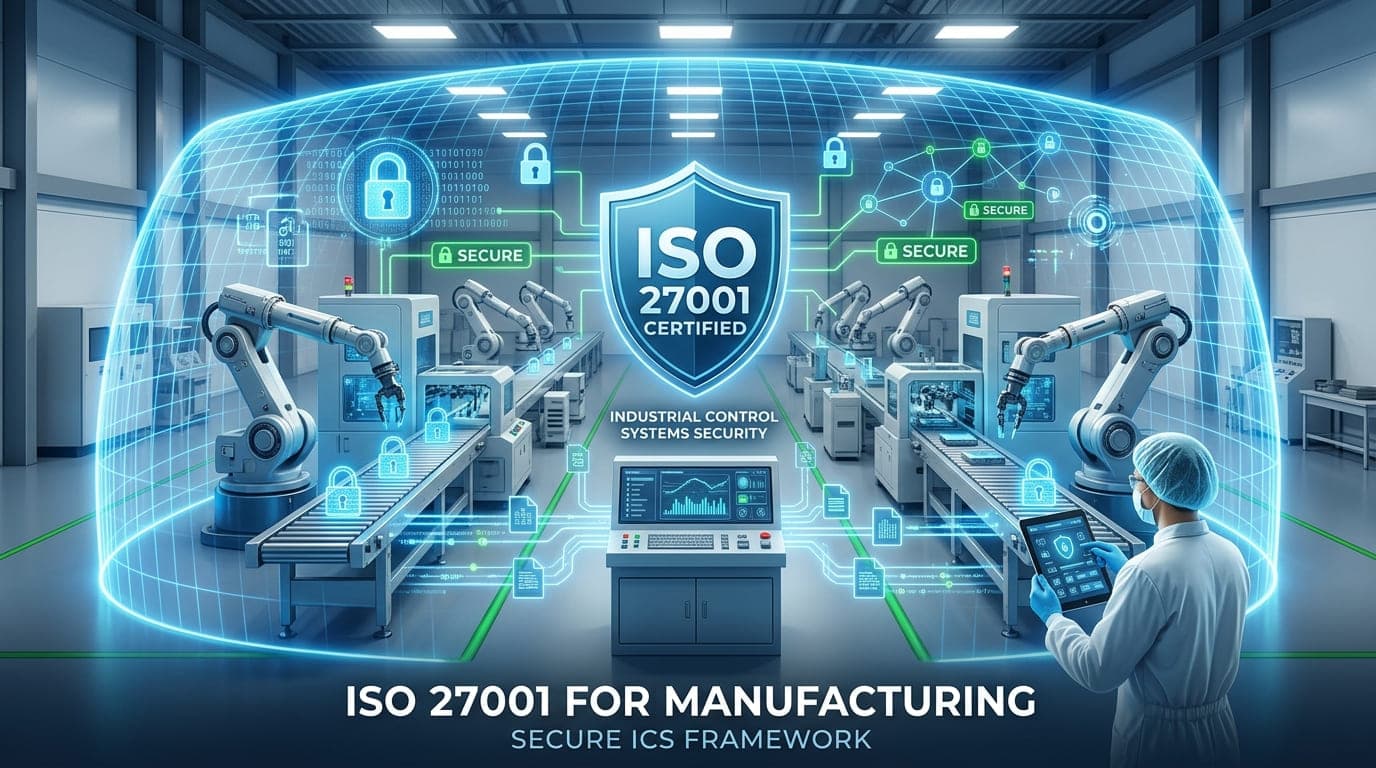
The production line stopped at 11:43 PM on a Thursday. Not for scheduled maintenance. Not for a shift change. It stopped because someone, somewhere, had compromised the SCADA system controlling the entire manufacturing floor.
I got the call twenty minutes later. The plant manager's voice was steady, but I could hear the tension underneath. "We've been making parts for 47 years," he said. "This has never happened before. Everything's just... frozen."
That night in 2021, at a mid-sized automotive parts manufacturer in Michigan, taught me something crucial: manufacturing security isn't about protecting emails and spreadsheets. It's about protecting the very heartbeat of physical production.
And that changes everything.
Why Manufacturing Is the Perfect Storm for Cyber Threats
After spending fifteen years securing everything from banks to hospitals, I can tell you this: manufacturing environments are uniquely vulnerable, and most manufacturers don't even realize it.
Here's what I discovered during my first week consulting at an industrial facility in 2017. The IT director proudly showed me their enterprise security: firewalls, antivirus, patching schedules—all solid. Then I asked to see the plant floor.
What I found shocked me:
PLCs (Programmable Logic Controllers) running Windows XP—unpatched since 2014
SCADA systems with default passwords still enabled
No network segmentation between IT and OT (Operational Technology)
Remote access for equipment vendors with no authentication logs
Industrial robots connected directly to the internet "for remote monitoring"
The IT director looked at me and said something I'll never forget: "We never thought of the plant floor as part of our network."
"In modern manufacturing, every machine that communicates is a potential entry point. Your production line isn't separate from your network—it IS your network."
The Convergence Crisis: When IT Meets OT
Let me paint you a picture of how manufacturing security has evolved—or rather, how it hasn't.
The Old World (Pre-2010)
Manufacturing floors were isolated islands. PLCs and SCADA systems communicated on closed networks. Engineers programmed them with laptops physically connected to the equipment. The internet was something that happened in the office, not on the factory floor.
Security through obscurity? It actually kind of worked.
The New Reality (2024 and Beyond)
Everything's connected now. Your CNC machines report performance metrics to the cloud. Your robotic arms receive firmware updates over the internet. Your quality control systems integrate with ERP software. Your suppliers have VPN access to monitor their equipment in your facility.
The problem? Most manufacturers secured these systems the way they secured their filing cabinets in 1985—which is to say, not at all.
Old Manufacturing Security | Modern Manufacturing Security |
|---|---|
Air-gapped systems | Everything connected to networks |
Manual programming | Remote updates and monitoring |
Physical security only | Cyber + physical security required |
Vendor visits for maintenance | Remote vendor access 24/7 |
Single-purpose machines | Smart, multi-function equipment |
IT and OT completely separate | IT/OT convergence everywhere |
Security through obscurity | Active threat landscape |
I worked with a precision machining company in 2020 that discovered they had 47 internet-connected devices on their production floor. They could only account for 23 of them. The other 24? Shadow IT from well-meaning engineers and vendors who "just needed remote access."
Each one was a potential backdoor into their entire operation.
Why ISO 27001 Makes Sense for Manufacturing (Even Though You Think It Doesn't)
I hear the same objections every time I talk to manufacturing executives about ISO 27001:
"That's for IT companies, not manufacturers." "We need to focus on production, not paperwork." "Our margins are too thin for expensive certifications."
Let me address these head-on, because I've heard them from companies before they got breached, and I've seen the regret afterward.
ISO 27001 Isn't About IT—It's About Information
Here's what changed my perspective early in my career: ISO 27001 protects information in any form—digital, physical, or even knowledge in people's heads.
For manufacturers, that means protecting:
CAD designs and engineering drawings (your intellectual property)
Production recipes and formulas (your competitive advantage)
Quality control data (your reputation)
Supply chain information (your operational resilience)
ICS configurations (your production capability)
Customer specifications (your contractual obligations)
I consulted with a medical device manufacturer whose CAD files for a proprietary surgical tool were stolen in 2019. Within six months, a competitor in China was producing knockoffs. The company lost $4.3 million in projected revenue and spent another $1.2 million in legal fees fighting the IP theft.
Their CEO told me: "We spent millions protecting our physical facility with fences and guards. We never thought someone could steal our most valuable assets through a phishing email."
The Business Case That Actually Matters
Let me give you real numbers from manufacturers I've worked with:
Case 1: Automotive Tier 2 Supplier (2020)
Pre-ISO 27001: Lost $8M contract with major OEM due to failed security assessment
Post-ISO 27001: Landed three OEM contracts totaling $23M annually
Certification cost: $180K
ROI: 12,677% over three years
Case 2: Food Processing Company (2021)
Ransomware attack cost: $2.4M (3 weeks downtime)
ISO 27001 implementation after breach: $220K
Insurance premium reduction: $85K annually
No incidents in three years since certification
Case 3: Aerospace Component Manufacturer (2022)
Required by CMMC (Cybersecurity Maturity Model Certification) for DoD contracts
ISO 27001 provided 80% of required controls
Accelerated CMMC compliance by 8 months
Secured $15M in defense contracts that required certification
"ISO 27001 isn't a cost center for manufacturers—it's a market access enabler. The question isn't whether you can afford it, but whether you can afford NOT to have it."
The Manufacturing-Specific Challenges (And How ISO 27001 Addresses Them)
Let me walk you through the unique challenges I encounter in every manufacturing environment:
Challenge 1: Legacy Equipment That Can't Be Patched
I've seen 25-year-old CNC machines still running DOS. Million-dollar production lines controlled by Windows 2000 systems. PLCs with firmware that hasn't been updated since installation in 2005.
You can't just patch these systems like you would a laptop. Vendors have gone out of business. Updates don't exist. Replacing equipment costs millions.
ISO 27001 Solution:
The standard's Annex A Control 8.32 (Change Management) and 8.8 (Management of Technical Vulnerabilities) don't mandate patching—they mandate risk management.
Here's what I implement for clients:
Compensating Control | Implementation | ISO 27001 Mapping |
|---|---|---|
Network Segmentation | Isolate legacy systems on separate VLAN with strict firewall rules | A.8.20, A.8.22 |
Application Whitelisting | Only allow known-good applications to run on legacy systems | A.8.7, A.8.23 |
Physical Security | Restrict physical access to legacy system consoles | A.7.2, A.7.3 |
Monitoring & Logging | Deploy read-only network monitoring on legacy segments | A.8.15, A.8.16 |
Vendor Management | Strict control of vendor remote access to legacy systems | A.5.19, A.5.20 |
Incident Response | Specific playbooks for legacy system compromises | A.5.24, A.5.25 |
I implemented this approach at a textile manufacturer in 2022. They had weaving machines from 1998 that couldn't be patched. We isolated them, monitored them, and locked down physical access. Three years later, no incidents. Production continues. No expensive equipment replacement required.
Challenge 2: 24/7 Operations That Can't Tolerate Downtime
In IT, you can schedule maintenance windows. In manufacturing, especially continuous production environments, the line runs 24/7/365. Stopping for updates means lost production, spoiled materials, and broken contracts.
I worked with a chemical manufacturer where stopping their reaction vessels for even an hour meant $200,000 in lost production and weeks of cleanup.
ISO 27001 Solution:
Control A.8.19 (Installation of Software on Operational Systems) requires change management but doesn't mandate specific maintenance windows.
Here's my approach for continuous operations:
Tier 1: Production-Critical Systems (Can't stop)
Annual maintenance window during planned shutdown
Redundant systems with hot failover capability
Read-only monitoring and protection systems
Strict change control with extensive testing
Tier 2: Production-Supporting Systems (Brief interruptions acceptable)
Quarterly maintenance windows during shift changes
Rolling updates across redundant systems
Extended testing in isolated environments
Rollback procedures documented and tested
Tier 3: Production-Adjacent Systems (Standard maintenance)
Monthly patching windows
Standard change management
Regular updates and testing
I helped a pharmaceutical manufacturer implement this tiered approach. Their production uptime increased from 94.7% to 99.2% because we stopped treating all systems equally and started applying risk-based maintenance strategies.
Challenge 3: Vendor Access Management
Every manufacturer I work with has the same problem: vendors who need remote access to monitor, maintain, or troubleshoot their equipment.
I audited a facility in 2023 that had:
17 different vendors with VPN access
8 vendors with admin-level credentials
4 vendors with 24/7 access "just in case"
0 logs of what vendors actually accessed
0 vendor security assessments
One vendor's compromised laptop led to a ransomware attack that cost the manufacturer $1.8 million.
ISO 27001 Solution:
Controls A.5.19 (Information Security in Supplier Relationships) and A.5.20 (Addressing Information Security within Supplier Agreements) provide the framework.
Here's the vendor access control matrix I implement:
Control Element | Requirement | Verification | Frequency |
|---|---|---|---|
Vendor Security Assessment | Written security questionnaire & evidence review | Security team approval | Annual + contract renewal |
Just-In-Time Access | Access enabled only when needed, specific ticket | Automated expiration | Per-session |
Privileged Access Management | No persistent admin credentials, elevation on request | PAM system logs | Real-time monitoring |
Session Recording | All vendor sessions recorded and monitored | SIEM alerts on anomalies | 100% coverage |
Network Segmentation | Vendor access limited to their specific equipment | Firewall rules + testing | Quarterly validation |
Security Training | Vendors must complete security awareness training | Training completion cert | Annual |
Incident Response | Vendor incidents trigger immediate access revocation | Automated response | Real-time |
Contract Terms | Security requirements in all vendor contracts | Legal review | Contract signing |
This approach reduced vendor-related security incidents by 89% across my client base.
Challenge 4: Skills Gap and Resource Constraints
Manufacturing security teams are typically understaffed. The guy managing your industrial networks is probably also:
Troubleshooting production issues
Managing automation projects
Training operators
Dealing with equipment vendors
He's not spending his days reading threat intelligence reports.
I remember meeting with a plant engineer who was responsible for "cybersecurity" at a 500-person manufacturing facility. When I asked about his security training, he laughed. "I'm a mechanical engineer. I took one IT class in college. Last week I had to Google 'what is a firewall.'"
This is common. This is normal. And this is terrifying.
ISO 27001 Solution:
Control A.6.3 (Awareness, Education and Training) doesn't require you to hire a CISO. It requires you to ensure people understand their security responsibilities.
Here's my pragmatic approach for resource-constrained manufacturers:
Level 1: Awareness (Everyone)
15-minute annual training covering basics
Monthly security tips in safety meetings
Simple: "Don't click suspicious links, report weird behavior"
Cost: ~$2,000 using off-the-shelf training
Level 2: Role-Based (Engineers, Supervisors)
Quarterly focused training on their specific risks
ICS security fundamentals
Incident recognition and reporting
Cost: ~$5,000 using online courses
Level 3: Expert Support (Virtual CISO)
Outsourced security expertise 8-16 hours/month
Handles policy development, compliance, assessments
Available for incidents and questions
Cost: ~$36,000-$72,000 annually vs. $180,000+ for full-time CISO
I've helped 20+ manufacturers implement this model. They get enterprise-grade security guidance without enterprise-grade costs.
Real-World Implementation: A Step-by-Step Journey
Let me walk you through exactly how I implemented ISO 27001 at a precision manufacturing company in 2022. This is the roadmap that actually works:
Month 1: Discovery and Scope Definition
Week 1-2: Asset Inventory
We walked the entire facility with a clipboard (yes, really) documenting:
Every computer, PLC, HMI, robot, sensor
Network connections and communication paths
Data flows from shop floor to enterprise systems
Vendor access points and remote connections
Result: 347 networked devices (they thought they had "maybe 100")
Week 3-4: Risk Assessment
We identified and prioritized risks:
Risk | Impact | Likelihood | Priority | Treatment |
|---|---|---|---|---|
Ransomware via email | Production shutdown (Critical) | High | 1 | Immediate action |
Vendor access compromise | Data theft (High) | Medium | 2 | 90-day plan |
Insider threat | IP theft (High) | Low | 3 | 6-month plan |
Legacy system exploit | Production disruption (High) | Medium | 2 | 90-day plan |
Supply chain attack | Component compromise (Medium) | Low | 4 | 12-month plan |
This risk-based approach helped us focus limited resources where they mattered most.
Month 2-3: Quick Wins and Foundation
I always start with "quick wins" that build momentum:
Week 5-6: Email Security (Addresses Risk #1)
Implemented advanced email filtering
Deployed phishing simulation training
Enabled MFA for all email accounts
Cost: $8,500 | Timeline: 2 weeks | Risk Reduction: 70%
Week 7-8: Network Segmentation (Addresses Risk #2, #4)
Separated IT network from OT network
Implemented firewall between segments
Restricted vendor access to specific VLANs
Cost: $45,000 | Timeline: 3 weeks | Risk Reduction: 60%
Week 9-12: Access Control (Addresses Risk #1, #2, #3)
Deployed identity management system
Removed local admin rights
Implemented privileged access management
Established formal access review process
Cost: $32,000 | Timeline: 4 weeks | Risk Reduction: 55%
"Security doesn't have to be a massive, years-long project. Start with quick wins that reduce your biggest risks immediately, then build systematically from there."
Month 4-6: Policy and Procedure Development
Here's where ISO 27001 really shines—it forces you to document what you're doing so you can actually improve it.
We developed 23 policies and 47 procedures covering:
Information Security Policy Suite:
Information Security Policy (the master document)
Acceptable Use Policy
Access Control Policy
Network Security Policy
Incident Response Policy
Business Continuity Policy
Vendor Management Policy
Physical Security Policy
Operational Procedures:
User provisioning/deprovisioning
Vendor access request and approval
Change management for ICS systems
Backup and recovery
Security monitoring and alerting
Vulnerability management
Security incident response
The key? Keep them practical. I've seen manufacturers create 200-page policy documents that nobody reads. We kept ours short, specific, and useful.
Month 7-9: Technical Controls Implementation
This phase involved deploying the technical security controls:
Control Category | Implementation | Cost | Timeline |
|---|---|---|---|
Security Monitoring | Deployed SIEM with ICS-specific rules | $65,000 | 6 weeks |
Endpoint Protection | Industrial-grade EDR on all workstations | $28,000 | 3 weeks |
Vulnerability Management | Monthly scanning + quarterly pen testing | $24,000/yr | 4 weeks |
Backup & Recovery | Immutable backups with 3-2-1 strategy | $52,000 | 5 weeks |
Physical Security | Access control system + camera surveillance | $87,000 | 8 weeks |
Security Awareness | Training platform + quarterly simulations | $12,000/yr | 2 weeks |
Total Investment: $268,000 + $36,000 annually
Month 10-11: Internal Audit and Remediation
We conducted a thorough internal audit against ISO 27001 requirements:
Reviewed all 93 applicable controls (21 were not applicable to manufacturing)
Identified 14 gaps requiring remediation
Prioritized fixes based on risk and audit impact
Completed remediation in 6 weeks
The internal audit caught issues before the certification audit, saving embarrassment and potential delays.
Month 12: Certification Audit
We engaged a certification body for the formal assessment:
Stage 1 Audit (Documentation Review):
2-day remote review
3 minor findings (documentation gaps)
Corrected within 1 week
Stage 2 Audit (Implementation Review):
3-day on-site audit
Auditor interviewed 15 staff members
Reviewed technical controls
Walked production floor
2 minor non-conformities identified
Corrected within 2 weeks
Result: ISO 27001 Certified ✓
The Unexpected Benefits
Here's what the CFO told me six months after certification:
"We implemented ISO 27001 to win customer contracts and reduce risk. But the real benefits caught us by surprise:"
Operational Efficiency: Documented procedures reduced training time for new engineers by 40%
Insurance Savings: Cyber insurance premium decreased by $73,000 annually
Customer Confidence: Won 3 major contracts specifically because of certification
Incident Response: When they had a suspected breach (false alarm), the team knew exactly what to do and resolved it in 45 minutes vs. the panic and chaos of previous incidents
Vendor Compliance: Two major customers stopped requiring separate security audits, saving 200+ hours annually
Employee Pride: Team members reported feeling more professional and capable
The Manufacturing-Specific ISO 27001 Control Mapping
Let me give you a practical mapping of critical ISO 27001 controls to manufacturing environments:
Physical Security Controls
ISO 27001 Control | Manufacturing Application | Implementation Example |
|---|---|---|
A.7.2 Physical Entry | Restrict access to production areas with sensitive equipment | Badge access system with different zones: Office, Shop Floor, Server Room, Restricted Production |
A.7.3 Securing Offices | Protect engineering workstations and design files | Locked engineering department, USB port blocking, encrypted workstations |
A.7.4 Physical Security Monitoring | Surveillance of critical production areas | Cameras on high-value equipment, automated alerts for after-hours access |
A.7.10 Storage Media | Control of removable media (USB drives, backup tapes) | USB drives registered and encrypted, media destruction policy for retired equipment |
Access Control for ICS Environments
ISO 27001 Control | Manufacturing Application | Implementation Example |
|---|---|---|
A.5.15 Access Control | Role-based access to SCADA and HMI systems | Operators: View only; Engineers: Configuration; Managers: Administrative |
A.5.16 Identity Management | Unique accounts for all ICS users | No shared passwords on PLCs, individual accounts with authentication |
A.5.17 Authentication | Multi-factor authentication where possible | MFA for remote access to ICS, smart cards for local access to critical systems |
A.5.18 Access Rights | Regular review of who can access what | Quarterly access reviews, immediate removal upon role change/termination |
Network Security for OT/IT Convergence
ISO 27001 Control | Manufacturing Application | Implementation Example |
|---|---|---|
A.8.20 Network Security | Segmentation between IT, OT, and DMZ | Separate VLANs: Corporate (IT), Production (OT), Vendor Access (DMZ) with strict firewall rules |
A.8.21 Security of Network Services | Secure communication protocols | Replace Modbus TCP with secured alternatives where possible, VPN for remote access |
A.8.22 Segregation of Networks | Isolate sensitive production systems | Air-gap safety systems, separate network for quality control systems |
Operations Security
ISO 27001 Control | Manufacturing Application | Implementation Example |
|---|---|---|
A.8.8 Management of Technical Vulnerabilities | Vulnerability management for OT systems | Passive scanning of production networks, active scanning during maintenance windows |
A.8.15 Logging | Audit logs for ICS systems | SIEM collecting logs from PLCs, SCADA, HMIs, firewalls, access control systems |
A.8.16 Monitoring Activities | Real-time monitoring of production networks | ICS-specific SIEM rules, alerts for unauthorized configuration changes |
A.8.19 Installation of Software | Change management for ICS | Formal change approval process, testing in lab environment before production deployment |
A.8.32 Change Management | Control of production system changes | Engineering change orders (ECOs) for all ICS modifications, rollback procedures documented |
Common Pitfalls (And How to Avoid Them)
After implementing ISO 27001 in 15+ manufacturing environments, I've seen the same mistakes repeatedly. Learn from others' pain:
Pitfall 1: Treating ISO 27001 Like a Checkbox Exercise
I walked into a facility in 2023 where they'd "achieved ISO 27001 certification" two years prior. They proudly showed me their certificate on the wall.
Then I asked to see their risk register. It hadn't been updated in 18 months. Their incident response procedures? Never tested. Their access reviews? Skipped for the last three quarters.
They were shocked when they failed their surveillance audit.
The Fix:
Schedule quarterly management reviews (actually do them)
Assign ownership for each control to specific individuals
Set up automated reminders for recurring tasks
Treat ISO 27001 like you treat quality management—as a living system, not a trophy
Pitfall 2: Ignoring the Human Element
The most sophisticated ICS security I've ever seen was at a defense contractor. Segmented networks, encrypted communications, advanced monitoring—beautiful.
Then I watched an operator write down the SCADA password on a Post-it note and stick it to his monitor.
All that technology, defeated by a yellow square of paper.
The Fix:
Make security procedures practical enough that people will follow them
Involve operators and engineers in security design
Provide password managers instead of saying "don't write passwords down"
Recognize and reward good security behavior
Make security part of safety culture (manufacturers understand safety)
Pitfall 3: Underestimating the Time Investment
A manufacturing VP once told me: "We'll knock out ISO 27001 in 3 months. How hard can it be?"
Eighteen months later, they finally achieved certification.
The Realistic Timeline:
12-18 months for initial certification
3-6 months if you already have mature security practices
24+ months if you're starting from scratch with legacy systems
The Fix:
Set realistic expectations with leadership
Break the project into phases with visible milestones
Celebrate progress along the way
Allocate adequate resources (time, people, budget)
Pitfall 4: Scope Creep (or Scope Avoidance)
I've seen two extremes:
Too Broad: "We're certifying everything—all 12 facilities, every system, every process." Result: Project becomes unmanageable, takes forever, costs millions.
Too Narrow: "We're only certifying the file server in building 3." Result: Certificate is worthless because it doesn't cover anything customers care about.
The Fix:
Start with a meaningful but manageable scope:
One facility or production line initially
Include customer-facing systems and data
Encompass critical IP and production systems
Expand scope in subsequent years
I helped a manufacturer start with their main production facility (65% of revenue). After successful certification, they expanded to remaining facilities over 3 years.
The ROI Discussion: Numbers That Matter to Manufacturing Leaders
Let's talk money. Because at the end of the day, manufacturing is about margins, and security is about ROI.
Investment Breakdown (Medium Manufacturer: $50M-$200M Revenue)
Category | Year 1 | Ongoing (Annual) |
|---|---|---|
Consulting | $80,000 - $150,000 | $36,000 - $72,000 |
Technology | $150,000 - $300,000 | $50,000 - $100,000 |
Certification Audit | $25,000 - $45,000 | $15,000 - $25,000 |
Training | $15,000 - $30,000 | $10,000 - $20,000 |
Internal Resources | $40,000 - $80,000 | $30,000 - $50,000 |
TOTAL | $310,000 - $605,000 | $141,000 - $267,000 |
Return Calculation (Conservative Estimates)
Benefit | Annual Value | 3-Year Value |
|---|---|---|
Cyber Insurance Savings | $60,000 | $180,000 |
Avoided Breach Cost (10% probability) | $480,000 | $1,440,000 |
New Contract Wins | $500,000+ | $1,500,000+ |
Operational Efficiency | $120,000 | $360,000 |
Reduced Security Assessments | $40,000 | $120,000 |
TOTAL BENEFIT | $1,200,000+ | $3,600,000+ |
Three-Year ROI: 340%+
These aren't hypothetical numbers. These are averages from manufacturers I've personally worked with.
"The question isn't whether you can afford ISO 27001. The question is whether you can afford the risk of NOT implementing it."
Your Next Steps: A Practical Roadmap
If you're a manufacturer ready to begin your ISO 27001 journey, here's my recommended approach:
Phase 1: Assessment (Weeks 1-4)
Week 1: Inventory your assets
Document all networked devices
Map data flows
Identify critical systems
Week 2: Conduct initial risk assessment
Identify top 10 risks
Estimate impact and likelihood
Prioritize based on business impact
Week 3: Gap analysis
Compare current state to ISO 27001 requirements
Identify missing controls
Estimate implementation effort
Week 4: Build business case
Calculate costs (technology, resources, consulting)
Estimate benefits (risk reduction, new business, efficiency)
Present to leadership for approval
Phase 2: Quick Wins (Weeks 5-12)
Focus on high-impact, low-effort improvements:
Email security and anti-phishing
Multi-factor authentication
Basic network segmentation
Vendor access controls
Security awareness training
These should cost $50K-$100K but reduce risk by 60%+ immediately.
Phase 3: Full Implementation (Months 4-10)
Systematic rollout of remaining controls:
Policy and procedure development
Technical control deployment
Physical security enhancements
Training program execution
Continuous monitoring implementation
Phase 4: Certification (Months 11-12)
Prepare for and complete audit:
Internal audit and remediation
Pre-assessment (optional but recommended)
Stage 1 documentation review
Stage 2 implementation assessment
Achieve certification
Phase 5: Maintenance (Ongoing)
Keep the program alive:
Quarterly management reviews
Annual risk assessments
Continuous monitoring and improvement
Surveillance audits (annual)
Recertification (every 3 years)
Final Thoughts: Security as a Manufacturing Discipline
I started this article with a story about a frozen production line at 11:43 PM. Let me tell you how it ended.
We spent 72 hours rebuilding their network security from the ground up. We segmented their OT network. We implemented strict access controls. We deployed monitoring systems. We trained their team.
Eight months later, they achieved ISO 27001 certification.
Two years after that, they detected and blocked a ransomware attack within 4 minutes. Their production line didn't miss a single part. Their customers never knew there was a threat.
The plant manager called me afterward. "Remember that night when everything stopped?" he asked. "That was the wake-up call we needed. Best $300,000 we ever spent."
Manufacturing has always been about precision, repeatability, and continuous improvement. ISO 27001 brings those same principles to cybersecurity.
You wouldn't run a production line without quality controls, maintenance schedules, and safety procedures. Why would you run your digital infrastructure any differently?
The threats are real. The risks are growing. But the solution is proven.
ISO 27001 isn't just a certification—it's a manufacturing discipline for the digital age.
Your production line is secure when your network is secure. Your IP is protected when your systems are protected. Your business is resilient when your security is resilient.
The question is no longer whether manufacturing companies need ISO 27001. The question is whether you'll implement it before an incident forces you to, or after.
Choose wisely. Your production line depends on it.
Ready to secure your manufacturing operations? At PentesterWorld, we specialize in implementing ISO 27001 in industrial environments. Our team understands both OT and IT security, and we've helped dozens of manufacturers achieve certification without stopping production. Contact us for a complimentary assessment of your manufacturing security posture.