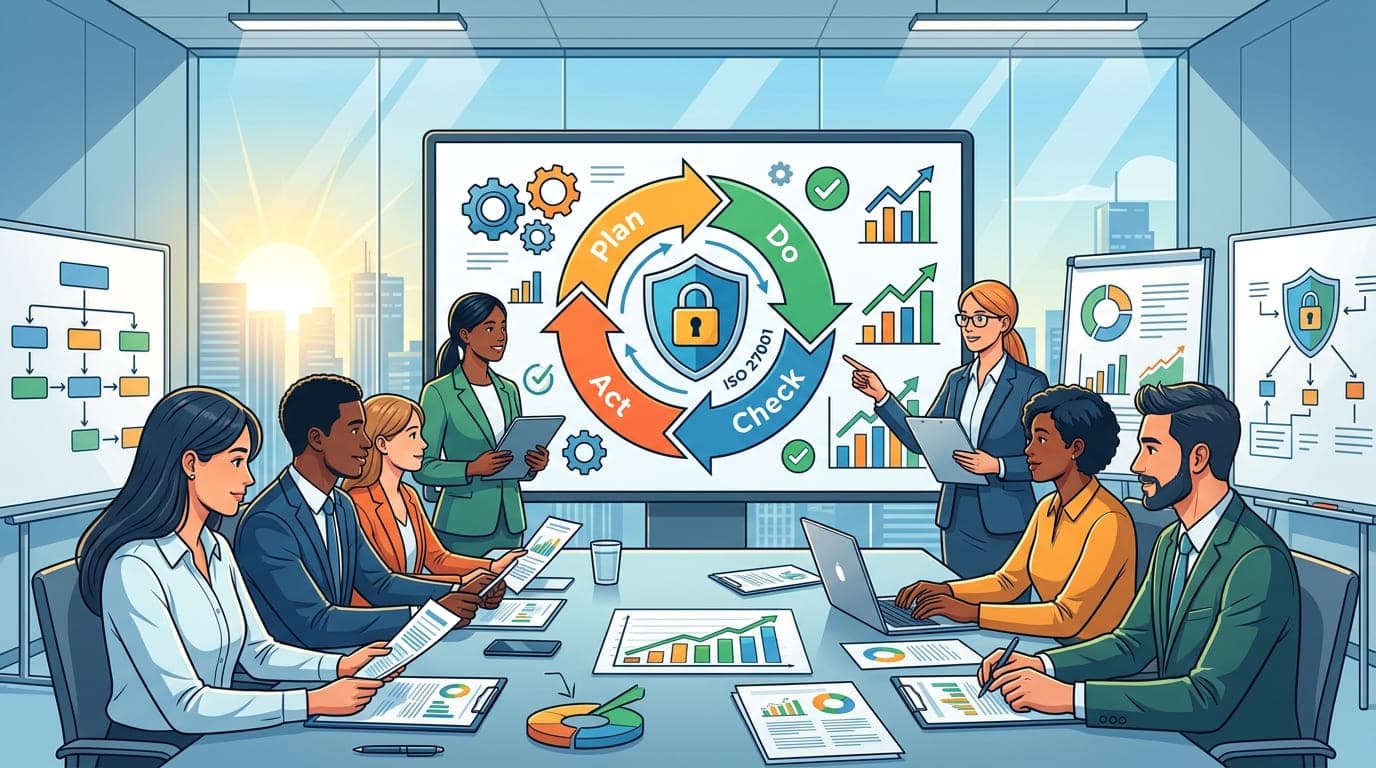
The conference room was uncomfortably silent. I was sitting across from the CEO of a fintech company that had just failed their ISO 27001 surveillance audit. They'd achieved certification 18 months earlier with great fanfare, but now they were at risk of losing it.
"We have the certificate on the wall," the CEO said, frustration evident in his voice. "We paid for the audit. What went wrong?"
I pulled out their management review records. The last documented review? Fourteen months ago, right after certification. The problem wasn't their security controls—it was that nobody was steering the ship.
After fifteen years of implementing and auditing ISO 27001 programs, I've learned a hard truth: getting certified is the easy part. Maintaining certification requires something far more challenging—genuine, ongoing management commitment through regular, meaningful reviews.
What ISO 27001 Management Review Actually Means (And Why Most Organizations Get It Wrong)
Let me be blunt: most management reviews I've witnessed are theatrical performances. Leaders gather quarterly, flip through slides prepared by the security team, nod sagely, and move on to discussing the next quarter's sales targets.
That's not a management review. That's a checkbox exercise.
The ISO 27001 standard (Clause 9.3) requires top management to review the organization's Information Security Management System (ISMS) at planned intervals. But here's what the standard doesn't tell you—and what I learned the hard way:
"A management review isn't a presentation TO management. It's a strategic decision-making session BY management about the future of your security program."
The Anatomy of an Effective Management Review
I'll share what I learned from a manufacturing company I worked with in 2021. Their CISO, Maria, transformed their management reviews from dreaded quarterly obligations into the most valuable strategic meeting the company held.
Here's what changed:
Before:
45-minute PowerPoint presentations
Security team talked, executives listened (barely)
No decisions made
No actions assigned
Minutes buried in a shared drive
After:
90-minute strategic discussions
Pre-read materials sent 48 hours in advance
First 15 minutes: "What's changed since last quarter?"
Next 45 minutes: Discussion of risks, opportunities, and resource needs
Final 30 minutes: Decisions, budget allocations, and action items
Minutes distributed within 24 hours with clear ownership
Their audit results? Flawless. More importantly, their security posture actually improved continuously instead of degrading between audits.
The Nine Essential Inputs: What You Must Review
ISO 27001 Clause 9.3.2 specifies what must be included in management reviews. But let me translate the standard-speak into what this actually means in practice:
Required Input | What It Really Means | Red Flags I've Seen |
|---|---|---|
Status of actions from previous reviews | Did we actually do what we said we'd do? | "Still in progress" appearing for 3+ quarters |
Changes in external and internal issues | What's different in our risk landscape? | Generic statements like "No significant changes" |
Feedback on information security performance | Are our controls actually working? | Only positive metrics presented, no failures discussed |
Feedback from interested parties | What are customers, auditors, regulators saying? | Customer complaints not mentioned in reviews |
Results of risk assessment | What are our current top risks? | Same risks listed quarter after quarter |
Status of risk treatment plans | Are we reducing risk as planned? | Plans exist but no progress tracking |
Opportunities for continuous improvement | How can we get better? | This section simply missing from agenda |
Results from internal audits | What did our internal auditors find? | Only "observations," never "findings" |
Nonconformities and corrective actions | What broke and how did we fix it? | No nonconformities ever reported (impossible!) |
Let me share a story about that last item—nonconformities. I was auditing a company that proudly announced they'd had "zero nonconformities" in 18 months. Impressive, right?
Wrong. After digging deeper, I found:
Three security incidents they classified as "minor events"
Four internal audit findings labeled as "observations"
Two customer complaints about data handling marked as "feedback"
Multiple policy violations treated as "training opportunities"
They weren't perfect—they were hiding problems. And hiding problems is the fastest way to fail an audit and, more importantly, to get breached.
"If you're not finding problems in your ISMS, you're not looking hard enough. The goal isn't perfection—it's continuous improvement through honest assessment."
The Critical Outputs: Decisions That Actually Matter
Here's where most organizations completely miss the point. The standard requires management reviews to produce specific outputs. But in my experience, these outputs separate mature security programs from compliance theater:
1. Opportunities for Continuous Improvement
I worked with a healthcare provider whose management review identified that their incident response time averaged 4.2 hours. Good? Bad? They didn't know.
We researched industry benchmarks (aim for <1 hour for critical incidents). They allocated $120,000 for a SOAR platform and additional training. Six months later, their average response time was 42 minutes.
That's continuous improvement driven by management review.
2. Changes Needed to the ISMS
A retail client discovered during management review that their ISMS scope hadn't been updated in three years. Meanwhile, they'd:
Launched a mobile app (not in scope)
Migrated to AWS (partially in scope)
Opened offices in two new countries (not in scope)
Acquired a competitor (not in scope)
Their ISMS was governing about 60% of their actual operations. The management review forced them to expand scope, update documentation, and properly secure their entire operation.
3. Resource Needs
This is the output that matters most to security teams and gets ignored most by executives.
Let me share a table from a real management review I facilitated in 2023:
Security Initiative | Business Impact | Resource Required | Decision |
|---|---|---|---|
EDR Deployment | Detect ransomware attacks 15x faster | $85K annually | ✅ Approved |
Additional Security Analyst | Reduce incident backlog from 37 to <5 | $95K annually | ✅ Approved |
Security Awareness Platform | Reduce phishing success rate from 18% to <5% | $24K annually | ✅ Approved |
SIEM Upgrade | Centralize logging from 47 to 100% of systems | $45K annually | ❌ Deferred 6 months |
Penetration Testing | Identify vulnerabilities before attackers do | $35K annually | ✅ Approved |
Total approved budget increase: $239K. The CFO initially balked. Then the CISO presented data showing their cyber insurance quote required these controls to avoid a $180K premium increase.
Management review isn't just about reviewing—it's about resourcing.
The Management Review Cycle: Frequency and Timing
The standard says "at planned intervals." I've seen organizations interpret this as:
Annually (too infrequent)
Monthly (too burdensome for top management)
Quarterly (just right for most organizations)
But here's what I've learned: the right frequency depends on your rate of change.
Frequency Decision Matrix
Organization Type | Recommended Frequency | Why |
|---|---|---|
Stable, mature enterprise | Quarterly | Risk landscape changes slowly |
High-growth startup | Monthly | Everything changes constantly |
Highly regulated industry | Quarterly + incident-triggered | Regulatory scrutiny demands attention |
Post-breach recovery | Monthly for 6 months, then quarterly | Intensive oversight during recovery |
Pre-certification/audit | Monthly | Rapid iteration needed |
I helped a SaaS company that was growing 300% year-over-year. Quarterly reviews weren't enough—by the time management reviewed risks, the company had already evolved significantly. We moved to monthly reviews for 12 months, then transitioned to quarterly once growth stabilized.
How to Prepare for Management Review: The Security Team's Checklist
I've sat through hundreds of management reviews. The best ones don't happen accidentally—they're meticulously prepared. Here's the checklist I give every security team I work with:
Four Weeks Before Review
[ ] Schedule the meeting (90 minutes minimum, no interruptions)
[ ] Assign pre-work: Who's preparing which sections?
[ ] Pull metrics: Gather data from SIEM, ticketing system, vulnerability scanner, etc.
[ ] Review previous minutes: What actions were assigned? What's their status?
[ ] Identify major changes: New systems, major incidents, regulatory changes, etc.
Two Weeks Before Review
[ ] Conduct mini-interviews with key stakeholders (IT, legal, compliance, operations)
[ ] Compile audit findings: Internal audit results, external audit observations
[ ] Update risk register: Any new risks? Changed risk levels?
[ ] Prepare resource requests: Fully justified with business impact analysis
[ ] Create executive summary: One-page overview of key points
One Week Before Review
[ ] Distribute pre-read materials: No surprises in the meeting
[ ] Brief the CEO/presenting executive: Make sure they understand key issues
[ ] Prepare visual aids: Charts, graphs, dashboards (not just text)
[ ] Draft decision items: What specific decisions need to be made?
[ ] Coordinate with executive assistant: Confirm attendance, logistics
Day Before Review
[ ] Final prep: Test presentation technology, print materials
[ ] Confirmation: Send reminder with agenda and key decision items
[ ] Set up room: Ensure confidentiality for sensitive discussions
I know this seems like overkill. But I've seen too many management reviews fail because someone tried to throw together materials the night before.
The Meeting Itself: Facilitation Best Practices
Let me share the structure I've refined over 15 years of facilitating these reviews:
The 90-Minute Management Review Agenda
Time | Agenda Item | Facilitator Notes |
|---|---|---|
0-5 min | Welcome & objectives | Set the tone: this is strategic discussion, not status report |
5-20 min | Review previous actions | Status of all action items from last review. No excuses. |
20-35 min | Environmental changes | What's different? New regulations, major incidents, business changes |
35-50 min | Performance metrics | What's working? What's not? Trend analysis, not just snapshots |
50-65 min | Risk assessment update | Top 10 risks, changes in risk levels, risk treatment status |
65-75 min | Resource needs | Specific requests with business justification |
75-85 min | Decision time | Make actual decisions. Allocate resources. Set direction. |
85-90 min | Action items & next steps | Clear ownership, deadlines, success criteria |
I facilitated a management review in 2022 where we spent 40 minutes discussing a single issue: whether to implement multi-factor authentication for all remote access (cost: $140K annually).
The discussion was heated. Finance pushed back on cost. Operations worried about user friction. Legal cited increasing breach liability. The CISO presented data showing 81% of breaches involve compromised credentials.
After thorough discussion, the CEO made the decision: implement MFA. More importantly, she allocated budget, assigned ownership, and set a deadline.
That's what good management review looks like—substantive debate leading to clear decisions.
Common Pitfalls I've Witnessed (And How to Avoid Them)
After auditing over 100 management reviews, I've seen patterns emerge. Here are the most common failures:
Pitfall #1: Death by PowerPoint
What it looks like:
60+ slides
Dense text
Complex charts nobody understands
Presenter reads every word
How to fix it: I worked with a CISO who reduced her management review deck from 73 slides to 12. She followed the rule: "One slide, one point, one decision or discussion."
Her CEO told me: "Before, I endured management reviews. Now, I actually look forward to them because we discuss real issues instead of reading slides together."
Pitfall #2: All Good News, No Problems
What it looks like:
100% of metrics showing improvement
Zero nonconformities reported
No resource requests
Everything "on track"
How to fix it: A healthcare CISO I mentored was terrified to present bad news to her board. I told her: "Your job isn't to present perfection. It's to present reality so leadership can make informed decisions."
She started reporting problems honestly. Initially uncomfortable, but six months later, her CEO told the board: "I trust our security program because our CISO doesn't sugarcoat problems. When she says we're secure, I believe it."
Pitfall #3: No Decisions Made
What it looks like:
Everything is "information only"
No action items assigned
Resource requests tabled for "further discussion"
Same issues appear quarter after quarter
How to fix it: I implemented a simple rule: every management review must produce at least three decisions. Even if it's just "Continue current approach" or "Revisit in Q3"—make explicit decisions.
One company I worked with started tracking "decision velocity"—how quickly management reviews led to action. They went from averaging 8 weeks between decision and action to less than 2 weeks.
Pitfall #4: Wrong People in the Room
What it looks like:
IT Director instead of CIO
VP instead of C-suite
People who can't make budget decisions
Key stakeholders missing
How to fix it: ISO 27001 requires "top management" review. That means people who can:
Allocate resources
Make strategic decisions
Commit the organization
I audited a company whose "management review" was attended by a Senior IT Manager. He had zero budget authority. Every resource request went to "the executives" who weren't in the room.
That's not management review—that's middle management reporting.
Documentation: Making Your Review Audit-Proof
Here's something auditors love: good documentation. Here's what they hate: the appearance of retrospective documentation.
I can spot fake management review minutes from a mile away:
All meetings exactly 30 minutes long
Minutes created the same day as the "meeting"
No specific decisions or action items
Generic, templated language
Essential Documentation Elements
Every management review must produce minutes that include:
Element | Why It Matters | Example |
|---|---|---|
Date, time, duration | Proves meeting actually happened | "March 15, 2024, 2:00-3:30 PM" |
Attendees (by name and title) | Shows appropriate level of participation | "Jane Smith, CEO; John Doe, CIO; Sarah Johnson, CFO" |
Agenda items discussed | Creates audit trail of topics covered | Link to distributed pre-read materials |
Key points raised | Captures substantive discussion | "CFO raised concerns about $180K security investment..." |
Decisions made | Documents management commitment | "Approved: Additional security analyst position, $95K annually" |
Action items | Creates accountability | "John Doe to complete MFA implementation by June 30" |
Next review date | Shows commitment to continuity | "Next review scheduled: June 12, 2024" |
I helped a company create a management review template that became their most valuable audit artifact. When auditors asked for evidence of management commitment, they produced 12 quarters of detailed minutes showing active engagement and decision-making.
The lead auditor told me: "These are the best management review records I've seen. It's clear that management doesn't just rubber-stamp—they actively drive the security program."
Metrics That Actually Matter in Management Reviews
Here's a trap I see constantly: security teams present dozens of metrics that mean nothing to business leaders.
Let me share a real example. A security team presented these metrics in a management review:
Meaningless Metrics:
"Processed 2.4 million security events this quarter"
"Blocked 847,000 spam emails"
"Conducted 12 vulnerability scans"
"100% of patches applied within SLA"
The CFO's response: "So what? Are we more secure or not?"
Now compare to these metrics:
Meaningful Metrics:
Metric | Q4 2023 | Q1 2024 | Trend | Business Impact |
|---|---|---|---|---|
Mean time to detect incidents | 4.2 hours | 1.8 hours | ↓ 57% | Faster detection reduces breach impact by avg. $1.2M per IBM data |
Phishing test failure rate | 18% | 12% | ↓ 33% | 6% fewer employees fall for phishing; reduces credential compromise risk |
Critical vulnerabilities open >30 days | 23 | 8 | ↓ 65% | Reduced attack surface significantly |
Security incidents requiring customer notification | 1 | 0 | ↓ 100% | No customer trust impact, zero notification costs |
Systems covered by endpoint protection | 87% | 96% | ↑ 10% | Near-complete visibility and protection |
See the difference? The second set connects security activities to business outcomes.
"Security metrics should answer one question: Are we reducing business risk? If your metrics don't answer that, you're tracking the wrong things."
The Evolution of Management Reviews: Maturity Over Time
I've noticed that management reviews evolve predictably as organizations mature. Here's what I typically see:
Year 1: Compliance Focus
Characteristics:
Heavy focus on meeting ISO 27001 requirements
Lots of documentation review
Establishing baseline metrics
Setting up processes
What success looks like:
Achieving initial certification
Establishing review cadence
Getting management engaged
Year 2: Efficiency Focus
Characteristics:
Streamlining processes
Automating metric collection
Reducing time spent on status reporting
Increasing time on strategic discussion
What success looks like:
Reviews become smoother, less burdensome
Management actually looks forward to them
Decisions get made faster
Year 3+: Strategic Focus
Characteristics:
Security integrated into business planning
Proactive risk discussions
Forward-looking scenario planning
Security as business enabler
What success looks like:
Security considerations in every major business decision
Management review influences company strategy
Security team seen as business partners, not gatekeepers
I worked with a financial services company through all three phases. In Year 1, their CEO attended management reviews out of obligation. By Year 3, he told me: "Management review is where we make some of our most important strategic decisions. Security considerations influence everything from M&A to product roadmap."
That's maturity.
Special Considerations: When Things Go Wrong
Let me be real: sometimes management reviews need to address serious problems. I've facilitated reviews after:
Major security breaches
Failed audits
Regulatory enforcement actions
Customer data loss incidents
These aren't normal management reviews. They're crisis response meetings. Here's how they differ:
Crisis Management Review Framework
Standard Review | Crisis Review |
|---|---|
Quarterly | Immediately + weekly until resolved |
90 minutes | 2-4 hours |
Standard agenda | Incident-focused |
Improvement opportunities | Immediate remediation actions |
Regular attendees | + Legal, PR, potentially board members |
Normal documentation | Enhanced documentation (legal privilege considerations) |
I facilitated a crisis management review after a healthcare breach in 2020. We met daily for the first week, then weekly for three months. Every meeting had three sections:
What happened since last meeting? (Incident status, containment, investigation)
What are we doing right now? (Active remediation, customer communication)
What must we do next? (Immediate next steps, resource needs)
The CISO later told me: "Those crisis reviews saved us. We made decisions in hours instead of weeks. It was exhausting, but it worked."
Making Management Review a Strategic Advantage
Here's something most organizations miss: management review isn't just an ISO 27001 requirement—it's a strategic business tool.
The best organizations I've worked with use management review to:
1. Align security with business strategy
A SaaS company used management review to ensure their security program supported their expansion into enterprise markets. Every quarter, they reviewed:
What enterprise customers were demanding
What competitors were offering
What certifications would open new markets
Result: They achieved FedRAMP authorization before any competitor, giving them 18 months of exclusive access to federal customers.
2. Demonstrate governance to customers and auditors
A fintech company includes their management review process in customer security presentations. They show:
Quarterly review schedule
Executive attendance records
Sample (redacted) decisions and action items
Their VP of Sales told me: "Customers love seeing that our CEO is personally involved in security quarterly. It closes deals."
3. Drive continuous improvement culture
A manufacturing company made continuous improvement their management review theme. Every quarter, they:
Celebrate one major security improvement
Recognize the team that drove it
Allocate budget for next quarter's improvement
Their security team went from seeing management review as a chore to competing to present improvements.
Your Management Review Action Plan
If you're building or improving your management review process, here's my recommended approach:
Month 1: Foundation
[ ] Review ISO 27001 Clause 9.3 requirements
[ ] Assess your current management review process
[ ] Identify gaps between current state and requirements
[ ] Secure executive commitment for proper reviews
Month 2: Design
[ ] Design review agenda and format
[ ] Identify required attendees
[ ] Create documentation templates
[ ] Establish metric collection processes
[ ] Schedule next 12 months of reviews
Month 3: Implementation
[ ] Conduct first proper management review
[ ] Document minutes thoroughly
[ ] Assign action items with clear ownership
[ ] Distribute minutes within 24 hours
Month 4-12: Refinement
[ ] Gather feedback after each review
[ ] Refine agenda and format
[ ] Improve metric quality
[ ] Track decision velocity
[ ] Celebrate improvements
Beyond Year 1: Maturity
[ ] Integrate with business planning cycle
[ ] Expand strategic discussions
[ ] Leverage for customer demonstrations
[ ] Use as model for other governance reviews
The Real Measure of Success
Let me end where I started—with that fintech company that failed their surveillance audit.
After we fixed their management review process, something remarkable happened. Nine months later, their CEO said something in a management review that stuck with me:
"I used to think management review was about checking a compliance box. Now I realize it's the most important security meeting we have. This is where we actually steer the program instead of just hoping for the best."
They passed their next surveillance audit with zero findings. More importantly, they detected and contained a ransomware attack six months later with minimal impact because their management review process had driven the improvements that saved them.
"Management review isn't about looking backward at what happened. It's about looking forward at what you're going to do about it. That's the difference between compliance and continuous improvement."
The question isn't whether you conduct management reviews—it's whether your reviews actually improve anything.
If your last management review didn't result in at least one decision that made your organization more secure, you're doing it wrong.
Fix that. Your future self (and your auditor) will thank you.
Building an ISO 27001 program that actually works? Download our free Management Review Template with pre-built agendas, documentation templates, and metric tracking tools at PentesterWorld.