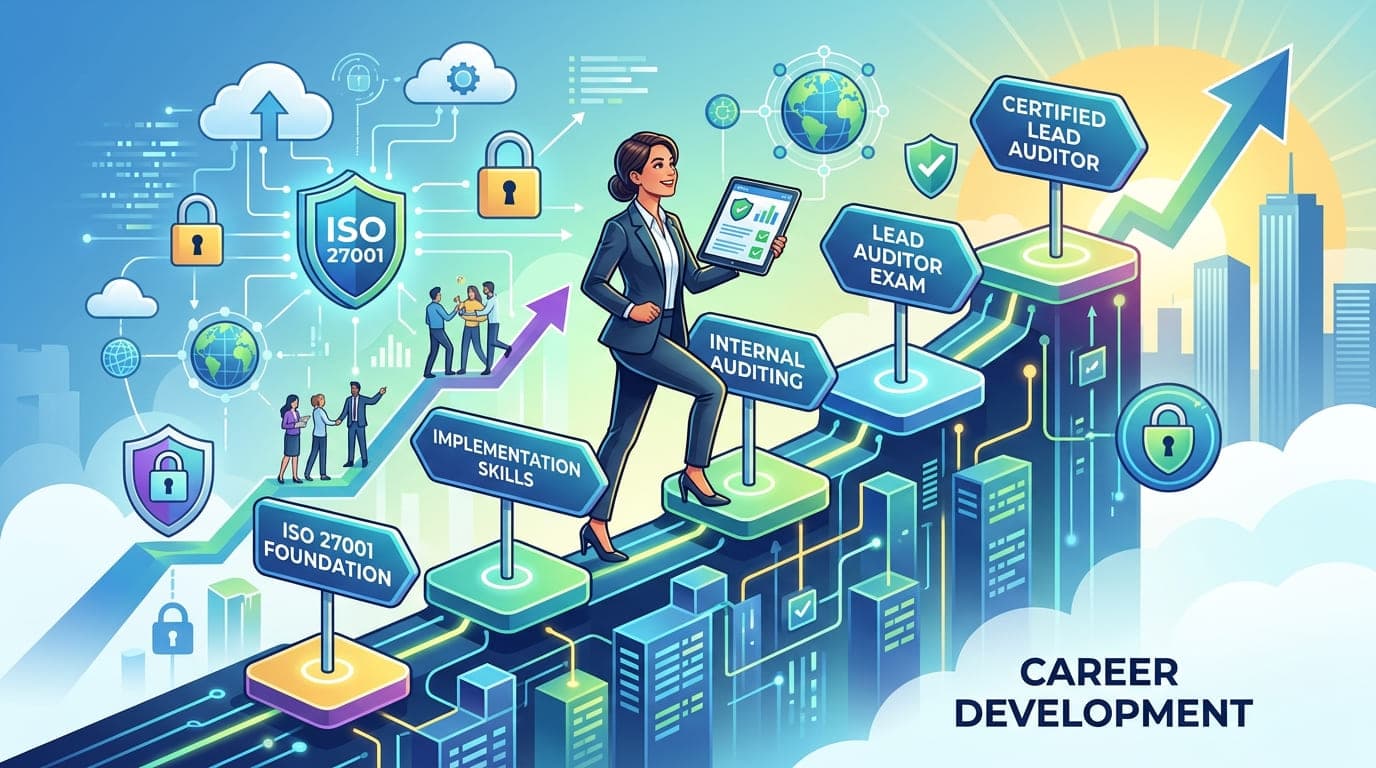
I still remember sitting in my first ISO 27001 Lead Auditor training course in 2011, surrounded by seasoned IT professionals, compliance officers, and a few battle-hardened auditors who'd been doing this since the ISO 17799 days. I felt completely out of my depth.
Fast forward to today: I've conducted over 120 ISO 27001 audits across 15 countries, trained dozens of auditors, and watched this certification transform careers—including my own. That initial five-day course wasn't just training; it was the beginning of a journey that would open doors I didn't even know existed.
If you're considering the ISO 27001 Lead Auditor certification, you're looking at one of the most valuable credentials in information security. Let me share what I've learned from over a decade in this field—the good, the challenging, and the brutally honest truth about what it takes to succeed.
Why ISO 27001 Lead Auditor? The Career Opportunity Nobody's Talking About
Here's something that surprised me: the global shortage of qualified ISO 27001 auditors is creating unprecedented career opportunities.
In 2023, I was contacted by a recruitment firm looking for qualified lead auditors. They had twelve open positions paying between $95,000 and $165,000 annually, plus benefits. The catch? They'd been searching for six months and could barely find qualified candidates.
This isn't an isolated case. The demand for ISO 27001 expertise is exploding because:
Over 45,000 organizations worldwide hold ISO 27001 certification
Each organization requires surveillance audits annually and recertification every three years
Organizations need internal auditors before seeking external certification
Consulting demand is skyrocketing as companies pursue compliance
"An ISO 27001 Lead Auditor certification isn't just a credential—it's a passport to a global career in information security that companies desperately need and will pay premium rates to secure."
The Career Trajectories I've Witnessed
Let me share three people I've mentored who took different paths with their Lead Auditor certification:
Sarah started as an IT administrator making $62,000. After getting her Lead Auditor certification, she moved into internal auditing at her company. Two years later, she joined a Big Four consulting firm as an ISO 27001 consultant at $115,000. Today, she's a senior manager leading a team of auditors, earning north of $180,000.
Marcus was a cybersecurity analyst who wanted to differentiate himself. He got certified, conducted internal audits at his organization, then transitioned to a certification body as an external auditor. He now travels internationally, conducting audits for major corporations, earning $135,000 plus expenses. He tells me he's visited 23 countries through his work.
Jennifer took a different route. She got certified while working at a mid-sized company, built an internal audit program, then left to start her own consultancy. She now contracts as a lead auditor for multiple certification bodies and consults on ISO 27001 implementation. Last year, she billed over $250,000.
Three different paths, three successful careers, all starting with the same certification.
Understanding the ISO 27001 Lead Auditor Certification Landscape
Before we dive into the path, let's clear up confusion. There are several ISO 27001 certifications, and they're not interchangeable:
Certification Level | Focus | Audit Authority | Typical Duration | Career Stage |
|---|---|---|---|---|
ISO 27001 Foundation | Basic understanding of ISMS concepts | None - awareness only | 2 days | Entry level |
ISO 27001 Internal Auditor | First-party audits within your organization | Internal audits only | 2-3 days | Early career |
ISO 27001 Lead Implementer | Implementing ISMS in organizations | None - implementation focus | 5 days | Mid career |
ISO 27001 Lead Auditor | Third-party certification audits | External audits for certification | 5 days | Advanced career |
ISO 27001 Lead Auditor (IRCA Certified) | Internationally recognized auditor | Global certification body audits | 5 days + experience requirements | Senior level |
The Lead Auditor certification is what we're focusing on—it's the gold standard that allows you to conduct certification audits on behalf of accredited certification bodies.
The Real Prerequisites: What They Don't Tell You in the Brochure
Training providers will tell you the formal prerequisites:
Understanding of ISO 27001 standard
Basic knowledge of information security
Familiarity with audit principles
That's technically true. But here's what I tell people who ask me if they're ready:
You Need Real-World Security Experience
I've seen people take the Lead Auditor course straight out of college. They passed the exam. They got the certificate. But they struggled to conduct meaningful audits because they couldn't recognize what good security practices actually look like in the real world.
My recommendation? Have at least 2-3 years of hands-on experience in information security, IT operations, or compliance before pursuing Lead Auditor certification.
Why? Because during audits, you'll need to:
Evaluate if access controls are implemented effectively
Assess whether risk assessments are comprehensive
Determine if incident response procedures are practical
Judge if security monitoring is adequate
You can't do this from a textbook. You need to have lived it.
You Need Business Acumen
Here's a truth that hit me during my third audit: being a Lead Auditor isn't just about security knowledge—it's about understanding business operations.
I once audited a manufacturing company where they'd implemented technically perfect encryption for their production control systems. Perfect implementation. Except it was slowing down their production line by 23%, costing them thousands of dollars daily.
Technical compliance? Yes. Practical business sense? Questionable.
Great auditors understand the business context. They can distinguish between controls that add value and controls that create bureaucratic burden without meaningful risk reduction.
You Need Communication Skills
This might surprise you: communication skills matter more than technical expertise once you reach a certain baseline of knowledge.
I've worked with auditors who were technical geniuses but couldn't explain findings to executives. Their audit reports were technically accurate but impossible to act on. Compare that to auditors who could translate technical findings into business language, explain implications clearly, and guide organizations toward practical improvements.
Guess which ones built successful careers?
"The best auditors I know aren't the ones who can cite every clause of ISO 27001 from memory—they're the ones who can help organizations understand why those clauses matter and how to implement them effectively."
The Certification Path: Step-by-Step Reality Check
Let me walk you through the actual journey, including the parts nobody mentions in the glossy brochures:
Step 1: Choose Your Training Provider (Weeks 1-2)
Not all training providers are equal. I've seen course quality range from exceptional to absolutely terrible.
What to look for:
Factor | Red Flags | Green Flags |
|---|---|---|
Instructor Experience | Trainer has never conducted actual audits | Trainer is active auditor with current certification |
Course Content | Focus only on passing the exam | Balance of theory, practical exercises, and exam prep |
Class Size | 40+ students in one session | 15-20 students maximum for interaction |
Practical Exercises | Minimal or no role-playing | Multiple audit simulations and case studies |
Accreditation | Generic training company | IRCA, Exemplar Global, or national accreditation body approved |
Post-Course Support | Certificate delivery only | Access to materials, mentor support, alumni network |
My recommendation: Choose an IRCA (International Register of Certificated Auditors) or Exemplar Global approved training organization. Yes, they're typically more expensive ($2,500-$3,500 vs. $1,500-$2,000 for non-accredited), but the quality difference is substantial.
I took a cheaper course first. I passed. But when I retook an IRCA-approved course two years later, I realized how much I'd missed the first time around.
Step 2: The Five-Day Training Course (Week 3)
Let me set realistic expectations about what this week looks like:
Day 1: Foundation
ISO 27001 standard deep dive
ISMS concepts and terminology
Audit principles and types
Risk-based thinking
This day is dense. Really dense. You're essentially downloading the entire ISO 27001 standard into your brain. I filled three notebooks.
Day 2: Audit Process
Audit program management
Audit planning and preparation
Documentation review
Opening meeting procedures
This is where it gets practical. You'll learn how to plan an audit, what documents to review, and how to structure your approach.
Day 3: Conducting Audits
Interviewing techniques
Evidence gathering
Sampling methodologies
Observation skills
Here's where good instructors shine. You'll do role-plays. You'll practice interviewing. You'll learn to distinguish between objective evidence and hearsay.
I still remember my instructor stopping a role-play I was doing and saying, "You're not asking open-ended questions. You're leading the witness." That lesson stuck.
Day 4: Reporting and Follow-Up
Audit findings classification
Non-conformity writing
Closing meeting conduct
Follow-up and surveillance audits
Writing clear, actionable non-conformities is an art. You'll practice writing findings that are specific, evidence-based, and tied to specific ISO 27001 clauses.
Day 5: Exam and Wrap-Up
Final review
Written examination (3-4 hours)
Results and certification
The exam is no joke. It typically includes:
Multiple choice questions (40-50% of exam)
Scenario-based questions (30-40% of exam)
Audit report writing exercise (20-30% of exam)
Pass rate reality check: About 75-80% of candidates pass on their first attempt. Those who fail usually struggle with the audit report writing section—they know the theory but can't apply it practically.
Step 3: Post-Training Reality (Months 1-3)
Here's what nobody tells you: getting certified is just the beginning. The real learning happens when you conduct your first actual audit.
To become a recognized lead auditor for certification bodies, you typically need:
Experience Requirements:
Certification Body | Audit Days Required | Lead Audit Experience | Technical Area Experience |
|---|---|---|---|
IRCA/CQI | 20 audit days minimum | 4 complete audits as audit team member | 4 years information security |
Exemplar Global | 15 audit days minimum | 3 complete audits | 3 years relevant experience |
PECB | 7 audit days minimum | 2 complete audits | 2 years information security |
Most Certification Bodies | 15-20 audit days | 3-5 complete audits | 3-5 years in field |
This is the challenging part. How do you get audit experience to become an auditor when certification bodies won't hire you without experience?
Here's how I did it, and how I advise others:
Month 1-2: Internal Auditing Start conducting internal audits at your current organization. Even if your company isn't ISO 27001 certified, you can:
Audit against the ISO 27001 standard anyway
Document your audit activities
Build your audit logs
Develop your skills in a friendly environment
I conducted eight internal audits over three months at my company. This gave me practical experience without the pressure of a certification audit.
Month 3-6: Shadow Auditing This is golden. Many certification bodies and consulting firms will let you shadow experienced auditors. You're not conducting the audit, but you're observing, learning, and logging audit days.
I shadowed a senior auditor for three audits. I watched how he asked questions, gathered evidence, and handled difficult situations. I learned more in those three weeks than I did in months of solo work.
Month 6-12: Team Member Audits Once you have some experience, you can join audit teams as a technical expert or team member. You're not the lead auditor yet, but you're conducting portions of the audit under supervision.
This is where you build confidence and competence.
Step 4: Building Your Auditor Credentials (Year 1-2)
To progress from "guy with a certificate" to "recognized professional auditor," you need to build your credibility systematically:
Professional Registration
Registration Body | Recognition Level | Annual Cost | Requirements | Career Benefit |
|---|---|---|---|---|
IRCA (CQI) | Global - Gold Standard | $400-600 | 20 audit days, 4 years experience | Highest industry recognition |
Exemplar Global | Global - High Recognition | $300-500 | 15 audit days, 3 years experience | Strong international recognition |
National Boards | Country-specific | $200-400 | Varies by country | Regional recognition |
PECB Certified | International | $250-450 | 7 audit days, 2 years experience | Growing recognition |
I went with IRCA registration. Yes, it took longer to meet requirements. Yes, it cost more. But when I walked into audit meetings and could say I was IRCA-registered, it opened doors.
Building Your Audit Log
Keep meticulous records of every audit:
Organization name and type
Audit dates and duration
Your role (team member, lead, shadow)
Scope and complexity
Certification body or internal audit
Any findings or challenges
This audit log becomes your professional portfolio. I've been asked to provide this for job interviews, certification body applications, and consulting engagements.
Step 5: Continuous Professional Development (Ongoing)
Here's where many certified auditors stall: they think getting certified is the finish line, not the starting line.
To maintain your certification and stay relevant, you need ongoing education:
Annual CPD Requirements:
Activity | Time Commitment | Professional Value | Cost Range |
|---|---|---|---|
Standards Updates | 5-10 hours/year | Critical - standards evolve | Free - $500 |
Technical Training | 15-20 hours/year | High - technology changes rapidly | $500 - $2,000 |
Audit Workshops | 10-15 hours/year | High - skills improvement | $300 - $1,500 |
Industry Conferences | 20-30 hours/year | Medium - networking and trends | $1,000 - $3,000 |
Peer Review Sessions | 10-15 hours/year | High - learn from others | Free - $500 |
Reading and Research | 20-30 hours/year | Medium - staying current | $200 - $800 |
Total Annual CPD | 80-120 hours | Essential for career growth | $2,000 - $8,000 |
I budget about $4,000 annually for professional development. My employer covers most of it, but I supplement with personal investment. It's paid for itself many times over.
The Career Paths: Where This Certification Takes You
Based on watching dozens of certified auditors over the years, here are the typical career trajectories:
Path 1: External Auditor for Certification Bodies
Timeline: 2-4 years from certification to established auditor
Income Progression:
Junior Auditor (Team Member): $70,000 - $95,000
Lead Auditor: $95,000 - $135,000
Senior Lead Auditor: $125,000 - $165,000
Principal Auditor/Technical Reviewer: $150,000 - $200,000
Lifestyle Reality:
Travel: 40-60% of time
Work Schedule: Often includes weekends and off-hours
Variety: High - different companies, industries, challenges
Job Security: Good - high demand for qualified auditors
I know an auditor who's been doing this for eight years. He loves the travel and variety. He's audited companies in 31 countries. He says he'll never take a desk job again.
I also know an auditor who burned out after three years. The travel became exhausting. He missed family events. He transitioned to internal auditing for better work-life balance.
Path 2: Internal Auditor/Compliance Manager
Timeline: 1-3 years from certification to senior role
Income Progression:
Internal Auditor: $75,000 - $100,000
Senior Internal Auditor: $95,000 - $125,000
Compliance Manager: $110,000 - $145,000
Head of Compliance/Audit: $135,000 - $185,000
Lifestyle Reality:
Travel: 10-20% of time
Work Schedule: Regular business hours
Variety: Medium - same organization, different areas
Job Security: Excellent - internal positions are stable
This is the path I ultimately chose. I loved external auditing for five years, but I wanted stability. I joined a Fortune 500 company as their Lead Internal Auditor for Information Security.
The pay was slightly less than external auditing, but the work-life balance was dramatically better. I could attend my daughter's soccer games. I could plan vacations. I slept in my own bed most nights.
Path 3: Independent Consultant/Contractor
Timeline: 3-5 years from certification to viable independence
Income Potential:
Part-Time Consulting: $50,000 - $100,000 (supplemental)
Full-Time Consulting: $100,000 - $250,000+
Established Practice: $200,000 - $500,000+
Lifestyle Reality:
Travel: Variable (30-70% based on client needs)
Work Schedule: Completely variable - feast or famine
Variety: Very high - different clients and industries
Job Security: Self-created - depends on your network
Financial Reality:
Day rates: $800 - $2,500 per day
Audit contracts: $15,000 - $45,000 per engagement
Retainer clients: $5,000 - $15,000 monthly
This is the highest-risk, highest-reward path. I know consultants who make $300,000+ annually. I also know consultants who struggled for years before building sustainable practices.
The key differentiator? Business development skills. The best technical auditors don't automatically become successful consultants. You need to market yourself, build relationships, and manage client expectations.
Path 4: Big Four or Major Consulting Firms
Timeline: 0-2 years from certification to hire (they often hire and train)
Income Progression:
Consultant: $80,000 - $110,000
Senior Consultant: $110,000 - $145,000
Manager: $140,000 - $180,000
Senior Manager/Director: $180,000 - $250,000+
Partner: $300,000 - $1,000,000+
Lifestyle Reality:
Travel: 60-80% of time
Work Schedule: Demanding - 50-70 hour weeks common
Variety: Very high - major clients, complex engagements
Career Growth: Fast - clear progression if you perform
The Big Four and major consulting firms (Deloitte, EY, KPMG, PwC, Accenture, Booz Allen) actively recruit ISO 27001 Lead Auditors. They offer:
Structured career progression
Extensive training
Major client exposure
Global opportunities
High compensation potential
The trade-off? Demanding work schedules and high-pressure environments. I've seen people thrive in these environments and others burn out in 18 months.
"Your Lead Auditor certification is a tool, not a destination. How you use it—whether as an external auditor, internal compliance professional, consultant, or corporate leader—depends entirely on your career goals and lifestyle preferences."
The Skills That Separate Good Auditors from Great Ones
After conducting over 120 audits and training dozens of auditors, I've identified the skills that truly differentiate exceptional auditors:
1. Active Listening Over Interrogation
Weak auditors ask closed questions and wait to pounce on wrong answers. Great auditors ask open-ended questions and genuinely listen to understand.
I learned this the hard way during an audit in 2014. I was convinced a company wasn't doing proper risk assessments. I kept asking pointed questions to confirm my suspicion. The auditee became defensive. The conversation went nowhere.
My senior colleague pulled me aside: "Stop trying to catch them making mistakes. Start trying to understand their process. Then you'll know if it's effective."
When I changed my approach, I discovered they had an excellent risk process—it just looked different than what I expected.
2. Business Context Understanding
Technical compliance without business context is meaningless.
I once audited a startup with 12 employees. Their documentation wasn't perfect. Their procedures were informal. By strict ISO 27001 interpretation, I could have written fifteen non-conformities.
But I understood their business context. They were resource-constrained, growing rapidly, and had implemented pragmatic controls that actually reduced risk. Writing fifteen findings would have been technically correct and practically useless.
Instead, I wrote three findings focused on areas where their approach created genuine risk, and provided observations about areas to improve as they grew.
The CEO told me later: "That was the most valuable audit we've had. You understood our situation and helped us improve, not just judged us against an abstract standard."
3. Evidence-Based Judgment
Opinion doesn't matter. Evidence does.
Weak auditor approach: "I don't think your incident response procedure is adequate."
Strong auditor approach: "I reviewed your incident response procedure dated January 15, 2024. I observed that it doesn't include specific escalation timeframes or define roles for legal notification, which are required by ISO 27001 Clause A.16.1.5. Can you show me where these elements are documented?"
The difference? The second approach is specific, evidence-based, and actionable.
4. Report Writing Clarity
Your audit report is often the only thing executives see. If they can't understand it, it's worthless.
Bad finding: "Non-conformity identified in accordance with ISO 27001:2022 Clause 6.1.2 regarding risk assessment methodology implementation deficiencies."
Good finding: "The organization hasn't updated its information security risk assessment in 18 months, despite significant changes including cloud migration and acquisition of two subsidiaries. ISO 27001 Clause 6.1.2 requires risk assessments to be updated when significant changes occur. This creates a risk that current threats aren't being properly identified and addressed."
Which one would you rather receive as an executive trying to understand what needs fixing?
5. Professional Skepticism with Respect
You need to be skeptical—that's your job. But you don't need to be an asshole about it.
I've worked with auditors who treated every auditee like a criminal trying to deceive them. They created hostile environments where people became defensive and unhelpful.
The best auditors maintain professional skepticism while treating auditees with respect. They understand that most people are trying to do the right thing, and if something's wrong, it's usually due to misunderstanding, resource constraints, or competing priorities—not malicious intent.
The Financial Reality: What You'll Actually Earn
Let's talk money. Here's what I've observed across different markets and career stages:
Year 1-2 After Certification:
Role | Salary Range (USD) | Additional Compensation | Total Compensation |
|---|---|---|---|
Junior Internal Auditor | $60,000 - $85,000 | Bonus: 5-10% | $63,000 - $93,500 |
Team Member (Cert Body) | $65,000 - $90,000 | Per Diem: $15,000/year | $80,000 - $105,000 |
Consultant (Big Four) | $75,000 - $100,000 | Bonus: 10-20% | $82,500 - $120,000 |
Year 3-5 After Certification:
Role | Salary Range (USD) | Additional Compensation | Total Compensation |
|---|---|---|---|
Senior Internal Auditor | $85,000 - $115,000 | Bonus: 10-15% | $93,500 - $132,250 |
Lead Auditor (Cert Body) | $95,000 - $135,000 | Per Diem: $20,000/year | $115,000 - $155,000 |
Senior Consultant | $105,000 - $145,000 | Bonus: 15-25% | $120,750 - $181,250 |
Independent Consultant | $100,000 - $250,000 | Variable | $100,000 - $250,000+ |
Year 6-10 After Certification:
Role | Salary Range (USD) | Additional Compensation | Total Compensation |
|---|---|---|---|
Compliance Manager | $110,000 - $150,000 | Bonus: 15-20% | $126,500 - $180,000 |
Principal Auditor | $125,000 - $165,000 | Per Diem: $25,000/year | $150,000 - $190,000 |
Manager (Big Four) | $130,000 - $180,000 | Bonus: 20-30% | $156,000 - $234,000 |
Established Consultant | $150,000 - $400,000+ | Variable | $150,000 - $400,000+ |
Geographic Variations:
These numbers vary significantly by location:
Region | Salary Multiplier | Market Factors |
|---|---|---|
US - Major Cities (NYC, SF, LA) | 1.2x - 1.5x | High demand, high cost of living |
US - Secondary Markets | 1.0x (baseline) | Balanced market |
UK/Western Europe | 0.9x - 1.2x | Strong market, currency variations |
Middle East | 1.1x - 1.4x | Growing compliance requirements, tax advantages |
Asia-Pacific | 0.7x - 1.1x | Varies widely by country and city |
Eastern Europe | 0.5x - 0.8x | Growing market, lower cost of living |
The Challenges Nobody Warns You About
I want to be completely honest about the difficulties you'll face:
Challenge 1: The First Audit Terror
Your first solo lead audit will be terrifying. I don't care how confident you are—when you're sitting across from a room full of executives waiting for you to lead the opening meeting, your heart will race.
My first lead audit was for a 200-person financial services company. I barely slept the night before. I rehearsed my opening meeting statement twenty times. I was convinced I'd miss something critical.
You know what? I did miss things. I asked some clumsy questions. My initial audit plan needed adjustment on day two. But I got through it, and the organization got value from the audit.
The terror fades. By your fifth audit, you'll wonder why you were so nervous. By your twentieth, it'll feel routine.
Challenge 2: Difficult Auditees
Some people don't want to be audited. They'll be:
Hostile and defensive
Evasive and unhelpful
Argumentative about every finding
Contemptuous of the entire process
I once audited an IT director who believed auditing was "bureaucratic nonsense" and made his opinion clear. Every question was met with minimal responses. Every finding was challenged aggressively.
You need thick skin and professional persistence. You also need to recognize when someone's behavior crosses from difficult to obstructive, and know how to escalate appropriately.
Challenge 3: Knowledge Limitations
Technology evolves faster than standards. You'll encounter systems, architectures, and security approaches you've never seen before.
During one audit, I encountered a zero-trust architecture implementation that was completely foreign to me. I had to think fast: acknowledge I needed to learn about their approach, ask them to explain it, then evaluate whether it met ISO 27001 requirements.
Great auditors aren't know-it-alls. They're rapid learners who can assess unfamiliar systems against control objectives.
Challenge 4: The Ethical Dilemmas
You'll face situations where:
You find major issues but management wants them downplayed
Commercial pressure to "go easy" on paying clients
Personal relationships with auditees that could compromise objectivity
Organizational pressure to rush audits and cut corners
I've walked away from situations where I felt I couldn't maintain independence. It cost me short-term income but preserved my professional integrity and reputation.
"Your reputation as an auditor is built over years and can be destroyed in a single audit where you compromise your independence and objectivity. Never let commercial pressure override professional judgment."
Challenge 5: The Physical and Mental Toll
Auditing is exhausting:
Constant travel and irregular schedules
Eight-hour days conducting intense interviews
Evenings spent reviewing evidence and writing reports
Mental fatigue from sustained concentration
Stress of delivering difficult findings
I've seen auditors burn out. I've felt it myself—that moment after your third audit in three weeks where you can't face another opening meeting.
You need strategies to manage this: exercise, proper sleep, time off, hobbies outside auditing, and knowing when to say no to additional work.
My Honest Recommendations: Should You Pursue This Path?
After everything I've shared, here's my guidance on who should pursue ISO 27001 Lead Auditor certification:
You're an Excellent Candidate If:
✅ You have 2+ years of hands-on information security or IT experience ✅ You enjoy analyzing processes and finding improvement opportunities ✅ You're comfortable having difficult conversations professionally ✅ You can explain technical concepts to non-technical people ✅ You're detail-oriented but can see the big picture ✅ You're willing to invest time in continuous learning ✅ You want career flexibility and multiple path options ✅ You don't mind travel (if pursuing external auditing)
Reconsider or Wait If:
❌ You have minimal real-world security experience ❌ You struggle with interpersonal communication ❌ You need immediate income increase (certification takes time to pay off) ❌ You can't invest $3,000-$5,000 in training and registration ❌ You want a purely technical role without business interaction ❌ You're not comfortable with ambiguity and judgment calls ❌ You need perfect work-life balance immediately
Your Action Plan: Getting Started
If you're ready to pursue this path, here's your practical roadmap:
Months 1-3: Foundation Building
Read ISO 27001:2022 standard thoroughly (available from ISO.org, ~$200)
Assess your current knowledge gaps
Identify areas needing practical experience
Research training providers and compare options
Budget for training, exam, and registration costs
Month 4: Training Selection and Registration
Choose IRCA/Exemplar Global accredited training
Register for course ($2,500-$3,500)
Block five consecutive days for intensive training
Arrange coverage for work responsibilities
Prepare mentally for intensive learning week
Month 5: Training Completion
Attend five-day lead auditor course
Take and pass certification exam
Receive your certificate
Join professional auditor networks
Connect with course alumni
Months 6-12: Experience Building
Conduct internal audits at current organization
Volunteer for audit activities
Shadow experienced auditors when possible
Document all audit activities in audit log
Build professional relationships with certification bodies
Year 2: Career Transition
Apply for junior auditor positions
Consider temporary assignments or contracts
Register with professional auditor bodies (IRCA/Exemplar)
Continue professional development
Start building your reputation and network
Year 3+: Career Development
Choose your preferred path (external, internal, consulting)
Pursue additional certifications if beneficial
Mentor junior auditors
Contribute to professional community
Plan long-term career progression
The Unexpected Benefits I Discovered
Beyond the obvious career advantages, this certification gave me unexpected benefits:
1. Cross-Industry Knowledge
I've audited healthcare, finance, manufacturing, retail, technology, government, and non-profit organizations. This breadth of exposure taught me how different industries approach security, what works, and what fails spectacularly.
This knowledge makes me more valuable in any role because I can say, "Here's how leading financial services companies handle this challenge," or "Manufacturing organizations solve this problem by..."
2. Global Perspective
I've conducted audits in 15 countries. I've seen how cultural differences affect security implementations. I've learned that "best practices" often need cultural adaptation.
This global exposure is invaluable in today's interconnected business environment.
3. Executive Communication Skills
Regular interaction with C-level executives during audit opening and closing meetings dramatically improved my ability to communicate up the organizational hierarchy.
I learned to present technical findings in business terms, to prioritize based on business impact, and to communicate clearly under pressure.
4. Professional Network
The auditor community is surprisingly tight-knit. I've built relationships with auditors worldwide. These connections have led to job opportunities, consulting referrals, and collaborative problem-solving on difficult audits.
5. Personal Confidence
There's something about conducting successful audits for major organizations that builds deep professional confidence. You learn you can walk into unfamiliar situations, assess complex systems, and provide valuable insights.
This confidence extends beyond auditing into all professional interactions.
Final Thoughts: The Journey is Worth It
I'm sitting here writing this after over a decade as an ISO 27001 Lead Auditor. Looking back at that nervous person in the training room in 2011, I'm amazed at how this certification changed my career trajectory.
It hasn't always been easy. I've had difficult audits, demanding clients, and moments of doubt. I've worked weekends, missed family events, and pushed through exhaustion to complete audit reports.
But I've also:
Built a career I genuinely enjoy
Earned a comfortable income doing work that matters
Helped dozens of organizations improve their security
Mentored young auditors finding their way
Created opportunities I never imagined when I started
Would I do it again? Absolutely, without hesitation.
Should you do it? If you're passionate about information security, enjoy helping organizations improve, and want a career with multiple paths and strong demand, then yes.
The ISO 27001 Lead Auditor certification isn't a magic bullet. It won't instantly transform your career or guarantee success. But it opens doors, creates opportunities, and provides a foundation for a rewarding career in information security.
The question isn't whether the certification is worth pursuing. The question is whether you're ready to commit to the journey and build a career as a professional auditor.
If you are, I'll see you in an audit someday. And when you conduct your first audit and feel that mixture of terror and excitement, remember: we've all been there, and you'll be great.
"The ISO 27001 Lead Auditor certification is your entry ticket to a career where you'll constantly learn, regularly challenge yourself, and consistently make a difference in how organizations protect their information assets. The journey is demanding, but for those who commit to excellence, the rewards are extraordinary."
Ready to start your ISO 27001 Lead Auditor journey? Subscribe to PentesterWorld for in-depth guides on certification preparation, audit techniques, and career development advice from experienced practitioners.