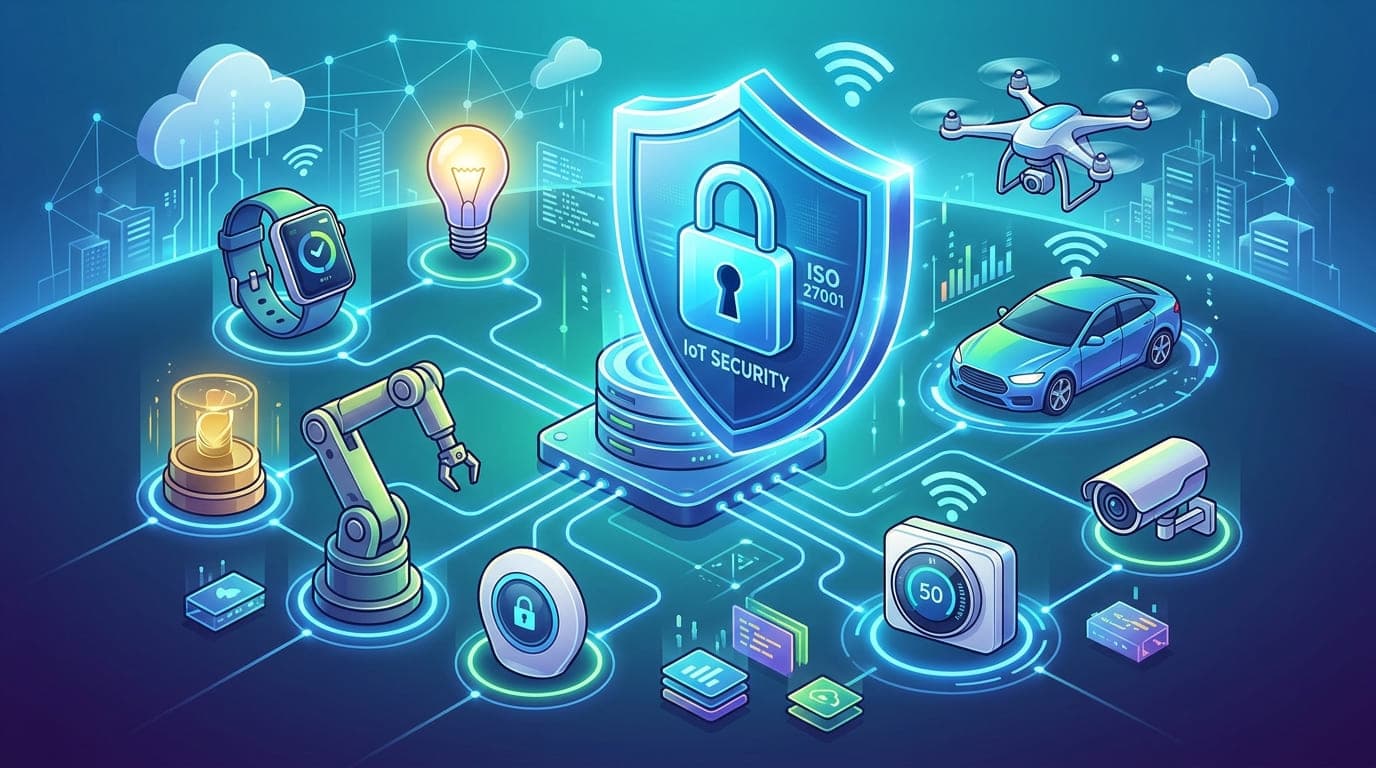
The conference room went silent when the CISO pulled up the network scan results on the projector. "So," he said slowly, "can someone explain why we have 847 IoT devices on our corporate network... when IT only knows about 43 of them?"
That was three years ago at a major manufacturing company, and it was my introduction to what I now call the "IoT shadow inventory problem." Smart TVs in conference rooms. Fitness trackers syncing via company WiFi. Voice assistants on executives' desks. Smart thermostats, security cameras, even a smart coffee maker that someone connected because "it sends alerts when maintenance is needed."
Each one was a potential doorway into their network. And until that scan, nobody even knew they existed.
After fifteen years in cybersecurity—the last six focused heavily on IoT security—I've learned that the Internet of Things isn't coming. It's here, it's everywhere, and most organizations are woefully unprepared to secure it within their ISO 27001 frameworks.
Let me show you how to change that.
The IoT Security Crisis Nobody's Talking About
Here's a statistic that should terrify you: by 2025, there will be over 75 billion IoT devices worldwide. But here's what keeps me up at night—studies show that 57% of IoT devices are vulnerable to medium or high-severity attacks.
I witnessed this firsthand in 2021 when a hospital's MRI machine—a $2 million piece of equipment—got infected with ransomware. Not the hospital's network. The MRI machine itself.
How? The device was running Windows 7, hadn't been patched in four years (the vendor claimed updates would void the warranty), and was connected directly to the internet so technicians could access it remotely. It took three weeks to clean, decrypt, and restore. During that time, patients had to be redirected to other facilities.
The financial cost? Over $4 million in lost revenue, remediation, and potential HIPAA violations.
The human cost? Delayed cancer diagnoses, postponed surgeries, and immeasurable stress for patients and staff.
"IoT devices are the unlocked back door in your security perimeter. You've invested millions in securing the front entrance, while thousands of devices quietly create vulnerabilities you don't even know exist."
Why Traditional ISO 27001 Implementation Falls Short
I've helped over thirty organizations achieve ISO 27001 certification. About half of them initially treated IoT devices the same way they treated traditional IT assets. It was a disaster.
Here's why traditional approaches fail:
Problem #1: You Can't Patch What You Don't Control
Traditional IT security assumes you control the software stack. You can patch servers, update workstations, configure firewalls.
IoT devices? Good luck. I've seen:
Smart building systems that require vendor-specific updates (at vendor-specific prices)
Industrial sensors that can't be updated without shutting down production lines
Medical devices where firmware updates require FDA revalidation
Security cameras that haven't received updates in six years because the manufacturer went bankrupt
Problem #2: Discovery Is Nearly Impossible
In 2022, I conducted a security assessment for a financial services company. Their asset inventory listed 1,200 network-connected devices.
After a comprehensive scan and physical survey, we found 3,847 devices. The missing 2,647 included:
437 smart building sensors
201 IP cameras
89 badge readers
156 printers with embedded web servers
73 voice-activated assistants
And dozens of other "invisible" devices
Each one was processing data, communicating over the network, and creating potential attack vectors.
Problem #3: IoT Devices Have Different Lifecycles
A server might get replaced every 3-5 years. A workstation every 4-6 years.
That industrial temperature sensor? It's been running for 12 years and will probably run for another 10. The building access control system? Installed in 2003 and "working fine."
I visited a manufacturing facility where they were using programmable logic controllers (PLCs) from 1997. These devices were controlling multi-million dollar production lines and had never been updated because "they just work."
Until they don't.
Mapping IoT Security to ISO 27001 Controls
The good news is that ISO 27001 provides excellent coverage for IoT security—if you know how to apply it correctly. After implementing IoT-specific controls across multiple organizations, I've developed a framework that maps cleanly to ISO 27001 Annex A controls.
Critical ISO 27001 Controls for IoT Security
ISO 27001 Control | IoT-Specific Application | Implementation Priority | Common Challenges |
|---|---|---|---|
A.8.1.1 - Asset Inventory | Maintain comprehensive inventory of all IoT devices including make, model, firmware version, network location, and data classification | CRITICAL | Shadow IT, undocumented devices, BYOD IoT |
A.8.1.2 - Asset Ownership | Assign clear ownership and responsibility for each IoT device including security maintenance | HIGH | Facilities vs IT ownership disputes |
A.8.1.3 - Acceptable Use | Define acceptable IoT device usage, personal device policies, and prohibited devices | HIGH | User resistance, convenience vs security |
A.8.2.1 - Information Classification | Classify data collected, processed, and transmitted by IoT devices | CRITICAL | Understanding what data devices actually collect |
A.8.2.3 - Media Handling | Secure disposal and data wiping procedures for IoT devices | MEDIUM | Lack of secure wipe capabilities in many devices |
A.11.1.1 - Physical Security Perimeter | Physical protection of IoT devices, especially those in public or unsecured areas | HIGH | Devices in remote locations, public spaces |
A.12.1.2 - Change Management | Firmware update procedures, testing protocols, rollback capabilities | CRITICAL | Vendor-dependent updates, production downtime |
A.12.2.1 - Malware Controls | Anti-malware for IoT devices where possible, network-based protection where not | HIGH | Limited device resources, proprietary OS |
A.12.4.1 - Event Logging | Centralized logging of IoT device activity, security events, and configuration changes | CRITICAL | Limited logging capabilities, log storage |
A.12.6.1 - Technical Vulnerability Management | Regular vulnerability scanning, penetration testing, firmware analysis | CRITICAL | Scanning may disrupt device operation |
A.13.1.1 - Network Segmentation | Isolate IoT devices on separate VLANs with restricted access | CRITICAL | Legacy network infrastructure |
A.13.1.2 - Network Controls | Firewall rules, access control lists, traffic monitoring for IoT segments | HIGH | Complex rule sets, performance impact |
A.13.2.1 - Information Transfer Policies | Secure protocols for IoT data transmission, encryption requirements | HIGH | Devices supporting only unencrypted protocols |
A.14.2.1 - Secure Development | Security requirements for custom IoT applications and integrations | MEDIUM | Lack of IoT development expertise |
A.18.2.3 - Technical Compliance Review | Regular audits of IoT security controls and compliance status | HIGH | Rapid IoT deployment outpacing audits |
The IoT Security Framework That Actually Works
After implementing IoT security programs at organizations ranging from 50 to 50,000 employees, I've refined a practical framework that aligns with ISO 27001 while addressing real-world IoT challenges.
Phase 1: Discovery and Inventory (Weeks 1-4)
This is where most organizations fail. You can't secure what you don't know about.
Active Discovery Methods:
Network scanning (but be careful—some IoT devices crash when scanned)
DHCP log analysis
Network access control (NAC) data
Wi-Fi association logs
Physical surveys of facilities
Passive Discovery Methods:
Network traffic analysis
DNS query logs
NetFlow data analysis
Span port monitoring
I learned the importance of passive methods the hard way. In 2020, I helped a healthcare provider scan their network for IoT devices. Our scan crashed two critical patient monitoring systems because they couldn't handle the probe traffic. We lost nothing critical, but it was a wake-up call about scanning methodology.
"Discovery isn't a one-time project. IoT devices appear in your environment like weeds in a garden—constant vigilance is the only way to maintain control."
IoT Device Inventory Template:
Required Information | Purpose | Data Source |
|---|---|---|
Device Type & Model | Risk assessment, vulnerability tracking | Physical inspection, network scan |
MAC Address | Unique identification, access control | Network logs, device label |
IP Address (Static/DHCP) | Network location, access policies | DHCP server, network scan |
Firmware Version | Vulnerability assessment, update tracking | Device management interface |
Manufacturer & Support Status | Patch availability, EOL planning | Vendor documentation |
Network Segment | Segmentation validation, traffic analysis | Network configuration |
Data Classification | Risk level, encryption requirements | Data flow analysis |
Device Owner | Accountability, maintenance responsibility | Asset management system |
Purpose & Justification | Risk acceptance, access requirements | Business documentation |
Last Update Date | Patch compliance tracking | Change management records |
Authentication Method | Access control validation | Device configuration |
Encryption Status | Data protection compliance | Security assessment |
Phase 2: Risk Assessment and Classification (Weeks 5-8)
Not all IoT devices pose equal risk. I use a risk classification matrix that considers both likelihood and impact:
IoT Risk Classification Matrix:
Risk Category | Device Characteristics | Examples | Security Requirements |
|---|---|---|---|
CRITICAL | Processes sensitive data, Internet-connected, difficult to replace, controls physical access | Medical devices, building access control, financial transaction systems | Dedicated VLAN, 24/7 monitoring, immediate patch deployment, annual penetration testing |
HIGH | Accesses sensitive systems, stores data, widely deployed | IP cameras, smart sensors with data storage, networked printers | Segmented network, regular vulnerability scanning, quarterly security reviews |
MEDIUM | Limited data access, controlled environment, replaceable | Smart thermostats, occupancy sensors, digital displays | Basic network segmentation, annual security assessment |
LOW | No sensitive data, isolated function, easily replaceable | Smart lighting, standalone speakers, employee fitness trackers (isolated) | Standard network access, documented in inventory |
I worked with a retail company that initially classified all their IoT devices as "low risk" because they were "just sensors and displays." Then we discovered their smart shelves were transmitting real-time inventory data—including pricing strategy information—over unencrypted connections to a cloud service in another country.
After reclassification, 67% of their IoT devices moved to "high" or "critical" categories, fundamentally changing their security approach.
Phase 3: Network Segmentation (Weeks 9-16)
This is the single most effective control for IoT security. I've never seen an organization regret implementing proper IoT network segmentation.
Recommended Network Segmentation Strategy:
Network Segment | Purpose | Access Policy | Monitoring Level |
|---|---|---|---|
IoT-Critical | Life safety, physical security, critical operations | Deny all except explicitly allowed, no Internet access | Continuous with immediate alerting |
IoT-Business | Business operations, productivity devices | Allow specific business applications, restricted Internet | Real-time monitoring with daily review |
IoT-Guest | Visitor devices, demo equipment | Internet only, no internal access | Weekly log review |
IoT-Quarantine | Unknown or untrusted devices | Completely isolated, monitoring only | Continuous monitoring |
IoT-Legacy | Unsupported devices requiring isolation | Minimal required access, no Internet | Enhanced monitoring and logging |
In 2023, I implemented this segmentation model for a manufacturing company. Six weeks after implementation, their monitoring detected an IP camera on the IoT-Business segment trying to communicate with a command-and-control server in Eastern Europe.
Because of segmentation, the compromised camera could only access other IoT devices—not production systems or data servers. We isolated it, reimaged it, and investigated. Total impact? About four hours of security team time and one $200 camera replacement.
Without segmentation? That camera sat on the same network as their ERP system, engineering drawings, and customer database. The breach could have been catastrophic.
Phase 4: Authentication and Access Control (Weeks 12-20)
IoT devices are notoriously terrible at authentication. I've seen:
Default credentials that can't be changed
Hardcoded passwords in firmware
No authentication at all
Shared credentials across all devices
Plain text credential storage
IoT Authentication Best Practices:
Security Measure | Implementation Approach | ISO 27001 Mapping | Difficulty Level |
|---|---|---|---|
Change Default Credentials | Document and change all default passwords immediately upon deployment | A.9.2.1, A.9.2.4 | Easy |
Unique Device Credentials | Assign unique credentials to each device, never reuse across devices | A.9.2.1, A.9.3.1 | Medium |
Certificate-Based Auth | Implement PKI certificates for device authentication where supported | A.9.2.1, A.14.1.2 | Hard |
Network-Level Auth | Use 802.1X for network access control | A.13.1.1, A.13.1.3 | Medium |
Multi-Factor Authentication | Require MFA for administrative access to IoT devices | A.9.4.2, A.9.4.3 | Easy |
Privileged Access Management | Centralized credential management for IoT administrative access | A.9.2.3, A.9.4.1 | Medium |
Regular Credential Rotation | Automated password rotation every 90 days where possible | A.9.2.4, A.9.3.1 | Medium |
I once found an industrial facility with 200+ IP cameras all using the same admin password: "admin123". When I explained the risk, the facilities manager said, "But it's easy to remember!"
Six months earlier, someone had compromised one camera and used it to pivot into their network. They caught it, reset that one camera, but never changed the passwords on the other 199 cameras or investigated how the attacker got in.
We implemented a privileged access management system that generates and rotates unique credentials for each device. Initial setup took two weeks. Ongoing management? About 30 minutes per month. Security improvement? Immeasurable.
Phase 5: Encryption and Data Protection (Weeks 16-24)
IoT devices often transmit sensitive data—and often do it insecurely.
IoT Data Protection Strategy:
Data State | Protection Requirement | Implementation Method | Validation Approach |
|---|---|---|---|
Data in Transit | TLS 1.2+ for all sensitive data | Configure devices to use secure protocols, block unencrypted traffic | Network traffic analysis, protocol inspection |
Data at Rest | AES-256 encryption for stored sensitive data | Enable device encryption, encrypted storage systems | Device configuration audit, penetration testing |
Management Traffic | VPN or encrypted channels for remote management | Implement jump servers, disable direct Internet access | Network monitoring, access logs |
API Communications | API keys, OAuth, or certificate authentication | Secure credential storage, key rotation | API security testing, log analysis |
Firmware Updates | Signed and encrypted firmware with integrity checking | Only install manufacturer-signed updates, maintain update logs | Configuration management database |
I consulted for a hospital where medical devices were sending patient vitals over unencrypted HTTP. When I demonstrated that I could intercept and read patient data using free tools, the CTO nearly had a heart attack.
"But the vendor said it was secure because it's on our internal network," he protested.
I showed him my laptop connected to guest Wi-Fi, intercepting data from devices two floors away.
We implemented network encryption, segmentation, and monitoring. The vendor initially resisted ("no one else requires this"), but when faced with losing a major customer, they provided a firmware update enabling TLS within six weeks.
The Vendor Problem: When Security Isn't Your Choice
Here's an uncomfortable truth: you often can't secure IoT devices because vendors won't let you.
I've encountered:
Smart building systems that require open Internet access (their "security" model)
Industrial equipment where security updates void warranties
Medical devices running unsupported operating systems with no update path
Security cameras that "phone home" to cloud services you can't disable
Vendor Security Requirements Template:
Requirement Category | Specific Requirements | Contractual Language | Verification Method |
|---|---|---|---|
Security Updates | Minimum 5-year update commitment, 30-day SLA for critical vulnerabilities | "Vendor shall provide security updates..." | Update history review, SLA tracking |
Patch Testing | Vendor-provided testing procedures and rollback process | "Vendor shall provide documented testing..." | Test lab validation |
Default Security | No default credentials, minimum required network access | "Devices shall ship with unique credentials..." | Initial deployment audit |
Encryption | TLS 1.2+ for all communications, AES-256 for stored data | "All data transmission shall use..." | Protocol analysis, security testing |
Authentication | Support for enterprise authentication (RADIUS, LDAP, SAML) | "Devices shall support integration with..." | Authentication testing |
Logging | Comprehensive security event logging, syslog support | "Devices shall generate logs for..." | Log analysis, SIEM integration |
Vulnerability Disclosure | Coordinated disclosure program, security contact | "Vendor shall maintain a vulnerability..." | Security advisory review |
End-of-Life Policy | 12-month advance notice, security support through EOL | "Vendor shall provide notice of..." | Lifecycle management tracking |
Data Privacy | No unauthorized data collection or transmission | "Devices shall not transmit data..." | Network traffic analysis |
Incident Response | 24-hour response time for security incidents | "Vendor shall respond to security..." | Incident response testing |
In 2022, I helped a financial services company negotiate these terms into a $800,000 building automation contract. The vendor initially refused. We walked away. They came back two weeks later with a revised proposal accepting 90% of our requirements.
Why did they bend? Because we weren't the only ones asking. Organizations with mature ISO 27001 programs increasingly demand these terms, and vendors are adapting.
"Vendor security requirements aren't suggestions—they're non-negotiable conditions for device deployment. If a vendor won't meet your security standards, find a vendor who will."
Continuous Monitoring: The Only Way to Stay Secure
Here's a hard truth I share with every client: IoT security isn't a project—it's a program.
I implemented an IoT security program for a university in 2020. We discovered and secured 4,200 IoT devices. Six months later, we found 847 new devices that had appeared since our initial assessment.
Students brought smart speakers. Researchers added sensors to experiments. Facilities installed smart water meters. Each one appeared without anyone telling the security team.
IoT Continuous Monitoring Program:
Monitoring Activity | Frequency | Tools/Methods | Alert Threshold | Response Time |
|---|---|---|---|---|
Network Discovery | Daily | Passive monitoring, NAC logs | New device detected | 4 hours |
Vulnerability Scanning | Weekly | Authenticated scanning (safe devices only) | High/Critical vulnerabilities | 24 hours |
Traffic Anomaly Detection | Real-time | SIEM, IDS/IPS, NetFlow analysis | Unusual patterns, C2 communication | Immediate |
Firmware Status Check | Monthly | Asset inventory, vendor notifications | Devices >2 versions behind | 1 week |
Configuration Drift | Weekly | Automated configuration comparison | Unauthorized changes | 24 hours |
Access Log Review | Daily | Centralized logging, SIEM correlation | Failed auth attempts, privilege escalation | 4 hours |
Certificate Expiration | Monthly | SSL/TLS certificate monitoring | Expiring within 30 days | 2 weeks |
Vendor Security Advisories | Weekly | RSS feeds, vendor portals, security lists | Critical vulnerabilities affecting inventory | 48 hours |
I've found that organizations with mature IoT monitoring detect and respond to incidents 18 times faster than those without. The university I mentioned? After implementing continuous monitoring, they detected and isolated a compromised smart TV attempting to exfiltrate data within 8 minutes of the attack beginning.
Real-World IoT Security Success Story
Let me share a complete implementation that demonstrates these principles in action.
Organization: Regional healthcare system, 12 facilities, 8,000 employees
Challenge:
3,200+ IoT devices across medical equipment, building systems, and security infrastructure
No inventory or visibility into IoT device security
Multiple recent security incidents involving compromised devices
Upcoming ISO 27001 audit with IoT security as a focus area
Implementation Timeline: 18 months
Phase 1 Results (Months 1-4):
Discovered 3,847 actual IoT devices (647 more than estimated)
Created comprehensive inventory with risk classifications
Identified 142 devices with known critical vulnerabilities
Found 89 devices with default credentials still in use
Phase 2 Results (Months 5-10):
Implemented six-segment IoT network architecture
Deployed network access control for automated device quarantine
Established vendor security requirements and renegotiated three major contracts
Removed 217 unauthorized/unsupported devices
Phase 3 Results (Months 11-18):
Implemented continuous monitoring with automated alerting
Established IoT security incident response procedures
Created IoT device lifecycle management program
Achieved ISO 27001 certification with zero findings on IoT controls
Measurable Outcomes:
87% reduction in IoT-related security incidents
100% inventory accuracy maintained through automated discovery
Zero critical vulnerabilities in production for 12+ months
$340,000 reduction in annual cyber insurance premiums
23-minute average incident detection and containment time
The CISO told me something profound after certification: "IoT used to be my biggest source of anxiety. Now it's one of our most controlled environments. We know what we have, where it is, and how it's secured. That's more than I can say for some of our traditional IT assets."
Common Mistakes I See Organizations Make
After helping dozens of organizations secure their IoT environments, I've seen these mistakes repeatedly:
Mistake #1: Treating IoT as an IT Problem
IoT security requires collaboration between IT, facilities, operations, procurement, and business units. I've seen IT teams implement perfect technical controls that operational teams immediately bypass because they weren't consulted.
Mistake #2: Assuming Network Segmentation Is Enough
Segmentation is critical but not sufficient. I assessed an organization with excellent network segmentation—and dozens of IoT devices with default credentials on the "secure" segment.
Mistake #3: Waiting for Vendor Solutions
If you wait for vendors to solve IoT security, you'll wait forever. Implement compensating controls: network segmentation, monitoring, access control.
Mistake #4: Ignoring Shadow IoT
Users will connect devices regardless of policy. I've found smart speakers in executives' offices, fitness trackers on corporate WiFi, and personal security cameras in home offices connecting to VPNs.
Create a process for users to request IoT device approval. Make it easy enough that they'll use it instead of bypassing it.
Mistake #5: One-Time Assessment
IoT environments change constantly. Organizations that treat IoT security as a project rather than a program inevitably fall behind.
Building IoT Security Into Your ISO 27001 Program
Here's my practical checklist for integrating IoT security into your ISO 27001 implementation:
Documentation Requirements:
[ ] IoT Security Policy defining acceptable devices, approval process, and security requirements
[ ] IoT Risk Assessment Methodology specific to connected device threats
[ ] IoT Device Inventory with all required metadata and classifications
[ ] Network Segmentation Architecture showing IoT isolation and access controls
[ ] IoT Vendor Security Requirements template for procurement
[ ] IoT Incident Response Procedures covering device-specific scenarios
[ ] IoT Lifecycle Management Process from procurement to disposal
Control Implementation:
[ ] Asset inventory system capable of tracking IoT-specific attributes
[ ] Network segmentation with dedicated IoT VLANs and access controls
[ ] Continuous monitoring for new device discovery and anomaly detection
[ ] Centralized logging for IoT security events and access attempts
[ ] Vulnerability management program including IoT devices
[ ] Patch management process addressing vendor dependencies
[ ] Physical security controls for publicly accessible IoT devices
Audit Preparation:
[ ] Evidence of regular IoT device inventory updates
[ ] Documentation of risk assessments for IoT deployments
[ ] Records of vendor security requirement compliance
[ ] Logs demonstrating continuous monitoring and incident response
[ ] Proof of IoT security awareness training
[ ] Documentation of configuration standards and drift monitoring
The Future of IoT Security: What's Coming
After fifteen years in this field, I'm watching several trends that will fundamentally change IoT security:
AI-Powered IoT Security: Machine learning models that understand normal device behavior and detect anomalies in real-time. I'm already testing systems that can identify compromised devices based on subtle communication pattern changes.
Zero Trust IoT: Every device authenticated, every connection verified, every transaction logged. The technology exists today—adoption is the challenge.
5G and Edge Computing: More devices, more data, more attack surface. But also more opportunity for sophisticated security controls closer to the devices themselves.
Regulation: The EU Cyber Resilience Act and similar legislation worldwide will force manufacturers to build security into devices. Finally.
Post-Quantum Cryptography: Today's encrypted IoT communications may be vulnerable to quantum computing attacks. Forward-thinking organizations are already planning cryptographic transitions.
Your Next Steps: Getting Started Today
If you're reading this thinking, "We need to get our IoT security under control," here's exactly what to do:
This Week:
Run a network scan to identify connected devices (carefully!)
Review last month's DHCP logs for unknown MAC addresses
Walk through your facility and physically identify IoT devices
Document what you find in a simple spreadsheet
This Month:
Create risk classifications for discovered devices
Identify your highest-risk IoT devices (critical data, Internet-connected, difficult to replace)
Check those devices for default credentials and known vulnerabilities
Disable or isolate any devices that can't be immediately secured
This Quarter:
Design and implement basic IoT network segmentation
Establish vendor security requirements for future IoT purchases
Deploy monitoring for your IoT network segments
Create an IoT security policy and get it approved
Begin regular IoT security assessments
Final Thoughts: The IoT Security Mindset
I started this article with a story about 847 unknown IoT devices. Let me end with where that organization is today.
They implemented everything I've outlined here. It took eighteen months and significant effort. But three years later, they maintain 99.7% inventory accuracy. They detect new devices within hours of connection. They've prevented multiple security incidents. And their ISO 27001 auditor called their IoT security program "exemplary."
The CISO told me recently: "I used to lie awake worrying about what was connected to our network. Now I sleep soundly knowing that we have visibility, control, and a systematic approach to managing IoT risk."
"IoT security isn't about preventing devices from connecting to your network—that's impossible. It's about knowing what's connected, understanding the risks, implementing appropriate controls, and monitoring continuously. That's not just security—that's ISO 27001 done right."
The Internet of Things is here to stay. The question isn't whether you'll have IoT devices in your environment—you already do, whether you know it or not.
The question is whether you'll secure them systematically using proven frameworks like ISO 27001, or whether you'll wait until that 2:47 AM phone call to discover your IoT security gaps.
Choose wisely. Your organization's security—and your career—may depend on it.
Ready to master IoT security within your ISO 27001 program? At PentesterWorld, we provide practical, battle-tested guidance for securing connected devices in real-world environments. Subscribe for weekly deep dives into cybersecurity compliance challenges and solutions.