It was 11:43 PM when my phone lit up with a message that made my heart sink: "We're seeing unusual database queries. Thousands per second. This doesn't look right."
I was three months into helping a financial services firm achieve ISO 27001 certification. We'd spent weeks documenting their incident response procedures, running tabletop exercises, and training the team. Now it was time to see if all that preparation would pay off.
Spoiler alert: it did. But not in the way most people think.
Why Most Incident Response Plans Fail (And How ISO 27001 Fixes It)
After fifteen years in cybersecurity, I've responded to more incidents than I can count. And here's what I've learned: having an incident response plan doesn't mean you're prepared. Having a practiced, tested, ISO 27001-aligned playbook does.
The difference? A plan is a document that sits on a shared drive. A playbook is a living, breathing operational guide that your team can execute under pressure, at 2 AM, when their hands are shaking and the CEO is calling every ten minutes.
"In the chaos of a security incident, people don't rise to the occasion—they fall to the level of their training. ISO 27001 ensures that level is high enough to survive."
Let me share what separates organizations that survive incidents from those that don't.
Understanding ISO 27001's Incident Management Requirements
ISO 27001 Annex A.16 specifically addresses incident management, but here's what the standard doesn't tell you: the requirements are intentionally framework-agnostic because every organization's incidents are different.
What ISO 27001 does mandate:
Documented incident management procedures (A.16.1.1)
Defined responsibilities and procedures (A.16.1.2)
Incident response training and awareness (A.16.1.3)
Evidence collection and preservation (A.16.1.7)
Learning from incidents (A.16.1.6)
Sounds simple, right? Trust me, it's not.
The Real-World Challenge
I once audited a company that proudly showed me their 47-page incident response plan. It was beautifully formatted, technically comprehensive, and completely useless.
Why? Because when I asked their on-call engineer what to do if ransomware was detected, he couldn't tell me. He'd never read the plan. Didn't even know where to find it.
That's when I learned: ISO 27001 compliance isn't about documentation quality—it's about operational readiness.
The Anatomy of an Effective ISO 27001 Incident Response Playbook
Here's the structure I've refined over dozens of implementations:
1. Incident Classification Matrix
Your team needs to make split-second decisions about severity. Here's the framework I use:
Severity | Business Impact | Response Time | Escalation Required | Examples |
|---|---|---|---|---|
Critical (P1) | Complete business disruption, data breach confirmed, regulatory reporting required | Immediate (15 min) | CEO, Board, Legal, PR | Ransomware encryption, confirmed customer data exfiltration, complete system outage |
High (P2) | Major system unavailable, potential data exposure, significant customer impact | 1 hour | CTO, CISO, Legal | Failed ransomware attempt, unauthorized access detected, major service degradation |
Medium (P3) | Limited functionality impaired, isolated security event, contained impact | 4 hours | Security Team Lead | Malware contained to single endpoint, suspicious activity detected, minor policy violation |
Low (P4) | Minimal impact, potential security concern, no immediate risk | 24 hours | On-call Engineer | Policy violation without security impact, failed login attempts, routine security alerts |
This matrix saved a client $2.3 million in 2023. They detected suspicious database activity at 6 PM on a Friday. Using this classification, they immediately escalated to P2 (potential data exposure), activated their response team, and contained the breach before any data was exfiltrated.
Without the matrix? Their on-call engineer would have logged it as P3 and gone home for the weekend. By Monday morning, it would have been a different story.
"Incident classification isn't academic—it's the difference between catching a spark and fighting a five-alarm fire."
2. Response Team Structure and Responsibilities
ISO 27001 requires defined responsibilities. Here's the structure that actually works:
Role | Primary Responsibility | Authority Level | On-Call Requirement |
|---|---|---|---|
Incident Commander | Overall response coordination, decision authority, stakeholder communication | Final decision on containment actions, can authorize system shutdowns | 24/7 rotation |
Technical Lead | Technical investigation, evidence collection, system analysis | Direct server/network access, can modify security controls | 24/7 rotation |
Communications Lead | Internal/external communications, regulatory notifications, customer updates | Approved to communicate with media, regulators, customers | Business hours + on-call |
Legal Counsel | Regulatory compliance, evidence preservation, liability assessment | Privilege decisions, regulatory notification authority | As needed |
Business Continuity Lead | Service restoration, workaround implementation, business impact assessment | Resource allocation, business priority decisions | Business hours + on-call |
I learned the importance of this structure the hard way. In 2019, I responded to an incident where five different people thought they were "in charge." They contradicted each other, duplicated efforts, and wasted critical hours in confusion.
Now, I insist on a single Incident Commander with clear authority. Everything else flows from there.
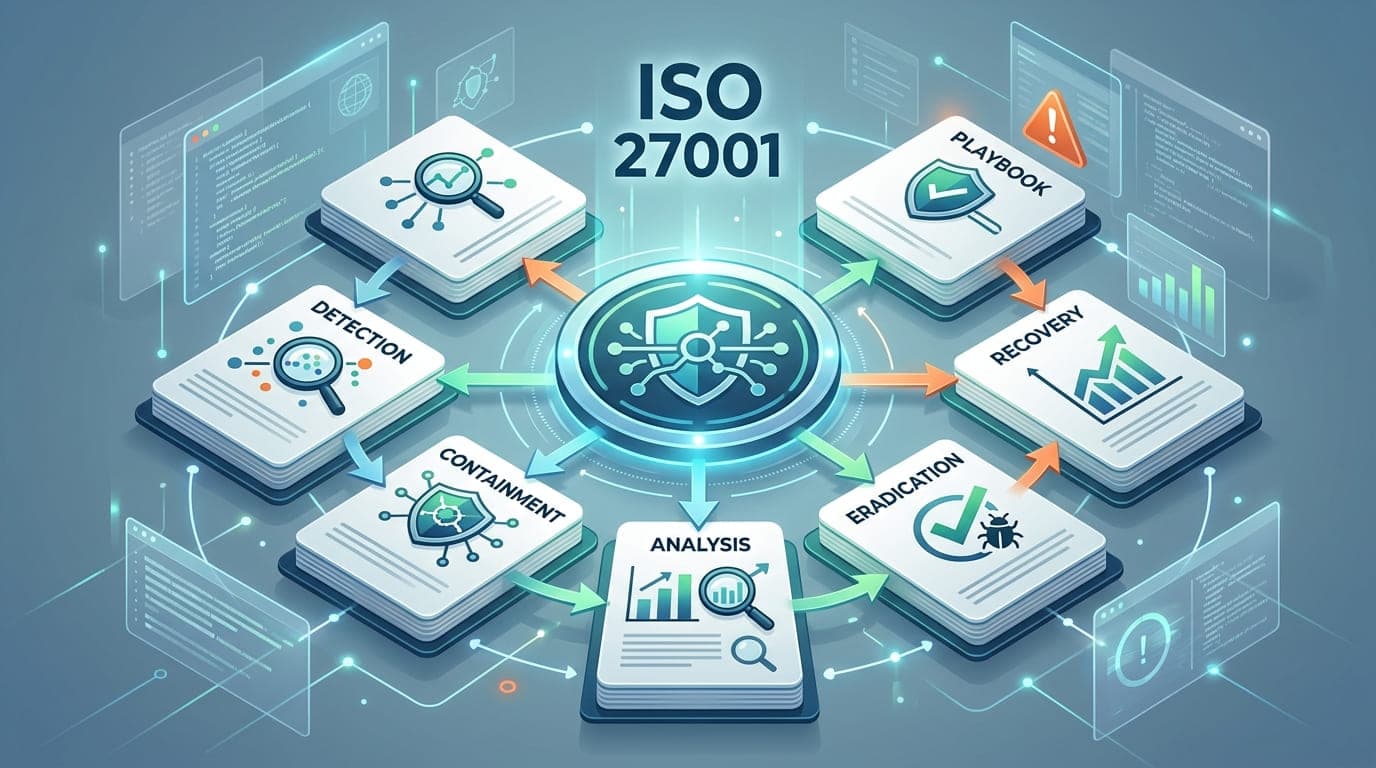
3. The Five-Phase Response Framework
ISO 27001 doesn't prescribe a specific incident response methodology, but I've found this five-phase approach aligns perfectly with the standard's requirements:
Phase 1: Detection and Identification (ISO 27001 A.16.1.1, A.12.4.1)
Objective: Recognize that an incident is occurring and classify its severity.
Key Activities:
Monitor security alerts and anomalies
Validate the incident (eliminate false positives)
Classify severity using the matrix above
Document initial observations
Activate appropriate response team
Real-World Example:
Last year, a healthcare client's SIEM flagged 200+ failed login attempts to their patient portal. Their playbook guided them through verification:
✓ Confirmed: Attempts from 43 unique IP addresses (not a single user issue)
✓ Confirmed: Attempts targeted admin accounts (credential stuffing attack)
✓ Confirmed: 3 successful logins before MFA stopped them (partial breach)
✓ Classification: P2 (High) - Unauthorized access attempt with partial success
✓ Action: Incident Commander activated, full response team assembled
Time from detection to team activation: 12 minutes.
Phase 2: Containment (ISO 27001 A.16.1.5)
Objective: Stop the incident from spreading while preserving evidence.
This is where most organizations panic and make critical mistakes. I've seen teams:
Shut down systems without capturing memory (destroying evidence)
Change passwords globally (alerting attackers)
Restore from backups immediately (overwriting forensic data)
Here's the containment decision tree I use:
Incident Type | Short-Term Containment | Long-Term Containment | Evidence Preservation |
|---|---|---|---|
Ransomware | Isolate infected systems (network level), disable admin accounts, snapshot affected systems | Rebuild systems from known-good backups, implement enhanced monitoring | Preserve encrypted files, maintain network logs, image affected systems before rebuild |
Data Exfiltration | Block malicious IPs, disable compromised accounts, increase logging | Rotate credentials, patch vulnerabilities, implement DLP controls | Capture network traffic, preserve user activity logs, maintain file access records |
Insider Threat | Disable user access, revoke credentials, monitor associated accounts | Remove physical access, review all user activities, implement enhanced monitoring | Preserve user logs, capture workstation image, document timeline |
Malware Infection | Isolate infected endpoint, disable network access, capture memory dump | Reimage system, update security controls, scan related systems | Image infected system, preserve malware sample, maintain execution logs |
A Story About Containment:
In 2021, I worked with a manufacturing company hit by ransomware. Their IT director's first instinct was to shut down every server immediately.
I stopped him.
Instead, we:
Identified patient zero (took 8 minutes using endpoint detection)
Isolated affected network segments (not individual servers)
Captured memory dumps from encrypted systems (evidence preservation)
Then initiated controlled shutdown
This approach allowed us to:
Understand the attack vector (phishing email)
Identify all compromised credentials
Determine if data was exfiltrated (it wasn't)
Provide law enforcement with actionable evidence
Total containment time: 34 minutes. Zero data loss. Full recovery in 18 hours.
"Containment isn't about speed—it's about surgical precision. You're performing emergency surgery on a live patient. Every action matters."
Phase 3: Eradication (ISO 27001 A.16.1.5)
Objective: Remove the threat completely from your environment.
This phase is where patience pays dividends. I've seen organizations rush eradication and face re-infection within hours.
Systematic Eradication Checklist:
□ Root Cause Identified
  □ Attack vector determined and documented
  □ Vulnerabilities exploited identified
□ All affected systems mappedReal-World Gotcha:
A client once eradicated malware from their production servers but missed their development environment. The malware re-infected production within 6 hours through their CI/CD pipeline.
Now, my playbooks always include: "Assume compromise is wider than initially detected. Verify clean status of all connected systems before declaring eradication complete."
Phase 4: Recovery (ISO 27001 A.16.1.5)
Objective: Restore normal operations while maintaining security.
Recovery isn't just about turning systems back on. It's about restoring with confidence that you won't face immediate re-infection.
Phased Recovery Approach:
Recovery Phase | Activities | Verification Required | Rollback Triggers |
|---|---|---|---|
Phase 1: Critical Systems | Restore business-critical services, enhanced monitoring, limited user access | System integrity verified, security controls operational, clean traffic patterns | New indicators of compromise, unusual system behavior, failed security checks |
Phase 2: Core Business | Restore standard business systems, normal user access, regular monitoring | User acceptance testing passed, performance baselines met, security posture confirmed | User-reported anomalies, performance degradation, security alerts |
Phase 3: Full Operations | Restore all services, remove temporary restrictions, return to normal operations | All systems operational, full functionality restored, incident metrics reviewed | Any security concerns, unresolved issues, stakeholder concerns |
A Recovery Story That Taught Me Everything:
In 2020, I was helping a SaaS company recover from a sophisticated attack. We eradicated the threat, verified our systems were clean, and brought everything back online.
Six hours later, we were down again. Same attack, different vector.
Here's what we missed: The attacker had compromised a vendor's system that had API access to our environment. We secured our systems but never checked the third-party integration.
Now, my recovery procedures always include: "Verify security of all integrations, APIs, and third-party access points before declaring recovery complete."
That lesson cost them 18 additional hours of downtime. But they've never made that mistake again.
Phase 5: Post-Incident Activities (ISO 27001 A.16.1.6)
Objective: Learn from the incident and improve defenses.
ISO 27001 explicitly requires learning from incidents. This isn't optional—it's mandatory. And it's where most organizations fail their audits.
Post-Incident Review Template:
Within 72 hours of incident resolution, conduct a structured review:
Review Component | Key Questions | Documentation Required |
|---|---|---|
Incident Timeline | When was the attack initiated? When was it detected? What was the detection lag? | Complete timeline with all key events, decisions, and actions |
Root Cause Analysis | How did the attacker gain access? What vulnerabilities were exploited? Could we have prevented this? | Technical analysis report, vulnerability assessment, attack vector documentation |
Response Effectiveness | What went well? What went poorly? Where did we waste time? What would we do differently? | Response timeline analysis, decision documentation, team feedback |
Detection Capability | Why didn't we detect it earlier? What signals did we miss? How can we improve monitoring? | Detection gap analysis, SIEM rule review, monitoring enhancement plan |
Business Impact | What was the financial cost? How were customers affected? What was the reputational impact? | Cost analysis, customer impact assessment, business metrics |
Improvement Actions | What specific changes will we make? Who is responsible? What is the timeline? When will we verify effectiveness? | Action plan with owners, deadlines, and success criteria |
The Review That Saved Millions:
A financial services client suffered a phishing attack that compromised three employee accounts. The incident itself was relatively minor—we detected and contained it within 2 hours.
But during our post-incident review, we discovered something alarming: 27% of employees had clicked on the phishing link. We'd only caught the three who entered their credentials because we had credential monitoring. But the click-through rate revealed a massive awareness problem.
This discovery led to:
Complete security awareness program overhaul
Monthly phishing simulations
Role-specific security training
Executive security briefings
Six months later, when attackers launched a sophisticated spear-phishing campaign, only 3% of employees clicked the link. Zero credentials compromised. Attack failed completely.
That post-incident review probably prevented a breach that would have cost millions.
"Post-incident reviews aren't about blame—they're about evolution. Every incident is a lesson that makes you harder to breach next time."
Building Your ISO 27001-Compliant Incident Response Playbook
Now let's get practical. Here's how to build a playbook that will pass your ISO 27001 audit and actually work during an incident.
Step 1: Create Incident-Specific Playbooks
Generic procedures don't work under pressure. You need specific playbooks for your most likely incident types:
Priority Playbooks for Most Organizations:
Playbook | Priority Level | Reason |
|---|---|---|
Ransomware Response | Critical | Most common high-impact threat, requires immediate action |
Data Breach Response | Critical | Regulatory reporting requirements, potential massive liability |
Phishing/Business Email Compromise | High | Most common attack vector, can lead to larger breaches |
Insider Threat Response | High | Complex legal/HR issues, requires careful handling |
DDoS Attack Response | Medium | Business continuity threat, requires coordination with providers |
Malware Infection Response | Medium | Common occurrence, needs systematic approach |
Lost/Stolen Device Response | Medium | Data exposure risk, requires swift action |
For each playbook, I use this structure:
[INCIDENT TYPE] Response Playbook
Recognition Criteria: How do you know this incident is occurring?
Immediate Actions (First 15 minutes): What must happen right now?
Investigation Steps: How do you understand what happened?
Containment Actions: How do you stop it from spreading?
Eradication Procedures: How do you remove the threat?
Recovery Steps: How do you restore operations?
Communication Templates: Who needs to know what and when?
Evidence Preservation: What must be saved for investigation?
Step 2: Develop Communication Templates
During an incident, clear communication is critical. But writing thoughtful messages while your systems are burning is nearly impossible.
I create pre-approved templates for every scenario:
Internal Communication Templates:
TEMPLATE: Initial Incident Notification (Internal)
-------------------------------------------------
TO: [Response Team Distribution List]
FROM: [Incident Commander]
SUBJECT: SECURITY INCIDENT - [P1/P2/P3/P4] - [Brief Description]External Communication Templates:
TEMPLATE: Customer Notification (Data Breach)
----------------------------------------------
SUBJECT: Important Security Notice - Action RequiredHaving these templates prepared saved a client 4 hours during a critical breach notification. Four hours that would have been spent debating wording while customers remained uninformed and at risk.
Step 3: Create Decision Trees for Complex Scenarios
Some incidents require difficult judgment calls. Decision trees help your team make consistent, defensible decisions under pressure.
Example: Data Breach Notification Decision Tree
Was personal information accessed or acquired without authorization?
├─ NO → Document the incident, conduct post-incident review, no notification required
└─ YES → Continue belowThis decision tree has helped clients navigate the complex landscape of breach notification laws across multiple jurisdictions without missing critical deadlines.
Step 4: Document Evidence Collection Procedures
ISO 27001 A.16.1.7 requires evidence collection, and this is where many organizations fail their audits. You need documented procedures that preserve legal admissibility.
Evidence Collection Standards:
Evidence Type | Collection Method | Storage Requirements | Chain of Custody |
|---|---|---|---|
System Logs | Automated export to immutable storage, cryptographic hashing | Secure, tamper-proof storage; maintain for minimum 90 days | Automated logging with timestamps, system-generated chain |
Network Traffic | Full packet capture during incident, filtered by indicators of compromise | Encrypted storage, access logging required | Document who accessed, when, and why |
Disk Images | Forensic imaging using write-blockers, bit-for-bit copy with hash verification | Encrypted storage, multiple copies in separate locations | Complete documentation of imaging process, tool validation |
Memory Dumps | Live system memory capture using forensic tools, immediate preservation | Secure storage with restricted access | Document system state, capture time, tools used |
User Activity | Application logs, authentication records, file access logs | Centralized SIEM with tamper protection | Automated collection with integrity verification |
A Forensics Story:
In 2022, I worked with a company that suffered a breach and wanted to prosecute the attacker. They'd collected evidence, but it was inadmissible in court because:
No documented chain of custody
Logs were stored on systems that could be modified
No cryptographic hashing to prove integrity
Multiple people accessed evidence without documentation
The case was dismissed. The attacker walked free.
Now, every playbook I create includes detailed evidence collection procedures with legal admissibility in mind.
Testing Your Playbooks: The ISO 27001 Requirement Everyone Skips
ISO 27001 requires testing of incident response procedures. Yet this is where I see most organizations fail during audits.
"We have a plan!" they say proudly. "Have you tested it?" I ask. "Well... no. But we will when an incident happens!"
That's like saying you'll learn to use a parachute on your way down.
The Three-Tier Testing Approach
Tier 1: Tabletop Exercises (Quarterly)
Gather your response team and walk through scenarios. No systems affected, just discussion.
Example scenario I use:
SCENARIO: Ransomware Attack - Friday 4:45 PM
-----------------------------------------------
Your monitoring system alerts: Multiple servers showing ransomware
encryption activity. Files are being encrypted at a rate of
approximately 30 GB per minute. Time limit: 90 minutes. Document every gap, every uncertainty, every "I'm not sure" moment.
Tier 2: Simulation Exercises (Semi-Annually)
Actually execute your procedures in a test environment. Simulate the technical response.
I run these in isolated lab environments where teams:
Detect simulated attacks
Execute containment procedures
Practice evidence collection
Use actual tools and systems
Follow documented playbooks
Communicate using templates
The first time a client ran this, their "15-minute response time" took 4 hours. But better to learn that in a simulation than during a real breach.
Tier 3: Red Team Exercises (Annually)
Bring in external attackers to simulate real attacks without warning your team.
I partnered with a red team to breach a client's environment. Their team detected the intrusion, activated their playbook, and contained the attack within 47 minutes.
But we discovered critical gaps:
Their after-hours escalation process failed (nobody answered the phone)
Evidence collection procedures missed critical logs
Communication templates hadn't been updated for recent organizational changes
We fixed these issues before a real attacker exploited them.
"You don't test your playbooks to confirm they work. You test them to discover where they fail—while failure still doesn't matter."
Integration with ISO 27001 Documentation
Your incident response playbooks must integrate with your broader ISO 27001 documentation:
Required Documentation Cross-References:
ISO 27001 Document | Incident Response Integration |
|---|---|
Information Security Policy | References incident management as core security principle |
Risk Assessment | Incident response capabilities considered in risk treatment plans |
Asset Inventory | Playbooks reference specific assets and their criticality |
Access Control Policy | Emergency access procedures documented for incident response |
Business Continuity Plan | Incident response triggers BCP activation, recovery procedures aligned |
Communication Policy | Incident communication procedures referenced and consistent |
Training Records | Incident response training documented and tracked |
Audit Logs | Incident investigations leverage documented logging procedures |
I've seen audits fail because incident response playbooks were treated as standalone documents disconnected from the broader ISMS. Everything must connect.
Real-World Playbook Example: Ransomware Response
Let me show you what a complete, tested, ISO 27001-compliant playbook looks like:
RANSOMWARE RESPONSE PLAYBOOK v2.3
Last Updated: [Date]
Last Tested: [Date]
Owner: [CISO Name]
Approved By: [Management]
This level of detail might seem excessive. Until you're using it at 3 AM with your hands shaking and your CEO on the phone. Then every checkbox becomes a lifeline.
Common Mistakes That Fail ISO 27001 Audits
After conducting dozens of ISO 27001 audits, here are the incident response failures I see repeatedly:
Audit Failure | Why It Happens | How to Fix It |
|---|---|---|
No evidence of testing | Teams document procedures but never practice them | Schedule quarterly tabletop exercises, document results, track improvements |
Generic procedures | One-size-fits-all approach doesn't address specific threats | Create incident-specific playbooks for your highest-risk scenarios |
Missing evidence collection procedures | Teams focus on recovery, forget forensics | Document specific evidence requirements for each incident type, train team on collection |
No post-incident review records | Incidents get resolved and forgotten | Mandatory post-incident review within 72 hours, documented improvements required |
Undefined roles and responsibilities | Everyone assumes someone else is handling it | Clear RACI matrix for every incident phase, documented in playbooks |
Outdated contact information | Playbooks reference people who left the company months ago | Quarterly review of all contact information, automated verification |
No integration with business continuity | Incident response and BCP treated as separate | Cross-reference procedures, align recovery priorities, test together |
The Maintenance Schedule Nobody Talks About
Creating playbooks is hard. Keeping them current is harder. Here's the maintenance schedule that keeps playbooks relevant:
Weekly: Review and update contact lists Monthly: Review recent incidents and near-misses, update procedures based on lessons learned Quarterly: Conduct tabletop exercise, review and update threat intelligence, audit documentation accuracy Semi-Annually: Full playbook review and revision, simulation exercise Annually: External audit of incident response capabilities, red team exercise
I've seen playbooks become obsolete within months because nobody maintained them. Don't let your investment become shelfware.
Your Next Steps: Building ISO 27001-Compliant Incident Response
If you're starting from scratch, here's your 90-day roadmap:
Days 1-30: Foundation
Conduct risk assessment to identify likely incident scenarios
Create incident classification matrix
Define response team roles and responsibilities
Draft initial procedures for top 3 incident types
Days 31-60: Development
Complete playbooks for all priority scenarios
Create communication templates
Document evidence collection procedures
Integrate with existing ISO 27001 documentation
Days 61-90: Validation
Conduct first tabletop exercise
Revise procedures based on findings
Train all response team members
Schedule regular testing cadence
Final Thoughts: The Playbook That Saved Everything
I want to close with a story that encapsulates why this matters.
In 2023, a manufacturing client suffered a sophisticated supply chain attack. Their managed service provider was compromised, giving attackers access to their environment.
At 11:37 PM on a Tuesday, their monitoring system detected unusual activity. The on-call engineer opened their incident response playbook and started checking boxes.
Within 15 minutes, the Incident Commander was activated. Within 30 minutes, they'd contained the attack to a single network segment. Within 2 hours, they'd identified and closed the attack vector. Within 6 hours, they'd eradicated the threat. Within 18 hours, they were back to full operations.
Zero data exfiltrated. Zero encryption. Zero ransom paid. Total cost: approximately $47,000 in incident response fees.
Their MSP, lacking proper incident response procedures, took 3 weeks to recover. Lost multiple clients. Nearly went bankrupt.
The difference? One had an ISO 27001-compliant incident response playbook. The other had good intentions.
"In cybersecurity, good intentions don't stop attackers. Prepared, practiced procedures do. ISO 27001 ensures you have both the procedures and the discipline to use them."
Your playbooks aren't just compliance documents. They're your organization's immune system—detecting threats, responding to attacks, and building resilience with every incident you survive.
Build them well. Test them thoroughly. Maintain them religiously.
Because when that 2 AM phone call comes—and it will—your playbook might be the only thing standing between business continuity and catastrophe.