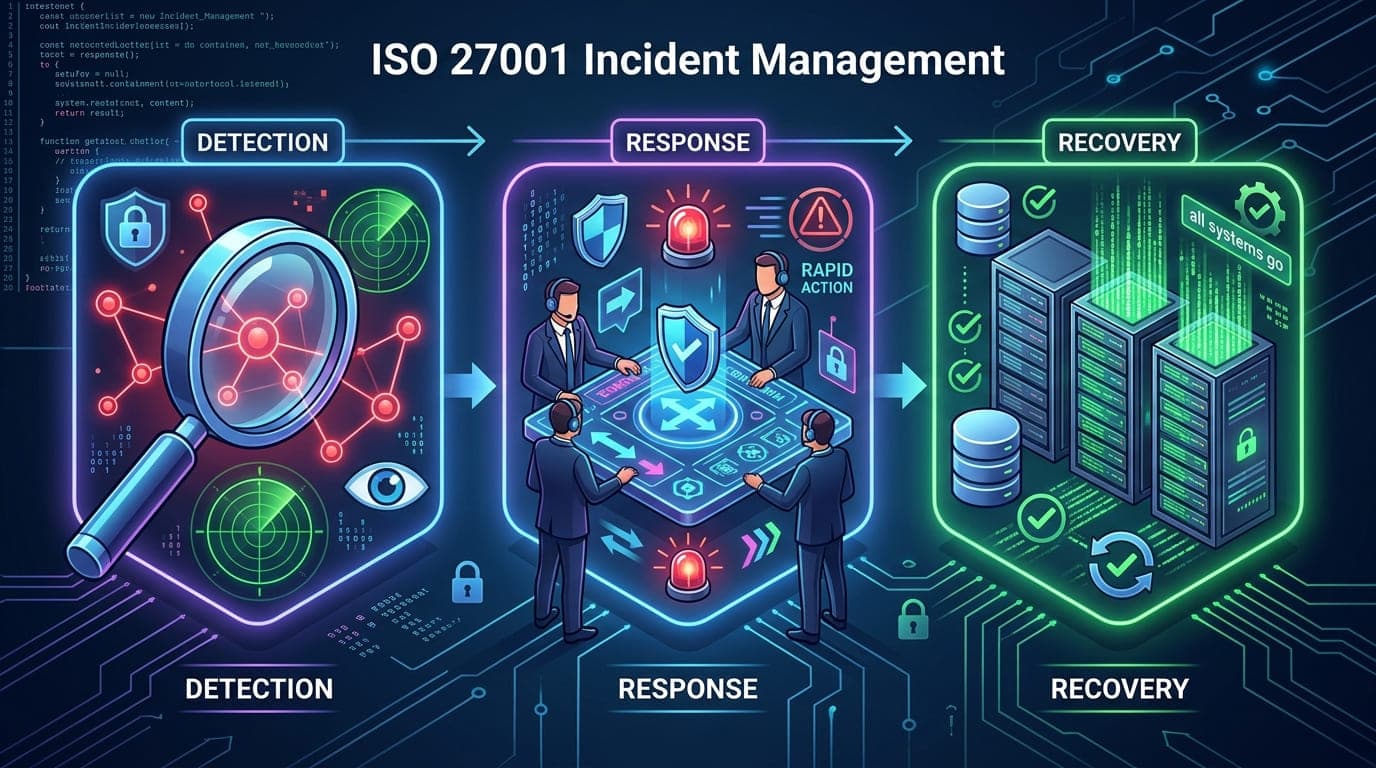
It was 11:43 PM on a Sunday when my phone buzzed with an alert I'd been dreading for months. A financial services client—one we'd just helped achieve ISO 27001 certification six weeks earlier—was experiencing what their monitoring system flagged as "unusual database access patterns."
My heart rate spiked. This was the moment of truth. Would all those incident response procedures we'd painstakingly documented actually work when it mattered most?
Spoiler alert: They did. And spectacularly.
Within 8 minutes, their incident response team was assembled (remotely—thank you, documented communication procedures). Within 23 minutes, they'd identified the threat vector. Within 47 minutes, they'd contained the breach. By morning, they'd conducted forensics, notified stakeholders, and begun recovery operations.
Total customer records exposed? Zero.
Compare that to the horror stories I've witnessed over my 15+ years in cybersecurity—companies that discovered breaches weeks or months after they occurred, had no idea what to do, and watched helplessly as their reputation burned.
The difference? A properly implemented ISO 27001 incident management process.
Why ISO 27001 Gets Incident Management Right
Let me be blunt: most organizations' incident response plans are security theater. They exist in a dusty SharePoint folder nobody's read since it was created. They're built by consultants who've never actually responded to an incident. They're tested never.
ISO 27001 is different. Annex A Control 5.24 through 5.28 doesn't just require that you have incident management procedures—it requires that they actually work.
"An incident response plan that hasn't been tested is just creative fiction. ISO 27001 forces you to turn fiction into operational reality."
Here's what makes ISO 27001's approach to incident management uniquely effective:
1. It's systematic, not reactive: You're required to have defined processes BEFORE incidents occur 2. It's tested regularly: Tabletop exercises and simulations are mandatory 3. It's continuously improved: Lessons learned from every incident feed back into the process 4. It's integrated: Incident management connects to risk assessment, change management, and business continuity 5. It's measurable: You must track metrics and demonstrate improvement over time
The ISO 27001 Incident Management Framework: A Complete Breakdown
Let me walk you through the framework I've implemented dozens of times across organizations of all sizes. This isn't textbook theory—this is battle-tested reality.
Phase 1: Preparation (Before Anything Goes Wrong)
This is where most organizations fail. They wait until there's smoke before buying a fire extinguisher.
I remember consulting with a rapidly growing SaaS company in 2021. Their CEO insisted they didn't need to invest in incident preparation. "We'll deal with problems when they happen," he said confidently.
Three months later, they detected unauthorized access to their production database. The ensuing chaos was painful to watch:
Nobody knew who should be notified
Three different people tried to investigate simultaneously, stepping on each other
Critical logs were overwritten during the response
It took 6 hours just to figure out what data might have been accessed
The CEO called me at 2 AM asking, "What do we do?"
Don't be that company.
Essential Preparation Components
Here's what ISO 27001 requires (and what actually works in practice):
Preparation Element | ISO 27001 Requirement | Real-World Implementation |
|---|---|---|
Incident Response Team | Defined roles and responsibilities (A.5.24) | Name specific people with 24/7 contact info; include technical leads, legal, communications, and executive sponsor |
Communication Plan | Internal and external communication procedures (A.5.25) | Pre-written templates for stakeholders, customers, regulators, media; decision trees for who approves what |
Tool Readiness | Systems for detection and investigation (A.8.16) | SIEM configured, forensic tools accessible, access credentials documented and tested monthly |
Documentation | Incident response procedures documented (A.5.24) | Step-by-step playbooks for common scenarios (ransomware, data breach, DDoS); quick reference cards laminated and available |
Training | Regular awareness and simulation exercises (A.6.3) | Quarterly tabletop exercises; annual simulated attacks; monthly security bulletins |
Legal Preparedness | Understanding regulatory obligations (A.5.27) | Pre-identified legal counsel familiar with cyber incidents; documented notification requirements with timelines |
Building Your Incident Response Team
Over the years, I've learned that the RIGHT team composition is critical. Here's the structure that works:
Core Team (Must be available 24/7):
Role | Responsibilities | Typical Position |
|---|---|---|
Incident Commander | Overall coordination, decision authority, stakeholder communication | CISO or Security Director |
Technical Lead | Investigation, containment, technical analysis | Security Engineer/Architect |
IT Operations | System access, infrastructure changes, restoration | Senior Systems Administrator |
Communications Lead | Internal/external messaging, customer notifications | Head of Communications or designated security lead |
Extended Team (On-call as needed):
Role | When to Engage | Typical Position |
|---|---|---|
Legal Counsel | Data breach, regulatory concerns, litigation risk | General Counsel or External Counsel |
Executive Sponsor | Major incidents, business impact decisions | CEO, CTO, or COO |
HR Representative | Insider threats, employee-related incidents | HR Director |
External Forensics | Complex attacks, legal evidence preservation | Third-party incident response firm |
Public Relations | Media interest, public statements | PR Agency or Communications VP |
Pro tip from the trenches: I always recommend identifying BACKUP personnel for every role. I've seen incident responses delayed by hours because the primary person was on a plane or in surgery. Murphy's Law applies double to security incidents.
Phase 2: Detection and Analysis (Knowing When Bad Things Happen)
Here's a truth that took me years to accept: you can't respond to incidents you don't detect.
I worked with a healthcare provider in 2020 that discovered they'd been breached—18 months earlier. The attackers had been exfiltrating patient records for over a year. The organization had security tools, but nobody was actually monitoring them.
ISO 27001 Control A.8.16 requires "monitoring technologies" be in place. But it's the implementation that matters.
Detection Capabilities: The Full Spectrum
Detection Layer | What It Catches | ISO 27001 Control | Implementation Example |
|---|---|---|---|
Network Monitoring | Unusual traffic patterns, data exfiltration, C2 communications | A.8.16, A.8.20 | IDS/IPS, NetFlow analysis, DNS monitoring |
Endpoint Detection | Malware execution, unauthorized changes, privilege escalation | A.8.16, A.8.7 | EDR solutions, file integrity monitoring |
Log Analysis | Authentication failures, privilege changes, configuration modifications | A.8.15, A.8.16 | SIEM with correlation rules, centralized logging |
User Behavior Analytics | Insider threats, compromised accounts, anomalous access | A.8.16, A.5.18 | UBA/UEBA solutions, baseline analysis |
Application Monitoring | Injection attacks, authentication bypasses, API abuse | A.8.14, A.8.25 | WAF, application logs, API gateways |
Cloud Security | Misconfigurations, unauthorized access, data exposure | A.8.9, A.5.23 | CSPM tools, cloud-native monitoring |
Threat Intelligence | Known attack patterns, emerging threats, IOCs | A.5.7 | Threat feeds, vulnerability databases |
The Alert Prioritization Problem
Here's a challenge every organization faces: modern security tools generate thousands of alerts daily. In 2022, I consulted with a tech company whose SIEM generated an average of 4,700 alerts per day. Their security team of three people was drowning.
We implemented what I call the "ISO 27001 Alert Triage Framework":
Severity Classification:
Priority | Description | Response Time | Examples |
|---|---|---|---|
P1 - Critical | Active attack, data breach in progress, system compromise confirmed | Immediate (< 15 min) | Ransomware deployment, active data exfiltration, root-level compromise |
P2 - High | Likely security incident, potential compromise, failed containment | 1 hour | Multiple failed authentication attempts from same source, malware detected but not executing, privilege escalation attempts |
P3 - Medium | Suspicious activity, policy violations, potential reconnaissance | 4 hours | Port scanning, suspicious DNS queries, unauthorized software installation |
P4 - Low | Security events, informational alerts, potential false positives | 24 hours | Single failed login, routine vulnerability scan results, low-risk policy violations |
P5 - Informational | Security events for awareness, no action required | Weekly review | Successful logins, routine system updates, informational vulnerability notifications |
After implementing this framework, their security team went from reactive firefighting to proactive hunting. Alert fatigue dropped 73%. Time to detect actual incidents decreased from hours to minutes.
"You can't investigate every alert, but you must investigate the right alerts. Prioritization isn't optional—it's survival."
Phase 3: Containment (Stopping the Bleeding)
I'll never forget watching a ransomware attack spread through a manufacturing company's network in real-time back in 2019. The security engineer, panicking, started shutting down servers randomly. He accidentally shut down the domain controller, locking everyone—including the response team—out of the network.
It took us 14 hours to regain control. The attackers had a field day.
Containment must be deliberate, documented, and decisive.
Short-Term Containment Actions
ISO 27001 Control A.5.26 requires that containment actions minimize impact while preserving evidence. Here's how that translates to reality:
Incident Type | Immediate Containment | Considerations | Evidence Preservation |
|---|---|---|---|
Malware/Ransomware | Isolate affected systems at network level; disable user accounts if compromised | Don't power off—may lose memory contents; document system state before changes | Capture memory dumps before isolation; screenshot/photograph infected systems |
Data Breach | Revoke access credentials; disable data export functions; block egress to identified IPs | Maintain business operations where possible; consider legal hold requirements | Preserve access logs; document data access patterns; maintain chain of custody |
Compromised Account | Disable account immediately; revoke all active sessions; reset passwords | Consider impact on business processes; notify account owner through separate channel | Document all account activities; preserve authentication logs; timeline analysis |
DDoS Attack | Enable DDoS mitigation; null route attack traffic; engage ISP/CDN | Balance protection vs. availability; communicate with customers | Packet captures; traffic analysis; source IP documentation |
Insider Threat | Disable access immediately; secure physical access; preserve workstation/laptop | Legal considerations; HR coordination; discretion required | Forensic imaging of devices; preserve email/communications; document all access |
Supply Chain Compromise | Isolate affected systems; disable vendor access; review all vendor activities | Assess blast radius; notify other affected parties; consider vendor notification | Document vendor access patterns; preserve logs; identify affected systems |
Long-Term Containment Strategy
Once the immediate threat is contained, ISO 27001 requires you to implement sustainable containment measures that allow business operations to continue while you investigate and remediate.
I worked with a financial services company in 2023 that discovered malware on 47 workstations. Short-term containment was straightforward—network isolation. But they needed those users working.
We implemented what I call "Controlled Quarantine":
Created a separate VLAN with limited internet access
Provisioned virtual desktops on known-clean infrastructure
Implemented enhanced monitoring on quarantine network
Established strict egress filtering rules
Maintained business operations while investigation continued
The result: Zero business disruption, complete attacker containment, and thorough forensic investigation. That's the ISO 27001 way.
Phase 4: Eradication (Removing the Threat)
Containment stops the bleeding. Eradication removes the knife.
I've seen too many organizations declare victory after containment, only to have the same attackers return days or weeks later. Why? Because they removed the symptom, not the disease.
Complete Eradication Checklist
Based on ISO 27001 Control A.5.24 requirements and years of incident response experience:
Threat Removal:
[ ] Identify and remove all malware variants (including polymorphic versions)
[ ] Remove attacker backdoors and persistence mechanisms
[ ] Delete unauthorized user accounts and access credentials
[ ] Remove unauthorized services, scheduled tasks, and startup items
[ ] Clean or rebuild compromised systems (rebuilding is usually safer)
[ ] Patch vulnerabilities that enabled initial access
Access Elimination:
[ ] Reset ALL passwords for compromised accounts and systems
[ ] Rotate all API keys, tokens, and service account credentials
[ ] Revoke and reissue certificates if PKI was compromised
[ ] Review and remove any unauthorized firewall rules
[ ] Audit and remove unauthorized VPN/remote access configurations
[ ] Review cloud permissions and roles for unauthorized changes
Verification:
[ ] Conduct comprehensive vulnerability scans
[ ] Perform deep malware scans with multiple tools
[ ] Review system configurations against security baselines
[ ] Analyze logs for any signs of continued compromise
[ ] Test detection capabilities to ensure they'd catch similar attacks
[ ] Engage external forensics if sophistication warrants
Pro tip: I always recommend what I call the "Zero Trust Rebuild" for critical systems. Don't try to clean malware from your domain controller—rebuild it from known-good backups or fresh installation. The time saved isn't worth the risk of persistent compromise.
Phase 5: Recovery (Getting Back to Business)
Recovery is where ISO 27001's integration with business continuity planning (Control A.5.29) really shines.
In 2021, I helped a healthcare provider recover from a ransomware attack that encrypted 340 servers. Because they'd properly implemented ISO 27001:
They had tested backups (verified monthly per A.8.13)
They had documented recovery procedures (per A.5.30)
They had defined recovery time objectives (per A.5.29)
They had prioritized system recovery order (per A.5.29)
Recovery Priority Matrix
Here's the framework I use to guide recovery decisions:
System Category | Recovery Priority | Maximum Downtime | Validation Required |
|---|---|---|---|
Critical Revenue Systems | Priority 1 | 4 hours | Full security validation, integrity checks, monitoring enabled before production use |
Critical Support Systems | Priority 2 | 8 hours | Security scans, configuration verification, enhanced monitoring |
Customer-Facing Systems | Priority 2 | 8 hours | Security validation, performance testing, customer communication plan |
Internal Operations | Priority 3 | 24 hours | Standard security checks, user acceptance testing |
Administrative Systems | Priority 4 | 72 hours | Basic security validation, limited testing |
The healthcare provider's recovery:
Critical patient care systems: 6 hours
Electronic health records: 8 hours
Billing systems: 18 hours
Email and collaboration: 24 hours
Administrative systems: 48 hours
They were back to full operations in two days. Compare that to the 21-day average for ransomware recovery, and the value of ISO 27001 preparation becomes crystal clear.
Recovery Validation Steps
ISO 27001 requires verification before returning systems to production. Here's my standard validation protocol:
Technical Validation:
Security Scanning: Full vulnerability and malware scans
Configuration Review: Verify against security baselines
Integrity Verification: Confirm no unauthorized changes
Functionality Testing: Ensure system operates correctly
Performance Baseline: Confirm normal operating parameters
Monitoring Confirmation: Verify detection capabilities active
Business Validation: 7. User Acceptance: Key stakeholders confirm system usability 8. Data Integrity: Verify no data corruption or loss 9. Integration Testing: Confirm all dependent systems working 10. Communication: Notify users system is available
"Recovery isn't complete when systems are online. It's complete when business operations are restored, validated, and secured against repeat attacks."
Phase 6: Post-Incident Activities (Learning from Incidents)
This is where ISO 27001 separates mature organizations from everyone else. Control A.5.28 explicitly requires documentation and learning from incidents.
I can't tell you how many organizations I've worked with that responded to incidents but never improved afterward. They'd get hit by the same attack vector six months later because they never addressed root causes.
Post-Incident Review Template
Here's the framework I use for every incident (mandated by ISO 27001 and proven effective over countless incidents):
Incident Summary Document:
Section | Key Questions | Documentation Required |
|---|---|---|
Incident Overview | What happened? When was it detected? What was impacted? | Timeline, affected systems list, data classification of impacted information |
Detection Analysis | How was it detected? How long between compromise and detection? Could we have detected it sooner? | Alert details, detection timeline, gaps in monitoring identified |
Response Effectiveness | What worked well? What didn't? Were response times adequate? | Response timeline, team effectiveness ratings, communication assessment |
Technical Analysis | How did attackers gain access? What vulnerabilities were exploited? What was the attack progression? | Attack chain diagram, vulnerability details, indicators of compromise (IOCs) |
Impact Assessment | What data was accessed/exfiltrated? What was the business impact? What were the financial costs? | Data inventory, business impact statement, cost breakdown |
Root Cause Analysis | Why did this happen? What control failures occurred? What were contributing factors? | Root cause identification, control gap analysis, systemic issues identified |
Lessons Learned | What should we do differently? What worked that we should repeat? What processes need improvement? | Improvement recommendations, policy updates needed, training gaps identified |
Action Items | What specific changes will we make? Who is responsible? What are the deadlines? | Action item list with owners and due dates, tracking mechanism |
The Real Value: Continuous Improvement
I worked with a tech company that experienced a phishing attack in 2020. An employee clicked a malicious link, compromising their credentials. The incident was contained quickly, but here's what made them special:
They actually learned from it.
Their post-incident review identified:
Phishing awareness training was too infrequent
Email security tools didn't flag the phishing email
Multi-factor authentication wasn't enabled for all users
Detection of credential compromise took 4 hours
Actions taken:
Monthly phishing simulations implemented
Email security rules updated with new indicators
MFA rollout accelerated to 100% coverage
Implemented behavioral analytics for credential use
Six months later, another phishing campaign hit them. This time:
12 employees received the phishing email
All 12 reported it (thanks to training)
Email security blocked the domain within minutes
Zero successful compromises
That's ISO 27001's continuous improvement cycle in action.
Metrics That Actually Matter
ISO 27001 requires that you measure incident management effectiveness. But most organizations track useless metrics.
Here are the metrics I've found actually correlate with program maturity:
Metric | What It Measures | Target Goal | Reality Check |
|---|---|---|---|
Mean Time to Detect (MTTD) | How quickly you identify incidents | < 15 minutes for P1 incidents | Industry average: 207 days. Yes, days. |
Mean Time to Respond (MTTR) | How quickly you initiate response | < 30 minutes for P1 incidents | Your goal should improve quarterly |
Mean Time to Contain (MTTC) | How quickly you stop incident progression | < 1 hour for P1 incidents | This is where preparation pays off |
Mean Time to Recover (MTTR) | How quickly you restore operations | Varies by RTO requirements | Should align with business continuity plans |
False Positive Rate | How many alerts are real incidents | < 5% for P1/P2 alerts | High FP rate = alert fatigue = missed incidents |
Incident Recurrence Rate | Same incident type repeating | 0% for same vulnerability | If > 0%, you're not learning |
Tabletop Exercise Completion | Training and preparedness | 100% of team, quarterly | Untested procedures don't work |
Post-Incident Actions Completed | Continuous improvement | 100% within 90 days | Open action items = unmitigated risks |
Real-world example: A financial services client I worked with tracked these metrics religiously:
Year 1 (baseline):
MTTD: 8.3 hours
MTTR: 14.2 hours
MTTC: 31.7 hours
False Positive Rate: 41%
Year 3 (mature program):
MTTD: 11 minutes
MTTR: 23 minutes
MTTC: 1.8 hours
False Positive Rate: 3%
Same team size. Better processes. Continuous improvement. That's the ISO 27001 difference.
Common Incident Management Failures (And How to Avoid Them)
After 15+ years, I've seen organizations make the same mistakes repeatedly. Here are the top failures and how ISO 27001 helps you avoid them:
Failure Mode | What Goes Wrong | ISO 27001 Prevention | Real-World Fix |
|---|---|---|---|
No Clear Authority | Multiple people giving conflicting directions | A.5.24 requires defined roles and responsibilities | Incident Commander role with explicit decision authority |
Poor Communication | Stakeholders learn about incidents from news | A.5.25 mandates communication procedures | Pre-approved communication templates and approval workflows |
Evidence Destruction | Response actions overwrite critical forensic data | A.5.26 requires evidence preservation | Forensic imaging before containment actions; documentation requirements |
Inadequate Testing | Procedures fail when actually needed | A.6.3 requires training and exercises | Quarterly tabletop exercises with different scenarios |
No Learning | Same incidents repeat | A.5.28 requires documented lessons learned | Mandatory post-incident review with tracked action items |
Tool Sprawl | Too many disconnected tools | A.8.16 requires integrated monitoring | Consolidated SIEM with correlated alerting |
Alert Fatigue | Real incidents missed in noise | A.8.16 requires effective monitoring | Tuned detection rules with prioritization framework |
Undocumented Procedures | Everyone responding differently | A.5.24 requires documented procedures | Written playbooks for common incident types |
Building Your ISO 27001 Incident Management Program
Let me give you a roadmap based on implementations I've led that actually work:
Month 1: Foundation
Document current state (what do you have?)
Identify gaps against ISO 27001 requirements
Define incident response team and roles
Select core technologies (SIEM, EDR, etc.)
Month 2-3: Documentation
Write incident response procedures
Create incident classification system
Develop communication templates
Document escalation paths
Month 4-5: Implementation
Deploy/configure security monitoring tools
Integrate logging and alerting
Establish 24/7 monitoring capability
Train incident response team
Month 6: Testing
Conduct first tabletop exercise
Test communication procedures
Validate tool effectiveness
Identify gaps and iterate
Month 7-12: Optimization
Refine detection rules
Reduce false positives
Improve response times
Document lessons learned from real and simulated incidents
Year 2+: Maturity
Advanced threat hunting
Automated response capabilities
Proactive security improvements
Industry collaboration and intelligence sharing
The Technology Stack That Works
ISO 27001 is tool-agnostic, but here's the technology stack I've implemented successfully across dozens of organizations:
Core Components:
Technology Category | Purpose | Example Solutions | Budget Considerations |
|---|---|---|---|
SIEM | Centralized logging and correlation | Splunk, Microsoft Sentinel, ELK Stack | Open source options available; plan for 300-500GB/day log volume |
EDR | Endpoint detection and response | CrowdStrike, Microsoft Defender, SentinelOne | Per-endpoint licensing; critical investment |
Network Detection | Traffic analysis and anomaly detection | Darktrace, Vectra, Zeek | Can start with NetFlow analysis |
Cloud Security | Cloud infrastructure monitoring | Wiz, Prisma Cloud, native tools | Often included with cloud provider |
SOAR | Automation and orchestration | Splunk SOAR, Palo Alto XSOAR, Tines | Mature programs only; requires skilled team |
Threat Intelligence | IOC feeds and threat context | MISP, ThreatConnect, VirusTotal | Many free feeds available |
Forensics | Investigation and analysis | EnCase, FTK, Velociraptor | Consider incident response retainer instead |
Budget Reality Check:
Small organization (< 50 employees): $30,000-60,000/year Medium organization (50-500 employees): $100,000-300,000/year Enterprise (500+ employees): $500,000+/year
Don't let budget constraints stop you. I've built effective incident management programs with open-source tools and managed services. ISO 27001 cares about effectiveness, not spending.
Real-World Success Story: Putting It All Together
Let me close with a story that shows how ISO 27001 incident management works when properly implemented.
In 2023, I was working with a healthcare technology company that had achieved ISO 27001 certification eight months earlier. They were processing sensitive patient data for over 200 hospitals.
At 3:47 AM on a Wednesday, their SIEM detected unusual API activity—someone was attempting to bulk-export patient records.
Here's what happened next:
3:49 AM: Automated alert triggered P1 incident response procedure 3:52 AM: On-call security engineer confirmed malicious activity 3:54 AM: Incident Commander notified; team assembly initiated 4:03 AM: API access revoked; affected accounts disabled 4:17 AM: Attack vector identified (compromised third-party vendor credentials) 4:31 AM: All vendor access audited; suspicious activities identified 5:12 AM: Forensics confirmed no data exfiltration occurred 6:00 AM: Executive team briefed; customer notification plan prepared 8:00 AM: Vendor notified; security review initiated 9:00 AM: Enhanced monitoring deployed; additional alerts configured
By noon: Full incident report completed, customers proactively notified, and remediation actions underway.
Total records exposed: Zero Time from detection to containment: 44 minutes Business operations impact: None Customer trust impact: Enhanced (proactive notification appreciated)
The CISO told me later: "Two years ago, this would have been a catastrophic breach. Because we'd properly implemented ISO 27001, it was a Tuesday morning incident that we handled smoothly."
"ISO 27001 incident management isn't about preventing all incidents—that's impossible. It's about ensuring that when incidents occur, they're just incidents, not catastrophes."
Your Next Steps
If you're ready to build or improve your incident management program:
Week 1: Assess your current capabilities
Can you detect incidents across all your systems?
Do you have documented response procedures?
Is your team trained and ready?
Have you tested your procedures?
Week 2: Map against ISO 27001 requirements
Review Controls A.5.24 through A.5.28
Identify gaps in your current program
Prioritize based on risk and compliance needs
Month 1: Build foundation
Define incident response team
Document core procedures
Establish basic monitoring
Create communication templates
Month 2-3: Implement and test
Deploy necessary technologies
Train your team
Conduct tabletop exercises
Refine procedures based on testing
Ongoing: Improve continuously
Track metrics
Learn from every incident
Update procedures regularly
Test frequently
Remember: Perfect is the enemy of good. Start with basic incident management capabilities and improve over time. The organizations with the most mature programs didn't build them overnight—they built them one incident, one lesson, and one improvement at a time.
Final Thoughts
That Sunday night call I mentioned at the beginning? The one at 11:43 PM that could have been a disaster?
The financial services company contained the threat in under an hour, completed investigation by morning, and had zero customer impact. Their board commended the security team. Their customers never knew how close they came to a breach. Their auditors praised their incident handling.
None of that happened by accident. It happened because they'd properly implemented ISO 27001 incident management controls. They'd done the boring work of writing procedures, conducting tabletop exercises, and testing their capabilities.
When the moment of truth arrived, they were ready.
That's the power of ISO 27001 incident management done right.
It transforms chaos into process. It converts panic into practiced response. It turns potential catastrophes into manageable incidents.
Because in cybersecurity, it's not if you'll face an incident—it's whether you'll be ready when it happens.
Are you?
Want to master ISO 27001 incident management? Subscribe to PentesterWorld's newsletter for practical insights, real-world case studies, and step-by-step implementation guides from veterans who've been in the trenches.