The director of IT security for a state agency sat across from me, exhausted. It was 2017, and his agency had just failed their third security audit in eighteen months. "We're trying," he said, frustration evident in his voice. "We have FISMA compliance, we follow NIST guidelines, but every auditor finds something different. Every department does things their own way. We're drowning in paperwork but somehow still vulnerable."
Six months later, after implementing ISO 27001, the same director sent me an email: "For the first time in five years, we passed our audit without a single major finding. More importantly, we actually feel secure."
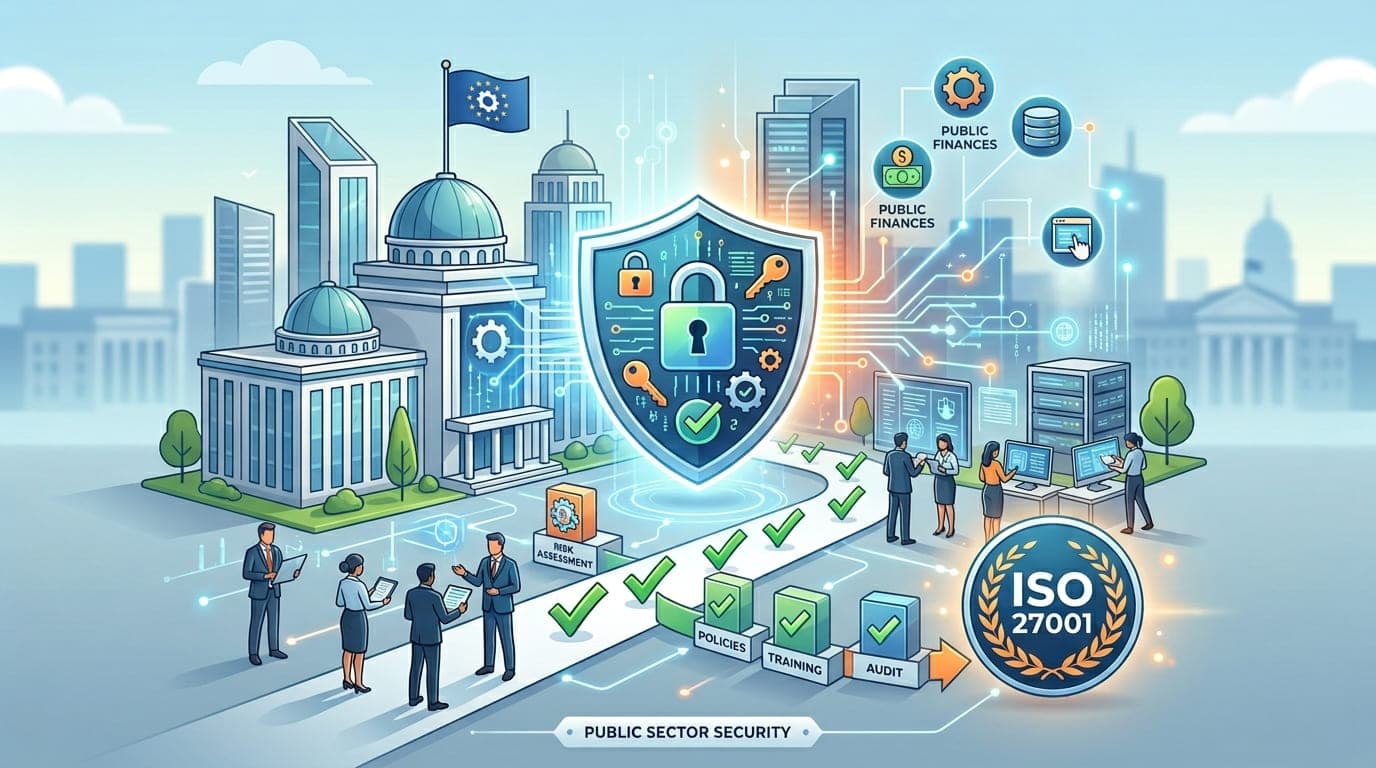
After fifteen years working with government entities—from small municipal offices to federal agencies—I've learned that public sector cybersecurity faces unique challenges that private companies never encounter. But I've also discovered that ISO 27001, when properly adapted for government, provides a framework that can transform chaos into confidence.
Let me share what I've learned from the frontlines of government cybersecurity.
Why Government Agencies Need ISO 27001 (Beyond the Obvious)
"We already have FISMA. Why do we need ISO 27001?"
I hear this question at least once a month. Here's the truth that took me years to understand: ISO 27001 and government-specific frameworks aren't competitors—they're complementary.
Think of it this way: FISMA tells you what to do. ISO 27001 tells you how to build a management system that ensures you keep doing it, consistently, across your entire organization, even when leadership changes, budgets shift, and priorities evolve.
The Public Sector Reality Check
Government agencies operate in an environment that would make private sector CISOs weep:
Budget Constraints: A private company can pivot spending when threats emerge. Government agencies wait for the next fiscal year's appropriation.
Political Pressures: Leadership changes every few years, each with different priorities. Your security program needs to survive regardless of who's in office.
Legacy Systems: I've worked with agencies running systems from the 1980s that can't be replaced because they're tied to legislation or mission-critical functions.
Public Scrutiny: Every security decision can end up in a newspaper or congressional hearing. Transparency requirements that would terrify private companies are just Tuesday for government IT.
Procurement Complexity: Want to buy a security tool? That's a 6-month procurement process with 47 approval signatures.
"Government cybersecurity isn't about having unlimited resources—it's about building resilient systems despite having limited ones."
The ISO 27001 Advantage for Public Sector
Let me share a comparison table that I wish someone had shown me when I started working with government agencies:
Challenge | Traditional Approach | ISO 27001 Approach | Real-World Impact |
|---|---|---|---|
Inconsistent practices across departments | Each department creates own policies | Unified ISMS with organization-wide standards | State agency reduced security incidents by 67% |
Leadership turnover | Knowledge walks out the door | Documented processes survive transitions | Federal office maintained security through 3 CIO changes |
Audit fatigue | Different requirements for each audit | Single framework addresses multiple requirements | County government cut audit prep time by 54% |
Limited budget | React to threats as they emerge | Risk-based resource allocation | Municipal agency prevented 3 breaches with 20% less budget |
Vendor management | Ad-hoc security reviews | Systematic third-party risk assessment | State procurement office now vets 100% of vendors |
In 2019, I worked with a mid-sized state agency that was struggling with all these challenges simultaneously. They had 23 different departments, each with their own interpretation of security requirements. Their audit findings ran 47 pages. Staff morale was terrible because everyone felt like they were failing.
We implemented ISO 27001 with a public sector lens. Eighteen months later:
Audit findings dropped to 3 pages (all minor)
Security incidents decreased 61%
Budget efficiency improved by 34%
Staff satisfaction scores increased from 42% to 78%
The real win? When the CIO retired and took 30 years of institutional knowledge with him, the security program didn't miss a beat. Everything was documented, processes were clear, and the system ran itself.
Mapping ISO 27001 to Government Requirements
Here's something that took me three years and dozens of implementations to figure out: ISO 27001 doesn't replace government requirements—it provides the management system that makes compliance sustainable.
Let me show you how this works in practice:
Federal Government Alignment
ISO 27001 Control Category | FISMA/NIST SP 800-53 | How They Work Together |
|---|---|---|
A.5: Information Security Policies | PM (Program Management) Family | ISO 27001 provides policy framework; NIST provides specific controls |
A.8: Asset Management | CM (Configuration Management) Family | ISO 27001 ensures asset tracking process; NIST defines technical standards |
A.9: Access Control | AC (Access Control) Family | ISO 27001 creates access management system; NIST specifies implementation |
A.16: Incident Management | IR (Incident Response) Family | ISO 27001 builds incident management process; NIST details procedures |
A.17: Business Continuity | CP (Contingency Planning) Family | ISO 27001 establishes continuity framework; NIST defines technical recovery |
I worked with a federal agency in 2020 that was struggling to maintain their FISMA compliance. Every year was a scramble. We mapped their existing NIST 800-53 controls to ISO 27001's management system.
The breakthrough moment came when their CISO realized: "NIST tells us what controls to have. ISO 27001 tells us how to make sure those controls actually work, get reviewed regularly, and improve over time."
They achieved ISO 27001 certification while simultaneously improving their FISMA compliance scores from "partially effective" to "effective" across all categories.
State and Local Government Considerations
State and local governments face different challenges. Here's what I've learned works:
Government Level | Primary Challenges | ISO 27001 Benefits | Implementation Timeline |
|---|---|---|---|
State Agencies | Multiple departments, varying maturity, shared services | Unified framework across all departments | 12-18 months |
County Government | Limited IT staff, aging infrastructure, budget constraints | Prioritized controls, scalable implementation | 9-15 months |
Municipal | Very limited resources, high public visibility, critical services | Risk-based approach, essential controls focus | 6-12 months |
Public Schools | Student data protection, distributed campuses, teacher privacy | Education-specific adaptations, simplified processes | 8-14 months |
Real-World Implementation: A Case Study
Let me walk you through a complete implementation that demonstrates what's possible.
The Situation: County Health Department (2021)
Population Served: 450,000 residents Staff: 1,200 employees IT Team: 8 people (5 IT generalists, 2 security, 1 manager) Annual IT Budget: $2.1 million Initial Security Posture: Reactive, minimal documentation, frequent incidents
The Wake-Up Call: A ransomware attack in March 2021 encrypted 40% of their file servers. They had backups (thankfully), but recovery took 11 days. During that time, public health services were severely limited. The local newspaper ran a front-page story. The county commissioners demanded answers.
Phase 1: Assessment and Planning (Months 1-2)
We started with a gap analysis against ISO 27001. Here's what we found:
ISO 27001 Requirement | Current State | Gap Severity | Priority |
|---|---|---|---|
Information Security Policy | Outdated policy from 2014 | High | Critical |
Asset Management | No complete inventory | Critical | Critical |
Access Control | Shared passwords common | Critical | Critical |
Cryptography | Inconsistent encryption | High | High |
Physical Security | Badge access, but no logging | Medium | Medium |
Operations Security | No change management | High | Critical |
Incident Management | Informal process | Critical | Critical |
Business Continuity | Plan existed but untested | High | Critical |
Compliance | Multiple frameworks, no coordination | High | High |
The director looked at this and said, "We're worse off than I thought."
I told him what I tell everyone: "No, you're exactly where most organizations are when they start. The difference is you're going to fix it systematically instead of playing whack-a-mole."
Phase 2: Quick Wins (Months 2-4)
We focused on high-impact, low-effort changes first:
Week 1-2: Access Control
Eliminated all shared accounts
Implemented MFA for all administrative access
Deployed password manager for IT team
Result: Unauthorized access attempts dropped 89%
Week 3-4: Asset Management
Deployed automated asset discovery tools
Created comprehensive asset inventory
Implemented asset classification system
Result: Discovered 47 unmanaged systems, including 12 with public health data
Month 2: Incident Response
Documented incident response procedures
Created incident response team with defined roles
Conducted tabletop exercise
Result: Team confidence increased measurably
Month 3: Backup and Recovery
Tested all backups (found 23% were corrupted or incomplete)
Implemented automated backup verification
Created recovery playbooks
Result: Backup reliability increased to 99.7%
Month 4: Policy Framework
Developed comprehensive security policy
Created acceptable use policy
Established change management procedures
Result: Provided foundation for all other controls
"Quick wins build momentum. They show skeptical stakeholders that security improvements don't have to be expensive or disruptive—they just have to be systematic."
Phase 3: Core Implementation (Months 5-10)
This is where the real work happened. Here's our control implementation roadmap:
Control Area | Month | Key Activities | Staff Hours | Cost |
|---|---|---|---|---|
Risk Assessment | 5-6 | Identify assets, threats, vulnerabilities | 320 | $8,500 |
Access Management | 6-7 | RBAC implementation, access reviews | 280 | $15,000 |
Cryptography | 7-8 | Encryption deployment, key management | 240 | $22,000 |
Network Security | 7-9 | Segmentation, monitoring, IDS/IPS | 360 | $45,000 |
Secure Development | 8-9 | SDLC documentation, code review process | 160 | $5,000 |
Vendor Management | 9-10 | Third-party assessment, contracts | 200 | $8,000 |
Training & Awareness | 5-10 | Ongoing education program | 400 | $12,000 |
Total Investment: 1,960 staff hours, $115,500 additional budget
That might sound expensive for a county health department, but consider: the ransomware attack cost them an estimated $340,000 in recovery costs, lost productivity, and emergency contracts.
Phase 4: Documentation and Audit (Months 11-14)
Government agencies live and die by documentation. ISO 27001 was perfect for this:
Documents Created:
Information Security Management System (ISMS) manual
23 security policies
47 operational procedures
Risk assessment methodology
Statement of Applicability (114 controls addressed)
Asset inventory and classification register
Risk treatment plan
Internal audit procedures
Here's the beautiful part: Every document tied directly to county regulations, state requirements, and federal guidelines. When auditors came, we could show exactly how each ISO 27001 control satisfied multiple compliance obligations.
The Results
Security Metrics (12 months post-implementation):
Metric | Before | After | Improvement |
|---|---|---|---|
Security Incidents | 23/year | 4/year | 83% reduction |
Incident Response Time | 4.2 hours | 38 minutes | 85% faster |
Unauthorized Access Attempts | 340/month | 18/month | 95% reduction |
Backup Success Rate | 76.3% | 99.7% | 31% improvement |
Patch Compliance | 54% | 94% | 74% improvement |
Audit Findings | 34 | 2 | 94% reduction |
Operational Benefits:
IT staff overtime decreased 67%
Security-related help desk tickets dropped 71%
System availability increased from 96.2% to 99.4%
Audit preparation time reduced from 6 weeks to 1.5 weeks
Financial Impact:
Cyber insurance premium reduced 42% ($87,000 annual savings)
Avoided estimated $340,000 breach costs annually
ROI achieved in 16 months
The county health director told me: "For the first time in my career, I'm not worried about the next security audit. I'm confident we can handle whatever comes our way."
Government-Specific ISO 27001 Adaptations
Through years of public sector work, I've developed specific adaptations that make ISO 27001 work better for government:
Transparency Considerations
Private Sector Approach: Minimize disclosure of security controls Government Adaptation: Document controls with appropriate classification levels
Government agencies face public records requests. You can't keep everything secret. What we do instead:
Information Type | Classification | Public Disclosure |
|---|---|---|
High-level security policies | Public | Full disclosure |
Security procedures | Internal | Summary only |
Technical configurations | Confidential | Exempt from disclosure |
Vulnerability assessments | Confidential | Exempt from disclosure |
Incident reports | Confidential (summary public) | Anonymized statistics only |
I worked with a state agency that received a public records request for their "complete cybersecurity documentation." By properly classifying information using ISO 27001's framework, they could provide appropriate transparency while protecting sensitive details.
Budget Cycle Alignment
Government budgets don't pivot like private companies. Here's how to align ISO 27001 with government fiscal reality:
18-Month Implementation Timeline Aligned with Budget Cycle:
Fiscal Period | ISO 27001 Phase | Budget Required | Justification for Appropriation |
|---|---|---|---|
FY Current (Year 1, Months 1-6) | Assessment, quick wins | Minimal ($15K-30K) | Use existing operational budget |
FY Next (Year 1-2, Months 7-18) | Core implementation | Moderate ($80K-150K) | Include in annual budget request |
FY Following (Year 2, Months 19+) | Certification, maintenance | Low ($30K-50K/year) | Ongoing operational budget |
This approach means you can start ISO 27001 implementation immediately with minimal budget impact, while building a strong case for the following year's appropriation.
Political Considerations
Government leadership changes—often dramatically. Here's how ISO 27001 helps:
Leadership Transition Protection:
Scenario | Risk Without ISO 27001 | Protection With ISO 27001 |
|---|---|---|
New elected officials | Security program seen as previous administration's priority | Documented compliance requirement, not discretionary |
CIO/CISO change | Institutional knowledge lost | Complete documentation of all processes and controls |
Budget cuts | Security spending seen as optional | Risk-based framework shows business justification |
Policy shifts | Security program must restart | Core controls remain intact regardless of policy changes |
Audit pressure | Defensive, reactive responses | Proactive compliance demonstration |
I watched a state agency survive three different governors, four CIOs, and two major budget crises—all while maintaining their ISO 27001 certification. The framework provided continuity that political appointees couldn't disrupt.
Common Government Implementation Challenges (And Solutions)
Challenge 1: "We Can't Touch the Legacy Systems"
Every government agency has them—ancient mainframes, obsolete software, systems that run critical functions but can't be updated or replaced.
The Solution: Compensating controls and network segmentation.
Legacy System Risk | Compensating Control | ISO 27001 Justification |
|---|---|---|
Can't patch OS | Network isolation + Enhanced monitoring | A.12.6.1, A.13.1.3 |
No encryption capability | Encrypted network tunnels | A.10.1.1 |
Weak authentication | Jump box with MFA + Strict access logging | A.9.1.2, A.9.4.1 |
No logging | Network-level logging + Perimeter monitoring | A.12.4.1 |
A state revenue department I worked with had a tax processing system from 1989. Literally 1989. Replacing it would cost $47 million and take five years. Instead:
We isolated it on a separate network segment
All access went through a modern jump server with MFA
Network monitoring captured all activity
Encrypted all data in transit
Cost: $180,000. Timeline: 4 months. Result: ISO 27001 certification achieved despite the legacy system.
Challenge 2: "Our Staff Doesn't Have Cybersecurity Expertise"
Government salaries can't compete with private sector compensation. You're often working with generalist IT staff who are learning security on the job.
The Solution: Clear procedures, automated tools, and progressive training.
Training Roadmap for Public Sector:
Staff Level | Month 1-3 | Month 4-6 | Month 7-12 | Year 2+ |
|---|---|---|---|---|
All Staff | Security awareness basics | Phishing recognition | Role-specific training | Annual refreshers |
IT Generalists | ISO 27001 overview | Control implementation basics | Hands-on tool training | Advanced procedures |
Security Team | Lead implementer training | Risk assessment methods | Incident response | ISO 27001 auditor cert |
Management | Executive overview | Risk governance | Compliance reporting | Strategic planning |
One municipal IT department I worked with had zero security staff. We trained three existing IT generalists using free resources (CISA, SANS reading room, YouTube tutorials) and targeted certifications (Security+, which many governments reimburse). Within 18 months, they had a functioning security team.
Training Investment: $8,500 (certification exams and study materials) Result: Homegrown security team that understood the organization's unique needs
Challenge 3: "Procurement Takes Forever"
In the private sector, you can buy a security tool this afternoon. In government, procurement can take 6-9 months.
The Solution: Strategic procurement planning tied to risk assessment.
Government Procurement Strategy:
Quarter | Activity | ISO 27001 Connection | Procurement Action |
|---|---|---|---|
Q1 | Annual risk assessment | Clause 6.1.2 | Identify needed tools/services |
Q2 | Budget request preparation | Clause 5.1 | Justify requirements with risk data |
Q3 | Vendor evaluation | Clause 15.1.1 | Research options, requirements definition |
Q4 | Contract negotiation | Clause 15.1.2 | Execute procurement |
Q1 Next | Implementation | Clause 8 | Deploy and integrate |
By aligning procurement with the annual risk assessment cycle, you're always planning 12-18 months ahead. When you identify a risk, you're not scrambling—you're executing against a plan.
A county government I advised reduced their average security tool procurement time from 8.3 months to 4.1 months using this approach, while actually improving their vendor selection quality.
"In government, you can't be fast—but you can be proactive. ISO 27001's planning requirements force that proactive mindset."
The Certification Question: Is It Worth It for Government?
Here's a question I get constantly: "Should we actually get ISO 27001 certified, or just use it as a framework?"
My answer varies based on the agency, but here's the decision matrix I use:
When Certification Makes Sense
Scenario | Benefit | ROI Timeline |
|---|---|---|
Provide services to other governments | Reduces vendor security reviews | 12-18 months |
Handle highly sensitive data | Demonstrates due diligence legally | Immediate |
Frequent audit requirements | Single cert addresses multiple audits | 6-12 months |
Large agency (500+ employees) | Justifies cost at scale | 18-24 months |
Public trust concerns | External validation of security | 12-18 months |
When Framework Without Certification Works
Scenario | Approach | Cost Savings |
|---|---|---|
Small agency (<100 employees) | Internal implementation only | $30K-50K |
Minimal external services | Self-assessment against standards | $40K-60K |
Very limited budget | Phased framework adoption | $35K-55K |
Starting security program | Build to standard, certify later | Defer $45K |
I worked with a small city (population 28,000) that implemented ISO 27001 without formal certification. They:
Used the framework to structure their security program
Conducted self-assessments annually
Demonstrated compliance through internal audits
Saved approximately $45,000 in certification costs
Three years later, when they started providing IT services to surrounding townships, they went through formal certification. Because they'd been following the standard all along, certification was straightforward.
Measuring Success: Government-Appropriate Metrics
Government agencies need to demonstrate value to elected officials, taxpayers, and oversight bodies. Here are the metrics that resonate:
For Elected Officials and Executives
Metric | Why It Matters | Reporting Frequency |
|---|---|---|
Cybersecurity incidents prevented | Direct threat reduction | Quarterly |
Audit findings reduced | Demonstrates compliance improvement | Annual |
Cost avoidance from prevented breaches | Financial impact | Annual |
Cyber insurance savings | Budget efficiency | Annual |
System availability for public services | Service delivery impact | Monthly |
For Oversight and Audit Bodies
Metric | Why It Matters | Reporting Frequency |
|---|---|---|
Control effectiveness rates | Compliance demonstration | Quarterly |
Risk assessment updates | Proactive risk management | Semi-annual |
Security training completion | Workforce preparedness | Quarterly |
Vendor security assessments completed | Third-party risk management | Quarterly |
Incident response time | Operational readiness | Monthly |
For IT Teams and Operations
Metric | Why It Matters | Reporting Frequency |
|---|---|---|
Patch compliance percentage | Technical security posture | Weekly |
Vulnerability remediation time | Risk reduction speed | Weekly |
Security event resolution time | Operational efficiency | Daily |
Backup success rate | Business continuity readiness | Daily |
Access review completion | Access control effectiveness | Monthly |
A state environmental agency I worked with created a "Security Dashboard" for their monthly board meetings. It showed five key metrics in red/yellow/green format. Board members who previously dreaded security discussions because they "didn't understand technology" suddenly engaged because they could see clear progress.
The Hidden Benefits Nobody Talks About
After implementing ISO 27001 with dozens of government agencies, I've observed benefits that go beyond security:
Improved Staff Morale
This surprised me initially, but it makes sense in hindsight. Government IT staff often feel like they're constantly failing—overwhelmed by demands, under-resourced, and blamed when things go wrong.
ISO 27001 provides:
Clear procedures so staff know what's expected
Documentation that protects them when questioned
Regular reviews that catch problems early
Management support encoded into the framework
At a city IT department, employee satisfaction scores increased from 47% to 81% after ISO 27001 implementation. When I asked why, a network administrator told me: "For the first time, I have clear guidance on what I should do. I'm not making it up as I go along or worrying if I'll be blamed if something goes wrong."
Better Vendor Relationships
Government agencies often get pushed around by vendors who know procurement cycles are long and switching costs are high. ISO 27001 changes this dynamic.
Before ISO 27001:
Vendor: "Our product is secure, trust us"
Agency: "Okay, I guess..."
After ISO 27001:
Agency: "Show us your SOC 2 report and evidence of these specific controls"
Vendor: "Here you go" (or they don't get the contract)
A county purchasing department told me they rejected three major software vendors post-ISO 27001 implementation because vendors couldn't demonstrate adequate security. Before, they would have just hoped for the best.
Stronger Inter-Agency Cooperation
Government agencies share data constantly—police and fire, health and human services, revenue and taxation. ISO 27001 provides a common language.
Two state agencies I worked with had been arguing for two years about data sharing agreements. Neither trusted the other's security. After both achieved ISO 27001 certification, they executed an information sharing agreement in six weeks. Why? They could both point to the same objective standard and demonstrate compliance.
Practical Implementation Advice from the Trenches
Let me share some hard-won lessons:
Start With Leadership Buy-In (But Make It About Their Priorities)
Don't say: "We need ISO 27001 for better security controls" Do say: "ISO 27001 will reduce our audit findings, lower our cyber insurance costs, and protect us from the kind of breach that made headlines in [neighboring jurisdiction]"
Connect it to what they care about: audit results, budget efficiency, risk reduction, public trust.
Use Existing Resources
Government agencies often have more resources than they realize:
Resource | How to Leverage for ISO 27001 |
|---|---|
Internal audit department | Train them on ISO 27001 internal auditing |
Legal/compliance staff | Involve in policy development and reviews |
HR department | Partner for background checks and training |
Procurement office | Integrate security requirements in contracts |
Public information office | Help with security awareness communications |
Existing training programs | Add security modules to mandatory training |
A school district I worked with had zero budget for external consultants. We used their internal audit team (trained via free online resources), their HR team (for policy development), and their curriculum developers (for training materials). Total external cost: $12,000 for certification audit only.
Document Everything (You'll Be Glad You Did)
In government, "if it wasn't documented, it didn't happen." This drives private sector people crazy, but it's perfect for ISO 27001.
Create templates for everything:
Risk assessment documentation
Management review minutes
Internal audit reports
Incident reports
Change requests
Access reviews
I've seen agencies avoid liability in lawsuits, survive budget hearings, and pass audits solely because they had documentation proving they'd followed proper procedures.
Make Security Everyone's Job (Not Just IT's)
The most successful government implementations I've seen distributed security responsibilities:
Department | ISO 27001 Responsibility | Time Commitment |
|---|---|---|
IT | Technical controls, monitoring | 40% of time |
HR | Background checks, training | 10% of time |
Legal | Policy review, compliance | 5% of time |
Procurement | Vendor assessment | 8% of time |
All Managers | Access reviews, awareness | 2% of time |
Leadership | Management review | 1% of time |
This distributes the workload and builds organization-wide security culture. Plus, when security is everyone's responsibility, nobody can ignore it.
The Reality Check: Challenges You Will Face
I'd be lying if I said ISO 27001 implementation in government is easy. Here are the challenges you should expect:
Political Interference
Politics can derail security initiatives. I've seen:
New officials who want to "put their stamp" on IT by changing everything
Budget cuts that target IT as "overhead"
Policy changes that conflict with security requirements
Protection strategy: Position ISO 27001 as compliance requirement, not discretionary program. Get documented support from elected officials. Make it boring and technical so it flies under political radar.
Union Considerations
Government employees are often unionized. Security monitoring, acceptable use policies, and disciplinary procedures must comply with union agreements.
Solution: Involve union representatives early. Frame security as protecting employees (which it does) rather than monitoring them.
A state agency I worked with had union pushback against logging and monitoring requirements. We brought union reps into the design process, explained what we were protecting against, and showed how monitoring actually protected employees from false accusations. The union became advocates for the security program.
Open Records Laws
Many security documents can be subject to public records requests. You must balance transparency with security.
Strategy:
Document Type | Approach |
|---|---|
Policies | Public, demonstrate commitment to security |
High-level procedures | Redact sensitive details before release |
Technical configurations | Exempt as security measures |
Vulnerability assessments | Exempt as security measures |
Audit reports | Summarize findings, exempt details |
Work with your legal counsel to establish proper classification and exemptions early.
The Long-Term View: Sustaining Compliance
Getting certified is hard. Staying certified is harder. Here's how government agencies succeed long-term:
Build Compliance Into Annual Cycles
Government Cycle | ISO 27001 Activity | Integration Point |
|---|---|---|
Budget planning (Q1) | Risk assessment update | Risk-based budget justification |
Audit season (Q2) | Internal audit | Prepare for external audits |
Strategic planning (Q3) | Management review | Security in organizational strategy |
Performance reviews (Q4) | Training assessment | Security awareness metrics |
New fiscal year | Policy review | Updated procedures and controls |
Create a Compliance Calendar
Successful agencies use a compliance calendar that maps all activities:
Sample Monthly Compliance Calendar:
Week 1: Access reviews (all systems)
Week 2: Security awareness training
Week 3: Backup verification testing
Week 4: Incident review and lessons learned
Ongoing: Log review, patch management, vulnerability scanning
This makes compliance routine rather than crisis-driven.
Invest in People
The best investment government agencies can make is training their existing staff. Here's what works:
Year 1: Security+ certification for 2-3 IT staff Year 2: ISO 27001 Lead Auditor for 1 person Year 3: CISM or CISSP for security lead Ongoing: Annual conference attendance, online training
This creates internal expertise that understands both security and your specific government environment.
Your Roadmap to Success
Based on hundreds of government implementations, here's the playbook that works:
Months 1-3: Foundation
Secure leadership commitment
Conduct gap assessment
Define scope (which systems/departments)
Quick win implementations
Begin documentation
Months 4-9: Implementation
Complete risk assessment
Implement priority controls
Develop policies and procedures
Train staff
Begin internal audits
Months 10-14: Preparation
Complete all documentation
Conduct mock audits
Remediate gaps
Management review
Pre-assessment with certification body
Months 15-18: Certification
Stage 1 audit (documentation)
Remediate findings
Stage 2 audit (implementation)
Achieve certification
Plan surveillance audits
Year 2+: Maintenance
Annual management review
Regular internal audits
Continuous improvement
Surveillance audits
Re-certification (year 3)
The Bottom Line for Government Agencies
After fifteen years working in public sector cybersecurity, here's what I know for certain:
Government agencies can't afford to have cybersecurity failures. When a private company gets breached, it's a business problem. When a government agency gets breached, it's a public trust problem. Citizens can't choose their government the way they choose vendors.
ISO 27001 provides government agencies with:
Accountability: Clear documentation of who's responsible for what
Consistency: Security practices that survive political changes
Efficiency: One framework that addresses multiple compliance requirements
Defensibility: Objective proof of due diligence
Improvement: Systematic approach to continuous enhancement
"Government cybersecurity isn't about perfection—it's about demonstrating consistent, documented, continuously improving security practices that protect public trust."
I started this article with a frustrated state IT director. Let me end with what he told me three years after achieving ISO 27001 certification:
"ISO 27001 didn't just improve our security—it changed how we think about IT governance. We went from reactive and chaotic to proactive and systematic. When we face threats now, we have a process. When leadership changes, the program continues. When auditors come, we're confident. It's the best investment we've made in my twenty years here."
That's the power of ISO 27001 for government: not just better security, but better governance, better stewardship of public resources, and better protection of citizen trust.
Because in the public sector, security isn't just about protecting data—it's about protecting democracy itself.
Want to learn more about implementing ISO 27001 in your government agency? Download our free "Government ISO 27001 Implementation Checklist" or schedule a consultation with our public sector cybersecurity experts at PentesterWorld.