I still remember walking into the conference room of a fintech company in 2021, armed with my laptop and a detailed gap analysis template. The CTO looked at me with a mix of hope and dread. "Just tell me," he said, "how bad is it?"
Three days later, we had our answer: 87 gaps across 114 controls. His face went pale. "There's no way we can fix all of this," he muttered.
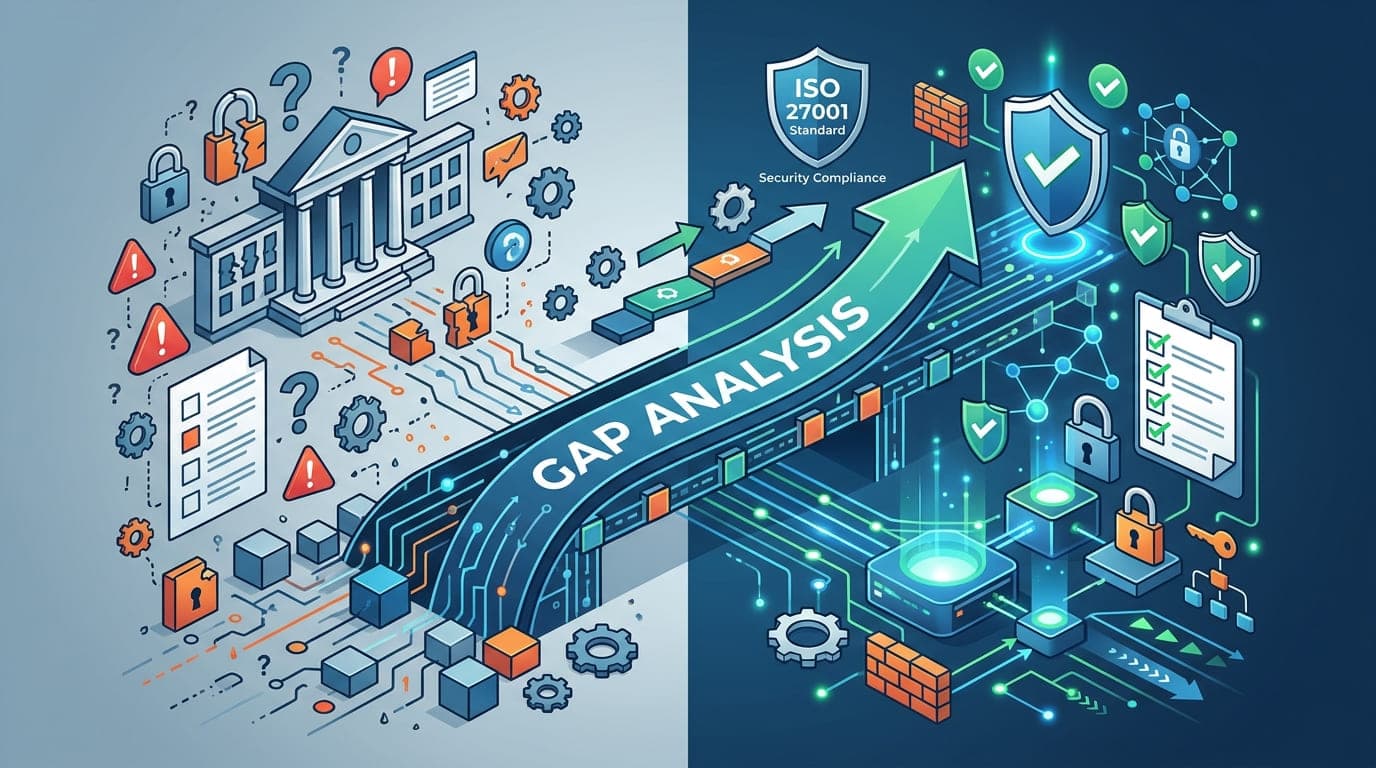
But here's what I told him then, and what I'll tell you now: Gap analysis isn't about counting problems—it's about creating a roadmap from where you are to where you need to be.
Six months later, that same company achieved ISO 27001 certification. Not because they fixed everything at once, but because the gap analysis showed them exactly what to prioritize, in what order, and why.
After conducting over 60 ISO 27001 gap analyses in my career, I've learned that this single activity determines whether your certification journey takes 6 months or 2 years, costs $150,000 or $500,000, and succeeds brilliantly or fails spectacularly.
Let me show you how to do it right.
What a Gap Analysis Actually Is (And Why Most People Get It Wrong)
Here's the biggest misconception I encounter: organizations think a gap analysis is about checking boxes on a compliance spreadsheet. They hire a junior consultant, spend a week answering yes/no questions, and call it done.
Then they wonder why their implementation goes off the rails.
A proper ISO 27001 gap analysis is a comprehensive diagnostic that reveals:
Current state: What security controls you actually have in place
Required state: What ISO 27001 mandates for your organization
The gaps: Specific deficiencies and missing elements
Risk levels: Which gaps pose the greatest threat
Implementation roadmap: Prioritized action plan with timelines and resources
Cost estimates: Real numbers for budgeting and planning
"A gap analysis without prioritization is just an expensive to-do list. A gap analysis with prioritization is a strategic implementation roadmap."
The Real-World Impact: A Tale of Two Companies
Let me share two stories that illustrate why gap analysis matters.
Company A: A 150-person SaaS company jumped straight into ISO 27001 implementation without a proper gap analysis. They hired consultants, bought tools, and started writing policies. Eighteen months and $480,000 later, they failed their certification audit. Why? They'd focused on easy wins instead of critical requirements. Their access control documentation was beautiful, but they had no incident response plan and no business continuity program—both mandatory requirements.
Company B: A similar-sized healthcare tech company invested $25,000 in a thorough gap analysis first. The analysis revealed 73 gaps, which they prioritized into three phases. They achieved certification in 9 months for $180,000 total investment. The gap analysis didn't just save them money—it saved them from failure.
The difference? Company B knew exactly what they needed to do, in what order, and why it mattered.
The Complete Gap Analysis Framework
Based on 15+ years of implementation experience, here's the framework I use for every gap analysis:
Phase 1: Scoping and Context (Week 1)
Before you can identify gaps, you need to understand what you're analyzing. I've seen organizations waste months analyzing systems that didn't even need to be in scope.
Key Questions to Answer:
What's your Information Security Management System (ISMS) scope?
Which business units, processes, and systems are included?
What types of information assets do you manage?
What are your external compliance obligations?
Who are your interested parties (customers, regulators, partners)?
I worked with a professional services firm that initially wanted to include their entire global operation in scope. After careful analysis, we reduced the scope to just their core delivery platform and corporate infrastructure. This cut their implementation timeline by 40% and their costs by 55%—without reducing the business value of certification.
Phase 2: Current State Assessment (Weeks 2-4)
This is where the real work begins. You're mapping every single ISO 27001 control against your current practices.
Here's the brutal truth: most organizations have about 30-40% of controls already in place, 30-40% partially implemented, and 20-30% completely missing.
The key is being honest. I've sat through dozens of gap analysis interviews where stakeholders insisted they had controls fully implemented, only to discover they existed as Word documents nobody had looked at in three years.
Assessment Level | What It Really Means | Typical Finding Rate |
|---|---|---|
Fully Implemented | Control is documented, operational, and regularly reviewed | 30-40% |
Partially Implemented | Control exists but has gaps in coverage, documentation, or operation | 30-40% |
Not Implemented | Control doesn't exist or is so inadequate it needs complete rebuild | 20-30% |
Not Applicable | Control genuinely doesn't apply to your organization | 5-10% |
"In gap analysis, optimism is expensive. Brutal honesty is what gets you certified."
Phase 3: Evidence Collection (Concurrent with Phase 2)
This is where many gap analyses fall apart. People claim they have controls but can't prove it.
For each control, you need evidence. Real, tangible, documented evidence that would satisfy an auditor.
Example: Access Control Review (ISO 27001 Control 5.18)
❌ "We review access quarterly" → No evidence
❌ Email showing one review from 8 months ago → Insufficient
✅ Quarterly access review reports for past 12 months with sign-offs → Acceptable evidence
I remember analyzing a manufacturing company that insisted they had comprehensive access controls. When I asked to see documentation, they showed me an Excel spreadsheet from 2019. Their actual access management? Entirely ad-hoc, no documentation, no reviews. We marked it as "Not Implemented" and they were shocked.
The lesson: If you can't prove it to an auditor, you don't have it.
Phase 4: Gap Documentation (Week 5)
Now you document every gap with precision. Vague gap descriptions lead to vague implementations that fail audits.
Here's how I structure gap documentation:
Element | Poor Example | Good Example |
|---|---|---|
Gap Description | "Need incident response plan" | "No documented incident response plan exists. No defined roles, escalation procedures, or communication protocols for security incidents" |
Current State | "None" | "Informal incident handling by IT team. No documentation. Response time varies 2-48 hours. No post-incident reviews conducted" |
Required State | "Have plan" | "Documented IRP with defined roles (incident manager, communications lead, technical lead), escalation matrix, communication templates, and quarterly tabletop exercises" |
Implementation Effort | "Medium" | "40 hours consulting + 20 hours internal development + 8 hours quarterly testing = 68 hours year 1, 24 hours annually ongoing" |
Cost Estimate | "$5K-$10K" | "$8,500 initial (consultant $6K + tools $2.5K) + $3,000 annual maintenance" |
The detail matters. When you're standing in front of your CFO asking for budget, "we need stuff" doesn't work. "We need $8,500 for incident response capability with proven ROI" opens wallets.
The Complete Gap Analysis Matrix
Here's a comprehensive view of how I structure gap analysis across all ISO 27001 control categories:
Control Category | Total Controls | Typically Implemented | Partially Implemented | Not Implemented | Priority Level |
|---|---|---|---|---|---|
Organizational Controls | 37 | 12-15 (32%) | 15-18 (43%) | 7-10 (25%) | HIGH |
People Controls | 8 | 3-4 (40%) | 3-4 (45%) | 1-2 (15%) | HIGH |
Physical Controls | 14 | 6-8 (50%) | 4-5 (32%) | 2-3 (18%) | MEDIUM |
Technological Controls | 34 | 12-15 (40%) | 12-16 (42%) | 6-8 (18%) | HIGH |
Total | 93 | 33-42 (38%) | 34-43 (40%) | 16-23 (22%) | - |
Note: ISO 27001:2022 includes 93 controls across Annex A. These percentages are based on my analysis of 60+ organizations.
Control-by-Control: The Critical Gaps I See Repeatedly
After 15 years of gap analyses, certain patterns emerge. Here are the gaps I find in nearly every assessment:
Information Security Policies (Control 5.1)
What Organizations Think They Have: A 50-page security policy gathering dust in SharePoint.
What They Actually Need: A living policy framework with:
Board-approved top-level information security policy
Supporting policies for specific domains (access control, encryption, incident response)
Annual review cycle with documented updates
Communication plan ensuring staff awareness
Version control and change management
Common Gap: Policies exist but nobody reads them, they're never updated, and there's no evidence of board approval or staff acknowledgment.
Real Story: I found a healthcare company with a comprehensive security policy—from 2016. It referenced systems they'd decommissioned, tools they no longer used, and a CISO who'd left three years ago. We essentially started from scratch.
Risk Assessment and Treatment (Control 5.7)
The Gap: Organizations do ad-hoc risk assessments occasionally, but lack:
Formal risk assessment methodology
Regular assessment schedule (at least annually)
Risk treatment plans with ownership and timelines
Documentation linking risks to controls
Board/executive acceptance of residual risks
Why It Matters: Risk assessment is the foundation of ISO 27001. Without it, you can't justify your control selection or demonstrate management oversight.
Implementation Reality: Proper risk assessment takes 40-80 hours initially, then 20-30 hours annually. Most organizations underestimate this massively.
Access Control (Controls 5.15-5.18)
This is where I find the most significant gaps. Here's the typical breakdown:
Access Control Requirement | Implementation Rate | Common Gap |
|---|---|---|
User Registration/De-registration | 60% | No formal onboarding/offboarding procedures |
Privileged Access Management | 35% | Admin rights given freely, no review process |
Access Rights Review | 25% | Reviews don't happen or aren't documented |
Secure Authentication | 70% | MFA exists but not enforced everywhere |
Access to Source Code | 45% | Developers have unrestricted access |
I worked with a financial services company where 40% of active accounts belonged to former employees. Their HR offboarding process didn't trigger IT access removal. This single gap could have destroyed their certification chances—and represented a massive security risk.
Incident Management (Control 5.24-5.26)
What Organizations Have: IT team that handles problems as they arise.
What ISO 27001 Requires:
Documented incident response procedures
Defined incident categories and severity levels
24/7 incident reporting mechanism
Incident response team with assigned roles
Post-incident review process
Evidence collection and preservation procedures
Communication plans for stakeholders
Regular testing through tabletop exercises
The Reality Check: I ask organizations, "If you discovered a breach right now, what would you do?" The answers are usually vague and inconsistent. That's a gap.
"The time to figure out your incident response plan is not during an incident. It's during your gap analysis."
Business Continuity (Control 5.29-5.30)
This is consistently one of the largest gaps I find. Organizations know they need backup systems but haven't formalized:
Business impact analysis
Recovery time objectives (RTO) and recovery point objectives (RPO)
Business continuity and disaster recovery plans
Alternative processing sites or work-from-home capabilities
Annual testing and updating of plans
War Story: A manufacturing company assured me they had disaster recovery "covered." When I asked about their RTO, they said "a few days, maybe a week." Their largest customer's contract required 4-hour RTO. They were one incident away from contract breach and didn't even know it.
The Gap Prioritization Matrix
Not all gaps are created equal. Here's how I prioritize what to fix first:
Priority | Criteria | Implementation Order | Example Controls |
|---|---|---|---|
Critical | Mandatory requirement + High risk + Audit failure guaranteed | Fix in Phase 1 (0-3 months) | Information security policy, Risk assessment, Access controls, Incident response |
High | Mandatory requirement + Medium risk + Likely audit finding | Fix in Phase 2 (3-6 months) | Asset management, Supplier security, Business continuity, Cryptography |
Medium | Best practice + Moderate risk + Possible audit observation | Fix in Phase 3 (6-9 months) | Secure disposal, Remote working, Documentation controls |
Low | Edge case + Low risk + Minor audit observation | Fix in Phase 4 (9-12 months) | Specific technical controls, Industry-specific requirements |
Not Applicable | Genuinely doesn't apply to your organization | Document why it's N/A | Controls specific to physical data centers when you're 100% cloud |
Real Prioritization Example
Here's how I prioritized gaps for a 200-person SaaS company:
Phase 1 (Month 1-3): Foundation - 23 gaps, $85,000
Information security policies (5.1)
Risk assessment methodology (5.7)
Access control procedures (5.15-5.18)
Incident response plan (5.24-5.26)
Asset inventory and classification (5.9-5.10)
Phase 2 (Month 4-6): Core Operations - 19 gaps, $45,000
Business continuity planning (5.29-5.30)
Supplier security assessment (5.19-5.23)
Backup and recovery (5.29)
Security monitoring and logging (8.15-8.16)
Vulnerability management (8.8)
Phase 3 (Month 7-9): Enhancement - 15 gaps, $25,000
Secure development lifecycle (8.25-8.29)
Change management (8.32)
Capacity management (8.6)
Technical compliance review (5.36)
Documentation and records (5.37)
Phase 4 (Month 10-12): Optimization - 8 gaps, $15,000
Advanced monitoring (8.16)
Configuration management (8.9)
Deletion of information (8.10)
Network security refinements (8.20-8.22)
Total: 65 gaps, $170,000, 12 months to certification.
The Gap Analysis Report: What Decision-Makers Need to See
I've written dozens of gap analysis reports. Here's what actually gets read and acted upon:
Executive Summary (1-2 pages)
Include:
Overall compliance level (percentage)
Total gaps by category and priority
Estimated implementation timeline
Budget requirements by phase
Top 5 critical risks
Recommended next steps
Skip:
Technical jargon
Detailed control descriptions
Lengthy explanations
Real Example Summary I Wrote:
"Current ISO 27001 compliance: 42%. We identified 73 gaps across 4 priority levels. Critical gaps (18) pose immediate certification risk and must be addressed in first 90 days. Estimated timeline to certification: 9-11 months. Required investment: $195,000 (Year 1), $45,000 annual maintenance. Key risks: No formal incident response, access controls inadequate, business continuity planning absent. Recommended approach: Phased implementation prioritizing critical and high-priority gaps first."
That's it. Two paragraphs that told the CEO everything they needed to make a decision.
Detailed Gap Analysis (20-40 pages)
This is the working document for implementation teams. For each gap:
Section | What to Include |
|---|---|
Control Reference | ISO 27001:2022 control number and title |
Current State | Detailed description of what exists today |
Gap Description | Specific deficiencies vs. requirements |
Risk Level | Critical/High/Medium/Low with justification |
Evidence Reviewed | Documents, interviews, observations |
Required State | Detailed requirements to close gap |
Implementation Steps | Specific actions with owners |
Effort Estimate | Hours/days by role (internal + external) |
Cost Estimate | Tools, consulting, training, ongoing costs |
Dependencies | Other gaps or activities that must complete first |
Timeline | Target completion date |
Implementation Roadmap (Visual Timeline)
Decision-makers love visual roadmaps. I create Gantt-style charts showing:
Phases with durations
Parallel vs. sequential activities
Key milestones
Resource allocation by month
Critical path items
Decision points
Pro Tip: I use color coding for priorities. Red for critical, orange for high, yellow for medium, green for low. Executives immediately see where attention is needed.
Common Gap Analysis Mistakes (That Cost Time and Money)
Mistake #1: Treating It as a One-Time Activity
What Happens: Organization does gap analysis, implements controls, and never looks back.
Why It Fails: Your environment changes. New systems are deployed. Staff turnover occurs. Threats evolve. That gap analysis is outdated within 6 months.
The Fix: Lightweight gap re-assessment quarterly, full analysis annually.
I worked with an e-commerce company that did a perfect gap analysis and implementation. Eighteen months later, they failed their surveillance audit. Why? They'd migrated to a new cloud platform and never assessed the security implications. New gaps had emerged that nobody tracked.
Mistake #2: Using Generic Templates Without Customization
What Happens: Download an ISO 27001 gap analysis template, fill it out generically, and wonder why implementation fails.
Why It Fails: Your organization is unique. Your risks, technology stack, business model, and constraints are different from every other company.
The Fix: Use templates as starting points, then customize ruthlessly for your specific context.
Mistake #3: Focusing Only on Technical Controls
What Happens: IT team leads gap analysis, focuses heavily on firewalls and encryption, ignores organizational and people controls.
Why It Fails: ISO 27001 is about 40% technology, 30% process, 30% people. Ignoring any dimension guarantees failure.
Real Example: A tech startup had perfect technical controls—encryption everywhere, sophisticated monitoring, zero trust architecture. But they had no documented policies, no risk assessment, and no management review process. They failed their audit despite excellent technical security.
"ISO 27001 isn't a technical certification. It's a management system certification that includes technical controls. Miss that distinction and you'll miss certification."
Mistake #4: Underestimating Documentation Requirements
What Happens: Gaps identified, controls implemented, but documentation is an afterthought.
Why It Fails: In ISO 27001, if it's not documented, it doesn't exist. Auditors assess evidence, not intentions.
The Reality: Documentation typically represents 30-40% of implementation effort. I've seen organizations with great security practices fail audits because they couldn't prove they'd been doing them consistently.
Mistake #5: No Executive Involvement
What Happens: Security team does gap analysis in isolation, presents massive to-do list, and gets rejected because leadership doesn't understand or support it.
Why It Fails: ISO 27001 requires management commitment, resource allocation, and strategic alignment. Without executive buy-in, you're dead in the water.
The Fix: Involve executives from day one. Share preliminary findings weekly. Frame gaps in business risk terms, not technical jargon. Show how certification enables business objectives.
The Tools That Actually Help
After trying dozens of tools over the years, here's what I actually use:
For Small Organizations (Under 100 employees)
Excel/Google Sheets: Don't laugh. A well-structured spreadsheet is often more effective than expensive GRC platforms for small teams.
My Template Structure:
Control library tab
Gap assessment tab
Risk scoring tab
Implementation tracking tab
Cost summary tab
Dashboard tab
Cost: Free Learning curve: 1 day Effectiveness: High for organizations under 100 people
For Medium Organizations (100-500 employees)
Dedicated GRC Platforms: Tools like Vanta, Drata, Secureframe, or Strike Graph.
Benefits:
Automated evidence collection
Continuous monitoring
Integration with your tool stack
Built-in compliance mapping
Audit-ready reports
Cost: $20,000-$50,000 annually Learning curve: 2-4 weeks Effectiveness: High, especially if you need multiple frameworks (SOC 2 + ISO 27001)
For Large Organizations (500+ employees)
Enterprise GRC Suites: ServiceNow GRC, RSA Archer, MetricStream, or similar.
These provide comprehensive risk, compliance, and governance capabilities across the entire organization.
Cost: $100,000+ annually Learning curve: 2-3 months Effectiveness: High for complex, multi-framework environments
My Honest Take: Start simple. I've seen organizations spend $150,000 on GRC platforms before they even understood their requirements. Do your first gap analysis in Excel. If you need more, upgrade later.
The Gap Analysis Template You Can Actually Use
Here's the exact structure I use for every control assessment:
CONTROL: 5.7 Threat IntelligenceRepeat this for all 93 Annex A controls, and you have a complete gap analysis.
When to Conduct Your Gap Analysis
Here's the timeline I recommend:
Scenario | When to Do Gap Analysis | Why |
|---|---|---|
New to ISO 27001 | Before any implementation work | Prevents wasted effort on wrong priorities |
Failed Previous Audit | Immediately | Understand why you failed and what to fix |
Major Business Changes | Within 30 days of change | M&A, new products, major system changes all create new gaps |
Annual Reassessment | 3 months before surveillance audit | Identify new gaps before auditors do |
Scope Expansion | Before expanding scope | New systems/processes = new gaps |
Real Story: A healthcare company did gap analysis 18 months before pursuing certification. By the time they started implementation, they'd moved to cloud infrastructure, acquired another company, and launched a mobile app. Their gap analysis was worthless. They spent $30,000 doing it again.
The Lesson: Gap analysis should be 3-6 months before planned certification, max. Any longer and it's outdated.
The Budget Reality Check
Let's talk money, because nobody else gives you real numbers.
Based on 60+ gap analyses I've conducted, here are actual costs:
Organization Size | Gap Analysis Cost | Implementation Cost | Timeline |
|---|---|---|---|
Under 50 employees | $8,000-$15,000 | $60,000-$120,000 | 6-9 months |
50-200 employees | $15,000-$30,000 | $120,000-$250,000 | 9-12 months |
200-500 employees | $30,000-$50,000 | $250,000-$500,000 | 12-18 months |
500+ employees | $50,000-$100,000 | $500,000-$1,500,000 | 18-24 months |
These numbers include:
Consultant fees for gap analysis
Internal staff time
Tool and technology costs
Training and awareness
Audit and certification fees
Ongoing maintenance (first year)
Critical Note: Organizations that skip or shortchange gap analysis typically spend 40-60% more on implementation because they waste time on wrong priorities, miss critical requirements, and have to redo work.
Your Gap Analysis Checklist
Here's what you need to start your gap analysis tomorrow:
Week Before:
[ ] Define ISMS scope clearly
[ ] Identify all stakeholders to interview
[ ] Gather existing documentation (policies, procedures, architecture diagrams)
[ ] Schedule interviews (2-3 hours per stakeholder)
[ ] Prepare interview questions and templates
[ ] Set expectations with leadership about time commitment
Week 1: Kickoff and Context
[ ] Conduct stakeholder interviews
[ ] Review business context and compliance obligations
[ ] Map information assets
[ ] Understand current security architecture
[ ] Document interested parties and their requirements
Weeks 2-4: Assessment
[ ] Assess each of 93 Annex A controls
[ ] Collect evidence for existing controls
[ ] Document gaps with detail
[ ] Conduct risk assessment for identified gaps
[ ] Interview control owners
[ ] Review technical configurations
[ ] Test control effectiveness where applicable
Week 5: Analysis and Planning
[ ] Prioritize gaps (Critical/High/Medium/Low)
[ ] Estimate implementation effort and costs
[ ] Create phased implementation roadmap
[ ] Identify dependencies and prerequisites
[ ] Assign preliminary ownership
[ ] Develop executive summary
Week 6: Reporting and Buy-In
[ ] Draft detailed gap analysis report
[ ] Create executive presentation
[ ] Review findings with technical teams
[ ] Present to leadership for buy-in
[ ] Secure budget approval
[ ] Finalize implementation plan
The Truth About Gap Analysis
After 15 years and 60+ gap analyses, here's what I know for certain:
Gap analysis is where ISO 27001 projects are won or lost. Get it right, and you have a clear roadmap to certification. Get it wrong, and you'll waste months (and hundreds of thousands of dollars) wandering in the wilderness.
The organizations that succeed treat gap analysis as strategic planning, not compliance theater. They involve the right people. They're brutally honest about current state. They prioritize ruthlessly. They secure executive buy-in before starting implementation.
The organizations that fail rush through it, minimize gaps to look better, and skip the hard conversations about resources and priorities.
"Your gap analysis isn't just a report—it's your blueprint for success. Invest the time to get it right, and everything else becomes easier."
What Happens After Gap Analysis
You've completed your gap analysis. Now what?
Immediate Next Steps (Week 1-2):
Present findings to executive team and secure budget approval
Recruit or assign implementation team members
Engage consultants if needed
Procure tools and technologies identified in gap analysis
Communicate plan to broader organization
Establish project governance and reporting cadence
First 90 Days:
Focus exclusively on Critical priority gaps
Build foundation (policies, risk assessment, basic access controls)
Establish management review process
Begin documentation in earnest
Start security awareness training
Months 4-6:
Address High priority gaps
Implement core operational controls
Conduct internal audits on completed controls
Refine and improve initial implementations
Prepare for pre-assessment audit
Months 7-9:
Complete Medium priority gaps
Conduct comprehensive internal audit
Engage certification body for pre-assessment
Address any findings from pre-assessment
Final documentation review
Months 10-12:
Final preparation and gap closure
Stage 1 audit (documentation review)
Address Stage 1 findings
Stage 2 audit (implementation review)
Certification!
Final Thoughts: Why This Matters
I opened this article with a CTO staring at 87 gaps with dread. Let me tell you how that story ended.
Six months after that gap analysis, we reconvened in that same conference room. This time, 82 of those 87 gaps were closed. The remaining 5 were in progress with clear completion dates.
They passed their certification audit on the first attempt with zero non-conformities. The auditor called it one of the smoothest certifications they'd conducted.
The CTO told me: "That gap analysis was the best $25,000 we ever spent. It gave us a plan when we were drowning in uncertainty. Every dollar we invested returned ten-fold in efficiency and avoided mistakes."
That's the power of a proper gap analysis.
It transforms the impossible into the achievable. It converts chaos into structure. It changes "we have no idea where to start" into "here's exactly what we need to do, when, and why."
Your gap analysis is your roadmap from current state to certified state. Invest the time, money, and honesty to do it right.
Because in ISO 27001, knowing where you're going is half the battle. The gap analysis is your map.
Ready to start your ISO 27001 gap analysis? Download our comprehensive gap analysis template at PentesterWorld, or reach out for a consultation. We've guided 60+ organizations through successful certification—we can help you too.