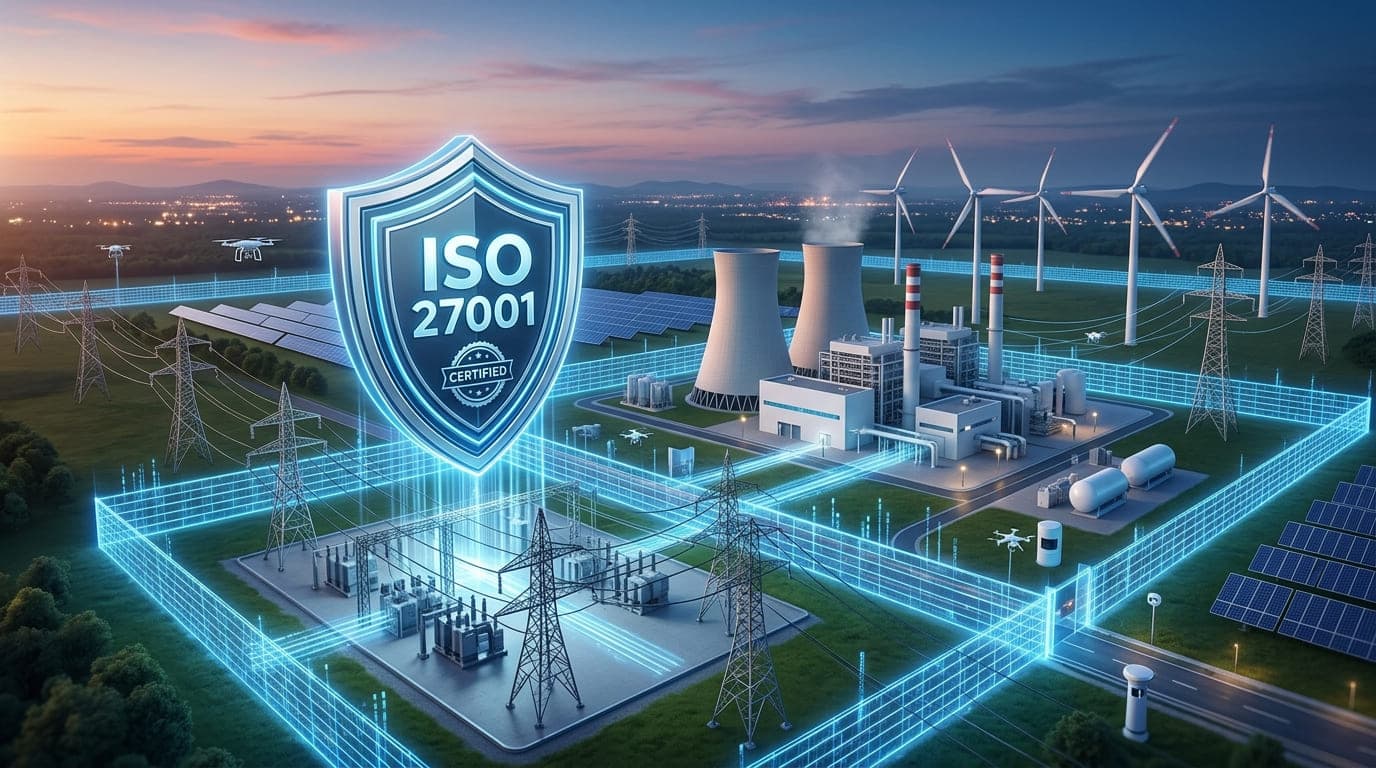
The control room went dark at 11:23 PM on December 23rd, 2015. In Ukraine, operators watched helplessly as cursors moved across their screens—controlled by someone hundreds or thousands of miles away. Within minutes, 30 substations were disconnected, plunging 230,000 people into darkness in the dead of winter.
This wasn't a movie. This was the first confirmed cyberattack to successfully take down a power grid.
I've spent the last eight years specializing in critical infrastructure security, particularly in the energy and utilities sector. That Ukrainian attack changed everything about how we approach security in this industry. It proved what many of us feared: our power grids, water systems, and natural gas networks weren't just vulnerable—they were actively being targeted by sophisticated adversaries.
If you're working in energy and utilities, ISO 27001 isn't just another compliance checkbox. It's your blueprint for defending infrastructure that entire cities depend on to survive.
Why Energy and Utilities Are Under Siege
Let me share something that keeps cybersecurity professionals in this sector awake at night: according to the Department of Homeland Security, the energy sector experiences more cyberattacks than any other critical infrastructure sector—accounting for nearly 40% of all critical infrastructure incidents.
I consulted with a regional electric utility in 2021 that was experiencing an average of 847 attempted intrusions per week. Per week. That's not a typo.
These aren't script kiddies or opportunistic criminals. We're talking about:
Nation-state actors conducting reconnaissance
Advanced persistent threat (APT) groups establishing footholds
Ransomware gangs targeting operational technology (OT)
Insider threats with physical access to critical systems
"In the energy sector, a successful cyberattack doesn't just steal data—it can literally kill people. That's why our security standards must be bulletproof."
The Unique Challenge: IT/OT Convergence
Here's what makes energy and utilities different from almost every other industry: you're not just protecting information—you're protecting physical infrastructure that was never designed with cybersecurity in mind.
I remember walking through a power generation facility in 2019. The plant manager proudly showed me their legacy SCADA system—still running Windows NT because replacing it would require a two-week shutdown costing millions in lost generation.
"We know it's vulnerable," he admitted. "But we can't just patch it like a laptop. If this system goes down unexpectedly, we could damage a $50 million turbine or destabilize the entire regional grid."
This is the reality of operational technology (OT) in energy and utilities:
IT Systems | OT Systems |
|---|---|
Prioritize confidentiality | Prioritize availability and safety |
Regular updates and patches | Updates require extensive testing and planned outages |
3-5 year replacement cycles | 20-40 year operational lifetimes |
Downtime measured in hours | Downtime measured in minutes before crisis |
Commercial off-the-shelf security tools | Specialized, often proprietary systems |
Network segmentation is standard | Legacy systems often lack basic segmentation |
ISO 27001 provides the framework to bridge this IT/OT divide, but implementation requires deep understanding of operational constraints.
Why ISO 27001 Is Perfect for Energy and Utilities
After implementing ISO 27001 across seven different utilities spanning electric, gas, and water systems, I can tell you why this framework works so well for critical infrastructure:
1. Risk-Based Approach Aligned With Operational Reality
ISO 27001 doesn't prescribe specific controls—it requires you to assess your unique risks and implement appropriate safeguards. This is crucial in energy and utilities where:
Every facility is different
Legacy systems require custom solutions
Operational constraints vary by system age and type
Regulatory requirements differ by jurisdiction
I worked with a water utility serving 2.3 million people. Their treatment plants ranged from a 1960s facility with analog controls to a 2018 plant with fully digital automation. ISO 27001's risk-based approach let us implement appropriate controls for each facility based on its actual risk profile and technical capabilities.
2. Systematic Documentation That Survives Personnel Changes
Energy and utilities face a massive knowledge transfer challenge. Experienced operators and engineers are retiring, taking decades of tribal knowledge with them.
A power generation company I advised had a critical problem: their lead SCADA engineer was retiring after 32 years. He was literally the only person who understood certain legacy system configurations.
ISO 27001's documentation requirements forced them to:
Document all critical system configurations
Create standard operating procedures for security tasks
Establish incident response protocols
Record risk assessments and mitigation strategies
When he retired eighteen months later, the transition was smooth. Everything was documented, reviewed, and approved. New engineers could reference procedures instead of relying on one person's memory.
"In critical infrastructure, institutional knowledge isn't a competitive advantage—it's a single point of failure. ISO 27001 forces you to document it before it walks out the door."
3. Regulatory Alignment and Audit Efficiency
The energy sector faces a dizzying array of regulations:
Region/Standard | Requirements | Applicability |
|---|---|---|
NERC CIP (North America) | Critical Infrastructure Protection standards | Electric utilities with bulk electric system |
NIS Directive (EU) | Network and Information Security requirements | Energy operators designated as essential services |
TSA Security Directives (US) | Pipeline and LNG facility security | Natural gas pipelines and liquefied natural gas facilities |
EPA AWIA (US) | Water system risk assessments | Public water systems serving 3,300+ people |
IEC 62443 (Global) | Industrial automation and control systems security | Manufacturing, process control, and SCADA systems |
NIST Cybersecurity Framework | Voluntary framework for critical infrastructure | All critical infrastructure sectors |
I've watched utilities struggle with multiple audits covering overlapping requirements. ISO 27001 creates a unifying framework that satisfies most of these requirements while reducing audit fatigue.
One electric utility I worked with went from spending 2,400 staff hours annually on compliance audits to 1,100 hours after implementing ISO 27001—a 54% reduction in effort while improving their actual security posture.
Real-World Implementation: A Case Study
Let me walk you through a real implementation I led at a mid-sized electric utility serving 340,000 customers across three states.
The Starting Point: Scary Reality
When I first assessed their security in late 2020, here's what I found:
No network segmentation between corporate IT and generation control systems
Shared credentials across critical SCADA systems
No logging on most operational technology systems
No incident response plan specific to OT environments
Nine different legacy control systems, oldest from 1987
Remote access to control systems with no multi-factor authentication
Their CISO looked me dead in the eye and said: "We're one sophisticated attack away from a catastrophic failure. I can't sleep. My board doesn't understand the risk. And I don't know where to start."
Sound familiar?
The 18-Month Journey
Here's how we structured their ISO 27001 implementation:
Phase 1: Risk Assessment and Scoping (Months 1-3)
We started by identifying all information assets across both IT and OT environments:
Asset Category | Examples | Critical Systems |
|---|---|---|
Generation Control | SCADA, DCS, HMI systems | 12 power plants |
Transmission/Distribution | Substation automation, smart grid | 89 substations |
Customer Systems | Billing, CRM, outage management | Corporate data center |
Corporate IT | Email, file servers, business apps | Cloud and on-premises |
Remote Assets | Weather stations, line sensors | 230+ remote sites |
We conducted a thorough risk assessment, identifying 127 unique risks across their infrastructure. The top risks included:
Remote access compromise leading to generation control
Ransomware spreading from IT to OT networks
Insider threat from contractors with substation access
Supply chain compromise through vendor maintenance access
Physical security gaps at remote unmanned facilities
Phase 2: Quick Wins and Foundation Building (Months 4-6)
We implemented immediate controls that didn't require major system changes:
✅ Network segmentation - Deployed industrial firewalls between IT and OT ✅ Multi-factor authentication - Required for all remote access ✅ Privileged access management - Eliminated shared SCADA credentials ✅ Security monitoring - Deployed OT-aware SIEM solution ✅ Incident response team - Trained 24/7 SOC on OT scenarios ✅ Vendor access controls - Implemented just-in-time access for maintenance
Within six months, we'd reduced their attack surface by an estimated 70% without touching a single legacy control system.
Phase 3: Legacy System Remediation (Months 7-12)
This was the hard part. We couldn't replace systems that would take 15+ years and hundreds of millions to upgrade. Instead, we:
Deployed unidirectional gateways for systems that needed to send data but never receive commands
Implemented application whitelisting on Windows-based SCADA servers
Created air-gapped backup systems for critical control functions
Established jump servers with strict access controls for legacy system management
Deployed passive monitoring to detect anomalies without disrupting operations
For their 1987 analog control system at their oldest plant, we couldn't add cybersecurity directly to the system. Instead, we:
Physically secured the control room with biometric access
Deployed video surveillance with 90-day retention
Implemented strict badge access logs
Required dual-person authorization for critical operations
Created manual backup procedures tested quarterly
"You can't always make old systems secure, but you can control who accesses them, monitor what they do, and detect when something's wrong."
Phase 4: Documentation and Certification (Months 13-18)
We documented everything:
Statement of Applicability - 93 of 114 ISO 27001 controls applied to their environment
Risk treatment plan - Specific mitigations for all identified high/critical risks
Operational procedures - 47 new or updated procedures for security operations
Incident response playbooks - 12 scenario-specific response plans
Business continuity plans - Recovery procedures for loss of control systems
Training materials - Role-based security training for all staff
The certification audit in month 18 took three days. We received ISO 27001 certification with zero non-conformities and only two minor observations.
The Results: Beyond Certification
The real impact went far beyond getting a certificate:
Security Improvements:
Detected and blocked 23 sophisticated intrusion attempts in the first year
Reduced mean time to detect security incidents from 18 days to 4.2 hours
Prevented ransomware spread from corporate IT to generation control (incident in month 9 post-certification)
Achieved 97.3% patch compliance for patchable systems (up from 34%)
Business Benefits:
Won $12 million contract to provide power to federal facilities (required ISO 27001)
Reduced cyber insurance premium by $430,000 annually
Decreased security audit burden by 54% (as mentioned earlier)
Improved board confidence in cybersecurity program (CISO finally sleeps)
Operational Excellence:
Zero unplanned outages due to cybersecurity incidents since implementation
Improved change management reduced configuration errors by 67%
Better vendor management decreased contractor-caused incidents by 89%
Enhanced documentation accelerated new employee onboarding
Critical ISO 27001 Controls for Energy and Utilities
Based on my experience across multiple utilities, here are the controls that matter most:
High Priority Controls
Control | Why It's Critical for Energy/Utilities | Implementation Challenge |
|---|---|---|
A.8.1 - Asset Inventory | Can't protect what you don't know exists; OT assets often undocumented | Legacy systems may lack identification tags; remote assets hard to inventory |
A.8.24 - Network Segmentation | Prevent attacks from spreading between IT and OT | Legacy systems may not support modern networking; production impact during implementation |
A.8.3 - Access Control | Limit who can control critical infrastructure | Balancing security with operational efficiency; emergency access scenarios |
A.8.16 - Monitoring and Logging | Detect attacks before they cause physical damage | OT systems often can't support logging agents; performance concerns |
A.8.23 - Web Filtering | Block command-and-control communications | OT networks may need internet access for remote monitoring |
A.8.15 - Malware Protection | Prevent ransomware and destructive attacks | Legacy systems may not support modern antivirus; false positives could disrupt operations |
A.5.7 - Threat Intelligence | Stay ahead of adversaries targeting your sector | Requires integration of IT and OT threat feeds; actionable intelligence is scarce |
A.5.24 - Incident Response | Minimize damage when attacks succeed | OT incident response requires specialized training; testing without disrupting operations |
A.5.30 - Business Continuity | Restore operations after cyberattack | Manual backup procedures for automated systems; testing without causing outages |
A.8.9 - Configuration Management | Prevent unauthorized changes to critical systems | Change windows are limited; emergency changes need special procedures |
Medium Priority But Often Overlooked
Control | Energy/Utilities Application |
|---|---|
A.5.19 - Supplier Security | Vendors often have remote access to control systems |
A.5.7 - Physical Security | Remote unmanned sites are vulnerable to tampering |
A.8.8 - User Training | Operators need specialized OT security awareness |
A.8.28 - Secure Coding | Custom SCADA interfaces must be developed securely |
A.8.10 - Information Deletion | Decommissioned systems may contain sensitive operational data |
Sector-Specific Challenges I've Encountered
Challenge 1: The "Safety vs. Security" Debate
I'll never forget a heated meeting with plant operators who resisted implementing access controls on a critical safety system.
"If there's an emergency, we need to shut this down immediately," the operations manager argued. "I'm not going to risk people's lives waiting for authentication."
He was right. Safety must come first in critical infrastructure. But security and safety aren't opposing forces—they're complementary.
We solved it by:
Implementing emergency override procedures with physical keys in break-glass boxes
Creating role-based access that gave operators necessary permissions
Adding secondary verification for non-emergency changes
Deploying tamper-evident logging for emergency access use
The key lesson: ISO 27001 must be adapted to respect operational safety requirements, not override them.
Challenge 2: The 24/7/365 Operation Reality
Unlike most industries, energy and utilities can't schedule maintenance windows easily. I worked with a natural gas pipeline operator who hadn't restarted their primary control server in 11 years because they couldn't risk the downtime.
ISO 27001 requires regular updates and patches. How do you reconcile this?
Our approach:
Prioritized patching - Only critical security patches for operational systems
Extensive testing - Lab environment mirroring production for patch validation
Redundancy-based patching - Patch redundant systems during planned equipment maintenance
Compensating controls - Network segmentation and monitoring when patching isn't feasible
Virtual patching - IPS/IDS rules to block exploits when system patching is impossible
"In critical infrastructure, uptime isn't negotiable. Your security program must work within that constraint, not against it."
Challenge 3: The Insider Threat Multiplier
Energy and utilities have a unique insider threat profile:
Long-term employees with deep system knowledge
Contractors with rotating staff but persistent access
Maintenance vendors with administrative credentials
Foreign vendors servicing international equipment
Disgruntled employees with physical access to critical facilities
I investigated an incident where a contractor, angry about a pay dispute, planted malware on a water treatment plant's SCADA system. He'd been given administrative access because "he's been working here for ten years."
ISO 27001's access control requirements force you to:
Implement least privilege access - even for long-term contractors
Enable activity monitoring - especially for privileged users
Require background checks - for all personnel with critical access
Enforce segregation of duties - no single person can sabotage operations
Mandate exit procedures - access revocation the moment employment ends
Challenge 4: Supply Chain Security in Global Equipment
Modern energy infrastructure relies on equipment from global suppliers. I've seen:
Chinese-manufactured smart meters with undocumented remote access
Eastern European turbine control systems with embedded backdoors
Networking equipment with firmware of questionable origin
Software updates delivered over unsecured channels
ISO 27001's supplier security controls (A.5.19-5.23) are absolutely critical:
Supply Chain Risk | ISO 27001 Control | Practical Implementation |
|---|---|---|
Compromised hardware/software | Supplier security requirements | Require security attestations, code escrow, source code review rights |
Unauthorized access via vendor | Third-party access management | Just-in-time access, monitored sessions, no persistent credentials |
Malicious updates | Change control and integrity checking | Digital signature verification, staged rollout, rollback procedures |
Vendor dependency | Supply chain continuity | Multiple suppliers, escrow agreements, in-house expertise development |
Nation-state supply chain attacks | Supplier risk assessment | Country-of-origin analysis, diverse supplier base, air-gapped critical systems |
Building Your ISO 27001 Program: Practical Steps
Based on implementations across electric, gas, water, and renewable energy systems, here's my recommended approach:
Month 1-2: Discovery and Scoping
Week 1-2: Asset Identification
✓ Map all IT systems (servers, networks, applications)
✓ Inventory OT systems (SCADA, DCS, PLCs, RTUs)
✓ Document physical sites (plants, substations, remote facilities)
✓ Identify data flows between IT and OT
✓ Catalog third-party connections and remote access points
Week 3-4: Risk Assessment Preparation
✓ Form cross-functional team (IT, OT, operations, safety, legal)
✓ Define risk assessment methodology
✓ Identify critical assets and processes
✓ Understand regulatory requirements (NERC CIP, NIS, TSA, etc.)
✓ Review historical incidents and near-misses
Month 3-6: Risk Assessment and Gap Analysis
Conduct thorough risk assessment covering:
Risk Category | Assessment Areas |
|---|---|
External Threats | Nation-state actors, ransomware, hacktivists, terrorists |
Internal Threats | Malicious insiders, negligent employees, contractor risks |
Technical Vulnerabilities | Unpatched systems, misconfigurations, weak authentication |
Physical Security | Site access, equipment tampering, social engineering |
Supply Chain | Vendor access, equipment backdoors, update mechanisms |
Natural Disasters | Flood, earthquake, fire impacts on critical systems |
Perform gap analysis against ISO 27001 requirements and identify which controls are:
✅ Already implemented and effective
⚠️ Partially implemented or need improvement
❌ Not implemented and required
N/A - Not applicable to your environment
Month 7-12: Implementation Phase 1 (Quick Wins)
Focus on high-impact, low-disruption controls:
Network Security (2-3 months)
Deploy industrial firewalls between IT/OT zones
Implement network segmentation per IEC 62443 guidelines
Enable network monitoring and anomaly detection
Restrict outbound connections from OT networks
Access Control (1-2 months)
Eliminate shared credentials across critical systems
Implement multi-factor authentication for remote access
Deploy privileged access management solution
Create role-based access model aligned with operational needs
Monitoring and Detection (2-3 months)
Deploy SIEM with OT protocol support
Enable logging on all capable systems
Create detection rules for OT-specific attacks
Establish 24/7 security operations capability
Month 13-18: Implementation Phase 2 (Complex Controls)
Address challenges requiring planning and testing:
Legacy System Security (3-4 months)
Deploy compensating controls for unpatchable systems
Implement application whitelisting
Create isolated networks for legacy systems
Establish jump server architecture for maintenance access
Incident Response (2-3 months)
Develop OT-specific incident response playbooks
Conduct tabletop exercises with operational staff
Create communication templates for stakeholders
Establish relationships with industrial control system forensics experts
Test backup and recovery procedures
Supply Chain Security (2-3 months)
Assess all critical vendors
Implement vendor access management platform
Require security attestations from suppliers
Establish secure update delivery mechanisms
Month 19-24: Documentation and Certification
Documentation Phase (3-4 months)
Complete Information Security Management System (ISMS) documentation
Develop Statement of Applicability (SOA)
Create evidence repository for all implemented controls
Document risk treatment decisions
Finalize policies, procedures, and work instructions
Pre-Certification Activities (1-2 months)
Conduct internal audit
Perform management review
Address any non-conformities
Select certification body
Schedule certification audit
Certification Audit (1 month)
Stage 1: Documentation review
Stage 2: On-site assessment
Address any findings
Receive certification (if successful)
Common Pitfalls (And How to Avoid Them)
Pitfall 1: Treating ISO 27001 as an IT Project
The Mistake: I've seen utilities assign ISO 27001 implementation solely to their IT department, completely excluding operations, engineering, and safety teams.
Why It Fails: OT security requires operational expertise. IT teams don't understand the physical consequences of security controls, leading to dangerous misconfigurations.
The Fix: Create a cross-functional steering committee with representatives from:
IT Security
OT/SCADA Engineering
Plant Operations
Safety Department
Legal/Compliance
Executive Leadership
Pitfall 2: One-Size-Fits-All Controls
The Mistake: Applying the same security controls to a 2023 smart grid system and a 1978 analog control system.
Why It Fails: Legacy systems can't support modern security tools. Forcing implementation can cause operational failures.
The Fix: Use ISO 27001's risk-based approach to implement appropriate controls for each system's capability level. Document compensating controls for systems that can't support standard protections.
Pitfall 3: Neglecting Physical Security
The Mistake: Focusing exclusively on cyber controls while ignoring physical access to critical systems.
Why It Fails: An attacker with physical access can bypass virtually any cybersecurity control. In critical infrastructure, physical and cyber security are inseparable.
The Fix: Integrate ISO 27001's physical security controls (A.7) with your existing facility security program. Pay special attention to:
Remote unmanned sites
Substation access points
Control room security
Equipment disposal procedures
Pitfall 4: Certification as the End Goal
The Mistake: Treating certification as a finish line, then letting controls degrade.
Why It Fails: ISO 27001 requires continuous improvement. Certification is the beginning, not the end.
The Fix: Build maintenance into operations:
Quarterly risk reviews
Annual internal audits
Regular management reviews
Continuous monitoring and improvement
Staff training and awareness programs
"ISO 27001 certification proves you built a security program. Your surveillance audits prove you're actually running it."
The Future: Emerging Threats and ISO 27001 Evolution
The energy sector is evolving rapidly, and so are the threats:
Renewable Energy Integration
As I work with more solar and wind operators, I'm seeing new attack surfaces:
Thousands of distributed solar inverters with weak security
Wind turbine control systems accessible via cellular networks
Energy storage systems with internet-connected management
Virtual power plants coordinating millions of distributed resources
ISO 27001's risk-based approach adapts well, but requires new thinking about:
Securing geographically dispersed assets
Managing firmware updates across thousands of devices
Protecting cloud-based coordination platforms
Ensuring grid stability despite potential compromises
AI and Machine Learning in Grid Operations
Utilities are deploying AI for:
Predictive maintenance
Load forecasting
Automated grid optimization
Anomaly detection
But AI introduces risks:
Training data poisoning
Model inversion attacks
Adversarial inputs causing incorrect decisions
Autonomous systems making safety-critical decisions
ISO 27001 will need to address:
AI/ML system security requirements
Algorithm transparency and auditability
Fallback procedures when AI fails
Adversarial robustness testing
Quantum Computing Threats
Within 10-15 years, quantum computers may break current encryption. For energy infrastructure with 30-40 year operational lifetimes, this is a today problem.
I'm advising utilities to:
Inventory all cryptographic implementations
Prioritize long-term data protection
Plan migration to quantum-resistant algorithms
Build cryptographic agility into new systems
Your Action Plan: Getting Started Today
Whether you're a CISO at a major utility or a security manager at a municipal water system, here's what you should do this week:
Day 1: Assessment
[ ] List all your critical operational systems
[ ] Identify which contain legacy technology
[ ] Document current security controls (or lack thereof)
[ ] Review recent security incidents and near-misses
Day 2: Stakeholder Alignment
[ ] Schedule meeting with operations leadership
[ ] Discuss safety vs. security concerns
[ ] Identify operational constraints for security implementation
[ ] Secure executive sponsorship for security program
Day 3: Regulatory Review
[ ] Identify all applicable regulations (NERC CIP, NIS, TSA, etc.)
[ ] Review recent enforcement actions in your sector
[ ] Assess current compliance gaps
[ ] Determine if ISO 27001 can unify compliance efforts
Day 4: Resource Planning
[ ] Estimate budget for ISO 27001 implementation
[ ] Identify internal resources and skill gaps
[ ] Research consultants with energy/utilities experience
[ ] Explore certification body options
Day 5: Quick Win Identification
[ ] List security improvements requiring no operational changes
[ ] Prioritize by risk reduction vs. implementation effort
[ ] Create 30-60-90 day action plan
[ ] Schedule follow-up with stakeholders
Final Thoughts: Why This Matters
I started this article with the Ukrainian power grid attack. Let me end with a different story.
In 2020, I worked with a small municipal electric utility—just 42,000 customers in a rural area. Their security budget was modest. Their systems were aging. They felt like cybersecurity was a problem for "big utilities."
Then they detected an intrusion. Someone had gained access to their billing system and was attempting to pivot to their distribution management system. Because they'd implemented basic ISO 27001 controls—network segmentation, monitoring, incident response—they detected and stopped the attack before it reached operational systems.
The CEO called me afterward. "We're a town of 35,000 people," he said. "Why would anyone target us?"
I told him what I'll tell you: In cybersecurity, there's no such thing as too small to target. Critical infrastructure is critical infrastructure, regardless of size.
ISO 27001 gives you a fighting chance. It won't make you invincible, but it will:
Help you understand your risks
Implement appropriate protections
Detect attacks before they succeed
Respond effectively when prevention fails
Recover quickly and improve continuously
The lights stayed on in that small town. The water kept flowing. Life continued normally.
That's the goal: invisible security that lets civilization function without interruption.
Because when energy and utilities security fails, it's not data that's lost—it's lives that are at risk.
Get certified. Stay vigilant. Keep the lights on.
Need help implementing ISO 27001 in your energy or utility organization? PentesterWorld specializes in critical infrastructure security. Contact us for a free assessment of your current security posture and a customized implementation roadmap.