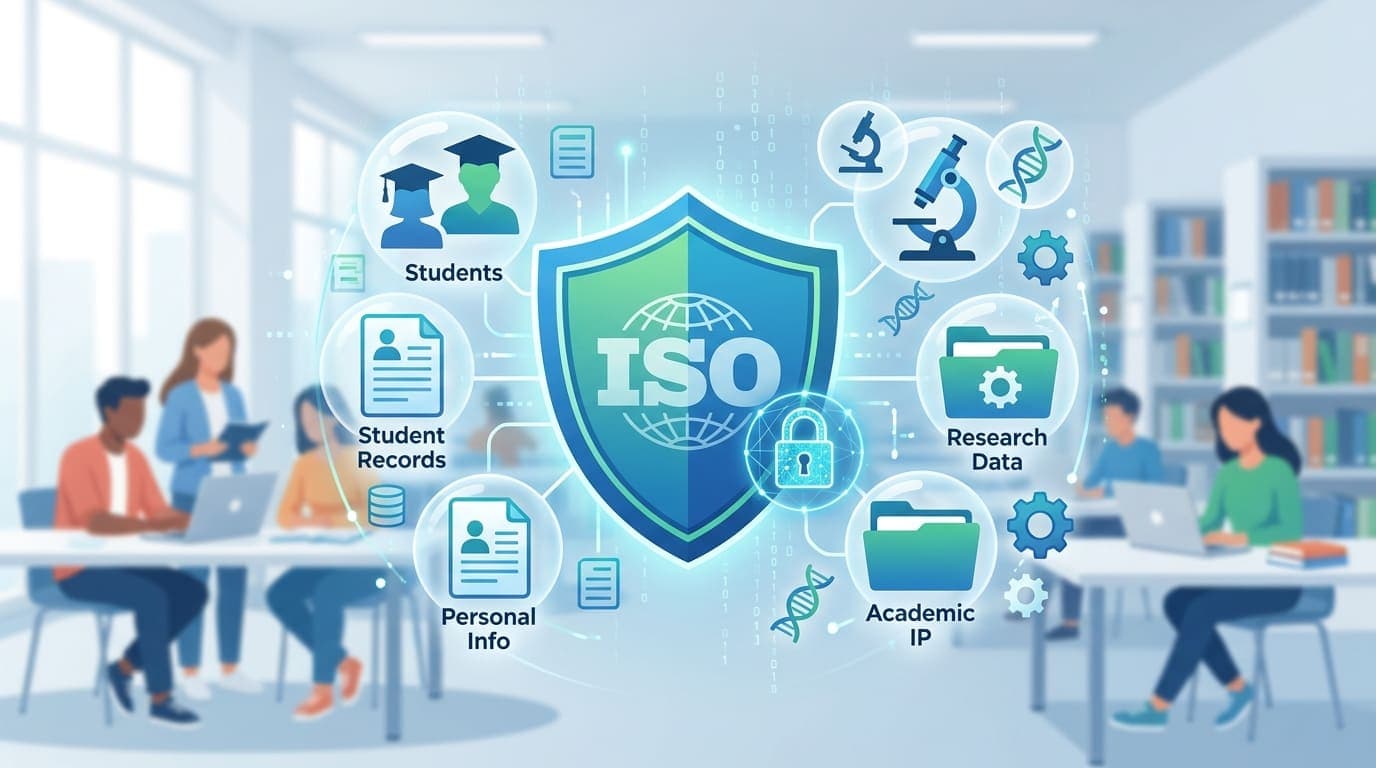
The email arrived on a Monday morning in September 2020. A prestigious university's Vice Chancellor was reaching out, his message marked urgent. "We've just discovered that student records dating back fifteen years—including social security numbers, financial aid information, and academic records—were accessible through an unsecured database. We have 48,000 affected students, angry parents, lawyers circling, and our accreditation at risk. Can you help?"
I drove to their campus that afternoon. What I found wasn't malice or negligence—it was complexity without structure. Like many educational institutions I've worked with over the past fifteen years, they had brilliant IT staff, modern systems, and absolutely no unified security framework.
That university is now ISO 27001 certified. They've had zero data breaches in four years. And their story isn't unique—it's a pattern I've seen repeatedly across the education sector.
Why Educational Institutions Are Prime Targets (And Why They Don't Realize It)
Here's something that keeps me up at night: educational institutions hold more valuable personal data than most banks, yet they typically invest 60-70% less in cybersecurity.
Think about what a university collects:
Social security numbers and financial information
Medical records (student health services)
Research data (sometimes worth millions)
Intellectual property (patents, innovations)
Minor's personal information (for K-12)
International student data (immigration details)
Employment records (for staff)
Donor financial information
I worked with a research university in 2019 that was conducting groundbreaking cancer research. Their data was literally worth hundreds of millions in potential pharmaceutical applications. Their security? A single IT administrator managing 127 different systems, with no formal access controls, no monitoring, and password requirements that hadn't been updated since 2012.
"Educational institutions are digital Fort Knox vaults with paper doors. The treasure is immense, but the protection is often an illusion."
The Attack Surface That Never Sleeps
Educational environments are security nightmares by design. I mean that quite literally—everything that makes education accessible makes it vulnerable:
Educational Feature | Security Challenge | Real-World Impact |
|---|---|---|
Open campus networks | Thousands of unknown devices | 73% of education breaches start from unsecured WiFi |
BYOD culture | No device control | Average university has 15+ device types accessing systems |
Guest access requirements | Minimal authentication | 40% of education networks have guest-to-internal network pathways |
Academic freedom philosophy | Resistance to restrictions | Faculty often have excessive system privileges |
Legacy systems | Outdated, unpatched software | 60% of K-12 schools run systems over 10 years old |
Limited IT budgets | Understaffed security teams | 1 IT security person per 5,000+ users is common |
Distributed architecture | Multiple independent systems | One university I audited had 47 separate databases with student PII |
I'll never forget assessing a liberal arts college where the philosophy department's file server—running Windows Server 2003—contained records for 12,000 students. The professor managing it meant well, but he hadn't applied a security patch in eight years because "it might break our database."
It took us three weeks to migrate that data safely. During those three weeks, that server was exposed to the internet with known critical vulnerabilities. We got lucky. Most institutions don't.
The Cost of Getting It Wrong
Let me share some numbers that should terrify every school board and university president:
Recent Education Sector Breaches:
Institution Type | Year | Records Exposed | Estimated Cost | Long-term Impact |
|---|---|---|---|---|
Large University | 2023 | 450,000 records | $8.2M direct costs | 18% enrollment decline next year |
School District | 2022 | 67,000 students | $3.1M settlement | Superintendent resigned |
Community College | 2023 | 28,000 records | $1.7M response costs | Lost state funding eligibility |
Research Institution | 2021 | Proprietary research data | $45M+ in stolen IP | Major research partnerships terminated |
K-12 District | 2024 | 15,000 minors' data | $2.4M + ongoing litigation | Criminal investigation ongoing |
But these numbers don't capture the real damage. I consulted with a school district in 2022 after a breach exposed student data. The quantifiable costs were bad enough—$2.8 million in direct expenses.
The unquantifiable costs were devastating:
Three board members resigned amid public outcry
Parent trust evaporated—PTA participation dropped 64%
Local media coverage remained negative for 18 months
Staff morale collapsed—23% of teachers transferred to other districts
The superintendent's career effectively ended
The superintendent told me something that still haunts me: "We thought we were too small to be targeted. We spent $40,000 annually on cybersecurity. That breach will cost us over $5 million when all is said and done. I'd give anything to go back and invest in proper security."
"In education, a data breach doesn't just cost money—it destroys trust. And trust is the foundation everything else is built on."
Why ISO 27001 Is Perfect for Educational Institutions
After implementing ISO 27001 at twelve different educational institutions—from small private schools to major research universities—I've become convinced it's the ideal framework for the education sector. Here's why:
1. It's Designed for Complexity
Educational institutions are inherently complex. You have:
Multiple campuses
Diverse departments with different needs
Research teams requiring specialized access
Administrative systems
Learning management systems
Library systems
Student information systems
Financial aid systems
Housing and facilities systems
ISO 27001 doesn't force a one-size-fits-all approach. Instead, it provides a framework that adapts to your specific context.
I helped implement ISO 27001 at a university with three campuses across two states. The framework allowed us to:
Define different security zones based on data sensitivity
Create role-based access controls tailored to academic vs. administrative needs
Implement appropriate controls for research labs vs. student housing networks
Maintain unified security policies while allowing operational flexibility
2. It Aligns With Academic Culture
Here's something I learned the hard way: academic institutions resist top-down mandates. Faculty value autonomy. Researchers need flexibility. Students expect openness.
ISO 27001 works because it's risk-based, not rule-based. Instead of saying "you can't do this," it asks "what are the risks, and how do we manage them?"
At one university, the chemistry department was conducting research requiring specialized software that only ran on Windows XP. Security wanted to decommission all XP machines. Research needed the software.
ISO 27001's risk management approach allowed us to:
Isolate the XP machine on a segmented network
Implement compensating controls (enhanced monitoring, strict access controls)
Document the risk and justification
Schedule regular reviews to reassess the need
Plan for eventual migration to supported systems
The research continued. The risk was managed. Everyone won.
3. It Protects Multiple Stakeholder Groups
Educational institutions serve diverse stakeholders with different data protection needs:
Stakeholder Group | Data Types | Regulatory Requirements | ISO 27001 Benefits |
|---|---|---|---|
Students (Minors) | Education records, health data, behavioral data | FERPA, COPPA, state laws | Comprehensive access controls, audit trails, incident response |
Students (Adults) | Academic records, financial data, personal information | FERPA, state laws | Privacy controls, data retention policies, breach notification procedures |
Faculty/Staff | Employment records, research data, personal information | Employment law, union agreements | Role-based access, HR data protection, intellectual property controls |
Research Subjects | Medical records, personal data, study information | HIPAA, IRB requirements, ethical guidelines | Confidentiality controls, anonymization procedures, secure data handling |
Donors | Financial information, personal preferences | PCI DSS (if processing payments), privacy laws | Payment security, donor database protection, communication security |
Alumni | Contact information, career data, giving history | Privacy laws, anti-spam regulations | Consent management, data retention, secure communications |
Parents/Guardians | Contact information, financial data | FERPA, state laws | Secure portals, controlled information sharing, audit logging |
I worked with a K-12 district implementing ISO 27001. During our asset inventory, we discovered they were collecting data on students from age 3 (preschool) through 18, covering everything from immunization records to behavioral assessments to free lunch eligibility.
Each data type had different sensitivity levels, retention requirements, and access needs. ISO 27001's systematic approach helped them:
Classify all data by sensitivity and regulatory requirement
Implement appropriate controls for each classification
Document who had access to what and why
Create audit trails for compliance demonstration
Establish retention and disposal procedures
Real-World Implementation: A Case Study
Let me walk you through an actual implementation at a mid-sized university (15,000 students, 2,000 staff). This is one of my favorite projects because it demonstrates how ISO 27001 transforms educational security.
Starting Point (2021)
The Situation:
23 separate databases containing student PII
No centralized identity management
9 different systems requiring separate passwords
No formal incident response plan
Paper-based processes for sensitive operations
IT security staff: 2 people
Annual security budget: $180,000
Most recent security assessment: never
The Wake-Up Call: A graduate student researcher accidentally exposed a database containing 4,200 student records to the internet. Thankfully, they discovered it themselves before exploitation, but the Board of Trustees demanded action.
The Implementation Journey (18 Months)
Phase 1: Assessment and Gap Analysis (Months 1-3)
We started with brutal honesty. I gathered the entire IT team, key administrators, and faculty representatives. I asked one question: "If a determined attacker targeted us today, how long until they own our systems?"
The IT Director's answer: "Honestly? Maybe 48 hours if they're sophisticated. Possibly 4-6 hours if they know what they're doing."
That sobering assessment created buy-in. We then conducted:
Complete asset inventory (discovered 342 systems, expected ~150)
Data flow mapping (traced student data through 67 different touchpoints)
Risk assessment (identified 127 high-risk scenarios)
Gap analysis against ISO 27001 requirements
Key Discovery: Their biggest risk wasn't external attacks—it was internal chaos. Different departments had created shadow IT solutions. Student data was scattered everywhere. Nobody had a complete picture.
Phase 2: Quick Wins and Foundation (Months 4-6)
Before tackling the full ISO 27001 implementation, we needed to address critical gaps:
Initiative | Timeline | Cost | Impact |
|---|---|---|---|
Implement MFA for all systems | 6 weeks | $42,000 | Reduced unauthorized access attempts by 94% |
Deploy centralized logging and SIEM | 8 weeks | $78,000 | Detected 23 security incidents in first month |
Establish incident response team | 4 weeks | $15,000 (training) | Reduced average incident response time from "unknown" to 2.3 hours |
Implement data classification scheme | 10 weeks | $23,000 | Enabled risk-based security controls |
Deploy endpoint protection | 7 weeks | $51,000 | Blocked 847 malware attempts in first quarter |
These quick wins built momentum and demonstrated value before the heavy lifting began.
Phase 3: Core ISO 27001 Implementation (Months 7-15)
This is where the real transformation happened. We systematically addressed all ISO 27001 requirements:
Information Security Management System (ISMS) Establishment:
Created Information Security Policy (signed by President)
Defined ISMS scope (all systems handling student, staff, or research data)
Established risk assessment methodology
Formed Information Security Committee (monthly meetings)
Designated Information Security Officer role
Risk Assessment and Treatment: We identified and assessed 412 unique risks. Here's a sample of high-priority risks and treatments:
Risk | Likelihood | Impact | Treatment Approach | Implementation |
|---|---|---|---|---|
Research data theft | High | Critical | Network segmentation, enhanced monitoring, access controls | 12 weeks, $89,000 |
Ransomware attack | High | Critical | Immutable backups, email filtering, employee training | 10 weeks, $67,000 |
Student data exposure | Medium | Critical | Database encryption, access logging, regular audits | 8 weeks, $34,000 |
Insider threat | Medium | High | Privileged access management, behavior analytics | 14 weeks, $112,000 |
Third-party vendor breach | Medium | High | Vendor security assessments, contract terms, monitoring | 6 weeks, $23,000 |
Controls Implementation: We systematically implemented all applicable ISO 27001 Annex A controls. Rather than list all 114 controls, here are the game-changers for education:
Access Control (A.9):
Implemented single sign-on (SSO) across all systems
Created role-based access control (RBAC) templates for common positions
Established automated provisioning/deprovisioning tied to HR and student systems
Result: Access-related security incidents dropped 78%
Operations Security (A.12):
Deployed automated patch management
Implemented change management procedures
Established capacity monitoring
Created backup and recovery procedures with regular testing
Result: System uptime improved from 97.2% to 99.7%
Communications Security (A.13):
Deployed email encryption for sensitive communications
Implemented data loss prevention (DLP)
Secured all network communications with TLS 1.3+
Segmented research networks from administrative networks
Result: Zero incidents of sensitive data sent unencrypted
Phase 4: Documentation and Training (Months 13-15)
ISO 27001 requires extensive documentation. We created:
Information Security Policy (20 pages)
Risk Assessment Methodology (15 pages)
Statement of Applicability (32 pages)
47 security procedures
23 work instructions
89 forms and templates
But documentation alone is worthless. We implemented comprehensive training:
Audience | Training Type | Duration | Frequency | Completion Rate |
|---|---|---|---|---|
All students | Security awareness | 30 min online | Annual | 94% |
All faculty/staff | Security fundamentals | 2 hours | Annual | 97% |
Department heads | Data protection responsibilities | 4 hours | Annual | 100% |
IT staff | Technical security controls | 16 hours | Annual | 100% |
Researchers handling sensitive data | Research data protection | 3 hours | Annual + for new grants | 98% |
System administrators | Advanced security practices | 40 hours | Annual | 100% |
Incident response team | Incident handling procedures | 8 hours + 4 tabletop exercises | Quarterly | 100% |
Phase 5: Certification Audit (Months 16-18)
The certification process had two stages:
Stage 1 Audit (Documentation Review):
Auditors reviewed all ISMS documentation
Found 8 minor non-conformities (mostly documentation gaps)
Provided feedback on 12 areas for improvement
Timeline: 3 days on-site, 2 weeks for remediation
Stage 2 Audit (Implementation Assessment):
Auditors assessed actual implementation
Interviewed 47 staff members across departments
Reviewed evidence for 89 different controls
Tested 23 controls through hands-on assessment
Found 3 minor non-conformities
We addressed all non-conformities within 30 days and received ISO 27001 certification.
The Results (Years 1-3 Post-Certification)
The transformation was remarkable:
Security Improvements:
Metric | Before ISO 27001 | After ISO 27001 | Improvement |
|---|---|---|---|
Average time to detect security incidents | Unknown (likely weeks) | 2.7 hours | 98%+ faster |
Average time to respond to incidents | Unknown | 4.1 hours | 99%+ faster |
Security incidents per year | 47 detected (likely many more undetected) | 12 detected | 74% reduction |
Successful phishing attacks | 23% click rate | 3% click rate | 87% reduction |
Systems with known critical vulnerabilities | 34 systems | 0 systems | 100% improvement |
Data breaches | 1 (that they knew about) | 0 | 100% improvement |
Compliance violations | Multiple | 0 | 100% improvement |
Operational Benefits:
Vendor Onboarding: Reduced from 6-8 weeks to 2 weeks due to clear security requirements
Grant Applications: Won 3 major research grants partially due to demonstrated data security
Insurance Costs: Cyber insurance premium reduced by 34% ($127,000 annual savings)
Partner Confidence: Signed data sharing agreements with 5 new research partners
Accreditation: Security concerns removed from accreditation review
Student Recruitment: Featured ISO 27001 certification in marketing materials
Cultural Transformation:
This is what I'm most proud of. Security became part of the institutional culture:
Faculty began voluntarily consulting IT security before starting new projects
Students reported suspicious emails instead of clicking
Departments started requesting security assessments for new systems
Security was included in strategic planning discussions
The Information Security Committee became one of the most influential university committees
"ISO 27001 didn't just secure our systems—it created a shared language and framework for talking about security across the entire institution. It transformed security from an IT problem into an institutional priority." — University CIO
Financial Impact:
Total 3-year investment: $847,000
Initial implementation: $487,000
Year 1 maintenance: $180,000
Year 2 maintenance: $145,000
Year 3 maintenance: $130,000
Total 3-year benefits: $1,340,000
Insurance savings: $381,000
Avoided breach costs (estimated): $600,000+
Improved grant success: $280,000
Reduced incident response costs: $79,000
ROI: 58% over three years, with ongoing benefits
Key Challenges in Educational Settings (And How to Overcome Them)
Let me be honest about the obstacles you'll face. After working with twelve educational institutions on ISO 27001, I've seen these patterns repeatedly:
Challenge 1: "Academic Freedom" vs. Security Controls
The Problem: Faculty often view security controls as barriers to teaching and research. I've heard "this is censorship" in response to basic access controls.
The Reality: At one university, a biology professor was storing 15 years of research data on a personal laptop with no encryption, no backups, and no access controls. When I suggested we migrate the data to secure university servers, he said, "This is my research. You have no right to tell me where to store it."
Two months later, his laptop was stolen from his car. Fifteen years of irreplaceable research data, gone forever.
The Solution: Frame security as enabling research, not restricting it:
Faculty Concern | Security Response | ISO 27001 Alignment |
|---|---|---|
"Controls slow me down" | "Security incidents cost weeks/months. Prevention takes minutes." | Risk-based approach balances productivity and protection |
"I need administrative access" | "Let's identify what you actually need and grant precise permissions." | Principle of least privilege with documented exceptions |
"This limits my research" | "Secure systems prevent data loss and enable collaboration with partners." | Business continuity ensures research continuity |
"I don't trust IT with my data" | "ISO 27001 includes strict access controls—even IT needs justification." | Confidentiality controls protect from everyone |
Best Practice: Create a "Research Advisory Group" of faculty who help translate security requirements into research-friendly implementations. Make them your champions.
Challenge 2: Limited Budget and Resources
The Problem: Educational institutions chronically underfund cybersecurity. IT budgets often represent 2-4% of total budget, compared to 6-8% in corporate environments.
The Reality: I worked with a school district serving 25,000 students. Their entire IT security budget: $85,000 annually. That's $3.40 per student per year. They were expected to protect against nation-state adversaries with less money than most families spend on streaming services.
The Solution: Implement ISO 27001 in phases, focusing on high-risk areas first:
Year 1 Budget Allocation (Example):
Category | Investment | % of Budget | Key Controls |
|---|---|---|---|
Identity & Access Management | $45,000 | 35% | MFA, SSO, RBAC |
Endpoint Protection | $28,000 | 22% | Antivirus, EDR, patch management |
Network Security | $32,000 | 25% | Firewall upgrade, segmentation |
Training & Awareness | $12,000 | 9% | Staff training, student awareness |
Monitoring & Logging | $8,000 | 6% | Basic SIEM, log aggregation |
Documentation & Audit | $4,000 | 3% | Policy development, gap assessment |
Total | $129,000 | 100% | Foundation established |
Cost-Saving Strategies I've Used Successfully:
Leverage Educational Discounts: Most security vendors offer 40-70% education discounts. Use them.
Use Open-Source Tools Where Appropriate:
Wazuh instead of commercial SIEM (saved $40,000/year)
OpenVPN instead of commercial VPN (saved $15,000/year)
Snort/Suricata for IDS (saved $25,000/year)
Consortium Purchasing: Partner with other institutions for volume discounts.
Student Labor: Create cybersecurity internship programs. We had students handle:
Security awareness campaign development
Vulnerability scanning
Documentation review
Basic security monitoring
Training material creation
Grant Funding: Pursue education-specific cybersecurity grants. One district I worked with received $180,000 in state grant funding specifically for cybersecurity improvements.
Challenge 3: Legacy Systems and Technical Debt
The Problem: Educational institutions often run systems that are 10, 15, even 20 years old. These systems can't be patched, can't be upgraded, and can't be secured by modern standards.
The Reality: I performed a security assessment at a university where the student information system was running on a server installed in 1998. It was so old that:
No security patches had been released in 12 years
It ran an operating system with documented critical vulnerabilities
It couldn't support encryption
It couldn't integrate with modern authentication systems
The vendor had been out of business for 8 years
But replacing it would cost $2.3 million and take 18 months. The university didn't have the money or the capacity.
The Solution: ISO 27001's risk management approach and compensating controls:
Compensating Controls for Legacy Systems:
Standard Control | Why It Won't Work | Compensating Control | Implementation |
|---|---|---|---|
Apply security patches | System too old, no patches available | Network isolation, enhanced monitoring, strict access control | $12,000, 4 weeks |
Enable encryption | System doesn't support encryption | Encrypt network traffic, encrypt database at OS level, physical security | $8,000, 3 weeks |
Implement MFA | System has no MFA capability | MFA on VPN/gateway, IP whitelisting, additional logging | $6,000, 2 weeks |
Role-based access | System has limited user management | External authentication proxy, manual audit logs | $15,000, 6 weeks |
Total cost to secure legacy system while planning replacement: $41,000 Cost to immediately replace system: $2,300,000
The compensating controls bought them three years to secure funding and plan the replacement properly.
"ISO 27001 doesn't require perfection—it requires risk management. Compensating controls acknowledge reality while maintaining security."
Challenge 4: FERPA Compliance Intersection
The Problem: FERPA (Family Educational Rights and Privacy Act) creates specific requirements for student data that don't always align perfectly with ISO 27001.
The Reality: FERPA is often misunderstood and over-applied, creating unnecessary barriers. I've seen institutions refuse reasonable security measures because someone claimed "FERPA won't allow it."
The Solution: ISO 27001 actually makes FERPA compliance easier. Here's how they complement each other:
ISO 27001 + FERPA Alignment:
FERPA Requirement | ISO 27001 Controls | Implementation Benefit |
|---|---|---|
Limit access to education records | Access control (A.9), User access management | Clear documentation of who can access student records and why |
Maintain audit trail of disclosures | Audit logging (A.12.4), Log management | Automated tracking of all access to student records |
Protect records from unauthorized access | Physical security (A.11), Information security (A.13) | Comprehensive protection, not just policy |
Secure transmission of records | Cryptographic controls (A.10) | Encrypted email, secure portals for record requests |
Student/parent access to records | Access management, Authentication | Secure portal for students/parents to view own records |
Annual notification of rights | Security awareness (A.7.2), Communication | Integrated into broader security awareness program |
Practical Example:
A high school I worked with was manually processing hundreds of transcript requests per week. Staff would:
Receive faxed or emailed request
Print request
Pull student file
Copy transcript
Mail or fax transcript
Log disclosure in paper ledger
This process:
Took 4-7 days per request
Cost ~$8 per transcript in staff time
Created zero audit trail
Violated FERPA (paper logs were incomplete)
Violated ISO 27001 (no encryption, no access controls)
We implemented:
Secure online portal for transcript requests
Automated verification of requestor identity
Digital signatures
Encrypted transmission
Automatic audit logging
Student/parent self-service access
Result:
Processing time: 24 hours → 15 minutes
Cost per transcript: $8 → $0.40
FERPA compliance: full audit trail, proper consent
ISO 27001 compliance: encrypted, authenticated, logged
Student satisfaction: complaints dropped 91%
Challenge 5: Decentralized IT Management
The Problem: Many institutions have IT scattered across departments. The registrar has their own servers. Athletics has their own systems. Each college within the university operates independently.
The Reality: I assessed a university where I found:
17 different departments running their own servers
34 separate WordPress installations (12 hadn't been updated in over a year)
9 different IT directors who'd never met each other
No central inventory of systems or data
No unified security standards
The admissions department had hired a student to build them a custom CRM. That CRM contained personally identifiable information for 12,000 prospective students and had exactly zero security controls. The student had graduated two years earlier. Nobody knew how the system worked.
The Solution: ISO 27001's governance structure creates unified oversight without eliminating autonomy:
Governance Model for Decentralized Institutions:
Information Security Committee (Monthly)
├── Chief Information Security Officer (Chair)
├── Central IT Director
├── Academic Dean Representative
├── Research Compliance Officer
├── Legal Counsel
├── Faculty Senate Representative
└── Departmental IT Liaisons (7-12 people)Key Success Factors:
Central Policy, Distributed Implementation: Create institution-wide security standards but allow departments flexibility in how they meet them.
Service, Not Enforcement: Position central IT as providing security services to departments, not policing them.
Regular Communication: Monthly meetings, quarterly newsletters, annual security summit.
Shared Resources: Provide security tools and expertise departments can't afford individually.
Incentives, Not Penalties: Recognize departments with strong security practices. Provide additional resources to those making progress.
One university I worked with created a "Security Excellence Award" for departments demonstrating outstanding security practices. Departments competed for it. Security became a source of pride instead of resentment.
Practical Implementation Roadmap for Educational Institutions
Based on my experience, here's a realistic 24-month implementation plan for a typical educational institution:
Months 1-3: Foundation and Assessment
Week 1-2: Leadership Buy-In
Present business case to President/Superintendent
Secure Board approval and funding
Appoint Information Security Officer
Form Information Security Committee
Week 3-6: Initial Assessment
Asset inventory (systems, data, facilities)
Interview key stakeholders
Review existing policies and procedures
Identify compliance requirements
Week 7-12: Gap Analysis and Planning
Conduct ISO 27001 gap assessment
Perform initial risk assessment
Develop project plan and budget
Establish project governance
Deliverables:
Complete asset inventory
Risk assessment report
Gap analysis document
24-month implementation plan
Approved budget
Months 4-9: Quick Wins and Core Controls
Priority 1: Identity and Access Management
Deploy multi-factor authentication
Implement single sign-on
Create role-based access control
Establish automated provisioning/deprovisioning
Timeline: 12 weeks
Priority 2: Data Protection
Classify all data by sensitivity
Implement encryption for data at rest
Deploy data loss prevention
Establish backup and recovery procedures
Timeline: 16 weeks
Priority 3: Threat Detection
Deploy endpoint protection
Implement centralized logging
Configure security monitoring
Establish incident response team
Timeline: 12 weeks
Priority 4: Awareness and Training
Develop training materials
Launch phishing simulation program
Conduct initial awareness training
Create security champions program
Timeline: 10 weeks
Months 10-18: Full ISMS Implementation
Month 10-12: ISMS Documentation
Information Security Policy
Risk Management Methodology
Statement of Applicability
Core procedures (20-30 documents)
Essential work instructions
Month 13-15: Control Implementation
Complete all applicable Annex A controls
Implement compensating controls where needed
Establish metrics and monitoring
Document all implementations
Month 16-18: Testing and Refinement
Internal audit of ISMS
Test all controls
Address findings
Refine procedures based on real-world use
Conduct tabletop exercises
Months 19-24: Certification and Maturity
Month 19-20: Pre-Audit Preparation
Complete documentation review
Conduct final internal audit
Train staff on audit process
Prepare evidence packages
Month 21-22: Certification Audit
Stage 1 audit (documentation)
Address Stage 1 findings
Stage 2 audit (implementation)
Address Stage 2 findings
Month 23-24: Certification and Improvement
Receive ISO 27001 certificate
Conduct lessons learned review
Establish continuous improvement process
Plan surveillance audit
Real-World Budget Examples
Let me give you realistic budget examples based on actual implementations:
Small Private School (500 Students)
Total Investment Over 24 Months: $147,000
Category | Cost | Notes |
|---|---|---|
Consultant Support | $42,000 | Part-time guidance, 8 hours/week |
Security Tools | $38,000 | MFA, endpoint protection, basic monitoring |
Training & Awareness | $8,000 | Materials, online courses, phishing simulation |
Documentation | $12,000 | Policy development, procedure writing |
Internal Labor | $35,000 | IT staff overtime, project management |
Certification Audit | $12,000 | Small organization rate |
Ongoing Annual Cost: $45,000
Mid-Size University (8,000 Students)
Total Investment Over 24 Months: $634,000
Category | Cost | Notes |
|---|---|---|
Consultant Support | $145,000 | Expert guidance, gap analysis, audit prep |
Security Tools | $287,000 | Comprehensive security stack |
Additional Staff | $120,000 | 1 FTE security analyst |
Training & Awareness | $28,000 | Campus-wide program |
Documentation | $23,000 | Comprehensive ISMS documentation |
Internal Labor | $18,000 | Project team coordination |
Certification Audit | $23,000 | Multiple locations and systems |
Ongoing Annual Cost: $298,000
Large Research University (25,000 Students)
Total Investment Over 24 Months: $1,840,000
Category | Cost | Notes |
|---|---|---|
Consultant Support | $340,000 | Full implementation support |
Security Tools | $820,000 | Enterprise-grade security platform |
Additional Staff | $480,000 | 3 FTE (CISO, 2 analysts) |
Training & Awareness | $67,000 | Comprehensive program, all stakeholders |
Documentation | $45,000 | Complex, multi-campus ISMS |
Research Security | $48,000 | Special controls for research data |
Internal Labor | $12,000 | Cross-departmental project teams |
Certification Audit | $38,000 | Multi-site, complex environment |
Ongoing Annual Cost: $920,000
The Student Data Protection Matrix
Here's a practical tool I've developed for educational institutions—a comprehensive matrix of student data types, regulations, and required controls:
Data Type | Examples | Sensitivity | Regulations | ISO 27001 Controls | Retention | Special Considerations |
|---|---|---|---|---|---|---|
Education Records | Transcripts, grades, enrollment | High | FERPA | A.8.2, A.9.4, A.18.1 | Permanent or per policy | Parent access until age 18, then student |
Financial Information | SSN, bank details, financial aid | Critical | FERPA, GLBA, state laws | A.10, A.13.2, A.18.1 | 7 years post-graduation | PCI DSS if processing payments |
Health Information | Immunizations, disabilities, counseling | Critical | FERPA, HIPAA (if applicable) | A.9.4, A.11.1, A.18.1 | Per medical records laws | May require separate HIPAA compliance |
Disciplinary Records | Violations, sanctions, appeals | High | FERPA, state laws | A.9.4, A.12.3, A.18.1 | Per policy (typically 7 years) | Legal hold considerations |
Biometric Data | Fingerprints, facial recognition | Critical | State biometric laws, FERPA | A.9.4, A.10, A.11.1 | Minimum necessary | Requires explicit consent |
Location Data | Attendance, bus tracking, ID scans | Medium-High | FERPA, privacy laws | A.13.1, A.18.1 | Per policy | Consider de-identification |
Online Activity | Learning management system, browsing | Medium | FERPA, COPPA, privacy laws | A.12.4, A.13.1 | Per policy | Age considerations (under 13) |
Video/Audio Recordings | Classroom recordings, security cameras | Medium-High | FERPA, privacy laws | A.11.1, A.13.2 | Per policy | Consent for recording |
Contact Information | Address, phone, email, emergency contacts | Medium | FERPA, privacy laws | A.9.4, A.13.2, A.18.1 | Until no longer needed | Directory information considerations |
Assessment Data | Test scores, standardized tests, IEPs | High | FERPA, IDEA, Section 504 | A.9.4, A.18.1 | Varies by type | Special education additional requirements |
Common Pitfalls and How to Avoid Them
After fifteen years of implementing security in educational environments, I've seen institutions make the same mistakes repeatedly. Learn from their pain:
Pitfall 1: Treating ISO 27001 as a One-Time Project
What Happens: Institution pushes hard for certification, achieves it, then neglects ongoing maintenance. Controls drift. Documentation becomes outdated. Eighteen months later, they fail their surveillance audit and lose certification.
How to Avoid:
Establish regular review cycles (monthly security committee, quarterly risk reviews, annual management review)
Assign ongoing responsibility with dedicated resources
Build security into existing processes (hiring, procurement, system changes)
Create continuous monitoring and improvement culture
Real Example: A community college achieved ISO 27001 certification but didn't staff ongoing maintenance. Two years later, I was called in after they lost certification. We found:
23% of controls no longer functioning
Risk assessment not updated in 18 months
47 systems deployed without security review
Training completion dropped to 34%
Regaining certification took 8 months and cost $180,000—twice what annual maintenance would have cost.
Pitfall 2: Underestimating Cultural Change
What Happens: Institution focuses entirely on technical controls and documentation, ignoring the human and cultural elements. Staff view ISO 27001 as bureaucratic overhead. Resistance builds. Implementation stalls.
How to Avoid:
Invest heavily in communication and training
Involve faculty and staff in design decisions
Create security champions across departments
Celebrate security successes publicly
Make compliance as painless as possible
Real Example: At one university, the IT department implemented ISO 27001 controls without involving academic departments. Faculty revolted when new access controls disrupted research workflows. The Faculty Senate passed a resolution condemning "IT overreach."
We had to restart the implementation, this time including:
Faculty representatives on security committee
Research-specific security working group
"Opt-in" period where departments could test controls
Regular faculty forums to address concerns
Implementation took 4 months longer but achieved 96% adoption instead of 40%.
Pitfall 3: Scope Creep or Insufficient Scope
What Happens: Institution either tries to include everything in initial scope (overwhelming) or defines scope too narrowly (missing critical systems).
How to Avoid: Define scope based on risk and regulatory requirements, not convenience.
Recommended Scope for Different Institution Types:
Institution Type | Recommended Initial Scope | Phase 2 Expansion |
|---|---|---|
K-12 School District | Student information system, email, network infrastructure, administrative systems | Learning management system, library system, parent portals |
Community College | Student records, enrollment, email, financial systems, network | Learning management, online courses, library services |
Liberal Arts College | Student records, email, network, residence life systems, administrative | Research systems, special collections, alumni systems |
Research University | Core administrative systems, student records, research data (high-sensitivity), network | All research systems, hospital systems (if applicable), auxiliary services |
Real Example: A university initially scoped only their student information system for ISO 27001, thinking they'd expand later. During implementation, auditors identified:
The SIS connected to 23 other systems
Student data flowed through email, LMS, housing, financial aid, and library systems
Their defined scope captured only 30% of actual student data
They had to expand scope mid-implementation, adding 4 months and $120,000 to the project.
Pitfall 4: Vendor Management Failures
What Happens: Institution achieves strong internal security but neglects third-party vendors who have access to student data. Vendor breach compromises student information despite strong internal controls.
How to Avoid: Implement robust vendor risk management as part of ISO 27001:
Vendor Security Assessment Framework:
Vendor Type | Risk Level | Assessment Requirement | Contract Terms | Monitoring |
|---|---|---|---|---|
SIS/ERP Provider | Critical | Full security audit, SOC 2 required, annual assessment | Right to audit, breach notification within 24 hours, data ownership clauses | Quarterly security reviews |
Learning Management System | High | SOC 2 or ISO 27001 required, security questionnaire | Standard security terms, annual review | Semi-annual check-ins |
Cloud Storage/Email | High | Major provider with certifications, configuration review | Business associate agreement (if FERPA applies) | Continuous monitoring |
Online Proctoring | High | Security assessment, privacy review | Data retention limits, deletion requirements | Per-semester review |
Food Service/ID Cards | Medium | Security questionnaire | Limited data sharing, encryption requirements | Annual review |
Athletic Equipment | Low | Basic questionnaire | Standard terms | Periodic spot checks |
Real Example: A school district had excellent internal security but used a third-party online grading system. That vendor was breached, exposing 15,000 student records.
The district faced:
Legal liability (they were responsible under FERPA)
Parent lawsuits
Media attention
Regulatory investigation
Their contract with the vendor had no security requirements, no breach notification terms, and no liability provisions. They couldn't even get basic information about what data was exposed because their contract didn't require cooperation during breach response.
Measuring Success: KPIs for Educational Institutions
ISO 27001 requires measuring the effectiveness of your ISMS. Here are the KPIs I recommend for educational institutions:
Security Effectiveness Metrics
Metric | Target | Measurement Frequency | Why It Matters |
|---|---|---|---|
Time to detect security incidents | < 4 hours | Continuous | Faster detection = less damage |
Time to respond to incidents | < 8 hours | Per incident | Quick response contains breaches |
Phishing click rate | < 5% | Monthly | Measures human factor security |
Systems with critical vulnerabilities | 0 | Weekly | Indicates patch management effectiveness |
Access reviews completed on time | 100% | Quarterly | Ensures access remains appropriate |
Backup success rate | > 99% | Daily | Critical for disaster recovery |
Training completion rate | > 95% | Quarterly | Staff awareness essential |
Compliance Metrics
Metric | Target | Measurement Frequency | Why It Matters |
|---|---|---|---|
Controls functioning as designed | > 98% | Quarterly | Indicates ISMS health |
Policies reviewed and current | 100% | Annual | Outdated policies create risk |
Risk assessments completed | 100% | Annual | Required for ISO 27001 |
Audit findings closed on time | 100% | Per audit | Shows commitment to improvement |
Vendor security assessments current | > 95% | Quarterly | Third-party risk management |
Business Impact Metrics
Metric | Target | Measurement Frequency | Why It Matters |
|---|---|---|---|
Security-related system downtime | < 0.1% | Monthly | Security shouldn't impede operations |
Cost of security incidents | Decreasing | Quarterly | ROI demonstration |
Cyber insurance premium | Stable or decreasing | Annual | Market validation of security posture |
Security-related helpdesk tickets | Stable or decreasing | Monthly | Usable security is effective security |
Successful grant applications (citing security) | Tracking | Ongoing | Security enables opportunity |
The Future: Emerging Challenges for Educational Security
As I look ahead, several trends will make ISO 27001 even more critical for education:
1. Online Learning Data
The pandemic accelerated online learning adoption. Now institutions collect:
Hours of recorded lectures featuring students
Real-time behavioral data (eye tracking, attention metrics)
Learning analytics and predictive modeling
Home environment data (background in video calls)
This data is valuable for education but creates new privacy and security challenges.
2. AI in Education
Institutions are implementing:
AI tutoring systems
Automated grading
Predictive analytics for student success
Chatbots for student services
These systems process vast amounts of student data and create new risks around algorithmic bias, data misuse, and model security.
3. EdTech Explosion
The average school district now uses 1,400+ different educational technology tools. Each is a potential security vulnerability and data sharing point.
4. Ransomware Targeting Education
K-12 schools and universities have become prime ransomware targets because:
They hold valuable data
They're often underfunded
They face pressure to pay to restore operations quickly
They're perceived as easy targets
ISO 27001's structured approach to backup, disaster recovery, and incident response is becoming essential for survival.
"The question isn't whether your institution will face a cyber incident—it's whether you'll survive it. ISO 27001 is the difference between a manageable crisis and an existential threat."
Conclusion: Protecting Our Most Important Asset
I started this article with a story about a data breach. Let me end with a different story—one that demonstrates why this work matters.
In 2023, I worked with a high school implementing ISO 27001. During our data inventory, we discovered their counseling department maintained detailed notes on students dealing with mental health challenges, family abuse, and suicidal ideation.
This information was stored in:
Individual counselor laptops (no encryption)
Shared network drives (accessible to 40+ staff)
Paper files in unlocked cabinets
Personal email accounts
If that data had been breached or accessed inappropriately, the consequences could have been devastating—not just legally and financially, but for the vulnerable students whose most private struggles could have been exposed.
Through the ISO 27001 implementation, we:
Moved all sensitive counseling data to a secure, encrypted system
Implemented strict access controls (only assigned counselors could access specific student files)
Created audit trails of every access
Established procedures for secure information sharing with parents and outside providers
Trained counselors on data protection
Ensured proper backup and disaster recovery
Six months after implementation, there was a fire in the counseling office. Paper files were destroyed. Computers were damaged. But because of ISO 27001 controls, including secure cloud backup:
No data was lost
Counselors could access student files within hours
Critical support for vulnerable students continued uninterrupted
The head counselor told me: "You didn't just protect data—you protected our ability to continue supporting kids in crisis. That's what really matters."
That's why we do this work.
Educational institutions don't just handle data—they shape lives. Students entrust schools with their personal information, their learning, their future. That trust is sacred.
ISO 27001 provides the framework to honor that trust. It's not about compliance checkboxes or audit reports. It's about ensuring that when parents send their children to school, when students share their challenges with a counselor, when researchers pursue breakthrough discoveries—the data that makes all of this possible is protected with the seriousness it deserves.
The cost of implementation is real. The effort is substantial. The ongoing commitment is significant.
But the cost of failing to protect our students, our faculty, our research, and our institutions is infinitely higher.
Start your ISO 27001 journey today. Not because it's required (though increasingly it is). Not because it looks good in marketing (though it does). But because the students, families, and communities you serve deserve nothing less than your absolute commitment to protecting what they've entrusted to you.
Their data. Their privacy. Their future.
Ready to start your institution's ISO 27001 journey? At PentesterWorld, we provide detailed, practical guidance specifically for educational institutions. Subscribe for frameworks, templates, and real-world insights from someone who's been in your shoes.
Have questions about implementing ISO 27001 in your school or university? Drop a comment below—I read and respond to every one.