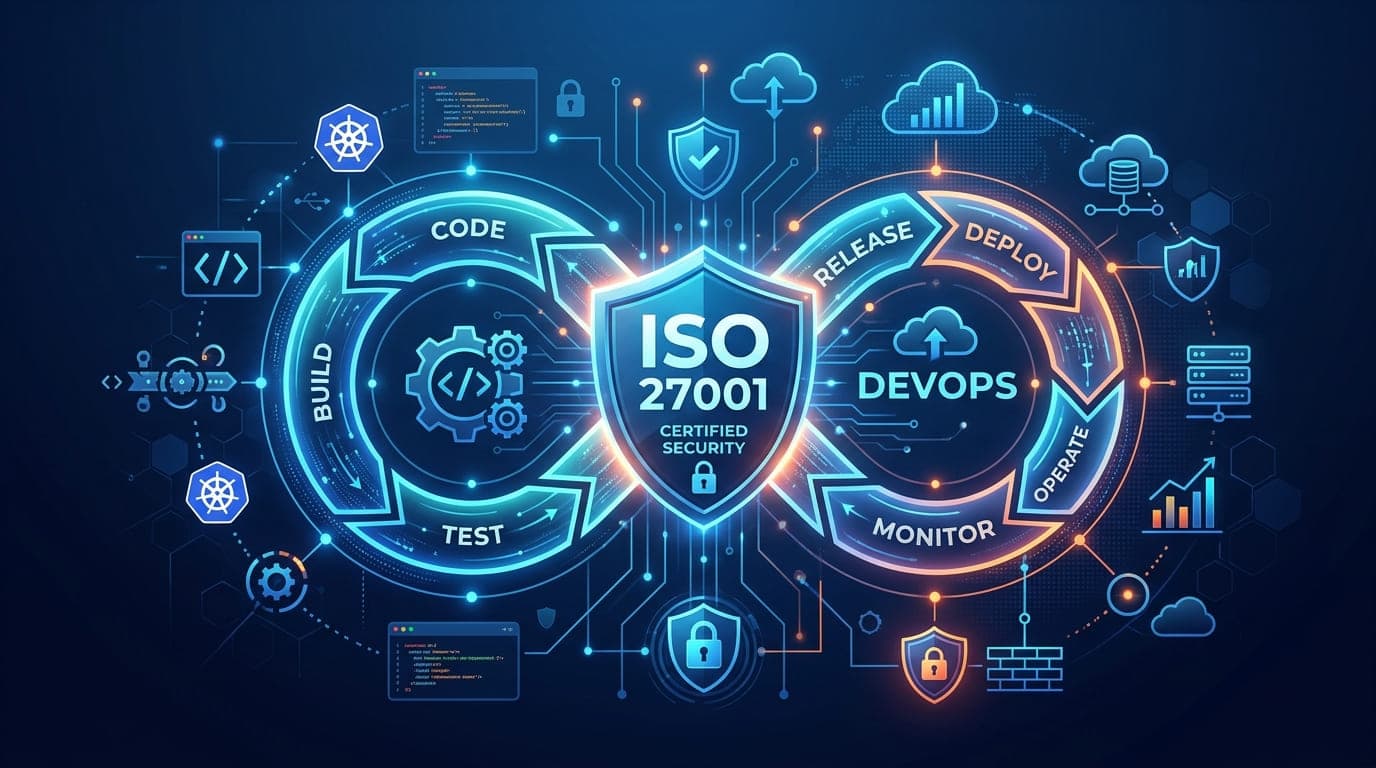
"Your ISO auditor is here and wants to see your change management logs."
I watched the color drain from the DevOps lead's face. It was 2018, and his team had deployed 847 changes to production in the last month. Their change log? A Slack channel with emoji reactions.
This was my introduction to the beautiful chaos of trying to marry ISO 27001's structured controls with DevOps' velocity-first culture. Spoiler alert: it didn't go well. That company failed their certification audit.
But here's the thing—I've since helped dozens of organizations achieve ISO 27001 certification while maintaining (and even improving) their DevOps velocity. The secret? ISO 27001 and DevOps aren't enemies. They're actually perfect partners, if you know how to introduce them properly.
After fifteen years in cybersecurity and countless late nights debugging deployment pipelines with frantic developers, I've learned that the organizations that get this right don't just achieve compliance—they build security programs that make them legitimately harder to hack.
Let me show you how.
The DevOps-Security Paradox (And Why It's Fake)
I need to address the elephant in the room: most developers think security slows them down. Most security people think developers move too fast.
I felt this tension viscerally back in 2017 when I was consulting for a fintech startup. Their development team was shipping features daily. Their security team was demanding two-week security reviews for every change. The result? Developers started finding "creative" ways to bypass security reviews.
Shadow IT. Undocumented deployments. "Emergency" changes that became the norm. The security team thought they were protecting the company. The developers thought they were protecting the business from security bureaucracy.
Both were wrong. And both were right.
"Security at the speed of DevOps doesn't mean securing slower. It means automating security so it moves at the speed of code."
The breakthrough came when we stopped treating security as a gate and started treating it as a pipeline. Instead of security reviews that blocked deployments, we built security checks into the deployment process itself.
Deployment velocity actually increased by 23% once we removed the human bottleneck. And security improved because every single deployment was checked, not just the ones that made it through the review queue.
Understanding ISO 27001 Through a DevOps Lens
Let's get real about what ISO 27001 actually requires. The standard has 114 controls across 14 domains, and many people think it's incompatible with modern development practices.
They're looking at it wrong.
ISO 27001 doesn't dictate how you implement controls—it specifies what outcomes you need to achieve. This flexibility is your secret weapon.
Here's how the key ISO 27001 domains map to DevOps practices:
ISO 27001 Domain | What It Really Means | DevOps Implementation |
|---|---|---|
A.8: Asset Management | Know what you have and who owns it | Infrastructure as Code, Service Catalogs, CMDB |
A.9: Access Control | Right people, right access, right time | RBAC, SSO, Just-in-Time Access, Service Accounts |
A.12: Operations Security | Secure day-to-day operations | CI/CD Security, Automated Testing, Monitoring |
A.14: System Acquisition | Build and buy securely | Secure SDLC, Dependency Scanning, Container Security |
A.16: Incident Management | Detect and respond to problems | Observability, Alerting, Automated Remediation |
A.17: Business Continuity | Keep running when things break | High Availability, Disaster Recovery, Chaos Engineering |
A.18: Compliance | Meet legal requirements | Audit Logging, Compliance as Code, Policy Enforcement |
When I show this table to DevOps teams, I watch the light bulbs go on. "Wait," they say, "we're already doing most of this. We just call it different things."
Exactly.
The Seven Principles of DevSecOps + ISO 27001
Over the years, I've distilled the integration of ISO 27001 into DevOps down to seven core principles. These aren't theoretical—they're battle-tested across organizations from 20-person startups to Fortune 500 enterprises.
1. Shift Left, But Don't Forget Right
"Shift left" is DevSecOps gospel—catch security issues early in the development process. But here's what nobody tells you: you also need "shift right" detection for what inevitably slips through.
I worked with an e-commerce platform that had fantastic pre-production security scanning. They caught 94% of vulnerabilities before production. They were proud of that number.
Then they got breached through a runtime configuration issue that their pre-production tools couldn't detect.
Here's my framework for comprehensive coverage:
Shift Left: Development-Time Controls
IDE security plugins (Snyk, SonarLint)
Pre-commit hooks (git-secrets, detect-secrets)
Pull request automated scans
Dependency vulnerability scanning
SAST (Static Application Security Testing)
Container image scanning
Shift Right: Runtime Controls
DAST (Dynamic Application Security Testing)
Runtime application self-protection (RASP)
API security monitoring
Behavioral anomaly detection
Cloud security posture management
Production vulnerability scanning
ISO 27001 Control A.12.6 requires technical vulnerability management. This dual-side approach satisfies the control while actually improving your security posture.
2. Automate Everything (Especially the Boring Stuff)
Here's a truth bomb: if your security control requires a human to remember to do something, it will eventually fail.
I can't count how many times I've seen this pattern:
Security team creates detailed checklist
Developers follow it religiously for three weeks
Deadline pressure hits
Checklist gets skipped "just this once"
"Just this once" becomes standard practice
The solution? Remove humans from the decision loop for routine security checks.
One of my favorite implementations was at a healthcare tech company. They needed to ensure all production deployments met specific security criteria (ISO 27001 Controls A.14.2.8 and A.14.2.9). Instead of security reviews, they built an automated deployment gate:
Deployment Pipeline Security Gates:
✓ SAST scan passed (no critical/high findings)
✓ Dependency vulnerabilities resolved
✓ Container signed by trusted builder
✓ Secrets not hardcoded (automated scan)
✓ Infrastructure changes reviewed (Terraform plan)
✓ Test coverage > 80%
✓ Security tests included
✓ Change ticket created automatically
If any check failed, deployment was automatically blocked. No human gatekeepers. No political pressure to "just push it through."
Deployment velocity increased by 31% because developers got instant feedback instead of waiting hours for security review. Security improved because 100% of deployments were checked, not just the ones that made it to the security team.
"The best security control is the one developers don't have to think about because it's already built into their workflow."
3. Treat Infrastructure as Code (And Audit It Like Code)
ISO 27001 Control A.12.1.2 requires documented change management procedures. When I tell DevOps teams this, they groan and imagine mountains of paperwork.
But here's the secret: if your infrastructure is code, your git commits ARE your change documentation.
I helped a SaaS company transform their ISO 27001 audit from a nightmare into a three-hour breeze by implementing proper Infrastructure as Code (IaC) practices:
Before IaC:
Manual change tickets (often created after the fact)
Unclear approval process
No rollback capability
Audit required interviewing 8 people and reviewing 200+ tickets
Compliance: Barely passing
After IaC:
Every change = Pull Request
Approval = Code Review + Merge
Automatic rollback capability
Audit = Review git history
Compliance: Exceeds requirements
Here's their IaC security framework:
Control Type | Implementation | ISO 27001 Control |
|---|---|---|
Version Control | All infrastructure in Git | A.12.1.2, A.14.2.6 |
Code Review | Required PR approvals | A.9.4.5 |
Automated Testing | Terraform validation, policy checks | A.14.2.8 |
Security Scanning | Checkov, tfsec, Terrascan | A.12.6.1 |
Secrets Management | HashiCorp Vault, AWS Secrets Manager | A.10.1.1, A.10.1.2 |
Immutable Infrastructure | Container images, AMIs | A.12.6.2 |
Audit Logging | Git history, CI/CD logs | A.12.4.1 |
The auditor literally said: "This is the cleanest change management system I've seen in five years."
4. Build Security Into Your Pipeline (Not Around It)
This is where most organizations fail. They treat their CI/CD pipeline as sacred and security as an afterthought.
I learned this lesson the hard way in 2019. I was consulting for a media company that had a beautiful CI/CD pipeline—fast, reliable, elegant. They bolted security scanning on as a separate parallel process.
Guess what developers did when security scans found issues? Ignored them. The scans weren't blocking, so they became noise.
Six months later, they deployed code with a critical SQL injection vulnerability that was flagged by their security scanner. Nobody had looked at the results. The vulnerability was exploited within three weeks of deployment.
The right way: Security as a first-class pipeline citizen
Here's the pipeline architecture I now recommend:
Developer Commit
    ↓
Pre-commit Hooks (secrets, credentials)
    ↓
Pull Request Triggered
    ↓
├─ Unit Tests
├─ SAST Scan (SonarQube, Semgrep)
├─ Dependency Check (OWASP Dependency-Check)
├─ Container Scan (Trivy, Aqua)
└─ IaC Security (Checkov, tfsec)
    ↓
Code Review (Human + Automated)
    ↓
Merge to Main
    ↓
Build & Package
    ↓
Sign Artifacts
    ↓
Deploy to Staging
    ↓
├─ Integration Tests
├─ DAST Scan (OWASP ZAP)
├─ API Security Testing
└─ Performance Tests
    ↓
Security Sign-off Gate (Automated)
    ↓
Deploy to Production
    ↓
Runtime Monitoring & Protection
Every step is automated. Every security check is blocking for critical/high findings. Developers get immediate feedback.
This architecture satisfies multiple ISO 27001 controls:
A.14.2.1: Secure development policy
A.14.2.8: System security testing
A.14.2.9: System acceptance testing
A.12.1.2: Change management
A.12.6.1: Technical vulnerability management
5. Embrace Immutable Infrastructure
I had an "aha moment" about ISO 27001 Control A.12.6.2 (restricting software installation) while working with a streaming service company.
They had 300+ servers that had been running for years. Different teams had installed different packages. Nobody knew what was on each server anymore. Auditing was a nightmare. Patching was terrifying—they couldn't be sure what would break.
We migrated them to immutable infrastructure: containers orchestrated by Kubernetes, with images built fresh for every deployment.
The transformation was dramatic:
Challenge | Traditional Approach | Immutable Infrastructure |
|---|---|---|
Patching | 3-week process, 15% failure rate | Rebuild image, redeploy (2 hours) |
Vulnerability Management | Scan 300+ unique servers | Scan 8 base images |
Configuration Drift | Constant problem, hard to detect | Impossible by design |
Audit Evidence | Screenshot every server config | Show Dockerfile + image hash |
Rollback | Hope backups work | Redeploy previous image version |
Compliance | 40+ hours of audit prep | 4 hours of audit prep |
"Immutable infrastructure doesn't just make you more secure—it makes security auditable by design."
The ISO 27001 benefits were enormous:
A.12.5.1 (Software installation): Controlled through Dockerfile
A.12.6.2 (Technical vulnerability management): Automated scanning of images
A.14.2.2 (System change procedures): Every change = new image
A.17.2.1 (Availability of information): Easy rollback and redundancy
6. Implement Obsessive Observability
ISO 27001 Control A.12.4.1 requires event logging. Most organizations interpret this as "save some logs somewhere."
That's not observability. That's data hoarding.
Real observability means you can answer these questions in under 60 seconds:
What deployments happened in the last 24 hours?
Who accessed production in the last week?
What configuration changes were made to our infrastructure?
Are there any anomalous patterns in API calls?
Which containers are running vulnerable dependencies?
I worked with a fintech company that collected terabytes of logs but couldn't answer basic security questions. Their "observability" was a compliance checkbox, not a security capability.
We rebuilt their approach around three pillars:
1. Structured Logging
Consistent JSON format across all services
Correlation IDs for request tracing
Security context in every log entry
Automatic log enrichment (user identity, IP, geo-location)
2. Real-time Security Metrics
Authentication failures by user/IP
Privilege escalation attempts
Data access patterns
API rate limit violations
Configuration changes
Vulnerability trends
3. Automated Alerting
Alert on anomalies, not just thresholds
Integrate alerts into ChatOps (Slack, Teams)
Automatic ticket creation for security events
Escalation paths for critical findings
The result? They detected and stopped a credential stuffing attack within 4 minutes because their observability stack flagged abnormal authentication patterns from a new geographic region.
For ISO 27001, their observability stack provided evidence for:
A.12.4.1: Event logging
A.12.4.2: Protection of log information
A.12.4.3: Administrator and operator logs
A.12.4.4: Clock synchronization
A.16.1.2: Incident detection and reporting
7. Make Security Failures Visible (And Non-Blocking for Learning)
Here's a controversial take: Not every security finding should block deployment.
Wait, hear me out.
I learned this from a CTO who told me: "If security always blocks deployments, developers learn to work around security. If security sometimes blocks deployments based on risk, developers learn to write secure code."
His team implemented a tiered response system:
Critical Findings: Block deployment automatically
Hardcoded credentials
Known CVEs with CVSS > 8.0
SQL injection vulnerabilities
Authentication bypasses
Secrets in code/logs
High Findings: Block deployment, allow override with justification
CVEs with CVSS 7.0-7.9
Weak cryptography
Missing authentication
Insecure deserialization
Medium/Low Findings: Create ticket, allow deployment
Code quality issues
Dependency updates available
Best practice violations
Informational findings
This approach had surprising benefits:
Developers trusted the system because it didn't cry wolf
Override requests created learning opportunities (security team explained risks)
Metrics showed improvement (fewer overrides needed over time)
Business velocity maintained (not blocked by low-priority findings)
For ISO 27001 Control A.14.2.9 (system acceptance testing), this approach demonstrated risk-based decision making while maintaining security standards.
The ISO 27001 DevOps Implementation Roadmap
Okay, enough theory. Let's talk about how to actually do this.
I've guided dozens of organizations through this journey. The ones that succeed follow a phased approach:
Phase 1: Foundation (Months 1-3)
Goal: Basic security hygiene and visibility
Activity | ISO 27001 Controls | Tools & Practices |
|---|---|---|
Secret management | A.9.4.3, A.10.1.1 | Vault, AWS Secrets Manager, Azure Key Vault |
Dependency scanning | A.12.6.1, A.14.2.8 | Snyk, Dependabot, WhiteSource |
SAST implementation | A.14.2.8 | SonarQube, Semgrep, Checkmarx |
Container scanning | A.12.6.1 | Trivy, Aqua, Prisma Cloud |
Basic logging | A.12.4.1 | ELK Stack, Splunk, Datadog |
Success Criteria:
No secrets in code (100% detection rate)
Visibility into all dependencies
Security scans running (not necessarily blocking yet)
Logs being collected and retained
Real Example: A healthcare SaaS company completed this phase in 10 weeks. They discovered 23 hardcoded API keys, 412 vulnerable dependencies, and 7 critical code vulnerabilities. None were blockers yet, but visibility alone drove behavior change.
Phase 2: Automation (Months 4-6)
Goal: Integrate security into CI/CD pipeline
Activity | ISO 27001 Controls | Implementation |
|---|---|---|
Automated security gates | A.14.2.8, A.14.2.9 | Policy-as-code, quality gates |
IaC security | A.12.1.2, A.14.2.6 | Terraform, Checkov, Sentinel |
Automated compliance checks | A.18.2.2 | Open Policy Agent, Cloud Custodian |
Pipeline security | A.14.2.2 | Signed commits, artifact signing |
PR security reviews | A.14.2.3 | Automated code review, required checks |
Success Criteria:
Security checks integrated into every deployment
Critical/high findings block deployments
Infrastructure changes require approval
All deployments traceable and auditable
Real Example: A fintech startup implemented this phase in 8 weeks. Deployment velocity initially dropped 12%, then increased 27% as developers learned the new patterns. Security findings decreased 68% as developers got immediate feedback.
Phase 3: Optimization (Months 7-12)
Goal: Mature security program with continuous improvement
Activity | ISO 27001 Controls | Advanced Capabilities |
|---|---|---|
Runtime security | A.12.6.1, A.16.1.2 | RASP, runtime scanning |
Security metrics | A.18.2.1 | Custom dashboards, KPIs |
Threat modeling | A.14.2.5 | Automated threat modeling |
Chaos engineering | A.17.1.3 | Security-focused chaos |
Advanced monitoring | A.12.4.1, A.16.1.4 | SIEM, SOAR, behavioral analytics |
Success Criteria:
Proactive threat detection
Security metrics drive decisions
Recovery time < 1 hour for any incident
Continuous compliance evidence
Real Example: An e-commerce platform reached this phase after 11 months. They detected and mitigated a zero-day exploit in a dependency within 45 minutes because their runtime monitoring flagged anomalous behavior.
Real-World Implementation: A Case Study
Let me share a complete story that ties everything together.
In 2021, I started working with a Series B SaaS company—let's call them "CloudMetrics." They had 80 employees, 50 enterprise customers, and a big problem: their largest customer required ISO 27001 certification within 6 months, or they'd lose a $3.2 million contract.
Their DevOps culture was strong: 15-20 deployments daily, infrastructure as code, solid CI/CD pipeline. Their security culture? Practically non-existent.
Month 1: Reality Check
We did a gap analysis against ISO 27001. The results were sobering:
What They Had:
✓ Version control (Git)
✓ Automated deployments
✓ Basic monitoring
✓ Cloud infrastructure (AWS)
What They Were Missing:
✗ Secret management (hardcoded everywhere)
✗ Security scanning (none)
✗ Access control documentation
✗ Change management records
✗ Incident response procedures
✗ Vulnerability management process
✗ Security testing
Their CTO was overwhelmed. "There's no way we can fix all this and keep shipping features," he said.
I told him what I'm telling you: "You don't need to choose between security and velocity. You need to build security that enables velocity."
Month 2-3: Quick Wins
We focused on automation first. Here's what we implemented:
Week 1-2: Secret Management
Migrated to AWS Secrets Manager
Implemented git-secrets pre-commit hooks
Rotated all exposed credentials
Result: Zero secrets in code (verified by automated scanning)
Week 3-4: Dependency Scanning
Added Snyk to GitHub
Automated PR checks
Created remediation process
Result: Visibility into 1,200+ dependencies, 45 critical vulnerabilities identified
Week 5-6: Container Security
Implemented Trivy scanning
Created base image standards
Automated image scanning in CI/CD
Result: All production containers from known, scanned images
Week 7-8: SAST Implementation
Deployed SonarQube
Integrated into PR process
Set initial quality gates
Result: Code quality baseline established, critical issues blocking
Week 9-12: Infrastructure Security
Implemented Checkov for Terraform
Created IaC review process
Documented infrastructure architecture
Result: All infrastructure changes auditable, security policies enforced
The transformation in developer behavior was remarkable. Initially, there was resistance. By week 8, developers were proud of their security metrics. They started competing to have the "cleanest" code.
Month 4-5: Building the Machine
With basics in place, we focused on processes:
Change Management:
PR process documented
Approval requirements defined
Emergency change procedures
Automated change logging
ISO 27001 Coverage: A.12.1.2, A.14.2.2
Access Control:
RBAC implemented in AWS
SSO deployed (Okta)
Access review process
Principle of least privilege
ISO 27001 Coverage: A.9.1.1, A.9.2.1, A.9.4.1
Incident Response:
IR playbooks created
On-call rotation established
Automated alerting configured
Post-incident review process
ISO 27001 Coverage: A.16.1.1-A.16.1.7
Vulnerability Management:
Weekly vulnerability reviews
SLA-based remediation
Automated patch management
Compensating controls documented
ISO 27001 Coverage: A.12.6.1, A.12.6.2
Month 6: Audit Preparation
The final month was about evidence collection, not implementation. Because we'd automated everything, we had:
Git history: Complete change management records
CI/CD logs: All deployments and security scans
AWS CloudTrail: All infrastructure changes
Monitoring dashboards: Real-time security posture
Automated reports: Compliance status by control
The external audit took 2 days. The auditor's feedback: "This is one of the most mature DevOps security programs I've seen at a company your size."
They achieved ISO 27001 certification in 5.5 months.
The Results
Security Metrics (6 months later):
Mean Time to Detect (MTTD): 4.2 minutes (from ∞)
Mean Time to Respond (MTTR): 47 minutes (from days)
Critical vulnerabilities: 0 in production (from 45)
Security incidents: 3 detected and mitigated (vs 0 detected before)
Failed deployments due to security: 0.3% (vs 0% before, but now actually checking)
Business Metrics:
Deployment frequency: 23 per day (up from 18)
Deployment failure rate: 2.1% (down from 5.7%)
Contract retained: $3.2M
New enterprise deals: 4 (all required ISO 27001)
Developer satisfaction: 8.2/10 (up from 6.1)
Cost Analysis:
Implementation cost: $185,000 (consultant, tools, employee time)
Ongoing annual cost: $92,000 (tools, maintenance, annual audit)
Revenue protected: $3.2M
New revenue enabled: $5.7M
ROI: 4,714% in first year
"ISO 27001 didn't slow us down—it gave us a framework to move faster with confidence. We're not just deploying code anymore; we're deploying secure code at scale." - CloudMetrics CTO
The DevOps Security Toolchain
Based on my experience, here's the essential toolchain for ISO 27001-compliant DevOps:
Core Security Tools
Category | Tools | ISO 27001 Controls | Price Range |
|---|---|---|---|
Secret Management | HashiCorp Vault, AWS Secrets Manager, Azure Key Vault | A.9.4.3, A.10.1.1, A.10.1.2 | $0-$5K/month |
SAST | SonarQube, Semgrep, Checkmarx | A.14.2.8 | $0-$10K/month |
DAST | OWASP ZAP, Burp Suite, Acunetix | A.14.2.8, A.14.2.9 | $0-$8K/month |
Dependency Scanning | Snyk, Dependabot, WhiteSource | A.12.6.1, A.14.2.8 | $0-$6K/month |
Container Security | Trivy, Aqua, Prisma Cloud | A.12.6.1, A.14.2.8 | $0-$15K/month |
IaC Security | Checkov, tfsec, Terraform Sentinel | A.12.1.2, A.14.2.6 | $0-$8K/month |
SIEM/Logging | Splunk, ELK Stack, Datadog | A.12.4.1, A.16.1.2 | $2K-$25K/month |
Runtime Protection | Falco, Aqua Runtime, Prisma Cloud | A.12.6.1, A.16.1.2 | $5K-$20K/month |
My Recommended Starter Stack (Budget-Conscious)
For organizations just starting out, here's a cost-effective stack that still provides comprehensive coverage:
Tool | Cost | What It Does |
|---|---|---|
GitHub Advanced Security | $49/user/month | SAST, Dependency scanning, Secret scanning |
Trivy | Free | Container and IaC scanning |
Checkov | Free | IaC security policy enforcement |
AWS Secrets Manager | $0.40/secret/month | Centralized secret management |
ELK Stack (self-hosted) | Infrastructure only | Log aggregation and analysis |
OWASP ZAP | Free | DAST scanning |
SonarQube Community | Free | Code quality and security |
Total Cost: ~$1,500-$3,000/month for a 30-person dev team
This stack covers all essential ISO 27001 controls and can scale as your organization grows.
Common Pitfalls (And How to Avoid Them)
In my 15+ years, I've seen organizations make the same mistakes repeatedly. Let me save you some pain:
Pitfall 1: Security Theater
The Mistake: Implementing security tools but not enforcing findings.
I visited a company that proudly showed me their security dashboard. It had 347 critical findings. I asked what they were doing about them. "Oh, we're working on it," they said. Those findings were 6 months old.
The Fix: Make critical findings blocking. If it's truly critical, it shouldn't reach production.
Pitfall 2: Over-Automation
The Mistake: Automating before understanding the process.
A startup automated their entire security pipeline based on someone else's blog post. They were blocking deployments for things that didn't matter and allowing things that did.
The Fix: Understand manual processes first, then automate. Start with high-confidence checks (secrets, critical CVEs) and gradually expand.
Pitfall 3: Ignoring Developer Experience
The Mistake: Forcing developers to use clunky security tools.
One company I worked with made developers run 7 different security scans manually before each PR. Compliance? ✓. Developer productivity? ✗. Actual security? ✗ (because developers found workarounds).
The Fix: Integrate security into existing workflows. If developers already use GitHub, use GitHub Advanced Security. If they use GitLab, use GitLab security features.
Pitfall 4: Documentation Overkill
The Mistake: Creating 200-page process documents nobody reads.
The Fix: Code is documentation. Use README files, architecture decision records (ADRs), and inline comments. Your git history is your change log. Your IaC is your infrastructure documentation.
Pitfall 5: Forgetting the Human Element
The Mistake: Assuming technology alone solves security.
The most sophisticated security setup I ever saw was bypassed by a developer who committed AWS keys because they were "testing locally."
The Fix:
Regular security training
Blameless post-mortems
Security champions program
Make security everyone's job, not just the security team's
Measuring Success: The Metrics That Matter
ISO 27001 requires you to measure your information security management system's effectiveness (Control A.9.1). Here are the DevOps security metrics I actually track:
Leading Indicators (Predict Future Problems)
Metric | Target | What It Tells You |
|---|---|---|
Time to Remediate Critical Findings | < 24 hours | How quickly you respond to threats |
% Deployments Passing Security Scans | > 95% | Developer security awareness |
Security Scan Coverage | 100% | No blind spots |
Mean Age of Vulnerabilities | < 7 days | Vulnerability management effectiveness |
Security Training Completion | 100% | Team preparedness |
Lagging Indicators (Show Past Performance)
Metric | Target | What It Tells You |
|---|---|---|
Security Incidents in Production | Trending down | Overall security posture |
MTTD (Mean Time to Detect) | < 15 minutes | Detection capability |
MTTR (Mean Time to Respond) | < 1 hour | Response effectiveness |
Critical Vulnerabilities in Production | 0 | Pipeline effectiveness |
Security-Related Deployment Rollbacks | < 1% | Security testing quality |
Business Metrics
Metric | Why It Matters |
|---|---|
Enterprise Deals Won | Compliance enables revenue |
Audit Prep Time | Efficiency of compliance program |
Developer Satisfaction Score | Sustainability of security program |
Insurance Premium Changes | External validation of security posture |
Customer Security Questionnaire Time | Sales efficiency |
One company I worked with reduced their security questionnaire response time from 3 weeks to 2 days by automating evidence collection from their DevOps pipeline. That single improvement helped them close $4.2M in deals that quarter because they could move faster than competitors.
The Cultural Transformation
Here's something nobody tells you about ISO 27001 + DevOps: the technology is the easy part. The culture change is hard.
I worked with a company where the development and security teams literally sat on different floors and communicated only through tickets. Tickets that took days to resolve. The tension was palpable.
We implemented "Security Champions"—developers who became part-time security advocates. They:
Attended security team meetings
Brought security requirements to sprint planning
Answered developer questions about security findings
Became trusted bridges between teams
Within 3 months, the relationship transformed. Developers started thinking about security proactively. Security team members started understanding development constraints.
The breakthrough moment came when a developer found a security issue before the security team did and proactively fixed it. The security team lead literally teared up. "This is what I've been dreaming of for five years," she said.
"The goal isn't to make developers think like security people. It's to make security people think like developers, and developers think about security. Meet in the middle."
Your Action Plan: Getting Started This Week
Enough theory. Here's what you can do right now:
This Week
Day 1: Assess Current State
List all applications and services
Document deployment processes
Identify where credentials are stored
Map current security tooling (if any)
Day 2: Quick Security Wins
Install git-secrets or similar on all developer machines
Run dependency vulnerability scan on main applications
Scan container images (if applicable)
Review cloud security posture (AWS Security Hub, Azure Security Center)
Day 3: Prioritize Findings
Critical: Exposed secrets, critical CVEs in production
High: Authentication issues, high-severity CVEs
Medium: Everything else
Day 4: Plan Remediation
Move secrets to proper secret management
Create remediation plan for critical vulnerabilities
Document findings and decisions
Day 5: Start Automation
Add secret scanning to CI/CD
Add dependency scanning to PRs
Block new secrets from being committed
This Month
Week 2: Implement basic SAST Week 3: Add container/IaC scanning Week 4: Document processes and create baselines
This Quarter
Month 2: Build comprehensive security pipeline Month 3: Implement runtime monitoring and response
Final Thoughts: The Journey Is Worth It
I started this article with a story about a failed audit. Let me end with a success story.
Last year, I worked with a company that went from zero security controls to ISO 27001 certification in 9 months while maintaining their aggressive development velocity. Their DevOps practices didn't slow down—they accelerated.
The CEO told me something profound: "I thought ISO 27001 would be a burden we had to carry to win enterprise deals. Instead, it became our competitive advantage. We're more reliable, more secure, and we move faster than competitors because our security is automated and built-in."
That's the real promise of integrating ISO 27001 with DevOps. It's not about slowing down to be secure. It's about building security that lets you move faster with confidence.
The organizations that win in the next decade won't be the ones that move fastest OR the ones that are most secure. They'll be the ones that do both simultaneously.
ISO 27001 + DevOps isn't a compromise. It's a force multiplier.
Now go build something secure at scale.
Ready to start your DevSecOps journey? At PentesterWorld, we provide practical guides, tool comparisons, and real-world implementation strategies. Subscribe for weekly deep-dives into cybersecurity compliance and DevOps integration.
Next in this series: "ISO 27001 Cloud Security: Extending Controls to Cloud Environments"—where we dive deep into AWS, Azure, and GCP compliance strategies.