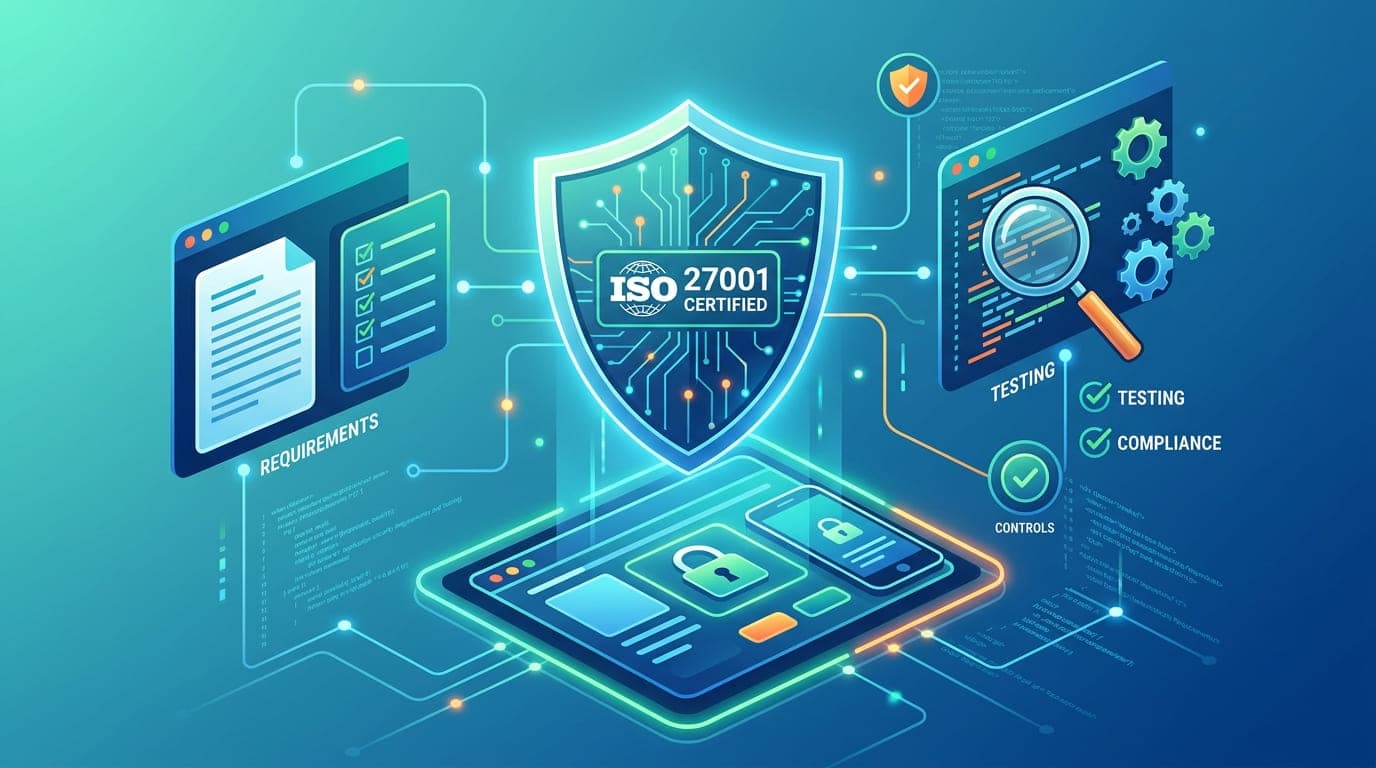
The conference room fell silent. I'd just finished presenting the penetration test results to the CTO of a promising fintech startup. Their flagship application—the one handling millions in daily transactions—had 23 high-severity vulnerabilities. SQL injection. Broken authentication. Insecure direct object references. The classics.
"But we're ISO 27001 certified," the CTO protested, confusion evident in his voice. "Doesn't that mean we're secure?"
This moment, which I've experienced variations of at least a dozen times in my career, perfectly captures a dangerous misconception: ISO 27001 certification doesn't automatically make your applications secure. It requires you to make them secure—if you implement the controls correctly.
After fifteen years of helping organizations navigate ISO 27001 compliance while simultaneously breaking into their applications as a penetration tester, I've learned this truth: the gap between having ISO 27001 certification and having secure applications is where most organizations stumble.
Let me show you how to bridge that gap.
Understanding ISO 27001's Application Security Landscape
First, let's clear up a common confusion. ISO 27001 doesn't have a single control called "Application Security." Instead, it weaves application security requirements throughout multiple controls in Annex A. This distributed approach is actually brilliant—it forces you to think about application security holistically rather than as a checkbox exercise.
Here are the primary controls that directly impact application security:
Control Number | Control Name | Application Security Focus |
|---|---|---|
A.8.1 | Information Security in Project Management | Security requirements in SDLC |
A.8.2 | Information Security Requirements Analysis | Defining security needs upfront |
A.8.3 | Secure System Architecture and Engineering | Security by design principles |
A.8.4 | Application Security Requirements | Explicit security coding standards |
A.8.5 | Secure Development | Security in the development process |
A.8.6 | Management of Technical Vulnerabilities | Vulnerability assessment and patching |
A.8.7 | System Security Testing | Pre-production security validation |
A.8.8 | Security Testing in Development and Acceptance | Continuous security testing |
A.8.9 | Outsourced Development | Third-party code security |
"ISO 27001 doesn't tell you exactly what to do. It tells you what outcomes you need to achieve. That's both its power and its challenge."
The Application Security Requirements That Actually Matter
Let me share something I learned the hard way. In 2019, I was helping a healthcare SaaS company prepare for their ISO 27001 audit. They had beautiful documentation—security policies, development standards, code review checklists. Everything looked perfect on paper.
Then I tested their application.
Within two hours, I had:
Extracted their entire customer database through SQL injection
Bypassed authentication using a simple parameter manipulation
Escalated privileges to administrator level through insecure direct object references
Downloaded sensitive patient records without any authorization
The problem? Their documentation described what they should do, not what they actually did. Their developers didn't follow the standards. Their code reviews were rubber-stamp exercises. Their testing was functional, not security-focused.
That experience taught me that ISO 27001 application security boils down to three core principles:
1. Security Requirements Must Be Defined Before Code Is Written
This seems obvious, but you'd be amazed how many organizations skip this step.
I worked with an e-commerce platform that had built their entire application before anyone asked, "What are our security requirements?" When we finally sat down to define them, we discovered:
No password complexity requirements
No session timeout mechanisms
No input validation standards
No encryption requirements for sensitive data
No logging of security-relevant events
Retrofitting these requirements into a production application took eight months and cost over $400,000. If they'd defined requirements upfront, implementation would have been part of the normal development process.
ISO 27001 Control A.8.2 requires you to:
Requirement Area | What You Must Define | Real-World Example |
|---|---|---|
Input Validation | What data is accepted and how it's validated | Email fields must match RFC 5322 format; SQL special characters must be escaped |
Authentication | How users prove their identity | Multi-factor authentication required; passwords minimum 12 characters with complexity |
Authorization | What users can access | Role-based access control; principle of least privilege |
Session Management | How sessions are created and maintained | Sessions expire after 15 minutes inactivity; secure, httpOnly cookies |
Cryptography | What must be encrypted and how | All PII encrypted with AES-256; TLS 1.3 for data in transit |
Error Handling | How errors are managed | Generic error messages to users; detailed logs for admins |
Logging | What security events are recorded | All authentication attempts, authorization failures, data access |
2. Security Testing Must Be Systematic and Continuous
Here's a story that still makes me wince.
A financial services company had passed their ISO 27001 audit with flying colors. They had annual penetration tests—check. They had code reviews—check. They had security testing documentation—check.
Six months after certification, they suffered a breach that exposed 340,000 customer records.
The vulnerability? A critical SQL injection flaw that was introduced in a routine update three months earlier. Their annual penetration test wouldn't have caught it for another nine months. Their code review process had missed it because reviewers were focused on functional correctness, not security.
ISO 27001 requires continuous testing, not annual checkbox exercises.
Here's the testing framework I've developed after breaking into (legally) hundreds of applications:
Testing Type | Frequency | ISO 27001 Control | When to Perform | What It Catches |
|---|---|---|---|---|
Static Application Security Testing (SAST) | Every commit | A.8.8 | During development | Code-level vulnerabilities, insecure coding patterns |
Dynamic Application Security Testing (DAST) | Every release | A.8.7, A.8.8 | In staging environment | Runtime vulnerabilities, configuration issues |
Interactive Application Security Testing (IAST) | Continuous | A.8.8 | During QA testing | Real-time vulnerability detection during testing |
Software Composition Analysis (SCA) | Every build | A.8.6, A.8.9 | Before deployment | Third-party library vulnerabilities |
Manual Code Review | High-risk changes | A.8.5 | Before merging to main | Logic flaws, business logic vulnerabilities |
Penetration Testing | Quarterly + after major changes | A.8.7 | Pre-production | Complex attack chains, business logic flaws |
Bug Bounty Program | Continuous | A.8.7 | Production | Real-world attack scenarios |
3. Vulnerabilities Must Be Managed, Not Just Discovered
I'll never forget the conversation I had with a security manager in 2021. They'd just received a penetration test report showing 47 vulnerabilities, including 12 criticals. "Great," he said, "we'll fix these before the next annual test."
I asked, "What about the critical SQL injection that allows data extraction?"
"We'll get to it in the next sprint. It's on the backlog."
That was in March. The sprint was scheduled for September.
Discovering vulnerabilities without acting on them is worse than not discovering them at all—because now you know about the risk and chose to accept it.
ISO 27001 Control A.8.6 requires you to manage technical vulnerabilities. Here's the framework that actually works:
Severity | Response Time | Remediation Action | Acceptable Mitigation |
|---|---|---|---|
Critical (CVSS 9.0-10.0) | 24-48 hours | Emergency patch/hotfix | WAF rule, disable feature, take offline if necessary |
High (CVSS 7.0-8.9) | 7 days | Scheduled patch release | Temporary access controls, monitoring |
Medium (CVSS 4.0-6.9) | 30 days | Regular release cycle | Compensating controls, enhanced monitoring |
Low (CVSS 0.1-3.9) | 90 days | Routine maintenance | Accept risk with documentation |
"The speed at which you respond to vulnerabilities tells your customers everything they need to know about how seriously you take security."
The Secure Development Lifecycle: Where Theory Meets Reality
Let me share what actually works in production environments. I've implemented secure development lifecycles (SDLCs) at organizations ranging from 5-person startups to 10,000-employee enterprises. Here's the framework that consistently succeeds:
Phase 1: Requirements and Design (Controls A.8.1, A.8.2, A.8.3)
What ISO 27001 requires:
Security requirements identified alongside functional requirements
Threat modeling performed during design phase
Security architecture review before development begins
What actually works in practice:
I helped a healthcare technology company implement this for their patient portal redesign. Here's what we did:
Security Requirements Workshop (Week 1)
Product team, security team, and compliance team in one room
Identified data sensitivity levels
Defined security requirements based on data classification
Created acceptance criteria that included security
Threat Modeling Sessions (Week 2)
Used STRIDE methodology
Created data flow diagrams
Identified trust boundaries
Documented potential threats and mitigations
Architecture Security Review (Week 3)
Security team reviewed proposed architecture
Identified security concerns before any code was written
Made design changes when security issues were found
Got sign-off from security before development started
Result: We identified 17 security issues during design that would have become vulnerabilities in production. Fixing them in design took 3 days. Fixing them in production would have taken 3 months.
Phase 2: Development (Controls A.8.4, A.8.5)
What ISO 27001 requires:
Secure coding standards defined and followed
Code reviews include security considerations
Developers trained on secure coding practices
Real-world implementation:
Practice | Implementation | ISO 27001 Evidence | Frequency |
|---|---|---|---|
Secure Coding Standards | OWASP guidelines adopted; custom standards for business logic | Documented standards; training records | Updated annually |
Security Training | Annual secure coding training; monthly security tips | Training completion certificates; quiz results | Annually + ongoing |
Automated Code Analysis | SAST tools integrated into CI/CD pipeline | Tool reports; exception documentation | Every commit |
Peer Code Reviews | Security checklist used in all reviews | Pull request comments; review sign-offs | Every code change |
Security Champions | Developers from each team trained as security advocates | Champion roster; meeting notes | Quarterly meetings |
Here's a truth I learned after watching hundreds of code reviews: developers need concrete examples, not abstract principles.
Instead of saying "validate all inputs," I created this checklist for a financial services company:
SECURITY CODE REVIEW CHECKLIST
After implementing this checklist, security issues found in code review increased by 340%. Not because security got worse—because reviews got better.
Phase 3: Testing (Controls A.8.7, A.8.8)
This is where most organizations fail their ISO 27001 audits, even if they pass certification. They do testing, but not security testing.
I was called in to help a company that had failed their surveillance audit. The auditor had asked to see evidence of security testing. They showed functional test reports.
"Where are the security test results?" the auditor asked.
"We test security as part of functional testing," they replied.
That doesn't count.
Here's the testing strategy that satisfies auditors and actually finds vulnerabilities:
Test Phase | Tools Used | What You're Testing | Pass Criteria | ISO 27001 Evidence |
|---|---|---|---|---|
Unit Testing | Jest, JUnit with security-focused tests | Input validation, authentication logic | 100% of security tests pass | Unit test reports with security test coverage |
SAST | SonarQube, Checkmarx, Fortify | Source code vulnerabilities | No high/critical findings | SAST reports; exception approvals for accepted findings |
DAST | OWASP ZAP, Burp Suite, Acunetix | Runtime vulnerabilities | No high/critical findings | DAST reports; remediation evidence |
SCA | Snyk, Black Duck, Dependabot | Third-party vulnerabilities | No critical vulnerabilities; high vulnerabilities patched within 7 days | SCA reports; patch evidence |
Manual Penetration Testing | Custom tools and techniques | Business logic flaws, complex attacks | No critical findings; all findings remediated per SLA | Penetration test reports; remediation evidence |
Phase 4: Deployment (Control A.8.5)
The mistake everyone makes: Treating security as something that happens before deployment.
The reality: Some of the worst vulnerabilities are introduced during deployment.
I discovered this the hard way when I was testing an e-commerce application that had passed all pre-production security tests. During deployment to production, the DevOps team:
Changed database connection strings
Modified authentication configurations
Disabled SSL certificate validation "temporarily" for troubleshooting
Enabled debug mode to check if deployment worked
They forgot to revert the debug mode and SSL changes.
I found the production server with debug mode enabled and extracted the entire codebase, including database credentials and API keys.
ISO 27001-compliant deployment checklist:
PRE-DEPLOYMENT SECURITY VERIFICATIONThe Real-World Testing Framework That Auditors Love
After preparing over 30 organizations for ISO 27001 audits, I've learned exactly what auditors want to see. Here's the comprehensive testing documentation framework:
Annual Penetration Testing (The Audit Cornerstone)
What auditors ask for:
Evidence of regular penetration testing
Qualified testers (internal or external)
Comprehensive scope
Findings documented and remediated
What actually satisfies them:
Element | What to Document | Where to Store | Auditor Questions You'll Face |
|---|---|---|---|
Test Scope | Applications tested, exclusions, methodologies | Security assessment folder | "Why wasn't [system] included?" |
Tester Qualifications | Certifications (OSCP, GPEN, etc.), experience | Vendor qualifications file | "What makes these testers qualified?" |
Testing Methodology | Standards followed (OWASP, PTES, etc.) | Test plan document | "How do you ensure comprehensive testing?" |
Findings | All vulnerabilities with severity ratings | Penetration test report | "Show me the critical findings" |
Remediation | Fix evidence for each finding | Remediation tracking sheet | "How were critical issues addressed?" |
Retesting | Validation that fixes work | Retest report | "How do you verify fixes are effective?" |
Pro tip from the trenches: Auditors love evidence trails. For every finding, create a paper trail:
Initial finding in penetration test report
Ticket created in your tracking system
Code change/configuration change to fix
Retest showing the vulnerability is fixed
Sign-off from security team
I helped a SaaS company create this documentation trail, and their auditor literally said, "This is the best vulnerability management evidence I've seen all year."
Continuous Security Testing (The Maturity Differentiator)
Here's what separates mature organizations from those just checking boxes:
Basic Compliance (Minimum Requirements):
Annual penetration testing
Code reviews before major releases
Basic vulnerability scanning
Mature Security Program (What Auditors Really Want to See):
Activity | Frequency | Automation Level | Evidence Generated |
|---|---|---|---|
SAST Scanning | Every commit | 100% automated | Daily reports; trend analysis |
Dependency Checking | Every build | 100% automated | Build reports; vulnerability alerts |
DAST Scanning | Every deployment to staging | 90% automated | Pre-release reports |
Configuration Scanning | Daily in production | 100% automated | Drift detection reports |
Manual Code Review | High-risk changes | Human-driven | Review comments; approval records |
Penetration Testing | Quarterly + after major changes | Human-driven | Quarterly reports |
Bug Bounty | Continuous | Crowdsourced | Ongoing findings; payout records |
"The difference between adequate and excellent ISO 27001 compliance is the difference between annual testing and continuous testing."
The Application Security Metrics That Matter
ISO 27001 Control A.8.8 requires you to measure security testing effectiveness. Here are the metrics that actually tell you something useful:
Lagging Indicators (What Happened)
Metric | What It Measures | Good Target | Red Flag |
|---|---|---|---|
Mean Time to Remediate (MTTR) Critical Vulnerabilities | How fast you fix critical issues | < 48 hours | > 7 days |
Vulnerabilities Found in Production | Issues that escaped pre-production testing | Trending down | Trending up |
Repeat Vulnerabilities | Same vulnerability types appearing | < 5% | > 15% |
Security Test Coverage | % of application tested | > 80% | < 60% |
Leading Indicators (What's Coming)
Metric | What It Predicts | Good Target | Red Flag |
|---|---|---|---|
SAST Findings Per 1000 Lines of Code | Code quality trending | Trending down | Trending up |
Security Training Completion | Team capability | 100% current | < 80% current |
Time in Security Review | Process efficiency | Trending down | Trending up |
False Positive Rate | Tool tuning effectiveness | < 20% | > 40% |
I implemented these metrics at a fintech company, and within six months, we had hard data showing:
Critical vulnerability remediation time dropped from 14 days to 36 hours
Vulnerabilities escaping to production decreased by 67%
Developer security awareness (measured by code review findings) improved by 45%
Their auditor was impressed. Their customers were more impressed. Their CEO was thrilled.
Common ISO 27001 Application Security Audit Failures
Let me share the five most common ways organizations fail application security audits, and how to avoid them:
Failure #1: Testing Theater
What it looks like: You have security testing, but it's not effective.
Real example: A company showed their auditor monthly vulnerability scan reports. Every report showed the same 43 vulnerabilities. Month after month. For 18 months.
"You're scanning," the auditor said, "but you're not remediating. That's not compliance."
The fix:
Link every finding to a remediation action
Track remediation status
Show trending improvement
Document accepted risks with business justification
Failure #2: Documentation-Reality Gap
What it looks like: Your policies say one thing, your practices do another.
Real example: Security policy required code review for all changes. Git history showed 67% of commits had no review comments.
The fix: Make your documentation match reality, or change reality to match documentation. There's no third option.
Failure #3: Point-in-Time Compliance
What it looks like: You secure things for the audit, then let them slip.
Real example: Company did penetration testing right before their annual audit. Found and fixed issues. Six months later (during surveillance audit), the same vulnerabilities were back.
The fix:
Implement continuous monitoring
Use automated regression testing
Create security baseline standards
Alert on configuration drift
Failure #4: Incomplete Scope
What it looks like: You test some applications but not all.
Real example: Organization had 5 customer-facing applications. They tested 1. Auditor asked about the other 4. "Those are low-risk" was not an acceptable answer.
The fix:
Document ALL applications and systems
Perform risk assessment for each
Test according to risk level
Document why lower-risk systems get less testing
Failure #5: Missing Evidence
What it looks like: You do the work but can't prove it.
Real example: Development team claimed they reviewed code for security. No evidence in pull requests, no review checklists, no documentation.
"I believe you," the auditor said. "But I can't verify it, so it doesn't count for audit purposes."
The fix: If it isn't documented, it didn't happen. Create evidence as you go, not after the fact.
The Practical Implementation Roadmap
Based on successfully implementing ISO 27001 application security controls at dozens of organizations, here's the roadmap that works:
Months 1-2: Foundation
Week 1-2: Assessment
Inventory all applications
Document current security testing practices
Identify gaps against ISO 27001 requirements
Prioritize based on risk
Week 3-4: Quick Wins
Implement automated dependency scanning
Add basic SAST to CI/CD pipeline
Create security code review checklist
Document current secure coding standards
Week 5-8: Planning
Define security requirements templates
Select and configure security testing tools
Create vulnerability management process
Establish remediation SLAs
Months 3-4: Implementation
Core Testing Program:
Deploy SAST and DAST tools
Conduct first penetration test
Implement vulnerability tracking
Start security-focused code reviews
Process Integration:
Add security gates to CI/CD
Update deployment procedures
Create security testing documentation
Train development team
Months 5-6: Optimization
Continuous Improvement:
Tune tools to reduce false positives
Analyze metrics and trends
Refine processes based on lessons learned
Prepare for audit
The Reality Check
Here's what this actually costs, based on my experience:
Organization Size | Initial Implementation | Ongoing Annual Cost | Timeline to Audit-Ready |
|---|---|---|---|
Startup (< 50 employees) | $50K - $100K | $30K - $60K | 4-6 months |
Mid-Market (50-500 employees) | $150K - $300K | $100K - $200K | 6-9 months |
Enterprise (500+ employees) | $500K+ | $300K+ | 9-12 months |
These costs include:
Security testing tools and licenses
External penetration testing
Security training for developers
Consultant/staff time for implementation
Process documentation and updates
Yes, it's significant. But remember that fintech startup I mentioned at the beginning? Their breach cost them $18 million. Their compliance program would have cost $150K.
Your Action Plan: Starting Tomorrow
If you're reading this and thinking, "We need to improve our application security for ISO 27001," here's exactly what to do:
This Week:
Inventory your applications and current security testing
Review your last penetration test report (if you have one)
Check your SDLC documentation against ISO 27001 requirements
Identify your three biggest gaps
This Month:
Implement automated dependency scanning (easiest quick win)
Add basic SAST to your CI/CD pipeline
Create a security code review checklist
Schedule a penetration test if you haven't had one in 6+ months
This Quarter:
Deploy comprehensive security testing tools
Conduct threat modeling for your critical applications
Implement vulnerability remediation SLAs
Train your development team on secure coding
This Year:
Complete full SDLC security integration
Establish continuous security testing
Implement security metrics and monitoring
Prepare for ISO 27001 audit
The Truth About Application Security and ISO 27001
After fifteen years in this field, here's what I know for certain:
ISO 27001 doesn't make your applications secure by itself. It creates a framework that forces you to think systematically about security. It requires you to test. It mandates that you remediate. It demands that you continuously improve.
The organizations that succeed treat ISO 27001 application security controls not as compliance requirements but as engineering best practices. They don't do security testing because an auditor might ask for evidence—they do it because it's how you build reliable, trustworthy software.
I started this article with a story about a CTO surprised that ISO 27001 certification didn't automatically mean secure applications. Here's how that story ended:
We implemented everything I've described in this article. We integrated security testing into their SDLC. We trained their developers. We established processes and metrics. We created documentation that reflected reality.
Eighteen months later, they passed their surveillance audit with zero findings. More importantly, they hadn't had a security incident. Their customers trusted them. Their developers understood security. Their applications were genuinely secure, not just certified.
The CTO called me after the audit. "I finally get it," he said. "ISO 27001 didn't make us secure. It gave us the structure to make ourselves secure."
That's the real value of ISO 27001 application security requirements. Not checkbox compliance. Genuine security maturity.
"Security certifications open doors. Secure applications keep them open."
Now go build something secure. Your users are counting on it.
Building your ISO 27001 application security program? At PentesterWorld, we provide detailed guides, checklists, and templates to help you implement controls that satisfy auditors and actually improve security. Subscribe for weekly practical insights from the trenches.